Public-key cryptosystems emerged to address issues in symmetric encryption, specifically key distribution and digital signatures. Users generate a pair of keys, with one public and one private, enabling secure message encryption, decryption, and authentication. Requirements for effective public-key cryptography include easy key generation, efficient encryption and decryption processes, and strong resistance against adversaries attempting to derive private keys or original messages.

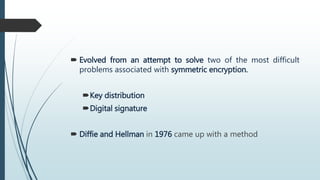
Evolved froman attempt to solve two of the most difficult
problems associated with symmetric encryption.
Key distribution
Digital signature
Diffie and Hellman in 1976 came up with a method
3.
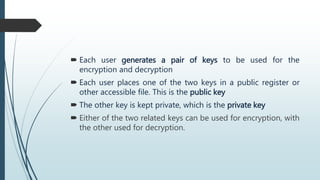
Each usergenerates a pair of keys to be used for the
encryption and decryption
Each user places one of the two keys in a public register or
other accessible file. This is the public key
The other key is kept private, which is the private key
Either of the two related keys can be used for encryption, with
the other used for decryption.
4.
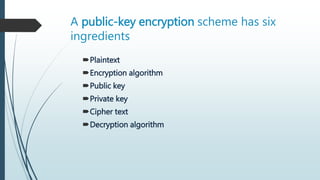
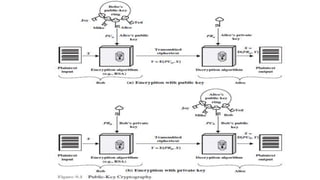
A public-key encryptionscheme has six
ingredients
Plaintext
Encryption algorithm
Public key
Private key
Cipher text
Decryption algorithm
With themessage X and the encryption key PUb as input
A forms the ciphertext Y , given by
Y = E(PUb, X)
Receiver in possession of the matching private key PRb, is
able to invert the transformation
X = D(PRb,Y)
8.
An adversary,observing Y and having access to PUb, but not
having access to PRb or X, must attempt to recover X and/or
PRb.
It is assumed that the adversary does have knowledge of the
encryption (E) and decryption (D) algorithms.
If the adversary is interested only in this particular message,
then the focus of effort is to recover X by generating a
plaintext estimate Xn .
Often, however, the adversary is interested in being able to
read future messages as well, in which case an attempt is
made to recover PRb by generating an estimate PRnb.
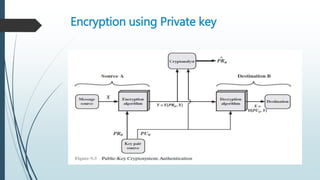
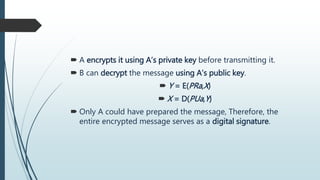
A encryptsit using A’s private key before transmitting it.
B can decrypt the message using A’s public key.
Y = E(PRa,X)
X = D(PUa,Y)
Only A could have prepared the message, Therefore, the
entire encrypted message serves as a digital signature.
11.
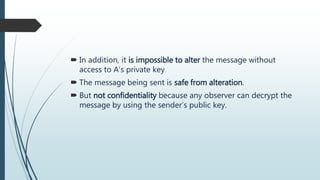
In addition,it is impossible to alter the message without
access to A’s private key
The message being sent is safe from alteration.
But not confidentiality because any observer can decrypt the
message by using the sender’s public key.
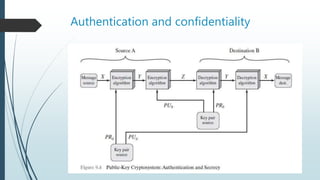
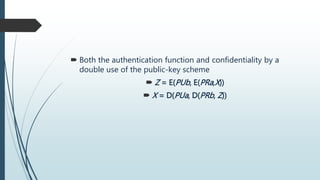
Both theauthentication function and confidentiality by a
double use of the public-key scheme
Z = E(PUb, E(PRa,X))
X = D(PUa, D(PRb, Z))
14.
We beginby encrypting a message, using the sender’s private
key.
This provides the digital signature.
Next, we encrypt again, using the receiver’s public key.
The final ciphertext can be decrypted only by the intended
receiver, who alone has the matching private key.
Thus, confidentiality is provided.
15.
Applications for Public-KeyCryptosystems
Encryption/decryption
Digital signature
Key exchange
Some algorithms are suitable for all three applications,
Some used only for one or two of these applications.
16.
Requirements for Public-KeyCryptography
1. It is computationally easy for a party B to generate a pair of
key (public key PUb, private key PRb).
2. It is computationally easy for a sender A, knowing the
public key and the message to be encrypted, M, to generate
the corresponding ciphertext:
C = E(PUb, M)
3. It is computationally easy for the receiver B to decrypt the
resulting ciphertext using the private key to recover the
original message:
M = D(PRb,C) = D[PRb, E(PUb,M)]
17.
4. Itis computationally infeasible for an adversary, knowing
the public key, PUb, to determine the private key, PRb.
5. It is computationally infeasible for an adversary, knowing
the public key, PUb, and a ciphertext, C, to recover the
original message, M
6. The two keys can be applied in either order:
M = D[PUb, E(PRb, M)] = D[PRb, E(PUb, M)]
18.
Public-Key Cryptanalysis
Vulnerableto a brute-force attack.
The countermeasure is the same: Use large keys.
Key size must be large enough to make brute-force attack
impractical but small enough for practical encryption and
decryption.