Download as ODP, PPTX





![Algorithm for DES
Cipher(plain[64],keys[16,48],cipher[64]){
permute(64,64,plain,inblock,IniPerTab)
split(64,32,inblock,left,right)
for(round =1 to 16)
{
mixer(left,right,keys[i])
if(round!=16) swapper(left,right)
}
combine(32,64,left,right,outblock)
permute(64,64,outblock,cipher,FinPerTab)
}](https://image.slidesharecdn.com/des-130220081535-phpapp02/85/Des-17-320.jpg)
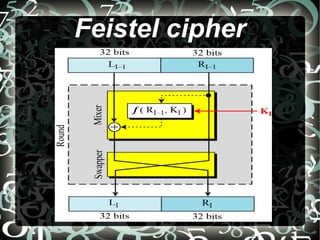
![mixer(left[32],right[32],keys[48]){
Copy(32,right,T1)
function(T1,keys,T2)
XOR(32,left,T2,T3)
Copy(32,T3,right)
}
swapper(left[32],right[32]){
Copy(32,left,T)
Copy(32,right,left)
Copy(32,T,right)
}](https://image.slidesharecdn.com/des-130220081535-phpapp02/85/Des-18-320.jpg)
![function(input[32],key[48],output[32]){
Permute(32,48,input,T1,ExpansionPerTab)
XOR(48, T1, key, T2)
substitute(T2,T3,SubstituteTab)
Permute(32,32,T3,output,StraightPerTab)
}](https://image.slidesharecdn.com/des-130220081535-phpapp02/85/Des-19-320.jpg)



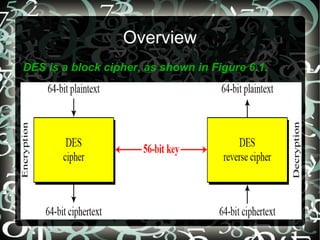
The document summarizes the Data Encryption Standard (DES) cryptosystem. It describes DES as a symmetric-key block cipher developed from a modified version of the Lucifer cipher and standardized by NIST in 1975. The core of DES is the DES function, which applies a 48-bit key to the rightmost 32 bits of the input block using substitution boxes and permutation tables to produce a 32-bit output in a Feistel network structure, with 16 rounds of processing to diffuse the plaintext over the block.


