6.1
Copyright © The McGraw-Hill Companies, Inc. Permission required for reproduction or display.
Chapter 6
Data Encryption Standard
(DES)
6.2
Objectives
❏ To review a short history of DES
❏ To define the basic structure of DES
❏ To describe the details of building elements of DES
❏ To describe the round keys generation process
❏ To analyze DES
Chapter 6
6.3
6-1 INTRODUCTION
The Data Encryption Standard (DES) is a symmetric-
key block cipher published by the National Institute of
Standards and Technology (NIST).
6.1.1 History
6.1.2 Overview
Topics discussed in this section:
6.4
In 1973, NIST published a request for proposals for a
national symmetric-key cryptosystem. A proposal from
IBM, a modification of a project called Lucifer, was
accepted as DES. DES was published in the Federal
Register in March 1975 as a draft of the Federal
Information Processing Standard (FIPS).
6.1.1 History
6.5
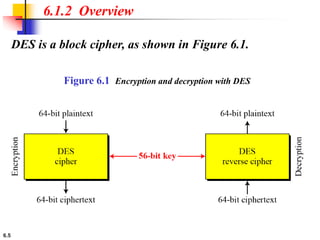
DES is a block cipher, as shown in Figure 6.1.
6.1.2 Overview
Figure 6.1 Encryption and decryption with DES
6.6
6-2 DES STRUCTURE
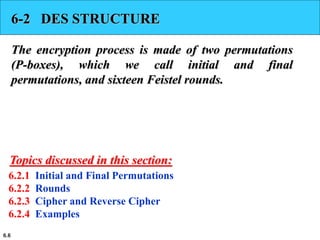
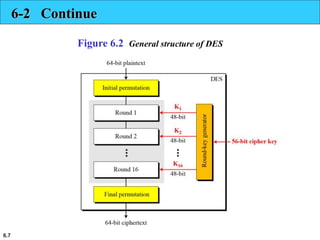
The encryption process is made of two permutations
(P-boxes), which we call initial and final
permutations, and sixteen Feistel rounds.
6.2.1 Initial and Final Permutations
6.2.2 Rounds
6.2.3 Cipher and Reverse Cipher
6.2.4 Examples
Topics discussed in this section:
6.7
6-2 Continue
Figure 6.2 General structure of DES
6.8
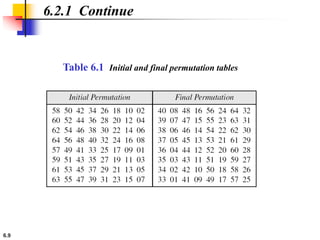
6.2.1 Initial and Final Permutations
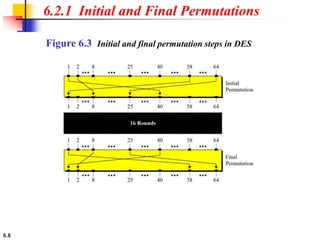
Figure 6.3 Initial and final permutation steps in DES
6.9
6.2.1 Continue
Table 6.1 Initial and final permutation tables
6.10
6.2.1 Continued
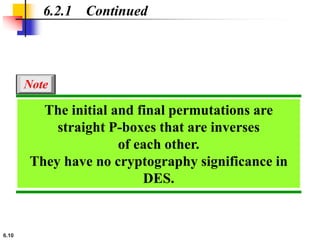
The initial and final permutations are
straight P-boxes that are inverses
of each other.
They have no cryptography significance in
DES.
Note
6.11
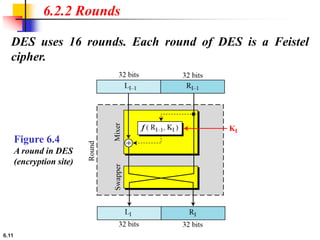
DES uses 16 rounds. Each round of DES is a Feistel
cipher.
6.2.2 Rounds
Figure 6.4
A round in DES
(encryption site)
6.12
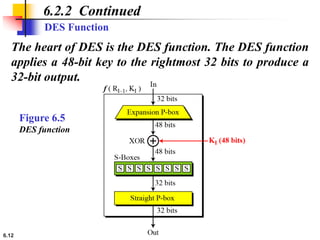
The heart of DES is the DES function. The DES function
applies a 48-bit key to the rightmost 32 bits to produce a
32-bit output.
6.2.2 Continued
DES Function
Figure 6.5
DES function
6.13
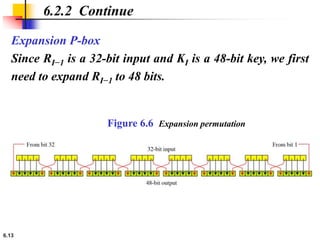
Expansion P-box
Since RI−1 is a 32-bit input and KI is a 48-bit key, we first
need to expand RI−1 to 48 bits.
6.2.2 Continue
Figure 6.6 Expansion permutation
6.14
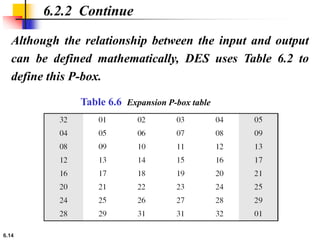
Although the relationship between the input and output
can be defined mathematically, DES uses Table 6.2 to
define this P-box.
6.2.2 Continue
Table 6.6 Expansion P-box table
6.15
Whitener (XOR)
After the expansion permutation, DES uses the XOR
operation on the expanded right section and the round
key. Note that both the right section and the key are 48-
bits in length. Also note that the round key is used only in
this operation.
6.2.2 Continue
6.16
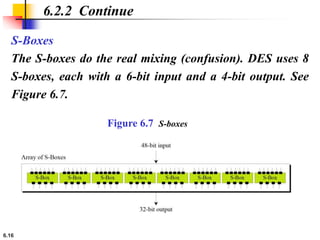
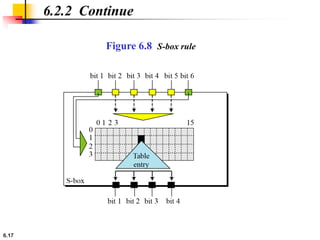
S-Boxes
The S-boxes do the real mixing (confusion). DES uses 8
S-boxes, each with a 6-bit input and a 4-bit output. See
Figure 6.7.
6.2.2 Continue
Figure 6.7 S-boxes
6.17
6.2.2 Continue
Figure 6.8 S-box rule
6.18
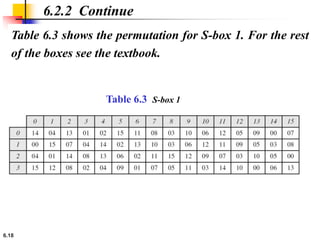
Table 6.3 shows the permutation for S-box 1. For the rest
of the boxes see the textbook.
6.2.2 Continue
Table 6.3 S-box 1
6.19
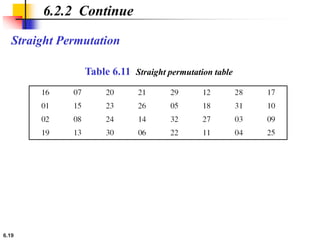
Straight Permutation
6.2.2 Continue
Table 6.11 Straight permutation table
6.20
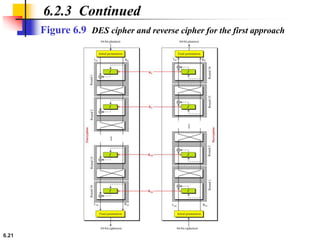
Using mixers and swappers, we can create the cipher and
reverse cipher, each having 16 rounds.
6.2.3 Cipher and Reverse Cipher
First Approach
To achieve this goal, one approach is to make the last
round (round 16) different from the others; it has only a
mixer and no swapper.
In the first approach, there is no swapper in
the last round.
Note
6.21
6.2.3 Continued
Figure 6.9 DES cipher and reverse cipher for the first approach
6.22
6.2.3 Continued
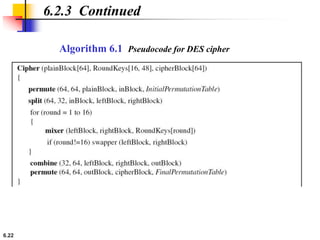
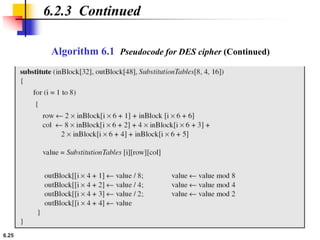
Algorithm 6.1 Pseudocode for DES cipher
6.23
6.2.3 Continued
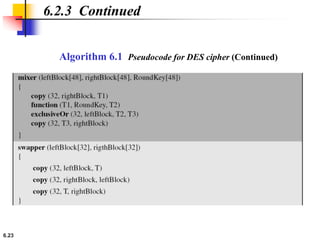
Algorithm 6.1 Pseudocode for DES cipher (Continued)
6.24
6.2.3 Continued
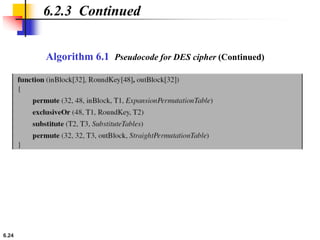
Algorithm 6.1 Pseudocode for DES cipher (Continued)
6.25
6.2.3 Continued
Algorithm 6.1 Pseudocode for DES cipher (Continued)
6.26
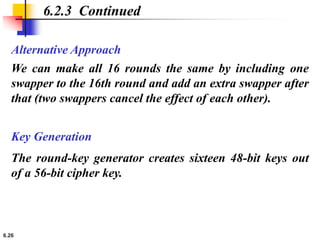
Alternative Approach
6.2.3 Continued
We can make all 16 rounds the same by including one
swapper to the 16th round and add an extra swapper after
that (two swappers cancel the effect of each other).
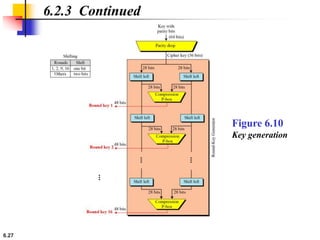
Key Generation
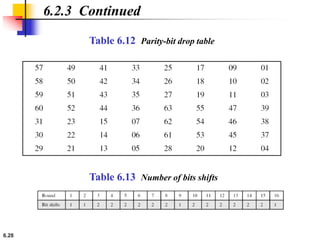
The round-key generator creates sixteen 48-bit keys out
of a 56-bit cipher key.
6.27
6.2.3 Continued
Figure 6.10
Key generation
6.28
6.2.3 Continued
Table 6.12 Parity-bit drop table
Table 6.13 Number of bits shifts
6.29
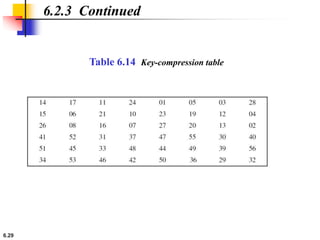
6.2.3 Continued
Table 6.14 Key-compression table
6.30
6.2.3 Continued
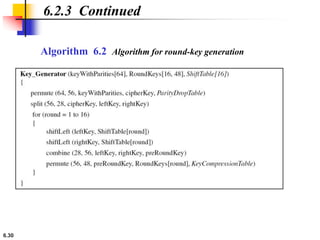
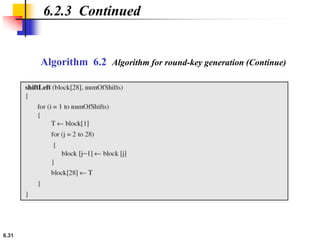
Algorithm 6.2 Algorithm for round-key generation
6.31
6.2.3 Continued
Algorithm 6.2 Algorithm for round-key generation (Continue)
6.32
6-3 DES ANALYSIS
Critics have used a strong magnifier to analyze DES.
Tests have been done to measure the strength of some
desired properties in a block cipher.
6.3.1 Properties
6.3.2 Design Criteria
6.3.3 DES Weaknesses
Topics discussed in this section:
6.33
Two desired properties of a block cipher are the
avalanche effect and the completeness.
6.3.1 Properties
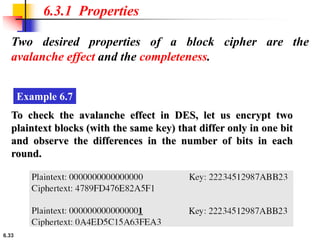
Example 6.7
To check the avalanche effect in DES, let us encrypt two
plaintext blocks (with the same key) that differ only in one bit
and observe the differences in the number of bits in each
round.
6.34
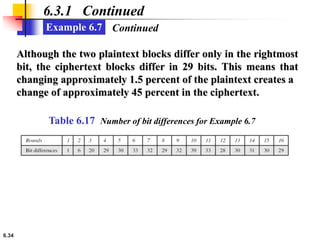
Example 6.7
6.3.1 Continued
Although the two plaintext blocks differ only in the rightmost
bit, the ciphertext blocks differ in 29 bits. This means that
changing approximately 1.5 percent of the plaintext creates a
change of approximately 45 percent in the ciphertext.
Table 6.17 Number of bit differences for Example 6.7
Continued
6.35
6.3.1 Continued
Completeness effect
Completeness effect means that each bit of the ciphertext
needs to depend on many bits on the plaintext.
6.36
6.3.2 Design Criteria
S-Boxe
The design provides confusion and diffusion of bits from
each round to the next.
P-Boxes
They provide diffusion of bits.
Number of Rounds
DES uses sixteen rounds of Feistel ciphers. the ciphertext
is thoroughly a random function of plaintext and
ciphertext.
6.37
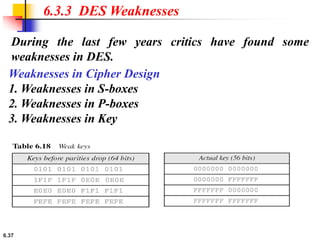
During the last few years critics have found some
weaknesses in DES.
6.3.3 DES Weaknesses
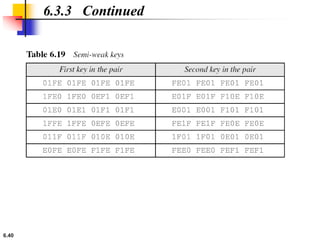
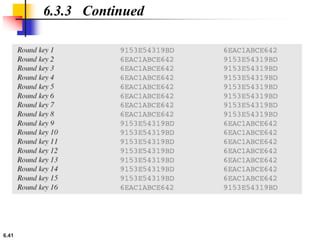
Weaknesses in Cipher Design
1. Weaknesses in S-boxes
2. Weaknesses in P-boxes
3. Weaknesses in Key
6.38
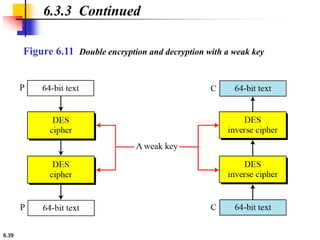
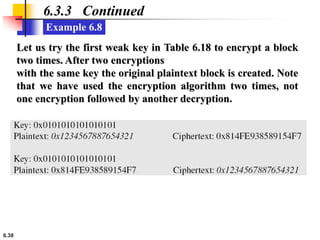
Example 6.8
6.3.3 Continued
Let us try the first weak key in Table 6.18 to encrypt a block
two times. After two encryptions
with the same key the original plaintext block is created. Note
that we have used the encryption algorithm two times, not
one encryption followed by another decryption.
6.39
6.3.3 Continued
Figure 6.11 Double encryption and decryption with a weak key
6.40
6.3.3 Continued
6.41
6.3.3 Continued
6.42
6.3.3 Continued
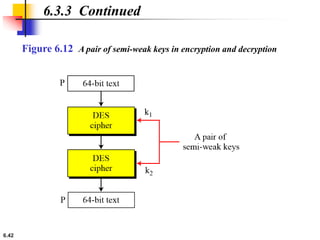
Figure 6.12 A pair of semi-weak keys in encryption and decryption
6.43
6.3.3 Continued
6.44
6-4 Multiple DES
The major criticism of DES regards its key length.
Fortunately DES is not a group. This means that we
can use double or triple DES to increase the key size.
6.4.1 Double DES
6.4.4 Triple DES
Topics discussed in this section:
6.45
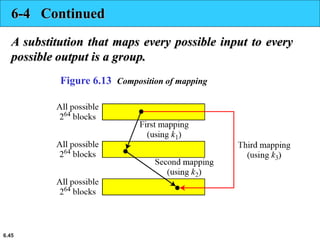
6-4 Continued
A substitution that maps every possible input to every
possible output is a group.
Figure 6.13 Composition of mapping
6.46
The first approach is to use double DES (2DES).
6.4.1 Double DES
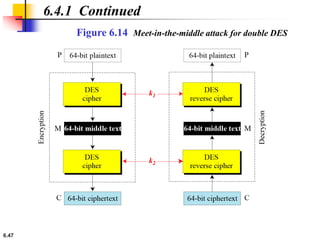
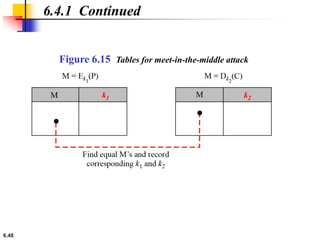
Meet-in-the-Middle Attack
However, using a known-plaintext attack called meet-in-
the-middle attack proves that double DES improves this
vulnerability slightly (to 257 tests), but not tremendously
(to 2112).
6.47
6.4.1 Continued
Figure 6.14 Meet-in-the-middle attack for double DES
6.48
6.4.1 Continued
Figure 6.15 Tables for meet-in-the-middle attack
6.49
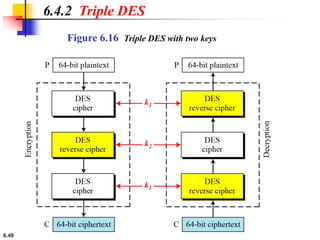
6.4.2 Triple DES
Figure 6.16 Triple DES with two keys
6.50
6.4.2 Continuous
Triple DES with Three Keys
The possibility of known-plaintext attacks on triple DES
with two keys has enticed some applications to use triple
DES with three keys. Triple DES with three keys is used
by many applications such as PGP (See Chapter 16).
6.51
6-5 Security of DES
DES, as the first important block cipher, has gone
through much scrutiny. Among the attempted attacks,
three are of interest: brute-force, differential
cryptanalysis, and linear cryptanalysis.
6.5.1 Brute-Force Attack
6.5.2 Differential Cryptanalysis
6.5.3 Linear Cryptanalysis
Topics discussed in this section:
6.52
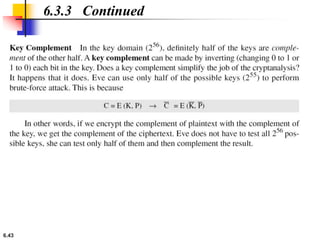
We have discussed the weakness of short cipher key in
DES. Combining this weakness with the key complement
weakness, it is clear that DES can be broken using 255
encryptions.
6.5.1 Brute-Force Attack
6.53
It has been revealed that the designers of DES already
knew about this type of attack and designed S-boxes and
chose 16 as the number of rounds to make DES
specifically resistant to this type of attack.
6.5.2 Differential Cryptanalysis
We show an example of DES differential
cryptanalysis in Appendix N.
Note
6.54
Linear cryptanalysis is newer than differential
cryptanalysis. DES is more vulnerable to linear
cryptanalysis than to differential cryptanalysis. S-boxes
are not very resistant to linear cryptanalysis. It has been
shown that DES can be broken using 243 pairs of known
plaintexts. However, from the practical point of view,
finding so many pairs is very unlikely.
6.5.3 Linear Cryptanalysis
We show an example of DES linear
cryptanalysis in Appendix N.
Note

DES.pptx

  • 1.
    6.1 Copyright © TheMcGraw-Hill Companies, Inc. Permission required for reproduction or display. Chapter 6 Data Encryption Standard (DES)
  • 2.
    6.2 Objectives ❏ To reviewa short history of DES ❏ To define the basic structure of DES ❏ To describe the details of building elements of DES ❏ To describe the round keys generation process ❏ To analyze DES Chapter 6
  • 3.
    6.3 6-1 INTRODUCTION The DataEncryption Standard (DES) is a symmetric- key block cipher published by the National Institute of Standards and Technology (NIST). 6.1.1 History 6.1.2 Overview Topics discussed in this section:
  • 4.
    6.4 In 1973, NISTpublished a request for proposals for a national symmetric-key cryptosystem. A proposal from IBM, a modification of a project called Lucifer, was accepted as DES. DES was published in the Federal Register in March 1975 as a draft of the Federal Information Processing Standard (FIPS). 6.1.1 History
  • 5.
    6.5 DES is ablock cipher, as shown in Figure 6.1. 6.1.2 Overview Figure 6.1 Encryption and decryption with DES
  • 6.
    6.6 6-2 DES STRUCTURE Theencryption process is made of two permutations (P-boxes), which we call initial and final permutations, and sixteen Feistel rounds. 6.2.1 Initial and Final Permutations 6.2.2 Rounds 6.2.3 Cipher and Reverse Cipher 6.2.4 Examples Topics discussed in this section:
  • 7.
    6.7 6-2 Continue Figure 6.2General structure of DES
  • 8.
    6.8 6.2.1 Initial andFinal Permutations Figure 6.3 Initial and final permutation steps in DES
  • 9.
    6.9 6.2.1 Continue Table 6.1Initial and final permutation tables
  • 10.
    6.10 6.2.1 Continued The initialand final permutations are straight P-boxes that are inverses of each other. They have no cryptography significance in DES. Note
  • 11.
    6.11 DES uses 16rounds. Each round of DES is a Feistel cipher. 6.2.2 Rounds Figure 6.4 A round in DES (encryption site)
  • 12.
    6.12 The heart ofDES is the DES function. The DES function applies a 48-bit key to the rightmost 32 bits to produce a 32-bit output. 6.2.2 Continued DES Function Figure 6.5 DES function
  • 13.
    6.13 Expansion P-box Since RI−1is a 32-bit input and KI is a 48-bit key, we first need to expand RI−1 to 48 bits. 6.2.2 Continue Figure 6.6 Expansion permutation
  • 14.
    6.14 Although the relationshipbetween the input and output can be defined mathematically, DES uses Table 6.2 to define this P-box. 6.2.2 Continue Table 6.6 Expansion P-box table
  • 15.
    6.15 Whitener (XOR) After theexpansion permutation, DES uses the XOR operation on the expanded right section and the round key. Note that both the right section and the key are 48- bits in length. Also note that the round key is used only in this operation. 6.2.2 Continue
  • 16.
    6.16 S-Boxes The S-boxes dothe real mixing (confusion). DES uses 8 S-boxes, each with a 6-bit input and a 4-bit output. See Figure 6.7. 6.2.2 Continue Figure 6.7 S-boxes
  • 17.
  • 18.
    6.18 Table 6.3 showsthe permutation for S-box 1. For the rest of the boxes see the textbook. 6.2.2 Continue Table 6.3 S-box 1
  • 19.
    6.19 Straight Permutation 6.2.2 Continue Table6.11 Straight permutation table
  • 20.
    6.20 Using mixers andswappers, we can create the cipher and reverse cipher, each having 16 rounds. 6.2.3 Cipher and Reverse Cipher First Approach To achieve this goal, one approach is to make the last round (round 16) different from the others; it has only a mixer and no swapper. In the first approach, there is no swapper in the last round. Note
  • 21.
    6.21 6.2.3 Continued Figure 6.9DES cipher and reverse cipher for the first approach
  • 22.
    6.22 6.2.3 Continued Algorithm 6.1Pseudocode for DES cipher
  • 23.
    6.23 6.2.3 Continued Algorithm 6.1Pseudocode for DES cipher (Continued)
  • 24.
    6.24 6.2.3 Continued Algorithm 6.1Pseudocode for DES cipher (Continued)
  • 25.
    6.25 6.2.3 Continued Algorithm 6.1Pseudocode for DES cipher (Continued)
  • 26.
    6.26 Alternative Approach 6.2.3 Continued Wecan make all 16 rounds the same by including one swapper to the 16th round and add an extra swapper after that (two swappers cancel the effect of each other). Key Generation The round-key generator creates sixteen 48-bit keys out of a 56-bit cipher key.
  • 27.
  • 28.
    6.28 6.2.3 Continued Table 6.12Parity-bit drop table Table 6.13 Number of bits shifts
  • 29.
    6.29 6.2.3 Continued Table 6.14Key-compression table
  • 30.
    6.30 6.2.3 Continued Algorithm 6.2Algorithm for round-key generation
  • 31.
    6.31 6.2.3 Continued Algorithm 6.2Algorithm for round-key generation (Continue)
  • 32.
    6.32 6-3 DES ANALYSIS Criticshave used a strong magnifier to analyze DES. Tests have been done to measure the strength of some desired properties in a block cipher. 6.3.1 Properties 6.3.2 Design Criteria 6.3.3 DES Weaknesses Topics discussed in this section:
  • 33.
    6.33 Two desired propertiesof a block cipher are the avalanche effect and the completeness. 6.3.1 Properties Example 6.7 To check the avalanche effect in DES, let us encrypt two plaintext blocks (with the same key) that differ only in one bit and observe the differences in the number of bits in each round.
  • 34.
    6.34 Example 6.7 6.3.1 Continued Althoughthe two plaintext blocks differ only in the rightmost bit, the ciphertext blocks differ in 29 bits. This means that changing approximately 1.5 percent of the plaintext creates a change of approximately 45 percent in the ciphertext. Table 6.17 Number of bit differences for Example 6.7 Continued
  • 35.
    6.35 6.3.1 Continued Completeness effect Completenesseffect means that each bit of the ciphertext needs to depend on many bits on the plaintext.
  • 36.
    6.36 6.3.2 Design Criteria S-Boxe Thedesign provides confusion and diffusion of bits from each round to the next. P-Boxes They provide diffusion of bits. Number of Rounds DES uses sixteen rounds of Feistel ciphers. the ciphertext is thoroughly a random function of plaintext and ciphertext.
  • 37.
    6.37 During the lastfew years critics have found some weaknesses in DES. 6.3.3 DES Weaknesses Weaknesses in Cipher Design 1. Weaknesses in S-boxes 2. Weaknesses in P-boxes 3. Weaknesses in Key
  • 38.
    6.38 Example 6.8 6.3.3 Continued Letus try the first weak key in Table 6.18 to encrypt a block two times. After two encryptions with the same key the original plaintext block is created. Note that we have used the encryption algorithm two times, not one encryption followed by another decryption.
  • 39.
    6.39 6.3.3 Continued Figure 6.11Double encryption and decryption with a weak key
  • 40.
  • 41.
  • 42.
    6.42 6.3.3 Continued Figure 6.12A pair of semi-weak keys in encryption and decryption
  • 43.
  • 44.
    6.44 6-4 Multiple DES Themajor criticism of DES regards its key length. Fortunately DES is not a group. This means that we can use double or triple DES to increase the key size. 6.4.1 Double DES 6.4.4 Triple DES Topics discussed in this section:
  • 45.
    6.45 6-4 Continued A substitutionthat maps every possible input to every possible output is a group. Figure 6.13 Composition of mapping
  • 46.
    6.46 The first approachis to use double DES (2DES). 6.4.1 Double DES Meet-in-the-Middle Attack However, using a known-plaintext attack called meet-in- the-middle attack proves that double DES improves this vulnerability slightly (to 257 tests), but not tremendously (to 2112).
  • 47.
    6.47 6.4.1 Continued Figure 6.14Meet-in-the-middle attack for double DES
  • 48.
    6.48 6.4.1 Continued Figure 6.15Tables for meet-in-the-middle attack
  • 49.
    6.49 6.4.2 Triple DES Figure6.16 Triple DES with two keys
  • 50.
    6.50 6.4.2 Continuous Triple DESwith Three Keys The possibility of known-plaintext attacks on triple DES with two keys has enticed some applications to use triple DES with three keys. Triple DES with three keys is used by many applications such as PGP (See Chapter 16).
  • 51.
    6.51 6-5 Security ofDES DES, as the first important block cipher, has gone through much scrutiny. Among the attempted attacks, three are of interest: brute-force, differential cryptanalysis, and linear cryptanalysis. 6.5.1 Brute-Force Attack 6.5.2 Differential Cryptanalysis 6.5.3 Linear Cryptanalysis Topics discussed in this section:
  • 52.
    6.52 We have discussedthe weakness of short cipher key in DES. Combining this weakness with the key complement weakness, it is clear that DES can be broken using 255 encryptions. 6.5.1 Brute-Force Attack
  • 53.
    6.53 It has beenrevealed that the designers of DES already knew about this type of attack and designed S-boxes and chose 16 as the number of rounds to make DES specifically resistant to this type of attack. 6.5.2 Differential Cryptanalysis We show an example of DES differential cryptanalysis in Appendix N. Note
  • 54.
    6.54 Linear cryptanalysis isnewer than differential cryptanalysis. DES is more vulnerable to linear cryptanalysis than to differential cryptanalysis. S-boxes are not very resistant to linear cryptanalysis. It has been shown that DES can be broken using 243 pairs of known plaintexts. However, from the practical point of view, finding so many pairs is very unlikely. 6.5.3 Linear Cryptanalysis We show an example of DES linear cryptanalysis in Appendix N. Note