By Srinivas Methuku
 After completion of this chapter you should be
conversant about:
 Meaning and contents of ledger
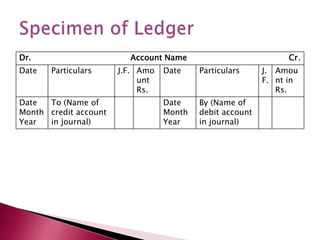
 Specimen of ledger
 Posting of entries from journal to ledger
 Balancing of ledger
 Introduction
 A Ledger is a book which contains all the accounts
whether personal, real or nominal, which are first
entered in journal
 Ledger is a principal or main book which contains all
the accounts in which the transactions recorded in the
books of original entry are transferred. Ledger is also
called the ‘Book of Final Entry’ or ‘Book of Secondary
Entry’, because the transactions are finally
incorporated in the Ledger.
 According to L.C. Cropper, ‘the book which contains a
classified and permanent record of all the transactions
of a business is called the Ledger’.
 The following are the advantages of ledger:
a) Complete information at a glance
b) Arithmetical Accuracy
c) Result of Business Operations
d) Accounting information
Dr. Account Name Cr.
Date Particulars J.F. Amo
unt
Rs.
Date Particulars J.
F.
Amou
nt in
Rs.
Date
Month
Year
To (Name of
credit account
in journal)
Date
Month
Year
By (Name of
debit account
in journal)
 The process of transferring the entries recorded in the
journal to the respective accounts opened in the
ledger is called Posting.
 In other words, posting means grouping of all the
transactions relating to a particular account at one
place.
 Procedure of Posting
 Posting of Compound Journal Entries
 Balance is the difference between the total debits
and the total credits of an account. When posting is
done, many accounts may have entries on their debit
side as well as credit side. The net result of such debits
and credits in an account is the balance.
 Balancing means the writing of the difference
between the amount columns of the two sides in the
lighter (smaller total) side, so that the grand totals of
the two sides become equal.
 There are three possibilities while balancing
an account during a given period. It may be a
debit balance or a credit balance or a nil
balance depending upon the debit total and
the credit total.
 Balancing is done periodically, i.e., weekly, monthly, quarterly,
half yearly or yearly, depending on the requirements of the
business.
I. Personal Accounts : These accounts are generally balanced
regularly to know the amounts due to the persons (creditors) or
due from the persons (debtors).
II. Real Accounts : These accounts are generally balanced at the
end of the financial year, when final accounts are being
prepared. However, cash account is frequently balanced to know
the cash on hand.
 A debit balance in an asset account indicated the value of the
asset owned by the business. Assets accounts always show debit
balances.
III. Nominal Accounts : These accounts are in fact, not
to be balanced as they are to be closed by transfer to
final accounts.
 A debit balance in a nominal account indicates that it is
an expense or loss. A credit balance in a nominal
account indicates that it is an income or gain.
 All such balances in personal and real accounts are
shown in the Balance Sheet and the balances in
nominal accounts are taken to the Profit and Loss
Account.
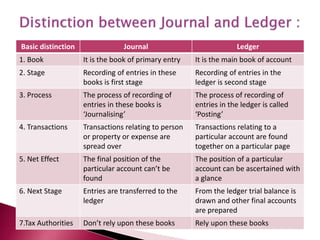
Basic distinction Journal Ledger
1. Book It is the book of primary entry It is the main book of account
2. Stage Recording of entries in these
books is first stage
Recording of entries in the
ledger is second stage
3. Process The process of recording of
entries in these books is
‘Journalising’
The process of recording of
entries in the ledger is called
‘Posting’
4. Transactions Transactions relating to person
or property or expense are
spread over
Transactions relating to a
particular account are found
together on a particular page
5. Net Effect The final position of the
particular account can’t be
found
The position of a particular
account can be ascertained with
a glance
6. Next Stage Entries are transferred to the
ledger
From the ledger trial balance is
drawn and other final accounts
are prepared
7.Tax Authorities Don’t rely upon these books Rely upon these books
 Journalise the following transactions of Mr. Ravi and post
them in the ledger and balance the same.
 2014, June 1 Ravi invested Rs.5,00,000 cash in the business
 3 Paid into Bank Rs.80,000
 5 Purchased building for Rs.3,00,000
 7 Purchased goods for Rs.70,000
 10 Sold goods for Rs.80,000
 15 With drew cash from bank Rs.10,000
 25 Paid electric charges Rs.3,000
 30 Paid Salary Rs. 15,000
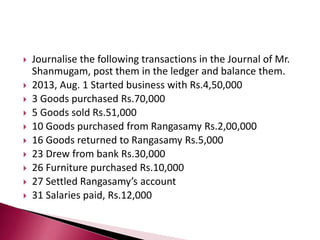
 Journalise the following transactions in the Journal of Mr.
Shanmugam, post them in the ledger and balance them.
 2013, Aug. 1 Started business with Rs.4,50,000
 3 Goods purchased Rs.70,000
 5 Goods sold Rs.51,000
 10 Goods purchased from Rangasamy Rs.2,00,000
 16 Goods returned to Rangasamy Rs.5,000
 23 Drew from bank Rs.30,000
 26 Furniture purchased Rs.10,000
 27 Settled Rangasamy’s account
 31 Salaries paid, Rs.12,000
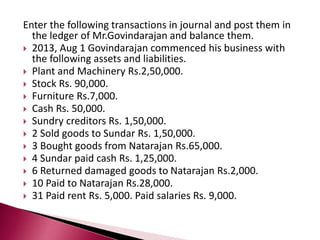
Enter the following transactions in journal and post them in
the ledger of Mr.Govindarajan and balance them.
 2013, Aug 1 Govindarajan commenced his business with
the following assets and liabilities.
 Plant and Machinery Rs.2,50,000.
 Stock Rs. 90,000.
 Furniture Rs.7,000.
 Cash Rs. 50,000.
 Sundry creditors Rs. 1,50,000.
 2 Sold goods to Sundar Rs. 1,50,000.
 3 Bought goods from Natarajan Rs.65,000.
 4 Sundar paid cash Rs. 1,25,000.
 6 Returned damaged goods to Natarajan Rs.2,000.
 10 Paid to Natarajan Rs.28,000.
 31 Paid rent Rs. 5,000. Paid salaries Rs. 9,000.
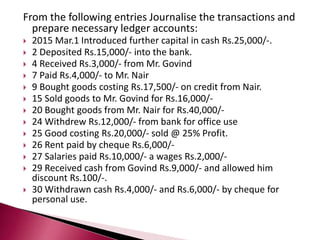
From the following entries Journalise the transactions and
prepare necessary ledger accounts:
 2015 Mar.1 Introduced further capital in cash Rs.25,000/-.
 2 Deposited Rs.15,000/- into the bank.
 4 Received Rs.3,000/- from Mr. Govind
 7 Paid Rs.4,000/- to Mr. Nair
 9 Bought goods costing Rs.17,500/- on credit from Nair.
 15 Sold goods to Mr. Govind for Rs.16,000/-
 20 Bought goods from Mr. Nair for Rs.40,000/-
 24 Withdrew Rs.12,000/- from bank for office use
 25 Good costing Rs.20,000/- sold @ 25% Profit.
 26 Rent paid by cheque Rs.6,000/-
 27 Salaries paid Rs.10,000/- a wages Rs.2,000/-
 29 Received cash from Govind Rs.9,000/- and allowed him
discount Rs.100/-.
 30 Withdrawn cash Rs.4,000/- and Rs.6,000/- by cheque for
personal use.
Topic 5 ledger

Topic 5 ledger

  • 1.
  • 2.
     After completionof this chapter you should be conversant about:  Meaning and contents of ledger  Specimen of ledger  Posting of entries from journal to ledger  Balancing of ledger
  • 3.
     Introduction  ALedger is a book which contains all the accounts whether personal, real or nominal, which are first entered in journal
  • 4.
     Ledger isa principal or main book which contains all the accounts in which the transactions recorded in the books of original entry are transferred. Ledger is also called the ‘Book of Final Entry’ or ‘Book of Secondary Entry’, because the transactions are finally incorporated in the Ledger.  According to L.C. Cropper, ‘the book which contains a classified and permanent record of all the transactions of a business is called the Ledger’.
  • 5.
     The followingare the advantages of ledger: a) Complete information at a glance b) Arithmetical Accuracy c) Result of Business Operations d) Accounting information
  • 6.
    Dr. Account NameCr. Date Particulars J.F. Amo unt Rs. Date Particulars J. F. Amou nt in Rs. Date Month Year To (Name of credit account in journal) Date Month Year By (Name of debit account in journal)
  • 7.
     The processof transferring the entries recorded in the journal to the respective accounts opened in the ledger is called Posting.  In other words, posting means grouping of all the transactions relating to a particular account at one place.  Procedure of Posting  Posting of Compound Journal Entries
  • 8.
     Balance isthe difference between the total debits and the total credits of an account. When posting is done, many accounts may have entries on their debit side as well as credit side. The net result of such debits and credits in an account is the balance.  Balancing means the writing of the difference between the amount columns of the two sides in the lighter (smaller total) side, so that the grand totals of the two sides become equal.
  • 9.
     There arethree possibilities while balancing an account during a given period. It may be a debit balance or a credit balance or a nil balance depending upon the debit total and the credit total.
  • 10.
     Balancing isdone periodically, i.e., weekly, monthly, quarterly, half yearly or yearly, depending on the requirements of the business. I. Personal Accounts : These accounts are generally balanced regularly to know the amounts due to the persons (creditors) or due from the persons (debtors). II. Real Accounts : These accounts are generally balanced at the end of the financial year, when final accounts are being prepared. However, cash account is frequently balanced to know the cash on hand.  A debit balance in an asset account indicated the value of the asset owned by the business. Assets accounts always show debit balances.
  • 11.
    III. Nominal Accounts: These accounts are in fact, not to be balanced as they are to be closed by transfer to final accounts.  A debit balance in a nominal account indicates that it is an expense or loss. A credit balance in a nominal account indicates that it is an income or gain.  All such balances in personal and real accounts are shown in the Balance Sheet and the balances in nominal accounts are taken to the Profit and Loss Account.
  • 12.
    Basic distinction JournalLedger 1. Book It is the book of primary entry It is the main book of account 2. Stage Recording of entries in these books is first stage Recording of entries in the ledger is second stage 3. Process The process of recording of entries in these books is ‘Journalising’ The process of recording of entries in the ledger is called ‘Posting’ 4. Transactions Transactions relating to person or property or expense are spread over Transactions relating to a particular account are found together on a particular page 5. Net Effect The final position of the particular account can’t be found The position of a particular account can be ascertained with a glance 6. Next Stage Entries are transferred to the ledger From the ledger trial balance is drawn and other final accounts are prepared 7.Tax Authorities Don’t rely upon these books Rely upon these books
  • 13.
     Journalise thefollowing transactions of Mr. Ravi and post them in the ledger and balance the same.  2014, June 1 Ravi invested Rs.5,00,000 cash in the business  3 Paid into Bank Rs.80,000  5 Purchased building for Rs.3,00,000  7 Purchased goods for Rs.70,000  10 Sold goods for Rs.80,000  15 With drew cash from bank Rs.10,000  25 Paid electric charges Rs.3,000  30 Paid Salary Rs. 15,000
  • 14.
     Journalise thefollowing transactions in the Journal of Mr. Shanmugam, post them in the ledger and balance them.  2013, Aug. 1 Started business with Rs.4,50,000  3 Goods purchased Rs.70,000  5 Goods sold Rs.51,000  10 Goods purchased from Rangasamy Rs.2,00,000  16 Goods returned to Rangasamy Rs.5,000  23 Drew from bank Rs.30,000  26 Furniture purchased Rs.10,000  27 Settled Rangasamy’s account  31 Salaries paid, Rs.12,000
  • 15.
    Enter the followingtransactions in journal and post them in the ledger of Mr.Govindarajan and balance them.  2013, Aug 1 Govindarajan commenced his business with the following assets and liabilities.  Plant and Machinery Rs.2,50,000.  Stock Rs. 90,000.  Furniture Rs.7,000.  Cash Rs. 50,000.  Sundry creditors Rs. 1,50,000.  2 Sold goods to Sundar Rs. 1,50,000.  3 Bought goods from Natarajan Rs.65,000.  4 Sundar paid cash Rs. 1,25,000.  6 Returned damaged goods to Natarajan Rs.2,000.  10 Paid to Natarajan Rs.28,000.  31 Paid rent Rs. 5,000. Paid salaries Rs. 9,000.
  • 16.
    From the followingentries Journalise the transactions and prepare necessary ledger accounts:  2015 Mar.1 Introduced further capital in cash Rs.25,000/-.  2 Deposited Rs.15,000/- into the bank.  4 Received Rs.3,000/- from Mr. Govind  7 Paid Rs.4,000/- to Mr. Nair  9 Bought goods costing Rs.17,500/- on credit from Nair.  15 Sold goods to Mr. Govind for Rs.16,000/-  20 Bought goods from Mr. Nair for Rs.40,000/-  24 Withdrew Rs.12,000/- from bank for office use  25 Good costing Rs.20,000/- sold @ 25% Profit.  26 Rent paid by cheque Rs.6,000/-  27 Salaries paid Rs.10,000/- a wages Rs.2,000/-  29 Received cash from Govind Rs.9,000/- and allowed him discount Rs.100/-.  30 Withdrawn cash Rs.4,000/- and Rs.6,000/- by cheque for personal use.