Double entry book keeping
By Srinivas Methuku
What do you know about double entry book
keeping?
 Introduction
 Luca De Pacioli – 1494
 Main Principle:
“Every debit has corresponding credit
and every credit has corresponding debit with equal
amount”.
Definition of double entry book keeping
 “Every business transaction has a two fold effect and
that it effects two accounts in opposite directions and
if a complete record is to be made of each such
transaction it would been necessary to debit one
account and credit another account. It is this
recording of two fold effect of every transaction that
has given rise to the term Double Entry.” - By J.R.
Batluboi
What are the advantages of double entry
book keeping?
 Advantages of double entry book keeping:
1. Accuracy
2. Business result
3. Complete record
4. Comparative study
5. Common acceptance
Conventional Accounting System
 This method is traditional method of recording
accounting information.
 Indian system of accounting is the example of
conventional accounting system.
Point Conventional accounting
system
Double entry book keeping
system
Meaning It records incomplete
business transactions
This method is scientific and
records complete business
transactions
Coverage It covers less details of
transactions
It covers complete details of
business transactions
Accuracy Arithmetic accuracy is not
guaranteed
Arithmetic accuracy is
guaranteed
Nature It is traditional method of
recording business
transactions
It is modern method of
recording business
transactions
Number of
account books
Only two books are prepared
(1) cash Book (2) Ledger
All subsidiary books/ Journals
and Ledgers are prepared
Recording All transactions are basically
recorded in only Cash book
All transactions are recorded
in different Subsidiary Books /
Journals
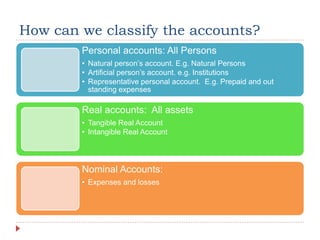
How can we classify the accounts?
Personal accounts: All Persons
• Natural person’s account. E.g. Natural Persons
• Artificial person’s account. e.g. Institutions
• Representative personal account. E.g. Prepaid and out
standing expenses
Real accounts: All assets
• Tangible Real Account
• Intangible Real Account
Nominal Accounts:
• Expenses and losses
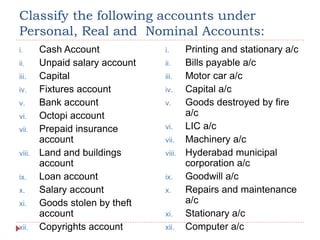
Classify the following accounts under
Personal, Real and Nominal Accounts:
i. Cash Account
ii. Unpaid salary account
iii. Capital
iv. Fixtures account
v. Bank account
vi. Octopi account
vii. Prepaid insurance
account
viii. Land and buildings
account
ix. Loan account
x. Salary account
xi. Goods stolen by theft
account
xii. Copyrights account
i. Printing and stationary a/c
ii. Bills payable a/c
iii. Motor car a/c
iv. Capital a/c
v. Goods destroyed by fire
a/c
vi. LIC a/c
vii. Machinery a/c
viii. Hyderabad municipal
corporation a/c
ix. Goodwill a/c
x. Repairs and maintenance
a/c
xi. Stationary a/c
xii. Computer a/c
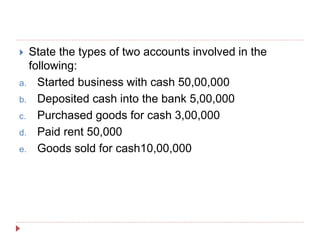
 State the types of two accounts involved in the
following:
a. Started business with cash 50,00,000
b. Deposited cash into the bank 5,00,000
c. Purchased goods for cash 3,00,000
d. Paid rent 50,000
e. Goods sold for cash10,00,000
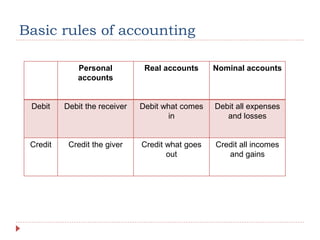
Basic rules of accounting
Personal
accounts
Real accounts Nominal accounts
Debit Debit the receiver Debit what comes
in
Debit all expenses
and losses
Credit Credit the giver Credit what goes
out
Credit all incomes
and gains
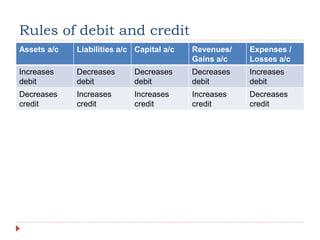
Rules of debit and credit
Assets a/c Liabilities a/c Capital a/c Revenues/
Gains a/c
Expenses /
Losses a/c
Increases
debit
Decreases
debit
Decreases
debit
Decreases
debit
Increases
debit
Decreases
credit
Increases
credit
Increases
credit
Increases
credit
Decreases
credit
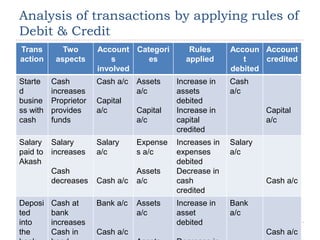
Analysis of transactions by applying rules of
Debit & Credit
Trans
action
Two
aspects
Account
s
involved
Categori
es
Rules
applied
Accoun
t
debited
Account
credited
Starte
d
busine
ss with
cash
Cash
increases
Proprietor
provides
funds
Cash a/c
Capital
a/c
Assets
a/c
Capital
a/c
Increase in
assets
debited
Increase in
capital
credited
Cash
a/c
Capital
a/c
Salary
paid to
Akash
Salary
increases
Cash
decreases
Salary
a/c
Cash a/c
Expense
s a/c
Assets
a/c
Increases in
expenses
debited
Decrease in
cash
credited
Salary
a/c
Cash a/c
Deposi
ted
into
the
Cash at
bank
increases
Cash in
Bank a/c
Cash a/c
Assets
a/c
Increase in
asset
debited
Bank
a/c
Cash a/c
Topic 3 Double entry book keeping

Topic 3 Double entry book keeping

  • 1.
    Double entry bookkeeping By Srinivas Methuku
  • 2.
    What do youknow about double entry book keeping?  Introduction  Luca De Pacioli – 1494  Main Principle: “Every debit has corresponding credit and every credit has corresponding debit with equal amount”.
  • 3.
    Definition of doubleentry book keeping  “Every business transaction has a two fold effect and that it effects two accounts in opposite directions and if a complete record is to be made of each such transaction it would been necessary to debit one account and credit another account. It is this recording of two fold effect of every transaction that has given rise to the term Double Entry.” - By J.R. Batluboi
  • 4.
    What are theadvantages of double entry book keeping?  Advantages of double entry book keeping: 1. Accuracy 2. Business result 3. Complete record 4. Comparative study 5. Common acceptance
  • 5.
    Conventional Accounting System This method is traditional method of recording accounting information.  Indian system of accounting is the example of conventional accounting system.
  • 6.
    Point Conventional accounting system Doubleentry book keeping system Meaning It records incomplete business transactions This method is scientific and records complete business transactions Coverage It covers less details of transactions It covers complete details of business transactions Accuracy Arithmetic accuracy is not guaranteed Arithmetic accuracy is guaranteed Nature It is traditional method of recording business transactions It is modern method of recording business transactions Number of account books Only two books are prepared (1) cash Book (2) Ledger All subsidiary books/ Journals and Ledgers are prepared Recording All transactions are basically recorded in only Cash book All transactions are recorded in different Subsidiary Books / Journals
  • 7.
    How can weclassify the accounts? Personal accounts: All Persons • Natural person’s account. E.g. Natural Persons • Artificial person’s account. e.g. Institutions • Representative personal account. E.g. Prepaid and out standing expenses Real accounts: All assets • Tangible Real Account • Intangible Real Account Nominal Accounts: • Expenses and losses
  • 8.
    Classify the followingaccounts under Personal, Real and Nominal Accounts: i. Cash Account ii. Unpaid salary account iii. Capital iv. Fixtures account v. Bank account vi. Octopi account vii. Prepaid insurance account viii. Land and buildings account ix. Loan account x. Salary account xi. Goods stolen by theft account xii. Copyrights account i. Printing and stationary a/c ii. Bills payable a/c iii. Motor car a/c iv. Capital a/c v. Goods destroyed by fire a/c vi. LIC a/c vii. Machinery a/c viii. Hyderabad municipal corporation a/c ix. Goodwill a/c x. Repairs and maintenance a/c xi. Stationary a/c xii. Computer a/c
  • 9.
     State thetypes of two accounts involved in the following: a. Started business with cash 50,00,000 b. Deposited cash into the bank 5,00,000 c. Purchased goods for cash 3,00,000 d. Paid rent 50,000 e. Goods sold for cash10,00,000
  • 10.
    Basic rules ofaccounting Personal accounts Real accounts Nominal accounts Debit Debit the receiver Debit what comes in Debit all expenses and losses Credit Credit the giver Credit what goes out Credit all incomes and gains
  • 11.
    Rules of debitand credit Assets a/c Liabilities a/c Capital a/c Revenues/ Gains a/c Expenses / Losses a/c Increases debit Decreases debit Decreases debit Decreases debit Increases debit Decreases credit Increases credit Increases credit Increases credit Decreases credit
  • 12.
    Analysis of transactionsby applying rules of Debit & Credit Trans action Two aspects Account s involved Categori es Rules applied Accoun t debited Account credited Starte d busine ss with cash Cash increases Proprietor provides funds Cash a/c Capital a/c Assets a/c Capital a/c Increase in assets debited Increase in capital credited Cash a/c Capital a/c Salary paid to Akash Salary increases Cash decreases Salary a/c Cash a/c Expense s a/c Assets a/c Increases in expenses debited Decrease in cash credited Salary a/c Cash a/c Deposi ted into the Cash at bank increases Cash in Bank a/c Cash a/c Assets a/c Increase in asset debited Bank a/c Cash a/c