presentation slide on Accounting General ledger & trial balance
This presentation discusses the general ledger, trial balance, and their purpose and process. The general ledger contains all balance sheet accounts and records transactions through debits and credits. A trial balance is created by summing the balances of each ledger account and comparing total debits to total credits to check for errors. An example transaction is provided to demonstrate preparing ledger accounts and a trial balance.
presentation slide on Accounting General ledger & trial balance
1.
PRESENTATION ONGENERAL LEDGER & TRAIL BALANCE Prepared by HASHIBUL HASAN [email_address]
2.
General ledger HASHIBULHASAN DEPARTMENT OF CSE DAFFODIL INTERNATIONAL UNIVERSITY DHAKA,BANGLADESH
3.
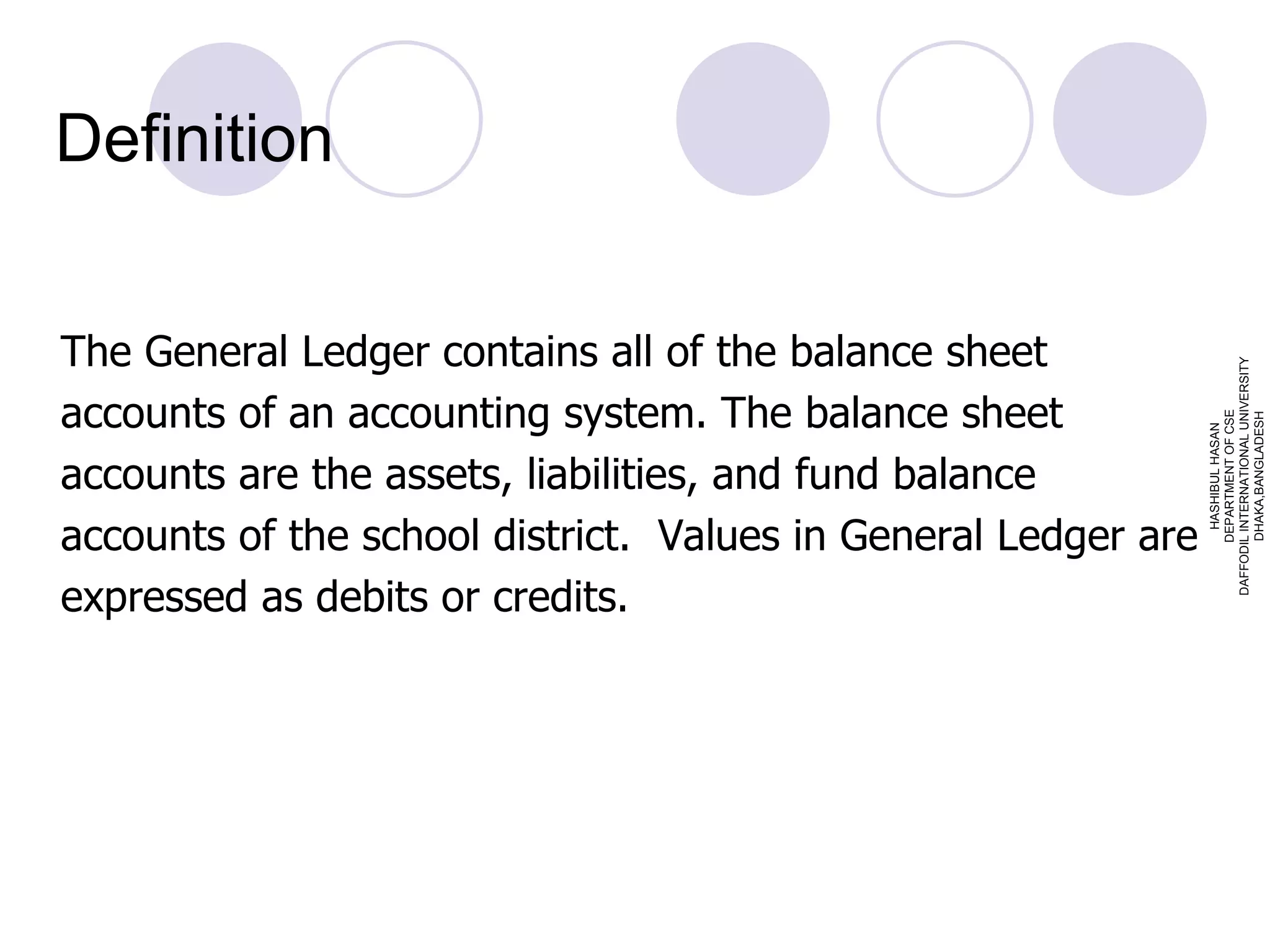
Definition The GeneralLedger contains all of the balance sheet accounts of an accounting system. The balance sheet accounts are the assets, liabilities, and fund balance accounts of the school district. Values in General Ledger are expressed as debits or credits. HASHIBUL HASAN DEPARTMENT OF CSE DAFFODIL INTERNATIONAL UNIVERSITY DHAKA,BANGLADESH
4.
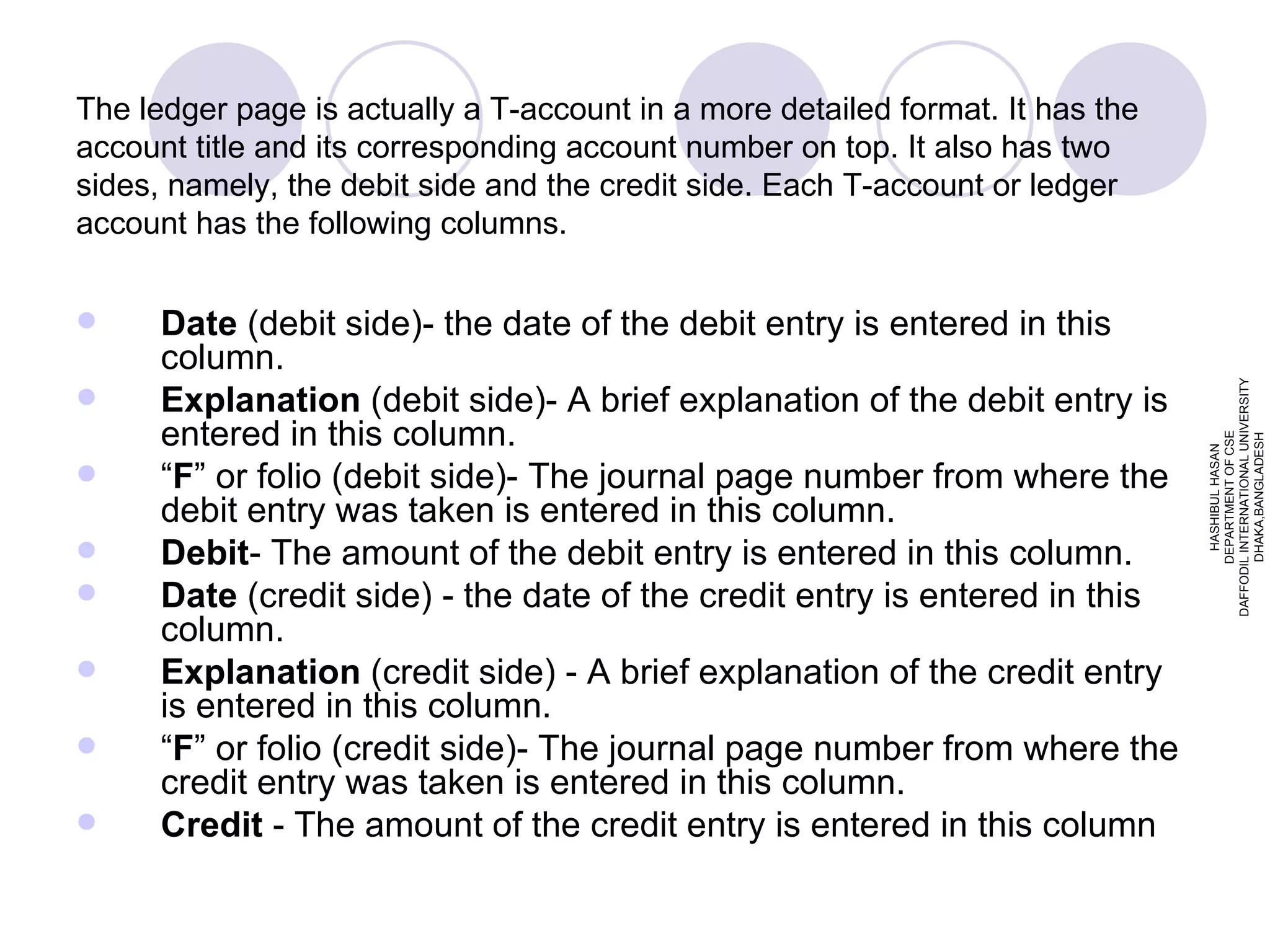
The ledger pageis actually a T-account in a more detailed format. It has the account title and its corresponding account number on top. It also has two sides, namely, the debit side and the credit side. Each T-account or ledger account has the following columns. Date (debit side)- the date of the debit entry is entered in this column. Explanation (debit side)- A brief explanation of the debit entry is entered in this column. “ F ” or folio (debit side)- The journal page number from where the debit entry was taken is entered in this column. Debit - The amount of the debit entry is entered in this column. Date (credit side) - the date of the credit entry is entered in this column. Explanation (credit side) - A brief explanation of the credit entry is entered in this column. “ F ” or folio (credit side)- The journal page number from where the credit entry was taken is entered in this column. Credit - The amount of the credit entry is entered in this column HASHIBUL HASAN DEPARTMENT OF CSE DAFFODIL INTERNATIONAL UNIVERSITY DHAKA,BANGLADESH
5.
An example ofa page from a ledger is as follows:- Accounts receivable Account No: 2001 Accounts receivable Account No: 2001 Accounts receivable Accounts receivable Account No: 2001 Accounts receivable HASHIBUL HASAN DEPARTMENT OF CSE DAFFODIL INTERNATIONAL UNIVERSITY DHAKA,BANGLADESH 0.0 Balance 50,000.00 30,000.00 1 Collection 10 20,000.00 1 Collection Sept. 30 50, 000.00 1 Service on credit Sept-29 2008 2008 Credit F Explanation Date Debit F Explanation Date 0.0 Balance 50,000.00 30,000.00 1 Collection 10 20,000.00 1 Collection Sept. 30 50, 000.00 1 Service on credit Sept-29 2008 2008 Credit F Explanation Date Debit F Explanation Date 0.0 Balance 50,000.00 30,000.00 1 Collection 10 20,000.00 1 Collection Sept. 30 50, 000.00 1 Service on credit Sept-29 2008 2008 Credit F Explanation Date Debit F Explanation Date 0.0 Balance 50,000.00 30,000.00 1 Collection 10 20,000.00 1 Collection Sept. 30 50, 000.00 1 Service on credit Sept-29 2008 2008 Credit F Explanation Date Debit F Explanation Date 0.0 Balance 50,000.00 30,000.00 1 Collection 10 20,000.00 1 Collection Sept. 30 50, 000.00 1 Service on credit Sept-29 2008 2008 Credit F Explanation Date Debit F Explanation Date
6.
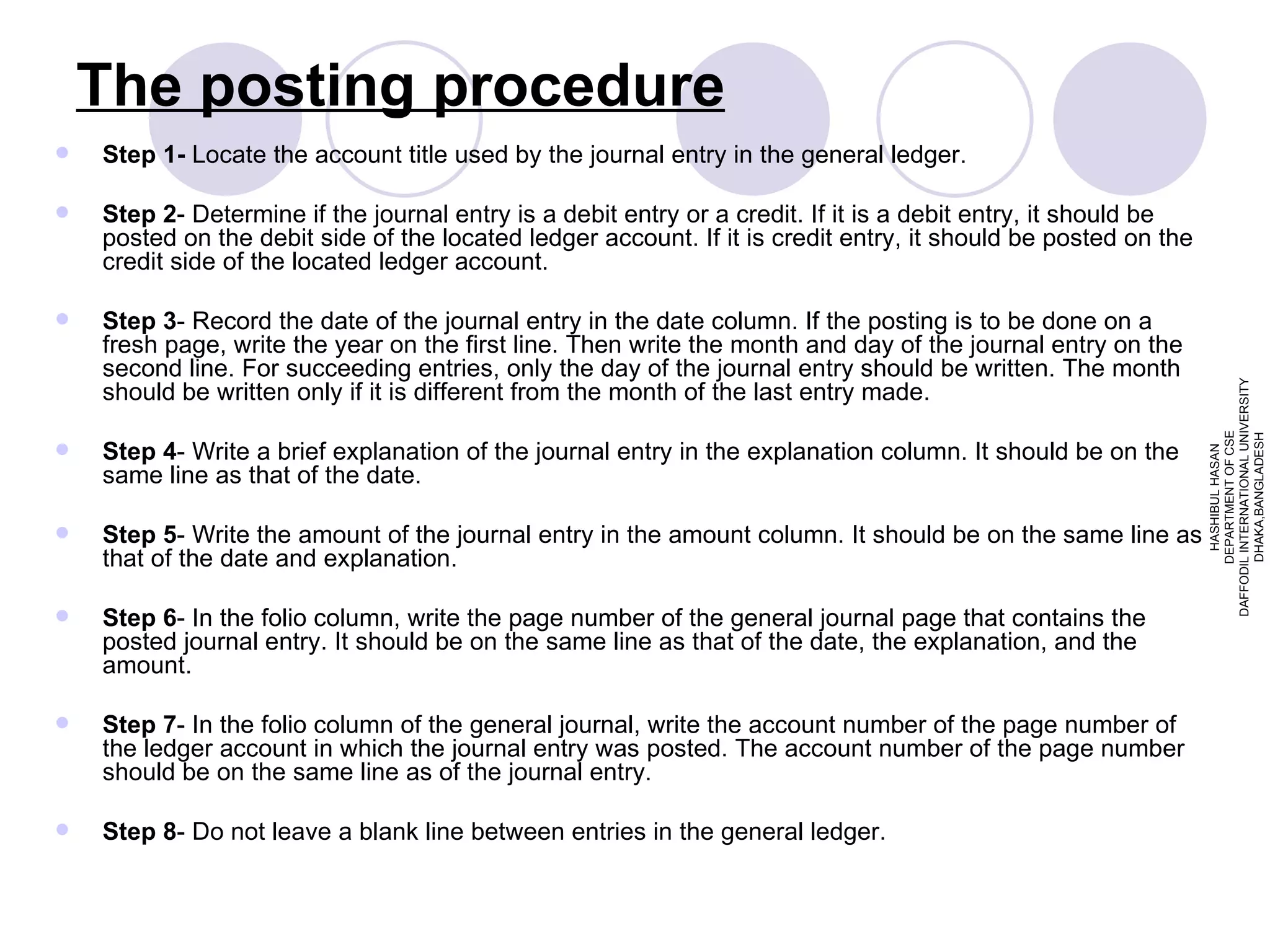
The posting procedureStep 1- Locate the account title used by the journal entry in the general ledger. Step 2 - Determine if the journal entry is a debit entry or a credit. If it is a debit entry, it should be posted on the debit side of the located ledger account. If it is credit entry, it should be posted on the credit side of the located ledger account. Step 3 - Record the date of the journal entry in the date column. If the posting is to be done on a fresh page, write the year on the first line. Then write the month and day of the journal entry on the second line. For succeeding entries, only the day of the journal entry should be written. The month should be written only if it is different from the month of the last entry made. Step 4 - Write a brief explanation of the journal entry in the explanation column. It should be on the same line as that of the date. Step 5 - Write the amount of the journal entry in the amount column. It should be on the same line as that of the date and explanation. Step 6 - In the folio column, write the page number of the general journal page that contains the posted journal entry. It should be on the same line as that of the date, the explanation, and the amount. Step 7 - In the folio column of the general journal, write the account number of the page number of the ledger account in which the journal entry was posted. The account number of the page number should be on the same line as of the journal entry. Step 8 - Do not leave a blank line between entries in the general ledger. HASHIBUL HASAN DEPARTMENT OF CSE DAFFODIL INTERNATIONAL UNIVERSITY DHAKA,BANGLADESH
7.
Explain With AExample :- HASHIBUL HASAN DEPARTMENT OF CSE DAFFODIL INTERNATIONAL UNIVERSITY DHAKA,BANGLADESH
8.
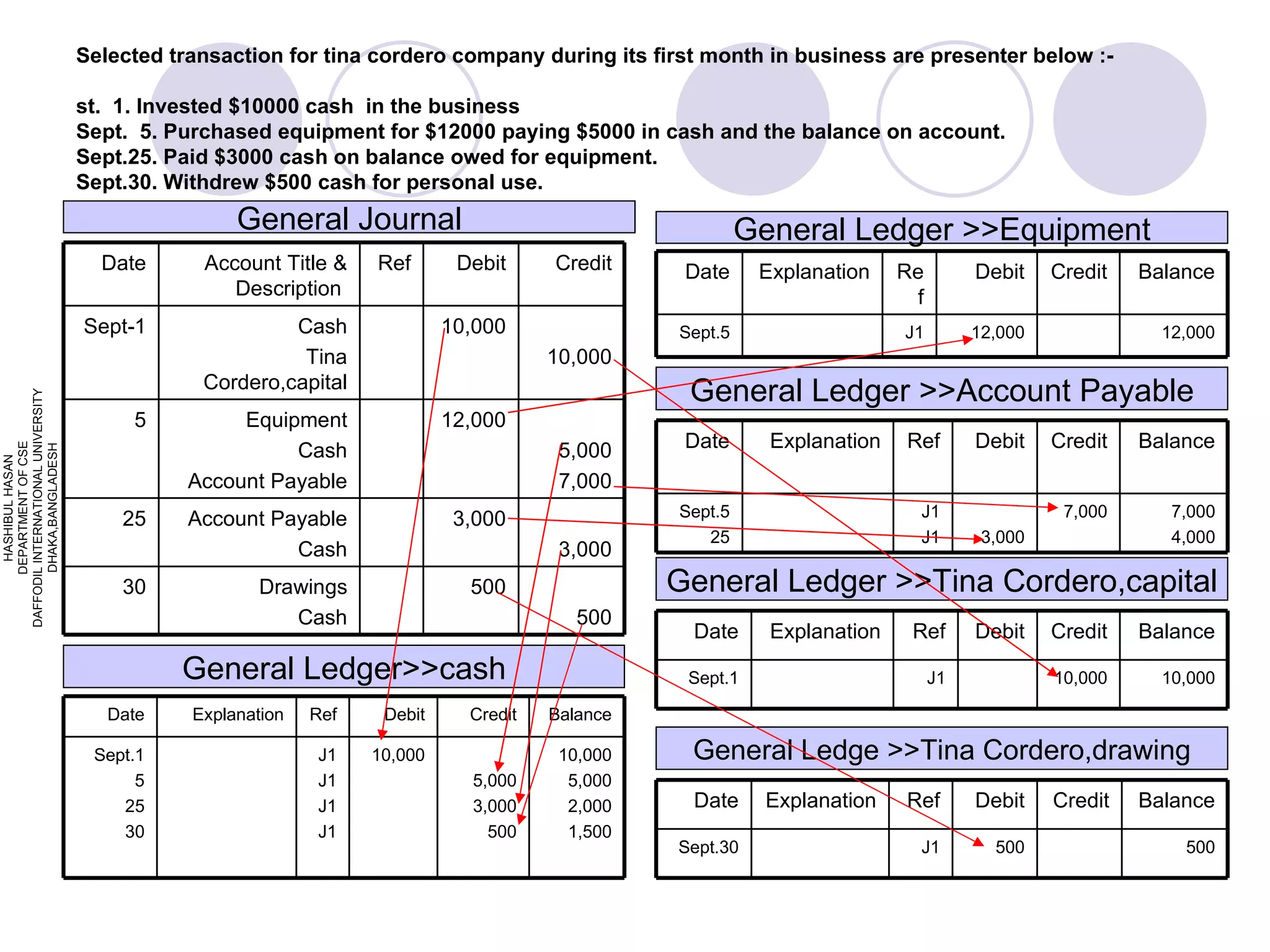
Selected transaction fortina cordero company during its first month in business are presenter below :- st. 1. Invested $10000 cash in the business Sept. 5. Purchased equipment for $12000 paying $5000 in cash and the balance on account. Sept.25. Paid $3000 cash on balance owed for equipment. Sept.30. Withdrew $500 cash for personal use. General Ledger>>cash General Ledge >>Tina Cordero,drawing General Ledger >>Tina Cordero,capital General Ledger >>Account Payable General Ledger >>Equipment General Journal HASHIBUL HASAN DEPARTMENT OF CSE DAFFODIL INTERNATIONAL UNIVERSITY DHAKA,BANGLADESH 500 500 Drawings Cash 30 3,000 3,000 Account Payable Cash 25 5,000 7,000 12,000 Equipment Cash Account Payable 5 10,000 10,000 Cash Tina Cordero,capital Sept-1 Credit Debit Ref Account Title & Description Date 10,000 5,000 2,000 1,500 5,000 3,000 500 10,000 J1 J1 J1 J1 Sept.1 5 25 30 Balance Credit Debit Ref Explanation Date 7,000 4,000 7,000 3,000 J1 J1 Sept.5 25 Balance Credit Debit Ref Explanation Date 12,000 12,000 J1 Sept.5 Balance Credit Debit Ref Explanation Date 10,000 10,000 J1 Sept.1 Balance Credit Debit Ref Explanation Date 500 500 J1 Sept.30 Balance Credit Debit Ref Explanation Date
9.
TRAIL BALANCE HASHIBUL HASAN DEPARTMENT OF CSE DAFFODIL INTERNATIONAL UNIVERSITY DHAKA,BANGLADESH
10.
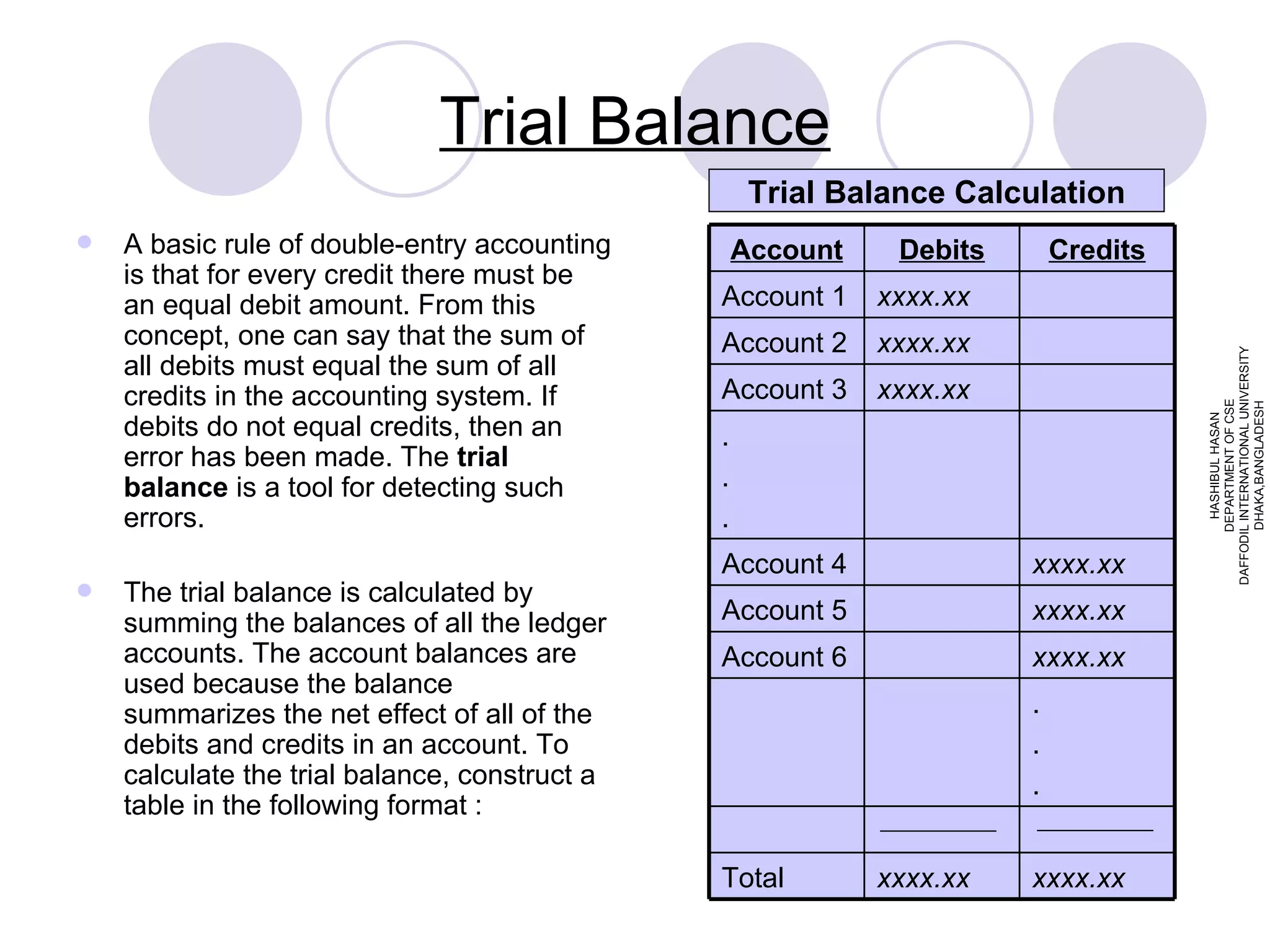
Trial Balance Abasic rule of double-entry accounting is that for every credit there must be an equal debit amount. From this concept, one can say that the sum of all debits must equal the sum of all credits in the accounting system. If debits do not equal credits, then an error has been made. The trial balance is a tool for detecting such errors. The trial balance is calculated by summing the balances of all the ledger accounts. The account balances are used because the balance summarizes the net effect of all of the debits and credits in an account. To calculate the trial balance, construct a table in the following format : Trial Balance Calculation HASHIBUL HASAN DEPARTMENT OF CSE DAFFODIL INTERNATIONAL UNIVERSITY DHAKA,BANGLADESH xxxx.xx xxxx.xx Total . . . xxxx.xx Account 6 xxxx.xx Account 5 xxxx.xx Account 4 . . . xxxx.xx Account 3 xxxx.xx Account 2 xxxx.xx Account 1 Credits Debits Account
11.
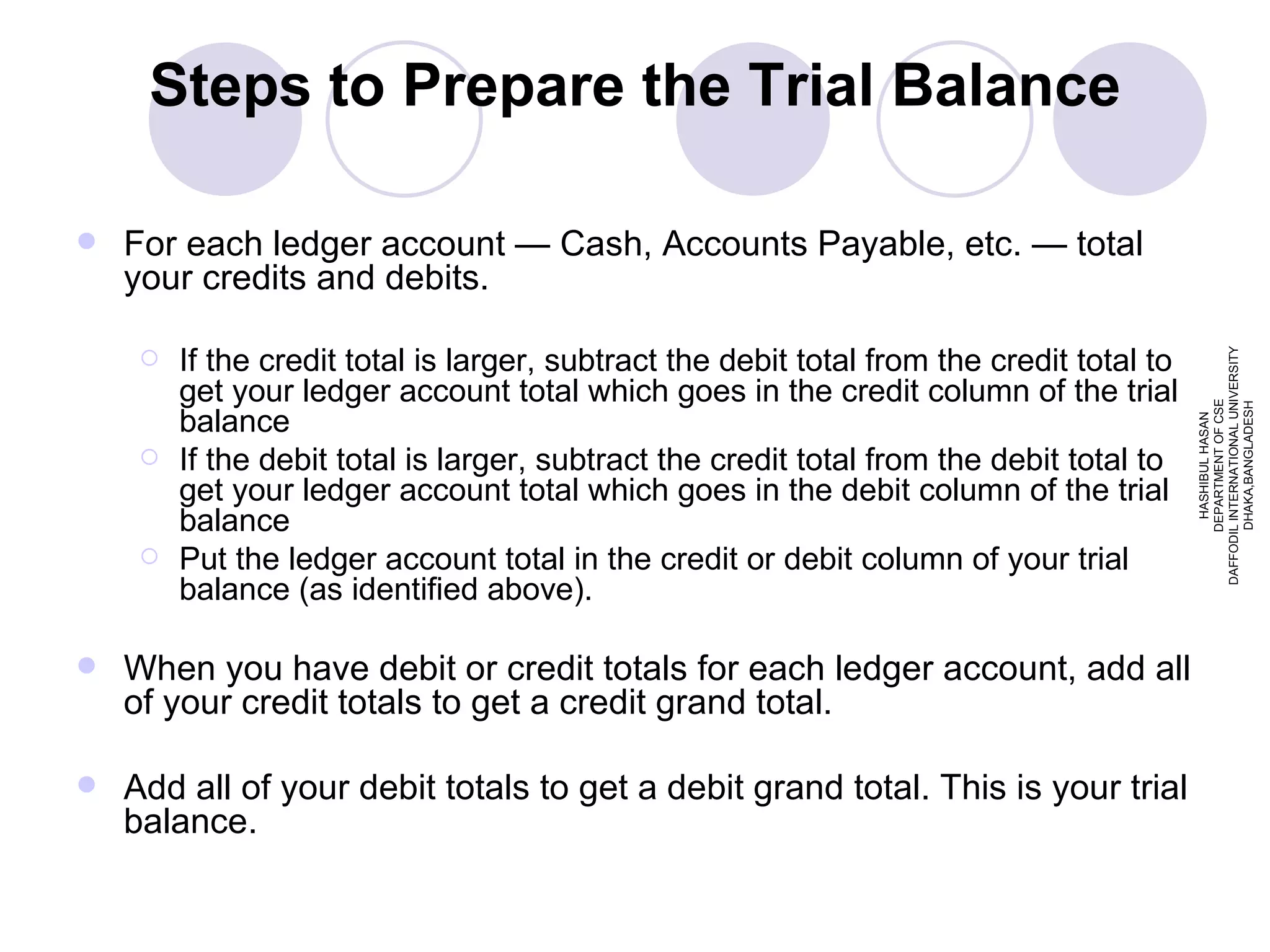
Steps to Preparethe Trial Balance For each ledger account — Cash, Accounts Payable, etc. — total your credits and debits. If the credit total is larger, subtract the debit total from the credit total to get your ledger account total which goes in the credit column of the trial balance If the debit total is larger, subtract the credit total from the debit total to get your ledger account total which goes in the debit column of the trial balance Put the ledger account total in the credit or debit column of your trial balance (as identified above). When you have debit or credit totals for each ledger account, add all of your credit totals to get a credit grand total. Add all of your debit totals to get a debit grand total. This is your trial balance. HASHIBUL HASAN DEPARTMENT OF CSE DAFFODIL INTERNATIONAL UNIVERSITY DHAKA,BANGLADESH
12.
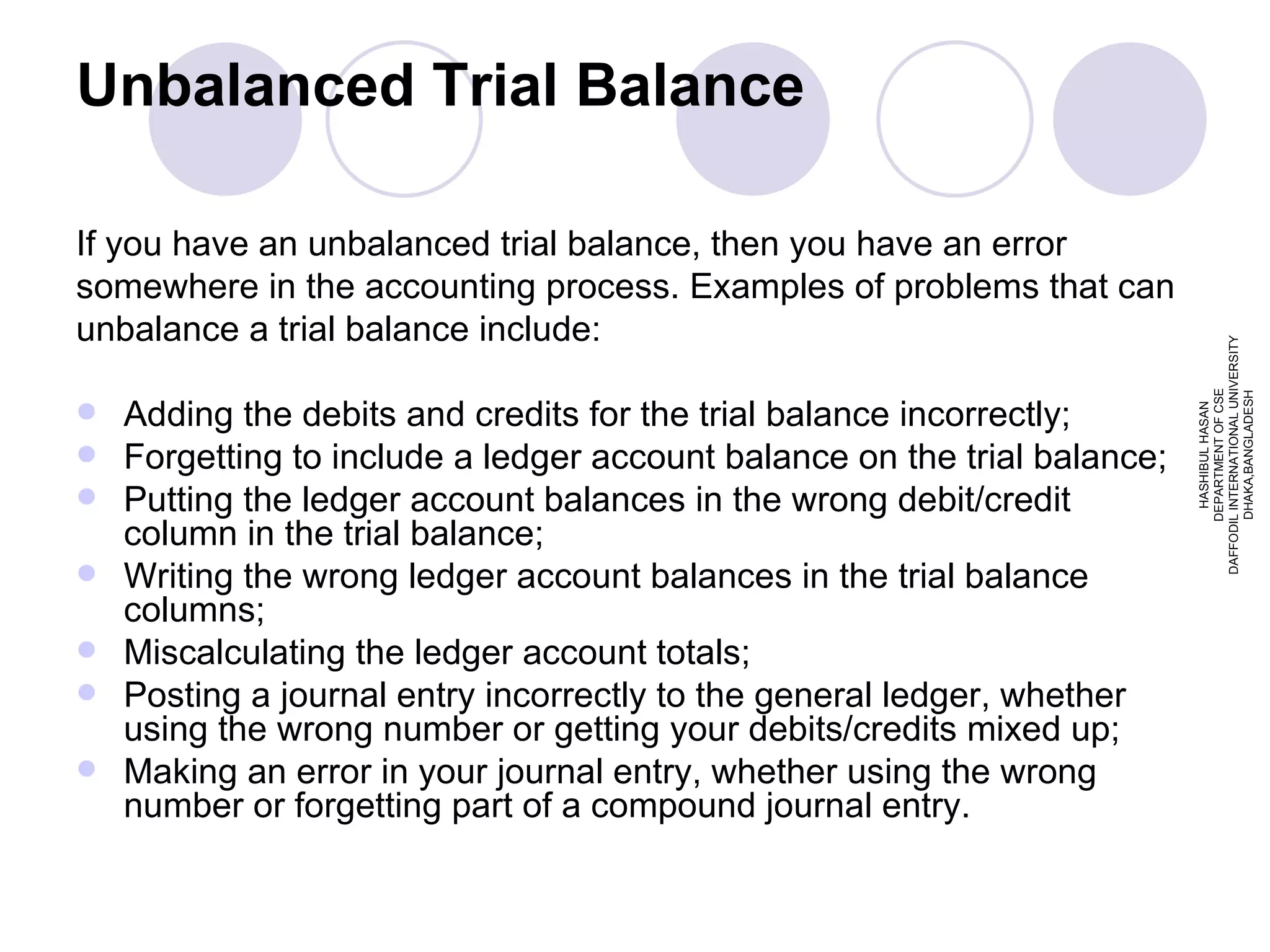
Unbalanced Trial BalanceIf you have an unbalanced trial balance, then you have an error somewhere in the accounting process. Examples of problems that can unbalance a trial balance include: Adding the debits and credits for the trial balance incorrectly; Forgetting to include a ledger account balance on the trial balance; Putting the ledger account balances in the wrong debit/credit column in the trial balance; Writing the wrong ledger account balances in the trial balance columns; Miscalculating the ledger account totals; Posting a journal entry incorrectly to the general ledger, whether using the wrong number or getting your debits/credits mixed up; Making an error in your journal entry, whether using the wrong number or forgetting part of a compound journal entry. HASHIBUL HASAN DEPARTMENT OF CSE DAFFODIL INTERNATIONAL UNIVERSITY DHAKA,BANGLADESH
13.
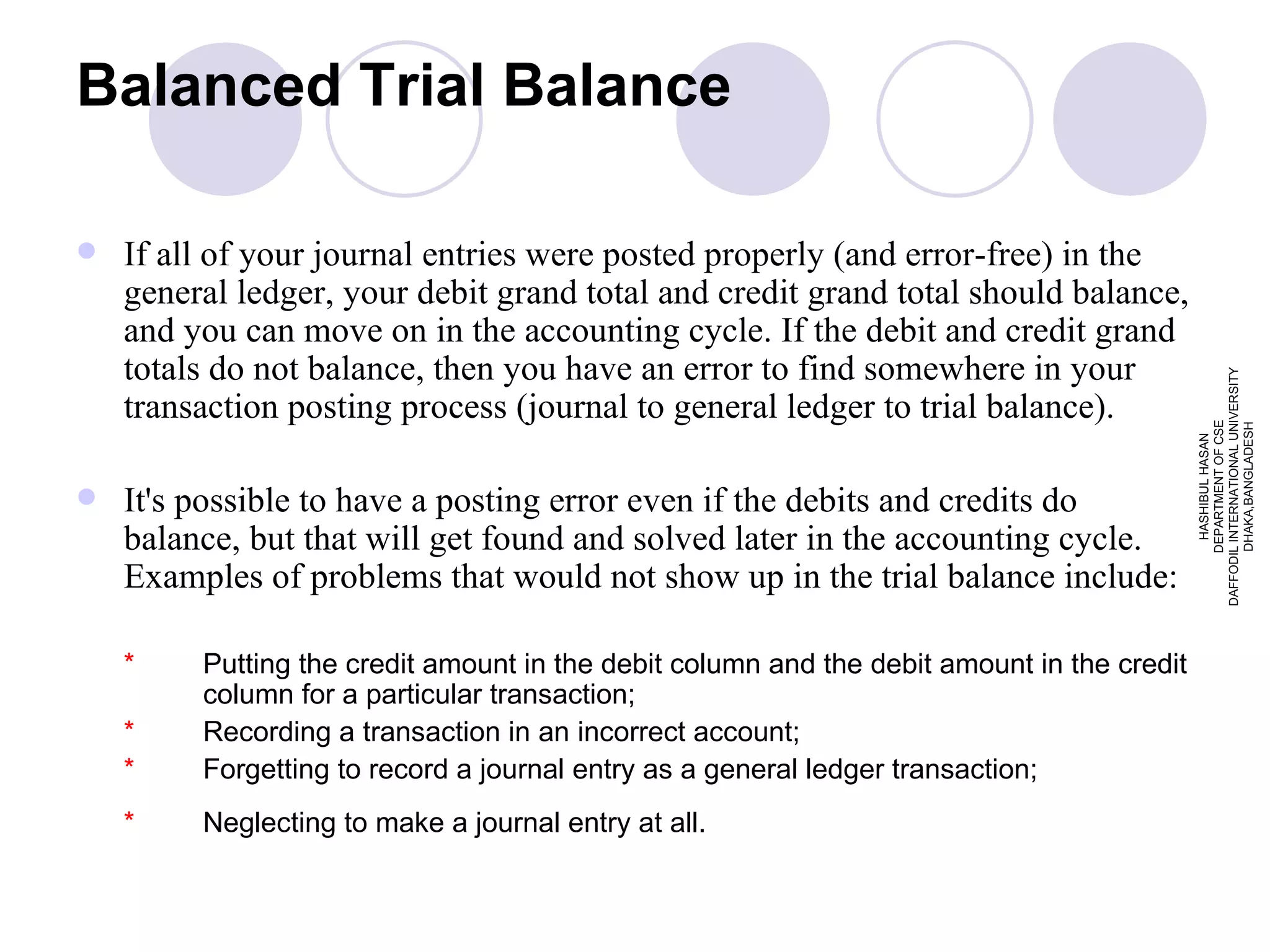
Balanced Trial BalanceIf all of your journal entries were posted properly (and error-free) in the general ledger, your debit grand total and credit grand total should balance, and you can move on in the accounting cycle. If the debit and credit grand totals do not balance, then you have an error to find somewhere in your transaction posting process (journal to general ledger to trial balance). It's possible to have a posting error even if the debits and credits do balance, but that will get found and solved later in the accounting cycle. Examples of problems that would not show up in the trial balance include: * Putting the credit amount in the debit column and the debit amount in the credit column for a particular transaction; * Recording a transaction in an incorrect account; * Forgetting to record a journal entry as a general ledger transaction; * Neglecting to make a journal entry at all. HASHIBUL HASAN DEPARTMENT OF CSE DAFFODIL INTERNATIONAL UNIVERSITY DHAKA,BANGLADESH
14.
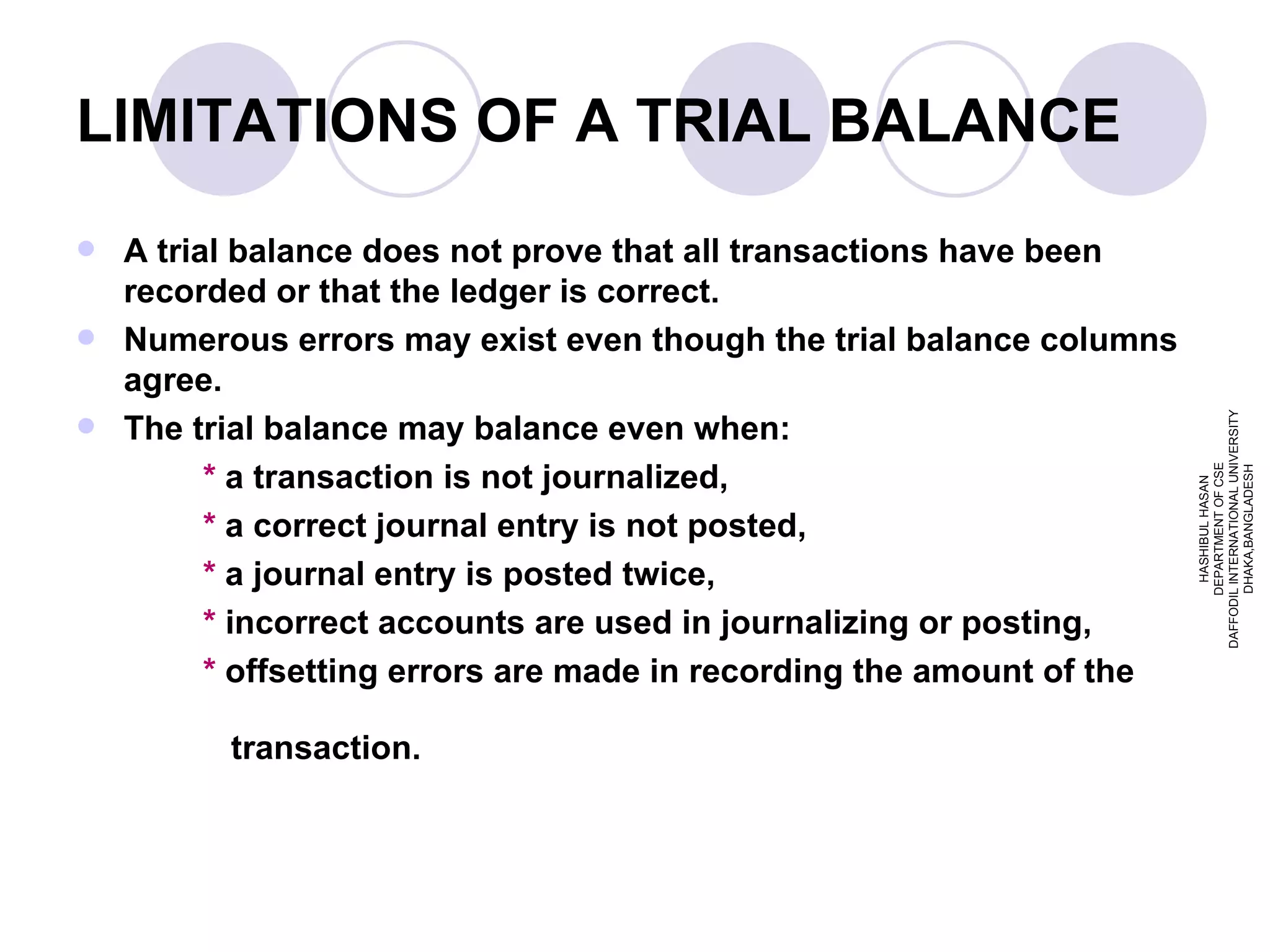
LIMITATIONS OF ATRIAL BALANCE A trial balance does not prove that all transactions have been recorded or that the ledger is correct. Numerous errors may exist even though the trial balance columns agree. The trial balance may balance even when: * a transaction is not journalized, * a correct journal entry is not posted, * a journal entry is posted twice, * incorrect accounts are used in journalizing or posting, * offsetting errors are made in recording the amount of the transaction. HASHIBUL HASAN DEPARTMENT OF CSE DAFFODIL INTERNATIONAL UNIVERSITY DHAKA,BANGLADESH
15.
Have Any Question ? HASHIBUL HASAN DEPARTMENT OF CSE DAFFODIL INTERNATIONAL UNIVERSITY DHAKA,BANGLADESH
16.
THANK YOU HASHIBULHASAN DEPARTMENT OF CSE DAFFODIL INTERNATIONAL UNIVERSITY DHAKA,BANGLADESH