
“RECTIFICATION OF eRRORS”
BY SRINIVAS METHUKU.
Learning Objectives:
•After learning this Chapter, you will be able to:
•Meaning and reasons for Errors
•Identify the Kinds of Errors.
•Understand the Procedure for Rectification of Errors.
Errors in Accounting:
• The fundamental principle of the double-entry system is that
every debit has a corresponding credit of equal amount and vice-
versa.
• Therefore, the total of all debit balances in different accounts
must be equal to the total of all credit balances in different
accounts
• An accounting error is a non-fraudulent discrepancy in financial
documentation.
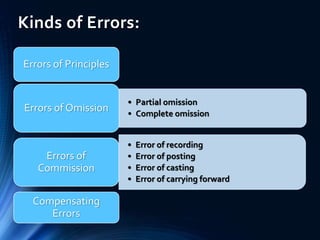
Kinds of Errors:
Errors of Principles
• Partial omission
• Complete omission
Errors of Omission
• Error of recording
• Error of posting
• Error of casting
• Error of carrying forward
Errors of
Commission
Compensating
Errors
I. Errors of Principles: If any of these principles is
violated or ignored, errors resulting from such violation are
known as errors of principle.
II. Clerical Errors: These errors arise because of
mistakes committed in the ordinary course of accounting
work.These can be further classified into three types as
follows.
a) Errors of Omission: This error arises when a transaction
is completely or partially omitted to be recorded in the books
of accounts. Errors of omission may be classified as below.
i. Error of Complete Omission:This error arises when a
transaction is totally omitted to be recorded in the
books of accounts.
For example, Goods purchased from Ram completely
omitted to be recorded.This error does not affect the
trial balance.
ii. Error of Partial Omission:This error arises when
only one aspect of the transaction either debit or
credit is recorded.
For example, a credit sale of goods to Siva recorded in
sales book but omitted to be posted in Siva’s account.
This error affects the trial balance.
b) Errors of Commission: This error arises due to wrong recording, wrong
posting, wrong casting, wrong balancing, wrong carrying forward
etc. Errors of commission may be classified as follows:
i. Error of Recording:This error arises when a transaction is
wrongly recorded in the books of original entry. For example,
Goods of Rs.5,000, purchased on credit fromViji, is recorded in
the book for Rs.5,500.This error does not affect the trial
balance.
ii. Error of Posting:This error arises when information recorded in
the books of original entry are wrongly entered in the ledger.
Error of posting may be
• Right amount in the right side of wrong account.
• Right amount in the wrong side of correct account
• Wrong amount in the right side of correct account
• Wrong amount in the wrong side of correct account
• Wrong amount in the wrong side of wrong account
• Wrong amount in the right side of wrong account, etc.
iii. Error of Casting (Totalling) :This error arises when a
mistake is committed while totalling the subsidiary book.
• For example, instead of Rs.12,000 it may be wrongly totalled as Rs.13,000.This
is called overcasting. If it is wrongly totalled as Rs.11,000, it is called
undercasting.
iv. Error of Carrying Forward :This error arises when a
• mistake is committed in carrying forward a total of one page to the next page.
• For example,Total of purchase book in page 282 of the ledger Rs.10,686, while
carrying forward the balance to the next page it was recorded as Rs.10,866.
c) Compensating Errors: The errors arising from excess
debits or under debits of accounts being neutralized by
the excess credits or under credits to the same extent of
some other account is compensating error.
• Since the errors in one direction are compensated by errors in
another direction, arithmetical accuracy of the trial balance is not
at all affected inspite of such errors.
• For example, If the purchases book and sales book are both
overcast (excess totalling) by Rs.10,000, the errors mutually
compensate each other.This error will not affect the agreement
of trial balance.
Errors disclosed and not disclosed by
trial balance:
Errors disclosed by trial balance:
1) Errors of partial omission
2) Errors of casting
3) Errors of carrying forward
4) Errors of posting in the wrong side of the correct account
5) Errors of posting to correct with wrong amount
6) Double posting in the same account
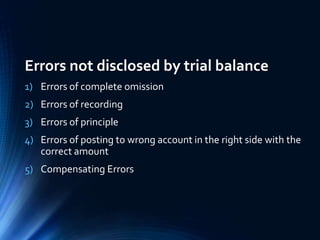
Errors not disclosed by trial balance
1) Errors of complete omission
2) Errors of recording
3) Errors of principle
4) Errors of posting to wrong account in the right side with the
correct amount
5) Compensating Errors
Suspense Account
• When it is difficult to locate the mistakes before preparing the
final accounts, the difference in the trial balance is transferred to
newly opened imaginary and temporary account called
‘Suspense Account’.
• Suspense account is prepared to avoid the delay in the
preparation of final accounts
• If the total debit balances of the trial balance exceeds the total
credit balances, the difference is transferred to the credit side of
the suspense account.
• if the total credit balances of the trial balance exceeds the total
debit balances the difference is transferred to the debit side of
the suspense account.
Topic 8 rectification of errors n

Topic 8 rectification of errors n

  • 1.
  • 2.
    Learning Objectives: •After learningthis Chapter, you will be able to: •Meaning and reasons for Errors •Identify the Kinds of Errors. •Understand the Procedure for Rectification of Errors.
  • 3.
    Errors in Accounting: •The fundamental principle of the double-entry system is that every debit has a corresponding credit of equal amount and vice- versa. • Therefore, the total of all debit balances in different accounts must be equal to the total of all credit balances in different accounts • An accounting error is a non-fraudulent discrepancy in financial documentation.
  • 4.
    Kinds of Errors: Errorsof Principles • Partial omission • Complete omission Errors of Omission • Error of recording • Error of posting • Error of casting • Error of carrying forward Errors of Commission Compensating Errors
  • 5.
    I. Errors ofPrinciples: If any of these principles is violated or ignored, errors resulting from such violation are known as errors of principle. II. Clerical Errors: These errors arise because of mistakes committed in the ordinary course of accounting work.These can be further classified into three types as follows. a) Errors of Omission: This error arises when a transaction is completely or partially omitted to be recorded in the books of accounts. Errors of omission may be classified as below.
  • 6.
    i. Error ofComplete Omission:This error arises when a transaction is totally omitted to be recorded in the books of accounts. For example, Goods purchased from Ram completely omitted to be recorded.This error does not affect the trial balance. ii. Error of Partial Omission:This error arises when only one aspect of the transaction either debit or credit is recorded. For example, a credit sale of goods to Siva recorded in sales book but omitted to be posted in Siva’s account. This error affects the trial balance.
  • 7.
    b) Errors ofCommission: This error arises due to wrong recording, wrong posting, wrong casting, wrong balancing, wrong carrying forward etc. Errors of commission may be classified as follows: i. Error of Recording:This error arises when a transaction is wrongly recorded in the books of original entry. For example, Goods of Rs.5,000, purchased on credit fromViji, is recorded in the book for Rs.5,500.This error does not affect the trial balance. ii. Error of Posting:This error arises when information recorded in the books of original entry are wrongly entered in the ledger. Error of posting may be • Right amount in the right side of wrong account. • Right amount in the wrong side of correct account • Wrong amount in the right side of correct account • Wrong amount in the wrong side of correct account • Wrong amount in the wrong side of wrong account • Wrong amount in the right side of wrong account, etc.
  • 8.
    iii. Error ofCasting (Totalling) :This error arises when a mistake is committed while totalling the subsidiary book. • For example, instead of Rs.12,000 it may be wrongly totalled as Rs.13,000.This is called overcasting. If it is wrongly totalled as Rs.11,000, it is called undercasting. iv. Error of Carrying Forward :This error arises when a • mistake is committed in carrying forward a total of one page to the next page. • For example,Total of purchase book in page 282 of the ledger Rs.10,686, while carrying forward the balance to the next page it was recorded as Rs.10,866.
  • 9.
    c) Compensating Errors:The errors arising from excess debits or under debits of accounts being neutralized by the excess credits or under credits to the same extent of some other account is compensating error. • Since the errors in one direction are compensated by errors in another direction, arithmetical accuracy of the trial balance is not at all affected inspite of such errors. • For example, If the purchases book and sales book are both overcast (excess totalling) by Rs.10,000, the errors mutually compensate each other.This error will not affect the agreement of trial balance.
  • 10.
    Errors disclosed andnot disclosed by trial balance: Errors disclosed by trial balance: 1) Errors of partial omission 2) Errors of casting 3) Errors of carrying forward 4) Errors of posting in the wrong side of the correct account 5) Errors of posting to correct with wrong amount 6) Double posting in the same account
  • 11.
    Errors not disclosedby trial balance 1) Errors of complete omission 2) Errors of recording 3) Errors of principle 4) Errors of posting to wrong account in the right side with the correct amount 5) Compensating Errors
  • 12.
    Suspense Account • Whenit is difficult to locate the mistakes before preparing the final accounts, the difference in the trial balance is transferred to newly opened imaginary and temporary account called ‘Suspense Account’. • Suspense account is prepared to avoid the delay in the preparation of final accounts • If the total debit balances of the trial balance exceeds the total credit balances, the difference is transferred to the credit side of the suspense account. • if the total credit balances of the trial balance exceeds the total debit balances the difference is transferred to the debit side of the suspense account.