Understanding  Double Entry System
Your objective to learn in this topic Basics of the Double Entry System Accounts and their Classification Rules of Debit and Credit
Double Entry System Modern Accounting System is based on double entry system which is based on the fundamental accounting equation Assets=Liabilities + Equity The double-entry accounting system ensures that the accounting equation always remains in balance.  Debits must be equal Credits.
The system is called Double Entry because every business transaction has dual aspect and affects at least two accounts. Every transaction must contain at least one account debited and at least one account credited thus posted in at least two different ledger accounts.  For every financial transaction recorded in the accounts of a business, there is a debit entry and a credit entry. Furthermore, the total of the entries on the debit side must always equal the total of the entries on the credit side All business transactions consist of an exchange of one thing for another, double entry accounting system uses debits and credits, to show this two-fold effect.
The original entry into the books of the business that records the debit and credit aspects of the source documents that evidence a financial event is called  transaction . Purchasing goods, paying bills, receiving cash, selling goods, recording depreciation, making payments, adjusting prepayments etc are the examples of business events which are need to be recorded in term of transaction. Every transaction must include at least on account debited and at least one account credited. Debits and Credits are system of notation used in bookkeeping to determine how to record any financial transaction.
Account  is the individual record of an asset, a liability, a revenue, an expense or capital, in a summarized manner. (Sales, Purchases, Cash, Bank, Income, Exp etc). It means if I need to see the detail of purchase or sale I will see the account of purchase or sale. Account included the detailed record of five element of accounting. Accounts and their classification
Classification of Accounts -Five elements of Accounts- Modern classification of accounts is based on the expended accounting equation. This is realistic approach and is easy to understand. Assets:   An asset is a resource that has future values. It is owns and utilized by a business or person to maintain the functionality and operation of a business .
Five elements of accounts with their respective normal balance Rules of Debit and Credit CREDIT DEBIT DEBIT DEBIT CREDIT WHEN DECREASE DEBIT CREDIT CREDIT CREDIT DEBIT WHEN INCREASE DEBIT CREDIT CREDIT CREDIT DEBIT NORMAL BALANCE EXPENSES REVENUE CAPITAL LIABILITIES ASSETS
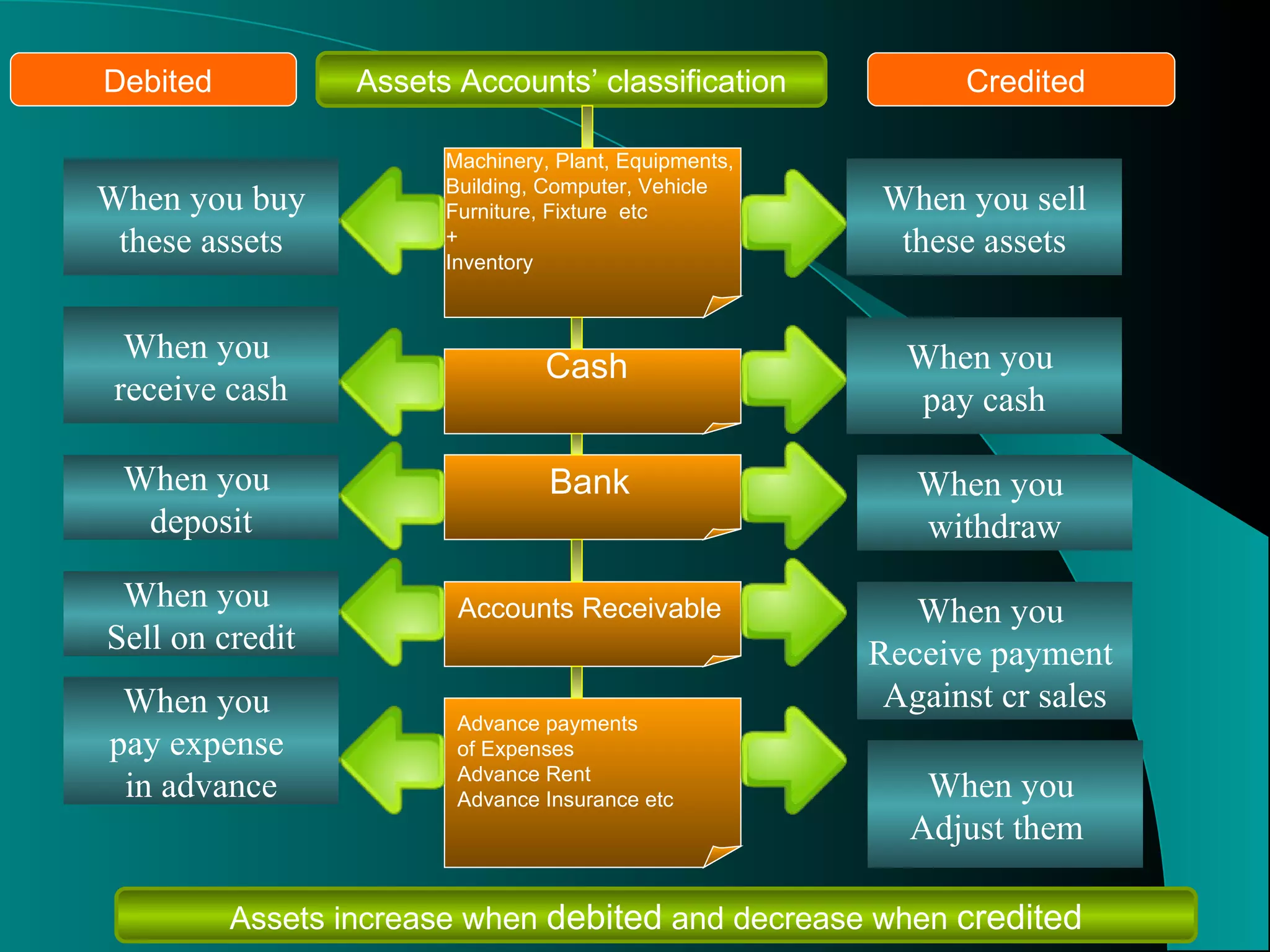
Assets Accounts’ classification Machinery, Plant, Equipments,  Building, Computer, Vehicle Furniture, Fixture  etc + Inventory Cash   Advance payments  of Expenses Advance Rent Advance Insurance etc Bank   Accounts Receivable   Assets increase when  debited  and decrease when  credited Credited Debited When you buy these assets When you sell these assets When you  receive cash When you  pay cash When you  deposit When you  withdraw When you  Sell on credit When you  Receive payment  Against cr sales When you  pay expense  in advance When you  Adjust them
Liabilities:   Liabilities are obligations or debts that an enterprise has to pay at some time in the future. They represent creditors’ claims on the firm’s assets. Followings are types of liabilities Purchases on credit . When you buy goods or assets on credit and promise to pay the due amount at some future. We use Accounts payable account for these. Expense due but not paid.  If expenses like rent , wages etc are due on end of the month/year but not paid are called outstanding expenses or accrued expenses.   Unearned revenue.  Suppose Ali is manufacturer of butter, one of his customer pays him Rs. 50,000 in advance. Unless Ali delivers the butter to his customer, the amount will be not be treated as Sales or Revenue, but it would be treated as Liability. When Ali delivers the butter, unearned revenue will be converted into REVENUE.
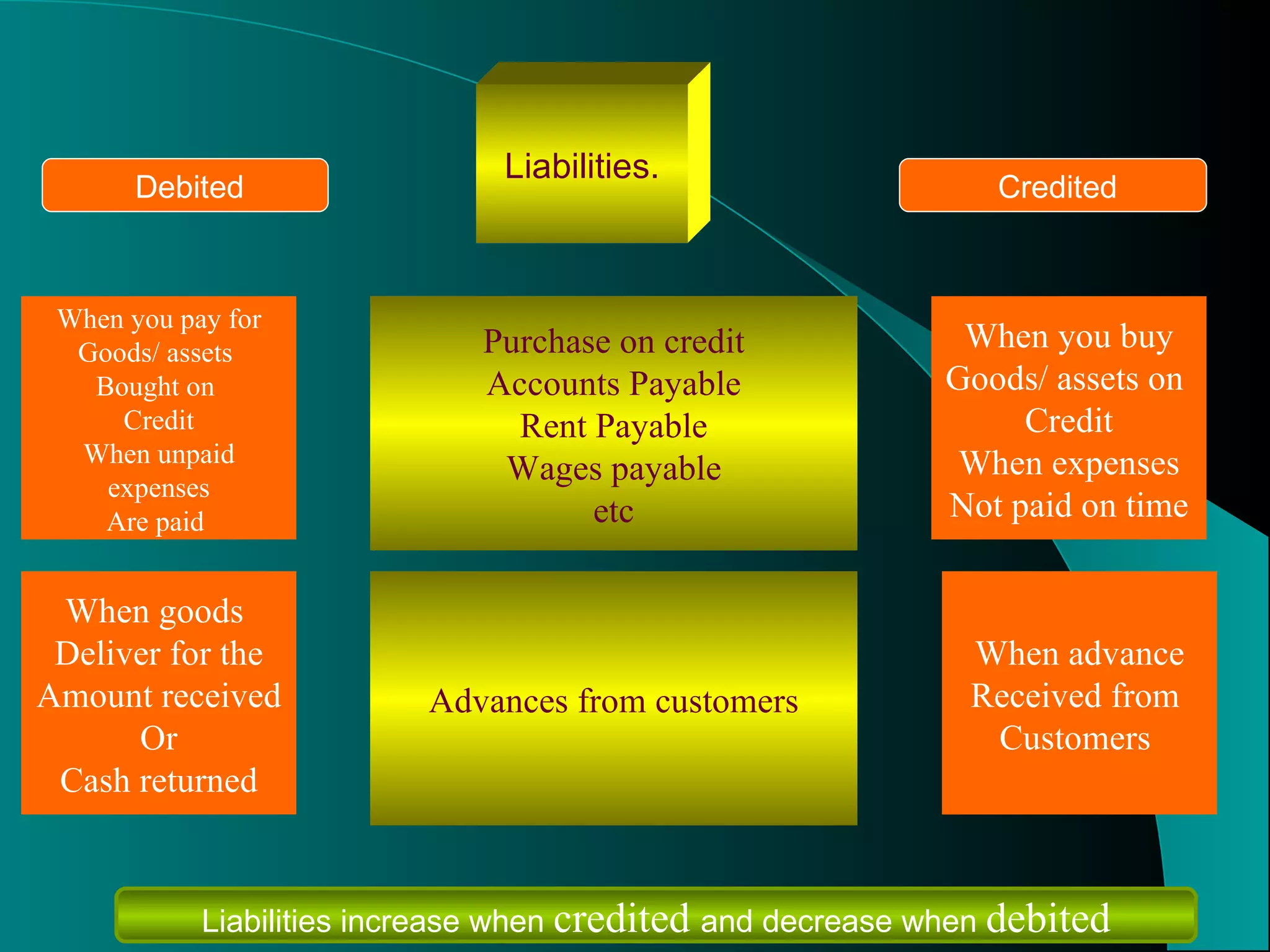
Liabilities increase when  credited  and decrease when  debited Purchase on credit Accounts Payable Rent Payable Wages payable etc Advances from customers Credited Debited When you buy Goods/ assets on  Credit When expenses Not paid on time When you pay for Goods/ assets  Bought on  Credit When unpaid expenses Are paid  When advance Received from  Customers  When goods  Deliver for the Amount received Or Cash returned Liabilities.
Capital or Equity Equity or Capital represents the owner's claim to the assets. When a new business starts, capital includes the amount invested by owner in term of cash or assets. For the next subsequent years, profits are added in it and losses and withdrawals or drawings are subtracted from it. So owner’s capital increased by earning profit or investing further assets and decreased by suffering loss or taking cash or goods for personal use and selling assets of the business.
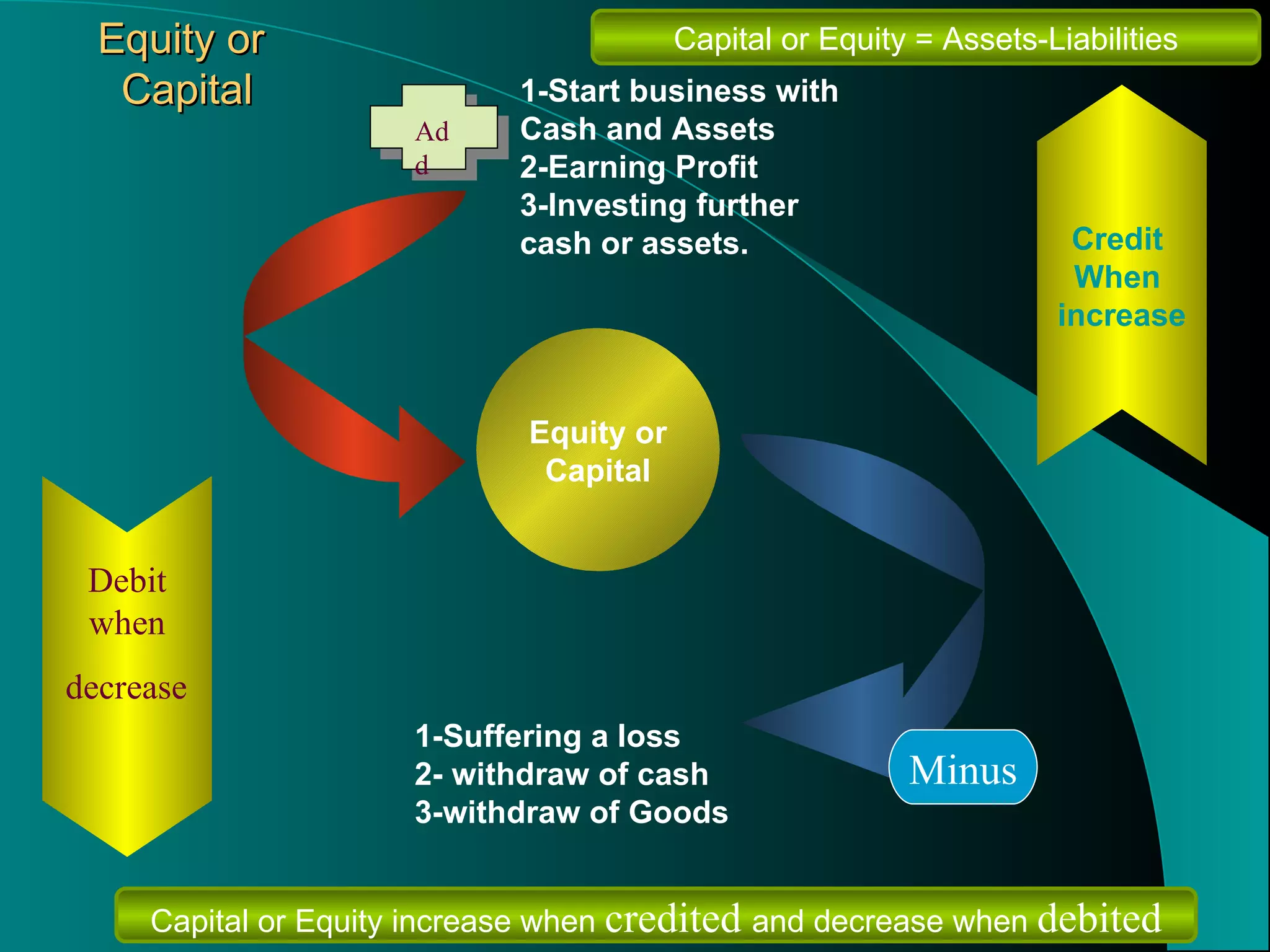
Equity or  Capital Equity or Capital 1-Suffering a loss 2- withdraw of cash 3-withdraw of Goods  1-Start business with  Cash and Assets 2-Earning Profit 3-Investing further  cash or assets. Add Capital or Equity increase when  credited  and decrease when  debited Minus Credit  When  increase Debit when decrease Capital or Equity = Assets-Liabilities
Revenue - Income There is fundamental difference between Revenue and Income. Revenue refers amount a business earns by selling services and products. Income describes as excess amount of revenues over expenses. Increase in revenue results increase in Income. When a business sells goods or services, it receives cash at same time or some future time, but in both cases revenue and income increase
Revenue or Income increase when  credited  and decrease when  debited Credit Revenue when increase -When goods or services are sold on Cash or  on credit
Revenue or Income increase when  credited  and decrease when  debited Debit Revenue when decrease -Technically revenue not credited usually except 1-At the end of period when closed and  2-Sales returns
Expenses An expense in accounting is the money spent or cost incurred in an entity's efforts to generate revenue.  Goods or services purchased directly for the running of the business that have completely spent their economic value at the time of the preparation of the financial statements. e.g. Wages expense, Bank charges, Electricity expense.  Expenses are debited when incurred regardless of being paid or payable
Expenses When incurred/ increased are debited Wages Purchases Utility  bills Other Exp Rent Bank  charges Taxes
Generally expenses are not decreased so never credited. When accounting period completes and revenues (sales) and expenses accounts are closed and are needed to  transfer the balances to Trading and P&L.  Expenses are credited to Trading and P&L account Purchase returns are also credited . Normally expenses are not decreased
How to originate Journal entry We have successfully completed our first part of understanding Double Entry system , next we have to do is how to make a Journal Entry. To make Journal entries we must recall how to debit or credit accounts. Lets have a look below to understand it more practically. On 1 st  of Feb 2012, Sameer started a business by  Investing Rs. 200,000 in Cash. We know that when we start business our two accounts are affected. One of two is Capital which increased so wed credit it secondly our cash also increase so we debit it. Don’t forget to use “To” before each credit.
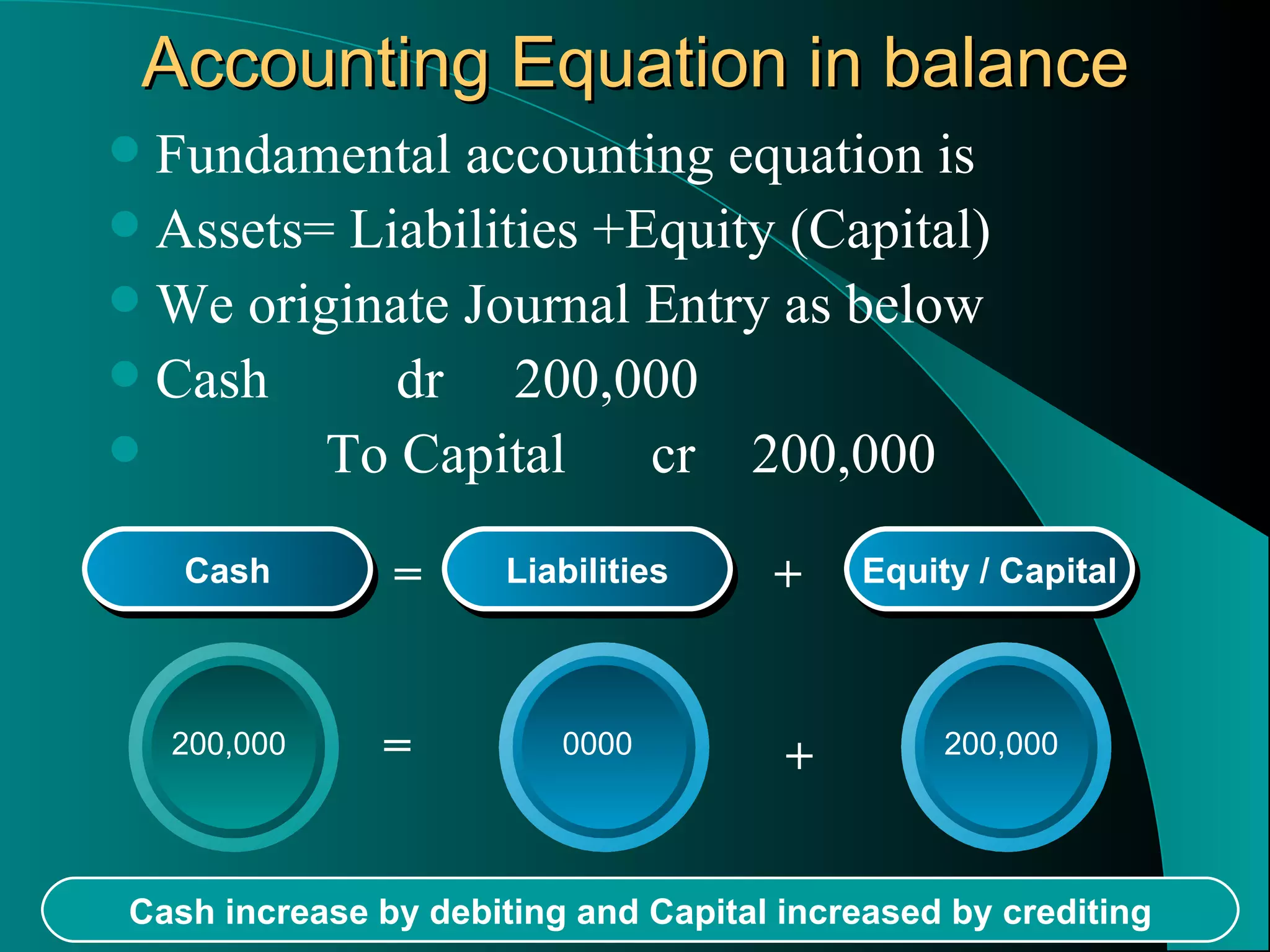
Accounting Equation in balance Fundamental accounting equation is Assets= Liabilities +Equity (Capital) We originate Journal Entry as below Cash  dr  200,000 To Capital  cr  200,000 Cash Equity / Capital Liabilities = + 0000 200,000 200,000 = + Cash increase by debiting and Capital increased by crediting
On 2 nd   of Feb 2012, Sameer purchased building for cash  Rupees 80,000. In the above transaction two assets accounts are affected. Sameer purchased Building, resulting an increase in asset (building) secondly cash paid for building thus decreasing in Cash. We know that we debit assets when increase and credit when decrease. We originate Journal entry in the following manner.
Accounting Equation in balance We originate Journal Entry as below Building  dr  80,000 To Cash  cr  80,000 Cash decreased and Asset (Building increased by the same amount) Total Asset are equal to Rs. 120,000 cash and Rs. 80,000 Building. (120,000+80,000) = 200,000. Cash Equity / Capital Liabilities = + 0000 200,000 200,000 = + Cash increase by debiting and Building increased by debiting also Building

Double entry systme

  • 1.
  • 2.
    Your objective tolearn in this topic Basics of the Double Entry System Accounts and their Classification Rules of Debit and Credit
  • 3.
    Double Entry SystemModern Accounting System is based on double entry system which is based on the fundamental accounting equation Assets=Liabilities + Equity The double-entry accounting system ensures that the accounting equation always remains in balance. Debits must be equal Credits.
  • 4.
    The system iscalled Double Entry because every business transaction has dual aspect and affects at least two accounts. Every transaction must contain at least one account debited and at least one account credited thus posted in at least two different ledger accounts. For every financial transaction recorded in the accounts of a business, there is a debit entry and a credit entry. Furthermore, the total of the entries on the debit side must always equal the total of the entries on the credit side All business transactions consist of an exchange of one thing for another, double entry accounting system uses debits and credits, to show this two-fold effect.
  • 5.
    The original entryinto the books of the business that records the debit and credit aspects of the source documents that evidence a financial event is called transaction . Purchasing goods, paying bills, receiving cash, selling goods, recording depreciation, making payments, adjusting prepayments etc are the examples of business events which are need to be recorded in term of transaction. Every transaction must include at least on account debited and at least one account credited. Debits and Credits are system of notation used in bookkeeping to determine how to record any financial transaction.
  • 6.
    Account isthe individual record of an asset, a liability, a revenue, an expense or capital, in a summarized manner. (Sales, Purchases, Cash, Bank, Income, Exp etc). It means if I need to see the detail of purchase or sale I will see the account of purchase or sale. Account included the detailed record of five element of accounting. Accounts and their classification
  • 7.
    Classification of Accounts-Five elements of Accounts- Modern classification of accounts is based on the expended accounting equation. This is realistic approach and is easy to understand. Assets: An asset is a resource that has future values. It is owns and utilized by a business or person to maintain the functionality and operation of a business .
  • 8.
    Five elements ofaccounts with their respective normal balance Rules of Debit and Credit CREDIT DEBIT DEBIT DEBIT CREDIT WHEN DECREASE DEBIT CREDIT CREDIT CREDIT DEBIT WHEN INCREASE DEBIT CREDIT CREDIT CREDIT DEBIT NORMAL BALANCE EXPENSES REVENUE CAPITAL LIABILITIES ASSETS
  • 9.
    Assets Accounts’ classificationMachinery, Plant, Equipments, Building, Computer, Vehicle Furniture, Fixture etc + Inventory Cash Advance payments of Expenses Advance Rent Advance Insurance etc Bank Accounts Receivable Assets increase when debited and decrease when credited Credited Debited When you buy these assets When you sell these assets When you receive cash When you pay cash When you deposit When you withdraw When you Sell on credit When you Receive payment Against cr sales When you pay expense in advance When you Adjust them
  • 10.
    Liabilities: Liabilities are obligations or debts that an enterprise has to pay at some time in the future. They represent creditors’ claims on the firm’s assets. Followings are types of liabilities Purchases on credit . When you buy goods or assets on credit and promise to pay the due amount at some future. We use Accounts payable account for these. Expense due but not paid. If expenses like rent , wages etc are due on end of the month/year but not paid are called outstanding expenses or accrued expenses. Unearned revenue. Suppose Ali is manufacturer of butter, one of his customer pays him Rs. 50,000 in advance. Unless Ali delivers the butter to his customer, the amount will be not be treated as Sales or Revenue, but it would be treated as Liability. When Ali delivers the butter, unearned revenue will be converted into REVENUE.
  • 11.
    Liabilities increase when credited and decrease when debited Purchase on credit Accounts Payable Rent Payable Wages payable etc Advances from customers Credited Debited When you buy Goods/ assets on Credit When expenses Not paid on time When you pay for Goods/ assets Bought on Credit When unpaid expenses Are paid When advance Received from Customers When goods Deliver for the Amount received Or Cash returned Liabilities.
  • 12.
    Capital or EquityEquity or Capital represents the owner's claim to the assets. When a new business starts, capital includes the amount invested by owner in term of cash or assets. For the next subsequent years, profits are added in it and losses and withdrawals or drawings are subtracted from it. So owner’s capital increased by earning profit or investing further assets and decreased by suffering loss or taking cash or goods for personal use and selling assets of the business.
  • 13.
    Equity or Capital Equity or Capital 1-Suffering a loss 2- withdraw of cash 3-withdraw of Goods 1-Start business with Cash and Assets 2-Earning Profit 3-Investing further cash or assets. Add Capital or Equity increase when credited and decrease when debited Minus Credit When increase Debit when decrease Capital or Equity = Assets-Liabilities
  • 14.
    Revenue - IncomeThere is fundamental difference between Revenue and Income. Revenue refers amount a business earns by selling services and products. Income describes as excess amount of revenues over expenses. Increase in revenue results increase in Income. When a business sells goods or services, it receives cash at same time or some future time, but in both cases revenue and income increase
  • 15.
    Revenue or Incomeincrease when credited and decrease when debited Credit Revenue when increase -When goods or services are sold on Cash or on credit
  • 16.
    Revenue or Incomeincrease when credited and decrease when debited Debit Revenue when decrease -Technically revenue not credited usually except 1-At the end of period when closed and 2-Sales returns
  • 17.
    Expenses An expensein accounting is the money spent or cost incurred in an entity's efforts to generate revenue.  Goods or services purchased directly for the running of the business that have completely spent their economic value at the time of the preparation of the financial statements. e.g. Wages expense, Bank charges, Electricity expense.  Expenses are debited when incurred regardless of being paid or payable
  • 18.
    Expenses When incurred/increased are debited Wages Purchases Utility bills Other Exp Rent Bank charges Taxes
  • 19.
    Generally expenses arenot decreased so never credited. When accounting period completes and revenues (sales) and expenses accounts are closed and are needed to transfer the balances to Trading and P&L. Expenses are credited to Trading and P&L account Purchase returns are also credited . Normally expenses are not decreased
  • 20.
    How to originateJournal entry We have successfully completed our first part of understanding Double Entry system , next we have to do is how to make a Journal Entry. To make Journal entries we must recall how to debit or credit accounts. Lets have a look below to understand it more practically. On 1 st of Feb 2012, Sameer started a business by Investing Rs. 200,000 in Cash. We know that when we start business our two accounts are affected. One of two is Capital which increased so wed credit it secondly our cash also increase so we debit it. Don’t forget to use “To” before each credit.
  • 21.
    Accounting Equation inbalance Fundamental accounting equation is Assets= Liabilities +Equity (Capital) We originate Journal Entry as below Cash dr 200,000 To Capital cr 200,000 Cash Equity / Capital Liabilities = + 0000 200,000 200,000 = + Cash increase by debiting and Capital increased by crediting
  • 22.
    On 2 nd of Feb 2012, Sameer purchased building for cash Rupees 80,000. In the above transaction two assets accounts are affected. Sameer purchased Building, resulting an increase in asset (building) secondly cash paid for building thus decreasing in Cash. We know that we debit assets when increase and credit when decrease. We originate Journal entry in the following manner.
  • 23.
    Accounting Equation inbalance We originate Journal Entry as below Building dr 80,000 To Cash cr 80,000 Cash decreased and Asset (Building increased by the same amount) Total Asset are equal to Rs. 120,000 cash and Rs. 80,000 Building. (120,000+80,000) = 200,000. Cash Equity / Capital Liabilities = + 0000 200,000 200,000 = + Cash increase by debiting and Building increased by debiting also Building

Editor's Notes

  • #2 Asian Institute of Virtual Learning