1
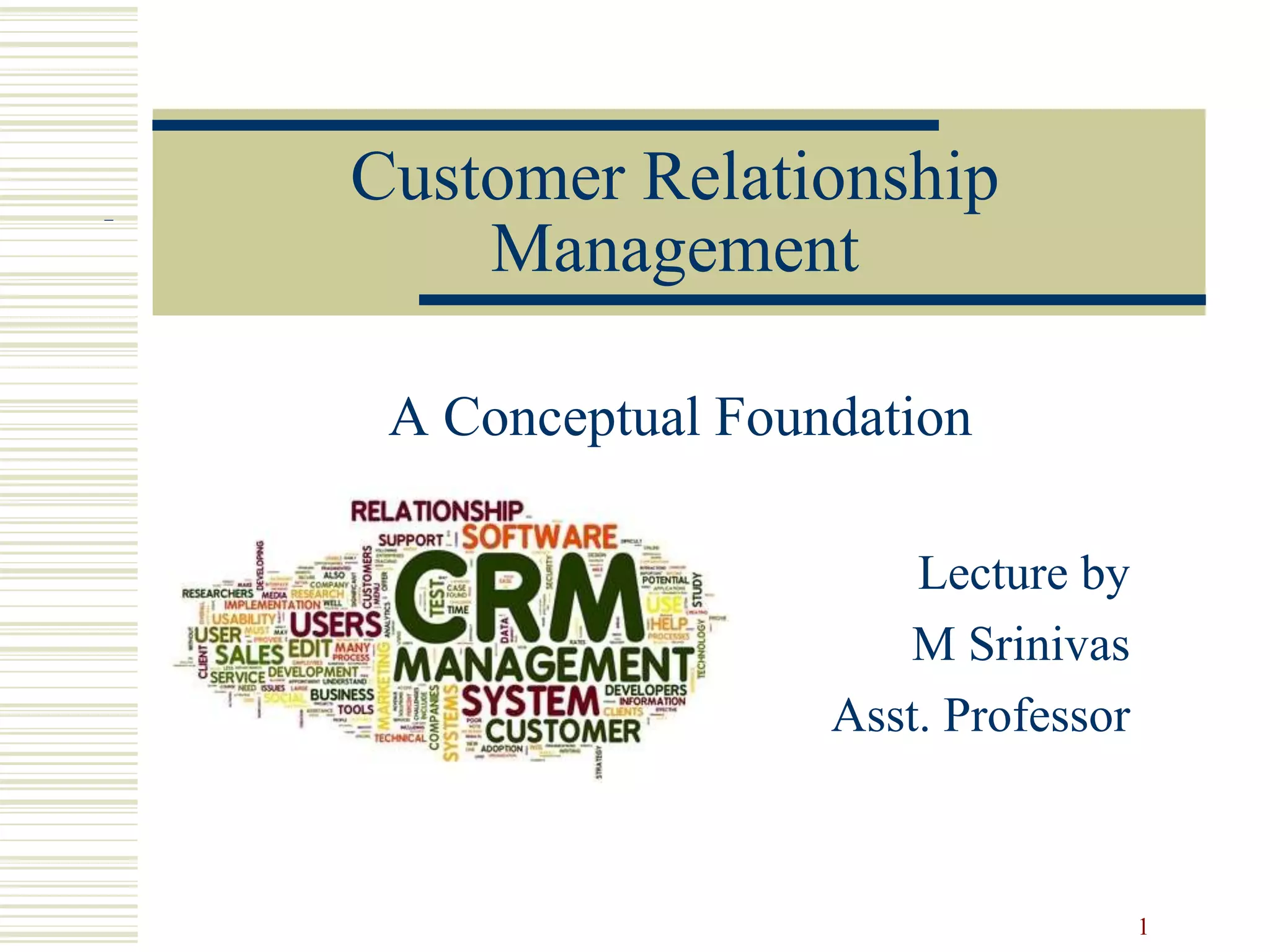
Customer Relationship
Management
A Conceptual Foundation
Lecture by
M Srinivas
Asst. Professor
2
Learning Objectives
After completion of this chapter, you will be able to:
 Acquire the conceptual understanding of the CRM.
 Identify the Stakeholders in CRM practices.
 Apprehend the advantages accruing to the organization on
the account of the successful CRM Practice.
There is only one boss; the customer. And
he can fire everybody in the company, from
the chairman on down, simply by spending
his money somewhere else.
- Sam Walton: Founder, Walmart Stores
3
Introduction to CRM
 Introduction to CRM – Relationships
 Developing close, cooperative relationship
with customers is more important in the
current era of intense competition and
demanding customers than it has been ever
before.
4
CRM: A Historical Perspective
 CRM often considered as database marketing
primarily linking marketing of the
organization with the database of the
customers. Some theories have been
considering it an exercise for customer
retention as many theories and studies have
been emphasizing on the rationale for
keeping customer.
5
Strategic Orientation in
Marketing
 McKenna (1991) emphasized on strategic
orientation…….
 Berry (1995) focused on developing closer
relationship with the newly attracted
customers.

6
Definition of CRM
 CRM is comprehensive strategy and process of
acquiring, retaining and partnering with selective
customers to create superior value for the company
and for the customers. – (Parvatiyar and Sheth
2001)
 CRM is considered as strategic process oriented,
cross-functional and value creating for buyer and
seller and a means of achieving superior functional
performance. - (Lambert 2004)
7
 A CRM system is a combination of people,
process, and technology that seeks to provide
understanding of a company’s customer and
to support a business strategy to build long-
term , profitable relationship with customers.
( Shang and Feng Ko 2006)
 CRM is defined as an effective tool to
achieve the objectives such as satisfied and
loyal customers and increased market share.
(Shafia et al. 2011)
8
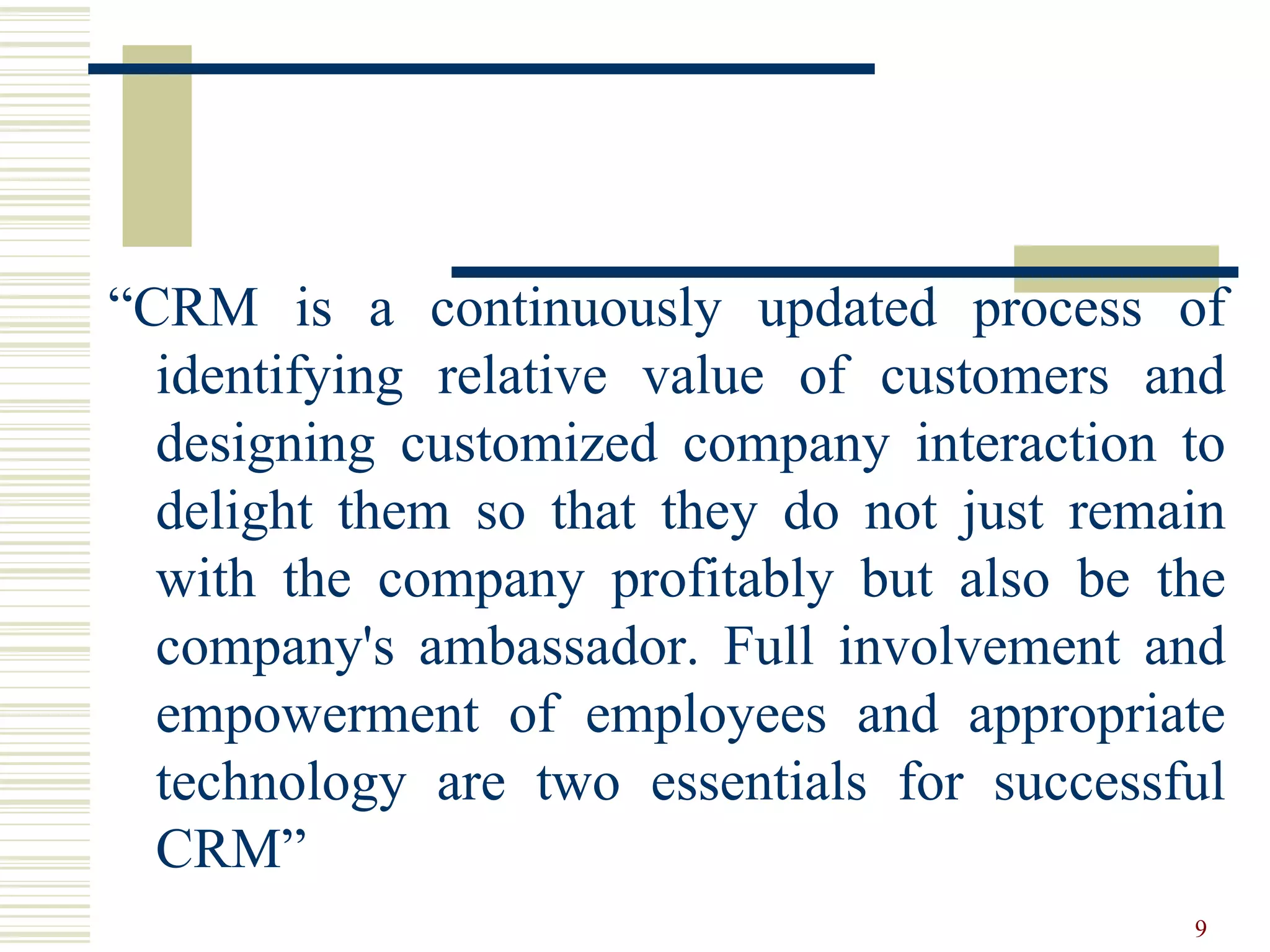
“CRM is a continuously updated process of
identifying relative value of customers and
designing customized company interaction to
delight them so that they do not just remain
with the company profitably but also be the
company's ambassador. Full involvement and
empowerment of employees and appropriate
technology are two essentials for successful
CRM”
9
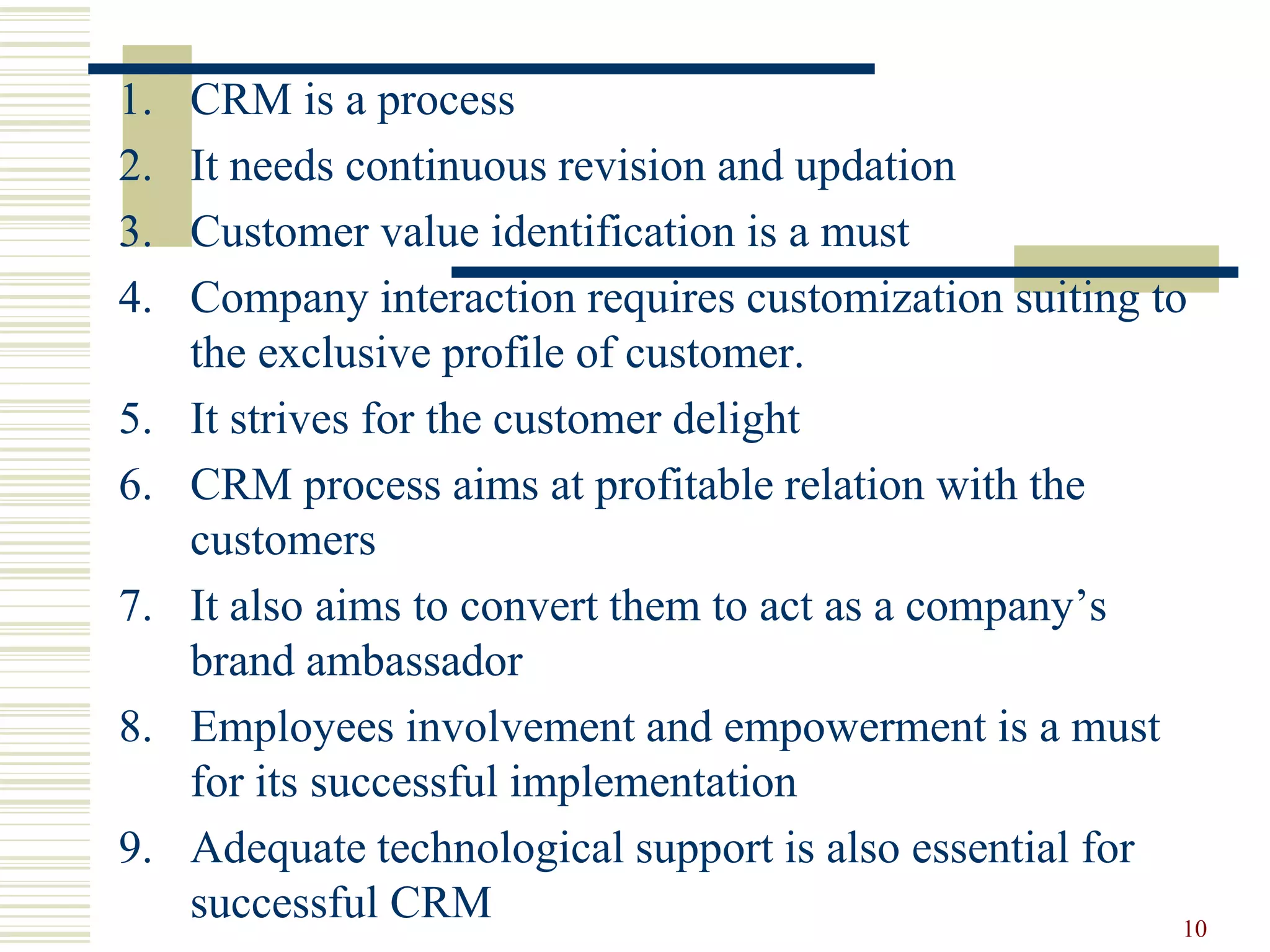
1. CRM is a process
2. It needs continuous revision and updation
3. Customer value identification is a must
4. Company interaction requires customization suiting to
the exclusive profile of customer.
5. It strives for the customer delight
6. CRM process aims at profitable relation with the
customers
7. It also aims to convert them to act as a company’s
brand ambassador
8. Employees involvement and empowerment is a must
for its successful implementation
9. Adequate technological support is also essential for
successful CRM 10
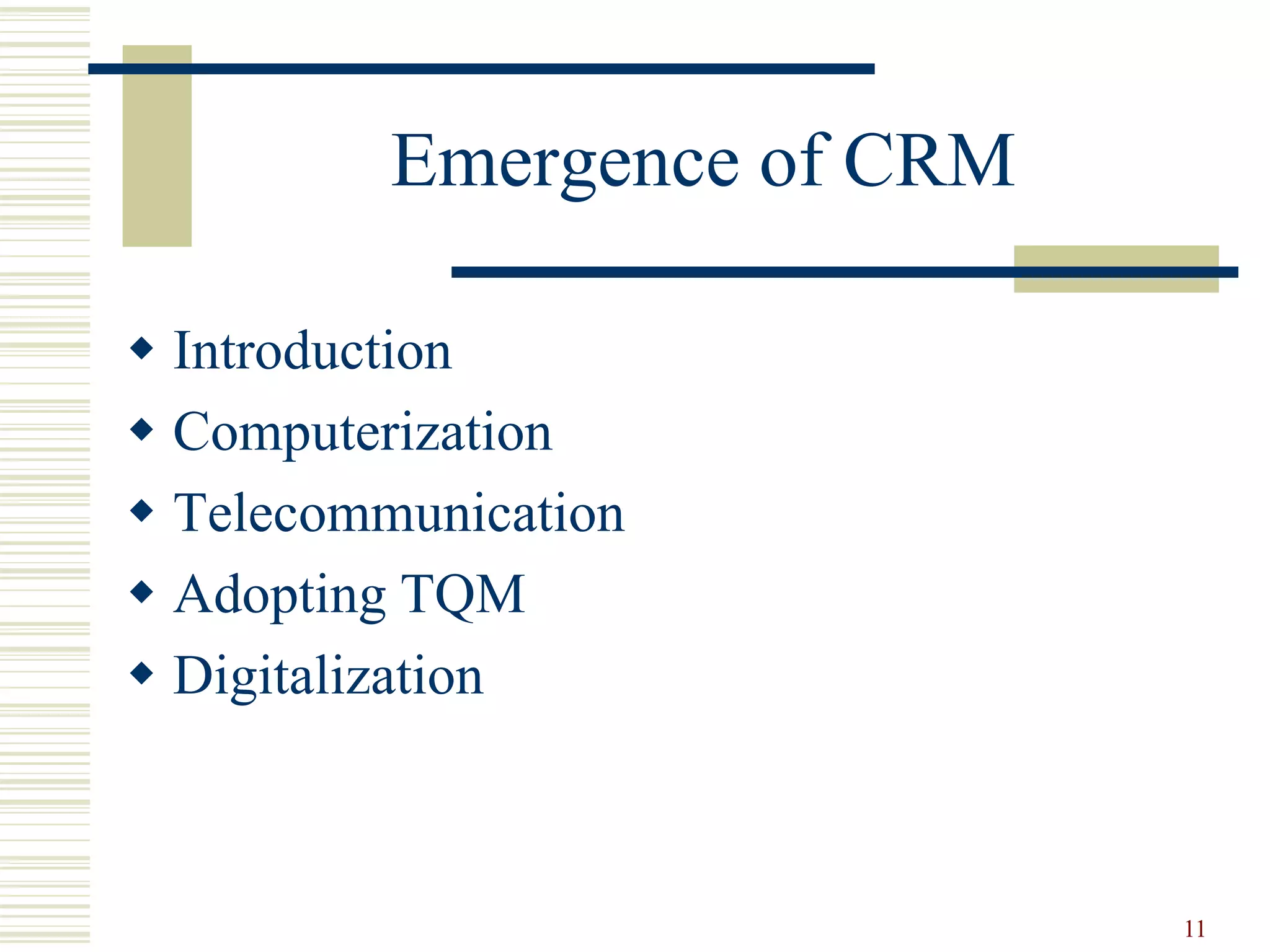
Emergence of CRM
 Introduction
 Computerization
 Telecommunication
 Adopting TQM
 Digitalization
11
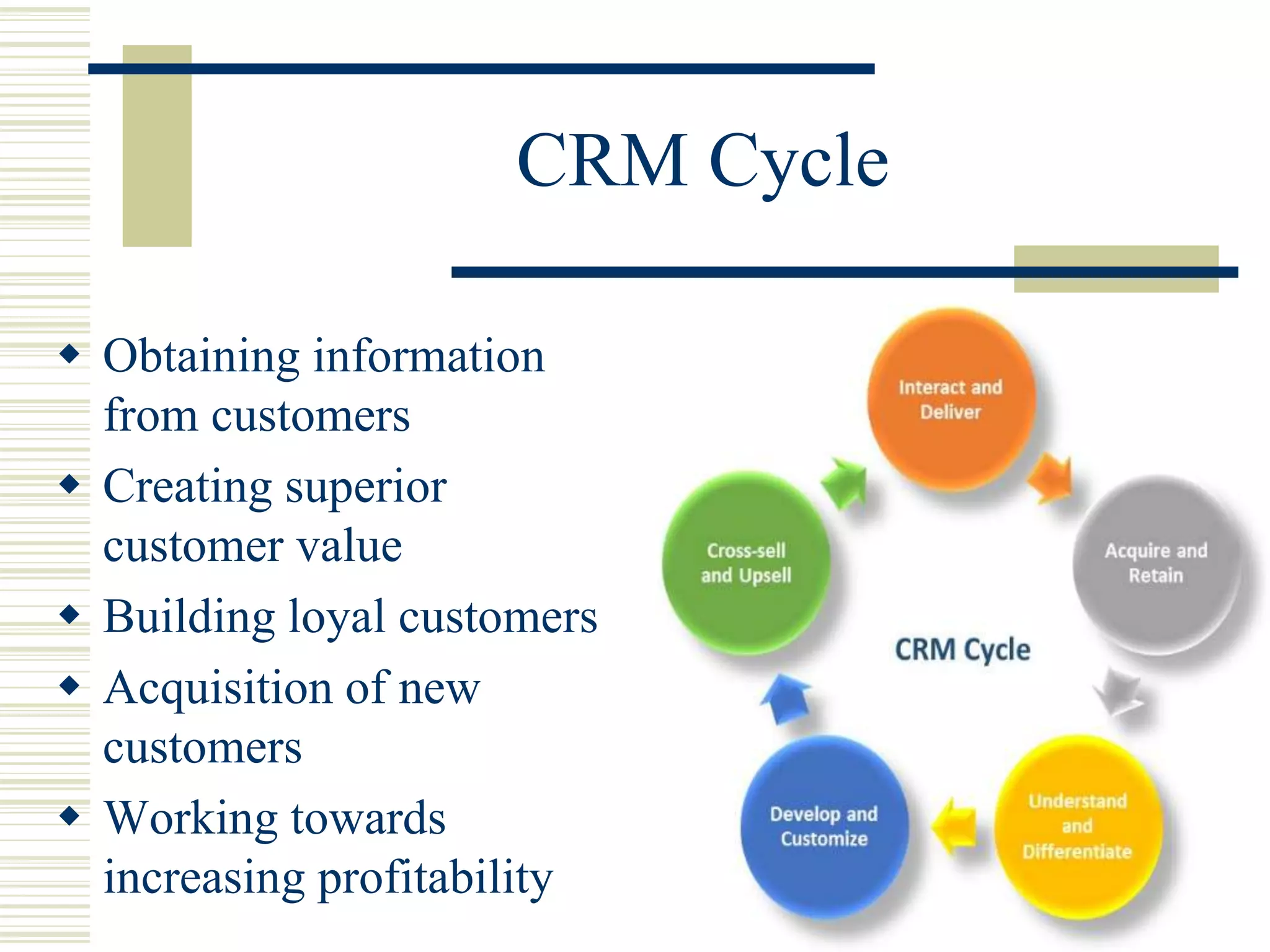
CRM Cycle
 Obtaining information
from customers
 Creating superior
customer value
 Building loyal customers
 Acquisition of new
customers
 Working towards
increasing profitability
12
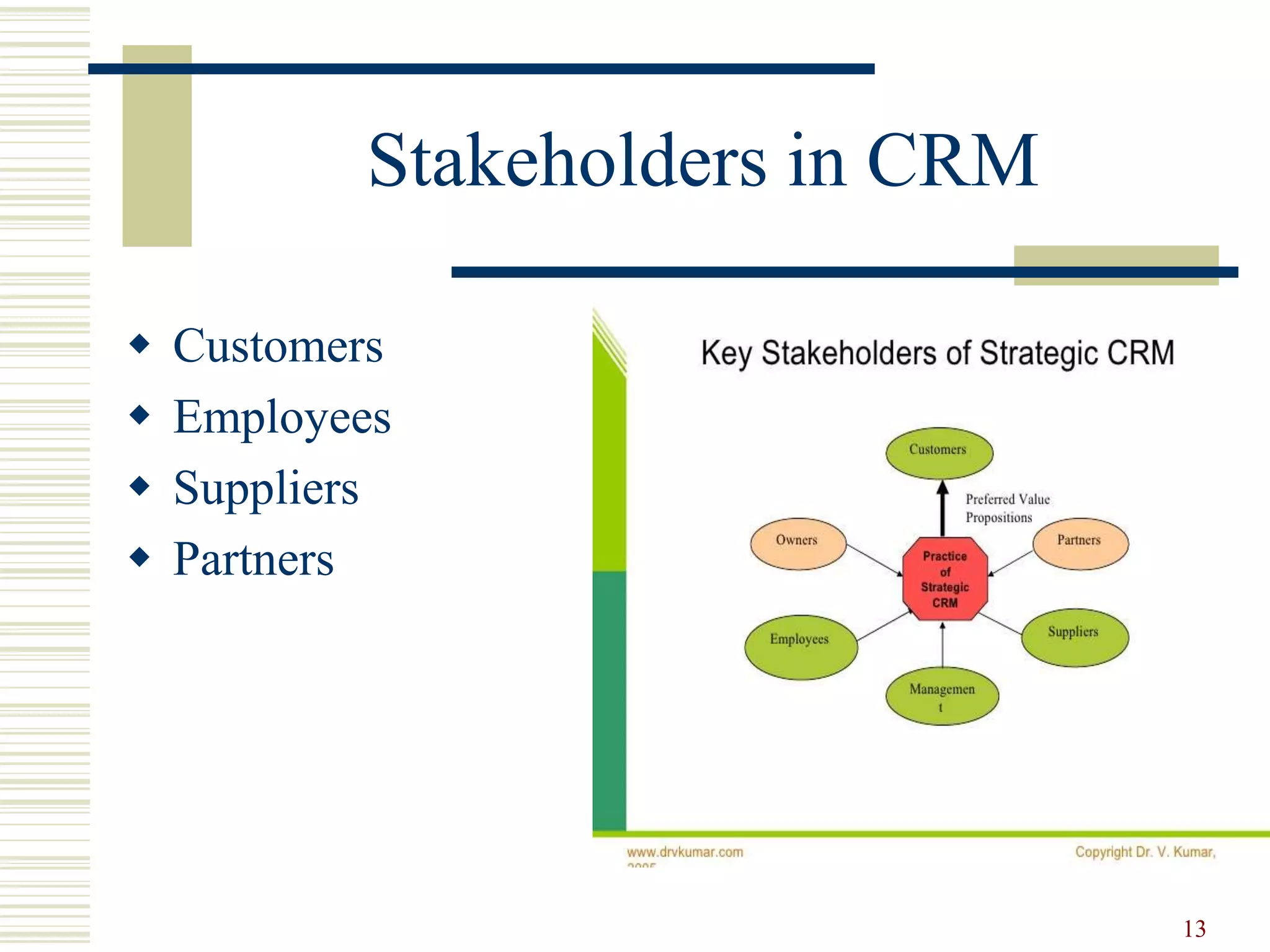
Stakeholders in CRM
 Customers
 Employees
 Suppliers
 Partners
13
Significance of CRM
 Perpetual stream of
revenue
 Positive referral creation
 Provides premium
 Helps customer retention
 Lowers cost of sale
 Helps understanding
customer behaviour
 Provides opportunity to
cross-sell and up-sell
 Reduces marketing time
 Channel cost
rationalization
 Enables business
process re-engineering
14
15
Case Study

CRM Introduction

  • 1.
    1 Customer Relationship Management A ConceptualFoundation Lecture by M Srinivas Asst. Professor
  • 2.
    2 Learning Objectives After completionof this chapter, you will be able to:  Acquire the conceptual understanding of the CRM.  Identify the Stakeholders in CRM practices.  Apprehend the advantages accruing to the organization on the account of the successful CRM Practice.
  • 3.
    There is onlyone boss; the customer. And he can fire everybody in the company, from the chairman on down, simply by spending his money somewhere else. - Sam Walton: Founder, Walmart Stores 3
  • 4.
    Introduction to CRM Introduction to CRM – Relationships  Developing close, cooperative relationship with customers is more important in the current era of intense competition and demanding customers than it has been ever before. 4
  • 5.
    CRM: A HistoricalPerspective  CRM often considered as database marketing primarily linking marketing of the organization with the database of the customers. Some theories have been considering it an exercise for customer retention as many theories and studies have been emphasizing on the rationale for keeping customer. 5
  • 6.
    Strategic Orientation in Marketing McKenna (1991) emphasized on strategic orientation…….  Berry (1995) focused on developing closer relationship with the newly attracted customers.  6
  • 7.
    Definition of CRM CRM is comprehensive strategy and process of acquiring, retaining and partnering with selective customers to create superior value for the company and for the customers. – (Parvatiyar and Sheth 2001)  CRM is considered as strategic process oriented, cross-functional and value creating for buyer and seller and a means of achieving superior functional performance. - (Lambert 2004) 7
  • 8.
     A CRMsystem is a combination of people, process, and technology that seeks to provide understanding of a company’s customer and to support a business strategy to build long- term , profitable relationship with customers. ( Shang and Feng Ko 2006)  CRM is defined as an effective tool to achieve the objectives such as satisfied and loyal customers and increased market share. (Shafia et al. 2011) 8
  • 9.
    “CRM is acontinuously updated process of identifying relative value of customers and designing customized company interaction to delight them so that they do not just remain with the company profitably but also be the company's ambassador. Full involvement and empowerment of employees and appropriate technology are two essentials for successful CRM” 9
  • 10.
    1. CRM isa process 2. It needs continuous revision and updation 3. Customer value identification is a must 4. Company interaction requires customization suiting to the exclusive profile of customer. 5. It strives for the customer delight 6. CRM process aims at profitable relation with the customers 7. It also aims to convert them to act as a company’s brand ambassador 8. Employees involvement and empowerment is a must for its successful implementation 9. Adequate technological support is also essential for successful CRM 10
  • 11.
    Emergence of CRM Introduction  Computerization  Telecommunication  Adopting TQM  Digitalization 11
  • 12.
    CRM Cycle  Obtaininginformation from customers  Creating superior customer value  Building loyal customers  Acquisition of new customers  Working towards increasing profitability 12
  • 13.
    Stakeholders in CRM Customers  Employees  Suppliers  Partners 13
  • 14.
    Significance of CRM Perpetual stream of revenue  Positive referral creation  Provides premium  Helps customer retention  Lowers cost of sale  Helps understanding customer behaviour  Provides opportunity to cross-sell and up-sell  Reduces marketing time  Channel cost rationalization  Enables business process re-engineering 14
  • 15.