Trial balance
Made by:
Shruti
What is trial balance?
A bookkeeping worksheet in which
the balances of all ledgers are
compiled into debit and credit
columns. A company prepares a trial
balance periodically, usually at the
end of every reporting period. The
general purpose of producing a trial
balance is to ensure the entries in a
company's bookkeeping system are
mathematically correct.
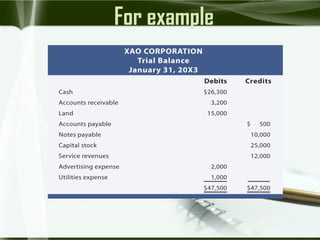
For example
Purpose of trial balance !
 Trial Balance acts as the first step in
the preparation of financial
statements. It is a working paper that
accountants use as a basis while
preparing financial statements.
 Trial balance ensures that the account
balances are accurately extracted
from accounting ledgers.
 Trail balance assists in the
identification and rectification of
errors.
 Trial balance ensures that for every debit
entry recorded, a corresponding credit
entry has been recorded in the books in
accordance with the double entry concept
of accounting. If the totals of the trial
balance do not agree, the differences may
be investigated and resolved before
financial statements are prepared.
Rectifying basic accounting errors can be
a much lengthy task after the financial
statements have been prepared because
of the changes that would be required to
correct the financial statements.
Features of trial balance!
 It is a list of balance of ledger accounts and
cash book.
 It is not a part of the double entry system of
book keeping. It is a result of double entry
system of book keeping. It is only a working
paper.
 It can be prepared on any date.
 It verifies the arithmetical accuracy of posting
of entries from the journal to the ledger.
 It is not a conclusive proof of the accuracy of
the books of accounts since some errors are
not disclosed by the trial balance.
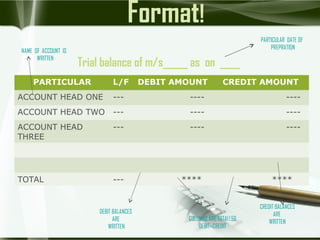
Format!
NAME OF ACCOUNT IS
WRITTEN

PARTICULAR DATE OF
PREPRATION

Trial balance of m/s_____ as on ____

PARTICULAR

L/F

DEBIT AMOUNT

CREDIT AMOUNT

ACCOUNT HEAD ONE

---

----

----

ACCOUNT HEAD TWO

---

----

----

ACCOUNT HEAD
THREE

---

----

----

TOTAL

---

DEBIT BALANCES
ARE
WRITTEN

****

COLUMNS ARE TOTALLED
DEBIT=CREDIT

****
CREDIT BALANCES
ARE
WRITTEN
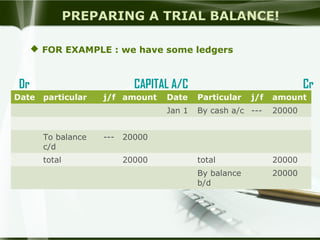
PREPARING A TRIAL BALANCE!
 FOR EXAMPLE : we have some ledgers

Dr
Date

CAPITAL A/C
particular

total

---

Date

Particular

Jan 1
To balance
c/d

j/f amount

Cr
j/f

amount

By cash a/c ---

20000

total

20000

By balance
b/d

20000

20000
20000
Dr

CASH A/C

Cr

Date

Particular

j/f

Amount Date Particular j/f

Jan 1

To capital
a/c

----

amount

20000
By balance ---c/d

total
To balance
b/d

----

20000
20000

20000

total

20000

----
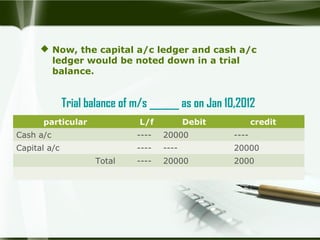
 Now, the capital a/c ledger and cash a/c
ledger would be noted down in a trial
balance.

Trial balance of m/s ______ as on Jan 10,2012
particular

L/f

Debit

credit

Cash a/c

----

20000

----

Capital a/c

----

----

20000

----

20000

2000

Total
Limitations!
 Trial Balance only confirms that the total of
all debit balances match the total of all credit
balances. Trial balance totals may agree in
spite of errors. An example would be an
incorrect debit entry being offset by an equal
credit entry. Likewise, a trial balance gives no
proof that certain transactions have not been
recorded at all because in such case, both
debit and credit sides of a transaction would
be omitted causing the trial balance totals to
still agree. Types of accounting errors and
their effect on trial balance are more fully
discussed in the section on Suspense
Accounts.
trial balance

trial balance

  • 1.
  • 2.
    What is trialbalance? A bookkeeping worksheet in which the balances of all ledgers are compiled into debit and credit columns. A company prepares a trial balance periodically, usually at the end of every reporting period. The general purpose of producing a trial balance is to ensure the entries in a company's bookkeeping system are mathematically correct.
  • 3.
  • 4.
    Purpose of trialbalance !  Trial Balance acts as the first step in the preparation of financial statements. It is a working paper that accountants use as a basis while preparing financial statements.  Trial balance ensures that the account balances are accurately extracted from accounting ledgers.  Trail balance assists in the identification and rectification of errors.
  • 5.
     Trial balanceensures that for every debit entry recorded, a corresponding credit entry has been recorded in the books in accordance with the double entry concept of accounting. If the totals of the trial balance do not agree, the differences may be investigated and resolved before financial statements are prepared. Rectifying basic accounting errors can be a much lengthy task after the financial statements have been prepared because of the changes that would be required to correct the financial statements.
  • 6.
    Features of trialbalance!  It is a list of balance of ledger accounts and cash book.  It is not a part of the double entry system of book keeping. It is a result of double entry system of book keeping. It is only a working paper.  It can be prepared on any date.  It verifies the arithmetical accuracy of posting of entries from the journal to the ledger.  It is not a conclusive proof of the accuracy of the books of accounts since some errors are not disclosed by the trial balance.
  • 7.
    Format! NAME OF ACCOUNTIS WRITTEN PARTICULAR DATE OF PREPRATION Trial balance of m/s_____ as on ____ PARTICULAR L/F DEBIT AMOUNT CREDIT AMOUNT ACCOUNT HEAD ONE --- ---- ---- ACCOUNT HEAD TWO --- ---- ---- ACCOUNT HEAD THREE --- ---- ---- TOTAL --- DEBIT BALANCES ARE WRITTEN **** COLUMNS ARE TOTALLED DEBIT=CREDIT **** CREDIT BALANCES ARE WRITTEN
  • 8.
    PREPARING A TRIALBALANCE!  FOR EXAMPLE : we have some ledgers Dr Date CAPITAL A/C particular total --- Date Particular Jan 1 To balance c/d j/f amount Cr j/f amount By cash a/c --- 20000 total 20000 By balance b/d 20000 20000 20000
  • 9.
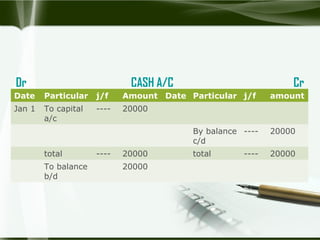
    Dr CASH A/C Cr Date Particular j/f Amount DateParticular j/f Jan 1 To capital a/c ---- amount 20000 By balance ---c/d total To balance b/d ---- 20000 20000 20000 total 20000 ----
  • 10.
     Now, thecapital a/c ledger and cash a/c ledger would be noted down in a trial balance. Trial balance of m/s ______ as on Jan 10,2012 particular L/f Debit credit Cash a/c ---- 20000 ---- Capital a/c ---- ---- 20000 ---- 20000 2000 Total
  • 11.
    Limitations!  Trial Balanceonly confirms that the total of all debit balances match the total of all credit balances. Trial balance totals may agree in spite of errors. An example would be an incorrect debit entry being offset by an equal credit entry. Likewise, a trial balance gives no proof that certain transactions have not been recorded at all because in such case, both debit and credit sides of a transaction would be omitted causing the trial balance totals to still agree. Types of accounting errors and their effect on trial balance are more fully discussed in the section on Suspense Accounts.