Lecture By: Srinivas Methuku.
 In narrow sense: currency and generally
accepted equivalents of cash like cheques,
drafts etc.
 In broad sense: includes near-cash assets, such
as marketable securities and time deposits in
banks.
 They can be readily sold and converted into cash.
 Can serve as a reserve pool of liquidity.
 Also provide short term investment outlet for excess
cash.
 Cash management is concerned with the
managing of:
 cash flows into and out of the firm,
 cash flows within the firm, and
 cash balances held by the firm at a point of time by
financing deficit or investing surplus cash
 Cash planning
 Managing the cash flows
 Optimum cash level
 Investing surplus cash
 Transaction motive
 Precautionary motive
 Speculative motive
 Compensating motive
 Holding of cash to meet routine cash
requirements to finance the transactions which
a firm carries on in the ordinary course of
business.
 Cash is held to pay for goods or services. It is
useful for conducting our everyday
transactions or purchases.
• The cash balances held in reserve for random
and unforeseen fluctuations in cash flows.
• A cushion to meet unexpected contingencies.
– Floods, strikes and failure of imp customers
– Unexpected slowdown in collection of accounts receivable
– Sharp increase in cost of raw materials
– Cancellation of some order of goods
• Defensive in nature
 Is a motive for holding cash/near-cash to
quickly take advantage of opportunities
typically outside the normal course of business.
 Positive and aggressive approach
 Helps to take advantage of:
 An opportunity to purchase raw materials at
reduced price
 Make purchase at favorable prices
 Delay purchase on anticipation of decline in prices
 Buying securities when interest rate is expected to
decline
 Is a motive for holding cash/near-cash to
compensate banks for providing certain
services or loans.
 Clients are supposed to maintain a minimum
balance of cash at the bank which they cannot
use themselves.
• Meeting payments schedule
– It prevents insolvency
– relationship with bank is not constrained
– Helps in fostering good relationships
– Cash discount can be availed
– Strong credit rating
– Take advantage of business opportunities
– Can meet unanticipated cash expenditure with a minimum
of strain.
• Minimizing funds committed to cash balances
– High level of cash: large funds remain idle
– Low level of cash: failure to meet payment schedule
1. Synchronization of cash needs
2. Short costs:
i. Transaction costs
ii. Borrowing costs
iii. Loss on cash discount
iv. Cost associated with deterioration of the credit
v. Penalty rates
3. Excess cash balance costs
4. Procurement and Management
5. Uncertainty and Management
 Accelerating Cash Collections
 Controlling Disbursements
1. Decentralised Collections
 Number of collection centres
 Collection centres will collect cheques from
customers and deposit in their local bank
accounts
 They will deposit the funds to a central bank
1. Lock-box System
 Collection centers are established considering the
customer locations and volume of remittances
 At each centre the firm hires a post office box
 Remittances are directly picked from the bank
whom the firm gives the authority
Advantages of lock-box system are:
 Cheques are deposited immediately upon receipt
of remittances
 Eliminates the period between the time cheques
are received by the firm and the time they are
deposited in the bank for collection
It means delay the payments as much as possible. Can
help the firm in conserving cash and reducing the
financial requirements.
Disbursement or Payment Float
 How quickly and cheaply a organization can raise cash
when needed.
 How accurately managers can predict cash
requirements.
Cash budget helps in this .
 How much precautionary cash the managers need for
emergencies.
• Availability of (short-term) investment opportunities
– e.g. money market funds, CDs, commercial paper
• Expected return on investment opportunities.
– e.g. If expected returns are high, organizations
should be quick to invest excess cash
• Transaction cost of withdrawing cash and making an
investment
• Demand for Cash for daily transactions
 A number of mathematical model have been to
develop to determined the optimal cash
balance.
 Two of such model are as follow;
a) William J. Baumol's inventory model
b) M. H. Miller and Daniel Orr’s Stochastic
model
Baumol’s model of cash management-
Trades off between opportunity cost or carrying
cost or holding cost & the transaction cost. As
such firm attempts to minimize the sum of the
holding cash & the cost of converting marketable
securities in to cash.
 Helps in determining a firm's optimum cash
balance under certainty
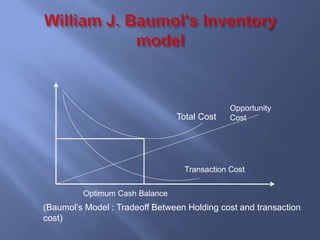
Total Cost
Opportunity
Cost
Transaction Cost
Optimum Cash Balance
(Baumol’s Model : Tradeoff Between Holding cost and transaction
cost)
Assumptions
 Cash needs of the firm is known with certainty
 Cash Disbursement over a period of time is
known with certainty
 Opportunity cost of holding cash is known and
remains constant
 Transaction cost of converting securities into
cash is known and remains constant
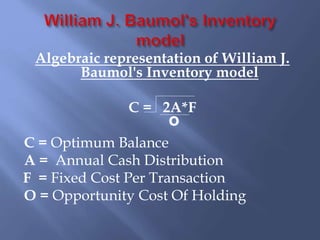
Algebraic representation of William J.
Baumol's Inventory model
C = 2A*F
C = Optimum Balance
A = Annual Cash Distribution
F = Fixed Cost Per Transaction
O = Opportunity Cost Of Holding
o
Uses
The Baumol’s model enables companies to find
out their desirable level of cash balance under
certainty. The Baumol’s model of cash
management theory relies on the tradeoff between
the liquidity provided by holding money (the
ability to carry out transactions) and the interest
foregone by holding one's assets in the form of
non-interest bearing money. The key variables of
the demand for money are then the nominal
interest rate, the level of real income which
corresponds to the amount of desired transactions
and to a fixed cost of transferring one's wealth
between liquid money and interest bearing assets
Evaluation of the model
 Helpful in determining optimum level of Cash
holding
 Facilitates the finance manager to minimize
Carrying cost and Maintain Cash
 Indicates idle cash Balance Gainful
employment
 Applicable only in a situation of certainty in
other words this model is deterministic model
Overview
 The Miller and Orr model of cash management
is one of the various cash management models in
operation. It is an important cash management
model as well. It helps the present day
companies to manage their cash while taking
into consideration the fluctuations in daily cash
flow.
Description
 As per the Miller and Orr
model of cash management the
companies let their cash
balance move within two limits
a) Upper Control limit
b) Lower Control Limit
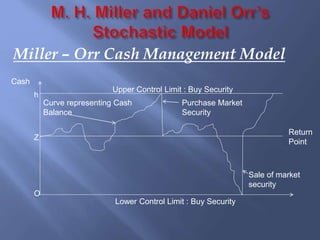
Miller – Orr Cash Management Model
Upper Control Limit : Buy Security
Curve representing Cash
Balance
Purchase Market
Security
Sale of market
security
Return
Point
Lower Control Limit : Buy Security
Cash
h
Z
O
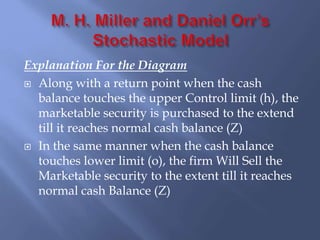
Explanation For the Diagram
 Along with a return point when the cash
balance touches the upper Control limit (h), the
marketable security is purchased to the extend
till it reaches normal cash balance (Z)
 In the same manner when the cash balance
touches lower limit (o), the firm Will Sell the
Marketable security to the extent till it reaches
normal cash Balance (Z)
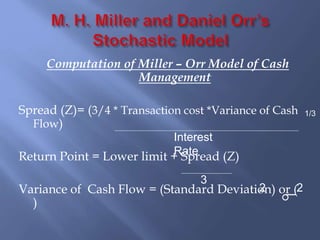
Computation of Miller – Orr Model of Cash
Management
Spread (Z)= (3/4 * Transaction cost *Variance of Cash
Flow)
Return Point = Lower limit + Spread (Z)
Variance of Cash Flow = (Standard Deviation) or (
)
1/3
Interest
Rate
3
22
Benefits
 Allows for net cash flow in a random fashion.
 transfer can take place at any time and are
instantaneous with a fixed transfer cost.
 Produce control limit can be used as basis for
balance management
Limitations
 May prove difficult to calculate.
 Monitoring needs to be calculated
for the organizations benefits
becomes a tedious Work.
Application
 Finding out the approximate prices at
which the salable securities could be
sold or bought
 Deciding the minimum possible levels
of desired cash balance
 Checking the rate of interest
 Calculating the SD (Standard Deviation)
of regular cash flows
Evaluation of the Model
 This Stochastic model can be employed even in
extreme uncertainty
 When the cash flow fluctuate violently in short
period it will give optimal result
 Finance Manager can apply this model in
highly unpredictable situation
Cash management

Cash management

  • 1.
  • 3.
     In narrowsense: currency and generally accepted equivalents of cash like cheques, drafts etc.  In broad sense: includes near-cash assets, such as marketable securities and time deposits in banks.  They can be readily sold and converted into cash.  Can serve as a reserve pool of liquidity.  Also provide short term investment outlet for excess cash.
  • 4.
     Cash managementis concerned with the managing of:  cash flows into and out of the firm,  cash flows within the firm, and  cash balances held by the firm at a point of time by financing deficit or investing surplus cash
  • 5.
     Cash planning Managing the cash flows  Optimum cash level  Investing surplus cash
  • 6.
     Transaction motive Precautionary motive  Speculative motive  Compensating motive
  • 7.
     Holding ofcash to meet routine cash requirements to finance the transactions which a firm carries on in the ordinary course of business.  Cash is held to pay for goods or services. It is useful for conducting our everyday transactions or purchases.
  • 8.
    • The cashbalances held in reserve for random and unforeseen fluctuations in cash flows. • A cushion to meet unexpected contingencies. – Floods, strikes and failure of imp customers – Unexpected slowdown in collection of accounts receivable – Sharp increase in cost of raw materials – Cancellation of some order of goods • Defensive in nature
  • 9.
     Is amotive for holding cash/near-cash to quickly take advantage of opportunities typically outside the normal course of business.  Positive and aggressive approach  Helps to take advantage of:  An opportunity to purchase raw materials at reduced price  Make purchase at favorable prices  Delay purchase on anticipation of decline in prices  Buying securities when interest rate is expected to decline
  • 10.
     Is amotive for holding cash/near-cash to compensate banks for providing certain services or loans.  Clients are supposed to maintain a minimum balance of cash at the bank which they cannot use themselves.
  • 11.
    • Meeting paymentsschedule – It prevents insolvency – relationship with bank is not constrained – Helps in fostering good relationships – Cash discount can be availed – Strong credit rating – Take advantage of business opportunities – Can meet unanticipated cash expenditure with a minimum of strain. • Minimizing funds committed to cash balances – High level of cash: large funds remain idle – Low level of cash: failure to meet payment schedule
  • 12.
    1. Synchronization ofcash needs 2. Short costs: i. Transaction costs ii. Borrowing costs iii. Loss on cash discount iv. Cost associated with deterioration of the credit v. Penalty rates 3. Excess cash balance costs 4. Procurement and Management 5. Uncertainty and Management
  • 13.
     Accelerating CashCollections  Controlling Disbursements
  • 14.
    1. Decentralised Collections Number of collection centres  Collection centres will collect cheques from customers and deposit in their local bank accounts  They will deposit the funds to a central bank
  • 15.
    1. Lock-box System Collection centers are established considering the customer locations and volume of remittances  At each centre the firm hires a post office box  Remittances are directly picked from the bank whom the firm gives the authority Advantages of lock-box system are:  Cheques are deposited immediately upon receipt of remittances  Eliminates the period between the time cheques are received by the firm and the time they are deposited in the bank for collection
  • 16.
    It means delaythe payments as much as possible. Can help the firm in conserving cash and reducing the financial requirements. Disbursement or Payment Float
  • 17.
     How quicklyand cheaply a organization can raise cash when needed.  How accurately managers can predict cash requirements. Cash budget helps in this .  How much precautionary cash the managers need for emergencies.
  • 18.
    • Availability of(short-term) investment opportunities – e.g. money market funds, CDs, commercial paper • Expected return on investment opportunities. – e.g. If expected returns are high, organizations should be quick to invest excess cash • Transaction cost of withdrawing cash and making an investment • Demand for Cash for daily transactions
  • 20.
     A numberof mathematical model have been to develop to determined the optimal cash balance.  Two of such model are as follow; a) William J. Baumol's inventory model b) M. H. Miller and Daniel Orr’s Stochastic model
  • 21.
    Baumol’s model ofcash management- Trades off between opportunity cost or carrying cost or holding cost & the transaction cost. As such firm attempts to minimize the sum of the holding cash & the cost of converting marketable securities in to cash.  Helps in determining a firm's optimum cash balance under certainty
  • 22.
    Total Cost Opportunity Cost Transaction Cost OptimumCash Balance (Baumol’s Model : Tradeoff Between Holding cost and transaction cost)
  • 23.
    Assumptions  Cash needsof the firm is known with certainty  Cash Disbursement over a period of time is known with certainty  Opportunity cost of holding cash is known and remains constant  Transaction cost of converting securities into cash is known and remains constant
  • 24.
    Algebraic representation ofWilliam J. Baumol's Inventory model C = 2A*F C = Optimum Balance A = Annual Cash Distribution F = Fixed Cost Per Transaction O = Opportunity Cost Of Holding o
  • 25.
    Uses The Baumol’s modelenables companies to find out their desirable level of cash balance under certainty. The Baumol’s model of cash management theory relies on the tradeoff between the liquidity provided by holding money (the ability to carry out transactions) and the interest foregone by holding one's assets in the form of non-interest bearing money. The key variables of the demand for money are then the nominal interest rate, the level of real income which corresponds to the amount of desired transactions and to a fixed cost of transferring one's wealth between liquid money and interest bearing assets
  • 26.
    Evaluation of themodel  Helpful in determining optimum level of Cash holding  Facilitates the finance manager to minimize Carrying cost and Maintain Cash  Indicates idle cash Balance Gainful employment  Applicable only in a situation of certainty in other words this model is deterministic model
  • 27.
    Overview  The Millerand Orr model of cash management is one of the various cash management models in operation. It is an important cash management model as well. It helps the present day companies to manage their cash while taking into consideration the fluctuations in daily cash flow.
  • 28.
    Description  As perthe Miller and Orr model of cash management the companies let their cash balance move within two limits a) Upper Control limit b) Lower Control Limit
  • 29.
    Miller – OrrCash Management Model Upper Control Limit : Buy Security Curve representing Cash Balance Purchase Market Security Sale of market security Return Point Lower Control Limit : Buy Security Cash h Z O
  • 30.
    Explanation For theDiagram  Along with a return point when the cash balance touches the upper Control limit (h), the marketable security is purchased to the extend till it reaches normal cash balance (Z)  In the same manner when the cash balance touches lower limit (o), the firm Will Sell the Marketable security to the extent till it reaches normal cash Balance (Z)
  • 31.
    Computation of Miller– Orr Model of Cash Management Spread (Z)= (3/4 * Transaction cost *Variance of Cash Flow) Return Point = Lower limit + Spread (Z) Variance of Cash Flow = (Standard Deviation) or ( ) 1/3 Interest Rate 3 22
  • 32.
    Benefits  Allows fornet cash flow in a random fashion.  transfer can take place at any time and are instantaneous with a fixed transfer cost.  Produce control limit can be used as basis for balance management
  • 33.
    Limitations  May provedifficult to calculate.  Monitoring needs to be calculated for the organizations benefits becomes a tedious Work.
  • 34.
    Application  Finding outthe approximate prices at which the salable securities could be sold or bought  Deciding the minimum possible levels of desired cash balance  Checking the rate of interest  Calculating the SD (Standard Deviation) of regular cash flows
  • 35.
    Evaluation of theModel  This Stochastic model can be employed even in extreme uncertainty  When the cash flow fluctuate violently in short period it will give optimal result  Finance Manager can apply this model in highly unpredictable situation