Financial
Accounting
Meaning of Accounting
It istheprocessof identifying,
measuring, recording,
classifying, summarising,
analysing, interpreting and
communicating theeconomic
information of an organisation
to itsuserswho need the
information for decision
making.
Definition of Accounting
“The art of recording, classifying and
summarizing in a significant manner
and in terms of money, transactions
and events, which are, in part at least,
of a financial character and
interpreting theresultsthereof”.
American Institute of Certified Public
Accountants (AICPA)
Functions orProcess of
Accounting
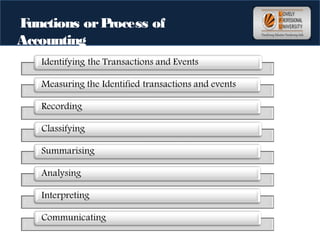
Identifying thetransaction or event
Accounting identifiestransactions
and eventsof aspecific entity. A
transaction isaexchangein which
each participant receiveor sacrifice
value.
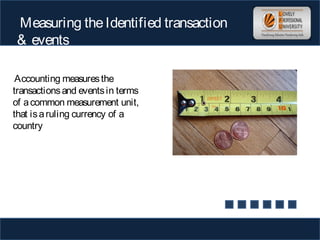
Measuring theIdentified transaction
& events
Accounting measuresthe
transactionsand eventsin terms
of acommon measurement unit,
that isaruling currency of a
country
Recording
Accounting isconcerned with the
recording of identified & measured
financial transactionsin an orderly
manner in theproper booksof
accountssoon after their occurrence.
 
Classifying
 
Accounting isconcerned with the
classification of recorded transactionsso
asto group thetransactionsof similar
typeat oneplace. Thisfunction is
performed by maintaining the ledger
in which different accountsareopened.
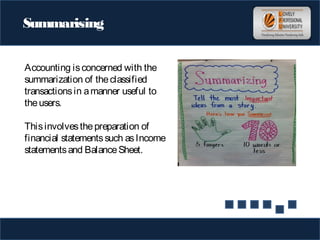
Summarising
Accounting isconcerned with the
summarization of theclassified
transactionsin amanner useful to
theusers.
Thisinvolvesthepreparation of
financial statementssuch asIncome
statementsand BalanceSheet.
Analysing
Accounting isconcerned with the
establishment of relationship
between thevariouselements
taken from theBalancesheet or
IncomeStatement or both.
Itspurposeisto identify the
financial strength or weaknessof
theenterprise
Interpreting
It isconcerned with explaining
themeaning and significanceof
therelationship so established by
theanalysis.
Theaccountantsshould interpret
thestatementsin amanner useful
to theusersso asto enablethe
usersto takereasonabledecisions
Communicating
Communication isconcerned with
thetransmission of summarized,
analysed and interpreted
information to theusersto enable
them to makereasonabledecisions.
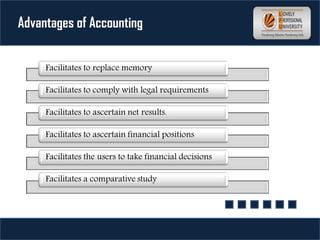
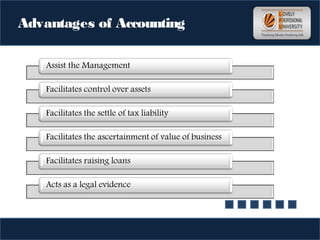
Advantages of Accounting
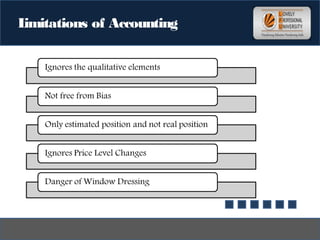
Limitations of Accounting
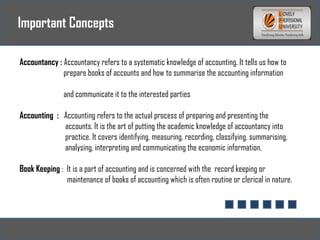
Important Concepts
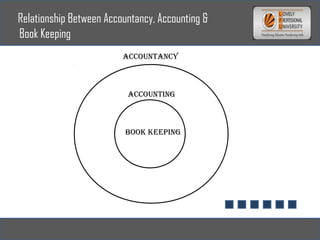
Accountancy : Accountancy refers to a systematic knowledge of accounting. It tells us how to
prepare books of accounts and how to summarise the accounting information
and communicate it to the interested parties
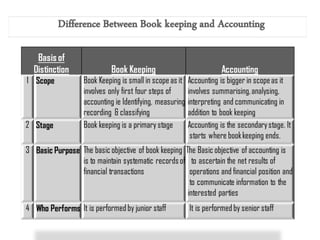
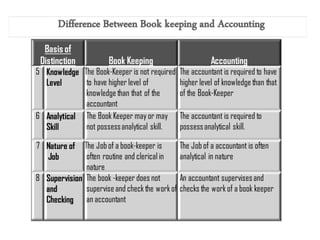
Accounting : Accounting refers to the actual process of preparing and presenting the
accounts. It is the art of putting the academic knowledge of accountancy into
practice. It covers identifying, measuring, recording, classifying, summarising,
analysing, interpreting and communicating the economic information.
Book Keeping : It is a part of accounting and is concerned with the record keeping or
maintenance of books of accounting which is often routine or clerical in nature.
Relationship Between Accountancy, Accounting &
Book Keeping
AccountAncy
Accounting
Book keeping
Trader
Trader
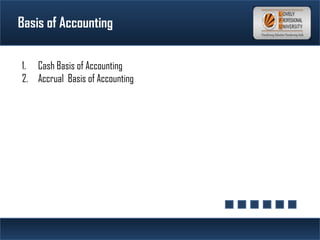
Basis of Accounting
1. Cash Basis of Accounting
2. Accrual Basis of Accounting
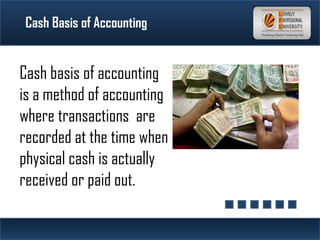
Cash Basis of Accounting
Cash basis of accounting
is a method of accounting
where transactions are
recorded at the time when
physical cash is actually
received or paid out.
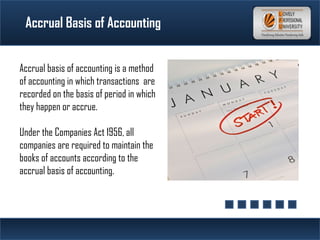
Accrual Basis of Accounting
Accrual basis of accounting is a method
of accounting in which transactions are
recorded on the basis of period in which
they happen or accrue.
Under the Companies Act 1956, all
companies are required to maintain the
books of accounts according to the
accrual basis of accounting.
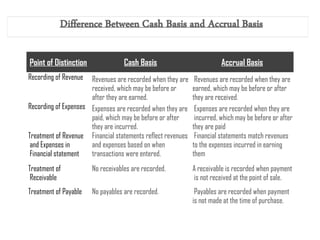
Point of Distinction Cash Basis Accrual Basis
Recording of Revenue Revenues are recorded when they are
received, which may be before or
after they are earned.
Revenues are recorded when they are
earned, which may be before or after
they are received.
Recording of Expenses Expenses are recorded when they are
paid, which may be before or after
they are incurred.
Expenses are recorded when they are
incurred, which may be before or after
they are paid
Treatment of Revenue
and Expenses in
Financial statement
Financial statements reflect revenues
and expenses based on when
transactions were entered.
Financial statements match revenues
to the expenses incurred in earning
them
Treatment of
Receivable
No receivables are recorded. A receivable is recorded when payment
is not received at the point of sale.
Treatment of Payable No payables are recorded. Payables are recorded when payment
is not made at the time of purchase.
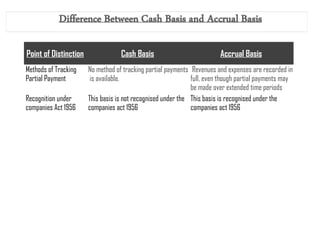
Point of Distinction Cash Basis Accrual Basis
Methods of Tracking
Partial Payment
No method of tracking partial payments
is available.
Revenues and expenses are recorded in
full, even though partial payments may
be made over extended time periods
Recognition under
companies Act 1956
This basis is not recognised under the
companies act 1956
This basis is recognised under the
companies act 1956
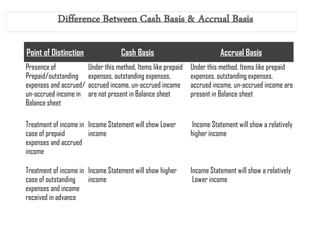
Point of Distinction Cash Basis Accrual Basis
Presence of
Prepaid/outstanding
expenses and accrued/
un-accrued income in
Balance sheet
Under this method, Items like prepaid
expenses, outstanding expenses,
accrued income, un-accrued income
are not present in Balance sheet
Under this method, Items like prepaid
expenses, outstanding expenses,
accrued income, un-accrued income are
present in Balance sheet
Treatment of income in
case of prepaid
expenses and accrued
income
Income Statement will show Lower
income
Income Statement will show a relatively
higher income
Treatment of income in
case of outstanding
expenses and income
received in advance
Income Statement will show higher
income
Income Statement will show a relatively
Lower income
Accounting Terms
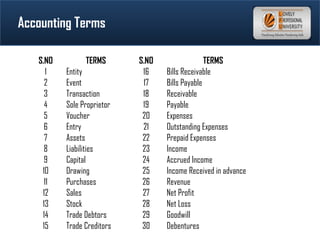
S.NO TERMS S.NO TERMS
1 Entity 16 Bills Receivable
2 Event 17 Bills Payable
3 Transaction 18 Receivable
4 Sole Proprietor 19 Payable
5 Voucher 20 Expenses
6 Entry 21 Outstanding Expenses
7 Assets 22 Prepaid Expenses
8 Liabilities 23 Income
9 Capital 24 Accrued Income
10 Drawing 25 Income Received in advance
11 Purchases 26 Revenue
12 Sales 27 Net Profit
13 Stock 28 Net Loss
14 Trade Debtors 29 Goodwill
15 Trade Creditors 30 Debentures
Entity
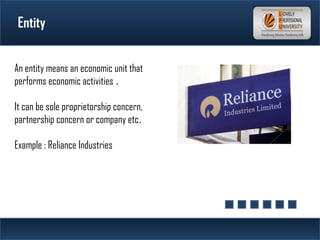
An entity means an economic unit that
performs economic activities .
It can be sole proprietorship concern,
partnership concern or company etc.
Example : Reliance Industries
Event
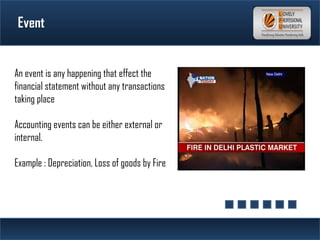
An event is any happening that effect the
financial statement without any transactions
taking place
Accounting events can be either external or
internal.
Example : Depreciation, Loss of goods by Fire
Transaction
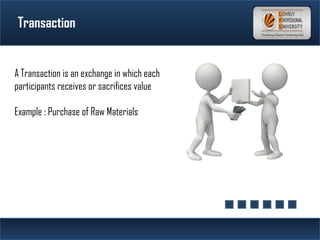
A Transaction is an exchange in which each
participants receives or sacrifices value
Example : Purchase of Raw Materials
Sole Proprietorship
A simple form of business where there is
one owner.
It is a simplest, oldest, and
most common form of business ownership i
n which only one individual acquires all
the benefits and risks of running
an enterprise
Voucher
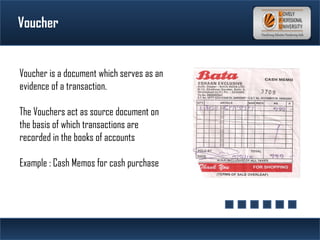
Voucher is a document which serves as an
evidence of a transaction.
The Vouchers act as source document on
the basis of which transactions are
recorded in the books of accounts
Example : Cash Memos for cash purchase
Entry
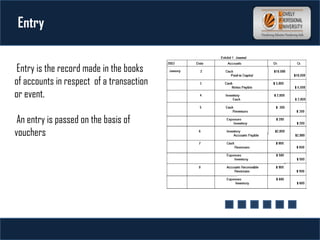
Entry is the record made in the books
of accounts in respect of a transaction
or event.
An entry is passed on the basis of
vouchers
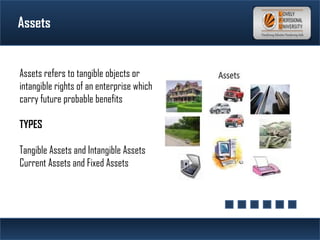
Assets
Assets refers to tangible objects or
intangible rights of an enterprise which
carry future probable benefits
TYPES
Tangible Assets and Intangible Assets
Current Assets and Fixed Assets
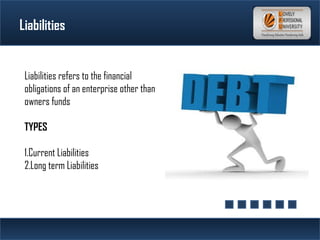
Liabilities
Liabilities refers to the financial
obligations of an enterprise other than
owners funds
TYPES
1.Current Liabilities
2.Long term Liabilities
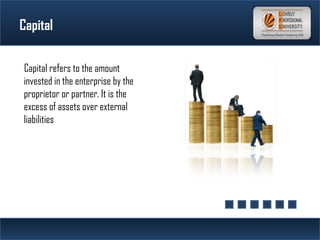
Capital
Capital refers to the amount
invested in the enterprise by the
proprietor or partner. It is the
excess of assets over external
liabilities
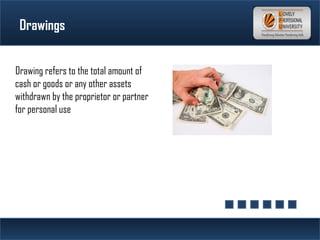
Drawings
Drawing refers to the total amount of
cash or goods or any other assets
withdrawn by the proprietor or partner
for personal use
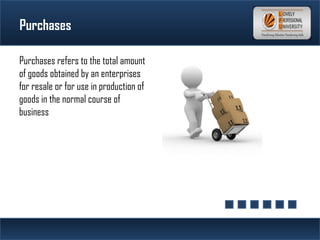
Purchases
Purchases refers to the total amount
of goods obtained by an enterprises
for resale or for use in production of
goods in the normal course of
business
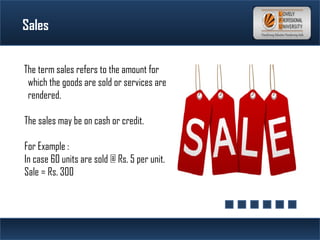
Sales
The term sales refers to the amount for
which the goods are sold or services are
rendered.
The sales may be on cash or credit.
For Example :
In case 60 units are sold @ Rs. 5 per unit.
Sale = Rs. 300
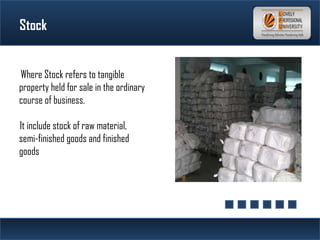
Stock
Where Stock refers to tangible
property held for sale in the ordinary
course of business.
It include stock of raw material,
semi-finished goods and finished
goods
Trade Debtors
Debtors refers to the person from
whom the amount are due for goods
sold or services rendered on the
credit basis
Trade Creditors
Trade creditors refers to the person
to whom the amount are due for goods
sold or services rendered on credit
basis
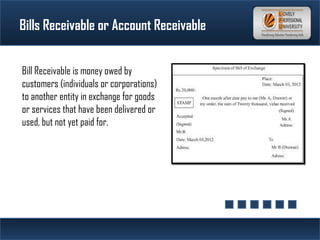
Bills Receivable or Account Receivable
Bill Receivable is money owed by
customers (individuals or corporations)
to another entity in exchange for goods
or services that have been delivered or
used, but not yet paid for.
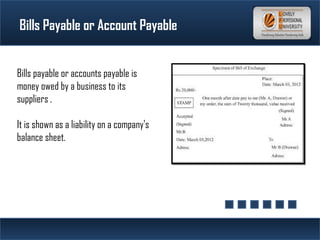
Bills Payable or Account Payable
Bills payable or accounts payable is
money owed by a business to its
suppliers .
It is shown as a liability on a company's
balance sheet.
Outstanding Expenses
Expenses which have been incurred but not
been paid for till the end of the accounting year
are known as Accrued expenses or outstanding
expenses.
Prepaid Expenses
Holidays
Prepaid expenses are future expenses
that have been paid in advance.
A common prepaid expense is six-month
premium for insurance on company's
vehicles.
Income
Income is increases in economic benefits
during the accounting period in the form
of inflows or enhancements of assets or
decreases of liabilities that result in
increases in equity,
Accrued Income
Accrued income is income which has been
earned but not yet received. Income must be
recorded in the accounting period in which it
is earned. -
Income received in advance
Prepaid income is revenue received in
advance but which is not yet earned.
Income must be recorded in the accounting
period in which it is earned.
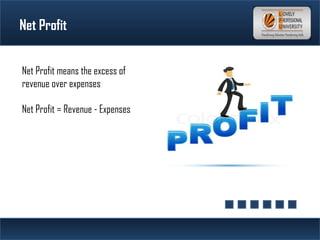
Net Profit
Net Profit means the excess of
revenue over expenses
Net Profit = Revenue - Expenses
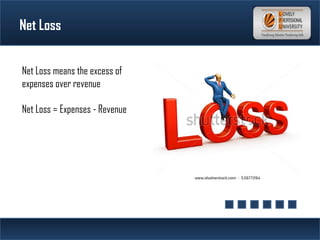
Net Loss
Net Loss means the excess of
expenses over revenue
Net Loss = Expenses - Revenue
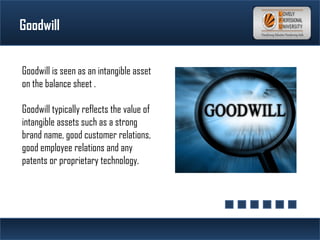
Goodwill
Goodwill is seen as an intangible asset
on the balance sheet .
Goodwill typically reflects the value of
intangible assets such as a strong
brand name, good customer relations,
good employee relations and any
patents or proprietary technology.
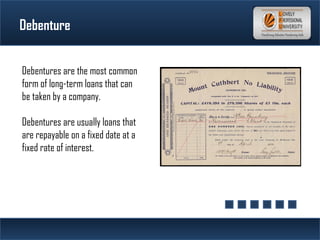
Debenture
Debentures are the most common
form of long-term loans that can
be taken by a company. 
Debentures are usually loans that
are repayable on a fixed date at a
fixed rate of interest.
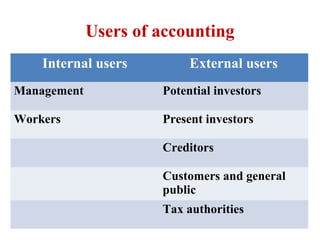
Users of accounting
Internal users External users
Management Potential investors
Workers Present investors
Creditors
Customers and general
public
Tax authorities

financial accounting

  • 1.
  • 2.
    Meaning of Accounting Itistheprocessof identifying, measuring, recording, classifying, summarising, analysing, interpreting and communicating theeconomic information of an organisation to itsuserswho need the information for decision making.
  • 3.
    Definition of Accounting “Theart of recording, classifying and summarizing in a significant manner and in terms of money, transactions and events, which are, in part at least, of a financial character and interpreting theresultsthereof”. American Institute of Certified Public Accountants (AICPA)
  • 4.
  • 5.
    Identifying thetransaction orevent Accounting identifiestransactions and eventsof aspecific entity. A transaction isaexchangein which each participant receiveor sacrifice value.
  • 6.
    Measuring theIdentified transaction &events Accounting measuresthe transactionsand eventsin terms of acommon measurement unit, that isaruling currency of a country
  • 7.
    Recording Accounting isconcerned withthe recording of identified & measured financial transactionsin an orderly manner in theproper booksof accountssoon after their occurrence.  
  • 8.
    Classifying   Accounting isconcerned withthe classification of recorded transactionsso asto group thetransactionsof similar typeat oneplace. Thisfunction is performed by maintaining the ledger in which different accountsareopened.
  • 9.
    Summarising Accounting isconcerned withthe summarization of theclassified transactionsin amanner useful to theusers. Thisinvolvesthepreparation of financial statementssuch asIncome statementsand BalanceSheet.
  • 10.
    Analysing Accounting isconcerned withthe establishment of relationship between thevariouselements taken from theBalancesheet or IncomeStatement or both. Itspurposeisto identify the financial strength or weaknessof theenterprise
  • 11.
    Interpreting It isconcerned withexplaining themeaning and significanceof therelationship so established by theanalysis. Theaccountantsshould interpret thestatementsin amanner useful to theusersso asto enablethe usersto takereasonabledecisions
  • 12.
    Communicating Communication isconcerned with thetransmissionof summarized, analysed and interpreted information to theusersto enable them to makereasonabledecisions.
  • 13.
  • 14.
  • 15.
  • 16.
    Important Concepts Accountancy :Accountancy refers to a systematic knowledge of accounting. It tells us how to prepare books of accounts and how to summarise the accounting information and communicate it to the interested parties Accounting : Accounting refers to the actual process of preparing and presenting the accounts. It is the art of putting the academic knowledge of accountancy into practice. It covers identifying, measuring, recording, classifying, summarising, analysing, interpreting and communicating the economic information. Book Keeping : It is a part of accounting and is concerned with the record keeping or maintenance of books of accounting which is often routine or clerical in nature.
  • 17.
    Relationship Between Accountancy,Accounting & Book Keeping AccountAncy Accounting Book keeping
  • 18.
  • 19.
  • 20.
    Basis of Accounting 1.Cash Basis of Accounting 2. Accrual Basis of Accounting
  • 21.
    Cash Basis ofAccounting Cash basis of accounting is a method of accounting where transactions are recorded at the time when physical cash is actually received or paid out.
  • 22.
    Accrual Basis ofAccounting Accrual basis of accounting is a method of accounting in which transactions are recorded on the basis of period in which they happen or accrue. Under the Companies Act 1956, all companies are required to maintain the books of accounts according to the accrual basis of accounting.
  • 23.
    Point of DistinctionCash Basis Accrual Basis Recording of Revenue Revenues are recorded when they are received, which may be before or after they are earned. Revenues are recorded when they are earned, which may be before or after they are received. Recording of Expenses Expenses are recorded when they are paid, which may be before or after they are incurred. Expenses are recorded when they are incurred, which may be before or after they are paid Treatment of Revenue and Expenses in Financial statement Financial statements reflect revenues and expenses based on when transactions were entered. Financial statements match revenues to the expenses incurred in earning them Treatment of Receivable No receivables are recorded. A receivable is recorded when payment is not received at the point of sale. Treatment of Payable No payables are recorded. Payables are recorded when payment is not made at the time of purchase.
  • 24.
    Point of DistinctionCash Basis Accrual Basis Methods of Tracking Partial Payment No method of tracking partial payments is available. Revenues and expenses are recorded in full, even though partial payments may be made over extended time periods Recognition under companies Act 1956 This basis is not recognised under the companies act 1956 This basis is recognised under the companies act 1956
  • 25.
    Point of DistinctionCash Basis Accrual Basis Presence of Prepaid/outstanding expenses and accrued/ un-accrued income in Balance sheet Under this method, Items like prepaid expenses, outstanding expenses, accrued income, un-accrued income are not present in Balance sheet Under this method, Items like prepaid expenses, outstanding expenses, accrued income, un-accrued income are present in Balance sheet Treatment of income in case of prepaid expenses and accrued income Income Statement will show Lower income Income Statement will show a relatively higher income Treatment of income in case of outstanding expenses and income received in advance Income Statement will show higher income Income Statement will show a relatively Lower income
  • 26.
    Accounting Terms S.NO TERMSS.NO TERMS 1 Entity 16 Bills Receivable 2 Event 17 Bills Payable 3 Transaction 18 Receivable 4 Sole Proprietor 19 Payable 5 Voucher 20 Expenses 6 Entry 21 Outstanding Expenses 7 Assets 22 Prepaid Expenses 8 Liabilities 23 Income 9 Capital 24 Accrued Income 10 Drawing 25 Income Received in advance 11 Purchases 26 Revenue 12 Sales 27 Net Profit 13 Stock 28 Net Loss 14 Trade Debtors 29 Goodwill 15 Trade Creditors 30 Debentures
  • 27.
    Entity An entity meansan economic unit that performs economic activities . It can be sole proprietorship concern, partnership concern or company etc. Example : Reliance Industries
  • 28.
    Event An event isany happening that effect the financial statement without any transactions taking place Accounting events can be either external or internal. Example : Depreciation, Loss of goods by Fire
  • 29.
    Transaction A Transaction isan exchange in which each participants receives or sacrifices value Example : Purchase of Raw Materials
  • 30.
    Sole Proprietorship A simpleform of business where there is one owner. It is a simplest, oldest, and most common form of business ownership i n which only one individual acquires all the benefits and risks of running an enterprise
  • 31.
    Voucher Voucher is adocument which serves as an evidence of a transaction. The Vouchers act as source document on the basis of which transactions are recorded in the books of accounts Example : Cash Memos for cash purchase
  • 32.
    Entry Entry is therecord made in the books of accounts in respect of a transaction or event. An entry is passed on the basis of vouchers
  • 33.
    Assets Assets refers totangible objects or intangible rights of an enterprise which carry future probable benefits TYPES Tangible Assets and Intangible Assets Current Assets and Fixed Assets
  • 34.
    Liabilities Liabilities refers tothe financial obligations of an enterprise other than owners funds TYPES 1.Current Liabilities 2.Long term Liabilities
  • 35.
    Capital Capital refers tothe amount invested in the enterprise by the proprietor or partner. It is the excess of assets over external liabilities
  • 36.
    Drawings Drawing refers tothe total amount of cash or goods or any other assets withdrawn by the proprietor or partner for personal use
  • 37.
    Purchases Purchases refers tothe total amount of goods obtained by an enterprises for resale or for use in production of goods in the normal course of business
  • 38.
    Sales The term salesrefers to the amount for which the goods are sold or services are rendered. The sales may be on cash or credit. For Example : In case 60 units are sold @ Rs. 5 per unit. Sale = Rs. 300
  • 39.
    Stock Where Stock refersto tangible property held for sale in the ordinary course of business. It include stock of raw material, semi-finished goods and finished goods
  • 40.
    Trade Debtors Debtors refersto the person from whom the amount are due for goods sold or services rendered on the credit basis
  • 41.
    Trade Creditors Trade creditorsrefers to the person to whom the amount are due for goods sold or services rendered on credit basis
  • 42.
    Bills Receivable orAccount Receivable Bill Receivable is money owed by customers (individuals or corporations) to another entity in exchange for goods or services that have been delivered or used, but not yet paid for.
  • 43.
    Bills Payable orAccount Payable Bills payable or accounts payable is money owed by a business to its suppliers . It is shown as a liability on a company's balance sheet.
  • 44.
    Outstanding Expenses Expenses whichhave been incurred but not been paid for till the end of the accounting year are known as Accrued expenses or outstanding expenses.
  • 45.
    Prepaid Expenses Holidays Prepaid expensesare future expenses that have been paid in advance. A common prepaid expense is six-month premium for insurance on company's vehicles.
  • 46.
    Income Income is increasesin economic benefits during the accounting period in the form of inflows or enhancements of assets or decreases of liabilities that result in increases in equity,
  • 47.
    Accrued Income Accrued incomeis income which has been earned but not yet received. Income must be recorded in the accounting period in which it is earned. -
  • 48.
    Income received inadvance Prepaid income is revenue received in advance but which is not yet earned. Income must be recorded in the accounting period in which it is earned.
  • 49.
    Net Profit Net Profitmeans the excess of revenue over expenses Net Profit = Revenue - Expenses
  • 50.
    Net Loss Net Lossmeans the excess of expenses over revenue Net Loss = Expenses - Revenue
  • 51.
    Goodwill Goodwill is seenas an intangible asset on the balance sheet . Goodwill typically reflects the value of intangible assets such as a strong brand name, good customer relations, good employee relations and any patents or proprietary technology.
  • 52.
    Debenture Debentures are themost common form of long-term loans that can be taken by a company.  Debentures are usually loans that are repayable on a fixed date at a fixed rate of interest.
  • 53.
    Users of accounting Internalusers External users Management Potential investors Workers Present investors Creditors Customers and general public Tax authorities