


Journal and Ledger
Visit www.googlevu.blogspot.com for more content
Chapter 5
Journal and Ledger
www.googlevu.com Slide 1/47
Journal and Ledger
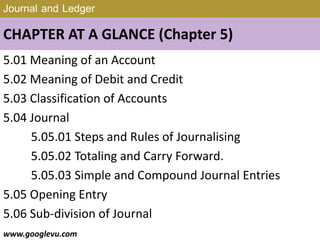
CHAPTER AT A GLANCE (Chapter 5)
5.01 Meaning of an Account
5.02 Meaning of Debit and Credit
5.03 Classification of Accounts
5.04 Journal
5.05.01 Steps and Rules of Journalising
5.05.02 Totaling and Carry Forward.
5.05.03 Simple and Compound Journal Entries
5.05 Opening Entry
5.06 Sub-division of Journal
www.googlevu.com Slide 2/47
Journal and Ledger
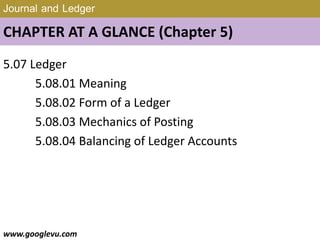
CHAPTER AT A GLANCE (Chapter 5)
5.07 Ledger
5.08.01 Meaning
5.08.02 Form of a Ledger
5.08.03 Mechanics of Posting
5.08.04 Balancing of Ledger Accounts
www.googlevu.com 3
Journal and Ledger
5.01
Meaning of an Account
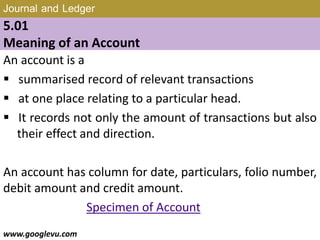
An account is a
 summarised record of relevant transactions
 at one place relating to a particular head.
 It records not only the amount of transactions but also
their effect and direction.
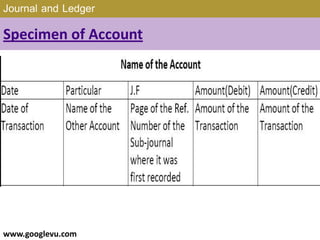
An account has column for date, particulars, folio number,
debit amount and credit amount.
Specimen of Account
www.googlevu.com Slide 4/47
Journal and Ledger
Specimen of Account
www.googlevu.com Slide 5/47
Journal and Ledger
5.02
Meaning of Debit and Credit
Under double entry system of book keeping each
transaction has two aspects.
 Debit Aspect and Credit Aspect
 Debit and credit aspects of a transaction form the basis
of double entry system.
www.googlevu.com Slide 6/47
Journal and Ledger
5.02
Meaning of Debit and Credit
An item recorded
 on the debit side of an account is said to be debited to
the account and
 a balance resting on this side is said to be a debit
balance.
An item recorded
 on the credit side of an account is said to be credited
to the account and
 the balance resting on this side is said to be a credit
balance.
www.googlevu.com Slide 7/47
Journal and Ledger
5.03
CLASSIFICATION OF ACCOUNTS
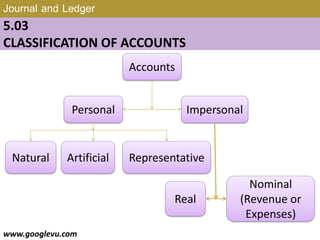
Accounts can be classified in two ways:
 1. Traditional Classification
 2. Modern Classification
www.googlevu.com Slide 8/47
Journal and Ledger
5.03
CLASSIFICATION OF ACCOUNTS
1. Traditional Classification of Accounts
This is a very old system of classifying accounts. Under
this system, accounts are classified into two groups
which is classified in the following charts
www.googlevu.com Slide 9/47
Journal and Ledger
5.03
CLASSIFICATION OF ACCOUNTS
Accounts
Personal Impersonal
Natural Artificial Representative
Real
Nominal
(Revenue or
Expenses)
www.googlevu.com Slide 10/47
Journal and Ledger
5.03
CLASSIFICATION OF ACCOUNTS
(i) Personal Accounts: Accounts which relate to persons,
i.e., individuals, firms, companies,
Examples
Ram & Co., Debtors or Creditors , Capital Account,
etc.
www.googlevu.com Slide 11/47
Journal and Ledger
5.03
CLASSIFICATION OF ACCOUNTS
(ii) Impersonal Accounts: Accounts which are not
personal such as Machinery Account, Cash Account,
Rent Account, etc. , are termed as ‘Impersonal
Accounts’.
 These can be further sub-divided into two accounts:
(a) Real Accounts
(b) Nominal Accounts
www.googlevu.com Slide 12/47
Journal and Ledger
(a) Real Accounts: The accounts which relate to tangible
or intangible assets of the firm (excluding debtors) are
termed as Real Accounts.
Examples (Tangible Assets)
 Land, building, investments, plant and machinery,
stock or cash in hand.
Examples (Intangible Assets)
 Goodwill, patents and trademark.
www.googlevu.com Slide 13/47
Journal and Ledger
5.03
CLASSIFICATION OF ACCOUNTS
(b) Nominal (or Revenue/Expense) Accounts: Accounts
which relate to expenses, losses, gains, revenue, etc.,
are termed as Nominal Accounts.
Examples
 Salary Account, Purchases Account, Interest paid
Account, Sales Account and commission received
Account.
www.googlevu.com Slide 14/47
Journal and Ledger
5.03
CLASSIFICATION OF ACCOUNTS
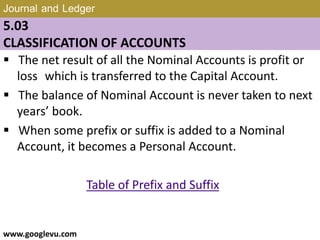
 The net result of all the Nominal Accounts is profit or
loss which is transferred to the Capital Account.
 The balance of Nominal Account is never taken to next
years’ book.
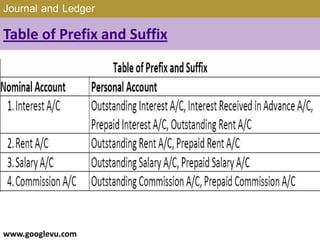
 When some prefix or suffix is added to a Nominal
Account, it becomes a Personal Account.
Table of Prefix and Suffix
www.googlevu.com Slide 15/47
Journal and Ledger
Table of Prefix and Suffix
www.googlevu.com Slide 16/47
Journal and Ledger
5.03
CLASSIFICATION OF ACCOUNTS
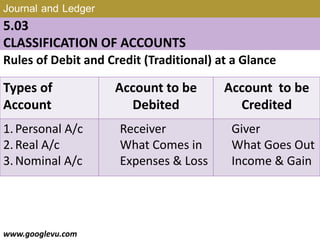
Rules of Debit and Credit (Traditional) at a Glance
www.googlevu.com
Types of
Account
Account to be
Debited
Account to be
Credited
1.Personal A/c
2.Real A/c
3.Nominal A/c
Receiver
What Comes in
Expenses & Loss
Giver
What Goes Out
Income & Gain
Slide 17/47
Journal and Ledger
5.03
CLASSIFICATION OF ACCOUNTS
www.googlevu.com
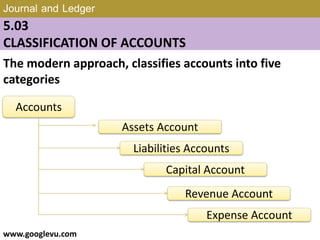
Liabilities Accounts
Accounts
The modern approach, classifies accounts into five
categories
Assets Account
Capital Account
Revenue Account
Expense Account
Slide 18/47
Journal and Ledger
5.03
CLASSIFICATION OF ACCOUNTS
RULES FOR DEBIT AND CREDIT
www.googlevu.com
Types of Account Accounts to be
Debited
Accounts to be
Credited
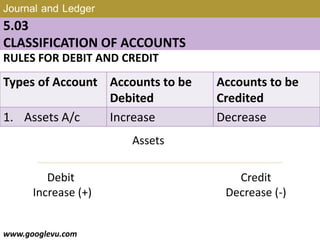
1. Assets A/c Increase Decrease
Assets
Debit
Increase (+)
Credit
Decrease (-)
Slide 19/47
Journal and Ledger
5.03
CLASSIFICATION OF ACCOUNTS
RULES FOR DEBIT AND CREDIT
www.googlevu.com
Types of Account Accounts to be
Debited
Accounts to be
Credited
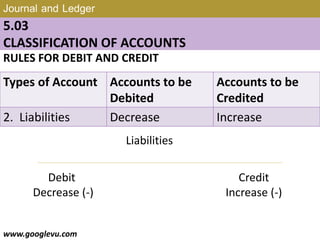
2. Liabilities Decrease Increase
Liabilities
Debit
Decrease (-)
Credit
Increase (-)
Slide 20/47
Journal and Ledger
5.03
CLASSIFICATION OF ACCOUNTS
RULES FOR DEBIT AND CREDIT
www.googlevu.com
Types of Account Accounts to be
Debited
Accounts to be
Credited
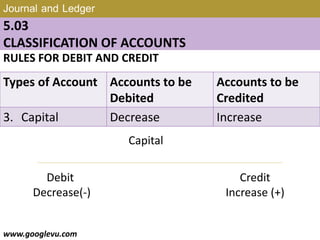
3. Capital Decrease Increase
Capital
Debit
Decrease(-)
Credit
Increase (+)
Slide 21/47
Journal and Ledger
5.03
CLASSIFICATION OF ACCOUNTS
RULES FOR DEBIT AND CREDIT
www.googlevu.com
Types of Account Accounts to be
Debited
Accounts to be
Credited
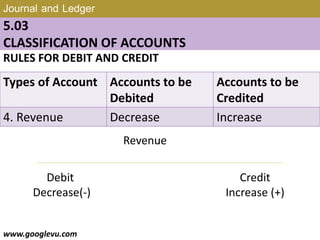
4. Revenue Decrease Increase
Revenue
Debit
Decrease(-)
Credit
Increase (+)
Slide 22/47
Journal and Ledger
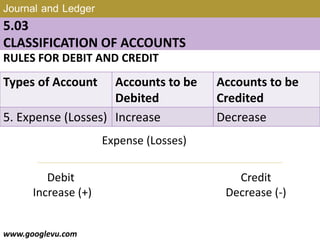
5.03
CLASSIFICATION OF ACCOUNTS
RULES FOR DEBIT AND CREDIT
www.googlevu.com
Types of Account Accounts to be
Debited
Accounts to be
Credited
5. Expense (Losses) Increase Decrease
Expense (Losses)
Debit
Increase (+)
Credit
Decrease (-)
Slide 23/47
Journal and Ledger
5.04
JOURNAL
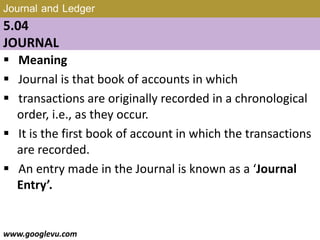
 Meaning
 Journal is that book of accounts in which
 transactions are originally recorded in a chronological
order, i.e., as they occur.
 It is the first book of account in which the transactions
are recorded.
 An entry made in the Journal is known as a ‘Journal
Entry’.
www.googlevu.com Slide 24/47
Journal and Ledger
5.04
JOURNAL
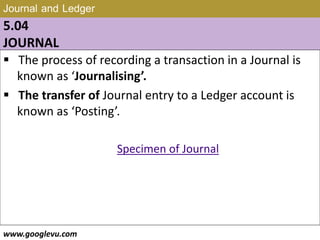
 The process of recording a transaction in a Journal is
known as ‘Journalising’.
 The transfer of Journal entry to a Ledger account is
known as ‘Posting’.
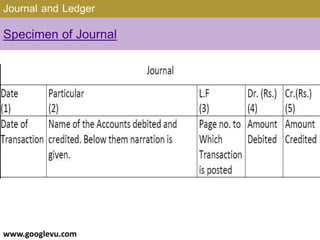
Specimen of Journal
www.googlevu.com Slide 25/47
Journal and Ledger
Specimen of Journal
www.googlevu.com Slide 26/47
Journal and Ledger
5.04
JOURNAL
5.05.03 Simple and Compound Journal Entries
Journal entries are of two types namely:
1. Simple Entry and
2. Compound Entry.
www.googlevu.com Slide 27/47
Journal and Ledger
5.04
JOURNAL
1. Simple Entry:
A simple entry is one in which only two accounts are
affected, viz.,
 one account is debited and
 another is credited with an equal amount.
2. Compound Entry
A compound entry is one in which
 two or more accounts are debited and
 one or more accounts are credited.
www.googlevu.com Slide 28/47
Journal and Ledger
5.05
OPENING ENTRY
Opening Entry
The entry passed to record the closing balances of the
previous year is called the Opening Entry.
 While passing an opening entry all Assets Accounts are
debited and
 all Liabilities Accounts are credited.
www.googlevu.com Slide 29/47
Journal and Ledger
5.06
SUB-DIVISION OF JOURNAL
Journal is sub-divided into subsidiary Journal books.
These are
 Cash Book – to record cash and bank transactions.
 Purchases Book – to record credit purchases of
goods dealt in or used in manufacturing.
 Purchase Returns Book – to record return of
purchased goods.
 Sales Book – to record credit sale of goods dealt in.
www.googlevu.com Slide 30/47
Journal and Ledger
5.06
SUB-DIVISION OF JOURNAL
 Sales Returns Book – to record return of goods sold.
 Bills Receivable Book – to record Bills Received.
 Bills Payable Book – to record Bills Payable.
 Journal Proper – to record all other transactions that
are not recorded in any of the above sub-journals.
www.googlevu.com Slide 31/47
Journal and Ledger
5.07
LEDGER
5.08.01 Meaning
A Ledger can be defined as
 a “book or register which contains,
 in a summarised and classified form,
 a permanent record of all transactions.”
 It is an important book of accounts, as the Trial Balance
is drawn from it and with the help of Trial Balance Final
Account is prepared.
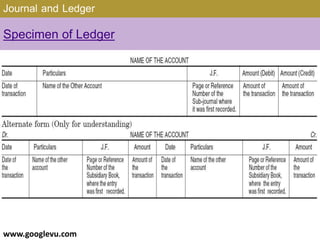
Specimen of Ledger
www.googlevu.com Slide 32/47
Journal and Ledger
Specimen of Ledger
www.googlevu.com Slide 33/47
Journal and Ledger
5.08
LEDGER
5.08.04 Balancing of Ledger Accounts
 After posting the transactions,
 accounts are balanced every year or
 after a certain period.
Balancing an account means
 that the two sides of account are totalled and
 the difference in total of the two sides is
 written on the side whose total is short.
www.googlevu.com Slide 34/47
Journal and Ledger
Virtual University
www.googlevu.com Slide 35/47

Journal and Ledger

  • 1.
    Journal and Ledger Visitwww.googlevu.blogspot.com for more content Chapter 5 Journal and Ledger www.googlevu.com Slide 1/47
  • 2.
    Journal and Ledger CHAPTERAT A GLANCE (Chapter 5) 5.01 Meaning of an Account 5.02 Meaning of Debit and Credit 5.03 Classification of Accounts 5.04 Journal 5.05.01 Steps and Rules of Journalising 5.05.02 Totaling and Carry Forward. 5.05.03 Simple and Compound Journal Entries 5.05 Opening Entry 5.06 Sub-division of Journal www.googlevu.com Slide 2/47
  • 3.
    Journal and Ledger CHAPTERAT A GLANCE (Chapter 5) 5.07 Ledger 5.08.01 Meaning 5.08.02 Form of a Ledger 5.08.03 Mechanics of Posting 5.08.04 Balancing of Ledger Accounts www.googlevu.com 3
  • 4.
    Journal and Ledger 5.01 Meaningof an Account An account is a  summarised record of relevant transactions  at one place relating to a particular head.  It records not only the amount of transactions but also their effect and direction. An account has column for date, particulars, folio number, debit amount and credit amount. Specimen of Account www.googlevu.com Slide 4/47
  • 5.
    Journal and Ledger Specimenof Account www.googlevu.com Slide 5/47
  • 6.
    Journal and Ledger 5.02 Meaningof Debit and Credit Under double entry system of book keeping each transaction has two aspects.  Debit Aspect and Credit Aspect  Debit and credit aspects of a transaction form the basis of double entry system. www.googlevu.com Slide 6/47
  • 7.
    Journal and Ledger 5.02 Meaningof Debit and Credit An item recorded  on the debit side of an account is said to be debited to the account and  a balance resting on this side is said to be a debit balance. An item recorded  on the credit side of an account is said to be credited to the account and  the balance resting on this side is said to be a credit balance. www.googlevu.com Slide 7/47
  • 8.
    Journal and Ledger 5.03 CLASSIFICATIONOF ACCOUNTS Accounts can be classified in two ways:  1. Traditional Classification  2. Modern Classification www.googlevu.com Slide 8/47
  • 9.
    Journal and Ledger 5.03 CLASSIFICATIONOF ACCOUNTS 1. Traditional Classification of Accounts This is a very old system of classifying accounts. Under this system, accounts are classified into two groups which is classified in the following charts www.googlevu.com Slide 9/47
  • 10.
    Journal and Ledger 5.03 CLASSIFICATIONOF ACCOUNTS Accounts Personal Impersonal Natural Artificial Representative Real Nominal (Revenue or Expenses) www.googlevu.com Slide 10/47
  • 11.
    Journal and Ledger 5.03 CLASSIFICATIONOF ACCOUNTS (i) Personal Accounts: Accounts which relate to persons, i.e., individuals, firms, companies, Examples Ram & Co., Debtors or Creditors , Capital Account, etc. www.googlevu.com Slide 11/47
  • 12.
    Journal and Ledger 5.03 CLASSIFICATIONOF ACCOUNTS (ii) Impersonal Accounts: Accounts which are not personal such as Machinery Account, Cash Account, Rent Account, etc. , are termed as ‘Impersonal Accounts’.  These can be further sub-divided into two accounts: (a) Real Accounts (b) Nominal Accounts www.googlevu.com Slide 12/47
  • 13.
    Journal and Ledger (a)Real Accounts: The accounts which relate to tangible or intangible assets of the firm (excluding debtors) are termed as Real Accounts. Examples (Tangible Assets)  Land, building, investments, plant and machinery, stock or cash in hand. Examples (Intangible Assets)  Goodwill, patents and trademark. www.googlevu.com Slide 13/47
  • 14.
    Journal and Ledger 5.03 CLASSIFICATIONOF ACCOUNTS (b) Nominal (or Revenue/Expense) Accounts: Accounts which relate to expenses, losses, gains, revenue, etc., are termed as Nominal Accounts. Examples  Salary Account, Purchases Account, Interest paid Account, Sales Account and commission received Account. www.googlevu.com Slide 14/47
  • 15.
    Journal and Ledger 5.03 CLASSIFICATIONOF ACCOUNTS  The net result of all the Nominal Accounts is profit or loss which is transferred to the Capital Account.  The balance of Nominal Account is never taken to next years’ book.  When some prefix or suffix is added to a Nominal Account, it becomes a Personal Account. Table of Prefix and Suffix www.googlevu.com Slide 15/47
  • 16.
    Journal and Ledger Tableof Prefix and Suffix www.googlevu.com Slide 16/47
  • 17.
    Journal and Ledger 5.03 CLASSIFICATIONOF ACCOUNTS Rules of Debit and Credit (Traditional) at a Glance www.googlevu.com Types of Account Account to be Debited Account to be Credited 1.Personal A/c 2.Real A/c 3.Nominal A/c Receiver What Comes in Expenses & Loss Giver What Goes Out Income & Gain Slide 17/47
  • 18.
    Journal and Ledger 5.03 CLASSIFICATIONOF ACCOUNTS www.googlevu.com Liabilities Accounts Accounts The modern approach, classifies accounts into five categories Assets Account Capital Account Revenue Account Expense Account Slide 18/47
  • 19.
    Journal and Ledger 5.03 CLASSIFICATIONOF ACCOUNTS RULES FOR DEBIT AND CREDIT www.googlevu.com Types of Account Accounts to be Debited Accounts to be Credited 1. Assets A/c Increase Decrease Assets Debit Increase (+) Credit Decrease (-) Slide 19/47
  • 20.
    Journal and Ledger 5.03 CLASSIFICATIONOF ACCOUNTS RULES FOR DEBIT AND CREDIT www.googlevu.com Types of Account Accounts to be Debited Accounts to be Credited 2. Liabilities Decrease Increase Liabilities Debit Decrease (-) Credit Increase (-) Slide 20/47
  • 21.
    Journal and Ledger 5.03 CLASSIFICATIONOF ACCOUNTS RULES FOR DEBIT AND CREDIT www.googlevu.com Types of Account Accounts to be Debited Accounts to be Credited 3. Capital Decrease Increase Capital Debit Decrease(-) Credit Increase (+) Slide 21/47
  • 22.
    Journal and Ledger 5.03 CLASSIFICATIONOF ACCOUNTS RULES FOR DEBIT AND CREDIT www.googlevu.com Types of Account Accounts to be Debited Accounts to be Credited 4. Revenue Decrease Increase Revenue Debit Decrease(-) Credit Increase (+) Slide 22/47
  • 23.
    Journal and Ledger 5.03 CLASSIFICATIONOF ACCOUNTS RULES FOR DEBIT AND CREDIT www.googlevu.com Types of Account Accounts to be Debited Accounts to be Credited 5. Expense (Losses) Increase Decrease Expense (Losses) Debit Increase (+) Credit Decrease (-) Slide 23/47
  • 24.
    Journal and Ledger 5.04 JOURNAL Meaning  Journal is that book of accounts in which  transactions are originally recorded in a chronological order, i.e., as they occur.  It is the first book of account in which the transactions are recorded.  An entry made in the Journal is known as a ‘Journal Entry’. www.googlevu.com Slide 24/47
  • 25.
    Journal and Ledger 5.04 JOURNAL The process of recording a transaction in a Journal is known as ‘Journalising’.  The transfer of Journal entry to a Ledger account is known as ‘Posting’. Specimen of Journal www.googlevu.com Slide 25/47
  • 26.
    Journal and Ledger Specimenof Journal www.googlevu.com Slide 26/47
  • 27.
    Journal and Ledger 5.04 JOURNAL 5.05.03Simple and Compound Journal Entries Journal entries are of two types namely: 1. Simple Entry and 2. Compound Entry. www.googlevu.com Slide 27/47
  • 28.
    Journal and Ledger 5.04 JOURNAL 1.Simple Entry: A simple entry is one in which only two accounts are affected, viz.,  one account is debited and  another is credited with an equal amount. 2. Compound Entry A compound entry is one in which  two or more accounts are debited and  one or more accounts are credited. www.googlevu.com Slide 28/47
  • 29.
    Journal and Ledger 5.05 OPENINGENTRY Opening Entry The entry passed to record the closing balances of the previous year is called the Opening Entry.  While passing an opening entry all Assets Accounts are debited and  all Liabilities Accounts are credited. www.googlevu.com Slide 29/47
  • 30.
    Journal and Ledger 5.06 SUB-DIVISIONOF JOURNAL Journal is sub-divided into subsidiary Journal books. These are  Cash Book – to record cash and bank transactions.  Purchases Book – to record credit purchases of goods dealt in or used in manufacturing.  Purchase Returns Book – to record return of purchased goods.  Sales Book – to record credit sale of goods dealt in. www.googlevu.com Slide 30/47
  • 31.
    Journal and Ledger 5.06 SUB-DIVISIONOF JOURNAL  Sales Returns Book – to record return of goods sold.  Bills Receivable Book – to record Bills Received.  Bills Payable Book – to record Bills Payable.  Journal Proper – to record all other transactions that are not recorded in any of the above sub-journals. www.googlevu.com Slide 31/47
  • 32.
    Journal and Ledger 5.07 LEDGER 5.08.01Meaning A Ledger can be defined as  a “book or register which contains,  in a summarised and classified form,  a permanent record of all transactions.”  It is an important book of accounts, as the Trial Balance is drawn from it and with the help of Trial Balance Final Account is prepared. Specimen of Ledger www.googlevu.com Slide 32/47
  • 33.
    Journal and Ledger Specimenof Ledger www.googlevu.com Slide 33/47
  • 34.
    Journal and Ledger 5.08 LEDGER 5.08.04Balancing of Ledger Accounts  After posting the transactions,  accounts are balanced every year or  after a certain period. Balancing an account means  that the two sides of account are totalled and  the difference in total of the two sides is  written on the side whose total is short. www.googlevu.com Slide 34/47
  • 35.
    Journal and Ledger VirtualUniversity www.googlevu.com Slide 35/47