
Technological Developments in
CRM – e-CRM
Lecture by: M. Srinivas
If you make customer unhappy in the
physical world, they might each tell 6
friends.
If you make customer unhappy on the
internet they can each tell 6,000 friends.
- JEFF BEZOZ
Learning Objectives:
 Learn the concept of e-CRM and its relevance to
service industry.
 Know the various advantages of e-CRM
 Understand the different e-CRM Technologies
 Develop diverse e-CRM softwares
 Learn formats of e-CRM applications
Technological Developments in CRM –
e-CRM
 Introduction
 e-CRM: An Information Technology Tool
 e-CRM in Business
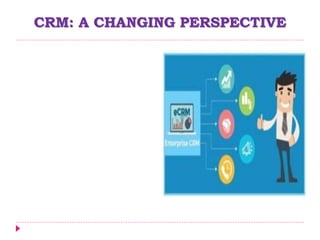
CRM: A CHANGING PERSPECTIVE
e-CRM: Definition
 The eCRM or electronic customer relationship
management coined by Oscar Gomes
encompasses all standard CRM functions with the
use of the net environment i.e., intranet, extranet and
internet. Electronic CRM concerns all forms of
managing relationships with customers through the
use of information technology (IT).
 eCRM processes include data collection, data
aggregation, and customer interaction. Compared to
traditional CRM, the integrated information for eCRM
intraorganizational collaboration can be more
efficient to communicate with customers.
FEATURES OF e-CRM
 It is driven by a data warehouse which maintained by
the organizations during purchases.
 It focuses on reaching out to the customers across
multiple channels.
 It enables a company to accommodate new market
dynamics that place the customer in control.
 It is structured to identify a customer’s profitability or
profit potential, and to determine effective investment
allocation decisions accordingly, so that the most
profitable customers could be identified and the
resources could be invested in relationships, which
are most profitable
Advantages of e-CRM
1. Lowers the cost
2. Adaptability to new
technology
3. Availability
4. Integration with the
system
5. Helps data
construction
6. Increased customer
interaction
7. Maneuverability
8. Managing data
reservoir
9. Lesser response time
10. Lower marginal cost
11. New customer service
opportunities
12. Reach and service
personalization
13. Automatic self
documentation
14. User control
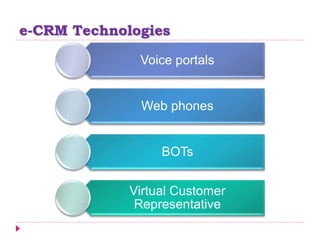
e-CRM Technologies
Voice portals
Web phones
BOTs
Virtual Customer
Representative
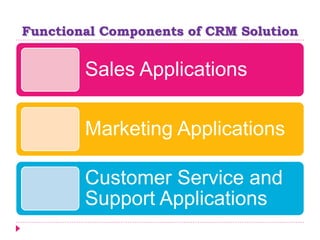
Functional Components of CRM Solution
Sales Applications
Marketing Applications
Customer Service and
Support Applications
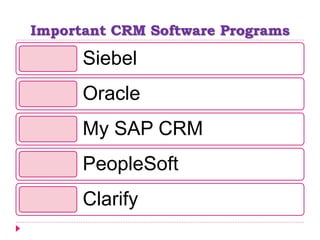
Important CRM Software Programs
Siebel
Oracle
My SAP CRM
PeopleSoft
Clarify
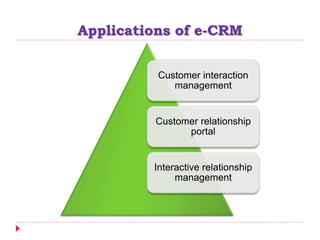
Applications of e-CRM
Customer interaction
management
Customer relationship
portal
Interactive relationship
management
E- CRM

E- CRM

  • 1.
    Technological Developments in CRM– e-CRM Lecture by: M. Srinivas
  • 2.
    If you makecustomer unhappy in the physical world, they might each tell 6 friends. If you make customer unhappy on the internet they can each tell 6,000 friends. - JEFF BEZOZ
  • 3.
    Learning Objectives:  Learnthe concept of e-CRM and its relevance to service industry.  Know the various advantages of e-CRM  Understand the different e-CRM Technologies  Develop diverse e-CRM softwares  Learn formats of e-CRM applications
  • 4.
    Technological Developments inCRM – e-CRM  Introduction  e-CRM: An Information Technology Tool  e-CRM in Business
  • 5.
    CRM: A CHANGINGPERSPECTIVE
  • 6.
    e-CRM: Definition  TheeCRM or electronic customer relationship management coined by Oscar Gomes encompasses all standard CRM functions with the use of the net environment i.e., intranet, extranet and internet. Electronic CRM concerns all forms of managing relationships with customers through the use of information technology (IT).  eCRM processes include data collection, data aggregation, and customer interaction. Compared to traditional CRM, the integrated information for eCRM intraorganizational collaboration can be more efficient to communicate with customers.
  • 7.
    FEATURES OF e-CRM It is driven by a data warehouse which maintained by the organizations during purchases.  It focuses on reaching out to the customers across multiple channels.  It enables a company to accommodate new market dynamics that place the customer in control.  It is structured to identify a customer’s profitability or profit potential, and to determine effective investment allocation decisions accordingly, so that the most profitable customers could be identified and the resources could be invested in relationships, which are most profitable
  • 8.
    Advantages of e-CRM 1.Lowers the cost 2. Adaptability to new technology 3. Availability 4. Integration with the system 5. Helps data construction 6. Increased customer interaction 7. Maneuverability 8. Managing data reservoir 9. Lesser response time 10. Lower marginal cost 11. New customer service opportunities 12. Reach and service personalization 13. Automatic self documentation 14. User control
  • 9.
    e-CRM Technologies Voice portals Webphones BOTs Virtual Customer Representative
  • 10.
    Functional Components ofCRM Solution Sales Applications Marketing Applications Customer Service and Support Applications
  • 11.
    Important CRM SoftwarePrograms Siebel Oracle My SAP CRM PeopleSoft Clarify
  • 12.
    Applications of e-CRM Customerinteraction management Customer relationship portal Interactive relationship management