Accounting Cycle
Unit 1 Introduction to Accounting
Step 1 : Identifying Financial Transactions
1.

Classify the following items into Personal, Real and
Nominal Accounts.
1. Capital
2. Sales
3. Drawings
4. Outstanding salary 5. Cash
6. Rent
7. Interest paid 8. Indian Bank
9. Discount received 10. Building
11. Bank
12. Chandrasekar
13. Murugan Lending Library
14. Advertisement
15. Purchases


t


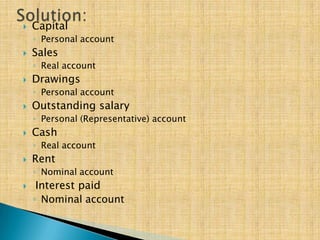
Capital
◦ Personal account



Sales
◦ Real account



Drawings
◦ Personal account



Outstanding salary
◦ Personal (Representative) account



Cash
◦ Real account



Rent
◦ Nominal account



Interest paid
◦ Nominal account


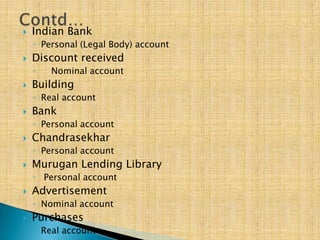
Indian Bank
◦ Personal (Legal Body) account



Discount received
◦



Nominal account

Building
◦ Real account



Bank
◦ Personal account



Chandrasekhar
◦ Personal account



Murugan Lending Library
◦ Personal account



Advertisement
◦ Nominal account



Purchases
◦ Real account
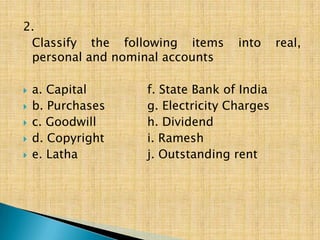
2.
Classify the following items
personal and nominal accounts







a. Capital
b. Purchases
c. Goodwill
d. Copyright
e. Latha

into

f. State Bank of India
g. Electricity Charges
h. Dividend
i. Ramesh
j. Outstanding rent

real,


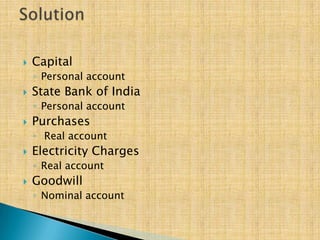
Capital
◦ Personal account



State Bank of India
◦ Personal account



Purchases
◦ Real account



Electricity Charges
◦ Real account



Goodwill
◦ Nominal account


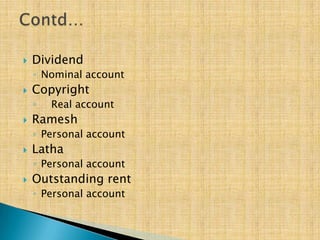
Dividend
◦ Nominal account



Copyright
◦



Real account

Ramesh
◦ Personal account



Latha
◦ Personal account



Outstanding rent
◦ Personal account


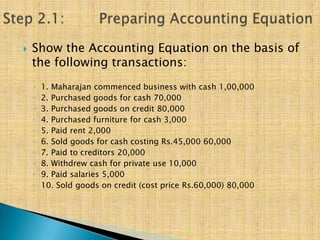
Show the Accounting Equation on the basis of
the following transactions:
◦
◦
◦
◦
◦
◦
◦
◦
◦
◦

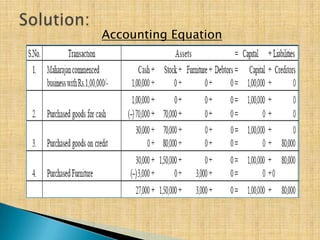
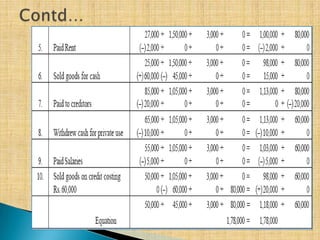
1. Maharajan commenced business with cash 1,00,000
2. Purchased goods for cash 70,000
3. Purchased goods on credit 80,000
4. Purchased furniture for cash 3,000
5. Paid rent 2,000
6. Sold goods for cash costing Rs.45,000 60,000
7. Paid to creditors 20,000
8. Withdrew cash for private use 10,000
9. Paid salaries 5,000
10. Sold goods on credit (cost price Rs.60,000) 80,000
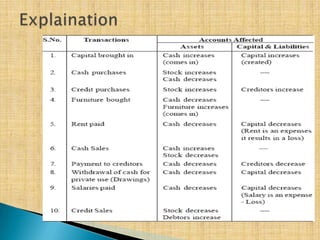
Accounting Equation


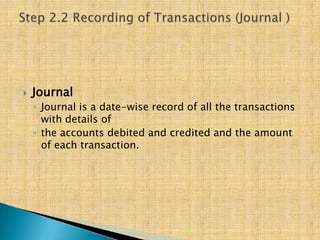
Journal
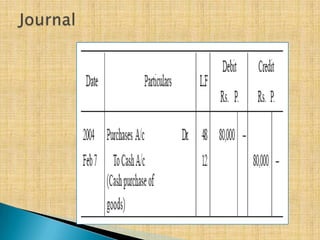
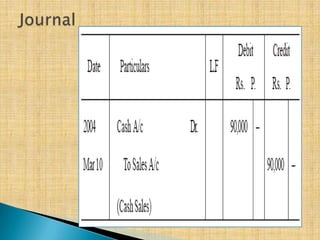
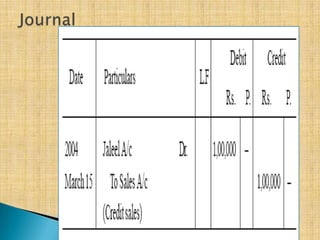
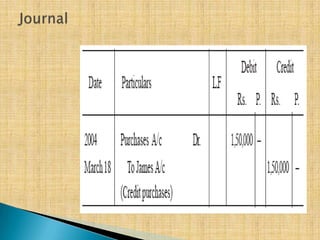
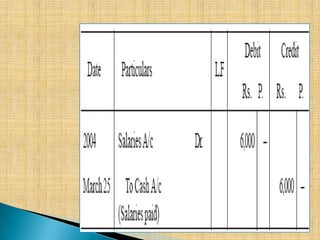
◦ Journal is a date-wise record of all the transactions
with details of
◦ the accounts debited and credited and the amount
of each transaction.
The process of analyzing the business transactions under the heads of
debit and credit and recording them in the Journal is called Journalizing. An
entry made in the journal is called a ‘Journal Entry’.
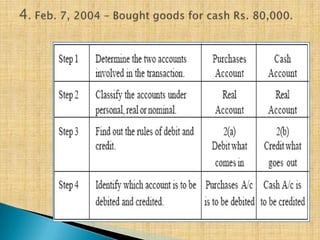
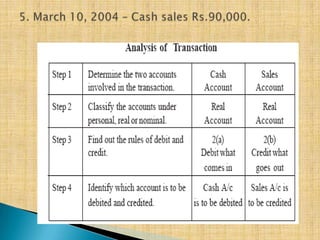
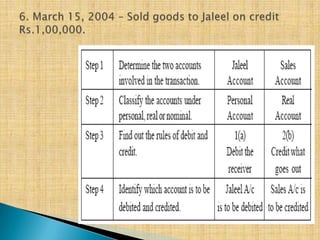
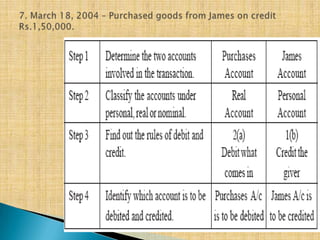
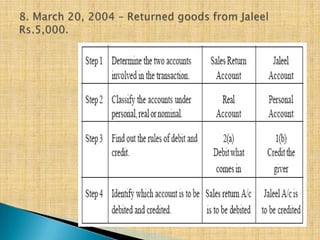
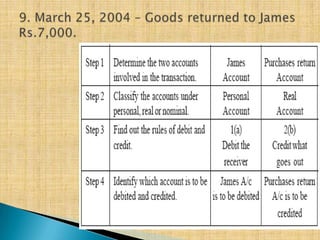
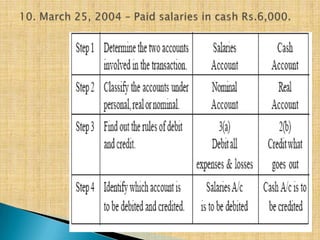
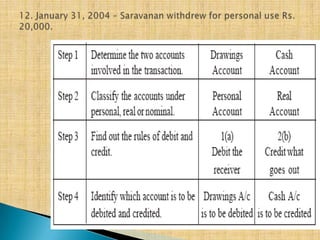
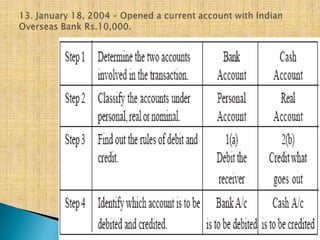
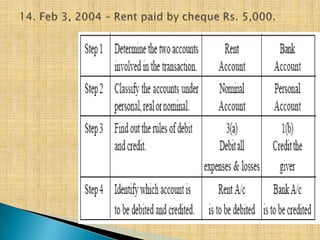
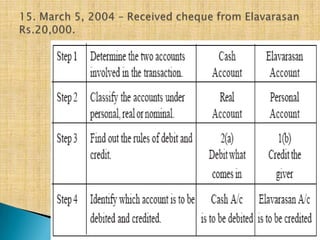
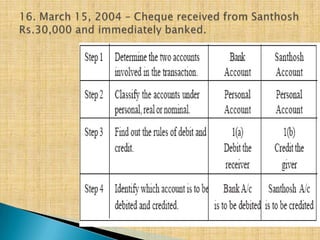
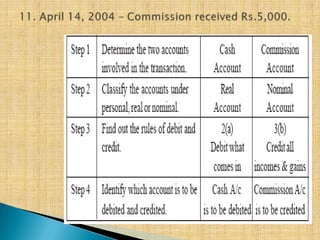
Step 1 Determine the two accounts which are involved in the
transaction.
Step 2 Classify the above two accounts under Personal, Real or
Nominal.
Step 3 Find out the rules of debit and credit for the above two
accounts.
Step 4 Identify which account is to be debited and which account is to
be credited.
Step 5 Record the date of transaction in the date column. The year and
month is written once, till they change. The sequence of the dates and
months should be strictly maintained.
•

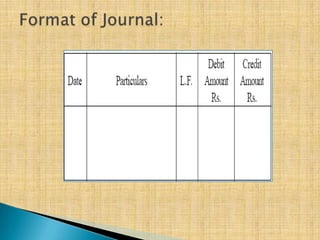
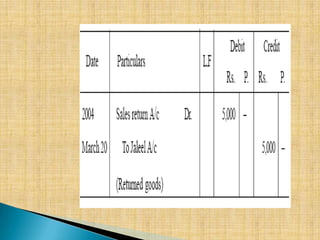
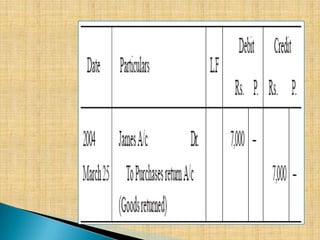
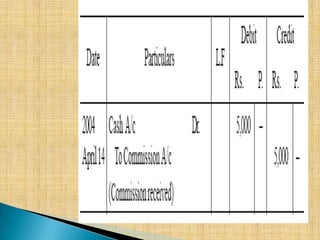
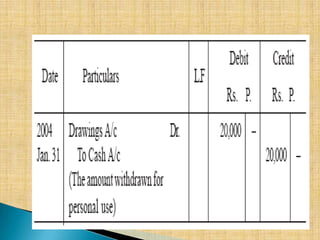
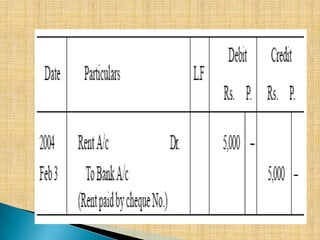
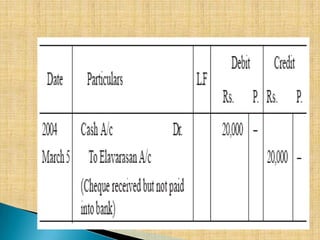
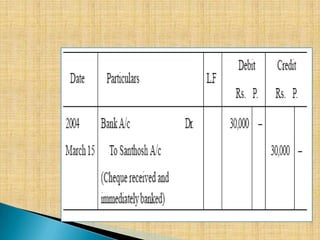
Step 6 Enter the name of the account to be debited in the

particulars column very close to the left hand side of the
particulars column followed by the abbreviation Dr. in the same
line. Against this, the amount to be debited is written in the debit
amount column in the same line.
•

Step 7 Write the name of the account to be credited in the

second line starts with the word ‘To’ a few space away from the
margin in the particulars column. Against this, the amount to be
credited is written in the credit amount column in the same line.
•

Step 8 Write the narration within brackets in the next line in

the particulars column.
•

Step 9 Draw a line across the entire particulars column to

separate one journal entry from the other.


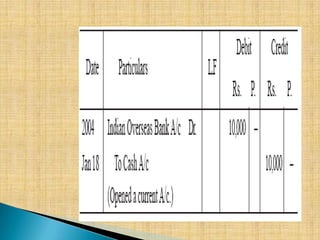
January 1, 2004 – Sravan started business
with Rs. 1,00,000.


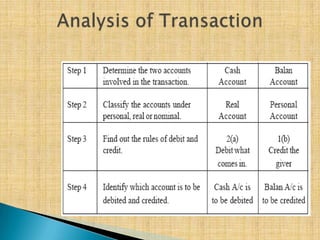
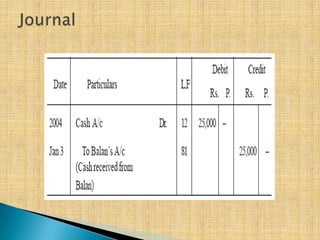
Jan. 3, 2004 : Received cash from Balan Rs.
25,000


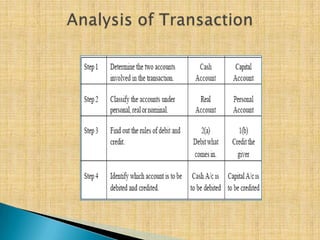
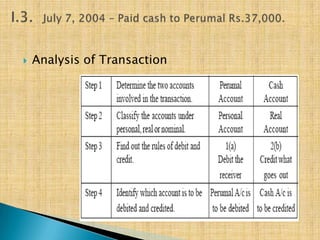
Analysis of Transaction


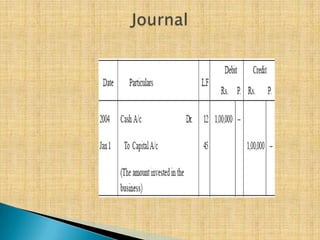
Journal
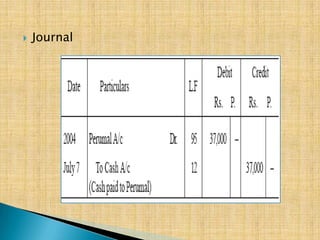
Journal
Journal
Journal
Journal
Journal
Journal
Journal
A Ledger is a book which contains all the
accounts whether personal, real or nominal,
which are first entered in journal or special
purpose subsidiary books.
According to L.C. Cropper, „the book
which contains a classified and permanent record
of all the transactions of a business is called the
Ledger‟.
The following are the advantages of ledger:
i. Complete information at a glance:
All the transactions pertaining to an account are collected at
one place in the ledger. By looking at the balance of that account,
one can understand the collective effect of all such transactions at
a glance.
ii. Arithmetical Accuracy
With the help of ledger balances, Trial balance can be
prepared to know the arithmetical accuracy of accounts.
iii. Result of Business Operations
It facilitates the preparation of final accounts for ascertaining
the operating result and the financial position of the business
concern.
iv. Accounting information
The data supplied by various ledger accounts are
summarized, analyzed and interpreted for obtaining various
accounting information.
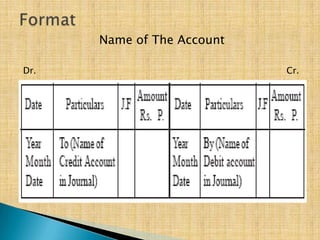
Name of The Account
Dr.

Cr.


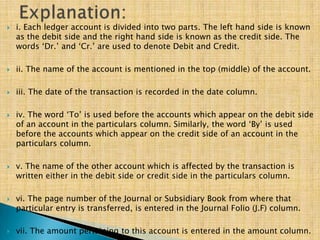
i. Each ledger account is divided into two parts. The left hand side is known
as the debit side and the right hand side is known as the credit side. The
words „Dr.‟ and „Cr.‟ are used to denote Debit and Credit.



ii. The name of the account is mentioned in the top (middle) of the account.



iii. The date of the transaction is recorded in the date column.









iv. The word „To‟ is used before the accounts which appear on the debit side
of an account in the particulars column. Similarly, the word „By‟ is used
before the accounts which appear on the credit side of an account in the
particulars column.
v. The name of the other account which is affected by the transaction is
written either in the debit side or credit side in the particulars column.
vi. The page number of the Journal or Subsidiary Book from where that
particular entry is transferred, is entered in the Journal Folio (J.F) column.
vii. The amount pertaining to this account is entered in the amount column.
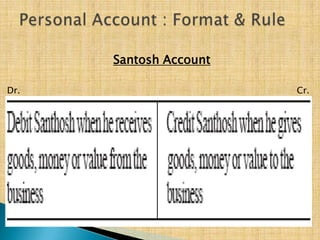
Santosh Account
Dr.

Cr.
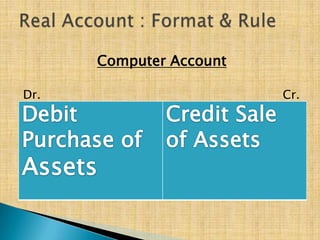
Computer Account
Dr.

Cr.
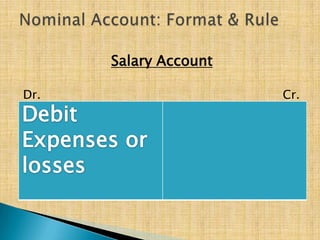
Salary Account
Dr.

Cr.
Commission Received Account
Dr.

Cr.
The process of transferring the
entries recorded in the journal or subsidiary
books to the respective accounts opened in
the ledger is called Posting.
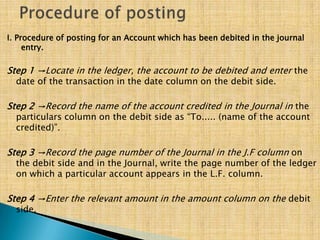
I. Procedure of posting for an Account which has been debited in the journal
entry.

Step 1 →Locate in the ledger, the account to be debited and enter the
date of the transaction in the date column on the debit side.

Step 2 →Record the name of the account credited in the Journal in the

particulars column on the debit side as “To..... (name of the account
credited)”.

Step 3 →Record the page number of the Journal in the J.F column on

the debit side and in the Journal, write the page number of the ledger
on which a particular account appears in the L.F. column.

Step 4 →Enter the relevant amount in the amount column on the debit
side.
II. Procedure of posting for an Account which has been credited in the
journal entry.

Step 1 →Locate in the ledger the account to be credited and enter the date
of the transaction in the date column on the credit side.

Step 2 → Record the name of the account debited in the Journal in the

particulars column on the credit side as “By...... (name of the account
debited)”

Step 3 → Record the page number of the Journal in the J.F column on the
credit side and in the Journal, write the page number of the ledger on
which a particular account appears in the L.F. column.

Step 4 → Enter the relevant amount in the amount column on the credit
side.


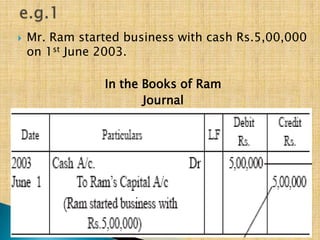
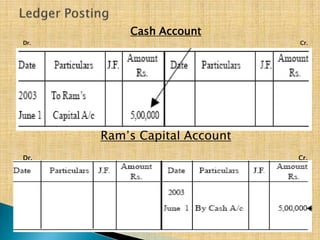
Mr. Ram started business with cash Rs.5,00,000
on 1st June 2003.

In the Books of Ram
Journal
Cash Account
Dr.

Cr.

Ram‟s Capital Account
Dr.

Cr.
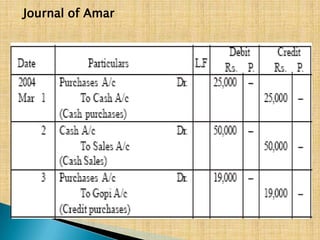
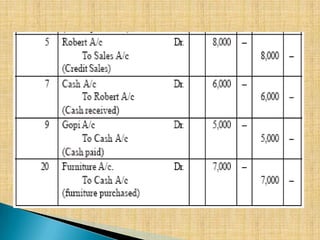
Journalise the following transactions in the books of
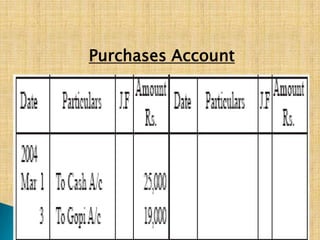
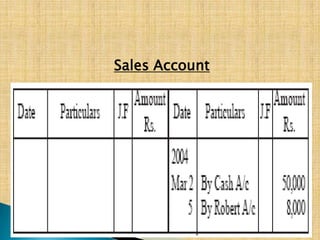
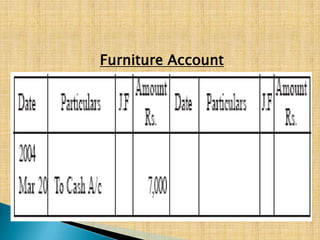
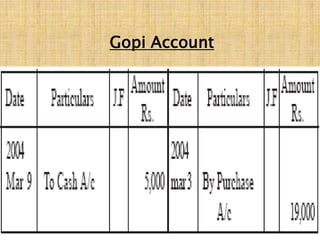
Amar and post them in the Ledger:2004
March1
2
3
5
7
9
20

Bought goods for cash Rs. 25,000
Sold goods for cash Rs. 50,000
Bought goods for credit from Gopi Rs.19,000
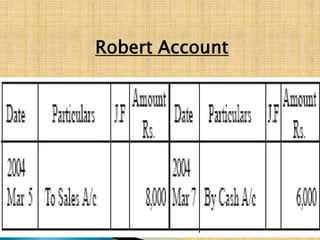
Sold goods on credit to Robert Rs.8,000
Received from Robert Rs. 6,000
Paid to Gopi Rs.5,000
Bought furniture for cash Rs. 7,000
Journal of Amar
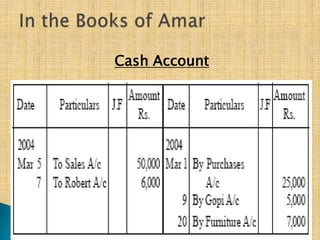
There are six accounts involved:
Cash, Purchases, Sales, Furniture, Gopi &
Robert, so six accounts are to be opened in
the ledger.
Cash Account
Purchases Account
Sales Account
Furniture Account
Gopi Account
Robert Account
Compound or Combined Journal Entry is one where more
than one transactions are recorded by passing only one
journal entry instead of passing several journal entries.
Since every debit must have the corresponding equal
amount of credit, special care must be taken in posting the
compound journal entry, where there may be only one debit
aspect but many corresponding credit aspects of equal value
or vise versa.
The posting of such transactions is done in the same way
as already explained.
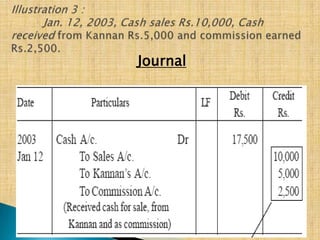
Journal

Accounting cycle

  • 1.
    Accounting Cycle Unit 1Introduction to Accounting
  • 2.
    Step 1 :Identifying Financial Transactions 1. Classify the following items into Personal, Real and Nominal Accounts. 1. Capital 2. Sales 3. Drawings 4. Outstanding salary 5. Cash 6. Rent 7. Interest paid 8. Indian Bank 9. Discount received 10. Building 11. Bank 12. Chandrasekar 13. Murugan Lending Library 14. Advertisement 15. Purchases  t
  • 3.
     Capital ◦ Personal account  Sales ◦Real account  Drawings ◦ Personal account  Outstanding salary ◦ Personal (Representative) account  Cash ◦ Real account  Rent ◦ Nominal account  Interest paid ◦ Nominal account
  • 4.
     Indian Bank ◦ Personal(Legal Body) account  Discount received ◦  Nominal account Building ◦ Real account  Bank ◦ Personal account  Chandrasekhar ◦ Personal account  Murugan Lending Library ◦ Personal account  Advertisement ◦ Nominal account  Purchases ◦ Real account
  • 5.
    2. Classify the followingitems personal and nominal accounts      a. Capital b. Purchases c. Goodwill d. Copyright e. Latha into f. State Bank of India g. Electricity Charges h. Dividend i. Ramesh j. Outstanding rent real,
  • 6.
     Capital ◦ Personal account  StateBank of India ◦ Personal account  Purchases ◦ Real account  Electricity Charges ◦ Real account  Goodwill ◦ Nominal account
  • 7.
     Dividend ◦ Nominal account  Copyright ◦  Realaccount Ramesh ◦ Personal account  Latha ◦ Personal account  Outstanding rent ◦ Personal account
  • 8.
     Show the AccountingEquation on the basis of the following transactions: ◦ ◦ ◦ ◦ ◦ ◦ ◦ ◦ ◦ ◦ 1. Maharajan commenced business with cash 1,00,000 2. Purchased goods for cash 70,000 3. Purchased goods on credit 80,000 4. Purchased furniture for cash 3,000 5. Paid rent 2,000 6. Sold goods for cash costing Rs.45,000 60,000 7. Paid to creditors 20,000 8. Withdrew cash for private use 10,000 9. Paid salaries 5,000 10. Sold goods on credit (cost price Rs.60,000) 80,000
  • 10.
  • 12.
     Journal ◦ Journal isa date-wise record of all the transactions with details of ◦ the accounts debited and credited and the amount of each transaction.
  • 14.
    The process ofanalyzing the business transactions under the heads of debit and credit and recording them in the Journal is called Journalizing. An entry made in the journal is called a ‘Journal Entry’. Step 1 Determine the two accounts which are involved in the transaction. Step 2 Classify the above two accounts under Personal, Real or Nominal. Step 3 Find out the rules of debit and credit for the above two accounts. Step 4 Identify which account is to be debited and which account is to be credited. Step 5 Record the date of transaction in the date column. The year and month is written once, till they change. The sequence of the dates and months should be strictly maintained.
  • 15.
    • Step 6 Enterthe name of the account to be debited in the particulars column very close to the left hand side of the particulars column followed by the abbreviation Dr. in the same line. Against this, the amount to be debited is written in the debit amount column in the same line. • Step 7 Write the name of the account to be credited in the second line starts with the word ‘To’ a few space away from the margin in the particulars column. Against this, the amount to be credited is written in the credit amount column in the same line. • Step 8 Write the narration within brackets in the next line in the particulars column. • Step 9 Draw a line across the entire particulars column to separate one journal entry from the other.
  • 16.
     January 1, 2004– Sravan started business with Rs. 1,00,000.
  • 19.
     Jan. 3, 2004: Received cash from Balan Rs. 25,000
  • 22.
  • 23.
  • 50.
  • 51.
  • 52.
  • 53.
  • 54.
  • 55.
  • 56.
  • 57.
    A Ledger isa book which contains all the accounts whether personal, real or nominal, which are first entered in journal or special purpose subsidiary books. According to L.C. Cropper, „the book which contains a classified and permanent record of all the transactions of a business is called the Ledger‟.
  • 58.
    The following arethe advantages of ledger: i. Complete information at a glance: All the transactions pertaining to an account are collected at one place in the ledger. By looking at the balance of that account, one can understand the collective effect of all such transactions at a glance. ii. Arithmetical Accuracy With the help of ledger balances, Trial balance can be prepared to know the arithmetical accuracy of accounts. iii. Result of Business Operations It facilitates the preparation of final accounts for ascertaining the operating result and the financial position of the business concern. iv. Accounting information The data supplied by various ledger accounts are summarized, analyzed and interpreted for obtaining various accounting information.
  • 59.
    Name of TheAccount Dr. Cr.
  • 60.
     i. Each ledgeraccount is divided into two parts. The left hand side is known as the debit side and the right hand side is known as the credit side. The words „Dr.‟ and „Cr.‟ are used to denote Debit and Credit.  ii. The name of the account is mentioned in the top (middle) of the account.  iii. The date of the transaction is recorded in the date column.     iv. The word „To‟ is used before the accounts which appear on the debit side of an account in the particulars column. Similarly, the word „By‟ is used before the accounts which appear on the credit side of an account in the particulars column. v. The name of the other account which is affected by the transaction is written either in the debit side or credit side in the particulars column. vi. The page number of the Journal or Subsidiary Book from where that particular entry is transferred, is entered in the Journal Folio (J.F) column. vii. The amount pertaining to this account is entered in the amount column.
  • 61.
  • 62.
  • 63.
  • 64.
  • 65.
    The process oftransferring the entries recorded in the journal or subsidiary books to the respective accounts opened in the ledger is called Posting.
  • 66.
    I. Procedure ofposting for an Account which has been debited in the journal entry. Step 1 →Locate in the ledger, the account to be debited and enter the date of the transaction in the date column on the debit side. Step 2 →Record the name of the account credited in the Journal in the particulars column on the debit side as “To..... (name of the account credited)”. Step 3 →Record the page number of the Journal in the J.F column on the debit side and in the Journal, write the page number of the ledger on which a particular account appears in the L.F. column. Step 4 →Enter the relevant amount in the amount column on the debit side.
  • 67.
    II. Procedure ofposting for an Account which has been credited in the journal entry. Step 1 →Locate in the ledger the account to be credited and enter the date of the transaction in the date column on the credit side. Step 2 → Record the name of the account debited in the Journal in the particulars column on the credit side as “By...... (name of the account debited)” Step 3 → Record the page number of the Journal in the J.F column on the credit side and in the Journal, write the page number of the ledger on which a particular account appears in the L.F. column. Step 4 → Enter the relevant amount in the amount column on the credit side.
  • 68.
     Mr. Ram startedbusiness with cash Rs.5,00,000 on 1st June 2003. In the Books of Ram Journal
  • 69.
  • 70.
    Journalise the followingtransactions in the books of Amar and post them in the Ledger:2004 March1 2 3 5 7 9 20 Bought goods for cash Rs. 25,000 Sold goods for cash Rs. 50,000 Bought goods for credit from Gopi Rs.19,000 Sold goods on credit to Robert Rs.8,000 Received from Robert Rs. 6,000 Paid to Gopi Rs.5,000 Bought furniture for cash Rs. 7,000
  • 71.
  • 73.
    There are sixaccounts involved: Cash, Purchases, Sales, Furniture, Gopi & Robert, so six accounts are to be opened in the ledger.
  • 74.
  • 75.
  • 76.
  • 77.
  • 78.
  • 79.
  • 80.
    Compound or CombinedJournal Entry is one where more than one transactions are recorded by passing only one journal entry instead of passing several journal entries. Since every debit must have the corresponding equal amount of credit, special care must be taken in posting the compound journal entry, where there may be only one debit aspect but many corresponding credit aspects of equal value or vise versa. The posting of such transactions is done in the same way as already explained.
  • 81.