Process COSTing
KALPITA VARMA 44
PALLAVI ZORE 63
SAYLI PANDIT 29
AKANKSHA KADAM 18
TANVI CHAVAN 06
INTRODUCTION
 Process costing is a special BRANCH of costing
used by the manufacturing industries.
 Who are involved in converting the RAW
MATERIAL into the FINISHED PRODUCT.
 Such work of conversation is done step by step ,
each step called “a process” .
 Process costing is a method of allocating
manufacturing cost to products to determine an
average cost per unit.
WHAT IS PROCESS COSTING
??
 Process costing is a method of costing
used to find out the cost of the product in
each process.
 It is used to calculate cost per unit of
product is ascertained at each stage of
production.
 It is a form of operations costing.
 Process costing is used in industries like
chemicals, textiles, steel, rubber, sugar,
shoes, petrol, etc.
OVERVIEW OF PROCESS COSTING
SYSTEMS
FEATURES
CONTINUOUS
HOMOGENEOUS
STANDARDIZED
EQUIVALENT
PRODUCTION
UNITS
PURPOSE OF PROCESS
COSTING
 To control the process.
 To know cumulative cost.
 To calculate the value of inventory of raw
material, work-in- progress and finished goods
at the end of the period.
 It is also used to assign price of the products.
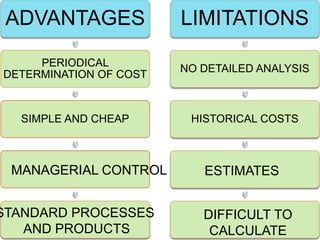
ADVANTAGES
PERIODICAL
DETERMINATION OF COST
SIMPLE AND CHEAP
LIMITATIONS
NO DETAILED ANALYSIS
HISTORICAL COSTS
MANAGERIAL CONTROL
STANDARD PROCESSES
AND PRODUCTS
ESTIMATES
DIFFICULT TO
CALCULATE
TERMS IN PROCESS
COSTING
 NORMAL LOSS
Normal loss is inherent in the processing
operation and which cannot be avoided.
Therefore it is also called as Unavoidable Loss.
 ABNORMAL LOSS
If the actual loss is greater than normal loss, then
such excess loss over and above the normal loss
is termed as abnormal loss.
 ABNORMAL GAIN
If the actual loss is less than the normal loss then
such different in the actual and normal loss is
termed as abnormal gains.
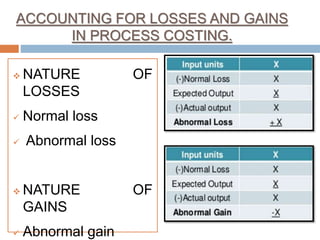
ACCOUNTING FOR LOSSES AND GAINS
IN PROCESS COSTING.
 NATURE OF
LOSSES
 Normal loss
 Abnormal loss
 NATURE OF
GAINS
 Abnormal gain
PROFOMA OF PROCESS COSTING
Cost per unit = total of debit side amount-total of credit side amoun
total of debit side units – total of credit side units
Q) The product of manufacturing concern passes through two processes A and
B and then to finished stock . It is ascertained that in each process 5% of total
weight is lost and 10% is scrap which from process A and B realize Rs80 and
Rs200 per tonns respectively.
The following are the figures relating to both the processes -
Particulars Process A Process B
Material (tonns) 1000 70
Cost per tone (Rs) 125 200
Wages (Rs) 28000 10000
Manufacturing Exp (Rs) 8000 5250
Output (tone) 830 780
Prepare process cost A/Cs showing cost per tone of each process .There
was no stock of work-in-process in any process.
Solution :
Note : Units = Tonns
particular
s
Uni
ts
CP
U
Amount
s
particulars unit
s
CPU Amount
s
To
material
100
0
125 125000 By loss of
weight(5%)
50 - -
To wages 28000 By normal
loss(10%)
100 80 8000
To
manufactu
ring exp.
8000 By
abnormal
loss
20 180 3600
By output
transferred
to process
B
830 180 149400
100
0
161000 100
0
161000
Process “ A ” A/CDr. Cr
.
particulars unit
s
CP
U
amoun
t
particulars uni
ts
CP
U
amount
To input transferred
from process A
830 180 149400 By loss of
weight(5%)
45 - -
To material 70 200 14000 By normal
loss(10%)
90 200 18000
To wages 10000 By out put
transferred to
finished goods
780 210 163800
To manufacturing
exp.
5250
To abnormal gains 15 210 3150
915 181800 915 181800
Process “B ” A/cDr. Cr.
Particular
s
Unit
s
CPU amoun
t
Particular
s
units CPU amoun
t
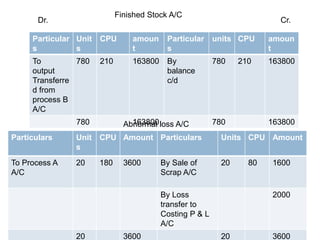
To
output
Transferre
d from
process B
A/C
780 210 163800 By
balance
c/d
780 210 163800
780 163800 780 163800
Finished Stock A/C
Dr. Cr.
Particulars Unit
s
CPU Amount Particulars Units CPU Amount
To Process A
A/C
20 180 3600 By Sale of
Scrap A/C
20 80 1600
By Loss
transfer to
Costing P & L
A/C
2000
20 3600 20 3600
Abnormal loss A/C
• Lastly the process costing system provides
the mechanism to survive in a today’s price
competing world. It facilitates the effective
pricing.
• When the cost of achieving good quality
increases, cost of poor quality decreases
automatically
Process costing

Process costing

  • 1.
    Process COSTing KALPITA VARMA44 PALLAVI ZORE 63 SAYLI PANDIT 29 AKANKSHA KADAM 18 TANVI CHAVAN 06
  • 2.
    INTRODUCTION  Process costingis a special BRANCH of costing used by the manufacturing industries.  Who are involved in converting the RAW MATERIAL into the FINISHED PRODUCT.  Such work of conversation is done step by step , each step called “a process” .  Process costing is a method of allocating manufacturing cost to products to determine an average cost per unit.
  • 3.
    WHAT IS PROCESSCOSTING ??  Process costing is a method of costing used to find out the cost of the product in each process.  It is used to calculate cost per unit of product is ascertained at each stage of production.  It is a form of operations costing.  Process costing is used in industries like chemicals, textiles, steel, rubber, sugar, shoes, petrol, etc.
  • 4.
    OVERVIEW OF PROCESSCOSTING SYSTEMS
  • 5.
  • 6.
    PURPOSE OF PROCESS COSTING To control the process.  To know cumulative cost.  To calculate the value of inventory of raw material, work-in- progress and finished goods at the end of the period.  It is also used to assign price of the products.
  • 7.
    ADVANTAGES PERIODICAL DETERMINATION OF COST SIMPLEAND CHEAP LIMITATIONS NO DETAILED ANALYSIS HISTORICAL COSTS MANAGERIAL CONTROL STANDARD PROCESSES AND PRODUCTS ESTIMATES DIFFICULT TO CALCULATE
  • 9.
    TERMS IN PROCESS COSTING NORMAL LOSS Normal loss is inherent in the processing operation and which cannot be avoided. Therefore it is also called as Unavoidable Loss.  ABNORMAL LOSS If the actual loss is greater than normal loss, then such excess loss over and above the normal loss is termed as abnormal loss.  ABNORMAL GAIN If the actual loss is less than the normal loss then such different in the actual and normal loss is termed as abnormal gains.
  • 10.
    ACCOUNTING FOR LOSSESAND GAINS IN PROCESS COSTING.  NATURE OF LOSSES  Normal loss  Abnormal loss  NATURE OF GAINS  Abnormal gain
  • 11.
  • 13.
    Cost per unit= total of debit side amount-total of credit side amoun total of debit side units – total of credit side units
  • 14.
    Q) The productof manufacturing concern passes through two processes A and B and then to finished stock . It is ascertained that in each process 5% of total weight is lost and 10% is scrap which from process A and B realize Rs80 and Rs200 per tonns respectively. The following are the figures relating to both the processes - Particulars Process A Process B Material (tonns) 1000 70 Cost per tone (Rs) 125 200 Wages (Rs) 28000 10000 Manufacturing Exp (Rs) 8000 5250 Output (tone) 830 780 Prepare process cost A/Cs showing cost per tone of each process .There was no stock of work-in-process in any process.
  • 15.
    Solution : Note :Units = Tonns particular s Uni ts CP U Amount s particulars unit s CPU Amount s To material 100 0 125 125000 By loss of weight(5%) 50 - - To wages 28000 By normal loss(10%) 100 80 8000 To manufactu ring exp. 8000 By abnormal loss 20 180 3600 By output transferred to process B 830 180 149400 100 0 161000 100 0 161000 Process “ A ” A/CDr. Cr .
  • 16.
    particulars unit s CP U amoun t particulars uni ts CP U amount Toinput transferred from process A 830 180 149400 By loss of weight(5%) 45 - - To material 70 200 14000 By normal loss(10%) 90 200 18000 To wages 10000 By out put transferred to finished goods 780 210 163800 To manufacturing exp. 5250 To abnormal gains 15 210 3150 915 181800 915 181800 Process “B ” A/cDr. Cr.
  • 17.
    Particular s Unit s CPU amoun t Particular s units CPUamoun t To output Transferre d from process B A/C 780 210 163800 By balance c/d 780 210 163800 780 163800 780 163800 Finished Stock A/C Dr. Cr. Particulars Unit s CPU Amount Particulars Units CPU Amount To Process A A/C 20 180 3600 By Sale of Scrap A/C 20 80 1600 By Loss transfer to Costing P & L A/C 2000 20 3600 20 3600 Abnormal loss A/C
  • 18.
    • Lastly theprocess costing system provides the mechanism to survive in a today’s price competing world. It facilitates the effective pricing. • When the cost of achieving good quality increases, cost of poor quality decreases automatically