LEDGER
Mrs. Pooja Kumar
Faculty
IMS, RU
Ranchi
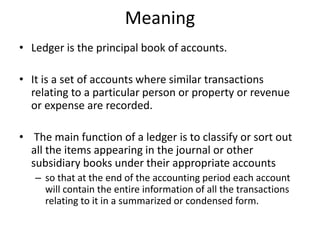
Meaning
• Ledger is the principal book of accounts.
• It is a set of accounts where similar transactions
relating to a particular person or property or revenue
or expense are recorded.
• The main function of a ledger is to classify or sort out
all the items appearing in the journal or other
subsidiary books under their appropriate accounts
– so that at the end of the accounting period each account
will contain the entire information of all the transactions
relating to it in a summarized or condensed form.
Features of ledger
• Ledger is an account book that contains various accounts to which various
business transactions of a business enterprise are posted.
• It is a book of final entry because the transactions that are first entered in
the journal or special purpose Books are finally posted in the ledger.
• It is also called the Principal Book of Accounts.
• In the ledger all types of accounts relating to assets, liabilities, capital,
revenue and expenses are maintained.
• It is a permanent record of business transactions classified into relevant
• accounts.
• It is the ‘reference book of accounting system and is used to classify and
summaries transactions to facilitate the preparation of financial
statements.
Purpose of Ledger
i) Quick information about various
transactions
ii) Proper control over transactions
iii) Helpful in preparing Trial Balance
iv) Helpful in preparing Financial Statements
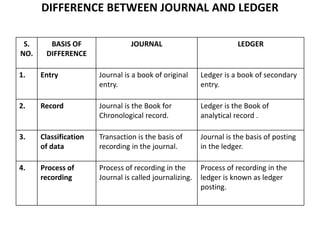
DIFFERENCE BETWEEN JOURNAL AND LEDGER
S.
NO.
BASIS OF
DIFFERENCE
JOURNAL LEDGER
1. Entry Journal is a book of original
entry.
Ledger is a book of secondary
entry.
2. Record Journal is the Book for
Chronological record.
Ledger is the Book of
analytical record .
3. Classification
of data
Transaction is the basis of
recording in the journal.
Journal is the basis of posting
in the ledger.
4. Process of
recording
Process of recording in the
Journal is called journalizing.
Process of recording in the
ledger is known as ledger
posting.
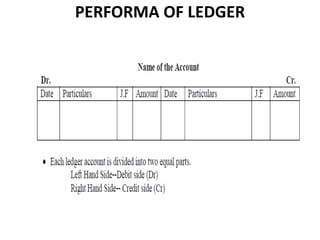
PERFORMA OF LEDGER
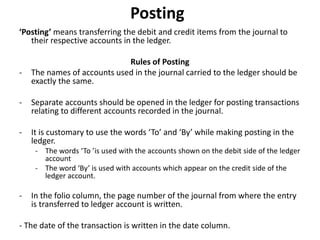
Posting
‘Posting’ means transferring the debit and credit items from the journal to
their respective accounts in the ledger.
Rules of Posting
- The names of accounts used in the journal carried to the ledger should be
exactly the same.
- Separate accounts should be opened in the ledger for posting transactions
relating to different accounts recorded in the journal.
- It is customary to use the words ‘To’ and ‘By’ while making posting in the
ledger.
- The words ‘To ’is used with the accounts shown on the debit side of the ledger
account
- The word ‘By’ is used with accounts which appear on the credit side of the
ledger account.
- In the folio column, the page number of the journal from where the entry
is transferred to ledger account is written.
- The date of the transaction is written in the date column.
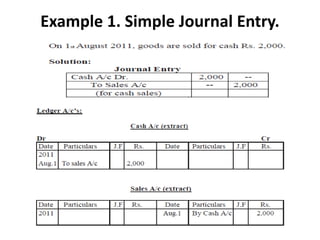
Example 1. Simple Journal Entry.
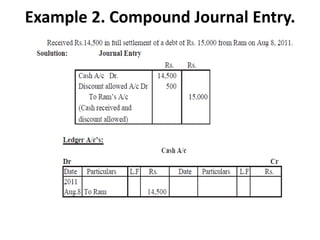
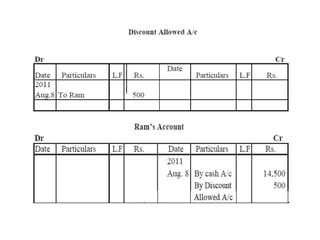
Example 2. Compound Journal Entry.
Illustration 1
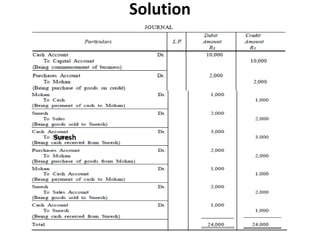
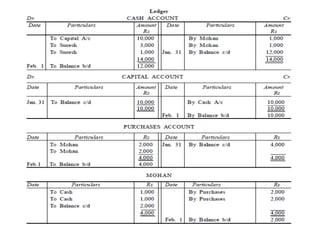
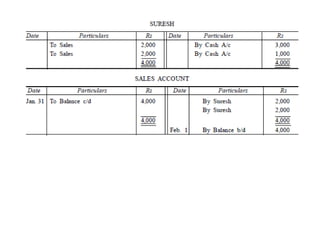
Journalize the following transactions, post them in the
Ledger and balance the accounts on 31 January:
1. Ram started business with a capital of Rs 10,000.
2. He purchased goods from Mohan on credit Rs 2,000.
3. He paid cash to Mohan Rs 1,000.
4. He sold goods to Suresh Rs 2,000.
5. He received cash from Suresh Rs 3,000.
6. He further purchased goods from Mohan Rs 2,000.
7. He paid cash to Mohan Rs 1,000.
8. He further sold goods to Suresh Rs 2,000.
9. He received cash from Suresh Rs 1,000.
Solution
Suresh
Importance of Ledger
• Knowledge of Business results
• Knowledge of book value of assets
• Useful for management
• Knowledge of Financial Position
• Instant Information
Types of Ledger
TRIAL BALANCE
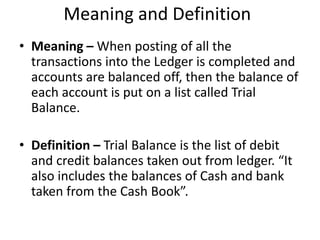
Meaning and Definition
• Meaning – When posting of all the
transactions into the Ledger is completed and
accounts are balanced off, then the balance of
each account is put on a list called Trial
Balance.
• Definition – Trial Balance is the list of debit
and credit balances taken out from ledger. “It
also includes the balances of Cash and bank
taken from the Cash Book”.
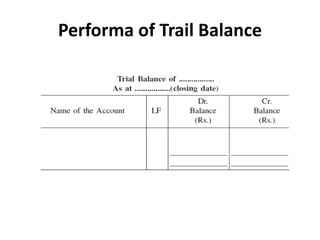
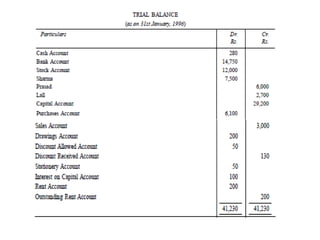
Performa of Trail Balance
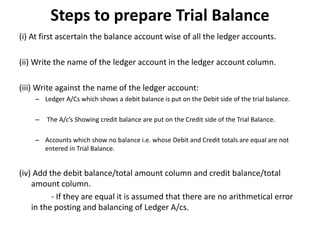
Steps to prepare Trial Balance
(i) At first ascertain the balance account wise of all the ledger accounts.
(ii) Write the name of the ledger account in the ledger account column.
(iii) Write against the name of the ledger account:
– Ledger A/Cs which shows a debit balance is put on the Debit side of the trial balance.
– The A/c’s Showing credit balance are put on the Credit side of the Trial Balance.
– Accounts which show no balance i.e. whose Debit and Credit totals are equal are not
entered in Trial Balance.
(iv) Add the debit balance/total amount column and credit balance/total
amount column.
- If they are equal it is assumed that there are no arithmetical error
in the posting and balancing of Ledger A/cs.
Objectives or Functions of Trial Balance
• It helps in ascertaining the arithmetical
accuracy of ledger accounts.
• Helps in locating errors.
• Provides the summary of Ledger A/c’s.
• Helps in the preparation of Final A/c’s.
CAUSES FOR THE DISAGREEMENT OF A TRIAL BALANCE
• Omission of posting in one account.
• Double posting in one account.
• Posting in the wrong side of an account.
• Posting wrong amount in an account.
• Omitting to post the total of a subsidiary book.
• Wrong totaling or balancing of an account.
• Omission of an account from Trial Balance.
• Writing the balance of an account in the wrong column of the Trial Balance.
• Wrong totaling of the Trial Balance
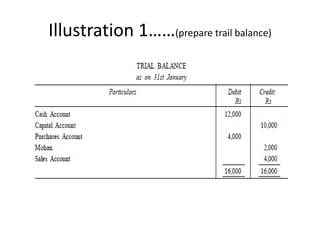
Illustration 1……(prepare trail balance)
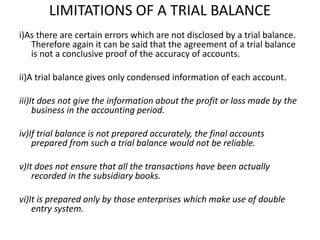
LIMITATIONS OF A TRIAL BALANCE
i)As there are certain errors which are not disclosed by a trial balance.
Therefore again it can be said that the agreement of a trial balance
is not a conclusive proof of the accuracy of accounts.
ii)A trial balance gives only condensed information of each account.
iii)It does not give the information about the profit or loss made by the
business in the accounting period.
iv)If trial balance is not prepared accurately, the final accounts
prepared from such a trial balance would not be reliable.
v)It does not ensure that all the transactions have been actually
recorded in the subsidiary books.
vi)It is prepared only by those enterprises which make use of double
entry system.
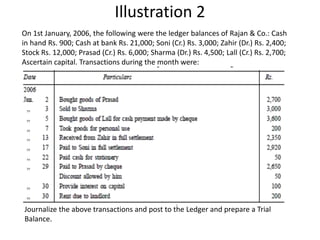
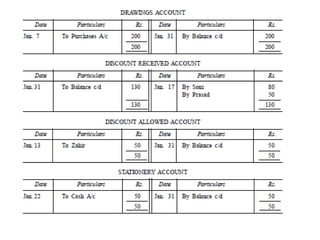
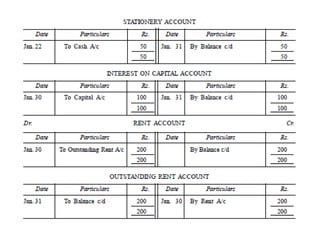
Illustration 2
On 1st January, 2006, the following were the ledger balances of Rajan & Co.: Cash
in hand Rs. 900; Cash at bank Rs. 21,000; Soni (Cr.) Rs. 3,000; Zahir (Dr.) Rs. 2,400;
Stock Rs. 12,000; Prasad (Cr.) Rs. 6,000; Sharma (Dr.) Rs. 4,500; Lall (Cr.) Rs. 2,700;
Ascertain capital. Transactions during the month were:
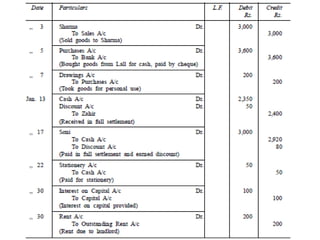
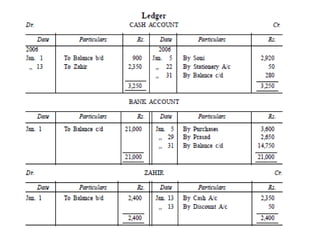
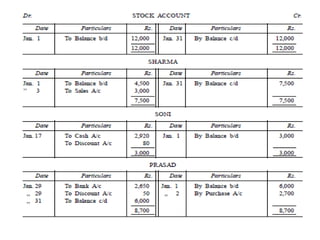
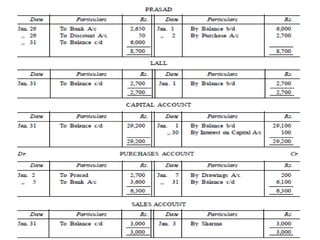
Journalize the above transactions and post to the Ledger and prepare a Trial
Balance.
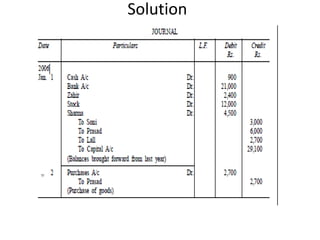
Solution
3.1.  LEDGER & TRAIL BALANCE.pptx

3.1. LEDGER & TRAIL BALANCE.pptx

  • 1.
  • 2.
    Meaning • Ledger isthe principal book of accounts. • It is a set of accounts where similar transactions relating to a particular person or property or revenue or expense are recorded. • The main function of a ledger is to classify or sort out all the items appearing in the journal or other subsidiary books under their appropriate accounts – so that at the end of the accounting period each account will contain the entire information of all the transactions relating to it in a summarized or condensed form.
  • 3.
    Features of ledger •Ledger is an account book that contains various accounts to which various business transactions of a business enterprise are posted. • It is a book of final entry because the transactions that are first entered in the journal or special purpose Books are finally posted in the ledger. • It is also called the Principal Book of Accounts. • In the ledger all types of accounts relating to assets, liabilities, capital, revenue and expenses are maintained. • It is a permanent record of business transactions classified into relevant • accounts. • It is the ‘reference book of accounting system and is used to classify and summaries transactions to facilitate the preparation of financial statements.
  • 4.
    Purpose of Ledger i)Quick information about various transactions ii) Proper control over transactions iii) Helpful in preparing Trial Balance iv) Helpful in preparing Financial Statements
  • 5.
    DIFFERENCE BETWEEN JOURNALAND LEDGER S. NO. BASIS OF DIFFERENCE JOURNAL LEDGER 1. Entry Journal is a book of original entry. Ledger is a book of secondary entry. 2. Record Journal is the Book for Chronological record. Ledger is the Book of analytical record . 3. Classification of data Transaction is the basis of recording in the journal. Journal is the basis of posting in the ledger. 4. Process of recording Process of recording in the Journal is called journalizing. Process of recording in the ledger is known as ledger posting.
  • 6.
  • 7.
    Posting ‘Posting’ means transferringthe debit and credit items from the journal to their respective accounts in the ledger. Rules of Posting - The names of accounts used in the journal carried to the ledger should be exactly the same. - Separate accounts should be opened in the ledger for posting transactions relating to different accounts recorded in the journal. - It is customary to use the words ‘To’ and ‘By’ while making posting in the ledger. - The words ‘To ’is used with the accounts shown on the debit side of the ledger account - The word ‘By’ is used with accounts which appear on the credit side of the ledger account. - In the folio column, the page number of the journal from where the entry is transferred to ledger account is written. - The date of the transaction is written in the date column.
  • 8.
    Example 1. SimpleJournal Entry.
  • 9.
    Example 2. CompoundJournal Entry.
  • 12.
    Illustration 1 Journalize thefollowing transactions, post them in the Ledger and balance the accounts on 31 January: 1. Ram started business with a capital of Rs 10,000. 2. He purchased goods from Mohan on credit Rs 2,000. 3. He paid cash to Mohan Rs 1,000. 4. He sold goods to Suresh Rs 2,000. 5. He received cash from Suresh Rs 3,000. 6. He further purchased goods from Mohan Rs 2,000. 7. He paid cash to Mohan Rs 1,000. 8. He further sold goods to Suresh Rs 2,000. 9. He received cash from Suresh Rs 1,000.
  • 13.
  • 16.
    Importance of Ledger •Knowledge of Business results • Knowledge of book value of assets • Useful for management • Knowledge of Financial Position • Instant Information
  • 17.
  • 18.
  • 19.
    Meaning and Definition •Meaning – When posting of all the transactions into the Ledger is completed and accounts are balanced off, then the balance of each account is put on a list called Trial Balance. • Definition – Trial Balance is the list of debit and credit balances taken out from ledger. “It also includes the balances of Cash and bank taken from the Cash Book”.
  • 20.
  • 21.
    Steps to prepareTrial Balance (i) At first ascertain the balance account wise of all the ledger accounts. (ii) Write the name of the ledger account in the ledger account column. (iii) Write against the name of the ledger account: – Ledger A/Cs which shows a debit balance is put on the Debit side of the trial balance. – The A/c’s Showing credit balance are put on the Credit side of the Trial Balance. – Accounts which show no balance i.e. whose Debit and Credit totals are equal are not entered in Trial Balance. (iv) Add the debit balance/total amount column and credit balance/total amount column. - If they are equal it is assumed that there are no arithmetical error in the posting and balancing of Ledger A/cs.
  • 22.
    Objectives or Functionsof Trial Balance • It helps in ascertaining the arithmetical accuracy of ledger accounts. • Helps in locating errors. • Provides the summary of Ledger A/c’s. • Helps in the preparation of Final A/c’s.
  • 23.
    CAUSES FOR THEDISAGREEMENT OF A TRIAL BALANCE • Omission of posting in one account. • Double posting in one account. • Posting in the wrong side of an account. • Posting wrong amount in an account. • Omitting to post the total of a subsidiary book. • Wrong totaling or balancing of an account. • Omission of an account from Trial Balance. • Writing the balance of an account in the wrong column of the Trial Balance. • Wrong totaling of the Trial Balance
  • 24.
  • 25.
    LIMITATIONS OF ATRIAL BALANCE i)As there are certain errors which are not disclosed by a trial balance. Therefore again it can be said that the agreement of a trial balance is not a conclusive proof of the accuracy of accounts. ii)A trial balance gives only condensed information of each account. iii)It does not give the information about the profit or loss made by the business in the accounting period. iv)If trial balance is not prepared accurately, the final accounts prepared from such a trial balance would not be reliable. v)It does not ensure that all the transactions have been actually recorded in the subsidiary books. vi)It is prepared only by those enterprises which make use of double entry system.
  • 26.
    Illustration 2 On 1stJanuary, 2006, the following were the ledger balances of Rajan & Co.: Cash in hand Rs. 900; Cash at bank Rs. 21,000; Soni (Cr.) Rs. 3,000; Zahir (Dr.) Rs. 2,400; Stock Rs. 12,000; Prasad (Cr.) Rs. 6,000; Sharma (Dr.) Rs. 4,500; Lall (Cr.) Rs. 2,700; Ascertain capital. Transactions during the month were: Journalize the above transactions and post to the Ledger and prepare a Trial Balance.
  • 27.