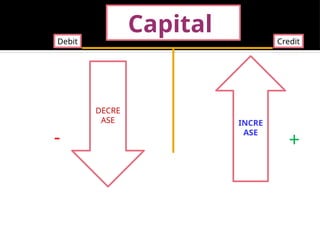
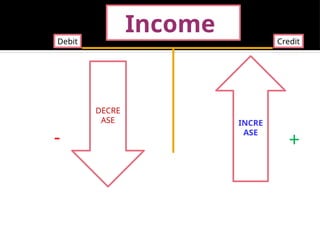
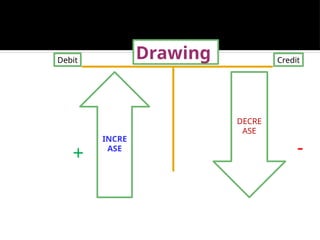
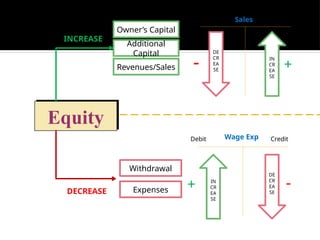
3
Definitions
• Book offirst entry
Journal
• Separate record showing
increases and decreases in
a specific assets or liability
Account
•A group of accounts for a business
entity
Ledger
•List of account and their balances at
a given time
Trial balance
4.
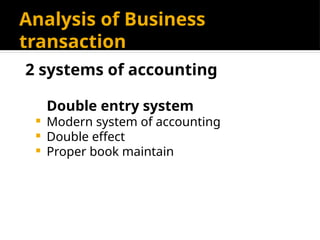
Analysis of Business
transaction
singleentry system
Old system of accounting
Single effect
Accounting records are not kept strictly
Only cash and person account maintain
Profit not accurate
Two system of accounting
Double entry conceptof
accounting
Based on a simple concept: each party in a
business transaction will receive something
and give something in return.
* The two sides of a coin
* Receive & Give
* Left versus Right
7.
7
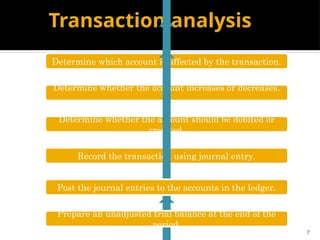
Transaction analysis
Determine whichaccount is affected by the transaction.
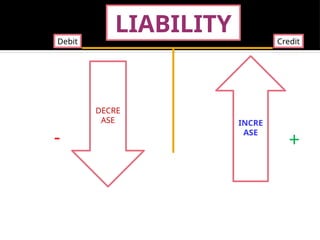
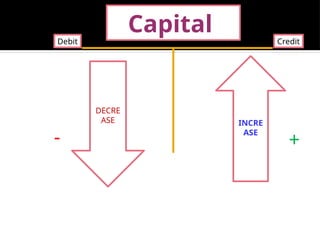
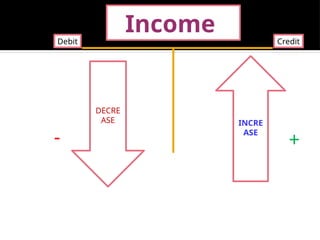
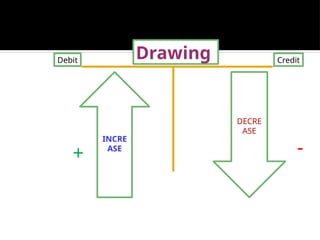
Determine whether the account increases or decreases.
Determine whether the account should be debited or
credited.
Record the transaction using journal entry.
Post the journal entries to the accounts in the ledger.
Prepare an unadjusted trial balance at the end of the
period.
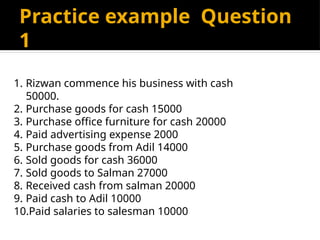
Practice example Question
1
1.Rizwan commence his business with cash
50000.
2. Purchase goods for cash 15000
3. Purchase office furniture for cash 20000
4. Paid advertising expense 2000
5. Purchase goods from Adil 14000
6. Sold goods for cash 36000
7. Sold goods to Salman 27000
8. Received cash from salman 20000
9. Paid cash to Adil 10000
10.Paid salaries to salesman 10000
17.
Practice example Question
2
1.Invested 100000 cash, building 75000 and furniture
25000.
2. Purchase goods for cash 44000 subject trade
discount 10%.
3. Purchase goods from Ali 5000
4. Sold goods on account to Zain 8000.
5. Receive cash from Zain 7800, discount allowed 200
6. Paid Ali 4750, discount received 250
7. Goods taken away by the owner 350
8. Paid salaries 1000, Rent 600 and Repairing charges
400
9. Received commission 1500
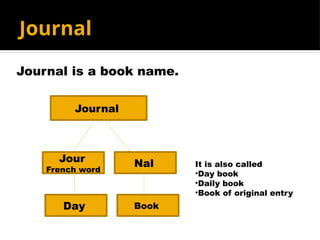
Journal
Journal is abook name.
Journal
Jour
French word
Nal
Day Book
It is also called
•Day book
•Daily book
•Book of original entry
20.
20
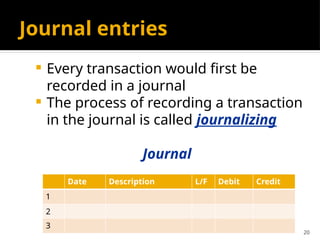
Journal entries
Everytransaction would first be
recorded in a journal
The process of recording a transaction
in the journal is called journalizing
Journal
Date Description L/F Debit Credit
1
2
3
21.
21
Journalizing steps
1. Recordthe date.
2. Record the title of the account debited in
the Description column.
3. Enter the amount in the Debit column.
4. Record the title of the account credited in
the Description column.
5. Enter the amount in the Credit column.
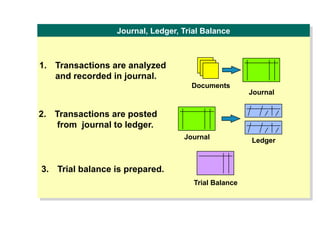
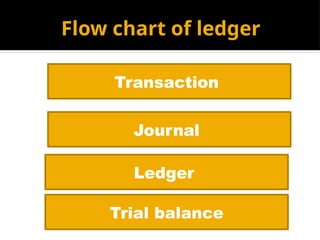
1. Transactions areanalyzed
and recorded in journal.
Documents
Journal
2. Transactions are posted
from journal to ledger.
Journal Ledger
3. Trial balance is prepared.
Journal, Ledger, Trial Balance
Trial Balance
30.
Journal entries
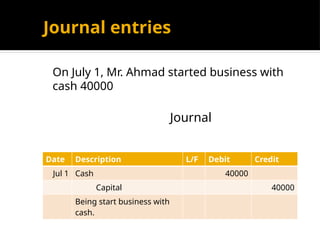
On July1, Mr. Ahmad started business with
cash 40000
Journal
Date Description L/F Debit Credit
Jul 1 Cash 40000
Capital 40000
Being start business with
cash.
31.
On July 5,Mr. Ahmad bought a piece of
land for Rupees 200,000 by paying cash.
Date Description PR Debit Credit
Nov 5 Land 200,000
Cash 200,000
Purchased land for
cash.
Dr Cr
Land Dr Cr
Cash
Jul 5 Land 200,000 Jul 5 Cash 200,000
32.
July10, Mr. Ahmadpurchased goods
on account for Rupees 13,500.
Date Description l/F Debit Credit
Jul10 Purchases 13,500
Accounts Payable 13,500
Purchased goods on
account.
Dr Cr
Purchases Dr Cr
A/C Payable
Jul 10 A/C Pay 13,500 Jul 10 Supplies 13,500
33.
July 30, Mr.Ahmad paid to creditors
Rs.9,500.
Date Description PR Debit Credit
Jul 30 Accounts Payable 9,500
Cash 9,500
Paid creditors.
Dr Cr
A/C Payable Dr Cr
Cash
Jul 30 Cash 9,500 Jul 30 A/C Pay 9,500
34.
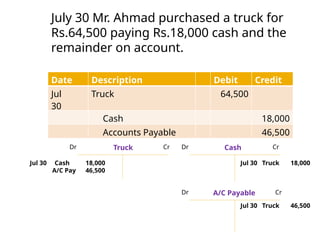
July 30 Mr.Ahmad purchased a truck for
Rs.64,500 paying Rs.18,000 cash and the
remainder on account.
Date Description Debit Credit
Jul
30
Truck 64,500
Cash 18,000
Accounts Payable 46,500
Dr Cr
Truck Dr Cr
A/C Payable
Jul 30 Cash 18,000
A/C Pay 46,500
Jul 30 Truck 18,000
Dr Cr
Cash
Jul 30 Truck 46,500
35.
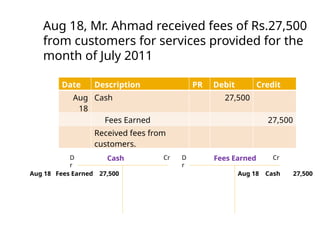
Aug 18, Mr.Ahmad received fees of Rs.27,500
from customers for services provided for the
month of July 2011
Date Description PR Debit Credit
Aug
18
Cash 27,500
Fees Earned 27,500
Received fees from
customers.
D
r
Cr Fees Earned
D
r
Cr
Cash
Aug 18 Fees Earned 27,500 Aug 18 Cash 27,500
36.
Aug 30 incurredthe following expenses:
wages Rs.20,500; and rent Rs3,000 paid by
cash.
Date Description PR Debit Credit
Aug
30
Wages account 20,500
cash account 20,500
Aug
30
Rent account 3,000
Cash account 3,000
D
r
Cr Wages Payable
D
r
Cr
Wages Exp
Aug 30 Wages Pay 20,500 Aug 30 Wages Exp
20,500
D
r
Cr Cash
D
r
Cr
Rent Exp
Aug 30 Cash 3,000 Aug 30 Rent Exp 3,000
37.
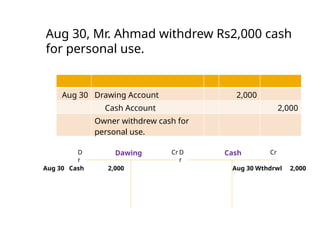
Aug 30, Mr.Ahmad withdrew Rs2,000 cash
for personal use.
Aug 30 Drawing Account 2,000
Cash Account 2,000
Owner withdrew cash for
personal use.
D
r
Cr Cash
D
r
Cr
Dawing
Aug 30 Cash 2,000 Aug 30 Wthdrwl 2,000
38.
Problem No. 2
Introduce cash 148000 and building
20000 as capital.
Purchase goods on account 100000
Purchase Motor vehicle from saleem auto
150000
Sold goods to Imran at list price trade
discount 5% Rs. 5000.
Paid travelling allowance 1000
39.
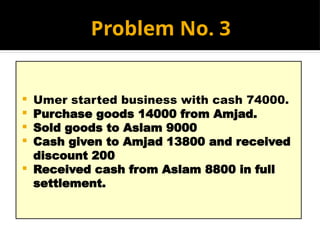
Problem No. 3
Umer started business with cash 74000.
Purchase goods 14000 from Amjad.
Sold goods to Aslam 9000
Cash given to Amjad 13800 and received
discount 200
Received cash from Aslam 8800 in full
settlement.
40.
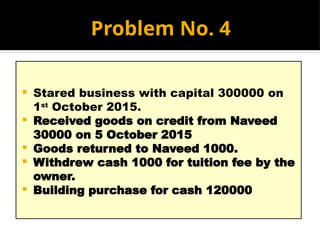
Problem No. 4
Stared business with capital 300000 on
1st
October 2015.
Received goods on credit from Naveed
30000 on 5 October 2015
Goods returned to Naveed 1000.
Withdrew cash 1000 for tuition fee by the
owner.
Building purchase for cash 120000
41.
Problem No. 5
Qaiser started business with cash 20000
Goods purchased from Ansar 10000
Goods lost by accident 12000
Goods given away as charity 5000
Cash given away as charity 1000
charged depreciation on machinery1000
42.
Problem No. 7
Started business with cash 60000
Deposit cash into bank 400000
Goods bought by cheque 150000
Purchased goods for cash 10000 and on
credit 5000 from Ali.
Sold goods for cash 12000 and on account
6000 to Aslam.
Ali’s account settled by receiving 200 as
discount
Aslam’s account settled by allowing 200 as
discount
43.
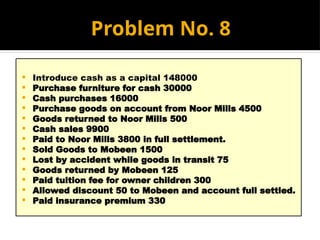
Problem No. 8
Introduce cash as a capital 148000
Purchase furniture for cash 30000
Cash purchases 16000
Purchase goods on account from Noor Mills 4500
Goods returned to Noor Mills 500
Cash sales 9900
Paid to Noor Mills 3800 in full settlement.
Sold Goods to Mobeen 1500
Lost by accident while goods in transit 75
Goods returned by Mobeen 125
Paid tuition fee for owner children 300
Allowed discount 50 to Mobeen and account full settled.
Paid insurance premium 330
44.
Ledger
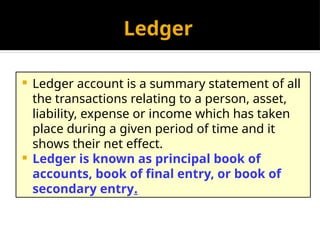
Ledger accountis a summary statement of all
the transactions relating to a person, asset,
liability, expense or income which has taken
place during a given period of time and it
shows their net effect.
Ledger is known as principal book of
accounts, book of final entry, or book of
secondary entry.
Utility of ledger
Completeinformation at a glance
Arithmetical accuracy
Result of business operations
Accounting information
47.
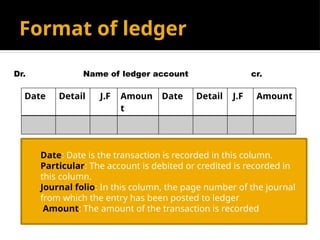
Format of ledger
Date:Date is the transaction is recorded in this column.
Particular: The account is debited or credited is recorded in
this column.
Journal folio: In this column, the page number of the journal
from which the entry has been posted to ledger
Amount: The amount of the transaction is recorded
Date Detail J.F Amoun
t
Date Detail J.F Amount
Name of ledger account
Dr. cr.
48.
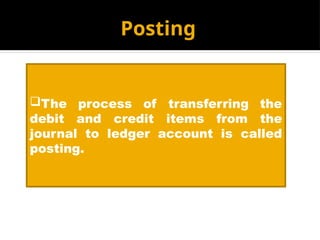
Posting
The process oftransferring the
debit and credit items from the
journal to ledger account is called
posting.
49.
Balancing of ledger
Balancingis the difference between
the total debits and the total credit of
an account.
When the posting is done, many accounts may have entries on
their debit side as well as credit side. The net result of such
debits and credits is an account is the balance.
Balancing means the writing of the difference between of the
two sides in the lighter (smaller total) side, so that the grand
total of two sides become equal.
50.
Significance of balancing
Thereare three possibilities while
balancing an account duing a given
period. It may be a debit balance or
credit balance or a nil balance
depending upon the debit total and
the credit total
51.
Trial balance
Atrial balance is a report that lists the
balances of all general ledge account of
a company at a certain point of time.
52.
Objective of trialbalance
To establish arithmetical accuracy of
books
To provide a base for preparation of
financial statements.
To summaries the ledger account.
53.
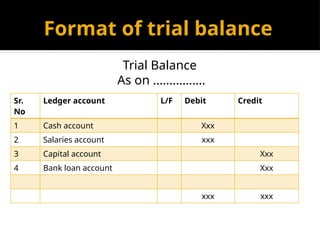
Format of trialbalance
Sr.
No
Ledger account L/F Debit Credit
1 Cash account Xxx
2 Salaries account xxx
3 Capital account Xxx
4 Bank loan account Xxx
xxx xxx
Trial Balance
As on …………….
54.
Format of trialbalance
Sr.
No
Ledger account L/F Debit Credit
1 Cash account Xxx
2 Salaries account xxx
3 Capital account Xxx
4 Bank loan account Xxx
xxx xxx
Trial Balance
As on …………….