The ledger is the principal book of
accounting system. It contains
different accounts where
transactions relating to that
account are recorded .A ledger is
the collection of all the accounts
,debited or credited ,in the journal
proper and various special journal.
A ledger is very useful and is of
utmost importance in the
organization. The net result of all
transactions in respect of a
particular account on a given date
can ascertained only from the
ledger
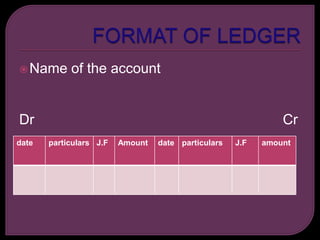
Name of the account
Dr Cr
date particulars J.F Amount date particulars J.F amount
Title of the account : The name of the item
is written at the top of the format as the
title of the account .the title of the account
ends with suffix account
Dr :Dr means debit side of the account that
is left side and Cr means credit side of the
account
Particulars :Name of the item with
reference to the original book of entry is
written on debit/credit side of the account
Journal folio : It records the page number
of the original book of entry on which
relevant transaction is recorded .this
column is filled up at the time of posting
Amount :This column records the amount
in numerical figure, corresponding to what
has been entered in the amount column of
the original book of entry
The journal is the book of first entry ;The
ledger is the book of second entry
 The journal is the book for chronological
record ;The ledger is the book for analytical
record
 The journal. as a book of source entry ,gets
greater importance as legal evidence than the
ledger
Transaction is the basis of classification of
data within the journal ; account is the
basis classification of data within the
ledger
Process of recording in the journal is called
journalising ; the process of recording in
the ledger is known as posting
Ledger accounts are classified in to five
categories namely assets, liabilities,
capital, revenues/ gains, and expense
losses. All these accounts may further be
put in to two groups, i.e. permanent
accounts and temporary accounts .All
permanent accounts are balanced and
carried forward to the next accounting
period .
The temporary accounts are closed at the
end of the accounting period by
transferring them to the trading and profit
and loss account. All permanent accounts
appears in the balance sheet.
THANK YOU
……………

Ledger

  • 2.
    The ledger isthe principal book of accounting system. It contains different accounts where transactions relating to that account are recorded .A ledger is the collection of all the accounts ,debited or credited ,in the journal proper and various special journal.
  • 3.
    A ledger isvery useful and is of utmost importance in the organization. The net result of all transactions in respect of a particular account on a given date can ascertained only from the ledger
  • 4.
    Name of theaccount Dr Cr date particulars J.F Amount date particulars J.F amount
  • 5.
    Title of theaccount : The name of the item is written at the top of the format as the title of the account .the title of the account ends with suffix account Dr :Dr means debit side of the account that is left side and Cr means credit side of the account Particulars :Name of the item with reference to the original book of entry is written on debit/credit side of the account
  • 6.
    Journal folio :It records the page number of the original book of entry on which relevant transaction is recorded .this column is filled up at the time of posting Amount :This column records the amount in numerical figure, corresponding to what has been entered in the amount column of the original book of entry
  • 7.
    The journal isthe book of first entry ;The ledger is the book of second entry  The journal is the book for chronological record ;The ledger is the book for analytical record  The journal. as a book of source entry ,gets greater importance as legal evidence than the ledger
  • 8.
    Transaction is thebasis of classification of data within the journal ; account is the basis classification of data within the ledger Process of recording in the journal is called journalising ; the process of recording in the ledger is known as posting
  • 9.
    Ledger accounts areclassified in to five categories namely assets, liabilities, capital, revenues/ gains, and expense losses. All these accounts may further be put in to two groups, i.e. permanent accounts and temporary accounts .All permanent accounts are balanced and carried forward to the next accounting period .
  • 10.
    The temporary accountsare closed at the end of the accounting period by transferring them to the trading and profit and loss account. All permanent accounts appears in the balance sheet.
  • 11.