Introduction to Financial
Management
Financial Management
Srinivas Methuku
Money itself is neither created nor destroyed,
its simply transferred from one perception to another.
What is finance??
What is Finance???
• Finance is the art & science of managing
'MONEY'.
• Finance is the life blood of Business (funds).
• “Finance v/s Money”
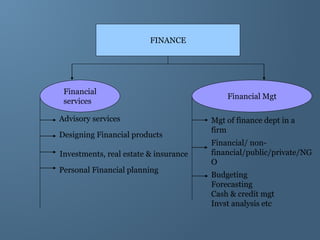
FINANCE
Financial
services
Financial Mgt
Advisory services

Designing Financial products
Investments, real estate & insurance
Personal Financial planning
Mgt of finance dept in a
firm
Financial/ non-
financial/public/private/NG
O
Budgeting
Forecasting
Cash & credit mgt
Invst analysis etc
Financial Management
• According to Ezra Solamn “Financial
management is concerned with the
efficient use of an important economic
resources viz capital funds”.
• Financial Management means planning,
organizing, directing and controlling the
financial activities such as procurement
and utilization of funds of the enterprise.
Meaning: Financial Management
• Financial Management is an operational activity,
which is accountable for the effective utilization
of funds necessary for operations. One of the
primary objectives of financial management is to
maintain enough money to meet the necessary
current and capital expenditure, apart from
maximizing profits.
Nature of Financial Management
 Financial management is mainly concerned with
the proper management of funds.
 The financial manager must see that the funds
are procured in a manner that there is risk, cost
and control considerations are properly
balanced in a given situation and there is
optimum utilization of funds.
Financial Management Process
• Assess Current Financial Position
• Define and Prioritizing Goals
• Financial and Investment Plan
• Implementation of the Plan
• Monitor, Evaluate and Adjust Performance
Scope of Financial Management
• Scope covers both acquisition & utilisation of
funds – efficient and wise allocation of funds to
various uses.
• Financial mgt involves providing solutions for
major financial operations of a firm
- Investment decisions
- Financing decisions
- Dividend policy decisions
Investment decision/ function
• Investment decisions relates to the selection of
assets (fixed & current assets) in which
funds will be invested by a firm.
• Invst in fixed & long term assets & projects is
called capital budgeting – volume of invst ,
risk & returns , cost of capital.
• Invst & mgt of current assets is called
working capital mgt –mgt of cash, inventory
& receivables, profitabilty & liquidity.
Financing Decision / Function
• Financing decisions are concerned with the
Capital structure decisions of a firm
( proportion of debt & equity).
• Creating proper mix between debt & equity –
optimum capital structure.
• Tradeoff between risk & return.
Dividend policy decisions /
functions
• Deciding the Dividend payout ratio considering
the benefit of shareholders & firm both.
• Dividend decision should be analysed in relation
to the financing decisions of the firm.
Duties / Roles / Responsibilities of
a Financial manager
• Performing Financial Analysis
• Making Investment decisions
• Making Financing decisions
Performing financial analysis &
planning
• Transforming financing data into form which
can be used for decision making.
• Determing need for additional (reducing)
finance.
Making investment decisions
• Determine the mix of current assets & fixed
assets to be held by a firm.
• Determine the type of asset in each category
Making Financing decisions
• Determining mix of short term & long term
financing.
• Indepth analysis of available financing
alternatives , their costs & long term
implications.
Risk Return Trade-Off
• Amount of Return = Amount of Risk Undertaken
• Amt X of Loss is more Epochal than Amt X of Gain
• Risk Averse Instrument have High Demand Raising
the Price and Lowering the Returns.
• Risk Premium is the Higher Return gained over
Risk Free Returns.
Emerging / Changing role of
Finance managers in India
• Post liberalisation the role of finance
manager has become more important,
complex & demanding.
• Industrial licensing abolished and scope of
private sector investment has increased.
• Abolition of MRTP
• Abolition of Capital issues control act –
freedom in designing and issuing securities.
• Market determined interest rate and
exchange rate volatality.
• Globalisation, FDI.
• Investors have become more demanding and
assertive.
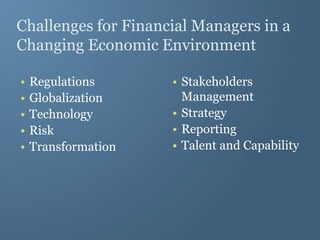
Challenges for Financial Managers in a
Changing Economic Environment
• Regulations
• Globalization
• Technology
• Risk
• Transformation
• Stakeholders
Management
• Strategy
• Reporting
• Talent and Capability
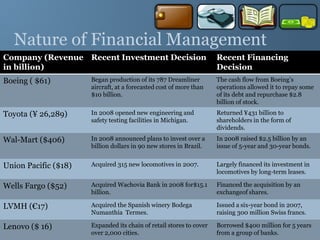
Nature of Financial Management
Company (Revenue
in billion)
Recent Investment Decision Recent Financing
Decision
Boeing ( $61) Began production of its 787 Dreamliner
aircraft, at a forecasted cost of more than
$10 billion.
The cash flow from Boeing’s
operations allowed it to repay some
of its debt and repurchase $2.8
billion of stock.
Toyota (¥ 26,289) In 2008 opened new engineering and
safety testing facilities in Michigan.
Returned ¥431 billion to
shareholders in the form of
dividends.
Wal-Mart ($406) In 2008 announced plans to invest over a
billion dollars in 90 new stores in Brazil.
In 2008 raised $2.5 billion by an
issue of 5-year and 30-year bonds.
Union Pacific ($18) Acquired 315 new locomotives in 2007. Largely financed its investment in
locomotives by long-term leases.
Wells Fargo ($52) Acquired Wachovia Bank in 2008 for$15.1
billion.
Financed the acquisition by an
exchangeof shares.
LVMH (€17) Acquired the Spanish winery Bodega
Numanthia Termes.
Issued a six-year bond in 2007,
raising 300 million Swiss francs.
Lenovo ($ 16) Expanded its chain of retail stores to cover
over 2,000 cities.
Borrowed $400 million for 5 years
from a group of banks.
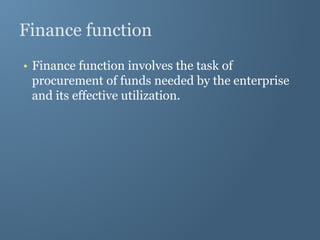
Finance function
• Finance function involves the task of
procurement of funds needed by the enterprise
and its effective utilization.
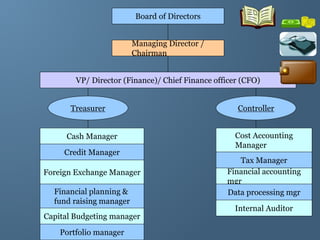
Organisation of Finance function
Board of Directors
Managing Director /
Chairman
VP/ Director (Finance)/ Chief Finance officer (CFO)
Treasurer Controller
Cash Manager
Credit Manager
Foreign Exchange Manager
Financial planning &
fund raising manager
Capital Budgeting manager
Portfolio manager
Cost Accounting
Manager
Tax Manager
Financial accounting
mgr
Data processing mgr
Internal Auditor
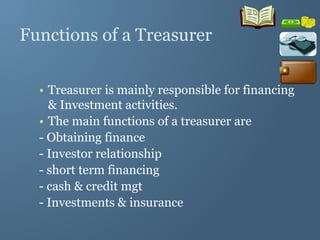
Functions of a Treasurer
• Treasurer is mainly responsible for financing
& Investment activities.
• The main functions of a treasurer are
- Obtaining finance
- Investor relationship
- short term financing
- cash & credit mgt
- Investments & insurance
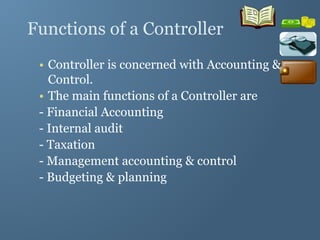
Functions of a Controller
• Controller is concerned with Accounting &
Control.
• The main functions of a Controller are
- Financial Accounting
- Internal audit
- Taxation
- Management accounting & control
- Budgeting & planning
Objectives of financial Management
a. Financial objectives
b. Non-Financial Objectives
Financial objectives or Financial Goals
 Profit maximization (profit after tax)
 Maximizing EPS(earnings Per Share)
 Wealth Maximization.
Profit Maximization
Maximizing the Rupee Income of Firm
Resources are efficiently utilized
Appropriate measure of firm performance
Serves interest of society also
Objections to Profit Maximization
• It is Vague
• It Ignores the Timing of Returns
• It Ignores Quality of benefits
Shareholders’ Wealth Maximization
• Maximizes the net present value.
• Fundamental objective — maximize the
market value of the firm’s shares
Maximizing EPS
• Ignores timing and risk of the expected
benefit.
• Maximizing EPS will not result in highest
price for company's shares.
Non financial Objectives
 General welfare of employees
 General welfare of society
 Fulfillment of responsibilities towards
customers, suppliers etc.
 Leadership in R&D.
 Effective utilization of funds
Interface of Financial Mgt with other
functional areas of Mgt
• Finance and Production
• Finance and Marketing
• Finance and Personnel ( Human resource)
• Finance and Research & Development
Finance and Production
• Finance is the basis of production and is
needed at every stage of production
• Planning & preparation of project report
• Acquiring raw materails, plant & machinery,
tools & spares, technological know how etc.
• Hold stocks of RM, WIP and FG .
Finance and Marketing
• Finance is needed in all vital areas of
marketing such as
• Sales promotion & Advertising
• Introduction of new products, diversification
of existing lines to satisfy customers changing
needs.
• Physical distribution of goods.
Finance and Personnel ( Human
resource)
• Finance in personnel is required for
• Recruitment
• Selection
• Training
• Promotion Schemes.
FINANCE AND RESEARCH &
DEVELOPMENT
• Finance in R& D is used for
• Innovation
• Technological up gradation
• To meet and cater the demands of changing
needs & preferences of customers
• To stay competitive
Functional Areas of Finance
• Personal Finance
• Corporate Finance
• Public Finance
Functional Areas of Finance
• Personal Finance
▫ Financial Position
▫ Adequate Protection
▫ Tax Planning
▫ Investment and Accumulation Goals
▫ Retirement Planning
▫ Estate Planning
Functional Areas of Finance
• Corporate Finance
▫ Balancing Risk and Profitability
▫ Maximizing Entity’s Wealth and Stock Value
▫ Managing the Working Capital
▫ Measure the Performance of Portfolio
Functional Areas of Finance
• Public Finance
▫ Related to Sovereign States & its entities
▫ Identification of required expenditure
▫ Source of that entities revenue
▫ Debt Issuance for Public Works Projects
Agency problem
• In corporate finance, the agency
problem usually refers to a conflict of interest
between a company's management and the
company's stockholders. The manager, acting as
the agent for the shareholders, or principals, is
supposed to make decisions that will maximize
shareholder wealth
Thank You
References:
Principles of Corporate Finance
(Brealy, Myers & Alen)
MIT OCW – Finance Theory 1
Financial Management – I M
Pandey
Financial Management M Y Khan

Introduction to financial management

  • 1.
  • 2.
    Money itself isneither created nor destroyed, its simply transferred from one perception to another.
  • 4.
  • 5.
    What is Finance??? •Finance is the art & science of managing 'MONEY'. • Finance is the life blood of Business (funds). • “Finance v/s Money”
  • 6.
    FINANCE Financial services Financial Mgt Advisory services DesigningFinancial products Investments, real estate & insurance Personal Financial planning Mgt of finance dept in a firm Financial/ non- financial/public/private/NG O Budgeting Forecasting Cash & credit mgt Invst analysis etc
  • 7.
    Financial Management • Accordingto Ezra Solamn “Financial management is concerned with the efficient use of an important economic resources viz capital funds”. • Financial Management means planning, organizing, directing and controlling the financial activities such as procurement and utilization of funds of the enterprise.
  • 8.
    Meaning: Financial Management •Financial Management is an operational activity, which is accountable for the effective utilization of funds necessary for operations. One of the primary objectives of financial management is to maintain enough money to meet the necessary current and capital expenditure, apart from maximizing profits.
  • 9.
    Nature of FinancialManagement  Financial management is mainly concerned with the proper management of funds.  The financial manager must see that the funds are procured in a manner that there is risk, cost and control considerations are properly balanced in a given situation and there is optimum utilization of funds.
  • 10.
    Financial Management Process •Assess Current Financial Position • Define and Prioritizing Goals • Financial and Investment Plan • Implementation of the Plan • Monitor, Evaluate and Adjust Performance
  • 11.
    Scope of FinancialManagement • Scope covers both acquisition & utilisation of funds – efficient and wise allocation of funds to various uses. • Financial mgt involves providing solutions for major financial operations of a firm - Investment decisions - Financing decisions - Dividend policy decisions
  • 12.
    Investment decision/ function •Investment decisions relates to the selection of assets (fixed & current assets) in which funds will be invested by a firm. • Invst in fixed & long term assets & projects is called capital budgeting – volume of invst , risk & returns , cost of capital. • Invst & mgt of current assets is called working capital mgt –mgt of cash, inventory & receivables, profitabilty & liquidity.
  • 13.
    Financing Decision /Function • Financing decisions are concerned with the Capital structure decisions of a firm ( proportion of debt & equity). • Creating proper mix between debt & equity – optimum capital structure. • Tradeoff between risk & return.
  • 14.
    Dividend policy decisions/ functions • Deciding the Dividend payout ratio considering the benefit of shareholders & firm both. • Dividend decision should be analysed in relation to the financing decisions of the firm.
  • 15.
    Duties / Roles/ Responsibilities of a Financial manager • Performing Financial Analysis • Making Investment decisions • Making Financing decisions
  • 16.
    Performing financial analysis& planning • Transforming financing data into form which can be used for decision making. • Determing need for additional (reducing) finance.
  • 17.
    Making investment decisions •Determine the mix of current assets & fixed assets to be held by a firm. • Determine the type of asset in each category
  • 18.
    Making Financing decisions •Determining mix of short term & long term financing. • Indepth analysis of available financing alternatives , their costs & long term implications.
  • 19.
    Risk Return Trade-Off •Amount of Return = Amount of Risk Undertaken • Amt X of Loss is more Epochal than Amt X of Gain • Risk Averse Instrument have High Demand Raising the Price and Lowering the Returns. • Risk Premium is the Higher Return gained over Risk Free Returns.
  • 20.
    Emerging / Changingrole of Finance managers in India • Post liberalisation the role of finance manager has become more important, complex & demanding. • Industrial licensing abolished and scope of private sector investment has increased. • Abolition of MRTP • Abolition of Capital issues control act – freedom in designing and issuing securities.
  • 21.
    • Market determinedinterest rate and exchange rate volatality. • Globalisation, FDI. • Investors have become more demanding and assertive.
  • 22.
    Challenges for FinancialManagers in a Changing Economic Environment • Regulations • Globalization • Technology • Risk • Transformation • Stakeholders Management • Strategy • Reporting • Talent and Capability
  • 23.
    Nature of FinancialManagement Company (Revenue in billion) Recent Investment Decision Recent Financing Decision Boeing ( $61) Began production of its 787 Dreamliner aircraft, at a forecasted cost of more than $10 billion. The cash flow from Boeing’s operations allowed it to repay some of its debt and repurchase $2.8 billion of stock. Toyota (¥ 26,289) In 2008 opened new engineering and safety testing facilities in Michigan. Returned ¥431 billion to shareholders in the form of dividends. Wal-Mart ($406) In 2008 announced plans to invest over a billion dollars in 90 new stores in Brazil. In 2008 raised $2.5 billion by an issue of 5-year and 30-year bonds. Union Pacific ($18) Acquired 315 new locomotives in 2007. Largely financed its investment in locomotives by long-term leases. Wells Fargo ($52) Acquired Wachovia Bank in 2008 for$15.1 billion. Financed the acquisition by an exchangeof shares. LVMH (€17) Acquired the Spanish winery Bodega Numanthia Termes. Issued a six-year bond in 2007, raising 300 million Swiss francs. Lenovo ($ 16) Expanded its chain of retail stores to cover over 2,000 cities. Borrowed $400 million for 5 years from a group of banks.
  • 24.
    Finance function • Financefunction involves the task of procurement of funds needed by the enterprise and its effective utilization.
  • 25.
  • 26.
    Board of Directors ManagingDirector / Chairman VP/ Director (Finance)/ Chief Finance officer (CFO) Treasurer Controller Cash Manager Credit Manager Foreign Exchange Manager Financial planning & fund raising manager Capital Budgeting manager Portfolio manager Cost Accounting Manager Tax Manager Financial accounting mgr Data processing mgr Internal Auditor
  • 27.
    Functions of aTreasurer • Treasurer is mainly responsible for financing & Investment activities. • The main functions of a treasurer are - Obtaining finance - Investor relationship - short term financing - cash & credit mgt - Investments & insurance
  • 28.
    Functions of aController • Controller is concerned with Accounting & Control. • The main functions of a Controller are - Financial Accounting - Internal audit - Taxation - Management accounting & control - Budgeting & planning
  • 29.
    Objectives of financialManagement a. Financial objectives b. Non-Financial Objectives
  • 30.
    Financial objectives orFinancial Goals  Profit maximization (profit after tax)  Maximizing EPS(earnings Per Share)  Wealth Maximization.
  • 31.
    Profit Maximization Maximizing theRupee Income of Firm Resources are efficiently utilized Appropriate measure of firm performance Serves interest of society also
  • 32.
    Objections to ProfitMaximization • It is Vague • It Ignores the Timing of Returns • It Ignores Quality of benefits
  • 33.
    Shareholders’ Wealth Maximization •Maximizes the net present value. • Fundamental objective — maximize the market value of the firm’s shares
  • 34.
    Maximizing EPS • Ignorestiming and risk of the expected benefit. • Maximizing EPS will not result in highest price for company's shares.
  • 35.
    Non financial Objectives General welfare of employees  General welfare of society  Fulfillment of responsibilities towards customers, suppliers etc.  Leadership in R&D.  Effective utilization of funds
  • 36.
    Interface of FinancialMgt with other functional areas of Mgt • Finance and Production • Finance and Marketing • Finance and Personnel ( Human resource) • Finance and Research & Development
  • 37.
    Finance and Production •Finance is the basis of production and is needed at every stage of production • Planning & preparation of project report • Acquiring raw materails, plant & machinery, tools & spares, technological know how etc. • Hold stocks of RM, WIP and FG .
  • 38.
    Finance and Marketing •Finance is needed in all vital areas of marketing such as • Sales promotion & Advertising • Introduction of new products, diversification of existing lines to satisfy customers changing needs. • Physical distribution of goods.
  • 39.
    Finance and Personnel( Human resource) • Finance in personnel is required for • Recruitment • Selection • Training • Promotion Schemes.
  • 40.
    FINANCE AND RESEARCH& DEVELOPMENT • Finance in R& D is used for • Innovation • Technological up gradation • To meet and cater the demands of changing needs & preferences of customers • To stay competitive
  • 41.
    Functional Areas ofFinance • Personal Finance • Corporate Finance • Public Finance
  • 42.
    Functional Areas ofFinance • Personal Finance ▫ Financial Position ▫ Adequate Protection ▫ Tax Planning ▫ Investment and Accumulation Goals ▫ Retirement Planning ▫ Estate Planning
  • 43.
    Functional Areas ofFinance • Corporate Finance ▫ Balancing Risk and Profitability ▫ Maximizing Entity’s Wealth and Stock Value ▫ Managing the Working Capital ▫ Measure the Performance of Portfolio
  • 44.
    Functional Areas ofFinance • Public Finance ▫ Related to Sovereign States & its entities ▫ Identification of required expenditure ▫ Source of that entities revenue ▫ Debt Issuance for Public Works Projects
  • 45.
    Agency problem • Incorporate finance, the agency problem usually refers to a conflict of interest between a company's management and the company's stockholders. The manager, acting as the agent for the shareholders, or principals, is supposed to make decisions that will maximize shareholder wealth
  • 46.
    Thank You References: Principles ofCorporate Finance (Brealy, Myers & Alen) MIT OCW – Finance Theory 1 Financial Management – I M Pandey Financial Management M Y Khan