TONSILITIS
BY: Mr.Ganesh V. Naik
II year MSc(N)
Pediatric Dept
SDM Institute of
Nursing Science’s Dharawad
INTRODUCTION
Tonsillitis is the term commonly used to
describe the inflammation and infection of
two palatine tonsils.
The purpose of these lymphoid tissues is
to filter and protect the respiratory and
digestive tracts from invasion by
pathogens, but often the tonsils become
site for infection.
DEFINITION
Tonsillitis is defined as an inflammation of
the tonsils and characterized by sore throat
and fever
INCIDENCE
The incidence of tonsillitis peaks between
age 4 and 7 years.
Group A Beta Hemolytic Streptococcus
infection occurs most frequently in the
winter and is spread more readily in
crowded living situation
ETIOLOGY
 The common cause of bacterial agent is Group A
Beta Hemolytic Streptococcus.
PATHOPHYSIOLOGY
Bacterial infection
Protective immunity not developed yet
(prone to infection)
Stimulate inflammatory response
Tonsilitis Inflammation of tonsils
Fever Sore throat Tonsils increase in size
May obstruct airway
CLINICAL MANIFESTATION
 Sore throat which may be persistent and recurrent
 Tonsils enlarged and bright and may be covered with
white exhudate
CONT…….
 Dysphagia (Difficulty in swallowing)
 Mouth breathing and unpleasant mouth odour
CONT…
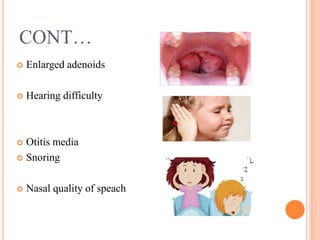
 Enlarged adenoids
 Hearing difficulty
 Otitis media
 Snoring
 Nasal quality of speach
DIAGNOSTIC EVALUATION
 Detailed history collection
 Physical examination:
 Note if the child’s voice sound muffled or hoarse.
 Inspect enlargement of tonsils
CONT….
 Throat swab culture
 Blood test
• Rapid streptococcal antigen tests
(rapid strep test) can accurately screen for group A
Beta hemolytic streptococcal infection
MANAGEMENT
MEDICAL MANAGEMENT
 During the acute phase of tonsilitis treatment is
symptomatic
 Acetaminophen or ibuprofen is used for pain.
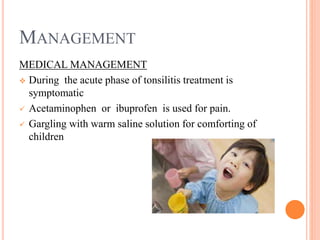
 Gargling with warm saline solution for comforting of
children
CONT…..
 Tonsillitis is most commonly treated with penicillin
given two or three times daily for 10days.
 Erythromycin may be used in children who are
allergic to penicillin
SURGICAL MANAGEMENT
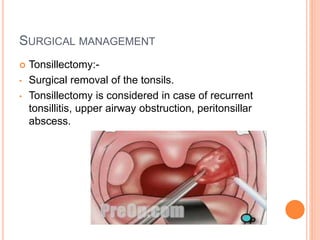
 Tonsillectomy:-
• Surgical removal of the tonsils.
• Tonsillectomy is considered in case of recurrent
tonsillitis, upper airway obstruction, peritonsillar
abscess.
CONT……
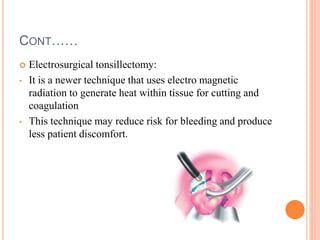
 Electrosurgical tonsillectomy:
• It is a newer technique that uses electro magnetic
radiation to generate heat within tissue for cutting and
coagulation
• This technique may reduce risk for bleeding and produce
less patient discomfort.
CONT..
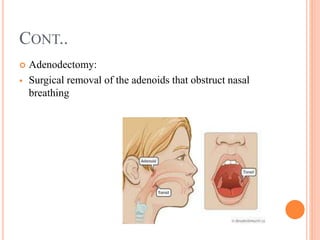
 Adenodectomy:
 Surgical removal of the adenoids that obstruct nasal
breathing
NURSING MANAGEMENT
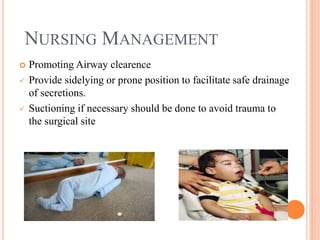
 Promoting Airway clearence
 Provide sidelying or prone position to facilitate safe drainage
of secretions.
 Suctioning if necessary should be done to avoid trauma to
the surgical site
CONT…
 Maintaining fluid volume
 Inspect throat for bleeding
 To avoid trauma to the surgical site discourage the child
from coughing, clearing the throat, blowing the nose and
using straws.
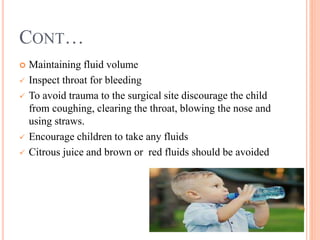
 Encourage children to take any fluids
 Citrous juice and brown or red fluids should be avoided
CONT…
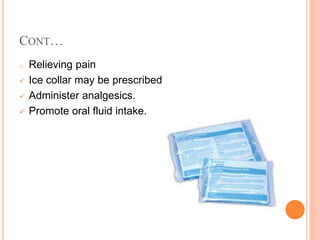
o Relieving pain
 Ice collar may be prescribed
 Administer analgesics.
 Promote oral fluid intake.
COMPLICATION
 Peritonsillar abscess
 Pharyngitis
 Blocked airway from swollen tonsills
PREVENTION
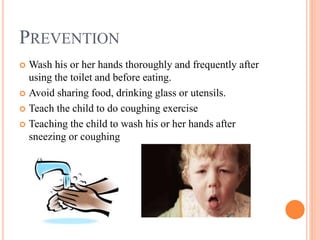
 Wash his or her hands thoroughly and frequently after
using the toilet and before eating.
 Avoid sharing food, drinking glass or utensils.
 Teach the child to do coughing exercise
 Teaching the child to wash his or her hands after
sneezing or coughing
Tonsilitis ppt 1