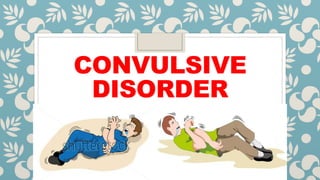
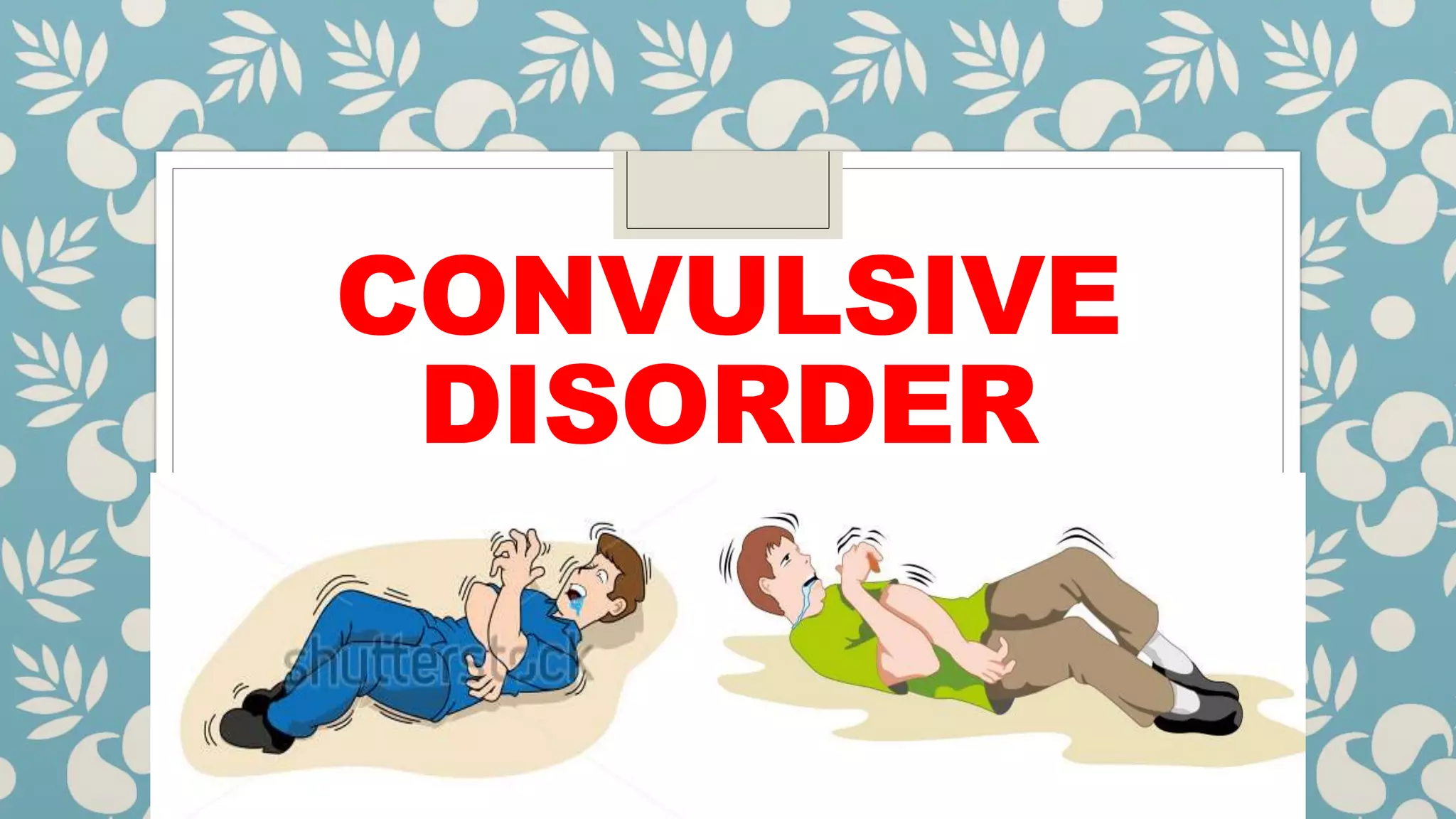
CONVULSIVE
DISORDER
INTRODUCTION
◦The word convulsion (or seizures) describes an involuntary
violent spasms, or a series of jerking of face, trunk, or
extremities with or without loss of consciousness, sensory,
autonomic or behavioral disturbances.
◦The word epilepsy describes a syndrome of recurrent
unprovoked, seizure unrelated to fever or to acute “cerebral
insult”.
◦Status epilepticus (SE) ia a severe form of seizure
activity lasting more than 30 minutes or recurrent
seizures with failure to recover consciousness between
repeated attacks.
DEFINATION
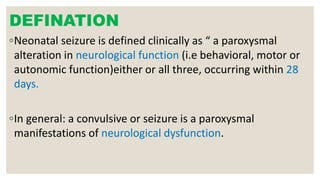
◦Neonatal seizure is defined clinically as “ a paroxysmal
alteration in neurological function (i.e behavioral, motor or
autonomic function)either or all three, occurring within 28
days.
◦In general: a convulsive or seizure is a paroxysmal
manifestations of neurological dysfunction.
INCIDENCE
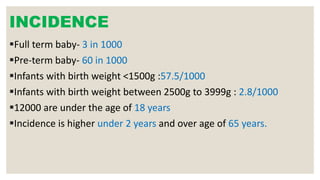
Full term baby- 3 in 1000
Pre-term baby- 60 in 1000
Infants with birth weight <1500g :57.5/1000
Infants with birth weight between 2500g to 3999g : 2.8/1000
12000 are under the age of 18 years
Incidence is higher under 2 years and over age of 65 years.
RISK FACTORS
MAJOR
Age < 1 year
Prolonged fever
Hyper pyrexia
Infections
MINOR
Family h/o of febrile seizures
Family h/o of epilepsy
Complex febrile seizures
Male gender
Electrolytes imbalance
ETIOLOGY
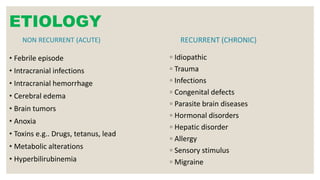
NON RECURRENT (ACUTE)
• Febrile episode
• Intracranial infections
• Intracranial hemorrhage
• Cerebral edema
• Brain tumors
• Anoxia
• Toxins e.g.. Drugs, tetanus, lead
• Metabolic alterations
• Hyperbilirubinemia
RECURRENT (CHRONIC)
◦ Idiopathic
◦ Trauma
◦ Infections
◦ Congenital defects
◦ Parasite brain diseases
◦ Hormonal disorders
◦ Hepatic disorder
◦ Allergy
◦ Sensory stimulus
◦ Migraine
PATHOPYSIOLOGY
RISK FACTORS AND ETIOLOGICAL FACTORS
ALTERED INTEGRITY OF NEURON IN THE EPILEPTOGENIC FOCUS
HYPEREXCITABILITY OF NEURONS
PARTIAL DEPOLORIZATION
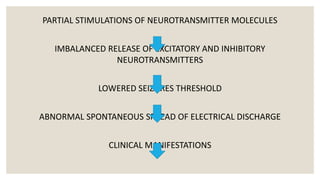
PARTIAL STIMULATIONS OF NEUROTRANSMITTER MOLECULES
IMBALANCED RELEASE OF EXCITATORY AND INHIBITORY
NEUROTRANSMITTERS
LOWERED SEIZURES THRESHOLD
ABNORMAL SPONTANEOUS SPREAD OF ELECTRICAL DISCHARGE
CLINICAL MANIFESTATIONS
CONVULSION CLASSIFICATIONS AND
CLINICAL MANIFESTATIONS
FEBRILE CONVULSIONS
◦It refers to the seizures associated with fever but excluding those
related to CNS infections. Common cause of convulsions in early
childhood (6 months to 5 years of age).
◦It has two types
◦Typical and Atypical
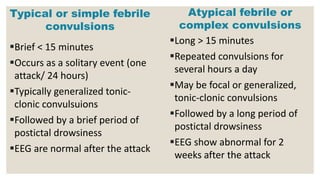
Typical or simple febrile
convulsions
Brief < 15 minutes
Occurs as a solitary event (one
attack/ 24 hours)
Typically generalized tonic-
clonic convulsuions
Followed by a brief period of
postictal drowsiness
EEG are normal after the attack
Atypical febrile or
complex convulsions
Long > 15 minutes
Repeated convulsions for
several hours a day
May be focal or generalized,
tonic-clonic convulsions
Followed by a long period of
postictal drowsiness
EEG show abnormal for 2
weeks after the attack
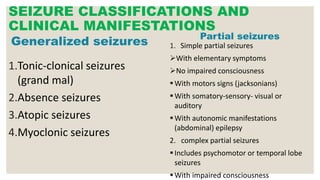
SEIZURE CLASSIFICATIONS AND
CLINICAL MANIFESTATIONS
Generalized seizures
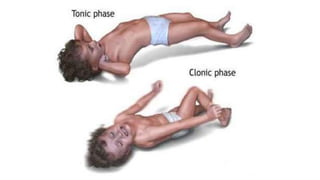
1.Tonic-clonical seizures
(grand mal)
2.Absence seizures
3.Atopic seizures
4.Myoclonic seizures
Partial seizures
1. Simple partial seizures
With elementary symptoms
No impaired consciousness
With motors signs (jacksonians)
With somatory-sensory- visual or
auditory
With autonomic manifestations
(abdominal) epilepsy
2. complex partial seizures
Includes psychomotor or temporal lobe
seizures
With impaired consciousness
DIAGNOSTIC EVALUATIONS
HISTORY TAKING
Maternal history
Family history
Labour and delivery history
Baby conditions at birth
NEONATAL EXAMINATION
General examination
Neurological examination
CBG
Spo2
METABOLIC WORK UP
INFECTIONS WORK UP
CBC
CULTURE
Torch
Igm
CRP
BLOOD GAS ANALYISIS
INBORN ERRORS OF METABOLISM
CT- SCAN
MRI
EEG
LUMBAR PUNCTURE
COMPLICATIONS
Cranial nerve palsies
Raised ICP
Subdural effusion
Cerebral palsy
Hydrocephalus
Mental-physical handicaps
Learning disability
Recurrence
PREVENTIONS
Regular ANC check up
Treatment of infections during ANC period
Correction of anemia and control of Gestational Diabetes
Training of local Dais or paramedics about proper delivery and referral system
Raising awareness about institutional delivery
Manage actively fetal distress
Ensuring proper training of neonatal resuscitations
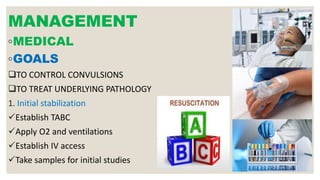
MANAGEMENT
◦MEDICAL
◦GOALS
TO CONTROL CONVULSIONS
TO TREAT UNDERLYING PATHOLOGY
1. Initial stabilization
Establish TABC
Apply O2 and ventilations
Establish IV access
Take samples for initial studies
2. DRUGS
First line (benzodiazepines)
Diazepam- 0.5mg/kg (max 10 mg) IV slow
Lorazepam- 0.05-0.1mg/kg IV per rectum or sublingual
Midazolam- 0.1-0.2mg/kg IV or IM
Dose may be repeated q5minutes up to 3 doses
Monitor respirations
3. SECOND LINE DRUGS (PHENYTOIN AND BARBITURATES
Phenytoin- 20mg/kg slow IV ( no faster than 1 mg/kg/min with a maximum
of 50 mg/min
Phenobarbitone- 15-20 mg/kg slow IV
Monitor blood pressure
4. Other drugs
Carabamzepine- 10-15mg/kg/day
Sodium valproate- 20-60mg/kg/day
Felbamate- 15mg/kg/day
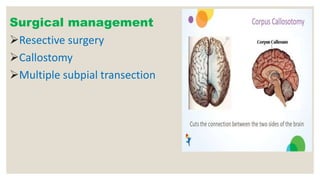
Surgical management
Resective surgery
Callostomy
Multiple subpial transection
BIBLIOGRAPHY
1.Pilliteri. A child health nursing, care of the child and fanmily. New
York: Lippincott willisams and wilkins; 1999.P. 580-84
2.Dutta P. pediatric nursing. 2nd ed. New Delhi: Jaypee brothers,
2009. P. 282-86
3.Jacob A. Paediatric Nursing. 1st ed. Indore: NR Brothers; 1997.P.
257-263
4. Marlow DR, Redding BA. Text book of pediatric nursing.
6th ed. New Delhi: Elseiver. 2011; P.947-56
5. Ghai P.O, Paul K.V, Bagg. A essential pediatrics. 7th ed.
New Delhi: CBS publishers; 2010.P. 1302-08

Convulsive disorder

  • 1.
  • 2.
    INTRODUCTION ◦The word convulsion(or seizures) describes an involuntary violent spasms, or a series of jerking of face, trunk, or extremities with or without loss of consciousness, sensory, autonomic or behavioral disturbances. ◦The word epilepsy describes a syndrome of recurrent unprovoked, seizure unrelated to fever or to acute “cerebral insult”.
  • 3.
    ◦Status epilepticus (SE)ia a severe form of seizure activity lasting more than 30 minutes or recurrent seizures with failure to recover consciousness between repeated attacks.
  • 4.
    DEFINATION ◦Neonatal seizure isdefined clinically as “ a paroxysmal alteration in neurological function (i.e behavioral, motor or autonomic function)either or all three, occurring within 28 days. ◦In general: a convulsive or seizure is a paroxysmal manifestations of neurological dysfunction.
  • 5.
    INCIDENCE Full term baby-3 in 1000 Pre-term baby- 60 in 1000 Infants with birth weight <1500g :57.5/1000 Infants with birth weight between 2500g to 3999g : 2.8/1000 12000 are under the age of 18 years Incidence is higher under 2 years and over age of 65 years.
  • 6.
    RISK FACTORS MAJOR Age <1 year Prolonged fever Hyper pyrexia Infections MINOR Family h/o of febrile seizures Family h/o of epilepsy Complex febrile seizures Male gender Electrolytes imbalance
  • 7.
    ETIOLOGY NON RECURRENT (ACUTE) •Febrile episode • Intracranial infections • Intracranial hemorrhage • Cerebral edema • Brain tumors • Anoxia • Toxins e.g.. Drugs, tetanus, lead • Metabolic alterations • Hyperbilirubinemia RECURRENT (CHRONIC) ◦ Idiopathic ◦ Trauma ◦ Infections ◦ Congenital defects ◦ Parasite brain diseases ◦ Hormonal disorders ◦ Hepatic disorder ◦ Allergy ◦ Sensory stimulus ◦ Migraine
  • 8.
    PATHOPYSIOLOGY RISK FACTORS ANDETIOLOGICAL FACTORS ALTERED INTEGRITY OF NEURON IN THE EPILEPTOGENIC FOCUS HYPEREXCITABILITY OF NEURONS PARTIAL DEPOLORIZATION
  • 9.
    PARTIAL STIMULATIONS OFNEUROTRANSMITTER MOLECULES IMBALANCED RELEASE OF EXCITATORY AND INHIBITORY NEUROTRANSMITTERS LOWERED SEIZURES THRESHOLD ABNORMAL SPONTANEOUS SPREAD OF ELECTRICAL DISCHARGE CLINICAL MANIFESTATIONS
  • 10.
    CONVULSION CLASSIFICATIONS AND CLINICALMANIFESTATIONS FEBRILE CONVULSIONS ◦It refers to the seizures associated with fever but excluding those related to CNS infections. Common cause of convulsions in early childhood (6 months to 5 years of age). ◦It has two types ◦Typical and Atypical
  • 11.
    Typical or simplefebrile convulsions Brief < 15 minutes Occurs as a solitary event (one attack/ 24 hours) Typically generalized tonic- clonic convulsuions Followed by a brief period of postictal drowsiness EEG are normal after the attack Atypical febrile or complex convulsions Long > 15 minutes Repeated convulsions for several hours a day May be focal or generalized, tonic-clonic convulsions Followed by a long period of postictal drowsiness EEG show abnormal for 2 weeks after the attack
  • 12.
    SEIZURE CLASSIFICATIONS AND CLINICALMANIFESTATIONS Generalized seizures 1.Tonic-clonical seizures (grand mal) 2.Absence seizures 3.Atopic seizures 4.Myoclonic seizures Partial seizures 1. Simple partial seizures With elementary symptoms No impaired consciousness With motors signs (jacksonians) With somatory-sensory- visual or auditory With autonomic manifestations (abdominal) epilepsy 2. complex partial seizures Includes psychomotor or temporal lobe seizures With impaired consciousness
  • 14.
    DIAGNOSTIC EVALUATIONS HISTORY TAKING Maternalhistory Family history Labour and delivery history Baby conditions at birth NEONATAL EXAMINATION General examination Neurological examination CBG Spo2 METABOLIC WORK UP INFECTIONS WORK UP CBC CULTURE Torch Igm CRP BLOOD GAS ANALYISIS INBORN ERRORS OF METABOLISM CT- SCAN MRI EEG LUMBAR PUNCTURE
  • 15.
    COMPLICATIONS Cranial nerve palsies RaisedICP Subdural effusion Cerebral palsy Hydrocephalus Mental-physical handicaps Learning disability Recurrence
  • 16.
    PREVENTIONS Regular ANC checkup Treatment of infections during ANC period Correction of anemia and control of Gestational Diabetes Training of local Dais or paramedics about proper delivery and referral system Raising awareness about institutional delivery Manage actively fetal distress Ensuring proper training of neonatal resuscitations
  • 17.
    MANAGEMENT ◦MEDICAL ◦GOALS TO CONTROL CONVULSIONS TOTREAT UNDERLYING PATHOLOGY 1. Initial stabilization Establish TABC Apply O2 and ventilations Establish IV access Take samples for initial studies
  • 18.
    2. DRUGS First line(benzodiazepines) Diazepam- 0.5mg/kg (max 10 mg) IV slow Lorazepam- 0.05-0.1mg/kg IV per rectum or sublingual Midazolam- 0.1-0.2mg/kg IV or IM Dose may be repeated q5minutes up to 3 doses Monitor respirations
  • 19.
    3. SECOND LINEDRUGS (PHENYTOIN AND BARBITURATES Phenytoin- 20mg/kg slow IV ( no faster than 1 mg/kg/min with a maximum of 50 mg/min Phenobarbitone- 15-20 mg/kg slow IV Monitor blood pressure 4. Other drugs Carabamzepine- 10-15mg/kg/day Sodium valproate- 20-60mg/kg/day Felbamate- 15mg/kg/day
  • 20.
  • 21.
    BIBLIOGRAPHY 1.Pilliteri. A childhealth nursing, care of the child and fanmily. New York: Lippincott willisams and wilkins; 1999.P. 580-84 2.Dutta P. pediatric nursing. 2nd ed. New Delhi: Jaypee brothers, 2009. P. 282-86 3.Jacob A. Paediatric Nursing. 1st ed. Indore: NR Brothers; 1997.P. 257-263
  • 22.
    4. Marlow DR,Redding BA. Text book of pediatric nursing. 6th ed. New Delhi: Elseiver. 2011; P.947-56 5. Ghai P.O, Paul K.V, Bagg. A essential pediatrics. 7th ed. New Delhi: CBS publishers; 2010.P. 1302-08