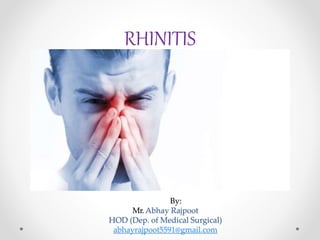



RHINITIS
By:
Mr. Abhay Rajpoot
HOD (Dep. of Medical Surgical)
abhayrajpoot5591@gmail.com
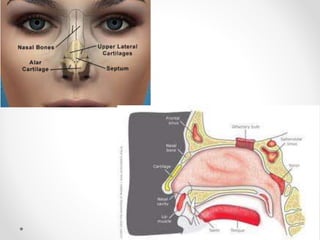
ANATOMY AND
PHYSIOLOGY
INTRODUCTION
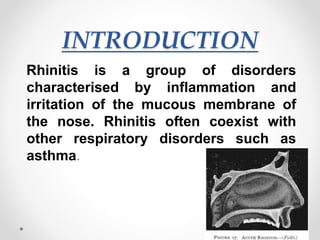
Rhinitis is a group of disorders
characterised by inflammation and
irritation of the mucous membrane of
the nose. Rhinitis often coexist with
other respiratory disorders such as
asthma.
DEFINITION
• Rhinitis is defined as the inflammation
of the mucous membrane of the nose
caused by bacterial or virus infection
or by an allergic reaction.
INCIDENCES
• It affects more than 50 million
people in the united states
annually
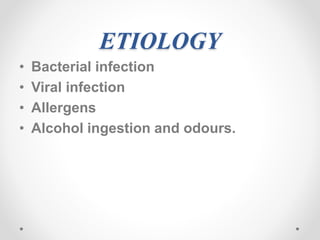
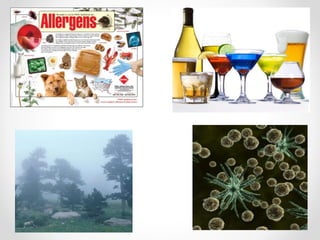
ETIOLOGY
• Bacterial infection
• Viral infection
• Allergens
• Alcohol ingestion and odours.
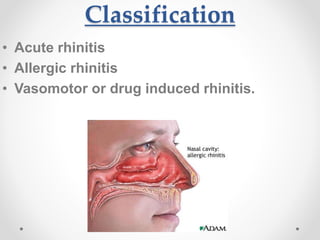
Classification
• Acute rhinitis
• Allergic rhinitis
• Vasomotor or drug induced rhinitis.
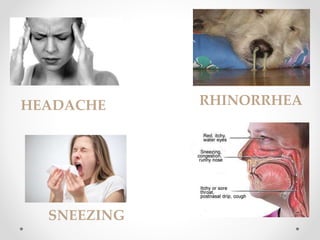
Clinical manifestation
• Rhinorrhea
• Nasal congestion
• Nasal discharge
• Sneezing
• Pruiritus
• Headache
HEADACHE RHINORRHEA
SNEEZING
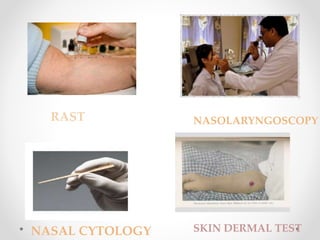
Diagnostic evaluation
• History
• Allergen specific immunonoglobulin E
antibody.
• Nasal cytology.
• Physical examination
• Nasolaryngoscopy.
• Intra dermal skin testing
• RAST (Radio-allegro-sorbent Test)
RAST
NASAL CYTOLOGY
NASOLARYNGOSCOPY
SKIN DERMAL TEST
MANAGEMENT
• TO REDUCE THE SIGN AND SYMPTOMS AND
ITS CAUSES.
• TO PREVENT FROM FURTHER
COMPLICATION.
GOAL-
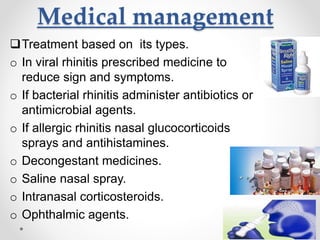
Medical management
Treatment based on its types.
o In viral rhinitis prescribed medicine to
reduce sign and symptoms.
o If bacterial rhinitis administer antibiotics or
antimicrobial agents.
o If allergic rhinitis nasal glucocorticoids
sprays and antihistamines.
o Decongestant medicines.
o Saline nasal spray.
o Intranasal corticosteroids.
o Ophthalmic agents.
Nursing management
• The nurse instructs the patients with allergic rhinitis
to avoid or reduce exposure to allergens or irritants
such as dust ,animals ,fumes ,odours, powder
,sprays and smoke tobacco.
• Patient education is essential when assisting the
patient in the use of all medication.
• The nurse instructs the patient in correct
administration of nasal medication.
• The patient is taught to keep the head upright spray
quickly and firmly into each nostrils away from the
nasal septum and wait at least one minute before
administering the second spray.
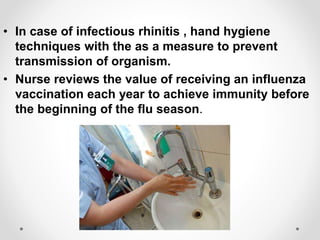
• In case of infectious rhinitis , hand hygiene
techniques with the as a measure to prevent
transmission of organism.
• Nurse reviews the value of receiving an influenza
vaccination each year to achieve immunity before
the beginning of the flu season.
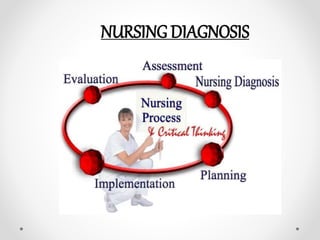
NURSING DIAGNOSIS
• Impaired comfort related to infectious
process.
• Hyperthermia related to infectious
process.
• Risk for infection transmission to
others related to presence of infectious
disease.
• Impaired verbal communication related
to physiologic changes and upper
airway irritation.
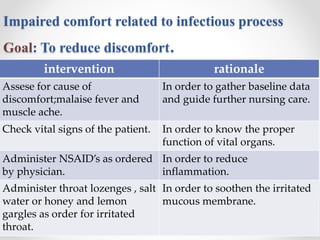
Impaired comfort related to infectious process
Goal: To reduce discomfort.
intervention rationale
Assese for cause of
discomfort;malaise fever and
muscle ache.
In order to gather baseline data
and guide further nursing care.
Check vital signs of the patient. In order to know the proper
function of vital organs.
Administer NSAID’s as ordered
by physician.
In order to reduce
inflammation.
Administer throat lozenges , salt
water or honey and lemon
gargles as order for irritated
throat.
In order to soothen the irritated
mucous membrane.
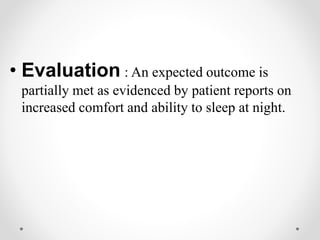
• Evaluation : An expected outcome is
partially met as evidenced by patient reports on
increased comfort and ability to sleep at night.
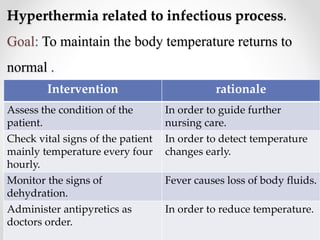
Hyperthermia related to infectious process.
Goal: To maintain the body temperature returns to
normal .
Intervention rationale
Assess the condition of the
patient.
In order to guide further
nursing care.
Check vital signs of the patient
mainly temperature every four
hourly.
In order to detect temperature
changes early.
Monitor the signs of
dehydration.
Fever causes loss of body fluids.
Administer antipyretics as
doctors order.
In order to reduce temperature.
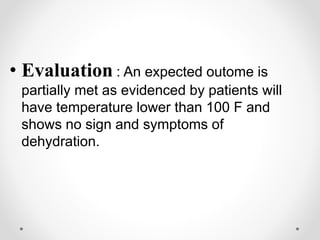
• Evaluation : An expected outome is
partially met as evidenced by patients will
have temperature lower than 100 F and
shows no sign and symptoms of
dehydration.
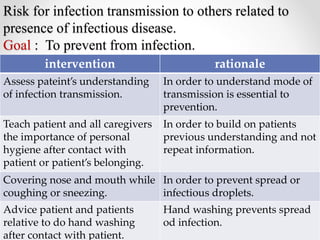
Risk for infection transmission to others related to
presence of infectious disease.
Goal : To prevent from infection.
intervention rationale
Assess pateint’s understanding
of infection transmission.
In order to understand mode of
transmission is essential to
prevention.
Teach patient and all caregivers
the importance of personal
hygiene after contact with
patient or patient’s belonging.
In order to build on patients
previous understanding and not
repeat information.
Covering nose and mouth while
coughing or sneezing.
In order to prevent spread or
infectious droplets.
Advice patient and patients
relative to do hand washing
after contact with patient.
Hand washing prevents spread
od infection.
• Evaluation : An expected outcome is
partially met as evidenced by risk for
infection of others will be reduced and the
patient taking precaution against spread.
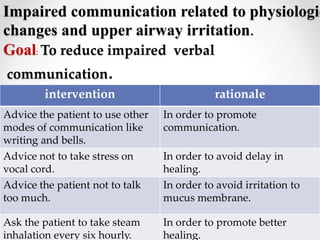
Impaired communication related to physiologic
changes and upper airway irritation.
Goal: To reduce impaired verbal
communication.
intervention rationale
Advice the patient to use other
modes of communication like
writing and bells.
In order to promote
communication.
Advice not to take stress on
vocal cord.
In order to avoid delay in
healing.
Advice the patient not to talk
too much.
In order to avoid irritation to
mucus membrane.
Ask the patient to take steam
inhalation every six hourly.
In order to promote better
healing.
• Evaluation: An expected outcome is
partially met as evidenced by patients
sneezing , congestion was reduced
and felt better.
Rhinitis