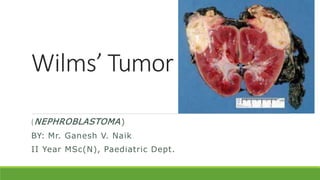
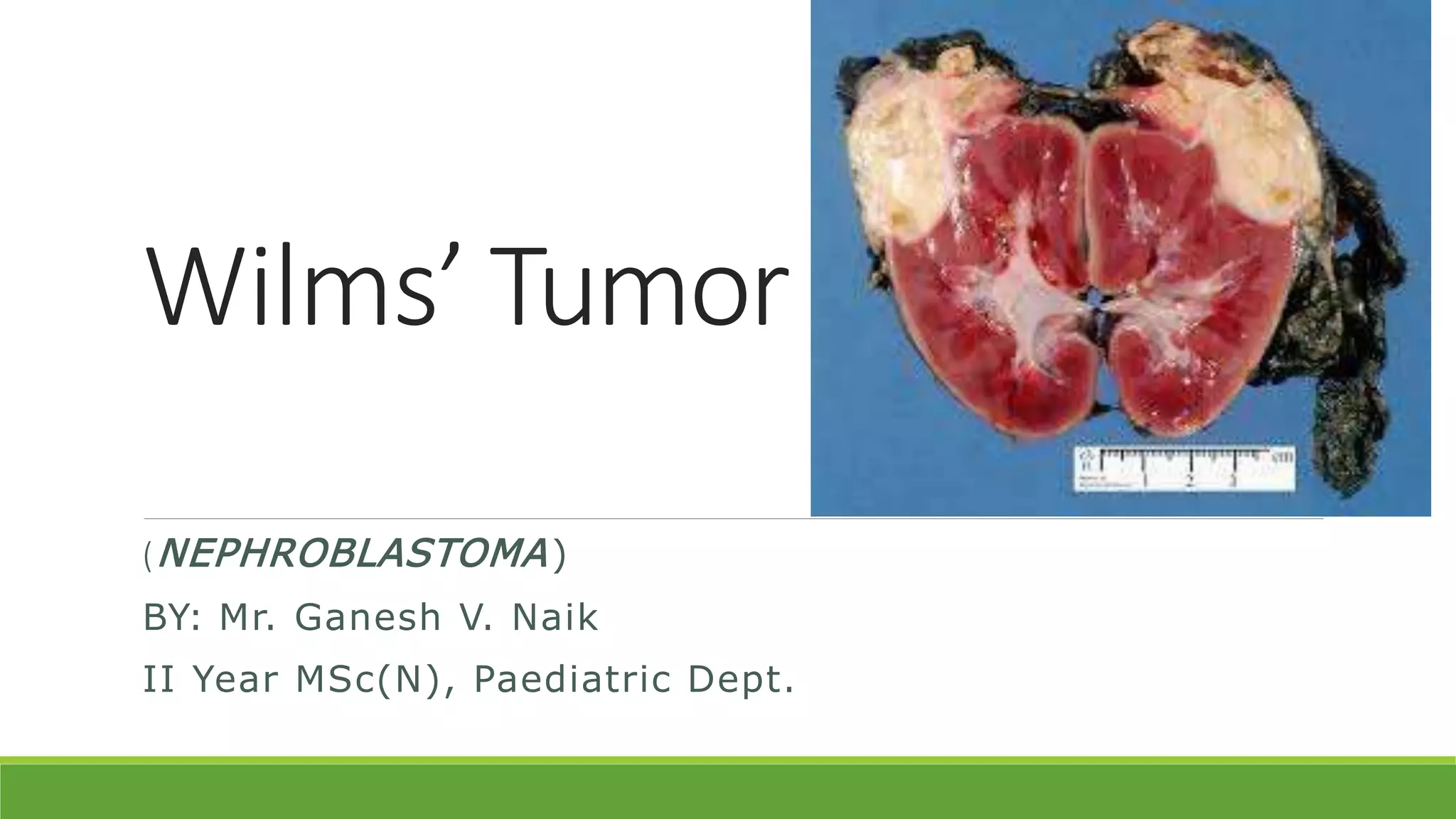


Wilms’ Tumor
(NEPHROBLASTOMA)
BY: Mr. Ganesh V. Naik
II Year MSc(N), Paediatric Dept.
INTRODUCTION
-A rare, malignant tumor of the kidney
-The most common intra-abdominal tumor in children
-Tumor is usually unilateral, favoring the left kidney, 5% of cases
affect both kidneys.
-Average age of diagnosis is 2 to 4 years old
-It is highly responsive to treatment with 90% of patients surviving
at least 5years
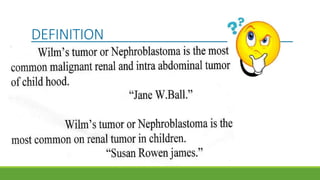
DEFINITION
- A
INCIDENCE
ITS FREQUENCEY IS ESTIMATED TO 1 IN 50,000 LIVE BIRTH
Dr.Max Wilms
(1867-1918)
German neurosurgeon
who is credited with
first describing the
condition in 1899
ETIOLOGY
IDIOPATHIC
Risk Factors
Family history of Wilms’ tumor
African Americans have a higher incidence of WT (lower rate of disease in children of Asian
decent)
Increased rate of incidence in children with certain birth defects:
-Hypospadias
-Cryptorchidism
- Aniridia
- Hemihypertrophy
Signs andSymptoms
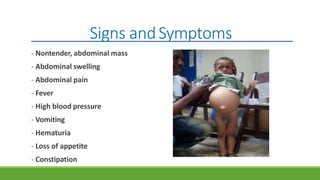
- Nontender, abdominal mass
- Abdominal swelling
- Abdominal pain
- Fever
- High blood pressure
- Vomiting
- Hematuria
- Loss of appetite
- Constipation
Diagnostic Testing
 HISTORY
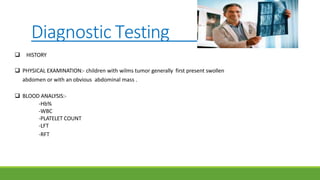
 PHYSICAL EXAMINATION:- children with wilms tumor generally first present swollen
abdomen or with an obvious abdominal mass .
 BLOOD ANALYSIS:-
-Hb%
-WBC
-PLATELET COUNT
-LFT
-RFT
Cont…..
-Abdominal ultrasound
-CT scan
-Intravenous Pyelography: Where dye injected into vein helps to show the structure of the
kidney
-Renal biopsy
-OTHER STUDIES CHEST –XRAY ,CT SCAN of the lungs,bone marrow biopsy may also be
done in order to see if the tumor has spread to other location.
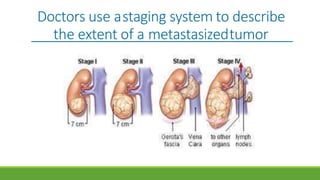
Doctors use astaging system to describe
the extent of a metastasizedtumor
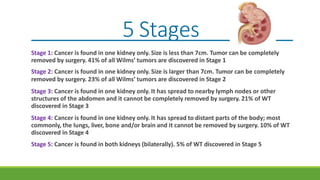
5 Stages
Stage 1: Cancer is found in one kidney only. Size is less than 7cm. Tumor can be completely
removed by surgery. 41% of all Wilms’ tumors are discovered in Stage 1
Stage 2: Cancer is found in one kidney only. Size is larger than 7cm. Tumor can be completely
removed by surgery. 23% of all Wilms’ tumors are discovered in Stage 2
Stage 3: Cancer is found in one kidney only. It has spread to nearby lymph nodes or other
structures of the abdomen and it cannot be completely removed by surgery. 21% of WT
discovered in Stage 3
Stage 4: Cancer is found in one kidney only. It has spread to distant parts of the body; most
commonly, the lungs, liver, bone and/or brain and it cannot be removed by surgery. 10% of WT
discovered in Stage 4
Stage 5: Cancer is found in both kidneys (bilaterally). 5% of WT discovered in Stage 5
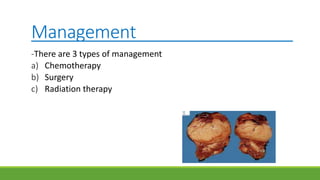
Management
-There are 3 types of management
a) Chemotherapy
b) Surgery
c) Radiation therapy
chemotherapy
-Medication used to kill cancer cells.It is also called systemic
treatment. Because the drugs enters blood and kill cancer cell
throughout the body.
-Under chemotherapy drugs used for 6 months
-This treatment for tumors that have metastasized to
surrounding tissues
•Vincristine
•Doxorubicin
•Cyclophosphamide
•Carboplatin
Surgery
surgery to remove the tumor and perhaps the affected kidney in Stage 1 and Stage 2
Types
1. A partial nephrectomy: Is when the cancer and the part of the kidney are removed .It is
usually done if the other kidney is damaged
2. A simple nephrectomy: Is when the whole kidney is removed
3. A Radical nephrectomy: removes the entire kidney and tissue around it. Some time
some lymph nodes may also be removed
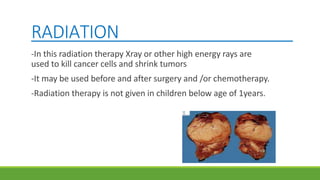
RADIATION
-In this radiation therapy Xray or other high energy rays are
used to kill cancer cells and shrink tumors
-It may be used before and after surgery and /or chemotherapy.
-Radiation therapy is not given in children below age of 1years.
NCLEX ALERT!
DON’T PALPATE THE ABDOMEN and prevent others from doing so. It may
disseminate cancer cells to other sites.
Nursing Care
Prior to Diagnostic Testing: Assess the child for allergies to dye or shellfish, Assist the child to remain
still, Instruct child to drink contrast medium if applicable, Sedate the child if prescribed
Prior to Surgical Resection: Do not palpate the abdomen, Provide emotional support, Provide
education to the child and family regarding treatment plan, ongoing therapy, and prognosis
Post Surgery: Administer prescribed analgesics, Monitor for signs of pain and infection, Monitor for
signs of hemorrhage, Monitor vital signs, Provide age-appropriate diversional activities, Keep child’s
skin clean and dry, Provide emotional support
Chemotherapy/Radiation: Medicate child with antiemetics prior to administration, Handle
chemotherapeutic agents carefully, Take care when radiation is in use (wear lead aprons), Observe
the mouth for mucosal ulcerations, Provide several food choices, allowing the child to choose
favorites, Offer cool fluids to prevent dehydration and soothe sore mucous membranes, Provide
education on side effects of chemotherapy/radiation, Use good hand hygiene, Instruct child to avoid
fresh fruits and vegetables, Avoid large crowds and sick visitors, Monitor for signs of bleeding, Avoid
invasive procedures and apply pressure to puncture sites for 5 mins.
THANK YOU

Wilm's tumor

  • 1.
    Wilms’ Tumor (NEPHROBLASTOMA) BY: Mr.Ganesh V. Naik II Year MSc(N), Paediatric Dept.
  • 2.
    INTRODUCTION -A rare, malignanttumor of the kidney -The most common intra-abdominal tumor in children -Tumor is usually unilateral, favoring the left kidney, 5% of cases affect both kidneys. -Average age of diagnosis is 2 to 4 years old -It is highly responsive to treatment with 90% of patients surviving at least 5years
  • 3.
  • 4.
    INCIDENCE ITS FREQUENCEY ISESTIMATED TO 1 IN 50,000 LIVE BIRTH
  • 5.
    Dr.Max Wilms (1867-1918) German neurosurgeon whois credited with first describing the condition in 1899
  • 6.
  • 7.
    Risk Factors Family historyof Wilms’ tumor African Americans have a higher incidence of WT (lower rate of disease in children of Asian decent) Increased rate of incidence in children with certain birth defects: -Hypospadias -Cryptorchidism - Aniridia - Hemihypertrophy
  • 8.
    Signs andSymptoms - Nontender,abdominal mass - Abdominal swelling - Abdominal pain - Fever - High blood pressure - Vomiting - Hematuria - Loss of appetite - Constipation
  • 9.
    Diagnostic Testing  HISTORY PHYSICAL EXAMINATION:- children with wilms tumor generally first present swollen abdomen or with an obvious abdominal mass .  BLOOD ANALYSIS:- -Hb% -WBC -PLATELET COUNT -LFT -RFT
  • 10.
    Cont….. -Abdominal ultrasound -CT scan -IntravenousPyelography: Where dye injected into vein helps to show the structure of the kidney -Renal biopsy -OTHER STUDIES CHEST –XRAY ,CT SCAN of the lungs,bone marrow biopsy may also be done in order to see if the tumor has spread to other location.
  • 11.
    Doctors use astagingsystem to describe the extent of a metastasizedtumor
  • 12.
    5 Stages Stage 1:Cancer is found in one kidney only. Size is less than 7cm. Tumor can be completely removed by surgery. 41% of all Wilms’ tumors are discovered in Stage 1 Stage 2: Cancer is found in one kidney only. Size is larger than 7cm. Tumor can be completely removed by surgery. 23% of all Wilms’ tumors are discovered in Stage 2 Stage 3: Cancer is found in one kidney only. It has spread to nearby lymph nodes or other structures of the abdomen and it cannot be completely removed by surgery. 21% of WT discovered in Stage 3 Stage 4: Cancer is found in one kidney only. It has spread to distant parts of the body; most commonly, the lungs, liver, bone and/or brain and it cannot be removed by surgery. 10% of WT discovered in Stage 4 Stage 5: Cancer is found in both kidneys (bilaterally). 5% of WT discovered in Stage 5
  • 13.
    Management -There are 3types of management a) Chemotherapy b) Surgery c) Radiation therapy
  • 14.
    chemotherapy -Medication used tokill cancer cells.It is also called systemic treatment. Because the drugs enters blood and kill cancer cell throughout the body. -Under chemotherapy drugs used for 6 months -This treatment for tumors that have metastasized to surrounding tissues •Vincristine •Doxorubicin •Cyclophosphamide •Carboplatin
  • 15.
    Surgery surgery to removethe tumor and perhaps the affected kidney in Stage 1 and Stage 2 Types 1. A partial nephrectomy: Is when the cancer and the part of the kidney are removed .It is usually done if the other kidney is damaged 2. A simple nephrectomy: Is when the whole kidney is removed 3. A Radical nephrectomy: removes the entire kidney and tissue around it. Some time some lymph nodes may also be removed
  • 16.
    RADIATION -In this radiationtherapy Xray or other high energy rays are used to kill cancer cells and shrink tumors -It may be used before and after surgery and /or chemotherapy. -Radiation therapy is not given in children below age of 1years.
  • 17.
    NCLEX ALERT! DON’T PALPATETHE ABDOMEN and prevent others from doing so. It may disseminate cancer cells to other sites.
  • 18.
    Nursing Care Prior toDiagnostic Testing: Assess the child for allergies to dye or shellfish, Assist the child to remain still, Instruct child to drink contrast medium if applicable, Sedate the child if prescribed Prior to Surgical Resection: Do not palpate the abdomen, Provide emotional support, Provide education to the child and family regarding treatment plan, ongoing therapy, and prognosis Post Surgery: Administer prescribed analgesics, Monitor for signs of pain and infection, Monitor for signs of hemorrhage, Monitor vital signs, Provide age-appropriate diversional activities, Keep child’s skin clean and dry, Provide emotional support Chemotherapy/Radiation: Medicate child with antiemetics prior to administration, Handle chemotherapeutic agents carefully, Take care when radiation is in use (wear lead aprons), Observe the mouth for mucosal ulcerations, Provide several food choices, allowing the child to choose favorites, Offer cool fluids to prevent dehydration and soothe sore mucous membranes, Provide education on side effects of chemotherapy/radiation, Use good hand hygiene, Instruct child to avoid fresh fruits and vegetables, Avoid large crowds and sick visitors, Monitor for signs of bleeding, Avoid invasive procedures and apply pressure to puncture sites for 5 mins.
  • 19.