PRESENTED BY
Dr. P.Asma Afreen
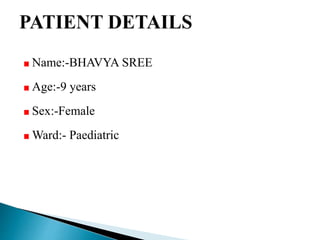
Name:-BHAVYA SREE
Age:-9 years
Sex:-Female
Ward:- Paediatric
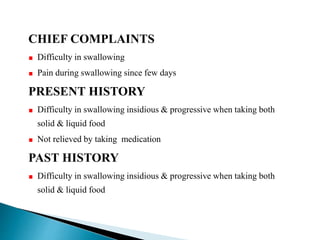
CHIEF COMPLAINTS
Difficulty in swallowing
Pain during swallowing since few days
PRESENT HISTORY
Difficulty in swallowing insidious & progressive when taking both
solid & liquid food
Not relieved by taking medication
PAST HISTORY
Difficulty in swallowing insidious & progressive when taking both
solid & liquid food
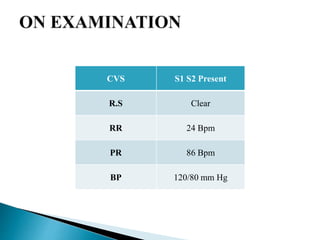
CVS S1 S2 Present
R.S Clear
RR 24 Bpm
PR 86 Bpm
BP 120/80 mm Hg
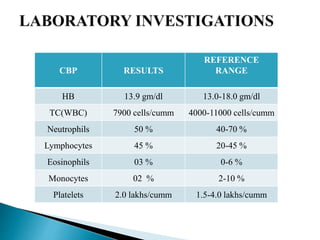
CBP RESULTS
REFERENCE
RANGE
HB 13.9 gm/dl 13.0-18.0 gm/dl
TC(WBC) 7900 cells/cumm 4000-11000 cells/cumm
Neutrophils 50 % 40-70 %
Lymphocytes 45 % 20-45 %
Eosinophils 03 % 0-6 %
Monocytes 02 % 2-10 %
Platelets 2.0 lakhs/cumm 1.5-4.0 lakhs/cumm
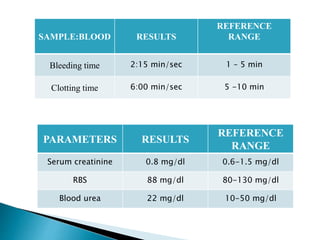
SAMPLE:BLOOD RESULTS
REFERENCE
RANGE
Bleeding time 2:15 min/sec 1 – 5 min
Clotting time 6:00 min/sec 5 -10 min
PARAMETERS RESULTS
REFERENCE
RANGE
Serum creatinine 0.8 mg/dl 0.6-1.5 mg/dl
RBS 88 mg/dl 80-130 mg/dl
Blood urea 22 mg/dl 10-50 mg/dl
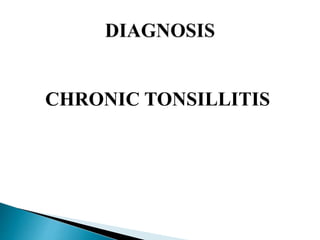
CHRONIC TONSILLITIS
SUBJECTIVE
A female patient of age 9 yrs was admitted in VBGH at ENT male ward with
chief complaints of :
Difficulty in swallowing
Pain during swallowing since few days
OBJECTIVE
Difficulty in swallowing insidious & progressive when taking both
solid & liquid food
Not relieved by taking medication
ASSESSMENT
 Based on the subjective and objective data the physician diagnosed
that the patient is suffering with CHRONIC TONSILLITIS
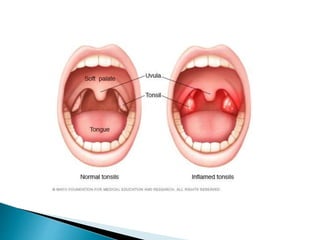
Tonsillitis is inflammation of the pharyngeal tonsils. The
inflammation usually extends to the adenoid and the
lingual tonsils. Therefore, the term pharyngitis may also
be used. Lingual tonsillitis refers to isolated
inflammation of the lymphoid tissue at the tongue base.
A "carrier state" is defined by a positive pharyngeal
culture of group A beta hemolytic Streptococcus
pyogenes(GABHS),without evidence of an
antistreptococcal immunologic response.
Tonsillitis is most often caused by common viruses, but bacterial infections
can also be the cause.
The most common bacterium causing tonsillitis is Streptococcus pyogenes
(group A streptococcus), the bacterium that causes strep throat. Other
strains of strep and other bacteria also may cause tonsillitis.
Why do tonsils get infected?
The tonsils are the immune system's first line of defense against bacteria
and viruses that enter your mouth. This function may make the tonsils
particularly vulnerable to infection and inflammation
A polymicrobial bacterial population is observed in most cases of
chronic tonsillitis, with alpha- and beta-hemolytic streptococcal species, S
aureus, H influenzae, and Bacteroides species having been identified.
A study that was based on bacteriology of the tonsillar surface and core in
30 children undergoing tonsillectomy suggested that antibiotics prescribed
6 months before surgery did not alter the tonsillar bacteriology at the time
of tonsillectomy. [4] A relationship between tonsillar size and chronic
bacterial tonsillitis is believed to exist.
This relationship is based on both the aerobic bacterial load and
the absolute number of B and T lymphocytes. H influenzae is the
bacterium most often isolated in hypertrophic tonsils and adenoids.
With regard to penicillin resistance or beta-lactamase production,
the microbiology of tonsils removed from patients with recurrent
GABHS pharyngitis has not been shown to be significantly
different from the microbiology oftonsilsremovedfrom patients with
tonsillar hypertrophy.
Local immunologic mechanisms are important in chronic
tonsillitis. The distribution of dendritic cells and antigen-presenting
cells is altered during disease, with fewer dendritic cells on the
surface epithelium and more in the crypts and extrafollicular areas.
Study of immunologic markers may permit differentiation
between recurrent and chronic tonsillitis.
Such markers in one study indicated that children more often
experience recurrent tonsillitis, whereas adults requiring
tonsillectomy more often experience chronic tonsillitis.
Tonsillitis most commonly affects children between preschool ages and the
mid-teenage years. Common signs and symptoms of tonsillitis include:
 Red, swollen tonsils
 White or yellow coating or patches on the tonsils
 Sore throat
 Difficult or painful swallowing
 Fever
 Enlarged, tender glands (lymph nodes) in the neck
 A scratchy, muffled or throaty voice
 Bad breath
 Stiff neck
 Headache
Signs
 Drooling due to difficult or painful swallowing
 Refusal to eat
 Unusual fussiness
 Young age. Tonsillitis most often occurs in children, but rarely in those
younger than age 2. Tonsillitis caused by bacteria is most common in
children ages 5 to 15, while viral tonsillitis is more common in younger
children.
 Frequent exposure to germs. School-age children are in close contact
with their peers and frequently exposed to viruses or bacteria that can
cause tonsillitis.
 Inflammation or swelling of the tonsils from frequent or ongoing (chronic)
tonsillitis can cause complications such as:
 Difficulty breathing
 Disrupted breathing during sleep (obstructive sleep apnea)
 Infection that spreads deep into surrounding tissue (tonsillar cellulitis)
 Infection that results in a collection of pus behind a tonsil (peritonsillar
abscess)
 Strep infection
If tonsillitis caused by group A streptococcus or another strain
of streptococcal bacteria isn't treated, or if antibiotic treatment is
incomplete, your child has an increased risk of rare disorders
such as:
 Rheumatic fever:- An inflammatory disorder that affects the
heart, joints and other tissues
 Poststreptococcal glomerulonephritis:- An inflammatory
disorder of the kidneys that results in inadequate removal of
waste and excess fluids from blood
 Your child's doctor will start with a physical exam that will include:
 Using a lighted instrument to look at your child's throat and likely
his or her ears and nose, which may also be sites of infection
 Checking for a rash known as scarlatina, which is associated with
some cases of strep throat
 Gently feeling (palpating) your child's neck to check for swollen
glands (lymph nodes)
 Listening to his or her breathing with a stethoscope
 Checking for enlargement of the spleen (for consideration of
mononucleosis, which also inflames the tonsils)
 Complete blood cell count (CBC)
 Throat swab
 Encourage rest Encourage your child to get plenty of sleep.
 Provide adequate fluids Give your child plenty of water to keep his or
her throat moist and prevent dehydration.
 Provide comforting foods and beverage Warm liquids broth,
caffeine-free tea or warm water with honey and cold treats like ice
pops can soothe a sore throat.
 Prepare a saltwater gargle If your child can gargle, a saltwater gargle
of 1 teaspoon (5 milliliters) of table salt to 8 ounces (237 milliliters) of
warm water can help soothe a sore throat. Have your child gargle the
solution and then spit it out.
 Humidify the air Use a cool-air humidifier to eliminate dry air that may further
irritate a sore throat, or sit with your child for several minutes in a steamy
bathroom.
 Offer lozenges Children older than age 4 can suck on lozenges to relieve a sore
throat.
 Avoid irritants Keep your home free from cigarette smoke and cleaning
products that can irritate the throat.
 Treat pain and fever Talk to your doctor about using ibuprofen (Advil,
Children's Motrin, others) or acetaminophen (Tylenol, others) to minimize
throat pain and control a fever. Low fevers without pain do not require
treatment.
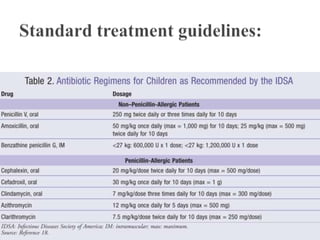
Antibiotics
 If tonsillitis is caused by a bacterial infection, your doctor will
prescribe a course of antibiotics. Penicillin taken by mouth for 10
days is the most common antibiotic treatment prescribed for
tonsillitis caused by group A streptococcus. If your child is allergic
to penicillin, your doctor will prescribe an alternative antibiotic.
 Your child must take the full course of antibiotics as prescribed
even if the symptoms go away completely. Failure to take all of the
medication as directed may result in the infection worsening or
spreading to other parts of the body. Not completing the full course
of antibiotics can, in particular, increase your child's risk of
rheumatic fever and serious kidney inflammation.
 Surgery to remove tonsils (tonsillectomy) may be used to treat
frequently recurring tonsillitis, chronic tonsillitis or bacterial
tonsillitis that doesn't respond to antibiotic treatment. Frequent
tonsillitis is generally defined as:
 More than seven episodes in one year
 More than four to five episodes a year in each of the preceding
two years
 More than three episodes a year in each of the preceding three
years
 A tonsillectomy may also be performed if tonsillitis results in
difficult-to-manage complications, such as:
 Obstructive sleep apnea
 Breathing difficulty
 Swallowing difficulty, especially meats and other chunky foods
 An abscess that doesn't improve with antibiotic treatment
 Tonsillectomy is usually done as an outpatient procedure, unless
your child is very young, has a complex medical condition or if
complications arise during surgery. That means your child
should be able to go home the day of the surgery. A complete
recovery usually takes seven to 14 days.
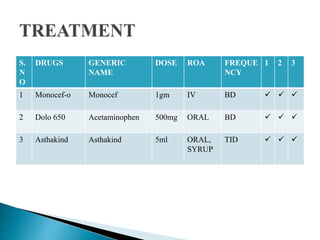
S.
N
O
DRUGS GENERIC
NAME
DOSE ROA FREQUE
NCY
1 2 3
1 Monocef-o Monocef 1gm IV BD   
2 Dolo 650 Acetaminophen 500mg ORAL BD   
3 Asthakind Asthakind 5ml ORAL,
SYRUP
TID   
 Practice good oral hygiene,including cleaning the bacteria off the back of
your brush your teeth.
 Smoking
 Gargle salt water,which can prevent tonsil stone formation and eliminate
the odor theycause
 Drink the recommended daily requirement of water and stay hydrated.

Chronic tonsillitis

  • 1.
  • 2.
  • 3.
    CHIEF COMPLAINTS Difficulty inswallowing Pain during swallowing since few days PRESENT HISTORY Difficulty in swallowing insidious & progressive when taking both solid & liquid food Not relieved by taking medication PAST HISTORY Difficulty in swallowing insidious & progressive when taking both solid & liquid food
  • 4.
    CVS S1 S2Present R.S Clear RR 24 Bpm PR 86 Bpm BP 120/80 mm Hg
  • 5.
    CBP RESULTS REFERENCE RANGE HB 13.9gm/dl 13.0-18.0 gm/dl TC(WBC) 7900 cells/cumm 4000-11000 cells/cumm Neutrophils 50 % 40-70 % Lymphocytes 45 % 20-45 % Eosinophils 03 % 0-6 % Monocytes 02 % 2-10 % Platelets 2.0 lakhs/cumm 1.5-4.0 lakhs/cumm
  • 6.
    SAMPLE:BLOOD RESULTS REFERENCE RANGE Bleeding time2:15 min/sec 1 – 5 min Clotting time 6:00 min/sec 5 -10 min PARAMETERS RESULTS REFERENCE RANGE Serum creatinine 0.8 mg/dl 0.6-1.5 mg/dl RBS 88 mg/dl 80-130 mg/dl Blood urea 22 mg/dl 10-50 mg/dl
  • 7.
  • 8.
    SUBJECTIVE A female patientof age 9 yrs was admitted in VBGH at ENT male ward with chief complaints of : Difficulty in swallowing Pain during swallowing since few days
  • 9.
    OBJECTIVE Difficulty in swallowinginsidious & progressive when taking both solid & liquid food Not relieved by taking medication ASSESSMENT  Based on the subjective and objective data the physician diagnosed that the patient is suffering with CHRONIC TONSILLITIS
  • 10.
    Tonsillitis is inflammationof the pharyngeal tonsils. The inflammation usually extends to the adenoid and the lingual tonsils. Therefore, the term pharyngitis may also be used. Lingual tonsillitis refers to isolated inflammation of the lymphoid tissue at the tongue base. A "carrier state" is defined by a positive pharyngeal culture of group A beta hemolytic Streptococcus pyogenes(GABHS),without evidence of an antistreptococcal immunologic response.
  • 12.
    Tonsillitis is mostoften caused by common viruses, but bacterial infections can also be the cause. The most common bacterium causing tonsillitis is Streptococcus pyogenes (group A streptococcus), the bacterium that causes strep throat. Other strains of strep and other bacteria also may cause tonsillitis. Why do tonsils get infected? The tonsils are the immune system's first line of defense against bacteria and viruses that enter your mouth. This function may make the tonsils particularly vulnerable to infection and inflammation
  • 14.
    A polymicrobial bacterialpopulation is observed in most cases of chronic tonsillitis, with alpha- and beta-hemolytic streptococcal species, S aureus, H influenzae, and Bacteroides species having been identified. A study that was based on bacteriology of the tonsillar surface and core in 30 children undergoing tonsillectomy suggested that antibiotics prescribed 6 months before surgery did not alter the tonsillar bacteriology at the time of tonsillectomy. [4] A relationship between tonsillar size and chronic bacterial tonsillitis is believed to exist.
  • 15.
    This relationship isbased on both the aerobic bacterial load and the absolute number of B and T lymphocytes. H influenzae is the bacterium most often isolated in hypertrophic tonsils and adenoids. With regard to penicillin resistance or beta-lactamase production, the microbiology of tonsils removed from patients with recurrent GABHS pharyngitis has not been shown to be significantly different from the microbiology oftonsilsremovedfrom patients with tonsillar hypertrophy.
  • 16.
    Local immunologic mechanismsare important in chronic tonsillitis. The distribution of dendritic cells and antigen-presenting cells is altered during disease, with fewer dendritic cells on the surface epithelium and more in the crypts and extrafollicular areas. Study of immunologic markers may permit differentiation between recurrent and chronic tonsillitis. Such markers in one study indicated that children more often experience recurrent tonsillitis, whereas adults requiring tonsillectomy more often experience chronic tonsillitis.
  • 17.
    Tonsillitis most commonlyaffects children between preschool ages and the mid-teenage years. Common signs and symptoms of tonsillitis include:  Red, swollen tonsils  White or yellow coating or patches on the tonsils  Sore throat  Difficult or painful swallowing  Fever  Enlarged, tender glands (lymph nodes) in the neck
  • 18.
     Enlarged, tenderglands (lymph nodes) in the neck  A scratchy, muffled or throaty voice  Bad breath  Stiff neck  Headache Signs  Drooling due to difficult or painful swallowing  Refusal to eat  Unusual fussiness
  • 19.
     Young age.Tonsillitis most often occurs in children, but rarely in those younger than age 2. Tonsillitis caused by bacteria is most common in children ages 5 to 15, while viral tonsillitis is more common in younger children.  Frequent exposure to germs. School-age children are in close contact with their peers and frequently exposed to viruses or bacteria that can cause tonsillitis.
  • 20.
     Inflammation orswelling of the tonsils from frequent or ongoing (chronic) tonsillitis can cause complications such as:  Difficulty breathing  Disrupted breathing during sleep (obstructive sleep apnea)  Infection that spreads deep into surrounding tissue (tonsillar cellulitis)  Infection that results in a collection of pus behind a tonsil (peritonsillar abscess)
  • 21.
     Strep infection Iftonsillitis caused by group A streptococcus or another strain of streptococcal bacteria isn't treated, or if antibiotic treatment is incomplete, your child has an increased risk of rare disorders such as:  Rheumatic fever:- An inflammatory disorder that affects the heart, joints and other tissues  Poststreptococcal glomerulonephritis:- An inflammatory disorder of the kidneys that results in inadequate removal of waste and excess fluids from blood
  • 22.
     Your child'sdoctor will start with a physical exam that will include:  Using a lighted instrument to look at your child's throat and likely his or her ears and nose, which may also be sites of infection  Checking for a rash known as scarlatina, which is associated with some cases of strep throat  Gently feeling (palpating) your child's neck to check for swollen glands (lymph nodes)  Listening to his or her breathing with a stethoscope  Checking for enlargement of the spleen (for consideration of mononucleosis, which also inflames the tonsils)  Complete blood cell count (CBC)  Throat swab
  • 23.
     Encourage restEncourage your child to get plenty of sleep.  Provide adequate fluids Give your child plenty of water to keep his or her throat moist and prevent dehydration.  Provide comforting foods and beverage Warm liquids broth, caffeine-free tea or warm water with honey and cold treats like ice pops can soothe a sore throat.  Prepare a saltwater gargle If your child can gargle, a saltwater gargle of 1 teaspoon (5 milliliters) of table salt to 8 ounces (237 milliliters) of warm water can help soothe a sore throat. Have your child gargle the solution and then spit it out.
  • 24.
     Humidify theair Use a cool-air humidifier to eliminate dry air that may further irritate a sore throat, or sit with your child for several minutes in a steamy bathroom.  Offer lozenges Children older than age 4 can suck on lozenges to relieve a sore throat.  Avoid irritants Keep your home free from cigarette smoke and cleaning products that can irritate the throat.  Treat pain and fever Talk to your doctor about using ibuprofen (Advil, Children's Motrin, others) or acetaminophen (Tylenol, others) to minimize throat pain and control a fever. Low fevers without pain do not require treatment.
  • 25.
    Antibiotics  If tonsillitisis caused by a bacterial infection, your doctor will prescribe a course of antibiotics. Penicillin taken by mouth for 10 days is the most common antibiotic treatment prescribed for tonsillitis caused by group A streptococcus. If your child is allergic to penicillin, your doctor will prescribe an alternative antibiotic.  Your child must take the full course of antibiotics as prescribed even if the symptoms go away completely. Failure to take all of the medication as directed may result in the infection worsening or spreading to other parts of the body. Not completing the full course of antibiotics can, in particular, increase your child's risk of rheumatic fever and serious kidney inflammation.
  • 26.
     Surgery toremove tonsils (tonsillectomy) may be used to treat frequently recurring tonsillitis, chronic tonsillitis or bacterial tonsillitis that doesn't respond to antibiotic treatment. Frequent tonsillitis is generally defined as:  More than seven episodes in one year  More than four to five episodes a year in each of the preceding two years  More than three episodes a year in each of the preceding three years  A tonsillectomy may also be performed if tonsillitis results in difficult-to-manage complications, such as:
  • 27.
     Obstructive sleepapnea  Breathing difficulty  Swallowing difficulty, especially meats and other chunky foods  An abscess that doesn't improve with antibiotic treatment  Tonsillectomy is usually done as an outpatient procedure, unless your child is very young, has a complex medical condition or if complications arise during surgery. That means your child should be able to go home the day of the surgery. A complete recovery usually takes seven to 14 days.
  • 28.
    S. N O DRUGS GENERIC NAME DOSE ROAFREQUE NCY 1 2 3 1 Monocef-o Monocef 1gm IV BD    2 Dolo 650 Acetaminophen 500mg ORAL BD    3 Asthakind Asthakind 5ml ORAL, SYRUP TID   
  • 30.
     Practice goodoral hygiene,including cleaning the bacteria off the back of your brush your teeth.  Smoking  Gargle salt water,which can prevent tonsil stone formation and eliminate the odor theycause  Drink the recommended daily requirement of water and stay hydrated.