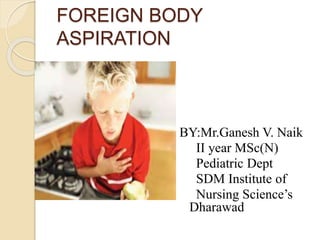
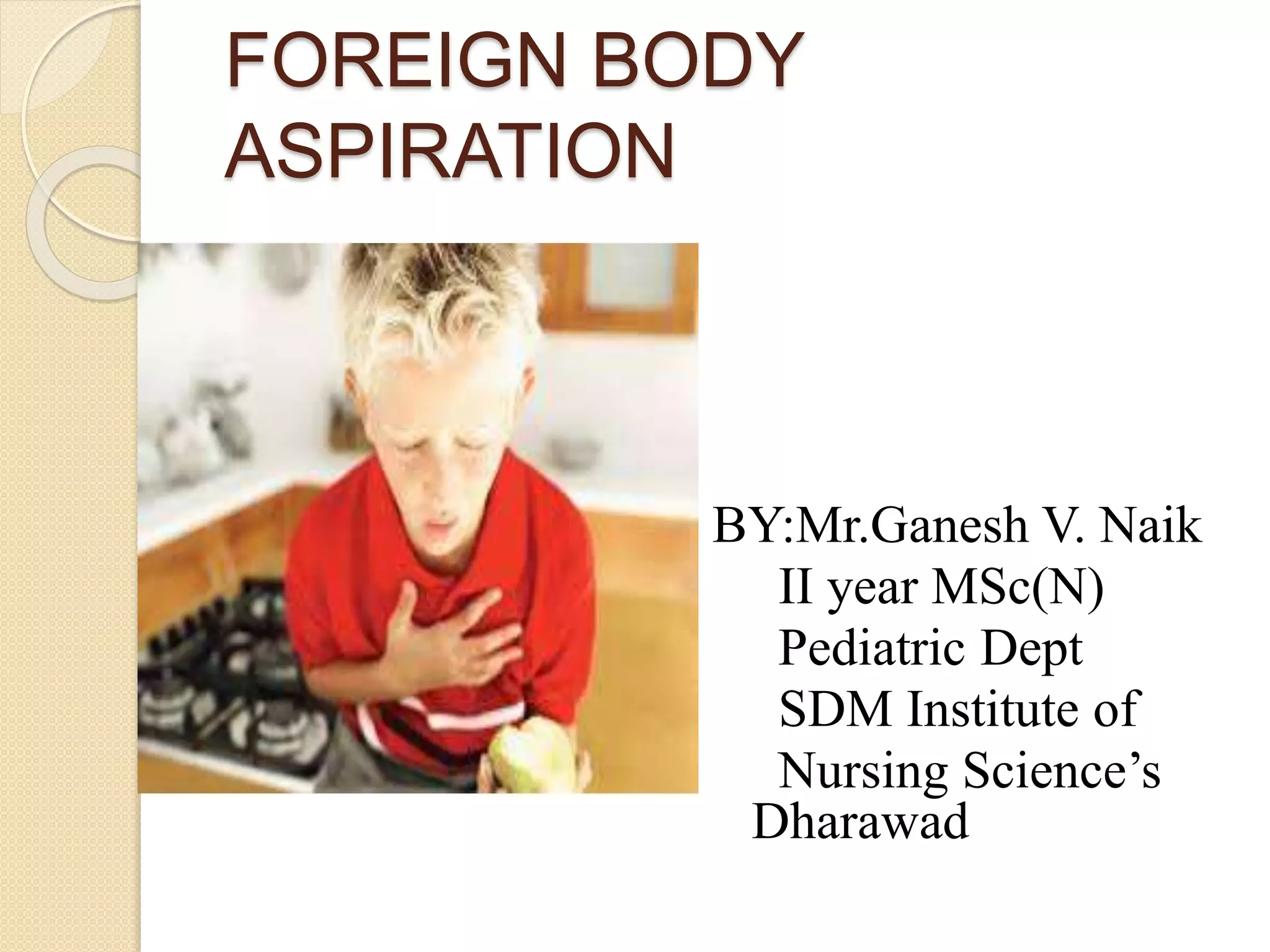

FOREIGN BODY
ASPIRATION
BY:Mr.Ganesh V. Naik
II year MSc(N)
Pediatric Dept
SDM Institute of
Nursing Science’s
Dharawad
INTRODUCTION
 Foreign body aspiration is seen most
frequently in children ages 6months 1 to
5years.
 Foreign bodies may be found in the larynx,
trachea or bronchi.
 They include non-organic (buttons, metallic
objects) or organic foreign bodies(eatables,
peanuts etc).
 Childrens who have objects in their mouth
while they are playing, running or laughing
at risk.
DEFINITION
Foreign body aspiration is a condition
occurs when any solid or liquid substance
is inhaled into the respiratory tract.
TYPES
Laryngeal foreign bodies:
• These manifest with croupy or horse
cough, aphonia, haemoptysis, dysphonia,
wheezing and cyanosis.
• Fatal aspiration may occur due to the
foreign body or its inflammatory reaction.
CONT……
Tracheal foreign bodies:
 These manifests as cough,
hoarseness, dyspnoea and cyanosis
CONT…..
Bronchial foreign bodies:
 Cough, wheeze, blood streaked
sputum may occur.
 History of choking, gagging
paroxysmal coughing, history of
eating substances like groundnuts etc
is vital in the diagnosis.
 On examination tracheal shift,
decreased breath sounds on side of
the foreign body aspiration occurs.
INCIDENCE
 Childhood aspiration can occur at any
age. But it occur most frequently in
children, 1 to 3 years of age.
 Forty percent of accidental death in
home are caused by foreign body
aspiration.
ETIOLOGY
 Children’s curiosity, oral needs and
occasionally lack of supervision
contribute the occurrence of foreign
body aspiration
COMMON ITEMS OF
ASPIRATION
 Nuts
 Pins
 Screws
 Coins
 Seeds
 Grapes
 Ear rings
 Small toys
CONT….
 Chunks of food
 Parts of toys
 Popcorn
 Carrots
 Hard candy
 Latex balloons
PATHOPHYSIOLOGY
 Most foreign bodies become lodged in
the bronchi.
 The right main bronchus is a more
common site than the left main bronchus
because of its anatomic development.
 Objects lodged in the larynx cause
edema and inflammation.
 Bronchial obstruction manifests as
obstructive emphysema, pneumonia or
atelectasis.
CONT…..
 Failure to remove obstructing foreign
objects is almost always fatal.
 Most can be removed mechanically
can lead to aspiration pneumonia and
airway trauma.
CLINICAL MANIFESTATION
Immediate signs and symptoms
include:
• Sudden violent coughing
• Gagging
• Wheezing
• Vomiting
• Brief episode of apnea
• Possibly cyanosis
CONT…..
After aspirating a foreign object the
child may remain asymptomatic for
hours or weeks.
If the object is not found and removed
signs and symptoms of tracheal
obstruction include:
 Chocking
 Dysphagia
 Hoarseness
CONT…..
 Croupy cough
 Stridor
 Possibly dyspnoea and cyanosis
 Wheezing
 Unilaterally decreased breath sound
 Pneumonitis
 Possibly respiratory arrest
DIAGNOSTIC EVALUATION
 History collection
 Physical examination
 Laryngeal foreign bodies:
X-ray and direct laryngoscopy reveal
the foreign body.
• Tracheal foreign bodies:
Bronchoscopy
Chest X-ray required to find foreign
body.
CONT……
Bronchial foreign body
 Chest X-ray
 Fluroscopy used to reveal presence of
foreign object in bronchus
MANAGEMENT
 Laryngeal foreign body needs to be
removed by rigid endoscope.
 Tracheotomy may be required with severe
degree of dyspnea.
 Bronchoscopy is necessary to removal of
the bronchial and tracheal foreign body.
 Rarely thoractotomy may be required.
CONT…..
 Chest physiotherapy and
bronchodilators should not be given.
 Antibiotics are needed for secondary
infections.
NURSING CARE
MANAGEMENT
 A major role of nurse is to recognize
the signs of foreign body aspiration
and implement immediate measures
to relieve the obstruction.
 Choking on food or other material
should not be fatal.
 Two simple procedures-Back blows
and the Heimlich maneuver which can
used by health profesionals can save
lives.
CONT…..
 To aid a child who is choking nurses
need to recognize the signs of
distress.
 Not every child who gags or coughs
while eating truly choking
 The most important nursing
intervention related foreign body
aspiration is prevention
PREVENTION
Anticipatory guidance for families.
 Avoid letting their child play with toys
with small parts and to keep coins and
other small objects out of the reach of
children.
 Teach parents not to feed peanuts and
popcorn to their child until he or she is
atleast 3years old.
CONT…
 When children progress to table food
teach parents to chop all food. So that they
are small enough to pass down the
trachea.
 Carrots, grapes and hot dogs should be cut
into small pieces.
 Harmful liquids should be kept out of the
reach of children
 Thank you

Foreign body aspiration 10 12-19

  • 1.
    FOREIGN BODY ASPIRATION BY:Mr.Ganesh V.Naik II year MSc(N) Pediatric Dept SDM Institute of Nursing Science’s Dharawad
  • 2.
    INTRODUCTION  Foreign bodyaspiration is seen most frequently in children ages 6months 1 to 5years.  Foreign bodies may be found in the larynx, trachea or bronchi.  They include non-organic (buttons, metallic objects) or organic foreign bodies(eatables, peanuts etc).  Childrens who have objects in their mouth while they are playing, running or laughing at risk.
  • 3.
    DEFINITION Foreign body aspirationis a condition occurs when any solid or liquid substance is inhaled into the respiratory tract.
  • 4.
    TYPES Laryngeal foreign bodies: •These manifest with croupy or horse cough, aphonia, haemoptysis, dysphonia, wheezing and cyanosis. • Fatal aspiration may occur due to the foreign body or its inflammatory reaction.
  • 5.
    CONT…… Tracheal foreign bodies: These manifests as cough, hoarseness, dyspnoea and cyanosis
  • 6.
    CONT….. Bronchial foreign bodies: Cough, wheeze, blood streaked sputum may occur.  History of choking, gagging paroxysmal coughing, history of eating substances like groundnuts etc is vital in the diagnosis.  On examination tracheal shift, decreased breath sounds on side of the foreign body aspiration occurs.
  • 7.
    INCIDENCE  Childhood aspirationcan occur at any age. But it occur most frequently in children, 1 to 3 years of age.  Forty percent of accidental death in home are caused by foreign body aspiration.
  • 8.
    ETIOLOGY  Children’s curiosity,oral needs and occasionally lack of supervision contribute the occurrence of foreign body aspiration
  • 9.
    COMMON ITEMS OF ASPIRATION Nuts  Pins  Screws  Coins  Seeds  Grapes  Ear rings  Small toys
  • 10.
    CONT….  Chunks offood  Parts of toys  Popcorn  Carrots  Hard candy  Latex balloons
  • 11.
    PATHOPHYSIOLOGY  Most foreignbodies become lodged in the bronchi.  The right main bronchus is a more common site than the left main bronchus because of its anatomic development.  Objects lodged in the larynx cause edema and inflammation.  Bronchial obstruction manifests as obstructive emphysema, pneumonia or atelectasis.
  • 12.
    CONT…..  Failure toremove obstructing foreign objects is almost always fatal.  Most can be removed mechanically can lead to aspiration pneumonia and airway trauma.
  • 13.
    CLINICAL MANIFESTATION Immediate signsand symptoms include: • Sudden violent coughing • Gagging • Wheezing • Vomiting • Brief episode of apnea • Possibly cyanosis
  • 14.
    CONT….. After aspirating aforeign object the child may remain asymptomatic for hours or weeks. If the object is not found and removed signs and symptoms of tracheal obstruction include:  Chocking  Dysphagia  Hoarseness
  • 15.
    CONT…..  Croupy cough Stridor  Possibly dyspnoea and cyanosis  Wheezing  Unilaterally decreased breath sound  Pneumonitis  Possibly respiratory arrest
  • 16.
    DIAGNOSTIC EVALUATION  Historycollection  Physical examination  Laryngeal foreign bodies: X-ray and direct laryngoscopy reveal the foreign body. • Tracheal foreign bodies: Bronchoscopy Chest X-ray required to find foreign body.
  • 17.
    CONT…… Bronchial foreign body Chest X-ray  Fluroscopy used to reveal presence of foreign object in bronchus
  • 18.
    MANAGEMENT  Laryngeal foreignbody needs to be removed by rigid endoscope.  Tracheotomy may be required with severe degree of dyspnea.  Bronchoscopy is necessary to removal of the bronchial and tracheal foreign body.  Rarely thoractotomy may be required.
  • 19.
    CONT…..  Chest physiotherapyand bronchodilators should not be given.  Antibiotics are needed for secondary infections.
  • 20.
    NURSING CARE MANAGEMENT  Amajor role of nurse is to recognize the signs of foreign body aspiration and implement immediate measures to relieve the obstruction.  Choking on food or other material should not be fatal.  Two simple procedures-Back blows and the Heimlich maneuver which can used by health profesionals can save lives.
  • 21.
    CONT…..  To aida child who is choking nurses need to recognize the signs of distress.  Not every child who gags or coughs while eating truly choking  The most important nursing intervention related foreign body aspiration is prevention
  • 22.
    PREVENTION Anticipatory guidance forfamilies.  Avoid letting their child play with toys with small parts and to keep coins and other small objects out of the reach of children.  Teach parents not to feed peanuts and popcorn to their child until he or she is atleast 3years old.
  • 23.
    CONT…  When childrenprogress to table food teach parents to chop all food. So that they are small enough to pass down the trachea.  Carrots, grapes and hot dogs should be cut into small pieces.  Harmful liquids should be kept out of the reach of children
  • 24.