INTRODUCTION
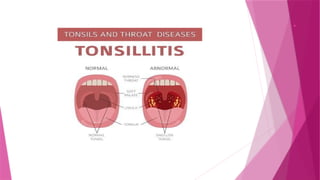
 Tonsillitis are two oval-shaped pads of tissue at
the back of the throat, one tonsil on each side
that help to protect the body from infection.
 Tonsillitis is infection & inflammation of the
tonsils.
 Tonsillitis is a very common childhood illness
typically affecting school-aged children aged
four to sixteen.
.
DEFINITION
Inflammation of tonsils due to bacterial or viral
infection causing a sore throat, fever & difficulty in
swallowing is called tonsillitis.
OR
 Tonsillitis is inflammation of the tonsils most
commonly caused by a viral or bacterial infection.
Symptoms may include sore throat and fever.
INCIDENCE
 The incidence is highest in children age 5 to 9 years
old, and decreases with age.
TYPES
• Acute Tonsillitis
• Chronic Tonsillitis
• Recurrent Tonsillitis
1. Acute Tonsillitis
Acute tonsillitis is characterized by the
sudden appearance of inflammation &
swelling in the tonsils. It is often caused by
a viral or bacterial infection like
Streptococcus infection.
Subtype of Acute Tonsillitis
 i) Acute Catarrhal Tonsillitis
 Caused by virus. The symptom is light, inflammation
located on mucosa. It is least severe form and manifested
as redness & sore throat.
 ii) Acute Follicular Tonsillitis
 It is infection spread into the crypts & ear yellow patches.
 iii) Acute Parenchymatous
 There is congestion & swelling of the entire organ.
 iv) Acute Purulent Tonsillitis
 It is caused by bacteria. The symptoms are severe,
inflammation develops in deep layers, purulent discharge
from tonsil crypt.
2. Chronic Tonsillitis
Chronic tonsillitis symptoms continue longer than
acute tonsillitis. Chronic tonsillitis is often associated
with recurring infections or an improperly &
incompletely treated case of acute tonsillitis.
3. Recurrent Tonsillitis
Recurrent tonsillitis is a condition where a person has
multiple episodes of tonsillitis within a year. It is called
recurrent tonsillitis.
It is manifested by sore throat, fever & swallowing
difficulty.
Other Causes
Viral infection – Adenoviruses, Measles virus
Bacterial infection – Streptococcus pyogenes, Streptococcus A
Fungal infection – Yeast infections
Allergies
Sinus infection – Can cause tonsillitis
Influenza virus
Risk Factor
Younger age
Frequent exposure to germs
.
Pathophysiology
 Due to etiological factors
🔽
Bacterial Viral infection
🔽
 Inflammatory response will occur
🔽
 Tonsils red/swollen may develop pus
discharge
🔽
 Tonsillitis
.
DIAGNOSTIC EVALUATION
•Complaints & symptoms
•Examination of the throat
•Inflammatory parameters - leukocytosis, ESR
& CRP are elevated
•Bacteriological testing - Rarely taken
because it takes 2-3 days to obtain a definitive
result.
•Rapid immunoassay - Can identify the
causative organism as a group A streptococcus
in 10 minutes.
•Blood test
•Throat swab
•Monospot test
MANAGEMENT
 1. Medical Management
 Antibiotics are used to treat acute tonsillitis.
 Saline throat irrigation or gargles may relieve the
discomfort.
 Antibiotics
 Azithromycin - 12 mg/kg PO once daily for 5 days
 Clarithromycin - 250 mg PO q12h for 10 days
 Erythromycin succinate - 20 mg/kg PO
 Clindamycin - 20 mg/kg/day PO in 3 divided doses
 Penicillin V - 25-50 mg/kg/day divided every 6 hours
 Benzathine
 Amoxicillin - 50 mg/kg/day PO in 2 or 3 divided doses
for 10 days
..
Analgesic
• Acetaminophen or Ibuprofen
• Diclofenac
Antipyretic
• Paracetamol, Pacacef, Dolo
Home Remedies
 ✔ Rest & drink plenty of fluids to prevent dehydration.
Gargle with salt water.
✔
Drink warm liquids or eat ice pops.
✔
Use a cool-air humidifier.
✔
Eat smooth, cool foods like ice cream.
✔
2. Surgical Management
• Tonsillectomy - Removal of the tonsils.
• Adenoidectomy - Removal of adenoids.
Nutritional Management
•Adequate hydration – Encourage
plenty of fluids such as water or
electrolyte-rich beverages like Pedialyte.
•Soft, easy-to-swallow foods – like
bananas & smoothies.
•Warm liquids – Provide warm liquids
like tea or broth to help soothe the throat.
•Avoid spicy or acidic foods.
•Vitamin C
Nursing Management
 Promoting airway clearance
 Provide side-lying or prone position
 Maintaining fluid volume
 Relieving pain
 Administer analgesic
 Tepid sponging to reduce temperature
PREVENTION
 Eating a balanced diet
 Getting enough sleep
 Exercising regularly
 Managing stress
 Washing hands frequently
 Avoiding people who are sick
.
COMPLICATION
 ✔ Chronic tonsillitis
Peritonsillar abscess
✔
Parapharyngeal abscess
✔
Rheumatic fever
✔
HEALTH EDUCATION
•Educate the patient about the disease and
provide an information leaflet to help manage
sore throat at home.
•Advise the patient to lead a healthy lifestyle.
•Promote immunization in children.
•Provide alternatives to antibiotic prescriptions.
•Educate on medication compliance & usage.
Conclusion
Tonsillitis is simply the inflammation of the
tonsils by bacteria or less often viral.
Overcrowding is one of the predisposing
factors of tonsillitis.
It is mainly caused by beta haemolytic
streptococcus.
Its management includes non-
pharmacological interventions such as:
Rest
Saline gargles
Taking lots of fluids, etc.
.
Summary
 Introduction
 Definition
 Incidence
 Types
 Causes
 Pathophysiology
 Sign & Symptoms
 Diagnostic Evaluation
 Management
 ✔ Pharmacological
 ✔ Surgical
 ✔ Nutritional
 ✔ Nursing Management
.
 Prevention
 Complication
 Health Education
 Conclusion
 Summary
Cva.ppt president the same information about cva

Cva.ppt president the same information about cva

  • 2.
    INTRODUCTION  Tonsillitis aretwo oval-shaped pads of tissue at the back of the throat, one tonsil on each side that help to protect the body from infection.  Tonsillitis is infection & inflammation of the tonsils.  Tonsillitis is a very common childhood illness typically affecting school-aged children aged four to sixteen.
  • 3.
  • 4.
    DEFINITION Inflammation of tonsilsdue to bacterial or viral infection causing a sore throat, fever & difficulty in swallowing is called tonsillitis. OR  Tonsillitis is inflammation of the tonsils most commonly caused by a viral or bacterial infection. Symptoms may include sore throat and fever. INCIDENCE  The incidence is highest in children age 5 to 9 years old, and decreases with age.
  • 5.
    TYPES • Acute Tonsillitis •Chronic Tonsillitis • Recurrent Tonsillitis 1. Acute Tonsillitis Acute tonsillitis is characterized by the sudden appearance of inflammation & swelling in the tonsils. It is often caused by a viral or bacterial infection like Streptococcus infection.
  • 7.
    Subtype of AcuteTonsillitis  i) Acute Catarrhal Tonsillitis  Caused by virus. The symptom is light, inflammation located on mucosa. It is least severe form and manifested as redness & sore throat.  ii) Acute Follicular Tonsillitis  It is infection spread into the crypts & ear yellow patches.  iii) Acute Parenchymatous  There is congestion & swelling of the entire organ.  iv) Acute Purulent Tonsillitis  It is caused by bacteria. The symptoms are severe, inflammation develops in deep layers, purulent discharge from tonsil crypt.
  • 8.
    2. Chronic Tonsillitis Chronictonsillitis symptoms continue longer than acute tonsillitis. Chronic tonsillitis is often associated with recurring infections or an improperly & incompletely treated case of acute tonsillitis. 3. Recurrent Tonsillitis Recurrent tonsillitis is a condition where a person has multiple episodes of tonsillitis within a year. It is called recurrent tonsillitis. It is manifested by sore throat, fever & swallowing difficulty.
  • 9.
    Other Causes Viral infection– Adenoviruses, Measles virus Bacterial infection – Streptococcus pyogenes, Streptococcus A Fungal infection – Yeast infections Allergies Sinus infection – Can cause tonsillitis Influenza virus Risk Factor Younger age Frequent exposure to germs
  • 10.
    . Pathophysiology  Due toetiological factors 🔽 Bacterial Viral infection 🔽  Inflammatory response will occur 🔽  Tonsils red/swollen may develop pus discharge 🔽  Tonsillitis
  • 11.
  • 12.
    DIAGNOSTIC EVALUATION •Complaints &symptoms •Examination of the throat •Inflammatory parameters - leukocytosis, ESR & CRP are elevated •Bacteriological testing - Rarely taken because it takes 2-3 days to obtain a definitive result. •Rapid immunoassay - Can identify the causative organism as a group A streptococcus in 10 minutes. •Blood test •Throat swab •Monospot test
  • 13.
    MANAGEMENT  1. MedicalManagement  Antibiotics are used to treat acute tonsillitis.  Saline throat irrigation or gargles may relieve the discomfort.  Antibiotics  Azithromycin - 12 mg/kg PO once daily for 5 days  Clarithromycin - 250 mg PO q12h for 10 days  Erythromycin succinate - 20 mg/kg PO  Clindamycin - 20 mg/kg/day PO in 3 divided doses  Penicillin V - 25-50 mg/kg/day divided every 6 hours  Benzathine  Amoxicillin - 50 mg/kg/day PO in 2 or 3 divided doses for 10 days
  • 14.
    .. Analgesic • Acetaminophen orIbuprofen • Diclofenac Antipyretic • Paracetamol, Pacacef, Dolo Home Remedies  ✔ Rest & drink plenty of fluids to prevent dehydration. Gargle with salt water. ✔ Drink warm liquids or eat ice pops. ✔ Use a cool-air humidifier. ✔ Eat smooth, cool foods like ice cream. ✔ 2. Surgical Management • Tonsillectomy - Removal of the tonsils. • Adenoidectomy - Removal of adenoids.
  • 15.
    Nutritional Management •Adequate hydration– Encourage plenty of fluids such as water or electrolyte-rich beverages like Pedialyte. •Soft, easy-to-swallow foods – like bananas & smoothies. •Warm liquids – Provide warm liquids like tea or broth to help soothe the throat. •Avoid spicy or acidic foods. •Vitamin C
  • 16.
    Nursing Management  Promotingairway clearance  Provide side-lying or prone position  Maintaining fluid volume  Relieving pain  Administer analgesic  Tepid sponging to reduce temperature
  • 17.
    PREVENTION  Eating abalanced diet  Getting enough sleep  Exercising regularly  Managing stress  Washing hands frequently  Avoiding people who are sick
  • 18.
    . COMPLICATION  ✔ Chronictonsillitis Peritonsillar abscess ✔ Parapharyngeal abscess ✔ Rheumatic fever ✔
  • 19.
    HEALTH EDUCATION •Educate thepatient about the disease and provide an information leaflet to help manage sore throat at home. •Advise the patient to lead a healthy lifestyle. •Promote immunization in children. •Provide alternatives to antibiotic prescriptions. •Educate on medication compliance & usage.
  • 20.
    Conclusion Tonsillitis is simplythe inflammation of the tonsils by bacteria or less often viral. Overcrowding is one of the predisposing factors of tonsillitis. It is mainly caused by beta haemolytic streptococcus. Its management includes non- pharmacological interventions such as: Rest Saline gargles Taking lots of fluids, etc.

  • 21.
    . Summary  Introduction  Definition Incidence  Types  Causes  Pathophysiology  Sign & Symptoms  Diagnostic Evaluation  Management  ✔ Pharmacological  ✔ Surgical  ✔ Nutritional  ✔ Nursing Management
  • 22.
    .  Prevention  Complication Health Education  Conclusion  Summary