RHEUMATIC FEVER
By: Mr. Ganesh V. Naik
Lecturer
KLES Institute of nursing
Sciences Ankola
DEFINITION
Rheumatic heart fever is an immunological
disorder initiated by Group A beta hemolytic
streptococcus. It is a systemic inflammatory
disease of childhood that can involve the
heart, joints, central nervous system, skin and
connective tissues.
INCIDENCE
Rheumatic fever develops 2-3 weeks
after streptococcal infection
Rheumatic fever occurs in equal numbers in
males and females, but the prognosis is
worse for females than for males.
It appears in children between the ages of 6
to 15years.
ETIOLOGY
Group A beta-hemolytic streptococcus.
Genetic
RISK FACTORS
Poor socio-economic status: People who
are poor and belongs to low socio-economic
conditions are prone to get Rheumatic heart
disease.
Over-crowding: People who are living in a
slum are more prone to get Rheumatic
heart disease.
Age: It appears most commonly in children
between the age of 5 to 15 years.
RISK FACTORS(contd…)
Climate and season: It occurs more in the
rainy season and in the cold climate.
Upper respiratory tract infection:
Rheumatic fever is an outcome of upper
respiratory tract infection with group Abeta-
hemolytic streptococcus.
RISK FACTORS(contd…)
Previous history of Rheumatic fever: The
client with previous history of Rheumatic fever
are at high risk to develop Rheumatic heart
disease.
Genetic predisposition: Rheumatic heart
disease shows familier tendancy.
PATHOPHYSIOLOGY
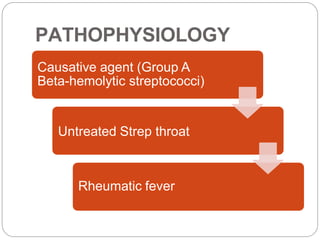
Causative agent (Group A
Beta-hemolytic streptococci)
Untreated Strep throat
Rheumatic fever
All layers of the heart and the
mitral valve become inflamed
Vegetation forms
Valvular regurgitations and
stenosis
Heart failure
CLINICAL
MANIFESTATIONS
Major manifestations
Carditis:Pancarditis involving pericardium,
myocardium and endocardium.
Polyarthritis:Inflammation of large joint, usually
starting in legs.
Sydneham’s choea:It consists of a series of
rapid movements without purpose occuring on
face and arms, weakness.
Erythema marginatum:Reddish rash begins on
the trunk spreads over body.
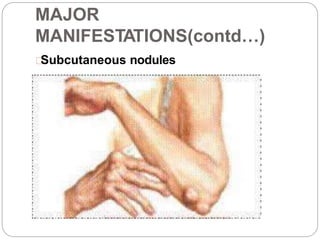
Subcutaneous nodules:can be present in bony
prominences like elbow, wrist, knees
Polyarthritis
Sydneham’s choea
MAJOR
MANIFESTATIONS(contd…)
Erythema marginatum
MAJOR
MANIFESTATIONS(contd…)
Subcutaneous nodules
Minor manifestations include:
Fever associated with weakness, malaise,
weight loss and anorexia
Arthralgia:Joint pain without swelling
DIAGNOSTIC EVALUATIONS
History Collection
The modified Jones criteria (revised in 1992)
provide guidelines for the diagnosis of
rheumatic fever.
JONES CRITERIA
2 major or
1 major and 2 minor
Jones’ criteria for the diagnosis of
Rheumatic fever
Major manifestations
Carditis
Polyarthritis
Chorea
Erythema marginatum
Subcutaneous nodules
Minor manifestations
a) Clinical findings
Previous rheumatic fever or rheumatic heart
disease.
Arthralgia
Fever associated with weakness, malaise,
weight loss and anorexia
b) Laboratory findings
Elevated ESR, C-reactive protein and
Leukocytosis
c) Evidence of Group A
streptococcal infection
Positive throat culture for strep A
Chest roentgenography :
Cardiomegaly, pulmonary congestion, and
other findings consistent with heart failure
may be seen on chest radiography.
Doppler-echocardiogram
In acute rheumatic heart disease, Doppler-
echocardiography identifies and quantitates
valve insufficiency and ventricular dysfunction.
ON ECG
It detect bradycardia ,atrial flutter, atrial
fibrillation .
Management: Medical Management
Administer antiinflammatory drugs like
corticosteroids or aspirin. Aspirin
100mg/kg/day
Ibuprofen is given for pain relief
Antibiotics for infection like penicillin,
erythromycin
Bed rest is recommended during acute phase
of disease.
Cummisurotomy can be done to widen the
valve.
Surgical management
In patients with critical stenosis, mitral
valvulotomy, percutaneous balloon
valvuloplasty, or mitral valve replacement
may be indicated.
NURSING MANAGEMENT
Pain related to inflammatory response in the
joints.
Interventions
Assess the level of pain, duration, intensity
and frequency of pain.
Complete bed rest and provide comfortable
position.
Provide diversional therapy and psychological
support.
Administer analgesics as needed.
Decreased cardiac output related to valve
dysfunction or HF.
Interventions
Assess the symptoms of heart failure
Assess for heart sounds.
Monitor intake and output.
Provide bed rest.
Administration of cardiac glycosides
as prescribed.
Knowledge deficit related to disease condition
and long term treatment.
Intervention
Assess the clients level of knowledge.
Assess the client’s ability to learn.
Explain about disease condition and about
prophylactic treatment of antibiotics.
Clarify the clients doubt clearly
Anxiety related to disease condition and
heart failure
Interventions
Assess the clients level of anxiety.
Clarify the doubts of the clients .
Explain all activities, procedures and
issues that involves the client.
Explain about the disease conditions
and prophylactic treatment.
THANK YOU

Rheumaticheartdisease

  • 1.
    RHEUMATIC FEVER By: Mr.Ganesh V. Naik Lecturer KLES Institute of nursing Sciences Ankola
  • 2.
    DEFINITION Rheumatic heart feveris an immunological disorder initiated by Group A beta hemolytic streptococcus. It is a systemic inflammatory disease of childhood that can involve the heart, joints, central nervous system, skin and connective tissues.
  • 3.
    INCIDENCE Rheumatic fever develops2-3 weeks after streptococcal infection Rheumatic fever occurs in equal numbers in males and females, but the prognosis is worse for females than for males. It appears in children between the ages of 6 to 15years.
  • 4.
    ETIOLOGY Group A beta-hemolyticstreptococcus. Genetic
  • 5.
    RISK FACTORS Poor socio-economicstatus: People who are poor and belongs to low socio-economic conditions are prone to get Rheumatic heart disease. Over-crowding: People who are living in a slum are more prone to get Rheumatic heart disease. Age: It appears most commonly in children between the age of 5 to 15 years.
  • 6.
    RISK FACTORS(contd…) Climate andseason: It occurs more in the rainy season and in the cold climate. Upper respiratory tract infection: Rheumatic fever is an outcome of upper respiratory tract infection with group Abeta- hemolytic streptococcus.
  • 7.
    RISK FACTORS(contd…) Previous historyof Rheumatic fever: The client with previous history of Rheumatic fever are at high risk to develop Rheumatic heart disease. Genetic predisposition: Rheumatic heart disease shows familier tendancy.
  • 8.
    PATHOPHYSIOLOGY Causative agent (GroupA Beta-hemolytic streptococci) Untreated Strep throat Rheumatic fever
  • 9.
    All layers ofthe heart and the mitral valve become inflamed Vegetation forms Valvular regurgitations and stenosis Heart failure
  • 10.
    CLINICAL MANIFESTATIONS Major manifestations Carditis:Pancarditis involvingpericardium, myocardium and endocardium. Polyarthritis:Inflammation of large joint, usually starting in legs. Sydneham’s choea:It consists of a series of rapid movements without purpose occuring on face and arms, weakness. Erythema marginatum:Reddish rash begins on the trunk spreads over body. Subcutaneous nodules:can be present in bony prominences like elbow, wrist, knees
  • 11.
  • 12.
  • 13.
  • 14.
  • 15.
    Minor manifestations include: Feverassociated with weakness, malaise, weight loss and anorexia Arthralgia:Joint pain without swelling
  • 16.
    DIAGNOSTIC EVALUATIONS History Collection Themodified Jones criteria (revised in 1992) provide guidelines for the diagnosis of rheumatic fever.
  • 17.
    JONES CRITERIA 2 majoror 1 major and 2 minor Jones’ criteria for the diagnosis of Rheumatic fever Major manifestations Carditis Polyarthritis Chorea Erythema marginatum Subcutaneous nodules
  • 18.
    Minor manifestations a) Clinicalfindings Previous rheumatic fever or rheumatic heart disease. Arthralgia Fever associated with weakness, malaise, weight loss and anorexia
  • 19.
    b) Laboratory findings ElevatedESR, C-reactive protein and Leukocytosis c) Evidence of Group A streptococcal infection Positive throat culture for strep A
  • 20.
    Chest roentgenography : Cardiomegaly,pulmonary congestion, and other findings consistent with heart failure may be seen on chest radiography.
  • 21.
    Doppler-echocardiogram In acute rheumaticheart disease, Doppler- echocardiography identifies and quantitates valve insufficiency and ventricular dysfunction.
  • 22.
    ON ECG It detectbradycardia ,atrial flutter, atrial fibrillation .
  • 23.
    Management: Medical Management Administerantiinflammatory drugs like corticosteroids or aspirin. Aspirin 100mg/kg/day Ibuprofen is given for pain relief Antibiotics for infection like penicillin, erythromycin Bed rest is recommended during acute phase of disease.
  • 24.
    Cummisurotomy can bedone to widen the valve. Surgical management
  • 25.
    In patients withcritical stenosis, mitral valvulotomy, percutaneous balloon valvuloplasty, or mitral valve replacement may be indicated.
  • 26.
  • 27.
    Pain related toinflammatory response in the joints. Interventions Assess the level of pain, duration, intensity and frequency of pain. Complete bed rest and provide comfortable position. Provide diversional therapy and psychological support. Administer analgesics as needed.
  • 28.
    Decreased cardiac outputrelated to valve dysfunction or HF. Interventions Assess the symptoms of heart failure Assess for heart sounds. Monitor intake and output. Provide bed rest. Administration of cardiac glycosides as prescribed.
  • 29.
    Knowledge deficit relatedto disease condition and long term treatment. Intervention Assess the clients level of knowledge. Assess the client’s ability to learn. Explain about disease condition and about prophylactic treatment of antibiotics. Clarify the clients doubt clearly
  • 30.
    Anxiety related todisease condition and heart failure Interventions Assess the clients level of anxiety. Clarify the doubts of the clients . Explain all activities, procedures and issues that involves the client. Explain about the disease conditions and prophylactic treatment.
  • 31.