TONSILLITIS
Prepared by:
Shiksha Khanal
BNS 2nd year
Roll no:29
General Objective
Table of content:
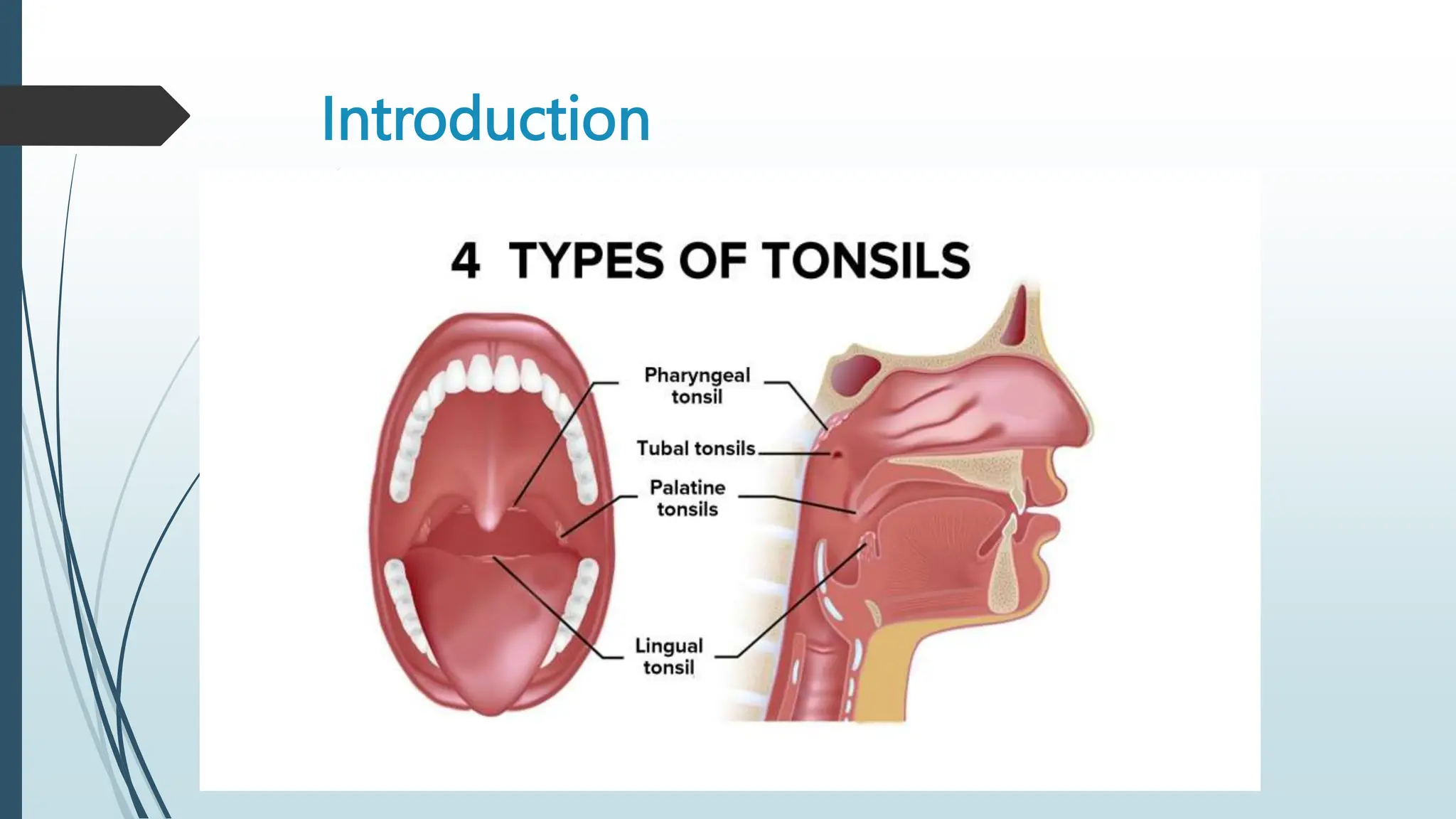
Introduction
Definition
Incidence
Etiology
Risk factor
Types
Pathophysiology
Clinical features
Diagnostic
evaluation
Prevention
Management
Complication
Prognosis
Introduction
Definition
Tonsillitis is the inflammation and infection
of tonsils, especially, the palatine (faucial)
tonsil
Incidence
According to a study published in the journal
Pediatrics in 2019,(UK) the incidence of
tonsillitis in children under 15 years old is
approximately 40 per 1,000 person-years.
The incidence is highest in children aged 5 to
9 years old, and decreases with age.
There is research in Egypt that indicates 15-30%
of sore throats in children and 5-10% sore throats
in adults are bacterial tonsillitis((Michael Gibson
C., Luk B.S. Tonsillitis Epidemiology and
Demographics)
Etiology
It is caused by either a virus or a bacteria
 Usually the streptococcus bacterium
(hemolytic streptococcus most common)
Others: Staphylococci, pneumococci, H
Influenza
Risk factor
Ingestion of cold or infected food stuff
Low immunity and resistance (mostly affect
school going children rare in infant and above
50 years of age)
Upper respiratory tract infection
Pollution and ill-ventilated environment
 Residual tonsillar tissue left post-tonsillectomy
Types of tonsillitis
1) Acute tonsillitis:
It is classified into:
Acute catarrhal or superficial tonsillitis
Acute follicular tonsillitis
Acute parenchymatous tonsillitis
Acute membranous tonsillitis
Acute catarrhal or superficial tonsillitis
It is a part of generalized pharyngitis and is
mostly seen in viral infections.
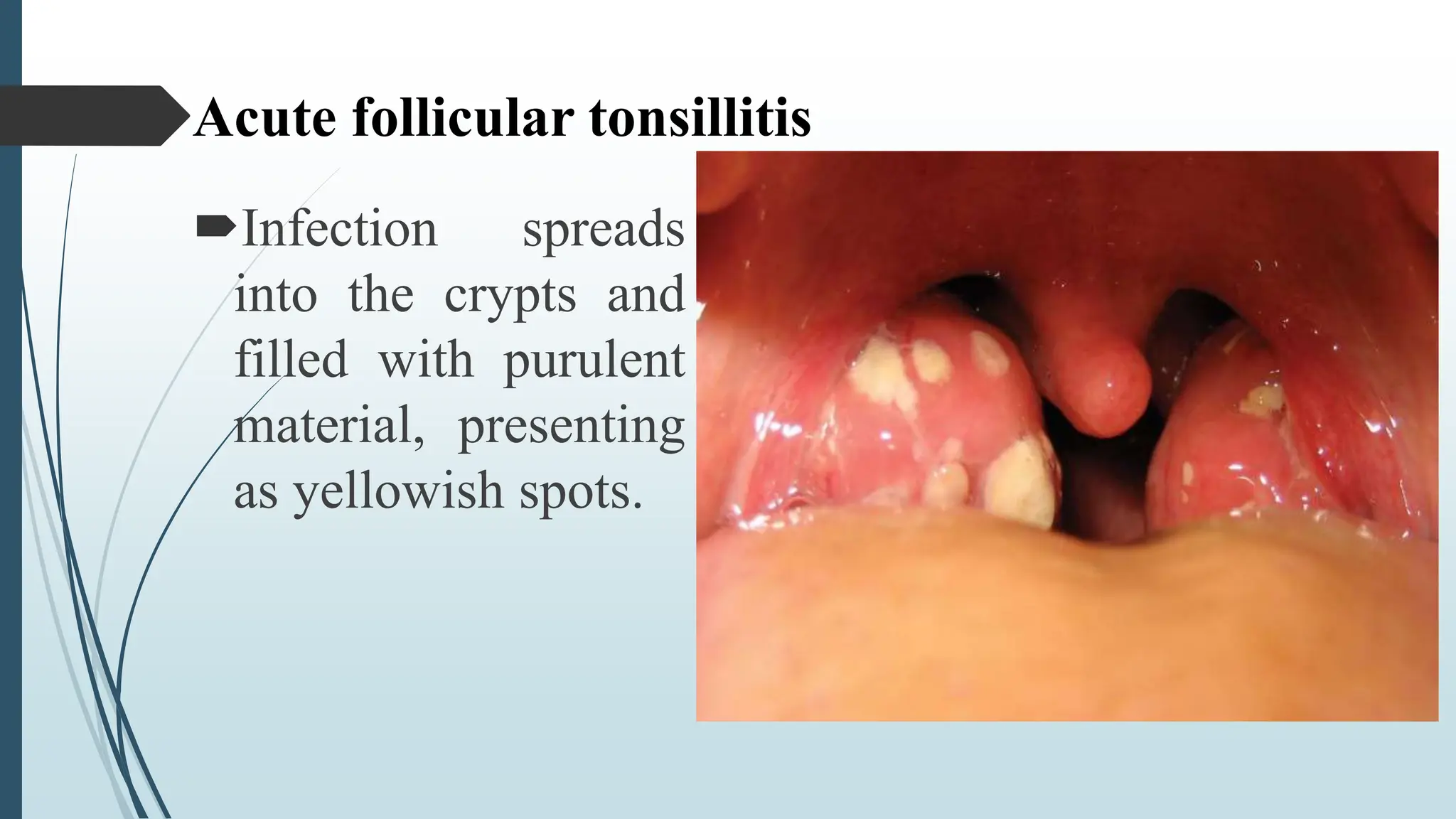
Acute follicular tonsillitis
Infection spreads
into the crypts and
filled with purulent
material, presenting
as yellowish spots.
Acute parenchymatous tonsillitis
The tonsil is
uniformly enlarged
and red.
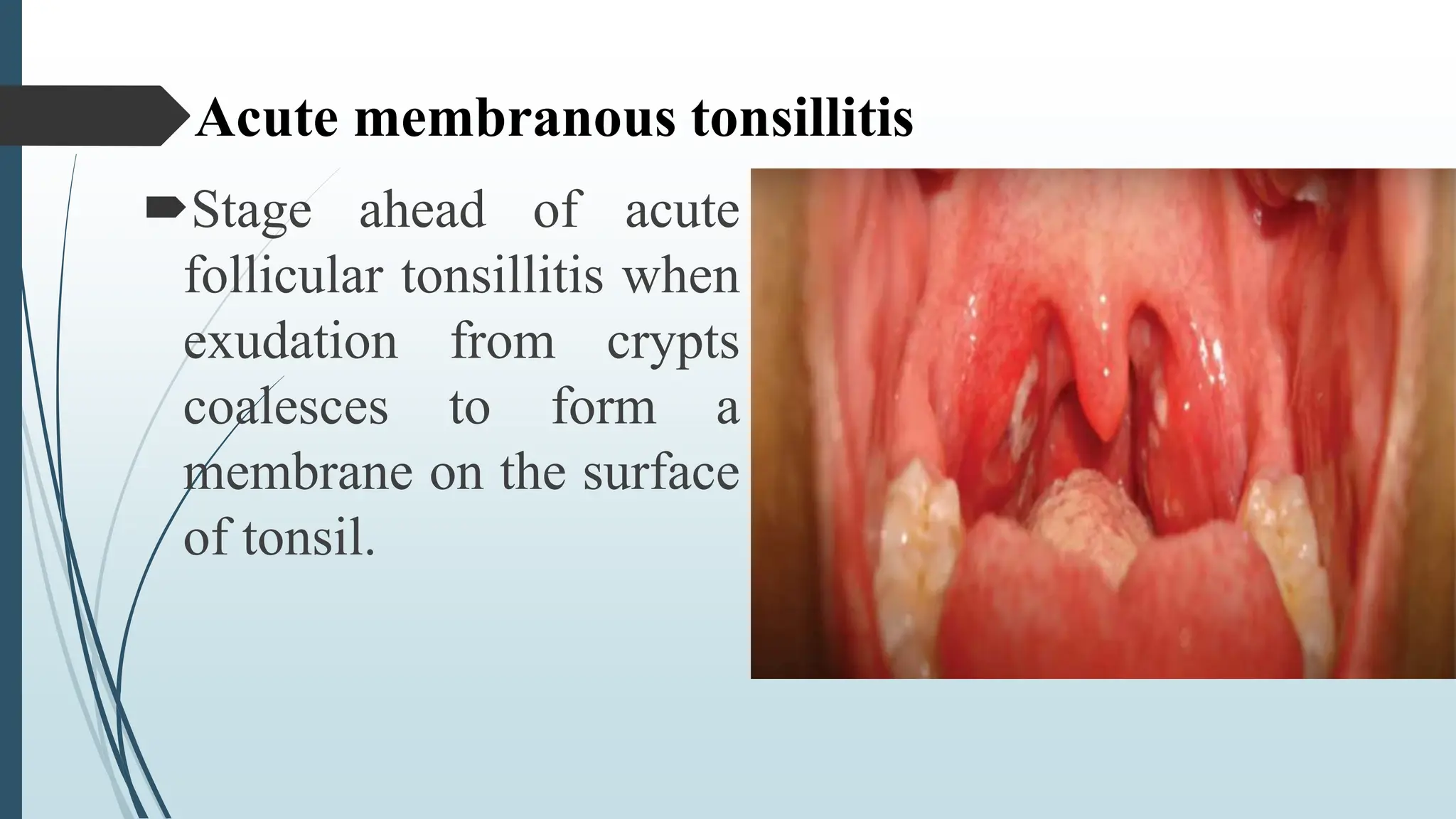
Acute membranous tonsillitis
Stage ahead of acute
follicular tonsillitis when
exudation from crypts
coalesces to form a
membrane on the surface
of tonsil.
2) Sub-acute tonsillitis
It can last between 3weeks to 3months
is caused by the bacterium
3) Chronic tonsillitis
It can last for long periods if not treated
and is almost always bacterial.
Complication of acute tonsillitis. It is
classified into:
Chronic follicular tonsillitis
Chronic parenchymatous tonsillitis
Chronic fibroid tonsillitis
Chronic follicular tonsillitis
Tonsillar crypts are
full of infected
cheesy material
which shows
yellowish spots.
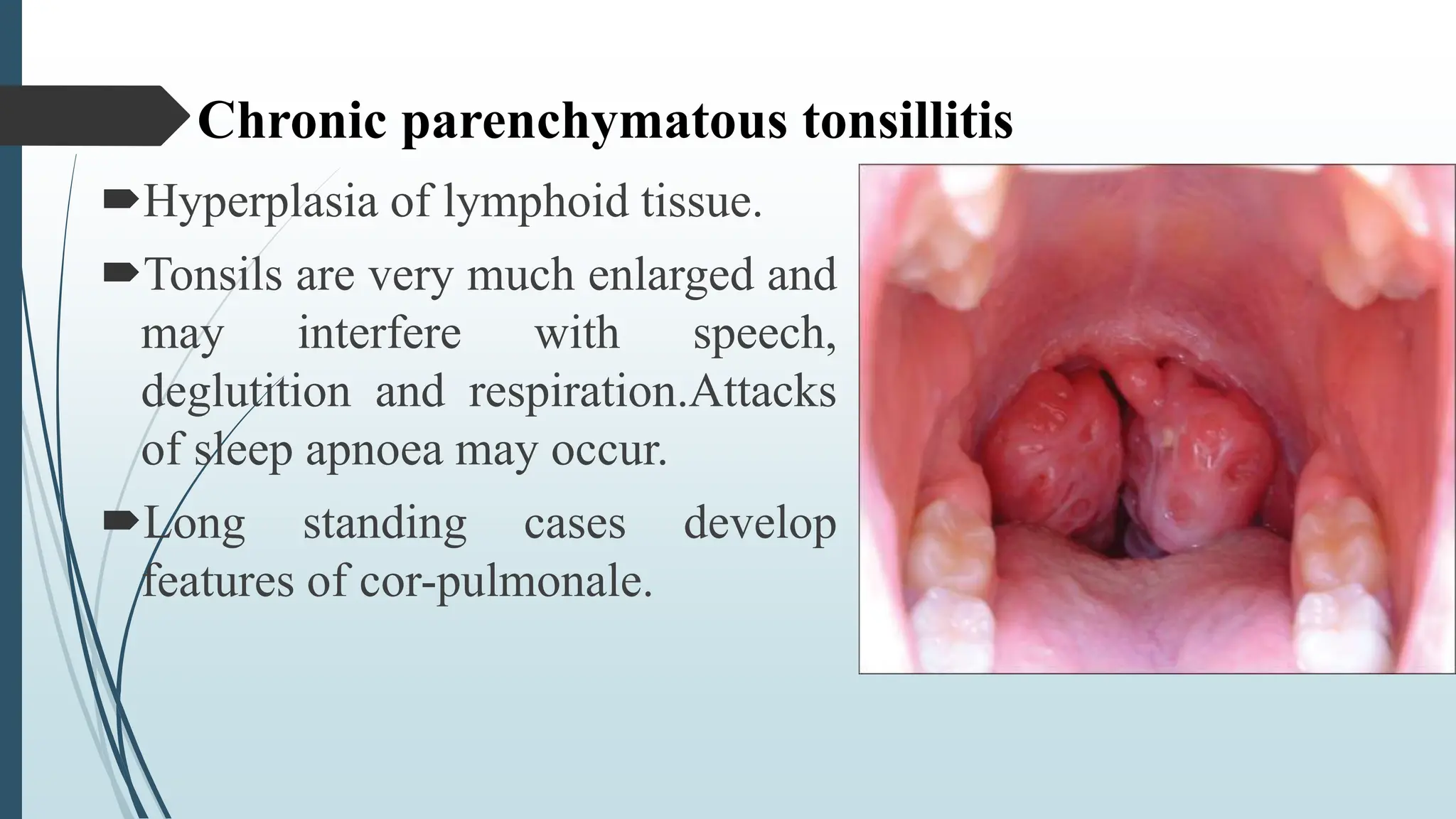
Chronic parenchymatous tonsillitis
Hyperplasia of lymphoid tissue.
Tonsils are very much enlarged and
may interfere with speech,
deglutition and respiration.Attacks
of sleep apnoea may occur.
Long standing cases develop
features of cor-pulmonale.
Chronic fibroid tonsillitis
Tonsils are small but infected with
history of repeated sore throats
Pathophysiology
Clinical features
Acute tonsillitis
Sore throat
Difficulty in swallowing
Fever: vary from 38 to 40C
Earache
Constitutional symptoms
Foetid breath and tongue is coasted
Clinical features contd…
Chronic tonsillitis
Recurrent attacks of sore throat or acute tonsillitis.
Chronic irritation in throat with cough.
Bad taste mouth and foul breath
Thick speech, difficulty in swallowing and choking
spells at night
Diagnostic evaluation
Prevention
Practice good hygiene
Avoid exposure to germs
Maintain a healthy diet
Hydration
Avoid irritants
Immunizations
Medical
manage-
ment
Tonsillectomy
Surgical management
Tonsillectomy:
Tonsillectomy is a surgical procedure in which
both palatine tonsils are fully removed.
The procedure is mainly performed for recurrent
tonsillitis, throat infections and obstructive sleep
apnea .
Tonsillectomy is not performed until 3 to 4 years
of age
Preoperative nursing care
A complete history is taken.
Take written informed consent.
Send and collect lab test report timely.
Informed parents of any problem are on lab test
report.
 Prepare child physically as per need such as keep nil
per orally, bath, administer pre-operative medication,
bowel and bladder preparation etc.
Pre-op care contd…
Psychological preparation of child by giving
a simple explanation about hospital routine,
permit child to try on operating room and
show the operating room and recovery areas
as appropriate age.
Encourage parent to remain with child.
Post operative nursing care
1) Provide immediate general post-operative care:
vital sign, intake and output, pain medication,
monitoring of bleeding
2) Maintain airway ventilation and circulation:
Position child on abdomen or side lying to facilitate
drainage.
Discourage coughing, clearing throat, blowing nose
Post-op care contd…
3) Diet:
When fully recovered from anesthesia, patient is
permitted to take cold liquid diet . Sucking of ice
cubes gives relief of pain and controlled
bleeding.
4) Oral hygiene
Salt water gargles three to four times a day.
A mouth wash with plain water after every feed.
Post-op care contd…
5) Analgesics and antiemetic
Analgesics like paracetamol can be given.
Avoid aspirin and ibuprofen as it can cause
bleeding.
Antiemetic such as ondansetron may be
administered if nausea vomiting present.
6) Antibiotics
Suitable antibiotic can be given orally or by
injection for a week.
Nursing Management of tonsillitis and
tonsillectomy
Assessment
Collection of subjective and objective data
History taking and physical examination
Assess for sign and symptoms
Assess laboratory reports
Nursing diagnosis
Risk for Ineffective Airway Clearance related to
postoperative swelling and pain, as evidenced by
noisy breathing, restlessness, and decreased
oxygen saturation levels.
Acute Pain related to inflammation and swelling
of the tonsils, as evidenced by facial grimacing.
Diagnosis contd…
Alter body temperature related to infection
and inflammation as evidenced by high body
temperature.
Deficient Knowledge related to the diagnosis
and treatment of tonsillitis/tonsillectomy, as
evidenced by frequent questions by patient's
caregiver.
Nursing interventions
To maintain patent airway
Assess for signs and symptoms of inadequate
oxygenation to identify early signs of hypoxia
Place the patient prone or side-lying position
Discourage the intake of milk, ice cream, and
pudding. However, post tonsillectomy patient
should start diet from cold food like cold milk or
ice cream.
Have a suction equipment available at the
bedside.
 Teach breathing exercises to promotes lung
expansion.
Administer medications as prescribed:
antibiotics
To relieve pain
Assess pain using appropriate pain scale.
Observe patient for nonverbal indications of pain.
Gargling and rinsing with warm salt water can
help sooth a sore throat and pain.
Avoid hot and spicy food it aggravate the pain.
Suggest diversional activity.
Administer pain medications as prescribed .
To maintain normal temperature
Administering antipyretic medications as prescribed.
Encouraging to maintain proper hydration and nutrition.
Tepid sponging
Monitoring for signs of complications such as dehydration,
seizures, or confusion, and intervening promptly if needed.
Evaluation
Patent airway maintained as demonstrated by
normal respiratory rate and rhythm and clear
breath sounds.
Decreased level of pain and patient appear more
relaxed/comfortable.
Normal temperature maintained.
Complication
Chronic tonsillitis
Peritonsillar abscess
Parapharyngeal abscess
Cervical abscess
Rheumatic fever
Sub-acute bacterial endocarditis
Peritonsillar abscess
Complication contd…
Respiratory obstruction
 Septicemia
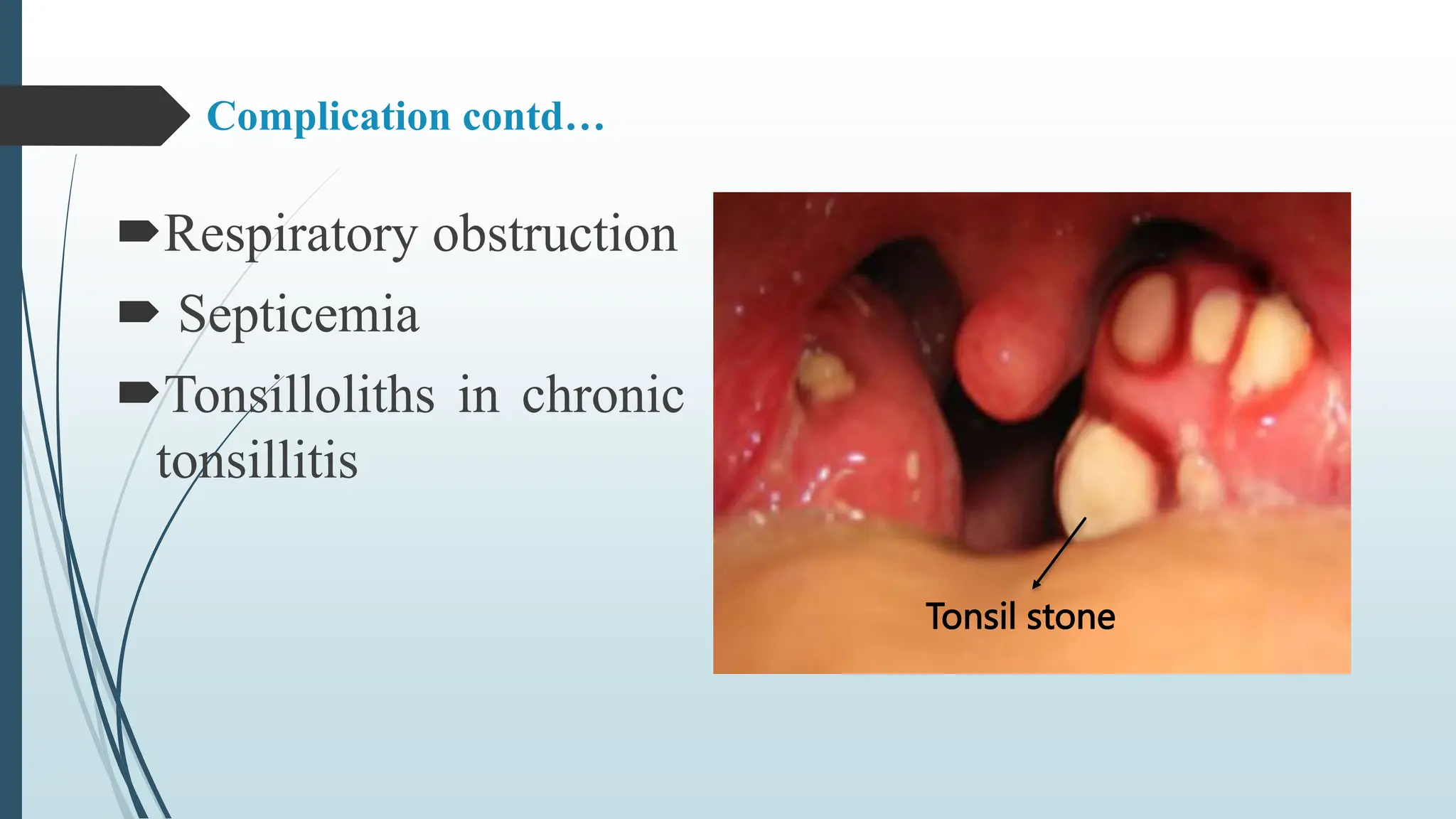
Tonsilloliths in chronic
tonsillitis
Tonsil stone
Prognosis
The prognosis of tonsillitis in children can vary
depending on the underlying cause, the severity of
the infection, and the child's overall health.
If left untreated or improperly managed, tonsillitis
in children can lead to complications.
With appropriate treatment, most children with
tonsillitis have a good prognosis and can recover
fully without any long-term complications.
Assignment
References:
Dhingra PL(2022).Disease of ear,nose,throat,head and neck
surgery.8th ed. RELX Pvt.Ltd.New delhi.India.pg.304-308
Uprety K.(2021).Child health nursing.3rd ed.Akshav
publication.ktmandu.pg.402-406
Sharna S.(2020).Lippincott manual of nursing practice.Wolters
publication.India.pg.1216-1219
Mandal GN.(2019).Text book of medical surgical nursing .6thed.
.Makalu publication.dillibazar.kathmandu.pg.1214-1218
Hockenberry M.Wilson D.(2018)Wong’s essential of pediatric
nursing.10th ed. RELX Pvt.Ltd. New delhi.India.pg.468-470
TONSILLITIS in child.pptx,tonsillits, toncelectomy, nursing

TONSILLITIS in child.pptx,tonsillits, toncelectomy, nursing

  • 2.
  • 3.
  • 4.
    Table of content: Introduction Definition Incidence Etiology Riskfactor Types Pathophysiology Clinical features Diagnostic evaluation Prevention Management Complication Prognosis
  • 5.
  • 6.
    Definition Tonsillitis is theinflammation and infection of tonsils, especially, the palatine (faucial) tonsil
  • 7.
    Incidence According to astudy published in the journal Pediatrics in 2019,(UK) the incidence of tonsillitis in children under 15 years old is approximately 40 per 1,000 person-years. The incidence is highest in children aged 5 to 9 years old, and decreases with age.
  • 8.
    There is researchin Egypt that indicates 15-30% of sore throats in children and 5-10% sore throats in adults are bacterial tonsillitis((Michael Gibson C., Luk B.S. Tonsillitis Epidemiology and Demographics)
  • 9.
    Etiology It is causedby either a virus or a bacteria  Usually the streptococcus bacterium (hemolytic streptococcus most common) Others: Staphylococci, pneumococci, H Influenza
  • 10.
    Risk factor Ingestion ofcold or infected food stuff Low immunity and resistance (mostly affect school going children rare in infant and above 50 years of age) Upper respiratory tract infection Pollution and ill-ventilated environment  Residual tonsillar tissue left post-tonsillectomy
  • 11.
    Types of tonsillitis 1)Acute tonsillitis: It is classified into: Acute catarrhal or superficial tonsillitis Acute follicular tonsillitis Acute parenchymatous tonsillitis Acute membranous tonsillitis
  • 12.
    Acute catarrhal orsuperficial tonsillitis It is a part of generalized pharyngitis and is mostly seen in viral infections.
  • 13.
    Acute follicular tonsillitis Infectionspreads into the crypts and filled with purulent material, presenting as yellowish spots.
  • 14.
    Acute parenchymatous tonsillitis Thetonsil is uniformly enlarged and red.
  • 15.
    Acute membranous tonsillitis Stageahead of acute follicular tonsillitis when exudation from crypts coalesces to form a membrane on the surface of tonsil.
  • 16.
    2) Sub-acute tonsillitis Itcan last between 3weeks to 3months is caused by the bacterium
  • 17.
    3) Chronic tonsillitis Itcan last for long periods if not treated and is almost always bacterial. Complication of acute tonsillitis. It is classified into: Chronic follicular tonsillitis Chronic parenchymatous tonsillitis Chronic fibroid tonsillitis
  • 18.
    Chronic follicular tonsillitis Tonsillarcrypts are full of infected cheesy material which shows yellowish spots.
  • 19.
    Chronic parenchymatous tonsillitis Hyperplasiaof lymphoid tissue. Tonsils are very much enlarged and may interfere with speech, deglutition and respiration.Attacks of sleep apnoea may occur. Long standing cases develop features of cor-pulmonale.
  • 20.
    Chronic fibroid tonsillitis Tonsilsare small but infected with history of repeated sore throats
  • 21.
  • 22.
    Clinical features Acute tonsillitis Sorethroat Difficulty in swallowing Fever: vary from 38 to 40C Earache Constitutional symptoms Foetid breath and tongue is coasted
  • 23.
    Clinical features contd… Chronictonsillitis Recurrent attacks of sore throat or acute tonsillitis. Chronic irritation in throat with cough. Bad taste mouth and foul breath Thick speech, difficulty in swallowing and choking spells at night
  • 24.
  • 25.
    Prevention Practice good hygiene Avoidexposure to germs Maintain a healthy diet Hydration Avoid irritants Immunizations
  • 26.
  • 27.
  • 28.
    Surgical management Tonsillectomy: Tonsillectomy isa surgical procedure in which both palatine tonsils are fully removed. The procedure is mainly performed for recurrent tonsillitis, throat infections and obstructive sleep apnea . Tonsillectomy is not performed until 3 to 4 years of age
  • 29.
    Preoperative nursing care Acomplete history is taken. Take written informed consent. Send and collect lab test report timely. Informed parents of any problem are on lab test report.  Prepare child physically as per need such as keep nil per orally, bath, administer pre-operative medication, bowel and bladder preparation etc.
  • 30.
    Pre-op care contd… Psychologicalpreparation of child by giving a simple explanation about hospital routine, permit child to try on operating room and show the operating room and recovery areas as appropriate age. Encourage parent to remain with child.
  • 31.
    Post operative nursingcare 1) Provide immediate general post-operative care: vital sign, intake and output, pain medication, monitoring of bleeding 2) Maintain airway ventilation and circulation: Position child on abdomen or side lying to facilitate drainage. Discourage coughing, clearing throat, blowing nose
  • 32.
    Post-op care contd… 3)Diet: When fully recovered from anesthesia, patient is permitted to take cold liquid diet . Sucking of ice cubes gives relief of pain and controlled bleeding. 4) Oral hygiene Salt water gargles three to four times a day. A mouth wash with plain water after every feed.
  • 33.
    Post-op care contd… 5)Analgesics and antiemetic Analgesics like paracetamol can be given. Avoid aspirin and ibuprofen as it can cause bleeding. Antiemetic such as ondansetron may be administered if nausea vomiting present. 6) Antibiotics Suitable antibiotic can be given orally or by injection for a week.
  • 34.
    Nursing Management oftonsillitis and tonsillectomy Assessment Collection of subjective and objective data History taking and physical examination Assess for sign and symptoms Assess laboratory reports
  • 35.
    Nursing diagnosis Risk forIneffective Airway Clearance related to postoperative swelling and pain, as evidenced by noisy breathing, restlessness, and decreased oxygen saturation levels. Acute Pain related to inflammation and swelling of the tonsils, as evidenced by facial grimacing.
  • 36.
    Diagnosis contd… Alter bodytemperature related to infection and inflammation as evidenced by high body temperature. Deficient Knowledge related to the diagnosis and treatment of tonsillitis/tonsillectomy, as evidenced by frequent questions by patient's caregiver.
  • 37.
    Nursing interventions To maintainpatent airway Assess for signs and symptoms of inadequate oxygenation to identify early signs of hypoxia Place the patient prone or side-lying position Discourage the intake of milk, ice cream, and pudding. However, post tonsillectomy patient should start diet from cold food like cold milk or ice cream.
  • 38.
    Have a suctionequipment available at the bedside.  Teach breathing exercises to promotes lung expansion. Administer medications as prescribed: antibiotics
  • 39.
    To relieve pain Assesspain using appropriate pain scale. Observe patient for nonverbal indications of pain. Gargling and rinsing with warm salt water can help sooth a sore throat and pain. Avoid hot and spicy food it aggravate the pain. Suggest diversional activity. Administer pain medications as prescribed .
  • 40.
    To maintain normaltemperature Administering antipyretic medications as prescribed. Encouraging to maintain proper hydration and nutrition. Tepid sponging Monitoring for signs of complications such as dehydration, seizures, or confusion, and intervening promptly if needed.
  • 41.
    Evaluation Patent airway maintainedas demonstrated by normal respiratory rate and rhythm and clear breath sounds. Decreased level of pain and patient appear more relaxed/comfortable. Normal temperature maintained.
  • 42.
    Complication Chronic tonsillitis Peritonsillar abscess Parapharyngealabscess Cervical abscess Rheumatic fever Sub-acute bacterial endocarditis Peritonsillar abscess
  • 43.
    Complication contd… Respiratory obstruction Septicemia Tonsilloliths in chronic tonsillitis Tonsil stone
  • 44.
    Prognosis The prognosis oftonsillitis in children can vary depending on the underlying cause, the severity of the infection, and the child's overall health.
  • 45.
    If left untreatedor improperly managed, tonsillitis in children can lead to complications. With appropriate treatment, most children with tonsillitis have a good prognosis and can recover fully without any long-term complications.
  • 48.
  • 49.
    References: Dhingra PL(2022).Disease ofear,nose,throat,head and neck surgery.8th ed. RELX Pvt.Ltd.New delhi.India.pg.304-308 Uprety K.(2021).Child health nursing.3rd ed.Akshav publication.ktmandu.pg.402-406 Sharna S.(2020).Lippincott manual of nursing practice.Wolters publication.India.pg.1216-1219 Mandal GN.(2019).Text book of medical surgical nursing .6thed. .Makalu publication.dillibazar.kathmandu.pg.1214-1218 Hockenberry M.Wilson D.(2018)Wong’s essential of pediatric nursing.10th ed. RELX Pvt.Ltd. New delhi.India.pg.468-470