OTITIS MEDIA
DEFINITION

Inflammation of the middle ear.
May also involve inflammation of
mastoid, petrous apex, and perilabyrinthine air cells
Classification
 Acute OM - rapid onset of signs &

symptoms, < 3 wk course
 Sub-acute OM - 3 wks to 3 months
 Chronic OM - 3 months or longer
Etiology
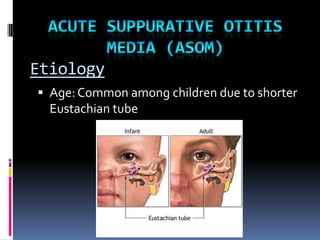
 Age: Common among children due to shorter

Eustachian tube
 Adenoiditis, Tonsillitis, Rhinitis, Sinusitis,
Pharyngitis & infections secondary to cleft
palate
 Trauma to the TM
 Head injury
 Barotrauma
Pathology
1. Catarrhal stage: is characterized by occlusion

of Eustachian tube and congestion of middle
ear.
2. Stage of exudation: Exudate collects in the

middle ear and ear drum is pushed laterally.
Initially the exudate is mucoid, later it
becomes purulent.
Pathology
3. Stage of suppuration: Pus in the middle ear
collects under tension, stretches the drum &
perforates it by pressure necrosis & the
exudate starts escaping into external auditory
canal
4. Stage of healing: The infection starts
resolving from any of the stages mentioned &
usually clears up completely without leaving
any sequelae.
Pathology
5. Stage of complications: Infection may
spread to the mastoid antrum. Initially it
causes Catarrhal mastoiditis [congestion of
the mastoid mucosa], stage of Coalescent
mastoiditis & later empyeme of the mastoid
Clinical manifestations: ASOM
1. Catarrhal stage (stage of congestion)
 Fullness or heaviness in the ear
 Severe ear pain at night
 Deafness
 Tinnitus (ringing or buzzing in the ear)
 Autophony (spoken words of patient echo in his
ears)
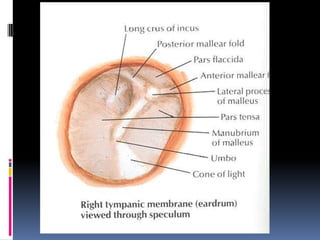
 TM (ear drum) gets retracted
 Cart wheel appearance of ear drum
 Absence of light reflex
2. Stage of exudation
 All symptoms becomes more severe.
3. Stage of suppuration
 Perforation of Ear drum
 Otorrhoea with mucoid purulent

discharge
 Pulsatile discharge (ear discharge
with each arterial dilation)
[Lighthouse sign]
4. Stage of healing
 Healing starts in this stage
5. Stage of complication
 Spread of infection to mastoid
Diagnosis
 Tuning fork test and audiometry
 Radiography
 Bacteriological examination of the ear

discharge
 Pneumatic otoscopy is gold standard
Treatment - AOM
 Systemic
 Antibiotics: Tetracycline, erythromycin, ampicillin

or penicillin for 6 days
 Systemic decongestants: Phenylephrine HCl

 Local
 Glycerine carbolic ear drops or warm olive oil

reduces pain before perforation of TM.
 Antibiotic drops : Chloramphenicol, spirit boric
drops is used after perforation of TM.
Surgery
 Myringotomy: The TM is incised to

drain the middle ear cavity.
 Myringo-puncture: Puncturing the

ear drum with a long thick injection
needle & aspirating the middle ear
contents.
Chronic Otitis Media
 It is the chronic infection of middle ear cleft

mucosa.
 Chronic Suppurative Otitis Media (CSOM):

accompanied by continuous or intermittent
otorrhoea
 Chronic Non-Suppurative Otitis Media: No
otorrhoea
 Chronic Specific Otitis Media: Tb OM or
syphilitic OM
CSOM
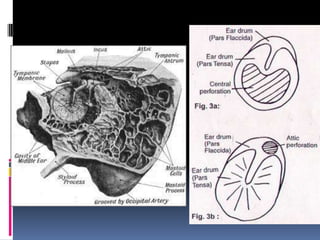
1. Benign or tubotympanic type with central

perforation of the ear drum: The disease is
limited to the TM & the Eustachian tube. No
complications occur as a rule.
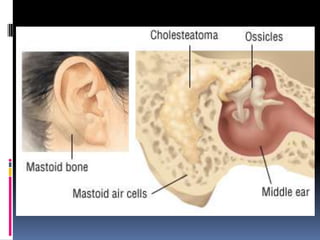
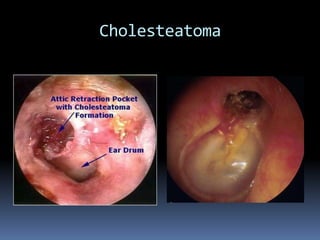
2. Dangerous or Attico-antral type with attic and
marginal perforation: It is characterised by
the presence of destructive cholesteatoma,
which may spread beyond the ear cleft
causing life threatening complications
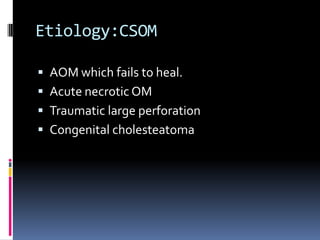
Etiology:CSOM
 AOM which fails to heal.
 Acute necrotic OM

 Traumatic large perforation
 Congenital cholesteatoma
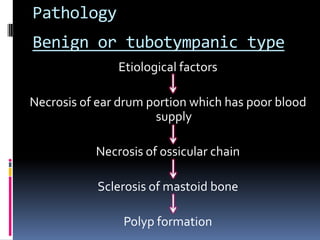
Pathology
Benign or tubotympanic type
Etiological factors
Necrosis of ear drum portion which has poor blood
supply
Necrosis of ossicular chain
Sclerosis of mastoid bone
Polyp formation
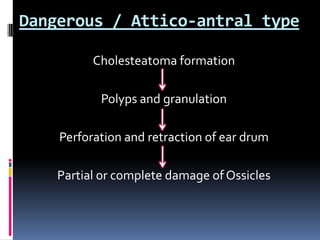
Dangerous / Attico-antral type
Cholesteatoma formation
Polyps and granulation

Perforation and retraction of ear drum
Partial or complete damage of Ossicles
Cholesteatoma
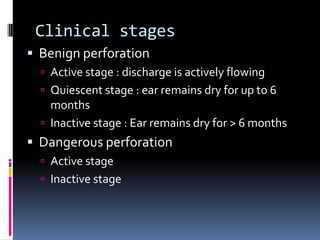
Clinical stages
 Benign perforation
 Active stage : discharge is actively flowing

 Quiescent stage : ear remains dry for up to 6

months
 Inactive stage : Ear remains dry for > 6 months

 Dangerous perforation
 Active stage
 Inactive stage
Diagnosis
 Examination of nose and pharynx to find any

septic focus or an obstruction around the
Eustachian tube
 Hearing test [voice test, tuning fork test,

audiometry]: Conductive deafness up to 60
db hearing loss
 Radiology of the mastoid
Diagnosis
 Testing the patency of Eustachian tube:
 Using ear drops

 Using Valsalva maneuver

 Otomicroscopy: perforation, cholesteatoma,

polyps
Management of Benign
Perforation
 Adenoidectomy, tonsillectomy; treatment of









sinusitis & DNS to remove the septic focci
Antibiotic ear drops
Chemical cautery using 50% trichloro acetic acid
TT injection
Tympanoplasty: Reconstruction of middle ear
and ossicular chain after removing the active
disease
Myringoplasty : repair of defect in TM
Management of dangerous perforation
 Suction and cleaning of cholesteatoma
 Excision of polyps and granulomas

 Mastoidectomy
 Atticotomy & atticoantrostomy
 tympanoplasty
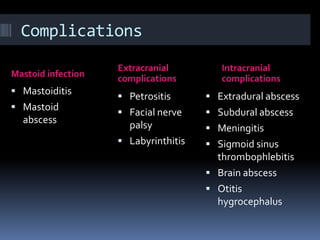
Complications
Mastoid infection

 Mastoiditis
 Mastoid

abscess

Extracranial
complications

Intracranial
complications

 Petrositis

 Extradural abscess

 Facial nerve

 Subdural abscess

palsy
 Labyrinthitis

 Meningitis

 Sigmoid sinus

thrombophlebitis
 Brain abscess
 Otitis
hygrocephalus
THANK YOU

Otitis media

  • 1.
  • 2.
    DEFINITION Inflammation of themiddle ear. May also involve inflammation of mastoid, petrous apex, and perilabyrinthine air cells
  • 3.
    Classification  Acute OM- rapid onset of signs & symptoms, < 3 wk course  Sub-acute OM - 3 wks to 3 months  Chronic OM - 3 months or longer
  • 4.
    Etiology  Age: Commonamong children due to shorter Eustachian tube
  • 5.
     Adenoiditis, Tonsillitis,Rhinitis, Sinusitis, Pharyngitis & infections secondary to cleft palate  Trauma to the TM  Head injury  Barotrauma
  • 6.
    Pathology 1. Catarrhal stage:is characterized by occlusion of Eustachian tube and congestion of middle ear. 2. Stage of exudation: Exudate collects in the middle ear and ear drum is pushed laterally. Initially the exudate is mucoid, later it becomes purulent.
  • 7.
    Pathology 3. Stage ofsuppuration: Pus in the middle ear collects under tension, stretches the drum & perforates it by pressure necrosis & the exudate starts escaping into external auditory canal 4. Stage of healing: The infection starts resolving from any of the stages mentioned & usually clears up completely without leaving any sequelae.
  • 8.
    Pathology 5. Stage ofcomplications: Infection may spread to the mastoid antrum. Initially it causes Catarrhal mastoiditis [congestion of the mastoid mucosa], stage of Coalescent mastoiditis & later empyeme of the mastoid
  • 9.
    Clinical manifestations: ASOM 1.Catarrhal stage (stage of congestion)  Fullness or heaviness in the ear  Severe ear pain at night  Deafness  Tinnitus (ringing or buzzing in the ear)  Autophony (spoken words of patient echo in his ears)  TM (ear drum) gets retracted  Cart wheel appearance of ear drum  Absence of light reflex
  • 11.
    2. Stage ofexudation  All symptoms becomes more severe.
  • 12.
    3. Stage ofsuppuration  Perforation of Ear drum  Otorrhoea with mucoid purulent discharge  Pulsatile discharge (ear discharge with each arterial dilation) [Lighthouse sign]
  • 13.
    4. Stage ofhealing  Healing starts in this stage
  • 14.
    5. Stage ofcomplication  Spread of infection to mastoid
  • 15.
    Diagnosis  Tuning forktest and audiometry  Radiography  Bacteriological examination of the ear discharge  Pneumatic otoscopy is gold standard
  • 16.
    Treatment - AOM Systemic  Antibiotics: Tetracycline, erythromycin, ampicillin or penicillin for 6 days  Systemic decongestants: Phenylephrine HCl  Local  Glycerine carbolic ear drops or warm olive oil reduces pain before perforation of TM.  Antibiotic drops : Chloramphenicol, spirit boric drops is used after perforation of TM.
  • 17.
    Surgery  Myringotomy: TheTM is incised to drain the middle ear cavity.  Myringo-puncture: Puncturing the ear drum with a long thick injection needle & aspirating the middle ear contents.
  • 18.
    Chronic Otitis Media It is the chronic infection of middle ear cleft mucosa.  Chronic Suppurative Otitis Media (CSOM): accompanied by continuous or intermittent otorrhoea  Chronic Non-Suppurative Otitis Media: No otorrhoea  Chronic Specific Otitis Media: Tb OM or syphilitic OM
  • 19.
    CSOM 1. Benign ortubotympanic type with central perforation of the ear drum: The disease is limited to the TM & the Eustachian tube. No complications occur as a rule. 2. Dangerous or Attico-antral type with attic and marginal perforation: It is characterised by the presence of destructive cholesteatoma, which may spread beyond the ear cleft causing life threatening complications
  • 21.
    Etiology:CSOM  AOM whichfails to heal.  Acute necrotic OM  Traumatic large perforation  Congenital cholesteatoma
  • 22.
    Pathology Benign or tubotympanictype Etiological factors Necrosis of ear drum portion which has poor blood supply Necrosis of ossicular chain Sclerosis of mastoid bone Polyp formation
  • 23.
    Dangerous / Attico-antraltype Cholesteatoma formation Polyps and granulation Perforation and retraction of ear drum Partial or complete damage of Ossicles
  • 25.
  • 26.
    Clinical stages  Benignperforation  Active stage : discharge is actively flowing  Quiescent stage : ear remains dry for up to 6 months  Inactive stage : Ear remains dry for > 6 months  Dangerous perforation  Active stage  Inactive stage
  • 27.
    Diagnosis  Examination ofnose and pharynx to find any septic focus or an obstruction around the Eustachian tube  Hearing test [voice test, tuning fork test, audiometry]: Conductive deafness up to 60 db hearing loss  Radiology of the mastoid
  • 28.
    Diagnosis  Testing thepatency of Eustachian tube:  Using ear drops  Using Valsalva maneuver  Otomicroscopy: perforation, cholesteatoma, polyps
  • 29.
    Management of Benign Perforation Adenoidectomy, tonsillectomy; treatment of      sinusitis & DNS to remove the septic focci Antibiotic ear drops Chemical cautery using 50% trichloro acetic acid TT injection Tympanoplasty: Reconstruction of middle ear and ossicular chain after removing the active disease Myringoplasty : repair of defect in TM
  • 30.
    Management of dangerousperforation  Suction and cleaning of cholesteatoma  Excision of polyps and granulomas  Mastoidectomy  Atticotomy & atticoantrostomy  tympanoplasty
  • 31.
    Complications Mastoid infection  Mastoiditis Mastoid abscess Extracranial complications Intracranial complications  Petrositis  Extradural abscess  Facial nerve  Subdural abscess palsy  Labyrinthitis  Meningitis  Sigmoid sinus thrombophlebitis  Brain abscess  Otitis hygrocephalus
  • 32.