ANATOMY
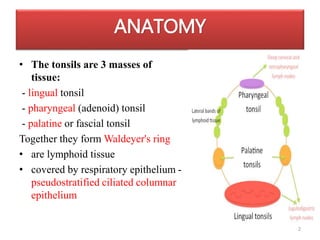
• The tonsils are 3 masses of
tissue:
- lingual tonsil
- pharyngeal (adenoid) tonsil
- palatine or fascial tonsil
Together they form Waldeyer's ring
• are lymphoid tissue
• covered by respiratory epithelium -
pseudostratified ciliated columnar
epithelium
2
Normal Function
• Situated at the opening of the pharynx to the external
environment, the tonsils and adenoid are in a position
to provide primary defense against foreign matter.
• produce lymphocytes
• are active in the synthesis of immunoglobulins
• Lymphoid tissue of Waldeyer ring is most
immunologically active between 4 and 10 yr of age,
with a decrease after puberty.
• No major immunologic deficiency has been
demonstrated after removal of either or both of the
tonsils and adenoid.
Pathology
• Acute Infection
• Most episodes of acute pharyngotonsillitis are caused by
viruses .
• Group A β-hemolytic streptococcus (GABHS) is the most
common cause of bacterial infection in the pharynx .
• Chronic Infection
• The tonsils and adenoids can be chronically infected by
multiple microbes, which can include a high incidence of β-
lactamase–producing organisms.
• Both aerobic species, such as streptococci and
Haemophilus influenzae, and anaerobic species, such as
Peptostreptococcus predominate.
• Airway Obstruction:
• Both the tonsils and adenoids are a major cause of
upper airway obstruction in children.
• Airway obstruction in children is typically manifested in
sleep-disordered breathing, including obstructive sleep
apnea, obstructive sleep hypopnea, and upper airway
resistance syndrome.
• Sleep-disordered breathing secondary to
adenotonsillar breathing is a cause of growth failure.
• Tonsillar Neoplasm
• Rapid enlargement of one tonsil is highly suggestive of
a tonsillar malignancy, typically lymphoma in children.
Clinical Manifestations
• Acute Infection
• Symptoms :include odynophagia, dry throat,
malaise, fever and chills, dysphagia, referred
otalgia, headache, muscular aches, and enlarged
cervical nodes.
• Signs include dry tongue, erythematous enlarged
tonsils, tonsillar or pharyngeal exudate, palatine
petechiae, and enlargement and tenderness of
the jugulodigastric lymph nodes
ACUTE TONSILLITIS-TYPES
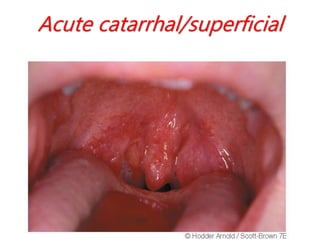
• Acute catarrhal/superficial  here tonsillitis is a part of
generalized pharyngitis, mostly seen in viral infections
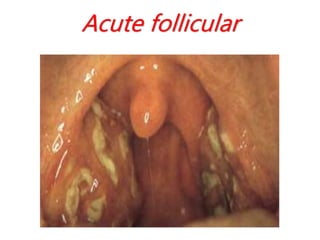
• Acute follicular  infection spread into the crypts with
purulent material, presenting at the opening of crypts as
yellow spots
• Acute parenchymatous  tonsil in uniformly enlarged
and congested
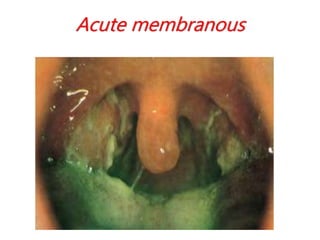
• Acute membranous  follows stage of acute follicular
tonsillitis where exudates coalesce to form membrane
on the surface
Acute catarrhal/superficial
Acute follicular
Acute membranous
• Chronic Infection
• Children with chronic or cryptic tonsillitis
often present with halitosis, chronic sore
throats, foreign body sensation, or a history of
expelling foul-tasting and foul-smelling cheesy
lumps.
• Examination can reveal tonsils of almost any
size and often they contain copious debris
within the crypts.
CHRONIC TONSILLITIS
• Aetiology:
Complication of acute tonsillitis
Sub clinical infection of tonsil
Chronic sinusitis or dental sepsis
Mostly affects children and young adults
TYPES OF CHRONIC TONSILLITIS
• Chronic follicular tonsillitis
• Chronic parenchymatous tonsillitis :
tonsils are very much enlarged uniformly
and may interfere with speech,
deglutition and respiration, long standing
cases may develop pulmonary
hypertension
• Chronic fibroid tonsillitis
CLINICAL FEATURES
• recurrent attacks of sore throat
• chronic irritation in throat with
cough
• halitosis
• dysphagia
• odynophagia
• thick speech
SIGNS
• Tonsil may show varying degree of
enlargement depending on the type
• Flushing of the anterior pillar compared
to rest of the pharyngeal mucosa
• Enlargement of the jugulo-digastric node
 soft non tender
Airway Obstruction
• In many children, the diagnosis of airway can be made
by history and physical examination.
• Daytime symptoms of airway obstruction, secondary
to adenotonsillar hypertrophy, include:
• chronic mouth breathing,
• nasal obstruction,
• hyponasal speech,
• hyposmia,
• decreased appetite,
• poor school performance, and, rarely,
• symptoms of right-sided heart failure.
• Nighttime symptoms consist of:
• loud snoring,
• choking, gasping,
• frank apneas,
• restless sleep,
• abnormal sleep positions,
• somnambulism, night terrors, diaphoresis, enuresis, and
sleep talking.
• Large tonsils are typically seen on examination, although
the absolute size might not indicate the degree of
obstruction.
• The size of the adenoid tissue can be demonstrated on a
lateral neck radiograph or with flexible endoscopy.
• Other signs that can contribute to airway obstruction
include the presence of a craniofacial syndrome or
hypotonia.
Treatment
• Bed rest
• Fluid intake
• Analgesics
• Antimicrobial – penicillin group, 7-10 days
• Admission if unable to take orally
• Tonsillolith or debris may be expressed manually
with either a cotton-tipped applicator or a water
jet.
• Chronically infected tonsillar crypts can be
cauterized using silver nitrate.
Tonsillectomy
• Tonsillectomy alone is usually performed for
recurrent or chronic pharyngotonsillitis.
• Indications for surgery remain uncertain;
there are large variations in surgical rates
among children across countries: 144/10,000
in Italy; 115/10,000 in the Netherlands;
65/10,000 in England; and 50/10,000 in the
United States.
• Rates are generally higher in boys.
• Potential but nonevidenced based indications include:
• 7 or more throat infections treated with antibiotics in the preceding
yr,
• 5 or more throat infections treated in each of the preceding 2 yr, or
• 3 or more throat infections treated with antibiotics in each of the
preceding 3 yr.
• The American Academy of Otolaryngology—Head and Neck
Surgery offers guidelines of 3 or more infections of tonsils and/or
adenoids per yr despite adequate medical therapy;
• the Scottish Intercollegiate Tonsillectomy Guidelines Network
recommends 5 or more episodes per yr of tonsillitis with disabling
symptoms and lasting for longer than 1 yr.
Tonsillectomy
• Tonsillectomy has been shown to be effective in
reducing the number of infections and the
symptoms of chronic tonsillitis such as halitosis,
persistent or recurrent sore throats, and
recurrent cervical adenitis.
• In resistant cases of cryptic tonsillitis,
tonsillectomy may be curative.
• Tonsillectomy has not been shown to offer clinical
benefit over conservative treatment in children
with mild symptoms.
Adenoidectomy
• Adenoidectomy alone may be indicated for the treatment of :
• chronic nasal infection (chronic adenoiditis),
• chronic sinus infections that have failed medical management, and
• recurrent bouts of acute otitis media, including those in children
with tympanostomy tubes who suffer from recurrent otorrhea.
• Adenoidectomy may be helpful in children with chronic or recurrent
otitis media with effusion.
• Adenoidectomy alone may be curative in the management of
patients with nasal obstruction, chronic mouth breathing, and loud
snoring suggesting sleep-disordered breathing.
• Adenoidectomy may also be indicated for children in whom upper
airway obstruction is suspected of causing craniofacial or occlusive
developmental abnormalities.
Tonsillectomy and Adenoidectomy
• The criteria for both tonsillectomy and adenoidectomy for
recurrent infection are the same as those for tonsillectomy
alone.
• The other major indication for performing both
procedures together is upper airway obstruction secondary
to adenotonsillar hypertrophy that results in sleep-
disordered breathing, failure to thrive, craniofacial or
occlusive developmental abnormalities, speech
abnormalities, or, rarely, cor pulmonale.
• A high proportion of children with failure to thrive in the
context of adenotonsillar hypertrophy resulting in sleep
disorder experience significant growth acceleration after
adenotonsillectomy.
COMPLICATIONS
• Peritonsillar abscess
• Parapharyngeal abscess
• Retro pharyngeal abscess
• Intra tonsillar abscess
• Tonsillar cyst
• Tonsillolith
• Focus of infection for RF, AGN
Thank You

Tonsils and adenoids in children

  • 2.
    ANATOMY • The tonsilsare 3 masses of tissue: - lingual tonsil - pharyngeal (adenoid) tonsil - palatine or fascial tonsil Together they form Waldeyer's ring • are lymphoid tissue • covered by respiratory epithelium - pseudostratified ciliated columnar epithelium 2
  • 3.
    Normal Function • Situatedat the opening of the pharynx to the external environment, the tonsils and adenoid are in a position to provide primary defense against foreign matter. • produce lymphocytes • are active in the synthesis of immunoglobulins • Lymphoid tissue of Waldeyer ring is most immunologically active between 4 and 10 yr of age, with a decrease after puberty. • No major immunologic deficiency has been demonstrated after removal of either or both of the tonsils and adenoid.
  • 4.
    Pathology • Acute Infection •Most episodes of acute pharyngotonsillitis are caused by viruses . • Group A β-hemolytic streptococcus (GABHS) is the most common cause of bacterial infection in the pharynx . • Chronic Infection • The tonsils and adenoids can be chronically infected by multiple microbes, which can include a high incidence of β- lactamase–producing organisms. • Both aerobic species, such as streptococci and Haemophilus influenzae, and anaerobic species, such as Peptostreptococcus predominate.
  • 5.
    • Airway Obstruction: •Both the tonsils and adenoids are a major cause of upper airway obstruction in children. • Airway obstruction in children is typically manifested in sleep-disordered breathing, including obstructive sleep apnea, obstructive sleep hypopnea, and upper airway resistance syndrome. • Sleep-disordered breathing secondary to adenotonsillar breathing is a cause of growth failure. • Tonsillar Neoplasm • Rapid enlargement of one tonsil is highly suggestive of a tonsillar malignancy, typically lymphoma in children.
  • 6.
    Clinical Manifestations • AcuteInfection • Symptoms :include odynophagia, dry throat, malaise, fever and chills, dysphagia, referred otalgia, headache, muscular aches, and enlarged cervical nodes. • Signs include dry tongue, erythematous enlarged tonsils, tonsillar or pharyngeal exudate, palatine petechiae, and enlargement and tenderness of the jugulodigastric lymph nodes
  • 7.
    ACUTE TONSILLITIS-TYPES • Acutecatarrhal/superficial  here tonsillitis is a part of generalized pharyngitis, mostly seen in viral infections • Acute follicular  infection spread into the crypts with purulent material, presenting at the opening of crypts as yellow spots • Acute parenchymatous  tonsil in uniformly enlarged and congested • Acute membranous  follows stage of acute follicular tonsillitis where exudates coalesce to form membrane on the surface
  • 8.
  • 9.
  • 10.
  • 11.
    • Chronic Infection •Children with chronic or cryptic tonsillitis often present with halitosis, chronic sore throats, foreign body sensation, or a history of expelling foul-tasting and foul-smelling cheesy lumps. • Examination can reveal tonsils of almost any size and often they contain copious debris within the crypts.
  • 12.
    CHRONIC TONSILLITIS • Aetiology: Complicationof acute tonsillitis Sub clinical infection of tonsil Chronic sinusitis or dental sepsis Mostly affects children and young adults
  • 13.
    TYPES OF CHRONICTONSILLITIS • Chronic follicular tonsillitis • Chronic parenchymatous tonsillitis : tonsils are very much enlarged uniformly and may interfere with speech, deglutition and respiration, long standing cases may develop pulmonary hypertension • Chronic fibroid tonsillitis
  • 14.
    CLINICAL FEATURES • recurrentattacks of sore throat • chronic irritation in throat with cough • halitosis • dysphagia • odynophagia • thick speech
  • 15.
    SIGNS • Tonsil mayshow varying degree of enlargement depending on the type • Flushing of the anterior pillar compared to rest of the pharyngeal mucosa • Enlargement of the jugulo-digastric node  soft non tender
  • 16.
    Airway Obstruction • Inmany children, the diagnosis of airway can be made by history and physical examination. • Daytime symptoms of airway obstruction, secondary to adenotonsillar hypertrophy, include: • chronic mouth breathing, • nasal obstruction, • hyponasal speech, • hyposmia, • decreased appetite, • poor school performance, and, rarely, • symptoms of right-sided heart failure.
  • 17.
    • Nighttime symptomsconsist of: • loud snoring, • choking, gasping, • frank apneas, • restless sleep, • abnormal sleep positions, • somnambulism, night terrors, diaphoresis, enuresis, and sleep talking. • Large tonsils are typically seen on examination, although the absolute size might not indicate the degree of obstruction. • The size of the adenoid tissue can be demonstrated on a lateral neck radiograph or with flexible endoscopy. • Other signs that can contribute to airway obstruction include the presence of a craniofacial syndrome or hypotonia.
  • 18.
    Treatment • Bed rest •Fluid intake • Analgesics • Antimicrobial – penicillin group, 7-10 days • Admission if unable to take orally • Tonsillolith or debris may be expressed manually with either a cotton-tipped applicator or a water jet. • Chronically infected tonsillar crypts can be cauterized using silver nitrate.
  • 19.
    Tonsillectomy • Tonsillectomy aloneis usually performed for recurrent or chronic pharyngotonsillitis. • Indications for surgery remain uncertain; there are large variations in surgical rates among children across countries: 144/10,000 in Italy; 115/10,000 in the Netherlands; 65/10,000 in England; and 50/10,000 in the United States. • Rates are generally higher in boys.
  • 20.
    • Potential butnonevidenced based indications include: • 7 or more throat infections treated with antibiotics in the preceding yr, • 5 or more throat infections treated in each of the preceding 2 yr, or • 3 or more throat infections treated with antibiotics in each of the preceding 3 yr. • The American Academy of Otolaryngology—Head and Neck Surgery offers guidelines of 3 or more infections of tonsils and/or adenoids per yr despite adequate medical therapy; • the Scottish Intercollegiate Tonsillectomy Guidelines Network recommends 5 or more episodes per yr of tonsillitis with disabling symptoms and lasting for longer than 1 yr. Tonsillectomy
  • 21.
    • Tonsillectomy hasbeen shown to be effective in reducing the number of infections and the symptoms of chronic tonsillitis such as halitosis, persistent or recurrent sore throats, and recurrent cervical adenitis. • In resistant cases of cryptic tonsillitis, tonsillectomy may be curative. • Tonsillectomy has not been shown to offer clinical benefit over conservative treatment in children with mild symptoms.
  • 22.
    Adenoidectomy • Adenoidectomy alonemay be indicated for the treatment of : • chronic nasal infection (chronic adenoiditis), • chronic sinus infections that have failed medical management, and • recurrent bouts of acute otitis media, including those in children with tympanostomy tubes who suffer from recurrent otorrhea. • Adenoidectomy may be helpful in children with chronic or recurrent otitis media with effusion. • Adenoidectomy alone may be curative in the management of patients with nasal obstruction, chronic mouth breathing, and loud snoring suggesting sleep-disordered breathing. • Adenoidectomy may also be indicated for children in whom upper airway obstruction is suspected of causing craniofacial or occlusive developmental abnormalities.
  • 23.
    Tonsillectomy and Adenoidectomy •The criteria for both tonsillectomy and adenoidectomy for recurrent infection are the same as those for tonsillectomy alone. • The other major indication for performing both procedures together is upper airway obstruction secondary to adenotonsillar hypertrophy that results in sleep- disordered breathing, failure to thrive, craniofacial or occlusive developmental abnormalities, speech abnormalities, or, rarely, cor pulmonale. • A high proportion of children with failure to thrive in the context of adenotonsillar hypertrophy resulting in sleep disorder experience significant growth acceleration after adenotonsillectomy.
  • 24.
    COMPLICATIONS • Peritonsillar abscess •Parapharyngeal abscess • Retro pharyngeal abscess • Intra tonsillar abscess • Tonsillar cyst • Tonsillolith • Focus of infection for RF, AGN
  • 25.