Dislocation of Hip
BY:
Mr. Ganesh V. Naik
II Year MSc(N)
Pediatric dept.
SDMINS Dharwad
INTRODUCTION
Dislocation of Hip is a congenital or acquired
deformation or malalignment of the hip joint.
It is also known as “Developmental Displasia
or Hip displacement.
DEFINITION
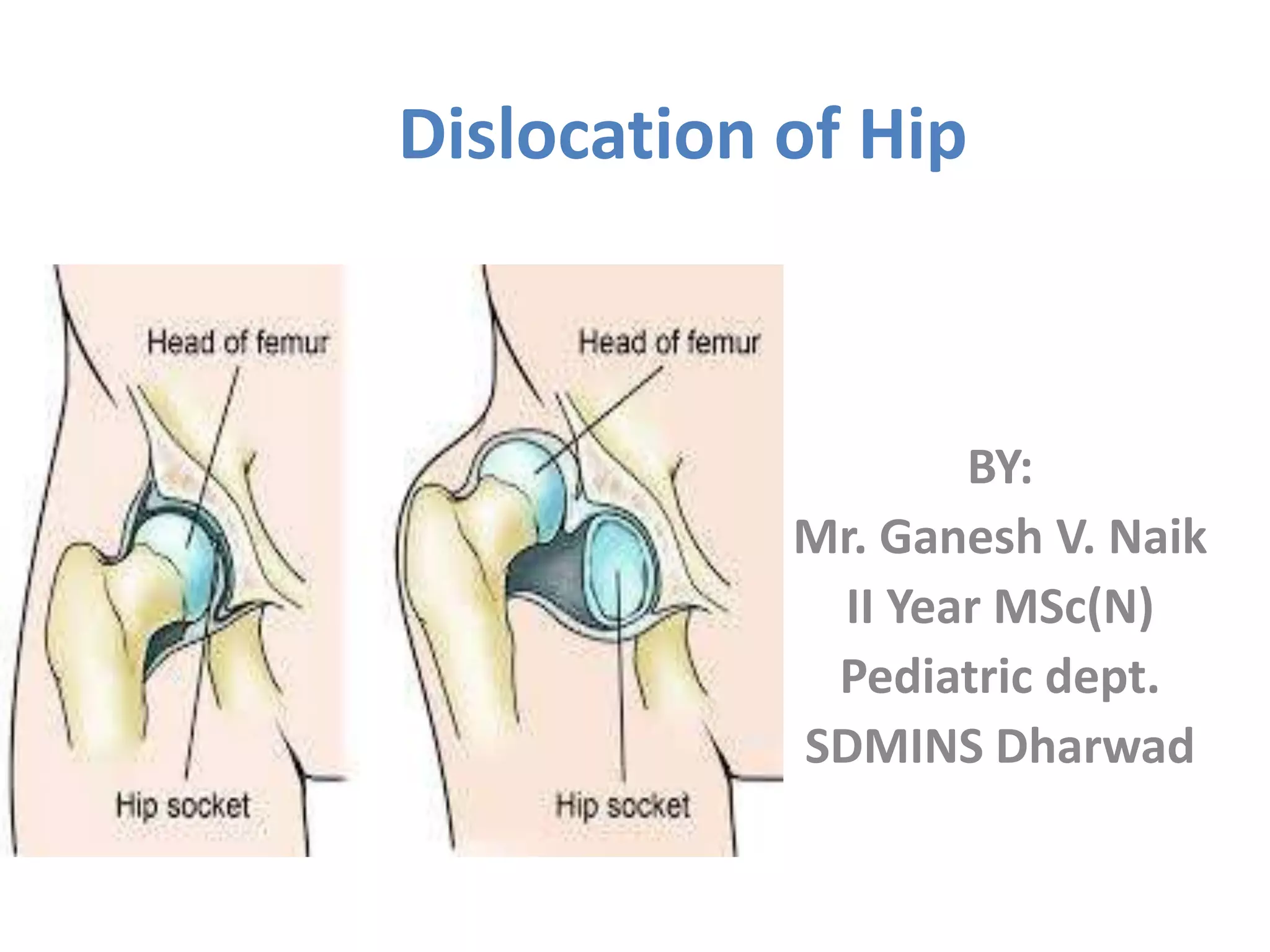
Dislocation of Hip refers to variety of
conditions in which the head of the femur and
acetabulum cavity are improperly aligned and
the femur head lies outside the hip socket or
acetabulum cavity.
INCIDENCE
1 to 2 in 1000 live births
Girls 6 times more affected than boys.
Left hip is more affected than right
Less common in tropical countries and hot
climates
TYPES
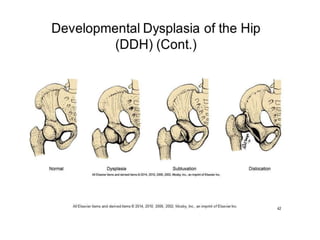
1. Acetabular dysplasia or preluxation:
• This is the mildest form in which the
acetabulum cavity or hip socket is too
shallow or deformed.
• The femur head remaining in the acetabulum
in this type.
Conti…
2. Subluxation:
• Subluxation means incomplete dislocation of
hip.
• The femur head remains in the contact with
acetabulum cavity , but it is displaced.
Conti..
3. Complete dislocation or luxation:
• In this type there is no contact between the
head of femur and acetabulum cavity.
• There is a comlpete loss of contact between the
femur head and acetabulum.
ETIOLOGY
Physiological factors:
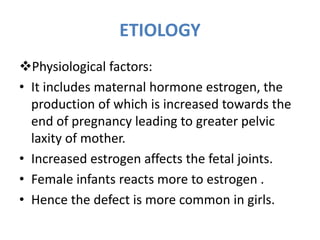
• It includes maternal hormone estrogen, the
production of which is increased towards the
end of pregnancy leading to greater pelvic
laxity of mother.
• Increased estrogen affects the fetal joints.
• Female infants reacts more to estrogen .
• Hence the defect is more common in girls.
Conti…
Mechanical factors:
• Abnormal intrauterine position of the fetus
• Breech presentation
• Large size of the fetus.
Genetic factors:
• A positive family history
CLINICAL FEATURES
• Depend on age of child
clinical features of infant are:
Shortening legs.
Assymmetry of legs.
Assymmetry of gluteal folds of skin , when
infant is placed in prone position.
Limited range of motion in affected hip.
Apparently short femur on affected side.
Conti…
After 3 months of age affected leg may turn
outward or become shorter than other leg.
Clinical features in older children are:
Unequal length of legs
Gait abnormalities such as toe-walking may be
present.
DIAGNOSTIC EVALUATION
History collection
Physical Examination.
Ultrasound Scan.
X-ray
There are two tests to detect dislocation of
Hip.
Conti..
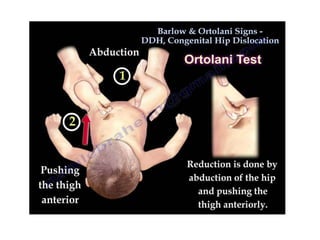
Ortalani test: The pediatrician will apply upward
for a while , they move your child’s hip away from
the child’s body movement away from the body is
called abduction.
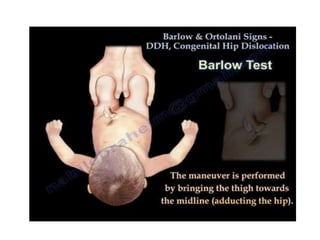
Barlow test:The pediatrician will apply downward
force, they move the child’s hip across child’s
body, movement towards the body is called
adduction.
These tests are only accurate before the child is
3months old.
MANAGEMENT
The treatment plan vary according to child’s age.
For infants younger than 3 months:
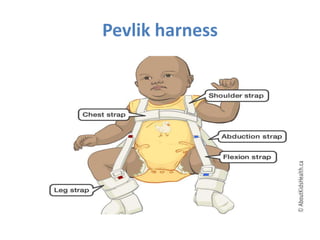
 The pevlik harness is the most commonly used
method for hip reduction.
For infants older than 3 months:
 Skin traction is used.
 Correction position, which involves relocating the
femoral head into the acetabulam.
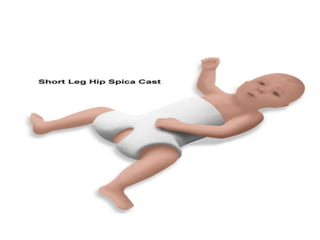
 Surgery and application of cast may be necessary
Pevlik harness
Conti..
In toddler and children aged 3 to 6years:
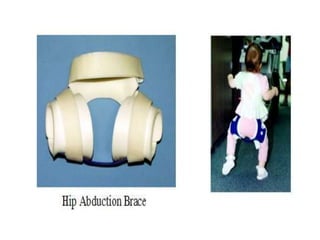
 Surgery and casting re usually necessary and
bracing may also be required.
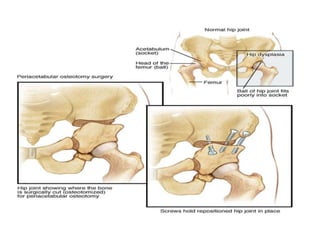
 Some profound cases need osteotomy and
reposition of femur.
Conti..
Nursing Management:
Knowledge deficiet related to dislocation of
Hip and in treatment.
Parental anxiety related to congenital
dislocation of Hip.
Risk of impaired skin integrity related to
procedure of skin by pelvic harness or cast

Dislocation of hip

  • 1.
    Dislocation of Hip BY: Mr.Ganesh V. Naik II Year MSc(N) Pediatric dept. SDMINS Dharwad
  • 2.
    INTRODUCTION Dislocation of Hipis a congenital or acquired deformation or malalignment of the hip joint. It is also known as “Developmental Displasia or Hip displacement.
  • 3.
    DEFINITION Dislocation of Hiprefers to variety of conditions in which the head of the femur and acetabulum cavity are improperly aligned and the femur head lies outside the hip socket or acetabulum cavity.
  • 4.
    INCIDENCE 1 to 2in 1000 live births Girls 6 times more affected than boys. Left hip is more affected than right Less common in tropical countries and hot climates
  • 5.
    TYPES 1. Acetabular dysplasiaor preluxation: • This is the mildest form in which the acetabulum cavity or hip socket is too shallow or deformed. • The femur head remaining in the acetabulum in this type.
  • 6.
    Conti… 2. Subluxation: • Subluxationmeans incomplete dislocation of hip. • The femur head remains in the contact with acetabulum cavity , but it is displaced.
  • 7.
    Conti.. 3. Complete dislocationor luxation: • In this type there is no contact between the head of femur and acetabulum cavity. • There is a comlpete loss of contact between the femur head and acetabulum.
  • 9.
    ETIOLOGY Physiological factors: • Itincludes maternal hormone estrogen, the production of which is increased towards the end of pregnancy leading to greater pelvic laxity of mother. • Increased estrogen affects the fetal joints. • Female infants reacts more to estrogen . • Hence the defect is more common in girls.
  • 10.
    Conti… Mechanical factors: • Abnormalintrauterine position of the fetus • Breech presentation • Large size of the fetus. Genetic factors: • A positive family history
  • 11.
    CLINICAL FEATURES • Dependon age of child clinical features of infant are: Shortening legs. Assymmetry of legs. Assymmetry of gluteal folds of skin , when infant is placed in prone position. Limited range of motion in affected hip. Apparently short femur on affected side.
  • 12.
    Conti… After 3 monthsof age affected leg may turn outward or become shorter than other leg. Clinical features in older children are: Unequal length of legs Gait abnormalities such as toe-walking may be present.
  • 13.
    DIAGNOSTIC EVALUATION History collection PhysicalExamination. Ultrasound Scan. X-ray There are two tests to detect dislocation of Hip.
  • 14.
    Conti.. Ortalani test: Thepediatrician will apply upward for a while , they move your child’s hip away from the child’s body movement away from the body is called abduction. Barlow test:The pediatrician will apply downward force, they move the child’s hip across child’s body, movement towards the body is called adduction. These tests are only accurate before the child is 3months old.
  • 17.
    MANAGEMENT The treatment planvary according to child’s age. For infants younger than 3 months:  The pevlik harness is the most commonly used method for hip reduction. For infants older than 3 months:  Skin traction is used.  Correction position, which involves relocating the femoral head into the acetabulam.  Surgery and application of cast may be necessary
  • 18.
  • 19.
    Conti.. In toddler andchildren aged 3 to 6years:  Surgery and casting re usually necessary and bracing may also be required.  Some profound cases need osteotomy and reposition of femur.
  • 23.
    Conti.. Nursing Management: Knowledge deficietrelated to dislocation of Hip and in treatment. Parental anxiety related to congenital dislocation of Hip. Risk of impaired skin integrity related to procedure of skin by pelvic harness or cast