TONSILLITIS‌
Lakshmi Bai Batra College Of Nursing‌‌
ADULT HEALTH NURSING II‌
SEMINAR ON‌
SUBMITTED TO: Ms. Karunanidhi‌
SUBMITTED BY: ANANNYA PAUL‌‌
‌
SEM 4 ROLL NO 29‌
SUBMITTED ON:‌
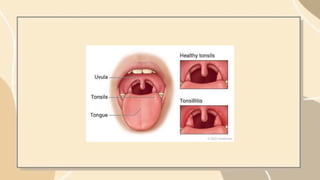
Definition‌‌
Tonsillitis is the inflammation of the tonsils, which are two
oval-shaped pads of tissue at the back of the throat.
It’s usually caused by a viral or bacterial infection.
Common symptoms include a sore throat, swollen tonsils,
difficulty swallowing, fever, and swollen lymph nodes in the neck.
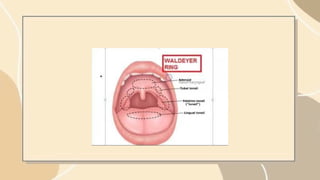
Anatomy & P hysiology of Tonsil
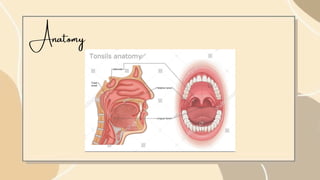
Anatomy
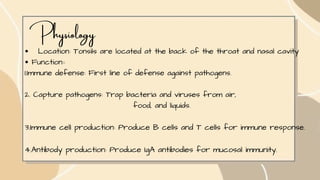
P hysiology
Location: Tonsils are located at the back of the throat and nasal cavity
Function::
1.Immune defense: First line of defense against pathogens.
2. Capture pathogens: Trap bacteria and viruses from air,
food, and liquids.
3.Immune cell production: Produce B cells and T cells for immune response.
4.Antibody production: Produce IgA antibodies for mucosal immunity.
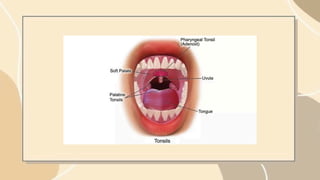
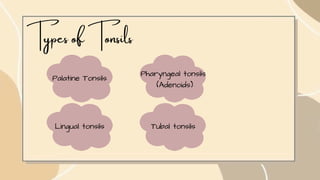
Types of Tonsils
Palatine Tonsils
Pharyngeal tonsils
(Adenoids)
Lingual tonsils Tubal tonsils
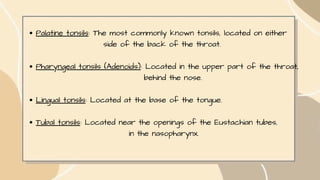
Palatine tonsils: The most commonly known tonsils, located on either
side of the back of the throat.
Pharyngeal tonsils (Adenoids): Located in the upper part of the throat,
behind the nose.
Lingual tonsils: Located at the base of the tongue.
Tubal tonsils: Located near the openings of the Eustachian tubes,
in the nasopharynx.
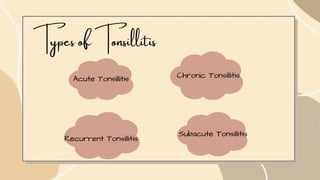
Types of Tonsillitis
Acute Tonsillitis Chronic Tonsillitis
Recurrent Tonsillitis
Subacute Tonsillitis
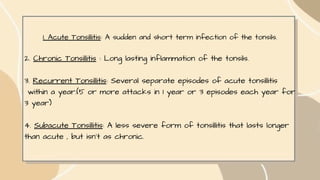
1. Acute Tonsillitis: A sudden and short term infection of the tonsils.
2. Chronic Tonsillitis : Long lasting inflammation of the tonsils.
3. Recurrent Tonsillitis: Several separate episodes of acute tonsillitis
within a year.(5 or more attacks in 1 year or 3 episodes each year for
3 year)
4. Subacute Tonsillitis: A less severe form of tonsillitis that lasts longer
than acute , but isn't as chronic.
Etiology
Viral Infections (most common)
Adenovirus
Influenza virus
Epstein-Barr virus (EBV)
Rhinovirus
Coronavirus
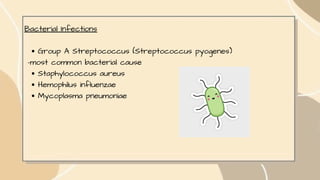
Bacterial Infections
Group A Streptococcus (Streptococcus pyogenes)
–most common bacterial cause
Staphylococcus aureus
Hemophilus influenzae
Mycoplasma pneumoniae
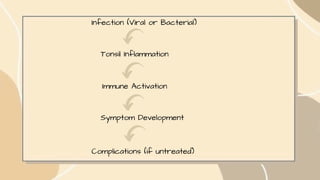
General Pathophysiology
Infection (Viral or Bacterial)
Tonsil Inflammation
Immune Activation
Symptom Development
Complications (if untreated)
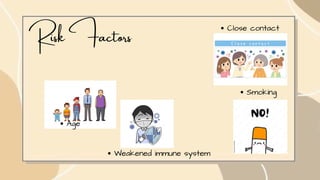
Risk Factors
Age
Weakened immune system
Close contact
Smoking
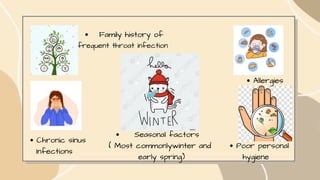
Seasonal factors
( Most commonlywinter and
early spring)
Family history of
frequent throat infection
Chronic sinus
Infections
Allergies
Poor personal
hygiene
Sign & Symptoms
Signs
Red, swollen tonsils
White or yellow spots on the tonsils
Swollen lymph nodes in the neck
Fever
Bad breath (Halitosis)
Scratchy or muffled voice
Stiff neck
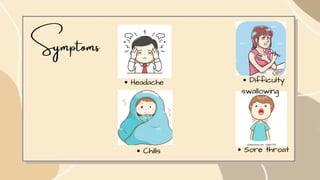
Symptoms
Chills
Headache Difficulty
swallowing
Sore throat
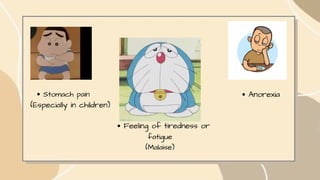
Stomach pain
(Especially in children)
Feeling of tiredness or
fatigue
(Malaise)
Anorexia
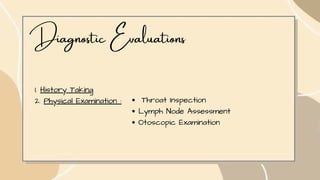
Diagnostic Evaluations
1. History Taking
2. Physical Examination : Throat Inspection
Lymph Node Assessment
Otoscopic Examination
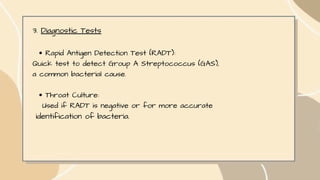
3. Diagnostic Tests
Rapid Antigen Detection Test (RADT):
Quick test to detect Group A Streptococcus (GAS),
a common bacterial cause.
Throat Culture:
Used if RADT is negative or for more accurate
identification of bacteria.
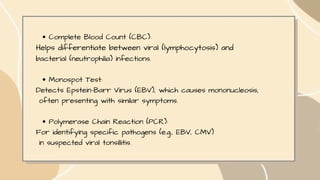
Complete Blood Count (CBC):
Helps differentiate between viral (lymphocytosis) and
bacterial (neutrophilia) infections.
Monospot Test:
Detects Epstein-Barr Virus (EBV), which causes mononucleosis,
often presenting with similar symptoms.
Polymerase Chain Reaction (PCR):
For identifying specific pathogens (e.g., EBV, CMV)
in suspected viral tonsillitis.
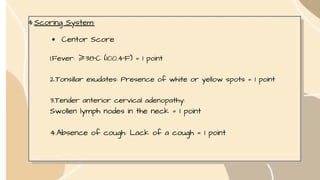
4.Scoring System:
Centor Score
1.Fever: ≥38°C (100.4°F) = 1 point
2.Tonsillar exudates: Presence of white or yellow spots = 1 point
3.Tender anterior cervical adenopathy:
Swollen lymph nodes in the neck = 1 point
4.Absence of cough: Lack of a cough = 1 point
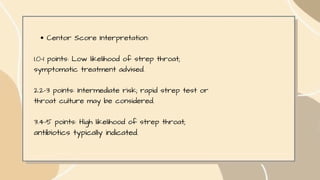
Centor Score Interpretation:
1.0-1 points: Low likelihood of strep throat;
symptomatic treatment advised.
2.2-3 points: Intermediate risk; rapid strep test or
throat culture may be considered.
3.4-5 points: High likelihood of strep throat;
antibiotics typically indicated.
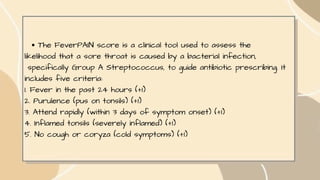
The FeverPAIN score is a clinical tool used to assess the
likelihood that a sore throat is caused by a bacterial infection,
specifically Group A Streptococcus, to guide antibiotic prescribing. It
includes five criteria:
1. Fever in the past 24 hours (+1)
2. Purulence (pus on tonsils) (+1)
3. Attend rapidly (within 3 days of symptom onset) (+1)
4. Inflamed tonsils (severely inflamed) (+1)
5. No cough or coryza (cold symptoms) (+1)
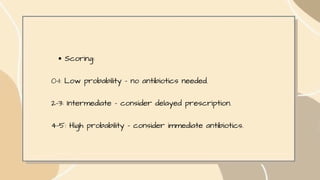
Scoring:
0–1: Low probability – no antibiotics needed.
2–3: Intermediate – consider delayed prescription.
4–5: High probability – consider immediate antibiotics.
Management
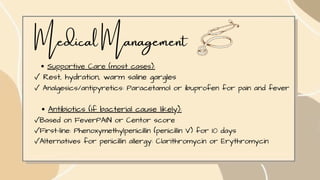
Medical Management
Supportive Care (most cases):
✓ Rest, hydration, warm saline gargles
✓ Analgesics/antipyretics: Paracetamol or ibuprofen for pain and fever
Antibiotics (if bacterial cause likely):
✓Based on FeverPAIN or Centor score
✓First-line: Phenoxymethylpenicillin (penicillin V) for 10 days
✓Alternatives for penicillin allergy: Clarithromycin or Erythromycin
Antiviral Management (if viral):
✓ No specific antiviral treatment; supportive care is usually sufficient.
I. ✓ If due to Epstein-Barr virus (mononucleosis),
corticosteroids may be used in severe cases
. (e.g., airway obstruction).
Corticosteroids (if severe inflammation):
✓May be used to reduce swelling and pain, especially if
there's difficulty swallowing or risk of airway obstruction
Surgical Management
Tonsillectomy
Surgical removal of the tonsils, usually performed under general
anesthesia.
Indications:
✓Recurrent tonsillitis (as per Paradise criteria: ≥7 episodes in 1 year,
≥5/year for 2 years, or ≥3/year for 3 years)
✓Chronic tonsillitis unresponsive to medical treatment
✓Peritonsillar abscess (especially if recurrent)
✓Obstructive sleep apnea due to enlarged tonsils
✓Suspected tonsillar malignancy
Nursing Management
1. Assessment
✓ Monitor for fever, sore throat, difficulty swallowing,
enlarged tonsils, and breathing issues.
✓Assess hydration status and nutritional intake.
✓Watch for signs of complications (e.g., peritonsillar abscess,
airway obstruction
2. Nursing Diagnosis
Ineffective Airway Clearance related to tonsillar inflammation and
edema as evidenced by dyspnea, noisy breathing, and difficulty swallowing.
Acute Pain related to inflammation and swelling of the tonsils
as evidenced by patient verbalization of sore throat, facial grimacing,
and difficulty swallowing.
Risk for Deficient Fluid Volume related to decreased
oral intake due to throat pain and difficulty swallowing.
Impaired Swallowing related to tonsillar swelling and pain
as evidenced by difficulty swallowing, drooling, and verbalized
discomfort when swallowing.
Hyperthermia related to infection (tonsillitis) as evidenced by
elevated body temperature, flushed skin, and chills.
Pre-Op Nursing Management
Explain procedure to patient/family
Obtain informed consent
Assess for infection or bleeding history
Stop NSAIDs/anticoagulants as advised
Ensure NPO 6–8 hours before surgery
Conduct baseline vitals and labs
Provide emotional support
Post-Op Nursing Management
Position on side to prevent aspiration
Monitor for bleeding (swallowing, vomiting blood)
Check vitals regularly
Give prescribed pain relief
Encourage cold fluids; avoid red or hot drinks
Start soft, cool diet
Prevent coughing/throat clearing
Watch for infection signs
Complications
1. Peritonsillar Abscess (Quinsy):
✓Symptoms: Severe sore throat, fever, trismus, drooling.
✓Management: Drainage and antibiotics.
2.Airway Obstruction:
✓Symptoms: Stridor, difficulty breathing, cyanosis.
✓Management: Corticosteroids, oxygen therapy, and possible intubation.
3.Dehydration:
✓Symptoms: Dry mouth, reduced urine output, dizziness.
✓Management: Encourage fluids, IV fluids if necessary
4.Rheumatic Fever:
✓Symptoms: Migratory arthritis, carditis.
✓Management: Antibiotics to treat strep infection, prophylaxis to prevent
recurrence.
5.Post-streptococcal Glomerulonephritis:
✓Symptoms: Hematuria, edema, hypertension.
✓Management: Supportive care, monitor kidney function.
6.Sepsis:
✓Symptoms: Fever, tachycardia, hypotension.
✓Management: IV antibiotics, fluid resuscitation.
7.Chronic Tonsillitis:
✓Symptoms: Persistent sore throat, enlarged tonsils.
✓Management: Tonsillectomy if recurrent or severe.
8.Obstructive Sleep Apnea (OSA):
✓Symptoms: Snoring, pauses in breathing, restless sleep, daytime fatigue.
✓Management: Tonsillectomy is often recommended to relieve obstruction
9.Otitis Media (Middle Ear Infection):
✓Symptoms: Ear pain, hearing loss, fever.
✓Management: Antibiotics, analgesics, and monitoring for
complications like ear effusion or chronic infection
Summary
Tonsillitis is the inflammation of the tonsils, usually caused by
a viral or bacterial infection (commonly strep throat).
Causes: Viruses or Streptococcus bacteria.
Symptoms: Sore throat, fever, swollen tonsils, difficulty
swallowing, bad breath
Diagnosis: Throat swab, physical exam
Treatment:
✓Viral: Rest, fluids, pain relievers
✓Bacterial: Antibiotics (e.g., penicillin)
✓Repeated cases: Tonsillectomy (surgical removal).
Complications:
✓Peritonsillar abscess
✓Otitis media (ear infection)
✓Obstructive sleep apnea
✓Rheumatic fever
✓Post-streptococcal glomerulonephritis
Thank You

TONSILLITIS ppt 2025 bsc nursing (H) 2nd year

  • 1.
    TONSILLITIS‌ Lakshmi Bai BatraCollege Of Nursing‌‌ ADULT HEALTH NURSING II‌ SEMINAR ON‌ SUBMITTED TO: Ms. Karunanidhi‌ SUBMITTED BY: ANANNYA PAUL‌‌ ‌ SEM 4 ROLL NO 29‌ SUBMITTED ON:‌
  • 2.
    Definition‌‌ Tonsillitis is theinflammation of the tonsils, which are two oval-shaped pads of tissue at the back of the throat. It’s usually caused by a viral or bacterial infection. Common symptoms include a sore throat, swollen tonsils, difficulty swallowing, fever, and swollen lymph nodes in the neck.
  • 3.
    Anatomy & Physiology of Tonsil
  • 4.
  • 8.
    P hysiology Location: Tonsilsare located at the back of the throat and nasal cavity Function:: 1.Immune defense: First line of defense against pathogens. 2. Capture pathogens: Trap bacteria and viruses from air, food, and liquids. 3.Immune cell production: Produce B cells and T cells for immune response. 4.Antibody production: Produce IgA antibodies for mucosal immunity.
  • 9.
    Types of Tonsils PalatineTonsils Pharyngeal tonsils (Adenoids) Lingual tonsils Tubal tonsils
  • 10.
    Palatine tonsils: Themost commonly known tonsils, located on either side of the back of the throat. Pharyngeal tonsils (Adenoids): Located in the upper part of the throat, behind the nose. Lingual tonsils: Located at the base of the tongue. Tubal tonsils: Located near the openings of the Eustachian tubes, in the nasopharynx.
  • 11.
    Types of Tonsillitis AcuteTonsillitis Chronic Tonsillitis Recurrent Tonsillitis Subacute Tonsillitis
  • 12.
    1. Acute Tonsillitis:A sudden and short term infection of the tonsils. 2. Chronic Tonsillitis : Long lasting inflammation of the tonsils. 3. Recurrent Tonsillitis: Several separate episodes of acute tonsillitis within a year.(5 or more attacks in 1 year or 3 episodes each year for 3 year) 4. Subacute Tonsillitis: A less severe form of tonsillitis that lasts longer than acute , but isn't as chronic.
  • 13.
    Etiology Viral Infections (mostcommon) Adenovirus Influenza virus Epstein-Barr virus (EBV) Rhinovirus Coronavirus
  • 14.
    Bacterial Infections Group AStreptococcus (Streptococcus pyogenes) –most common bacterial cause Staphylococcus aureus Hemophilus influenzae Mycoplasma pneumoniae
  • 15.
  • 16.
    Infection (Viral orBacterial) Tonsil Inflammation Immune Activation Symptom Development Complications (if untreated)
  • 17.
    Risk Factors Age Weakened immunesystem Close contact Smoking
  • 18.
    Seasonal factors ( Mostcommonlywinter and early spring) Family history of frequent throat infection Chronic sinus Infections Allergies Poor personal hygiene
  • 19.
  • 20.
    Signs Red, swollen tonsils Whiteor yellow spots on the tonsils Swollen lymph nodes in the neck Fever Bad breath (Halitosis) Scratchy or muffled voice Stiff neck
  • 21.
  • 22.
    Stomach pain (Especially inchildren) Feeling of tiredness or fatigue (Malaise) Anorexia
  • 23.
    Diagnostic Evaluations 1. HistoryTaking 2. Physical Examination : Throat Inspection Lymph Node Assessment Otoscopic Examination
  • 24.
    3. Diagnostic Tests RapidAntigen Detection Test (RADT): Quick test to detect Group A Streptococcus (GAS), a common bacterial cause. Throat Culture: Used if RADT is negative or for more accurate identification of bacteria.
  • 25.
    Complete Blood Count(CBC): Helps differentiate between viral (lymphocytosis) and bacterial (neutrophilia) infections. Monospot Test: Detects Epstein-Barr Virus (EBV), which causes mononucleosis, often presenting with similar symptoms. Polymerase Chain Reaction (PCR): For identifying specific pathogens (e.g., EBV, CMV) in suspected viral tonsillitis.
  • 26.
    4.Scoring System: Centor Score 1.Fever:≥38°C (100.4°F) = 1 point 2.Tonsillar exudates: Presence of white or yellow spots = 1 point 3.Tender anterior cervical adenopathy: Swollen lymph nodes in the neck = 1 point 4.Absence of cough: Lack of a cough = 1 point
  • 27.
    Centor Score Interpretation: 1.0-1points: Low likelihood of strep throat; symptomatic treatment advised. 2.2-3 points: Intermediate risk; rapid strep test or throat culture may be considered. 3.4-5 points: High likelihood of strep throat; antibiotics typically indicated.
  • 28.
    The FeverPAIN scoreis a clinical tool used to assess the likelihood that a sore throat is caused by a bacterial infection, specifically Group A Streptococcus, to guide antibiotic prescribing. It includes five criteria: 1. Fever in the past 24 hours (+1) 2. Purulence (pus on tonsils) (+1) 3. Attend rapidly (within 3 days of symptom onset) (+1) 4. Inflamed tonsils (severely inflamed) (+1) 5. No cough or coryza (cold symptoms) (+1)
  • 29.
    Scoring: 0–1: Low probability– no antibiotics needed. 2–3: Intermediate – consider delayed prescription. 4–5: High probability – consider immediate antibiotics.
  • 30.
  • 31.
    Medical Management Supportive Care(most cases): ✓ Rest, hydration, warm saline gargles ✓ Analgesics/antipyretics: Paracetamol or ibuprofen for pain and fever Antibiotics (if bacterial cause likely): ✓Based on FeverPAIN or Centor score ✓First-line: Phenoxymethylpenicillin (penicillin V) for 10 days ✓Alternatives for penicillin allergy: Clarithromycin or Erythromycin
  • 32.
    Antiviral Management (ifviral): ✓ No specific antiviral treatment; supportive care is usually sufficient. I. ✓ If due to Epstein-Barr virus (mononucleosis), corticosteroids may be used in severe cases . (e.g., airway obstruction). Corticosteroids (if severe inflammation): ✓May be used to reduce swelling and pain, especially if there's difficulty swallowing or risk of airway obstruction
  • 33.
    Surgical Management Tonsillectomy Surgical removalof the tonsils, usually performed under general anesthesia.
  • 34.
    Indications: ✓Recurrent tonsillitis (asper Paradise criteria: ≥7 episodes in 1 year, ≥5/year for 2 years, or ≥3/year for 3 years) ✓Chronic tonsillitis unresponsive to medical treatment ✓Peritonsillar abscess (especially if recurrent) ✓Obstructive sleep apnea due to enlarged tonsils ✓Suspected tonsillar malignancy
  • 35.
    Nursing Management 1. Assessment ✓Monitor for fever, sore throat, difficulty swallowing, enlarged tonsils, and breathing issues. ✓Assess hydration status and nutritional intake. ✓Watch for signs of complications (e.g., peritonsillar abscess, airway obstruction
  • 36.
    2. Nursing Diagnosis IneffectiveAirway Clearance related to tonsillar inflammation and edema as evidenced by dyspnea, noisy breathing, and difficulty swallowing.
  • 37.
    Acute Pain relatedto inflammation and swelling of the tonsils as evidenced by patient verbalization of sore throat, facial grimacing, and difficulty swallowing.
  • 38.
    Risk for DeficientFluid Volume related to decreased oral intake due to throat pain and difficulty swallowing.
  • 39.
    Impaired Swallowing relatedto tonsillar swelling and pain as evidenced by difficulty swallowing, drooling, and verbalized discomfort when swallowing.
  • 40.
    Hyperthermia related toinfection (tonsillitis) as evidenced by elevated body temperature, flushed skin, and chills.
  • 41.
    Pre-Op Nursing Management Explainprocedure to patient/family Obtain informed consent Assess for infection or bleeding history Stop NSAIDs/anticoagulants as advised Ensure NPO 6–8 hours before surgery Conduct baseline vitals and labs Provide emotional support
  • 42.
    Post-Op Nursing Management Positionon side to prevent aspiration Monitor for bleeding (swallowing, vomiting blood) Check vitals regularly Give prescribed pain relief Encourage cold fluids; avoid red or hot drinks Start soft, cool diet Prevent coughing/throat clearing Watch for infection signs
  • 43.
    Complications 1. Peritonsillar Abscess(Quinsy): ✓Symptoms: Severe sore throat, fever, trismus, drooling. ✓Management: Drainage and antibiotics. 2.Airway Obstruction: ✓Symptoms: Stridor, difficulty breathing, cyanosis. ✓Management: Corticosteroids, oxygen therapy, and possible intubation.
  • 44.
    3.Dehydration: ✓Symptoms: Dry mouth,reduced urine output, dizziness. ✓Management: Encourage fluids, IV fluids if necessary 4.Rheumatic Fever: ✓Symptoms: Migratory arthritis, carditis. ✓Management: Antibiotics to treat strep infection, prophylaxis to prevent recurrence.
  • 45.
    5.Post-streptococcal Glomerulonephritis: ✓Symptoms: Hematuria,edema, hypertension. ✓Management: Supportive care, monitor kidney function. 6.Sepsis: ✓Symptoms: Fever, tachycardia, hypotension. ✓Management: IV antibiotics, fluid resuscitation.
  • 46.
    7.Chronic Tonsillitis: ✓Symptoms: Persistentsore throat, enlarged tonsils. ✓Management: Tonsillectomy if recurrent or severe. 8.Obstructive Sleep Apnea (OSA): ✓Symptoms: Snoring, pauses in breathing, restless sleep, daytime fatigue. ✓Management: Tonsillectomy is often recommended to relieve obstruction
  • 47.
    9.Otitis Media (MiddleEar Infection): ✓Symptoms: Ear pain, hearing loss, fever. ✓Management: Antibiotics, analgesics, and monitoring for complications like ear effusion or chronic infection
  • 48.
    Summary Tonsillitis is theinflammation of the tonsils, usually caused by a viral or bacterial infection (commonly strep throat). Causes: Viruses or Streptococcus bacteria. Symptoms: Sore throat, fever, swollen tonsils, difficulty swallowing, bad breath Diagnosis: Throat swab, physical exam
  • 49.
    Treatment: ✓Viral: Rest, fluids,pain relievers ✓Bacterial: Antibiotics (e.g., penicillin) ✓Repeated cases: Tonsillectomy (surgical removal).
  • 50.
    Complications: ✓Peritonsillar abscess ✓Otitis media(ear infection) ✓Obstructive sleep apnea ✓Rheumatic fever ✓Post-streptococcal glomerulonephritis
  • 51.