N.KALPANA REDDY
II MSC
CHN
TONSILLITIS
TONSILLITIS
• Inflammation or infection of the tonsils is
medically termed as Tonsillitis.
• Tonsils are protective (lymph) glands that are
situated on both sides in the throat.
• The tonsils constitute an important part of the
body's immune system and are vital defense
organs.
• They protect the body from bacteria and
viruses by fighting these as soon as they enter
the body (via the oral / nasal cavity).
ANATOMY
• In the normal state, tonsils are pink in color (similar
to their surroundings tissues) and about the same
size.
• The tonsils along with adenoids are said to form the
'first line of defense' against infective organisms.
PATHOLOGY
• When the tonsils get inflamed, they become red,
swollen and may develop pus pockets that start
exuding a discharge.
• In cases with recurrent infections, the tonsils may
become so swollen over a period of time so as to
almost touch each other.
• Tonsillitis is very common amongst children.
• No particular gender predilection is seen in cases of
tonsillitis.
CAUSES
• Bacterial and viral infections can cause tonsillitis
through droplet infection.
• A common cause is Streptococcus bacteria.
• Other common causes include:
o Adenoviruses
o Influenza virus
o Epstein-Barr virus
o Parainfluenza viruses
o Enteroviruses
o Herpes simplex virus
TRIGGERING FACTORS
• Foods with artificial colors and preservatives.
• Peanuts.
• Cold foods, cold drinks, Ice creams.
• Changes of weather.
• Extremely cold climate,
• Damp weather.
• Exposure to a lot of pollution.
• Sour fruits, lemon, pineapple, grapes, oranges.
SIGNS
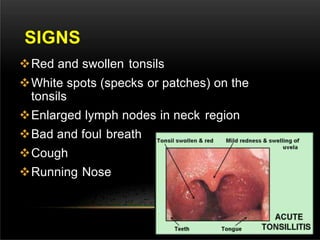
Red and swollen tonsils
White spots (specks or patches) on the
tonsils
Enlarged lymph nodes in neck region
Bad and foul breath
Cough
Running Nose
SYMPTOMS
• Soreness of throat
• Difficulty in swallowing or painful swallowing of food
and drinks
• Pain / discomfort while swallowing saliva
• Change of voice
• Pain in the ears (due to common nerve supply of the
back of the throat and ears)
• Headache
• Malaise, tiredness
• Difficulty in taking feeds in babies - this may be the
sole indicator in some cases of tonsillitis in infants
CATARRHAL TONSILLITIS
tonsils are
as part of
• When
inflamed
the
infection
generalised
of the
oropharyngeal
mucosa it is called
catarrhal tonsillitis.
MEMBRANOUS TONSILLITIS
• Some times
exudation from crypts
may coalesce to form
a membrane over the
surface of tonsil,
giving rise to clinical
ofpicture
membranous
tonsillitis.
PARENCHYMATOUS TONSILLITIS
• When
tonsil
the whole
is uniformly
and
is called
congested
swollen it
acute
parenchymatous
tonsillitis
DIAGNOSIS
 Examination of the throat in tonsillitis:
• Redness and swelling of the tonsils
• Pus pockets on the tonsils
• Discharge from the tonsils
• In case of peritonsillar abscess,
involvedmay be
towards
a shift
the center
of the
of the throat.
uvula may be shifted towards
there
tonsil
The
the
opposite side (away from the affected
tonsil).
DIAGNOSIS
 Throat swab :This is used to get a sample of the
secretion from the back of the throat.
• Monospot test: A blood test can detect certain
antibodies, which can help confirm that a person’s
symptoms are due to mononucleosis.
• Epstein-Barr virus antibodies: If a monospot test is
negative, antibodies in the blood against EBV might
help diagnose mononucleosis.
• Blood tests: This primarily includes a complete blood
count (CBC) which is done to confirm the presence of
infection.
COMPLICATIONS
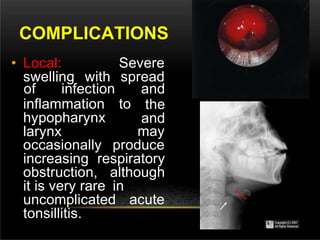
• Local: Severe
swelling with spread
inflammation to
of infection and
the
andhypopharynx
larynx may
occasionally produce
increasing respiratory
obstruction, although
it is very rare in
acuteuncomplicated
tonsillitis.
COMPLICATIONS
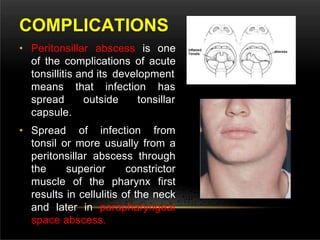
• Peritonsillar abscess is one
of the complications of acute
tonsillitis and its development
that infection has
outside tonsillar
means
spread
capsule.
• Spread of infection from
tonsil or more usually from a
peritonsillar abscess through
the superior constrictor
muscle of the pharynx first
results in cellulitis of the neck
and later in parapharyngeal
space abscess.
• The systemic or general complications of
acute tonsillitis are rare and almost confined to
childhood.
• Septicemia: Untreated acute tonsillitis can
result in septicemia with septic abscesses,
septic arthritis and meningitis
ALLOPATHIC TREATMENT
• Acetaminophen & Ibuprufen are given for relieving the
symptoms.
• Antibiotics are prescribed once bacterial infection is confirmed.
• Tonsillectomy –
• For those children's who do not repond to
antibiotics
• Quinsy - It is usually treated by draining the
and antibiotics. Sometimes
the tonsils is needed to treat
abscess
removing
quinsy.
PREVENTION
• Avoid close contact with others who are sick.
• Keep children away from kids who are known to have
tonsillitis or a sore throat.
• Remind kids about the importance of proper hand-
washing, especially when around people who appear to
be sick.
• Wash and disinfect surfaces and toys.
• Teaching kids to cover their mouths when coughing or
sneezing, preferably using a tissue so that germs do
not get on their hands. And show them how to use
tissues to wipe their noses.
• Carry disposable wipes and a hand sanitizer to clean
hands

Tonsilities

  • 1.
  • 2.
    TONSILLITIS • Inflammation orinfection of the tonsils is medically termed as Tonsillitis. • Tonsils are protective (lymph) glands that are situated on both sides in the throat. • The tonsils constitute an important part of the body's immune system and are vital defense organs. • They protect the body from bacteria and viruses by fighting these as soon as they enter the body (via the oral / nasal cavity).
  • 4.
    ANATOMY • In thenormal state, tonsils are pink in color (similar to their surroundings tissues) and about the same size. • The tonsils along with adenoids are said to form the 'first line of defense' against infective organisms.
  • 5.
    PATHOLOGY • When thetonsils get inflamed, they become red, swollen and may develop pus pockets that start exuding a discharge. • In cases with recurrent infections, the tonsils may become so swollen over a period of time so as to almost touch each other. • Tonsillitis is very common amongst children. • No particular gender predilection is seen in cases of tonsillitis.
  • 7.
    CAUSES • Bacterial andviral infections can cause tonsillitis through droplet infection. • A common cause is Streptococcus bacteria. • Other common causes include: o Adenoviruses o Influenza virus o Epstein-Barr virus o Parainfluenza viruses o Enteroviruses o Herpes simplex virus
  • 9.
    TRIGGERING FACTORS • Foodswith artificial colors and preservatives. • Peanuts. • Cold foods, cold drinks, Ice creams. • Changes of weather. • Extremely cold climate, • Damp weather. • Exposure to a lot of pollution. • Sour fruits, lemon, pineapple, grapes, oranges.
  • 10.
    SIGNS Red and swollentonsils White spots (specks or patches) on the tonsils Enlarged lymph nodes in neck region Bad and foul breath Cough Running Nose
  • 11.
    SYMPTOMS • Soreness ofthroat • Difficulty in swallowing or painful swallowing of food and drinks • Pain / discomfort while swallowing saliva • Change of voice • Pain in the ears (due to common nerve supply of the back of the throat and ears) • Headache • Malaise, tiredness • Difficulty in taking feeds in babies - this may be the sole indicator in some cases of tonsillitis in infants
  • 12.
    CATARRHAL TONSILLITIS tonsils are aspart of • When inflamed the infection generalised of the oropharyngeal mucosa it is called catarrhal tonsillitis.
  • 13.
    MEMBRANOUS TONSILLITIS • Sometimes exudation from crypts may coalesce to form a membrane over the surface of tonsil, giving rise to clinical ofpicture membranous tonsillitis.
  • 14.
    PARENCHYMATOUS TONSILLITIS • When tonsil thewhole is uniformly and is called congested swollen it acute parenchymatous tonsillitis
  • 15.
    DIAGNOSIS  Examination ofthe throat in tonsillitis: • Redness and swelling of the tonsils • Pus pockets on the tonsils • Discharge from the tonsils • In case of peritonsillar abscess, involvedmay be towards a shift the center of the of the throat. uvula may be shifted towards there tonsil The the opposite side (away from the affected tonsil).
  • 16.
    DIAGNOSIS  Throat swab:This is used to get a sample of the secretion from the back of the throat. • Monospot test: A blood test can detect certain antibodies, which can help confirm that a person’s symptoms are due to mononucleosis. • Epstein-Barr virus antibodies: If a monospot test is negative, antibodies in the blood against EBV might help diagnose mononucleosis. • Blood tests: This primarily includes a complete blood count (CBC) which is done to confirm the presence of infection.
  • 17.
    COMPLICATIONS • Local: Severe swellingwith spread inflammation to of infection and the andhypopharynx larynx may occasionally produce increasing respiratory obstruction, although it is very rare in acuteuncomplicated tonsillitis.
  • 18.
    COMPLICATIONS • Peritonsillar abscessis one of the complications of acute tonsillitis and its development that infection has outside tonsillar means spread capsule. • Spread of infection from tonsil or more usually from a peritonsillar abscess through the superior constrictor muscle of the pharynx first results in cellulitis of the neck and later in parapharyngeal space abscess.
  • 19.
    • The systemicor general complications of acute tonsillitis are rare and almost confined to childhood. • Septicemia: Untreated acute tonsillitis can result in septicemia with septic abscesses, septic arthritis and meningitis
  • 20.
    ALLOPATHIC TREATMENT • Acetaminophen& Ibuprufen are given for relieving the symptoms. • Antibiotics are prescribed once bacterial infection is confirmed. • Tonsillectomy – • For those children's who do not repond to antibiotics • Quinsy - It is usually treated by draining the and antibiotics. Sometimes the tonsils is needed to treat abscess removing quinsy.
  • 21.
    PREVENTION • Avoid closecontact with others who are sick. • Keep children away from kids who are known to have tonsillitis or a sore throat. • Remind kids about the importance of proper hand- washing, especially when around people who appear to be sick. • Wash and disinfect surfaces and toys. • Teaching kids to cover their mouths when coughing or sneezing, preferably using a tissue so that germs do not get on their hands. And show them how to use tissues to wipe their noses. • Carry disposable wipes and a hand sanitizer to clean hands