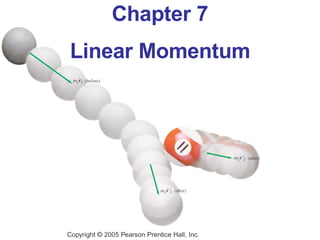
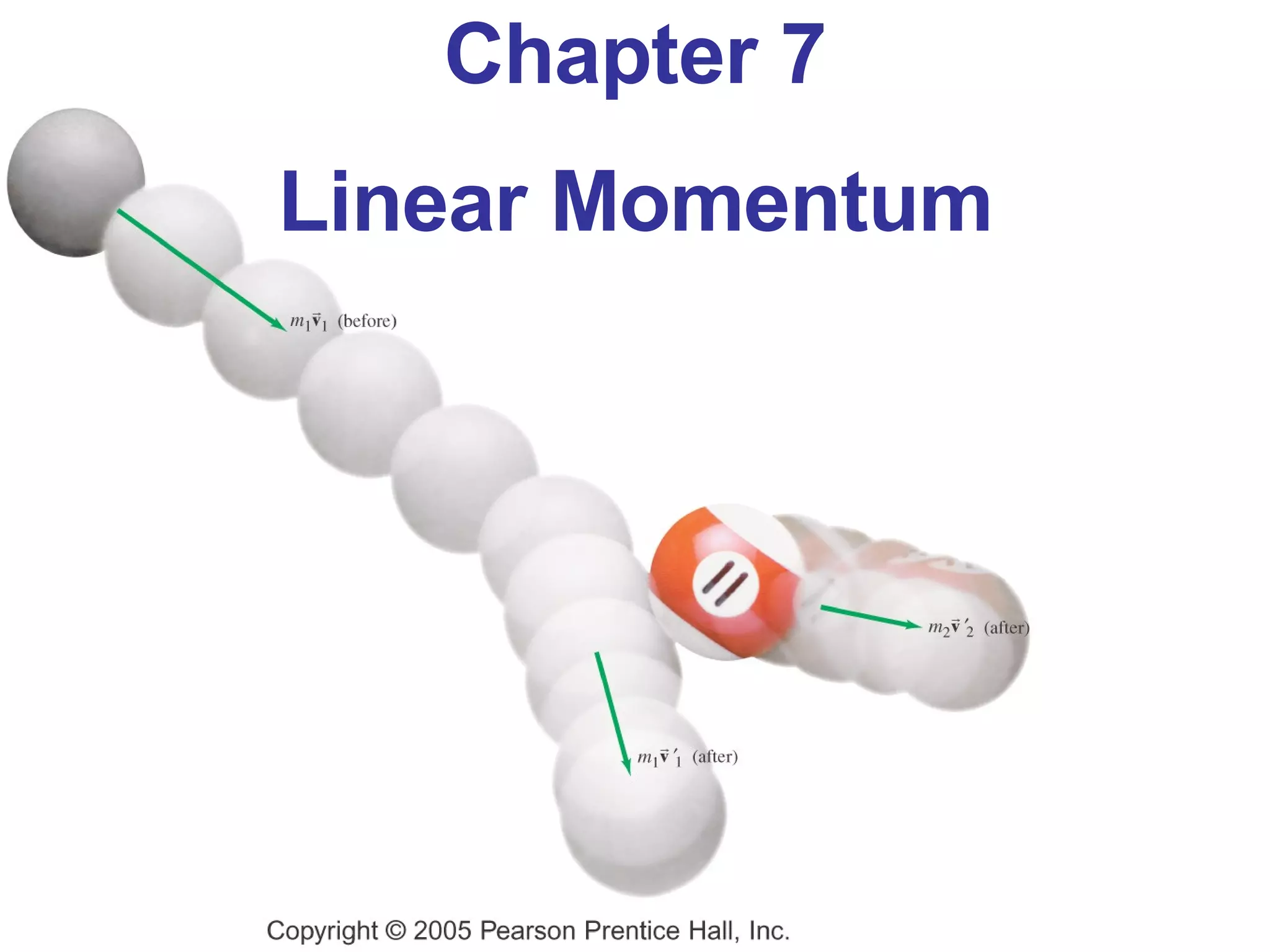
Chapter 7 Linear Momentum
Units of Chapter 7 Momentum and Its Relation to Force Conservation of Momentum Collisions and Impulse Conservation of Energy and Momentum in Collisions Elastic Collisions in One Dimension Inelastic Collisions Center of Mass (CM)
Momentum  is a vector symbolized by the symbol  p , and is defined as p = mv   (a  vector   || v ) SI Units:  kg    m/s = N    s Question:  How is the momentum of a body change? Chapter 7 Linear Momentum Answer:  By the application of a force  F (7-1)
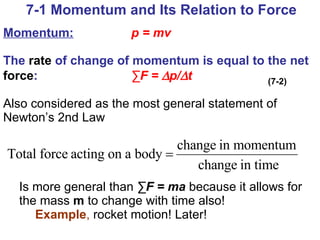
Momentum:   p = mv   The  rate  of change of momentum is equal to the net  force :  ∑F =   p/  t   Also considered as the most general statement of Newton’s 2nd Law Is more general than  ∑F = ma   because it allows for the mass  m  to change with time also! Example ,  rocket motion! Later! 7-1 Momentum and Its Relation to Force (7-2)
7-1 Momentum and Its Relation to Force Newton’s 2nd Law   (General Form!)   ∑ F =   p/  t   Note:  if  m  is constant, becomes:   ∑ F =   p/  t =   (mv)/  t = m(  v/  t) = ma m  = constant.  Initial momentum  p 0  = mv 0 , Final momentum  p = mv .  becomes:   ∑ F =   p/  t = m(v-v 0 )/  t  = m(  v/  t) = ma (as before)
∑ F =   p/  t Initial  p = mv Final  p = 0 Water rate = 1.5 kg/s  p = 0 – mv F = (  p/  t)  = [(0-mv)/  t] = - mv/   t m = 1.5 kg every second  On the water  F = -30 N On the car  F = 30 N Example 7-2
Experimental fact  (provable from Newton’s Laws):  For two colliding objects,  (zero external force)   the total momentum is conserved  (constant)  throughout the collision   The total (vector) momentum before the collision = the total (vector) momentum after the collision.   Law of Conservation of Momentum 7-2 Conservation of Momentum
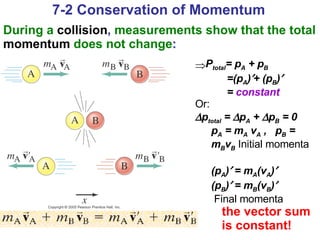
7-2 Conservation of Momentum During a   collision ,  measurements show that the total   momentum   does not change : P total = p A  + p B   =(p A )  + (p B )    =  constant Or:  p total  =   p A  +   p B  = 0 p A  = m A  v A  ,  p B  = m B v B   Initial momenta (p A )   = m A (v A )    (p B )   = m B (v B )  Final momenta the vector sum  is constant!
Collision:   m 1 v 1 +m 2 v 2  = m 1  (v 1 )    + m 2  (v 2 )    Proof,  using Newton’s Laws:  Force on  1, due to 2,  F 12  =   p 1 /  t   = m 1 [(v 1 )   - v 1 ]/  t   Force on  2, due to 1,  F 21  =   p 2 /  t   = m 2 [(v 2 )    - v 2 ]/   t Newton’s 3 rd  Law :  F 21  = - F 12      - m 1 [(v 1 )    - v 1 ]/  t = m 2 [(v 2 )    - v 2 ]/  t   OR:  m 1 v 1 +m 2 v 2  = m 1  (v 1 )    + m 2  (v 2 )       Proven ! A ->1 B->2
7-2 Conservation of Momentum More formally, the law of  conservation  of momentum states: The   total   momentum of an   isolated   system of objects   remains constant .
m 1 v 1 +m 2 v 2  = (m 1  + m 2 )V    v 2  = 0, (v 1 )   = (v 2 )   = V       V   = [(m 1 v 1 )/(m 1  + m 2 )] = 12 m/s Example 7-3 Initial Momentum = Final Momentum  (1D)
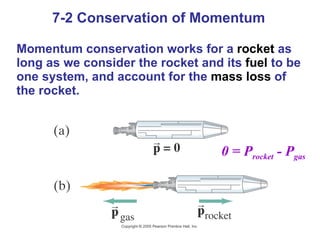
7-2 Conservation of Momentum Momentum conservation works for a  rocket  as long as we consider the rocket and its  fuel  to be one system, and account for the  mass loss  of the rocket. 0 = P rocket  - P gas
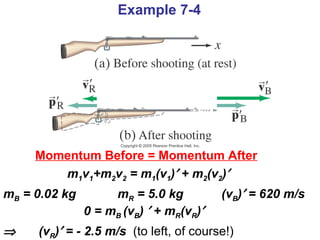
Momentum Before = Momentum After   m 1 v 1 +m 2 v 2  = m 1 (v 1 )   + m 2 (v 2 )    m B  = 0.02 kg  m R  = 5.0 kg  (v B )   = 620 m/s   0 = m B  (v B )    + m R (v R )     (v R )   = - 2.5 m/s   (to left, of course!) Example 7-4
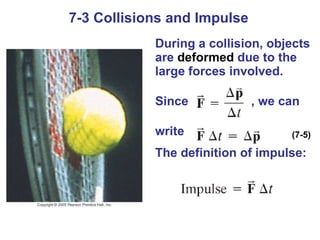
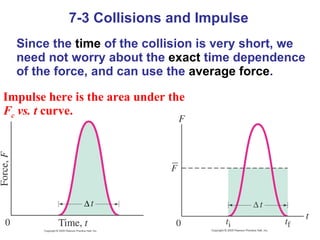
7-3 Collisions and Impulse During a collision, objects are  deformed  due to the large forces involved. Since  , we can  write The definition of impulse: (7-5)
7-3 Collisions and Impulse Since the  time  of the collision is very short, we need not worry about the  exact  time dependence of the force, and can use the  average force . Impulse here is the area under the  F c  vs. t  curve.
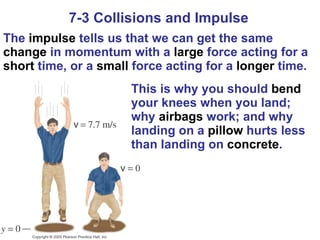
7-3 Collisions and Impulse The  impulse  tells us that we can get the same  change  in momentum with a  large  force acting for a  short  time, or a  small  force acting for a  longer  time.  This is why you should  bend  your knees when you land; why  airbags  work; and why landing on a  pillow  hurts less than landing on  concrete .
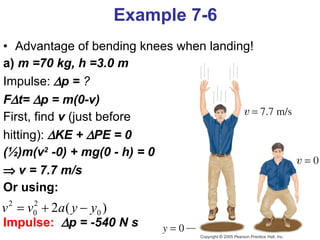
Advantage of bending knees when landing!  a)   m =70 kg, h =3.0 m   Impulse:    p =  ? F  t=   p = m(0-v) First, find   v  (just before hitting):   KE +   PE = 0   (½)m(v 2  -0) + mg(0 - h) = 0    v = 7.7 m/s Or using: Impulse:    p = -540 N s Example 7-6
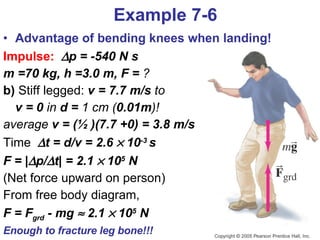
Advantage of bending knees when landing!  Impulse:    p = -540 N s m =70 kg, h =3.0 m, F =  ? b)  Stiff legged:   v = 7.7 m/s  to  v = 0  in  d =  1 cm ( 0.01m )! average  v = (½ )(7.7 +0) = 3.8 m/s Time    t = d/v = 2.6    10 -3  s F = |  p/  t| = 2.1    10 5  N  (Net force upward on person) From free body diagram,  F = F grd  - mg    2.1    10 5  N   Enough to fracture leg bone!!! Example 7-6
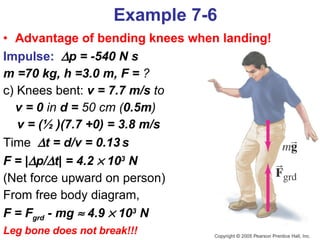
Example 7-6 Advantage of bending knees when landing!   Impulse:    p = -540 N s m =70 kg, h =3.0 m, F =  ? c) Knees bent:   v = 7.7 m/s  to  v = 0  in  d =  50 cm ( 0.5m ) v = (½ )(7.7 +0) = 3.8 m/s Time    t = d/v = 0.13   s F = |  p/  t| = 4.2    10 3  N   (Net force upward on person) From free body diagram,  F = F grd  - mg    4.9    10 3  N   Leg bone does not break!!!
Impulse:   m = 0.060 kg  v = 25 m/s  p  =  change in momentum     wall. Momentum  ||  to wall does not  change.    Impulse will be     wall.  Take + direction toward wall,  Impulse  =   p = m  v = m[(- v sin θ ) - (v sin θ )] = -2mv sin θ  = - 2.1 N  s.   Impulse on wall is in  opposite direction:  2.1 N  s . Problem 17 v i  = v sin θ   v f  = - v sin θ
Momentum is  ALWAYS  (!!!)  conserved in a collision!    m 1 v 1  +  m 2 v 2  = m 1 (v 1 )   +  m 2 (v 2 )  HOLDS for   ALL  collisions ! For Elastic Collisions   ONLY   (!!) Total Kinetic energy ( KE ) is conserved !! ( KE) before  = (KE) after    (½)m 1 (v 1 ) 2  + (½) m 2 (v 2 ) 2   = (½)m 1 (v 1  ) 2  + (½)m 2  (v 2  ) 2   7-4 Conservation of Energy and Momentum in Collisions
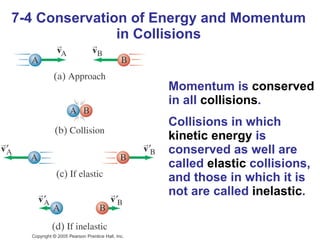
7-4 Conservation of Energy and Momentum in Collisions Momentum is  conserved  in all  collisions . Collisions in which  kinetic energy  is conserved as well are called  elastic  collisions, and those in which it is not are called  inelastic .
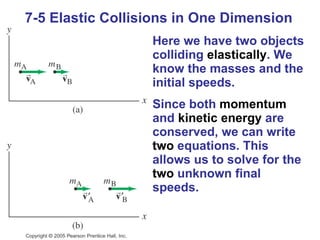
7-5 Elastic Collisions in One Dimension Here we have two objects colliding  elastically . We know the masses and the initial speeds. Since both  momentum  and  kinetic energy  are conserved, we can write  two  equations. This allows us to solve for the  two  unknown final speeds.
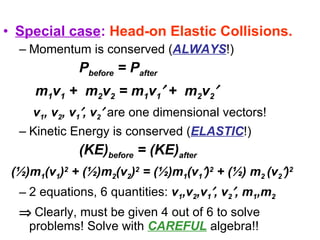
Special case :   Head-on Elastic Collisions. Momentum is conserved ( ALWAYS !)   P before  = P after  m 1 v 1  +  m 2 v 2  = m 1 v 1   +  m 2 v 2  v 1 , v 2 , v 1  , v 2    are one dimensional vectors!   Kinetic Energy is conserved ( ELASTIC !)   (KE) before  = (KE) after   (½)m 1 (v 1 ) 2  + (½)m 2 (v 2 ) 2  = (½)m 1 (v 1  ) 2  + (½) m 2  (v 2  ) 2   2 equations, 6 quantities:  v 1 ,v 2 ,v 1  , v 2  , m 1 ,m 2    Clearly, must be given 4 out of 6 to solve problems! Solve with  CAREFUL  algebra!!
  m 1 v 1  +  m 2 v 2  = m 1 v 1   +  m 2 v 2    (1)   (½)m 1 (v 1 ) 2  + (½)m 2 (v 2 ) 2  = (½)m 1 (v 1  ) 2  + (½) m 2  (v 2  ) 2   (2) Now, some algebra with  (1)  &  (2 ), the results of  which  will help to simplify problem solving : Rewrite  (1)  as:  m 1 (v 1  - v 1  ) = m 2 (v 2   - v 2 )   (a) Rewrite  (2)  as:   m 1 [(v 1 ) 2  - (v 1  ) 2 ]  = m 2 [(v 2  ) 2  - (v 2 ) 2 ]   (b) Divide  (b)  by  (a):    v 1  + v 1   = v 2  + v 2   or    v 1  - v 2  = v 2    - v 1    = -(v 1   - v 2  )   (3) Relative velocity before= - Relative velocity after   Elastic head-on (1d) collisions only!!
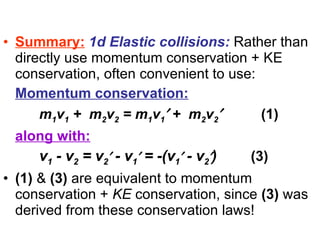
Summary:   1d Elastic collisions:  Rather than directly use momentum conservation + KE conservation, often convenient to use: Momentum conservation:   m 1 v 1  +  m 2 v 2  = m 1 v 1   +  m 2 v 2    (1) along with:   v 1  - v 2  = v 2   - v 1   = -(v 1   - v 2  )     (3) (1)  &  (3)  are equivalent to momentum conservation +  KE  conservation, since  (3)  was derived from these conservation laws!
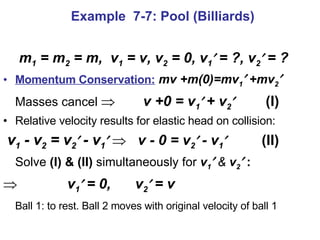
m 1  = m 2  = m,  v 1  = v, v 2  = 0, v 1   = ?, v 2   = ? Momentum Conservation:   mv +m(0)=mv 1   +mv 2    Masses cancel       v +0 = v 1    + v 2    (I) Relative velocity results for elastic head on collision: v 1  - v 2  = v 2   - v 1       v - 0 = v 2   - v 1    (II) Solve  (I) & (II)  simultaneously for  v 1    &  v 2   :    v 1   = 0,   v 2   = v  Ball 1: to rest. Ball 2 moves with original velocity of ball 1 Example  7-7: Pool (Billiards)
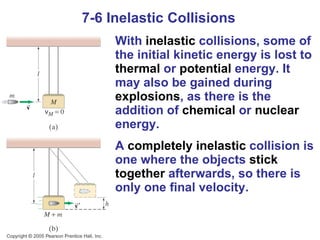
7-6 Inelastic Collisions With  inelastic  collisions, some of the initial kinetic energy is lost to  thermal  or  potential  energy. It may also be gained during  explosions , as there is the addition of  chemical  or  nuclear  energy. A  completely inelastic  collision is one where the objects  stick   together  afterwards, so there is only one final velocity.
Momentum Conservation   mv = (m + M)v ´ Energy Conservation (½)(m +M)(v´) 2  = (m + M)gh v´=  (2gh)½      v = [1 +(M/m)](2gh) ½   Ex. 7-10 & Prob. 32 (Inelastic Collisions)
Up to now, we’ve been mainly concerned with the motion of single (point) particles.  To treat extended bodies, we’ve approximated the body as a point particle & treated it  as if  it had all of its mass at a point! How is this possible? Real, extended bodies have complex motion, including (possibly): translation, rotation, & vibration! 7-8 Center of Mass
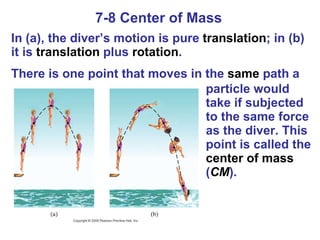
7-8 Center of Mass In (a), the diver’s motion is pure  translation ; in (b) it is  translation  plus  rotation . There is one point that moves in the  same  path a   particle would take if subjected to the same force as the diver. This point is called the  center of mass  ( CM ).
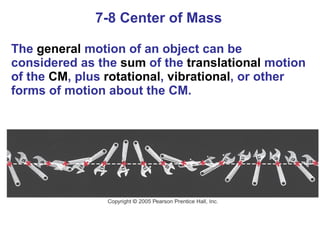
7-8 Center of Mass The  general  motion of an object can be considered as the  sum  of the  translational  motion of the  CM , plus  rotational ,  vibrational , or other forms of motion about the CM.
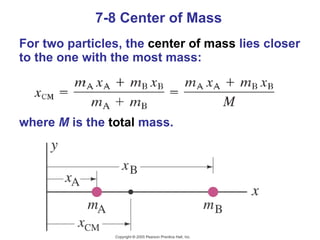
7-8 Center of Mass For two particles, the  center of mass  lies closer to the one with the most mass: where  M  is the  total  mass.
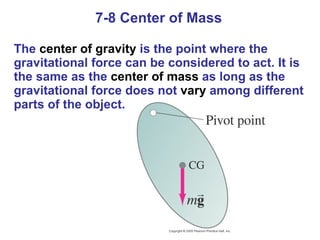
7-8 Center of Mass The  center of gravity  is the point where the gravitational force can be considered to act. It is the same as the  center of mass  as long as the gravitational force does not  vary  among different parts of the object.
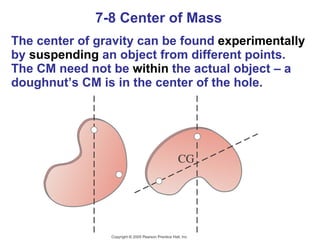
7-8 Center of Mass The center of gravity can be found  experimentally  by  suspending  an object from different points. The CM need not be  within  the actual object – a doughnut’s CM is in the center of the hole.
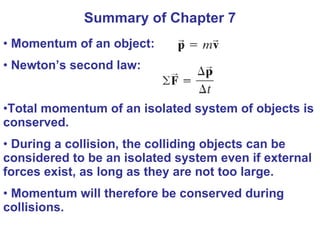
Summary of Chapter 7 Momentum of an object: Newton’s second law:  Total momentum of an isolated system of objects is conserved. During a collision, the colliding objects can be considered to be an isolated system even if external forces exist, as long as they are not too large. Momentum will therefore be conserved during collisions.
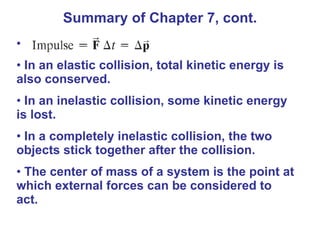
In an elastic collision, total kinetic energy is also conserved. In an inelastic collision, some kinetic energy is lost. In a completely inelastic collision, the two objects stick together after the collision. The center of mass of a system is the point at which external forces can be considered to act. Summary of Chapter 7, cont.

Lecture Ch 07

  • 1.
  • 2.
    Units of Chapter7 Momentum and Its Relation to Force Conservation of Momentum Collisions and Impulse Conservation of Energy and Momentum in Collisions Elastic Collisions in One Dimension Inelastic Collisions Center of Mass (CM)
  • 3.
    Momentum isa vector symbolized by the symbol p , and is defined as p = mv (a vector || v ) SI Units: kg  m/s = N  s Question: How is the momentum of a body change? Chapter 7 Linear Momentum Answer: By the application of a force F (7-1)
  • 4.
    Momentum: p = mv The rate of change of momentum is equal to the net force : ∑F =  p/  t Also considered as the most general statement of Newton’s 2nd Law Is more general than ∑F = ma because it allows for the mass m to change with time also! Example , rocket motion! Later! 7-1 Momentum and Its Relation to Force (7-2)
  • 5.
    7-1 Momentum andIts Relation to Force Newton’s 2nd Law (General Form!) ∑ F =  p/  t Note: if m is constant, becomes: ∑ F =  p/  t =  (mv)/  t = m(  v/  t) = ma m = constant. Initial momentum p 0 = mv 0 , Final momentum p = mv . becomes: ∑ F =  p/  t = m(v-v 0 )/  t = m(  v/  t) = ma (as before)
  • 6.
    ∑ F =  p/  t Initial p = mv Final p = 0 Water rate = 1.5 kg/s  p = 0 – mv F = (  p/  t) = [(0-mv)/  t] = - mv/  t m = 1.5 kg every second On the water F = -30 N On the car F = 30 N Example 7-2
  • 7.
    Experimental fact (provable from Newton’s Laws): For two colliding objects, (zero external force) the total momentum is conserved (constant) throughout the collision The total (vector) momentum before the collision = the total (vector) momentum after the collision. Law of Conservation of Momentum 7-2 Conservation of Momentum
  • 8.
    7-2 Conservation ofMomentum During a collision , measurements show that the total momentum does not change : P total = p A + p B =(p A )  + (p B )  = constant Or:  p total =  p A +  p B = 0 p A = m A v A , p B = m B v B Initial momenta (p A )  = m A (v A )  (p B )  = m B (v B )  Final momenta the vector sum is constant!
  • 9.
    Collision: m 1 v 1 +m 2 v 2 = m 1 (v 1 )  + m 2 (v 2 )  Proof, using Newton’s Laws: Force on 1, due to 2, F 12 =  p 1 /  t = m 1 [(v 1 )  - v 1 ]/  t Force on 2, due to 1, F 21 =  p 2 /  t = m 2 [(v 2 )  - v 2 ]/  t Newton’s 3 rd Law : F 21 = - F 12  - m 1 [(v 1 )  - v 1 ]/  t = m 2 [(v 2 )  - v 2 ]/  t OR: m 1 v 1 +m 2 v 2 = m 1 (v 1 )  + m 2 (v 2 )   Proven ! A ->1 B->2
  • 10.
    7-2 Conservation ofMomentum More formally, the law of conservation of momentum states: The total momentum of an isolated system of objects remains constant .
  • 11.
    m 1 v1 +m 2 v 2 = (m 1 + m 2 )V  v 2 = 0, (v 1 )  = (v 2 )  = V   V  = [(m 1 v 1 )/(m 1 + m 2 )] = 12 m/s Example 7-3 Initial Momentum = Final Momentum (1D)
  • 12.
    7-2 Conservation ofMomentum Momentum conservation works for a rocket as long as we consider the rocket and its fuel to be one system, and account for the mass loss of the rocket. 0 = P rocket - P gas
  • 13.
    Momentum Before =Momentum After m 1 v 1 +m 2 v 2 = m 1 (v 1 )  + m 2 (v 2 )  m B = 0.02 kg m R = 5.0 kg (v B )  = 620 m/s 0 = m B (v B )  + m R (v R )   (v R )  = - 2.5 m/s (to left, of course!) Example 7-4
  • 14.
    7-3 Collisions andImpulse During a collision, objects are deformed due to the large forces involved. Since , we can write The definition of impulse: (7-5)
  • 15.
    7-3 Collisions andImpulse Since the time of the collision is very short, we need not worry about the exact time dependence of the force, and can use the average force . Impulse here is the area under the F c vs. t curve.
  • 16.
    7-3 Collisions andImpulse The impulse tells us that we can get the same change in momentum with a large force acting for a short time, or a small force acting for a longer time. This is why you should bend your knees when you land; why airbags work; and why landing on a pillow hurts less than landing on concrete .
  • 17.
    Advantage of bendingknees when landing! a) m =70 kg, h =3.0 m Impulse:  p = ? F  t=  p = m(0-v) First, find v (just before hitting):  KE +  PE = 0 (½)m(v 2 -0) + mg(0 - h) = 0  v = 7.7 m/s Or using: Impulse:  p = -540 N s Example 7-6
  • 18.
    Advantage of bendingknees when landing! Impulse:  p = -540 N s m =70 kg, h =3.0 m, F = ? b) Stiff legged: v = 7.7 m/s to v = 0 in d = 1 cm ( 0.01m )! average v = (½ )(7.7 +0) = 3.8 m/s Time  t = d/v = 2.6  10 -3 s F = |  p/  t| = 2.1  10 5 N (Net force upward on person) From free body diagram, F = F grd - mg  2.1  10 5 N Enough to fracture leg bone!!! Example 7-6
  • 19.
    Example 7-6 Advantageof bending knees when landing! Impulse:  p = -540 N s m =70 kg, h =3.0 m, F = ? c) Knees bent: v = 7.7 m/s to v = 0 in d = 50 cm ( 0.5m ) v = (½ )(7.7 +0) = 3.8 m/s Time  t = d/v = 0.13 s F = |  p/  t| = 4.2  10 3 N (Net force upward on person) From free body diagram, F = F grd - mg  4.9  10 3 N Leg bone does not break!!!
  • 20.
    Impulse: m = 0.060 kg v = 25 m/s  p = change in momentum  wall. Momentum || to wall does not change.  Impulse will be  wall. Take + direction toward wall, Impulse =  p = m  v = m[(- v sin θ ) - (v sin θ )] = -2mv sin θ = - 2.1 N s. Impulse on wall is in opposite direction: 2.1 N s . Problem 17 v i = v sin θ v f = - v sin θ
  • 21.
    Momentum is ALWAYS (!!!) conserved in a collision!  m 1 v 1 + m 2 v 2 = m 1 (v 1 )  + m 2 (v 2 )  HOLDS for ALL collisions ! For Elastic Collisions ONLY (!!) Total Kinetic energy ( KE ) is conserved !! ( KE) before = (KE) after  (½)m 1 (v 1 ) 2 + (½) m 2 (v 2 ) 2 = (½)m 1 (v 1  ) 2 + (½)m 2 (v 2  ) 2 7-4 Conservation of Energy and Momentum in Collisions
  • 22.
    7-4 Conservation ofEnergy and Momentum in Collisions Momentum is conserved in all collisions . Collisions in which kinetic energy is conserved as well are called elastic collisions, and those in which it is not are called inelastic .
  • 23.
    7-5 Elastic Collisionsin One Dimension Here we have two objects colliding elastically . We know the masses and the initial speeds. Since both momentum and kinetic energy are conserved, we can write two equations. This allows us to solve for the two unknown final speeds.
  • 24.
    Special case : Head-on Elastic Collisions. Momentum is conserved ( ALWAYS !) P before = P after m 1 v 1 + m 2 v 2 = m 1 v 1  + m 2 v 2  v 1 , v 2 , v 1  , v 2  are one dimensional vectors! Kinetic Energy is conserved ( ELASTIC !) (KE) before = (KE) after (½)m 1 (v 1 ) 2 + (½)m 2 (v 2 ) 2 = (½)m 1 (v 1  ) 2 + (½) m 2 (v 2  ) 2 2 equations, 6 quantities: v 1 ,v 2 ,v 1  , v 2  , m 1 ,m 2  Clearly, must be given 4 out of 6 to solve problems! Solve with CAREFUL algebra!!
  • 25.
    m1 v 1 + m 2 v 2 = m 1 v 1  + m 2 v 2  (1) (½)m 1 (v 1 ) 2 + (½)m 2 (v 2 ) 2 = (½)m 1 (v 1  ) 2 + (½) m 2 (v 2  ) 2 (2) Now, some algebra with (1) & (2 ), the results of which will help to simplify problem solving : Rewrite (1) as: m 1 (v 1 - v 1  ) = m 2 (v 2  - v 2 ) (a) Rewrite (2) as: m 1 [(v 1 ) 2 - (v 1  ) 2 ] = m 2 [(v 2  ) 2 - (v 2 ) 2 ] (b) Divide (b) by (a):  v 1 + v 1  = v 2 + v 2  or v 1 - v 2 = v 2  - v 1  = -(v 1  - v 2  ) (3) Relative velocity before= - Relative velocity after Elastic head-on (1d) collisions only!!
  • 26.
    Summary: 1d Elastic collisions: Rather than directly use momentum conservation + KE conservation, often convenient to use: Momentum conservation: m 1 v 1 + m 2 v 2 = m 1 v 1  + m 2 v 2  (1) along with: v 1 - v 2 = v 2  - v 1  = -(v 1  - v 2  ) (3) (1) & (3) are equivalent to momentum conservation + KE conservation, since (3) was derived from these conservation laws!
  • 27.
    m 1 = m 2 = m, v 1 = v, v 2 = 0, v 1  = ?, v 2  = ? Momentum Conservation: mv +m(0)=mv 1  +mv 2  Masses cancel  v +0 = v 1  + v 2  (I) Relative velocity results for elastic head on collision: v 1 - v 2 = v 2  - v 1   v - 0 = v 2  - v 1  (II) Solve (I) & (II) simultaneously for v 1  & v 2  :  v 1  = 0, v 2  = v Ball 1: to rest. Ball 2 moves with original velocity of ball 1 Example 7-7: Pool (Billiards)
  • 28.
    7-6 Inelastic CollisionsWith inelastic collisions, some of the initial kinetic energy is lost to thermal or potential energy. It may also be gained during explosions , as there is the addition of chemical or nuclear energy. A completely inelastic collision is one where the objects stick together afterwards, so there is only one final velocity.
  • 29.
    Momentum Conservation mv = (m + M)v ´ Energy Conservation (½)(m +M)(v´) 2 = (m + M)gh v´= (2gh)½  v = [1 +(M/m)](2gh) ½ Ex. 7-10 & Prob. 32 (Inelastic Collisions)
  • 30.
    Up to now,we’ve been mainly concerned with the motion of single (point) particles. To treat extended bodies, we’ve approximated the body as a point particle & treated it as if it had all of its mass at a point! How is this possible? Real, extended bodies have complex motion, including (possibly): translation, rotation, & vibration! 7-8 Center of Mass
  • 31.
    7-8 Center ofMass In (a), the diver’s motion is pure translation ; in (b) it is translation plus rotation . There is one point that moves in the same path a particle would take if subjected to the same force as the diver. This point is called the center of mass ( CM ).
  • 32.
    7-8 Center ofMass The general motion of an object can be considered as the sum of the translational motion of the CM , plus rotational , vibrational , or other forms of motion about the CM.
  • 33.
    7-8 Center ofMass For two particles, the center of mass lies closer to the one with the most mass: where M is the total mass.
  • 34.
    7-8 Center ofMass The center of gravity is the point where the gravitational force can be considered to act. It is the same as the center of mass as long as the gravitational force does not vary among different parts of the object.
  • 35.
    7-8 Center ofMass The center of gravity can be found experimentally by suspending an object from different points. The CM need not be within the actual object – a doughnut’s CM is in the center of the hole.
  • 36.
    Summary of Chapter7 Momentum of an object: Newton’s second law: Total momentum of an isolated system of objects is conserved. During a collision, the colliding objects can be considered to be an isolated system even if external forces exist, as long as they are not too large. Momentum will therefore be conserved during collisions.
  • 37.
    In an elasticcollision, total kinetic energy is also conserved. In an inelastic collision, some kinetic energy is lost. In a completely inelastic collision, the two objects stick together after the collision. The center of mass of a system is the point at which external forces can be considered to act. Summary of Chapter 7, cont.