Heat To expand To contract Linear expansion coefficient  Volume expansion coefficient
To do an expansion experiment on solid, liquid, and gas. To explain the advantages of expansion in the daily life.
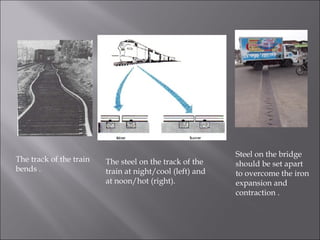
The steel on the track of the train at night/cool (left) and at noon/hot (right). Steel on the bridge should be set apart to overcome the iron expansion and contraction .  The track of the train bends .
The road damage
Do you remember..about  “ Theory Kinetic matter ”
Please explain using “ theory kinetic matter ”
Apropriate Theory kinetic matter The matter expansion if heated because  Moving particels faster distance between  particels with the other be longger
 
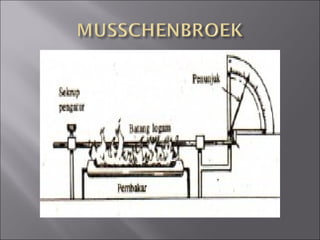
Apparatus and Materials - Musschenbroek  set and Bunsen burner -Three different kinds of different metal bar Procedures 1.  Take a metal bar and put it on Musschenbroek apparatus as seen in the figure. 2.  Turn the spanner in the Musschenbroek apparatus so that the indicator  arms are in  the same position 3.  Heat the metal bar evenly by using the Bunsen burner. Observe carefully those indicator  arms that are pushed by the metal bar. Repeat your experiment for the other two metal bars. Analysis What do you observe on those indicator arms? Do they move? In your opinion, is there any relation between the movement of those indicator arms and the kinds of metals that push them?
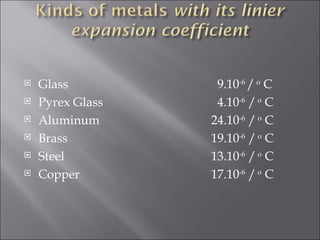
Glass   9 . 10 -6   /  o  C Pyrex Glass   4 . 10 -6  /  o  C Aluminum 24 . 10 -6  /  o  C Brass 19 . 10 -6  /  o  C Steel 13 . 10 -6  /  o  C Copper 17 . 10 -6  /  o  C
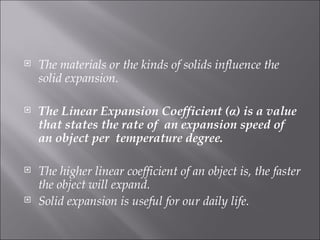
The materials or the kinds of solids influence the solid expansion.  The Linear Expansion Coefficient ( α ) is a value that states the rate of  an expansion speed of an object per  temperature degree.  The higher linear coefficient of an object is, the faster the object will expand.  Solid expansion is useful for our daily life.
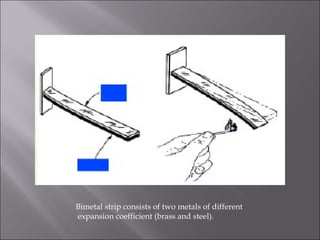
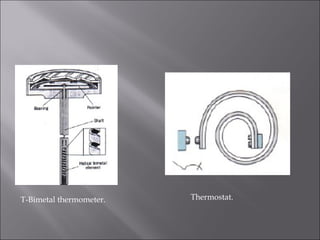
Bimetal strip consists of two metals of different  expansion coefficient (brass and steel).
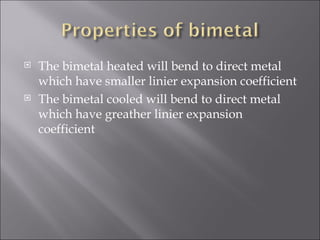
The bimetal heated will bend to direct metal which have smaller linier expansion coefficient The bimetal cooled will bend to direct metal which have greather linier expansion coefficient
Thermostat. T-Bimetal thermometer.
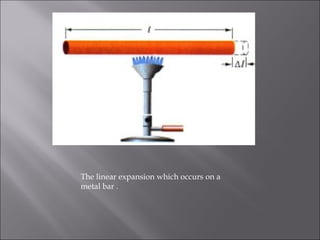
The linear expansion which occurs on a metal bar  .
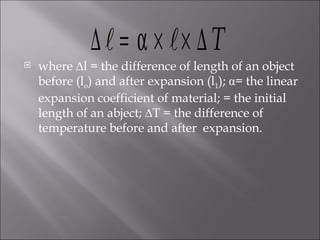
where ∆ l   = the difference of length of an object before ( l o ) and after expansion ( l 1 );  α = the linear expansion coefficient of material;   = the initial length of an abject; ∆ T   = the difference of temperature before and after  expansion.
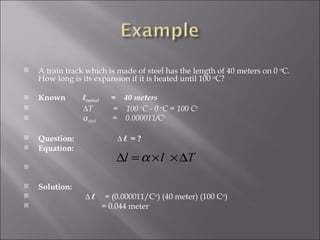
A train track which is made of steel has the length of 40 meters on 0  o C. How long is its expansion if it is heated until 100  o C? Known  l initial   =  40 meters ∆ T  =  100  o C - 0  o C = 100 C o α steel   =  0.000011/C o Question:   ∆  l   = ? Equation:  Solution:     ∆   l   = (0.000011/C o ) (40 meter) (100 C o )   = 0.044 meter
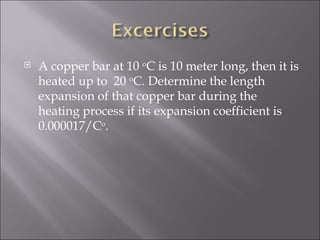
A copper bar at 10  o C is 10 meter long, then it is heated up to  20  o C. Determine the length expansion of that copper bar during the heating process if its expansion coefficient is  0.000017/C o .
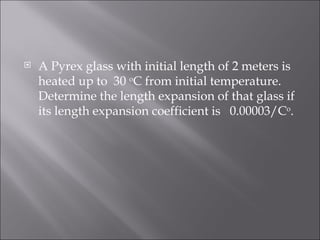
A Pyrex glass with initial length of 2 meters is heated up to  30  o C from initial temperature.  Determine the length expansion of that glass if its length expansion coefficient is  0.00003/C o .
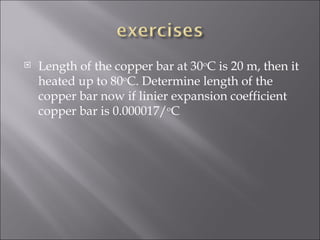
Length of the copper bar at 30 o C is 20 m, then it heated up to 80 o C. Determine length of the copper bar now if linier expansion coefficient copper bar is 0.000017/ o C
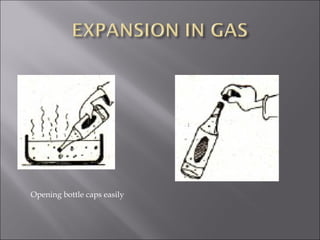
Opening bottle caps easily
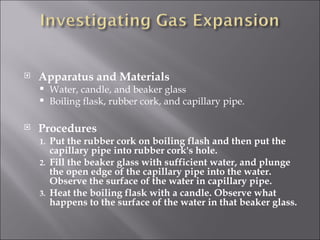
Apparatus and Materials Water, candle, and beaker glass Boiling flask, rubber cork, and capillary pipe. Procedures Put the rubber cork on boiling flash and then put the capillary pipe into rubber cork's hole. Fill the beaker glass with sufficient water, and plunge the open edge of the capillary pipe into the water. Observe the surface of the water in capillary pipe. Heat the boiling flask with a candle. Observe what happens to the surface of the water in that beaker glass.
Based on the result of the experiment and your observation, how is the shape of the water surface in the capillary pipe?  What happens to the water in the beaker glass after the boiling flask is heated?  In your opinion, how does it happen?

Expansion

  • 1.
  • 2.
  • 3.
    Heat To expandTo contract Linear expansion coefficient Volume expansion coefficient
  • 4.
    To do anexpansion experiment on solid, liquid, and gas. To explain the advantages of expansion in the daily life.
  • 5.
    The steel onthe track of the train at night/cool (left) and at noon/hot (right). Steel on the bridge should be set apart to overcome the iron expansion and contraction . The track of the train bends .
  • 6.
  • 7.
    Do you remember..about “ Theory Kinetic matter ”
  • 8.
    Please explain using“ theory kinetic matter ”
  • 9.
    Apropriate Theory kineticmatter The matter expansion if heated because Moving particels faster distance between particels with the other be longger
  • 10.
  • 11.
    Apparatus and Materials- Musschenbroek set and Bunsen burner -Three different kinds of different metal bar Procedures 1. Take a metal bar and put it on Musschenbroek apparatus as seen in the figure. 2. Turn the spanner in the Musschenbroek apparatus so that the indicator arms are in the same position 3. Heat the metal bar evenly by using the Bunsen burner. Observe carefully those indicator arms that are pushed by the metal bar. Repeat your experiment for the other two metal bars. Analysis What do you observe on those indicator arms? Do they move? In your opinion, is there any relation between the movement of those indicator arms and the kinds of metals that push them?
  • 12.
    Glass 9 . 10 -6 / o C Pyrex Glass 4 . 10 -6 / o C Aluminum 24 . 10 -6 / o C Brass 19 . 10 -6 / o C Steel 13 . 10 -6 / o C Copper 17 . 10 -6 / o C
  • 13.
    The materials orthe kinds of solids influence the solid expansion. The Linear Expansion Coefficient ( α ) is a value that states the rate of an expansion speed of an object per temperature degree. The higher linear coefficient of an object is, the faster the object will expand. Solid expansion is useful for our daily life.
  • 14.
    Bimetal strip consistsof two metals of different expansion coefficient (brass and steel).
  • 15.
    The bimetal heatedwill bend to direct metal which have smaller linier expansion coefficient The bimetal cooled will bend to direct metal which have greather linier expansion coefficient
  • 16.
  • 17.
    The linear expansionwhich occurs on a metal bar .
  • 18.
    where ∆ l = the difference of length of an object before ( l o ) and after expansion ( l 1 ); α = the linear expansion coefficient of material; = the initial length of an abject; ∆ T = the difference of temperature before and after expansion.
  • 19.
    A train trackwhich is made of steel has the length of 40 meters on 0 o C. How long is its expansion if it is heated until 100 o C? Known l initial = 40 meters ∆ T = 100 o C - 0 o C = 100 C o α steel = 0.000011/C o Question: ∆ l = ? Equation: Solution: ∆ l = (0.000011/C o ) (40 meter) (100 C o ) = 0.044 meter
  • 20.
    A copper barat 10 o C is 10 meter long, then it is heated up to 20 o C. Determine the length expansion of that copper bar during the heating process if its expansion coefficient is 0.000017/C o .
  • 21.
    A Pyrex glasswith initial length of 2 meters is heated up to 30 o C from initial temperature. Determine the length expansion of that glass if its length expansion coefficient is 0.00003/C o .
  • 22.
    Length of thecopper bar at 30 o C is 20 m, then it heated up to 80 o C. Determine length of the copper bar now if linier expansion coefficient copper bar is 0.000017/ o C
  • 23.
  • 24.
    Apparatus and MaterialsWater, candle, and beaker glass Boiling flask, rubber cork, and capillary pipe. Procedures Put the rubber cork on boiling flash and then put the capillary pipe into rubber cork's hole. Fill the beaker glass with sufficient water, and plunge the open edge of the capillary pipe into the water. Observe the surface of the water in capillary pipe. Heat the boiling flask with a candle. Observe what happens to the surface of the water in that beaker glass.
  • 25.
    Based on theresult of the experiment and your observation, how is the shape of the water surface in the capillary pipe? What happens to the water in the beaker glass after the boiling flask is heated? In your opinion, how does it happen?