By,
Josely Jose
• Vaporization
• Evaporation
• Thermal Expansion
• Types of thermal expansion
• Thermal expansion in solids,
liquids and gases
• Glass filled with water for a day –
level of water
• Boiling or evaporation ?
• This process occurred is evaporation
• Both processes are different
• Liquid changes to gaseous state at fixed
temp.(100˚C) by absorbing heat energy –
BOILING
• During this process all molecules of liquid
gets involved ( produce sound)
• Boiling point: the boiling of liquid which
occurs at fixed temp.
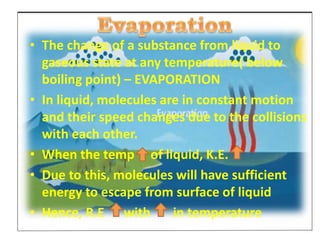
• The change of a substance from liquid to
gaseous state at any temperature( below
boiling point) – EVAPORATION
• In liquid, molecules are in constant motion
and their speed changes due to the collisions
with each other.
• When the temp of liquid, K.E.
• Due to this, molecules will have sufficient
energy to escape from surface of liquid
• Hence, R.E with in temperature
• Drying of wet clothes occurs
• Sweat absorbs heat from your
body . This helps to cool down
your body during summer.
• Water stored in earthen pot
Evaporation Boiling
1.Process occur at any
temperature
1.Process occurs at
particular temperature
2. Slow and silent Process 2. Brisk and violent process
3. Occurs at surface of a
liquid
3. Occurs in whole volume
of liquid
4. It causes cooling 4. It does not cause cooling
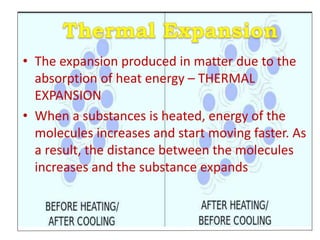
• The expansion produced in matter due to the
absorption of heat energy – THERMAL
EXPANSION
• When a substances is heated, energy of the
molecules increases and start moving faster. As
a result, the distance between the molecules
increases and the substance expands
• In solids, the molecules are closely packed. So
expansion is very little on heating.
• In liquids, the molecules are loosely packed so
expansion is more than solids. As the distance
between molecules increases
• In gases, molecules are free to move and force
of attraction between them is zero. So
expansion is maximum.
• The increase in length of a solid on
heating
• It depends in following factors:
1. Original length of the length
2. Increase in temperature
3. Nature of the solid
• The increase in area of a solid on
heating
• For eg. Sheet of metal, area of plate
increases on heating.
• The increase in volume of a
solid, liquid or gas on heating
• Small gaps are left between rail tracks to
allow them to expand in summer
• The iron girder used to make bridge is
fixed only from one end and other end
rests on rollers.
• Telephone and electric wires are kept
loose between poles to prevent them
from snapping in winter
• Loops are provided in pipelines to absorb
the effect of expansion or contraction
due to change in temperature
• Glass is used in glassware has certain
amount of thickness.
• It is a device that detects excess heat or
smoke in surrounding area
• In case of fire, it sounds a loud alert that
indicates danger
• The alert helps to try to put out fire or
evacuate immediately
• Kettles and saucepans are not filled up to the
brim in order to avoid of overflowing on
heating
• Space is left in medicine bottles to allow for
expansion when they are sent from cold to
hot conditions
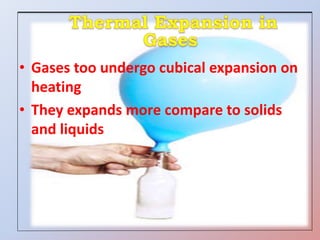
• Gases too undergo cubical expansion on
heating
• They expands more compare to solids
and liquids
Heat transfer

Heat transfer

  • 1.
  • 2.
    • Vaporization • Evaporation •Thermal Expansion • Types of thermal expansion • Thermal expansion in solids, liquids and gases
  • 3.
    • Glass filledwith water for a day – level of water • Boiling or evaporation ? • This process occurred is evaporation • Both processes are different
  • 4.
    • Liquid changesto gaseous state at fixed temp.(100˚C) by absorbing heat energy – BOILING • During this process all molecules of liquid gets involved ( produce sound) • Boiling point: the boiling of liquid which occurs at fixed temp.
  • 5.
    • The changeof a substance from liquid to gaseous state at any temperature( below boiling point) – EVAPORATION • In liquid, molecules are in constant motion and their speed changes due to the collisions with each other. • When the temp of liquid, K.E. • Due to this, molecules will have sufficient energy to escape from surface of liquid • Hence, R.E with in temperature
  • 6.
    • Drying ofwet clothes occurs • Sweat absorbs heat from your body . This helps to cool down your body during summer. • Water stored in earthen pot
  • 7.
    Evaporation Boiling 1.Process occurat any temperature 1.Process occurs at particular temperature 2. Slow and silent Process 2. Brisk and violent process 3. Occurs at surface of a liquid 3. Occurs in whole volume of liquid 4. It causes cooling 4. It does not cause cooling
  • 8.
    • The expansionproduced in matter due to the absorption of heat energy – THERMAL EXPANSION • When a substances is heated, energy of the molecules increases and start moving faster. As a result, the distance between the molecules increases and the substance expands
  • 9.
    • In solids,the molecules are closely packed. So expansion is very little on heating. • In liquids, the molecules are loosely packed so expansion is more than solids. As the distance between molecules increases • In gases, molecules are free to move and force of attraction between them is zero. So expansion is maximum.
  • 11.
    • The increasein length of a solid on heating • It depends in following factors: 1. Original length of the length 2. Increase in temperature 3. Nature of the solid
  • 12.
    • The increasein area of a solid on heating • For eg. Sheet of metal, area of plate increases on heating.
  • 13.
    • The increasein volume of a solid, liquid or gas on heating
  • 14.
    • Small gapsare left between rail tracks to allow them to expand in summer • The iron girder used to make bridge is fixed only from one end and other end rests on rollers. • Telephone and electric wires are kept loose between poles to prevent them from snapping in winter
  • 15.
    • Loops areprovided in pipelines to absorb the effect of expansion or contraction due to change in temperature • Glass is used in glassware has certain amount of thickness.
  • 16.
    • It isa device that detects excess heat or smoke in surrounding area • In case of fire, it sounds a loud alert that indicates danger • The alert helps to try to put out fire or evacuate immediately
  • 19.
    • Kettles andsaucepans are not filled up to the brim in order to avoid of overflowing on heating • Space is left in medicine bottles to allow for expansion when they are sent from cold to hot conditions
  • 20.
    • Gases tooundergo cubical expansion on heating • They expands more compare to solids and liquids

Editor's Notes

  • #6 Asbestos is a term for a group of minerals made of microscopic fibres. If you breathe in these fibres, they can damage your lungs.
  • #9 Asbestos is a term for a group of minerals made of microscopic fibres. If you breathe in these fibres, they can damage your lungs.
  • #10 Asbestos is a term for a group of minerals made of microscopic fibres. If you breathe in these fibres, they can damage your lungs.
  • #11 Asbestos is a term for a group of minerals made of microscopic fibres. If you breathe in these fibres, they can damage your lungs.
  • #12 Asbestos is a term for a group of minerals made of microscopic fibres. If you breathe in these fibres, they can damage your lungs.
  • #13 Asbestos is a term for a group of minerals made of microscopic fibres. If you breathe in these fibres, they can damage your lungs.
  • #14 Asbestos is a term for a group of minerals made of microscopic fibres. If you breathe in these fibres, they can damage your lungs.
  • #15 Asbestos is a term for a group of minerals made of microscopic fibres. If you breathe in these fibres, they can damage your lungs.
  • #16 Asbestos is a term for a group of minerals made of microscopic fibres. If you breathe in these fibres, they can damage your lungs.
  • #17 Asbestos is a term for a group of minerals made of microscopic fibres. If you breathe in these fibres, they can damage your lungs.
  • #18 Asbestos is a term for a group of minerals made of microscopic fibres. If you breathe in these fibres, they can damage your lungs.
  • #19 Asbestos is a term for a group of minerals made of microscopic fibres. If you breathe in these fibres, they can damage your lungs.
  • #20 Asbestos is a term for a group of minerals made of microscopic fibres. If you breathe in these fibres, they can damage your lungs.
  • #21 Asbestos is a term for a group of minerals made of microscopic fibres. If you breathe in these fibres, they can damage your lungs.
  • #22 Asbestos is a term for a group of minerals made of microscopic fibres. If you breathe in these fibres, they can damage your lungs.