Thermal Expansion
Overview
Thermal Expansion
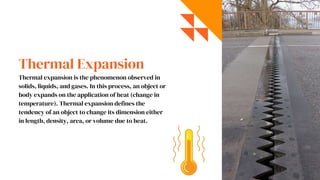
Thermal expansion is the phenomenon observed in
solids, liquids, and gases. In this process, an object or
body expands on the application of heat (change in
temperature). Thermal expansion defines the
tendency of an object to change its dimension either
in length, density, area, or volume due to heat.
What causes thermal expansion
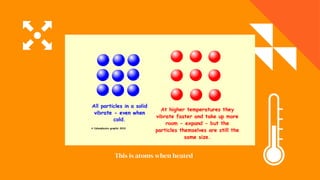
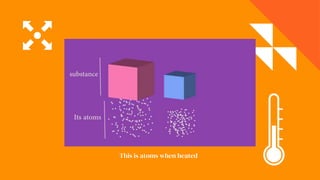
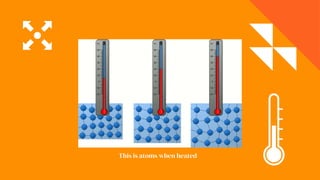
With increased temperature, the atoms vibrate back and forth
over greater distances. With wider vibrations in all dimensions, the solid expands
as a whole.
This is atoms when heated
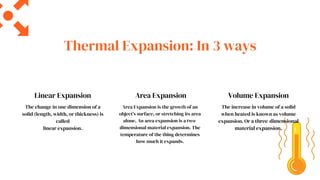
Thermal Expansion: In 3 ways
The change in one dimension of a
solid (length, width, or thickness) is
called
linear expansion.
Linear Expansion
The increase in volume of a solid
when heated is known as volume
expansion. Or a three-dimensional
material expansion.
Volume Expansion
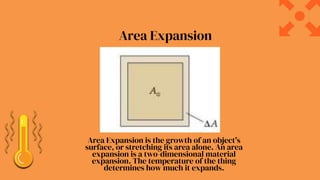
Area Expansion is the growth of an
object's surface, or stretching its area
alone. An area expansion is a two-
dimensional material expansion. The
temperature of the thing determines
how much it expands.
Area Expansion
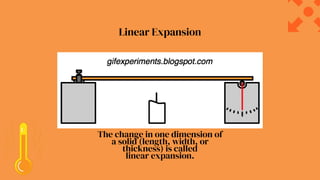
The change in one dimension of
a solid (length, width, or
thickness) is called
linear expansion.
Linear Expansion
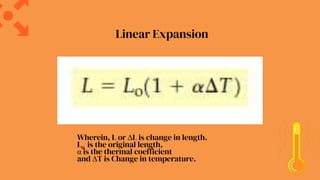
Wherein, L or ∆L is change in length.
Lo is the original length,
α is the thermal coefficient
and ∆T is Change in temperature.
Linear Expansion
Area Expansion is the growth of an object's
surface, or stretching its area alone. An area
expansion is a two-dimensional material
expansion. The temperature of the thing
determines how much it expands.
Area Expansion
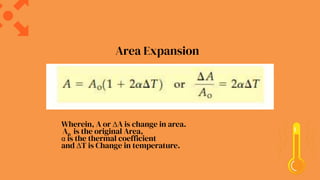
Wherein, A or ∆A is change in area.
Ao is the original Area,
α is the thermal coefficient
and ∆T is Change in temperature.
Area Expansion
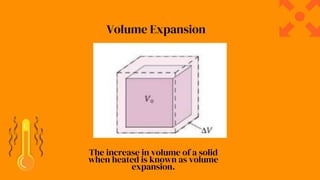
The increase in volume of a solid
when heated is known as volume
expansion.
Volume Expansion
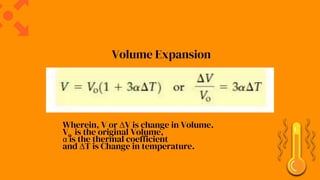
Wherein, V or ∆V is change in Volume.
Vo is the original Volume,
α is the thermal coefficient
and ∆T is Change in temperature.
Volume Expansion
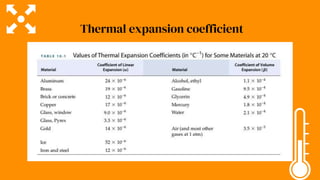
Thermal expansion coefficient
Linear expansion, Area expansion and Volume expansion
Sample problems.
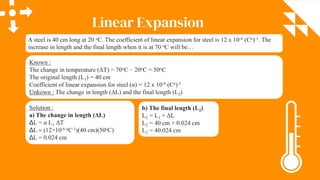
Linear Expansion
A steel is 40 cm long at 20 oC. The coefficient of linear expansion for steel is 12 x 10-6 (Co)-1. The
increase in length and the final length when it is at 70 oC will be…
Known :
The change in temperature (ΔT) = 70oC – 20oC = 50oC
The original length (L1) = 40 cm
Coefficient of linear expansion for steel (α) = 12 x 10-6 (Co)-1
Unkown : The change in length (ΔL) and the final length (L2)
Solution :
a) The change in length (ΔL)
ΔL = α L1 ΔT
ΔL = (12×10-6 oC-1)(40 cm)(50oC)
ΔL = 0.024 cm
b) The final length (L2)
L2 = L1 + ΔL
L2 = 40 cm + 0.024 cm
L2 = 40.024 cm
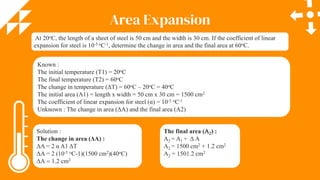
Area Expansion
At 20oC, the length of a sheet of steel is 50 cm and the width is 30 cm. If the coefficient of linear
expansion for steel is 10-5 oC-1, determine the change in area and the final area at 60oC.
Known :
The initial temperature (T1) = 20oC
The final temperature (T2) = 60oC
The change in temperature (ΔT) = 60oC – 20oC = 40oC
The initial area (A1) = length x width = 50 cm x 30 cm = 1500 cm2
The coefficient of linear expansion for steel (α) = 10-5 oC-1
Unknown : The change in area (ΔA) and the final area (A2)
Solution :
The change in area (ΔA) :
ΔA = 2 α A1 ΔT
ΔA = 2 (10-5 oC-1)(1500 cm2)(40oC)
ΔA = 1.2 cm2
The final area (A2) :
A2 = A1 + Δ A
A2 = 1500 cm2 + 1.2 cm2
A2 = 1501.2 cm2
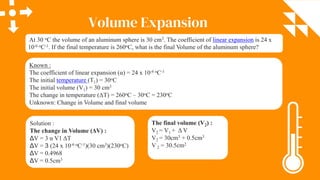
Volume Expansion
At 30 oC the volume of an aluminum sphere is 30 cm3. The coefficient of linear expansion is 24 x
10-6 oC-1. If the final temperature is 260oC, what is the final Volume of the aluminum sphere?
Known :
The coefficient of linear expansion (α) = 24 x 10-6 oC-1
The initial temperature (T1) = 30oC
The initial volume (V1) = 30 cm3
The change in temperature (ΔT) = 260oC – 30oC = 230oC
Unknown: Change in Volume and final volume
Solution :
The change in Volume (ΔV) :
ΔV = 3 α V1 ΔT
ΔV = 3 (24 x 10-6 oC-1)(30 cm3)(230oC)
ΔV = 0.4968
ΔV = 0.5cm3
The final volume (V2) :
V2 = V1 + Δ V
V2 = 30cm3 + 0.5cm3
V 2 = 30.5cm2
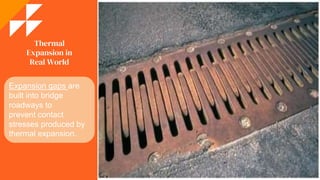
Thermal
Expansion in
Real World
Expansion gaps are
built into bridge
roadways to
prevent contact
stresses produced by
thermal expansion.
THANK YOU!!!!

Thermal expansion physics therdmodynamics pptx

  • 1.
  • 2.
    Thermal Expansion Thermal expansionis the phenomenon observed in solids, liquids, and gases. In this process, an object or body expands on the application of heat (change in temperature). Thermal expansion defines the tendency of an object to change its dimension either in length, density, area, or volume due to heat.
  • 3.
    What causes thermalexpansion With increased temperature, the atoms vibrate back and forth over greater distances. With wider vibrations in all dimensions, the solid expands as a whole.
  • 4.
    This is atomswhen heated
  • 5.
    This is atomswhen heated
  • 6.
    This is atomswhen heated
  • 7.
    Thermal Expansion: In3 ways The change in one dimension of a solid (length, width, or thickness) is called linear expansion. Linear Expansion The increase in volume of a solid when heated is known as volume expansion. Or a three-dimensional material expansion. Volume Expansion Area Expansion is the growth of an object's surface, or stretching its area alone. An area expansion is a two- dimensional material expansion. The temperature of the thing determines how much it expands. Area Expansion
  • 8.
    The change inone dimension of a solid (length, width, or thickness) is called linear expansion. Linear Expansion
  • 9.
    Wherein, L or∆L is change in length. Lo is the original length, α is the thermal coefficient and ∆T is Change in temperature. Linear Expansion
  • 10.
    Area Expansion isthe growth of an object's surface, or stretching its area alone. An area expansion is a two-dimensional material expansion. The temperature of the thing determines how much it expands. Area Expansion
  • 11.
    Wherein, A or∆A is change in area. Ao is the original Area, α is the thermal coefficient and ∆T is Change in temperature. Area Expansion
  • 12.
    The increase involume of a solid when heated is known as volume expansion. Volume Expansion
  • 13.
    Wherein, V or∆V is change in Volume. Vo is the original Volume, α is the thermal coefficient and ∆T is Change in temperature. Volume Expansion
  • 14.
  • 15.
    Linear expansion, Areaexpansion and Volume expansion Sample problems.
  • 16.
    Linear Expansion A steelis 40 cm long at 20 oC. The coefficient of linear expansion for steel is 12 x 10-6 (Co)-1. The increase in length and the final length when it is at 70 oC will be… Known : The change in temperature (ΔT) = 70oC – 20oC = 50oC The original length (L1) = 40 cm Coefficient of linear expansion for steel (α) = 12 x 10-6 (Co)-1 Unkown : The change in length (ΔL) and the final length (L2) Solution : a) The change in length (ΔL) ΔL = α L1 ΔT ΔL = (12×10-6 oC-1)(40 cm)(50oC) ΔL = 0.024 cm b) The final length (L2) L2 = L1 + ΔL L2 = 40 cm + 0.024 cm L2 = 40.024 cm
  • 17.
    Area Expansion At 20oC,the length of a sheet of steel is 50 cm and the width is 30 cm. If the coefficient of linear expansion for steel is 10-5 oC-1, determine the change in area and the final area at 60oC. Known : The initial temperature (T1) = 20oC The final temperature (T2) = 60oC The change in temperature (ΔT) = 60oC – 20oC = 40oC The initial area (A1) = length x width = 50 cm x 30 cm = 1500 cm2 The coefficient of linear expansion for steel (α) = 10-5 oC-1 Unknown : The change in area (ΔA) and the final area (A2) Solution : The change in area (ΔA) : ΔA = 2 α A1 ΔT ΔA = 2 (10-5 oC-1)(1500 cm2)(40oC) ΔA = 1.2 cm2 The final area (A2) : A2 = A1 + Δ A A2 = 1500 cm2 + 1.2 cm2 A2 = 1501.2 cm2
  • 18.
    Volume Expansion At 30oC the volume of an aluminum sphere is 30 cm3. The coefficient of linear expansion is 24 x 10-6 oC-1. If the final temperature is 260oC, what is the final Volume of the aluminum sphere? Known : The coefficient of linear expansion (α) = 24 x 10-6 oC-1 The initial temperature (T1) = 30oC The initial volume (V1) = 30 cm3 The change in temperature (ΔT) = 260oC – 30oC = 230oC Unknown: Change in Volume and final volume Solution : The change in Volume (ΔV) : ΔV = 3 α V1 ΔT ΔV = 3 (24 x 10-6 oC-1)(30 cm3)(230oC) ΔV = 0.4968 ΔV = 0.5cm3 The final volume (V2) : V2 = V1 + Δ V V2 = 30cm3 + 0.5cm3 V 2 = 30.5cm2
  • 19.
    Thermal Expansion in Real World Expansiongaps are built into bridge roadways to prevent contact stresses produced by thermal expansion.
  • 20.