Parts of the skeletal system:
• Bones (skeleton)
• Joints
• Cartilages
• Ligaments (bone to bone)(tendon=bone to
muscle)

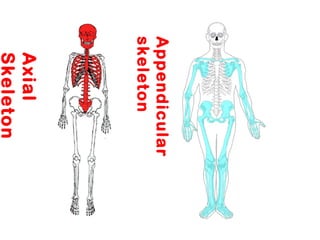
Divided into two sections
• Axial skeleton- skull, spinal column, and rib
cage
• Appendicular skeleton – limbs and girdle
Copyright © 2003 Pearson Education, Inc. publishing as Benjamin Cummings
Functions of Bones
• Support of the body
• Protection of soft organs
• Movement due to attached skeletal
muscles
• Storage of minerals and fats
• Blood cell formation
Copyright © 2003 Pearson Education, Inc. publishing as Benjamin Cummings
Bones of the Human Body
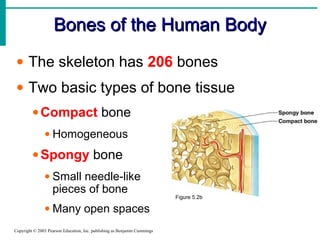
• The skeleton has 206 bones
• Two basic types of bone tissue
• Compact bone
• Homogeneous

• Spongy bone
• Small needle-like
pieces of bone
• Many open spaces
Copyright © 2003 Pearson Education, Inc. publishing as Benjamin Cummings

Figure 5.2b
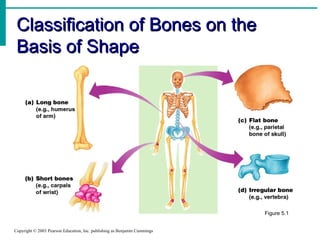
Bones are classified by their
shape:
1.Long- bones are longer than
they are wide (arms, legs)
2.Short- usually square in
shape, cube like (wrist, ankle)
3.Flat- flat , curved (skull,
Sternum)
4.Irregular- odd shapes
(vertebrae, pelvis)
Classification of Bones on the
Basis of Shape

Figure 5.1
Copyright © 2003 Pearson Education, Inc. publishing as Benjamin Cummings
Types of Bone Cells
• Osteocytes
• Mature bone cells

• Osteoblasts
• Bone-forming cells

• Osteoclasts
• Bone-destroying cells
• Break down bone matrix for remodeling and
release of calcium

• Bone remodeling is a process by both
osteoblasts and osteoclasts
Copyright © 2003 Pearson Education, Inc. publishing as Benjamin Cummings
Changes in the Human Skeleton
• In embryos, the skeleton is primarily
hyaline cartilage
• During development, much of this cartilage
is replaced by bone
• Cartilage remains in isolated areas
• Bridge of the nose
• Parts of ribs
• Joints
Copyright © 2003 Pearson Education, Inc. publishing as Benjamin Cummings
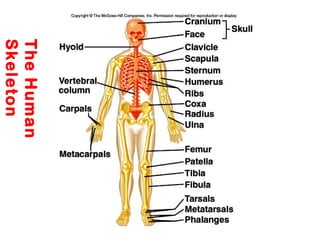
The Human
Skeleton
Appendicular
skeleton

Axial
Skeleton
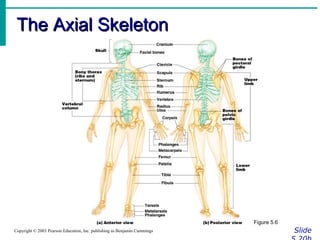
The Axial Skeleton
• Forms the longitudinal part of the body
• Divided into three parts
• Skull
• Vertebral Column
• Rib Cage

• Supports and protects organs of
head, neck and trunk.
Copyright © 2003 Pearson Education, Inc. publishing as Benjamin Cummings
The Axial Skeleton

Figure 5.6
Copyright © 2003 Pearson Education, Inc. publishing as Benjamin Cummings

Slide
Appendicular skeleton includes
bones of limbs and bones that
anchor them to the axial skeleton.
Appendicular skeleton:
pectoral girdle (clavicle, scapula)
upper limbs (arms)
pelvic girdle (sacrum, coccyx)
lower limbs (legs)
Articulation- where joints meet,
connect, and are formed.
Joints
A joint, or articulation, is the place where
two bones come together.
• Fibrous- Immovable:connect bones, no
movement. (skull and pelvis).
• Cartilaginous- slightly movable, bones are
attached by cartilage, a little movement
(spine or ribs).
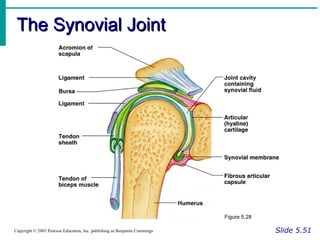
• Synovial- freely movable, much more
movement than cartilaginous joints. Cavities
between bones are filled with synovial fluid.
This fluid helps lubricate and protect the
bones.
The Synovial Joint

Figure 5.28
Copyright © 2003 Pearson Education, Inc. publishing as Benjamin Cummings

Slide 5.51
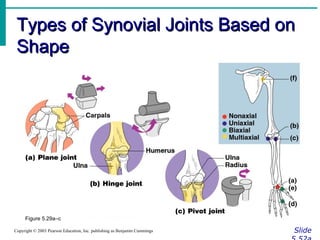
Types of Synovial Joints Based on
Shape

Figure 5.29a–c
Copyright © 2003 Pearson Education, Inc. publishing as Benjamin Cummings

Slide
Types of Joints based
on Movement
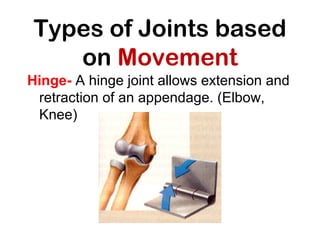
Hinge- A hinge joint allows extension and
retraction of an appendage. (Elbow,
Knee)
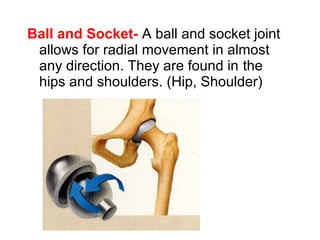
Ball and Socket- A ball and socket joint
allows for radial movement in almost
any direction. They are found in the
hips and shoulders. (Hip, Shoulder)
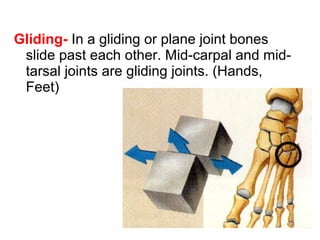
Gliding- In a gliding or plane joint bones
slide past each other. Mid-carpal and midtarsal joints are gliding joints. (Hands,
Feet)
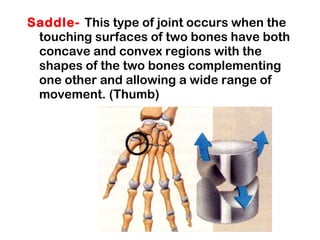
Saddle- This type of joint occurs when the
touching surfaces of two bones have both
concave and convex regions with the
shapes of the two bones complementing
one other and allowing a wide range of
movement. (Thumb)

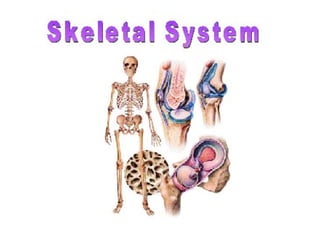
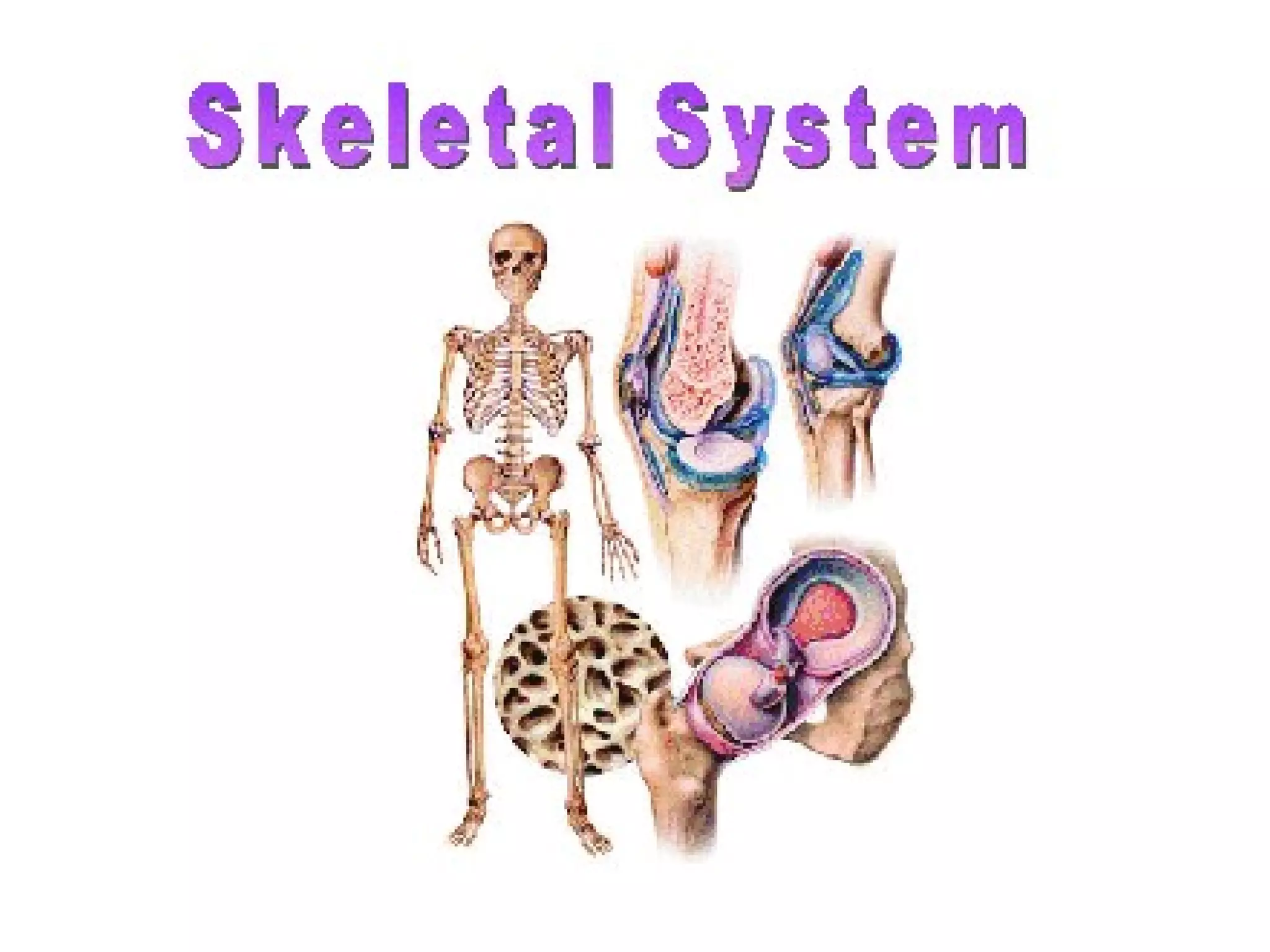
Skeletal System

  • 2.
    Parts of theskeletal system: • Bones (skeleton) • Joints • Cartilages • Ligaments (bone to bone)(tendon=bone to muscle) Divided into two sections • Axial skeleton- skull, spinal column, and rib cage • Appendicular skeleton – limbs and girdle Copyright © 2003 Pearson Education, Inc. publishing as Benjamin Cummings
  • 3.
    Functions of Bones •Support of the body • Protection of soft organs • Movement due to attached skeletal muscles • Storage of minerals and fats • Blood cell formation Copyright © 2003 Pearson Education, Inc. publishing as Benjamin Cummings
  • 4.
    Bones of theHuman Body • The skeleton has 206 bones • Two basic types of bone tissue • Compact bone • Homogeneous • Spongy bone • Small needle-like pieces of bone • Many open spaces Copyright © 2003 Pearson Education, Inc. publishing as Benjamin Cummings Figure 5.2b
  • 5.
    Bones are classifiedby their shape: 1.Long- bones are longer than they are wide (arms, legs) 2.Short- usually square in shape, cube like (wrist, ankle) 3.Flat- flat , curved (skull, Sternum) 4.Irregular- odd shapes (vertebrae, pelvis)
  • 6.
    Classification of Boneson the Basis of Shape Figure 5.1 Copyright © 2003 Pearson Education, Inc. publishing as Benjamin Cummings
  • 7.
    Types of BoneCells • Osteocytes • Mature bone cells • Osteoblasts • Bone-forming cells • Osteoclasts • Bone-destroying cells • Break down bone matrix for remodeling and release of calcium • Bone remodeling is a process by both osteoblasts and osteoclasts Copyright © 2003 Pearson Education, Inc. publishing as Benjamin Cummings
  • 8.
    Changes in theHuman Skeleton • In embryos, the skeleton is primarily hyaline cartilage • During development, much of this cartilage is replaced by bone • Cartilage remains in isolated areas • Bridge of the nose • Parts of ribs • Joints Copyright © 2003 Pearson Education, Inc. publishing as Benjamin Cummings
  • 9.
  • 10.
  • 11.
    The Axial Skeleton •Forms the longitudinal part of the body • Divided into three parts • Skull • Vertebral Column • Rib Cage • Supports and protects organs of head, neck and trunk. Copyright © 2003 Pearson Education, Inc. publishing as Benjamin Cummings
  • 13.
    The Axial Skeleton Figure5.6 Copyright © 2003 Pearson Education, Inc. publishing as Benjamin Cummings Slide
  • 14.
    Appendicular skeleton includes bonesof limbs and bones that anchor them to the axial skeleton. Appendicular skeleton: pectoral girdle (clavicle, scapula) upper limbs (arms) pelvic girdle (sacrum, coccyx) lower limbs (legs) Articulation- where joints meet, connect, and are formed.
  • 15.
    Joints A joint, orarticulation, is the place where two bones come together. • Fibrous- Immovable:connect bones, no movement. (skull and pelvis). • Cartilaginous- slightly movable, bones are attached by cartilage, a little movement (spine or ribs). • Synovial- freely movable, much more movement than cartilaginous joints. Cavities between bones are filled with synovial fluid. This fluid helps lubricate and protect the bones.
  • 16.
    The Synovial Joint Figure5.28 Copyright © 2003 Pearson Education, Inc. publishing as Benjamin Cummings Slide 5.51
  • 17.
    Types of SynovialJoints Based on Shape Figure 5.29a–c Copyright © 2003 Pearson Education, Inc. publishing as Benjamin Cummings Slide
  • 18.
    Types of Jointsbased on Movement Hinge- A hinge joint allows extension and retraction of an appendage. (Elbow, Knee)
  • 19.
    Ball and Socket-A ball and socket joint allows for radial movement in almost any direction. They are found in the hips and shoulders. (Hip, Shoulder)
  • 20.
    Gliding- In agliding or plane joint bones slide past each other. Mid-carpal and midtarsal joints are gliding joints. (Hands, Feet)
  • 21.
    Saddle- This typeof joint occurs when the touching surfaces of two bones have both concave and convex regions with the shapes of the two bones complementing one other and allowing a wide range of movement. (Thumb)