ELAINE N. MARIEB
EIGHTH EDITION
5
Copyright © 2006 Pearson Education, Inc., publishing as Benjamin Cummings
PowerPoint® Lecture Slide Presentation by Jerry L. Cook, Sam Houston University
ESSENTIALS
OF HUMAN
ANATOMY
& PHYSIOLOGY
PART A
The Skeletal System
Reporter: Ronald L. Rubi
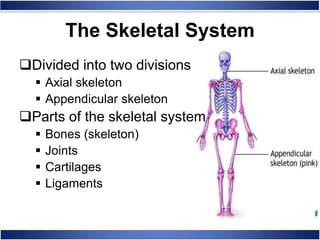
Divided into two divisions
 Axial skeleton
 Appendicular skeleton
Parts of the skeletal system
 Bones (skeleton)
 Joints
 Cartilages
 Ligaments
The Skeletal System
Functions of the Bones
• Support of the body
• Protection of soft organs
• Movement due to attached skeletal
muscles
• Storage of minerals and fats
• Blood cell formation
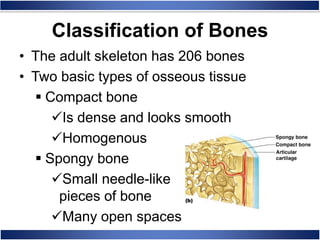
• The adult skeleton has 206 bones
• Two basic types of osseous tissue
 Compact bone
Is dense and looks smooth
Homogenous
 Spongy bone
Small needle-like
pieces of bone
Many open spaces
Classification of Bones
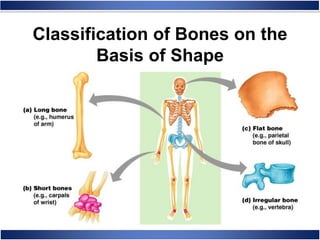
Classification of Bones on the
Basis of Shape
Long bones
 Typically longer than wide
 Have a shaft with heads at both ends
 Contain mostly compact bone
• Examples: Femur, humerus
Classification of Bones
Short bones
 Generally cube-shape
 Contain mostly spongy bone
• Examples: Carpals, tarsals
Classification of Bones
Flat bones
 Thin and flattened
 Usually curved
 Thin layers of compact bone around a
layer of spongy bone
• Examples: Skull, ribs, sternum
Classification of Bones
Irregular bones
 Irregular shape
 Do not fit into other bone classification
categories
• Example: Vertebrae and hip
Classification of Bones
Gross Anatomy of a Long Bone
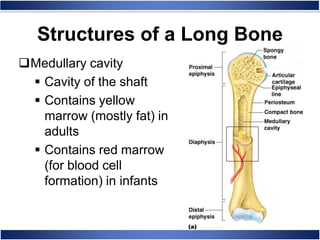
Diaphysis
 Shaft
 Composed of
compact bone
Epiphysis
 Ends of the bone
 Composed mostly of
spongy bone
Structures of a Long Bone
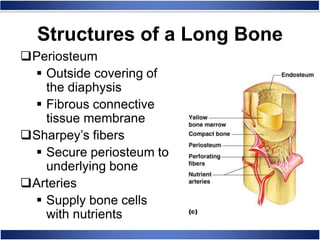
Periosteum
 Outside covering of
the diaphysis
 Fibrous connective
tissue membrane
Sharpey’s fibers
 Secure periosteum to
underlying bone
Arteries
 Supply bone cells
with nutrients
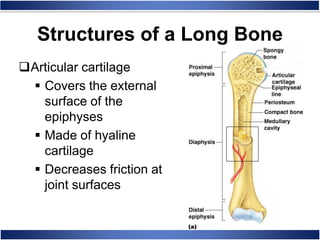
Articular cartilage
 Covers the external
surface of the
epiphyses
 Made of hyaline
cartilage
 Decreases friction at
joint surfaces
Structures of a Long Bone
Medullary cavity
 Cavity of the shaft
 Contains yellow
marrow (mostly fat) in
adults
 Contains red marrow
(for blood cell
formation) in infants
Structures of a Long Bone
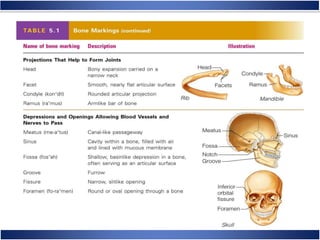
Bone Markings
• Surface features of bones
• Sites of attachments for muscles, tendons,
and ligaments
• Passages for nerves and blood vessels
• Categories of bone markings
– Projections and processes – grow out
from the bone surface
– Depressions or cavities – indentations
• Osteon (Haversian System)
– A unit of bone
• Central (Haversian) canal
– Opening in the center of an osteon
– Carries blood vessels and nerves
• Perforating (Volkman’s) canal
– Canal perpendicular to the central canal
– Carries blood vessels and nerves
Microscopic Anatomy of Bone
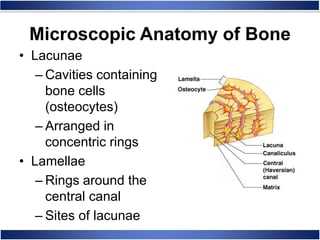
• Lacunae
– Cavities containing
bone cells
(osteocytes)
– Arranged in
concentric rings
• Lamellae
– Rings around the
central canal
– Sites of lacunae
Microscopic Anatomy of Bone
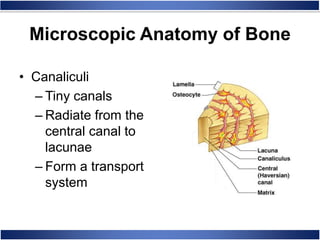
• Canaliculi
– Tiny canals
– Radiate from the
central canal to
lacunae
– Form a transport
system
Bone Formation, Growth and
Remodeling
• In embryos, the skeleton is primarily hyaline
cartilage
• During development, much of this cartilage is
replaced by bone
• Cartilage remains in isolated areas
– Bridge of the nose
– Parts of ribs
– Joints
Bone Formation, Growth and
Remodeling
• Ossification
– is the process of bone formation
• It involves two major phases:
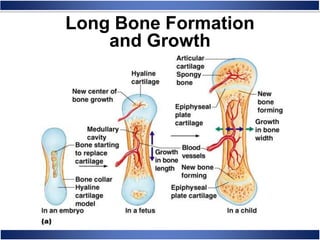
– First, the hyaline cartilage model is completely
covered with bone matrix by bone forming
cells called osteoblasts.
– Then, the enclosed hyaline cartilage model is
digested away, opening up a medullar cavity
within the newly formed bone.
Long Bone Formation
and Growth
How do bones widen?
• Osteoblasts in the periosteum add bone to the
external face of the diaphysis as osteoclasts
in the endosteum remove bone from the inner
face of the diaphysis wall.
• Appositional growth
- The process by which the bones increase
in diameter.
Formation and Growth of
Long Bones
• Bones are remodelled continually in
response changes in two factors:
Calcium levels in the blood
The pull of gravity and muscles on the
skeleton.
• Osteocytes
– Mature bone cells
• Osteoblasts
– Bone-forming cells
• Osteoclasts
– Bone-destroying cells
– Break down bone matrix for remodeling and
release of calcium
• Bone remodeling is a process by both
osteoblasts and osteoclasts
Types of Bone Cells
• Is essential if bones are retain normal
proportions and strength during long-bone
growth as the body increases in size and
weight.
• Bones become thicker and form large
projections to increase their strength in
areas where bulky muscles are attached.
Bone Remodeling
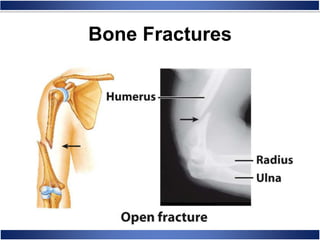
• A break in a bone
• Types of bone fractures
 Closed (simple) fracture- break that does
not penetrate the skin.
 Open (compound) fracture- broken bone
penetrates through the skin
• Bone fractures are treated by reduction or
immobilization
 Realignment of the bone
Bone Fractures
Bone Fractures
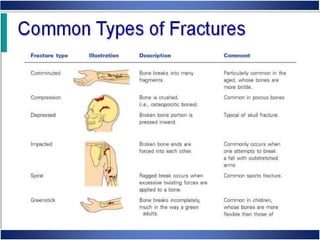
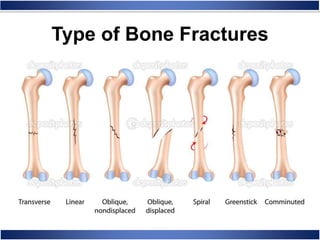
Type of Bone Fractures
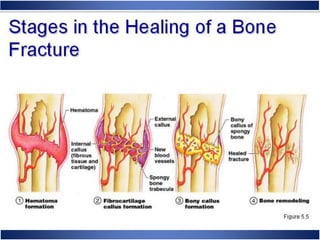
 Hematoma (blood-filled swelling) is
formed.
 Break is splinted by fibrocartilage to form
a callus.
 Fibrocartilage callus is replaced by a
bony callus
 Bony callus is remodeled to form a
permanent patch.
Repair of Bone Fractures
3. The bony callus forms
 As the more osteoblasts and osteoclasts
migrate into the area and multiply, the
fibrocartilage callus is gradually replaced by
one made of spongy bone the bony callus.
4. Bone remodeling occurs
 Over the next few weeks or months, the bony
callus is remodeled in response to the
mechanical stressed placed on it and it forms
a strong permanent “patch” at the fracture
sight.
Axial Skeleton
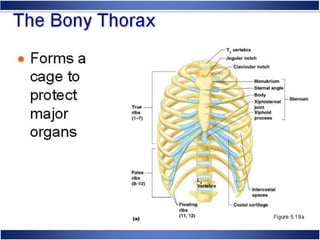
 Forms the longitudinal axis of the body
 Divided into three parts:
 Skull
 Vertebral column
 Bony thorax
The Skull
 Two sets of bones
 Cranium
 Facial bones
 Bones are joined by sutures
 Only the mandible is attached by a freely
movable joint.
Cranium
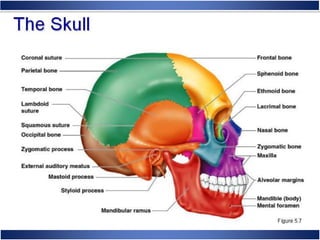
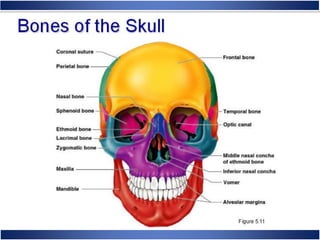
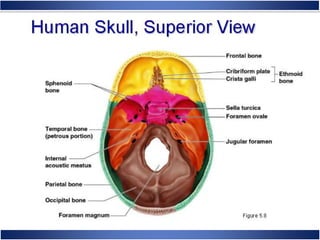
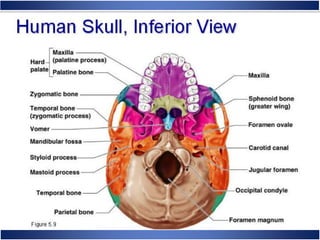
 The boxlike cranium is composed of eight
large flat bones.
 Frontal Bone- forms the forehead, the bony
projections under the eyebrows and the
superior part of each eye’s orbit.
 Parietal Bones- form most of the superior
and lateral walls of the cranium. They meet
in the midline of the skull at the sagittal
suture and form the coronal suture,
where they meet the frontal bone.
Cranium
 Temporal Bone- it lies inferior to the parietal
bones; they join them at the squamous
sutures.
 Occipital Bone- the most posterior part of the
cranium. It forms the floor and black wall of
the skull.
 Sphenoid Bone- the butterfly-shaped
sphenoid bone spans the width of the skull
and forms part of the floor of the cranial cavity.
Cranium
 Ethmoid Bone- is very irregularly shaped and
lies anterior to the sphenoid. It forms the roof
of the nasal cavity and part of the medial walls
of the orbits.
Skeletal System Anatomy and Physiology

Skeletal System Anatomy and Physiology

  • 1.
    ELAINE N. MARIEB EIGHTHEDITION 5 Copyright © 2006 Pearson Education, Inc., publishing as Benjamin Cummings PowerPoint® Lecture Slide Presentation by Jerry L. Cook, Sam Houston University ESSENTIALS OF HUMAN ANATOMY & PHYSIOLOGY PART A The Skeletal System Reporter: Ronald L. Rubi
  • 2.
    Divided into twodivisions  Axial skeleton  Appendicular skeleton Parts of the skeletal system  Bones (skeleton)  Joints  Cartilages  Ligaments The Skeletal System
  • 3.
    Functions of theBones • Support of the body • Protection of soft organs • Movement due to attached skeletal muscles • Storage of minerals and fats • Blood cell formation
  • 4.
    • The adultskeleton has 206 bones • Two basic types of osseous tissue  Compact bone Is dense and looks smooth Homogenous  Spongy bone Small needle-like pieces of bone Many open spaces Classification of Bones
  • 5.
    Classification of Boneson the Basis of Shape
  • 6.
    Long bones  Typicallylonger than wide  Have a shaft with heads at both ends  Contain mostly compact bone • Examples: Femur, humerus Classification of Bones
  • 7.
    Short bones  Generallycube-shape  Contain mostly spongy bone • Examples: Carpals, tarsals Classification of Bones
  • 8.
    Flat bones  Thinand flattened  Usually curved  Thin layers of compact bone around a layer of spongy bone • Examples: Skull, ribs, sternum Classification of Bones
  • 9.
    Irregular bones  Irregularshape  Do not fit into other bone classification categories • Example: Vertebrae and hip Classification of Bones
  • 10.
    Gross Anatomy ofa Long Bone Diaphysis  Shaft  Composed of compact bone Epiphysis  Ends of the bone  Composed mostly of spongy bone
  • 11.
    Structures of aLong Bone Periosteum  Outside covering of the diaphysis  Fibrous connective tissue membrane Sharpey’s fibers  Secure periosteum to underlying bone Arteries  Supply bone cells with nutrients
  • 12.
    Articular cartilage  Coversthe external surface of the epiphyses  Made of hyaline cartilage  Decreases friction at joint surfaces Structures of a Long Bone
  • 13.
    Medullary cavity  Cavityof the shaft  Contains yellow marrow (mostly fat) in adults  Contains red marrow (for blood cell formation) in infants Structures of a Long Bone
  • 14.
    Bone Markings • Surfacefeatures of bones • Sites of attachments for muscles, tendons, and ligaments • Passages for nerves and blood vessels • Categories of bone markings – Projections and processes – grow out from the bone surface – Depressions or cavities – indentations
  • 17.
    • Osteon (HaversianSystem) – A unit of bone • Central (Haversian) canal – Opening in the center of an osteon – Carries blood vessels and nerves • Perforating (Volkman’s) canal – Canal perpendicular to the central canal – Carries blood vessels and nerves Microscopic Anatomy of Bone
  • 18.
  • 19.
    Microscopic Anatomy ofBone • Lacunae – Cavities containing bone cells (osteocytes) – Arranged in concentric rings • Lamellae – Rings around the central canal – Sites of lacunae
  • 20.
    Microscopic Anatomy ofBone • Canaliculi – Tiny canals – Radiate from the central canal to lacunae – Form a transport system
  • 21.
    Bone Formation, Growthand Remodeling • In embryos, the skeleton is primarily hyaline cartilage • During development, much of this cartilage is replaced by bone • Cartilage remains in isolated areas – Bridge of the nose – Parts of ribs – Joints
  • 22.
    Bone Formation, Growthand Remodeling • Ossification – is the process of bone formation • It involves two major phases: – First, the hyaline cartilage model is completely covered with bone matrix by bone forming cells called osteoblasts. – Then, the enclosed hyaline cartilage model is digested away, opening up a medullar cavity within the newly formed bone.
  • 23.
  • 24.
    How do boneswiden? • Osteoblasts in the periosteum add bone to the external face of the diaphysis as osteoclasts in the endosteum remove bone from the inner face of the diaphysis wall. • Appositional growth - The process by which the bones increase in diameter.
  • 25.
    Formation and Growthof Long Bones
  • 26.
    • Bones areremodelled continually in response changes in two factors: Calcium levels in the blood The pull of gravity and muscles on the skeleton.
  • 27.
    • Osteocytes – Maturebone cells • Osteoblasts – Bone-forming cells • Osteoclasts – Bone-destroying cells – Break down bone matrix for remodeling and release of calcium • Bone remodeling is a process by both osteoblasts and osteoclasts Types of Bone Cells
  • 28.
    • Is essentialif bones are retain normal proportions and strength during long-bone growth as the body increases in size and weight. • Bones become thicker and form large projections to increase their strength in areas where bulky muscles are attached. Bone Remodeling
  • 29.
    • A breakin a bone • Types of bone fractures  Closed (simple) fracture- break that does not penetrate the skin.  Open (compound) fracture- broken bone penetrates through the skin • Bone fractures are treated by reduction or immobilization  Realignment of the bone Bone Fractures
  • 30.
  • 32.
    Type of BoneFractures
  • 33.
     Hematoma (blood-filledswelling) is formed.  Break is splinted by fibrocartilage to form a callus.  Fibrocartilage callus is replaced by a bony callus  Bony callus is remodeled to form a permanent patch. Repair of Bone Fractures
  • 34.
    3. The bonycallus forms  As the more osteoblasts and osteoclasts migrate into the area and multiply, the fibrocartilage callus is gradually replaced by one made of spongy bone the bony callus. 4. Bone remodeling occurs  Over the next few weeks or months, the bony callus is remodeled in response to the mechanical stressed placed on it and it forms a strong permanent “patch” at the fracture sight.
  • 36.
    Axial Skeleton  Formsthe longitudinal axis of the body  Divided into three parts:  Skull  Vertebral column  Bony thorax
  • 37.
    The Skull  Twosets of bones  Cranium  Facial bones  Bones are joined by sutures  Only the mandible is attached by a freely movable joint.
  • 38.
    Cranium  The boxlikecranium is composed of eight large flat bones.  Frontal Bone- forms the forehead, the bony projections under the eyebrows and the superior part of each eye’s orbit.  Parietal Bones- form most of the superior and lateral walls of the cranium. They meet in the midline of the skull at the sagittal suture and form the coronal suture, where they meet the frontal bone.
  • 39.
    Cranium  Temporal Bone-it lies inferior to the parietal bones; they join them at the squamous sutures.  Occipital Bone- the most posterior part of the cranium. It forms the floor and black wall of the skull.  Sphenoid Bone- the butterfly-shaped sphenoid bone spans the width of the skull and forms part of the floor of the cranial cavity.
  • 40.
    Cranium  Ethmoid Bone-is very irregularly shaped and lies anterior to the sphenoid. It forms the roof of the nasal cavity and part of the medial walls of the orbits.