SKELETAL SYSTEMS
Two Major Sections of the Skeleton
2

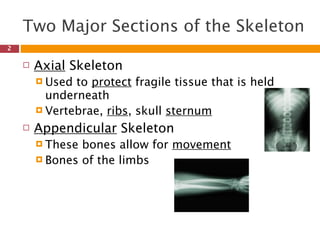
       Axial Skeleton
         Used to protect fragile tissue that is held
          underneath
         Vertebrae, ribs, skull sternum

       Appendicular Skeleton
         These bones allow for movement
         Bones of the limbs
Variations of Bones
3

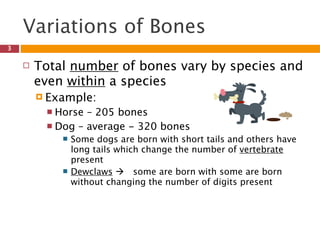
       Total number of bones vary by species and
        even within a species
         Example:
          Horse – 205 bones
          Dog – average - 320 bones
               Some dogs are born with short tails and others have
                long tails which change the number of vertebrate
                present
               Dewclaws  some are born with some are born
                without changing the number of digits present
Bones of the Axial Skeleton
4

       Cranium
         Made   mostly of flat bones (50 bones in a dog)
           Shape   varies between species and breed
         Used for protection of the brain and other
          sense organs (taste, smell, hearing, sight,)
         Lower jaw – mandible, is moveable allowing
          an animal to obtain and chew food
Bones of the Axial Skeleton
5

       The Vertebral Column
         Extends  the length of the body from the skull
         Protects the spinal cord and allows for
          movement
         Anatomy of the Vertebral Disk
           Covered  with bony arch - protects spinal cord
           Intervertebral disks can be found between
            vertebrae. add cushion between the disks (not
            found between C1 and C2)
Bones of the Axial Skeleton
6

       The Vertebral Column
         Broken   down into anatomical divisions
          Cervical(7)
          Thoratic (13)
          Lumbar (7)
          Sacrum (3)
          Coccygeal (14-23)
Bones of the Axial Skeleton
7

       The Vertebral Column
          Cervical   Vertebrae – neck
               Mammals have 7 Cervical Vertebrae
                  C1 – Atlas – allows for up and down movement of
                   head
                  C2 – Axis – allows for side to side movement

          Thoracic   Vertebrae – have attached ribs
               Help to protect the heart and lungs, allow for
                respiration
Bones of the Axial Skeleton
8

       The Vertebral Column
          Lumbar  Vertebrae – lower back between thoracic
           vertebra and pelvis
               Flexes and extends as an animal moves
               Provide support for organs in the abdomen
          Sacrum    Vertebrae
               Fuse with the pelvis allowing support of the hind end
                of the animal
Bones of the Axial Skeleton
9

       The Vertebral Column
          Coccygeal    Vertebrae – Tail
               Vary by species and within the species
               Dogs typically have 20 Coccygeal vertebrae but can
                range from 6-23!
Bones of the Axial Skeleton
10


                         10/13/10
Create it!
11

        Congrats…you have graduated from the
         school of vertebral engineering! Lets put
         that education to good use!
Bone of the Axial Skeleton
12

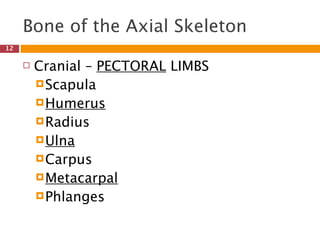
        Cranial – PECTORAL LIMBS
          Scapula
          Humerus
          Radius
          Ulna
          Carpus
          Metacarpal
          Phlanges
Bones of the Appendicular
13

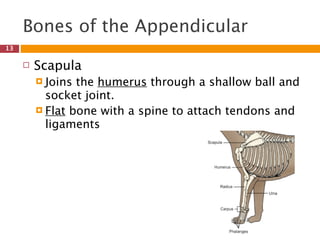
        Scapula
          Joins the humerus through a shallow ball and
           socket joint.
          Flat bone with a spine to attach tendons and
           ligaments
Bones of the Appendicular
14

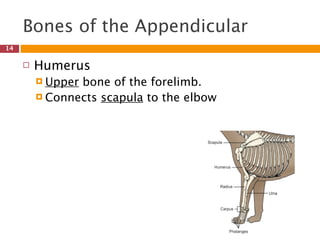
        Humerus
          Upperbone of the forelimb.
          Connects scapula to the elbow
Bones of the Appendicular
15

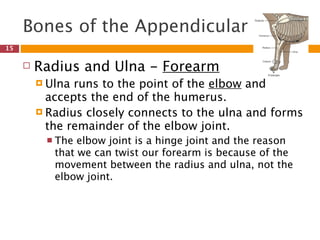
        Radius and Ulna - Forearm
          Ulna runs to the point of the elbow and
           accepts the end of the humerus.
          Radius closely connects to the ulna and forms
           the remainder of the elbow joint.
           The  elbow joint is a hinge joint and the reason
            that we can twist our forearm is because of the
            movement between the radius and ulna, not the
            elbow joint.
Bones of the Appendicular
16

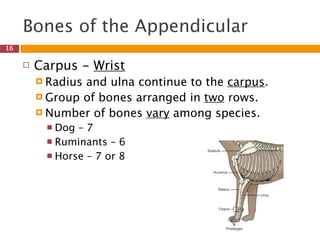
        Carpus - Wrist
          Radiusand ulna continue to the carpus.
          Group of bones arranged in two rows.
          Number of bones vary among species.
           Dog –7
           Ruminants – 6
           Horse – 7 or 8
Bones of the Appendicular
17

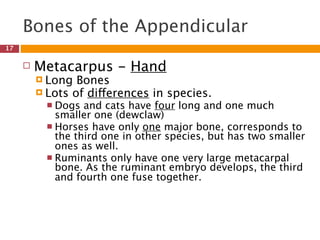
        Metacarpus - Hand
          Long  Bones
          Lots of differences in species.
            Dogs  and cats have four long and one much
             smaller one (dewclaw)
            Horses have only one major bone, corresponds to
             the third one in other species, but has two smaller
             ones as well.
            Ruminants only have one very large metacarpal
             bone. As the ruminant embryo develops, the third
             and fourth one fuse together.
Bones of the Appendicular
18

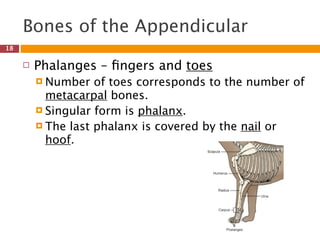
        Phalanges – fingers and toes
          Number   of toes corresponds to the number of
           metacarpal bones.
          Singular form is phalanx.
          The last phalanx is covered by the nail or
           hoof.
Bones of the Appendicular
19

        Caudal End – PELVIC LIMBS:
          Pelvis


          Femur
          Tibia
          Fibula
          Tarsus
          Metatarsus
          Phalanges
Bones of the Appendicular
20

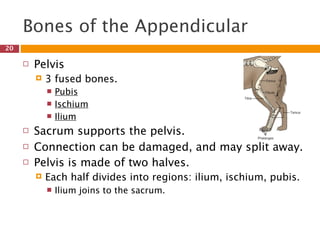
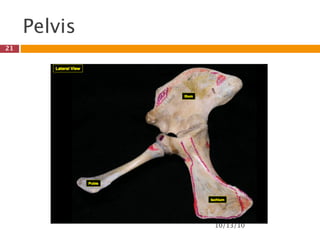
        Pelvis
            3 fused bones.
                Pubis
                Ischium
                Ilium
        Sacrum supports the pelvis.
        Connection can be damaged, and may split away.
        Pelvis is made of two halves.
            Each half divides into regions: ilium, ischium, pubis.
                Ilium joins to the sacrum.
Pelvis
21


              10/13/10
Bones of the Appendicular
22

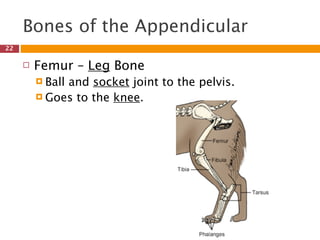
        Femur – Leg Bone
          Ball
              and socket joint to the pelvis.
          Goes to the knee.
Bones of the Appendicular
23

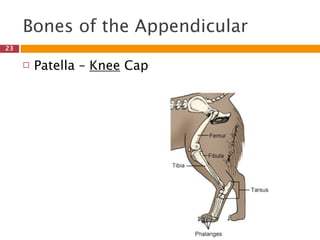
        Patella – Knee Cap
Bones of the Appendicular
24

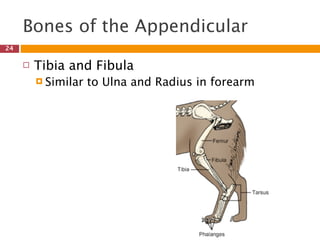
        Tibia and Fibula
          Similar   to Ulna and Radius in forearm
Bones of the Appendicular
25

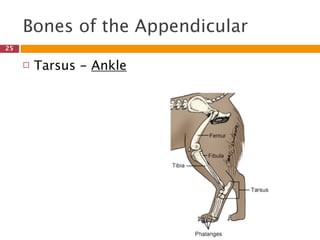
        Tarsus - Ankle
Bones of the Appendicular
26

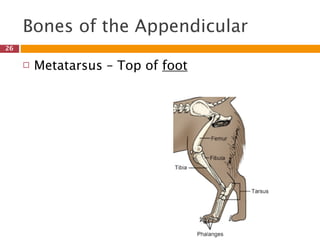
        Metatarsus – Top of foot
Bones of the Appendicular
27

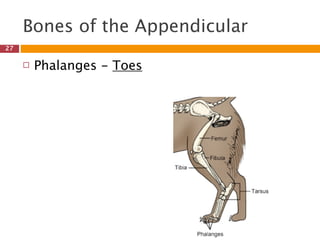
        Phalanges - Toes

Skeletal System Introduction

  • 1.
  • 2.
    Two Major Sectionsof the Skeleton 2  Axial Skeleton  Used to protect fragile tissue that is held underneath  Vertebrae, ribs, skull sternum  Appendicular Skeleton  These bones allow for movement  Bones of the limbs
  • 3.
    Variations of Bones 3  Total number of bones vary by species and even within a species  Example:  Horse – 205 bones  Dog – average - 320 bones  Some dogs are born with short tails and others have long tails which change the number of vertebrate present  Dewclaws  some are born with some are born without changing the number of digits present
  • 4.
    Bones of theAxial Skeleton 4  Cranium  Made mostly of flat bones (50 bones in a dog)  Shape varies between species and breed  Used for protection of the brain and other sense organs (taste, smell, hearing, sight,)  Lower jaw – mandible, is moveable allowing an animal to obtain and chew food
  • 5.
    Bones of theAxial Skeleton 5  The Vertebral Column  Extends the length of the body from the skull  Protects the spinal cord and allows for movement  Anatomy of the Vertebral Disk  Covered with bony arch - protects spinal cord  Intervertebral disks can be found between vertebrae. add cushion between the disks (not found between C1 and C2)
  • 6.
    Bones of theAxial Skeleton 6  The Vertebral Column  Broken down into anatomical divisions  Cervical(7)  Thoratic (13)  Lumbar (7)  Sacrum (3)  Coccygeal (14-23)
  • 7.
    Bones of theAxial Skeleton 7  The Vertebral Column  Cervical Vertebrae – neck  Mammals have 7 Cervical Vertebrae  C1 – Atlas – allows for up and down movement of head  C2 – Axis – allows for side to side movement  Thoracic Vertebrae – have attached ribs  Help to protect the heart and lungs, allow for respiration
  • 8.
    Bones of theAxial Skeleton 8  The Vertebral Column  Lumbar Vertebrae – lower back between thoracic vertebra and pelvis  Flexes and extends as an animal moves  Provide support for organs in the abdomen  Sacrum Vertebrae  Fuse with the pelvis allowing support of the hind end of the animal
  • 9.
    Bones of theAxial Skeleton 9  The Vertebral Column  Coccygeal Vertebrae – Tail  Vary by species and within the species  Dogs typically have 20 Coccygeal vertebrae but can range from 6-23!
  • 10.
    Bones of theAxial Skeleton 10 10/13/10
  • 11.
    Create it! 11  Congrats…you have graduated from the school of vertebral engineering! Lets put that education to good use!
  • 12.
    Bone of theAxial Skeleton 12  Cranial – PECTORAL LIMBS  Scapula  Humerus  Radius  Ulna  Carpus  Metacarpal  Phlanges
  • 13.
    Bones of theAppendicular 13  Scapula  Joins the humerus through a shallow ball and socket joint.  Flat bone with a spine to attach tendons and ligaments
  • 14.
    Bones of theAppendicular 14  Humerus  Upperbone of the forelimb.  Connects scapula to the elbow
  • 15.
    Bones of theAppendicular 15  Radius and Ulna - Forearm  Ulna runs to the point of the elbow and accepts the end of the humerus.  Radius closely connects to the ulna and forms the remainder of the elbow joint.  The elbow joint is a hinge joint and the reason that we can twist our forearm is because of the movement between the radius and ulna, not the elbow joint.
  • 16.
    Bones of theAppendicular 16  Carpus - Wrist  Radiusand ulna continue to the carpus.  Group of bones arranged in two rows.  Number of bones vary among species.  Dog –7  Ruminants – 6  Horse – 7 or 8
  • 17.
    Bones of theAppendicular 17  Metacarpus - Hand  Long Bones  Lots of differences in species.  Dogs and cats have four long and one much smaller one (dewclaw)  Horses have only one major bone, corresponds to the third one in other species, but has two smaller ones as well.  Ruminants only have one very large metacarpal bone. As the ruminant embryo develops, the third and fourth one fuse together.
  • 18.
    Bones of theAppendicular 18  Phalanges – fingers and toes  Number of toes corresponds to the number of metacarpal bones.  Singular form is phalanx.  The last phalanx is covered by the nail or hoof.
  • 19.
    Bones of theAppendicular 19  Caudal End – PELVIC LIMBS:  Pelvis  Femur  Tibia  Fibula  Tarsus  Metatarsus  Phalanges
  • 20.
    Bones of theAppendicular 20  Pelvis  3 fused bones.  Pubis  Ischium  Ilium  Sacrum supports the pelvis.  Connection can be damaged, and may split away.  Pelvis is made of two halves.  Each half divides into regions: ilium, ischium, pubis.  Ilium joins to the sacrum.
  • 21.
    Pelvis 21 10/13/10
  • 22.
    Bones of theAppendicular 22  Femur – Leg Bone  Ball and socket joint to the pelvis.  Goes to the knee.
  • 23.
    Bones of theAppendicular 23  Patella – Knee Cap
  • 24.
    Bones of theAppendicular 24  Tibia and Fibula  Similar to Ulna and Radius in forearm
  • 25.
    Bones of theAppendicular 25  Tarsus - Ankle
  • 26.
    Bones of theAppendicular 26  Metatarsus – Top of foot
  • 27.
    Bones of theAppendicular 27  Phalanges - Toes