WRITING GOOD
OBSERVATIONS
Skills Lesson
3 IMPORTANT THINGS TO
HELP IMPROVE YOUR
OBSERVATIONS IN SCIENCE
1. Avoid vague terms
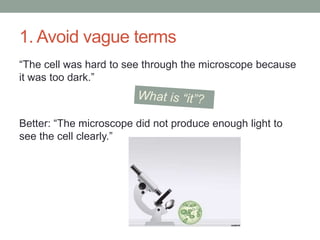
“The cell was hard to see through the microscope because
it was too dark.”
Better: “The microscope did not produce enough light to
see the cell clearly.”
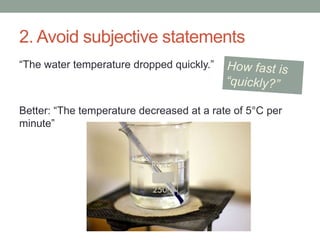
2. Avoid subjective statements
“The water temperature dropped quickly.”
Better: “The temperature decreased at a rate of 5°C per
minute”
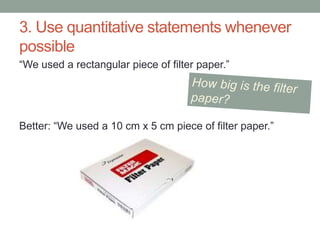
3. Use quantitative statements whenever
possible
“We used a rectangular piece of filter paper.”
Better: “We used a 10 cm x 5 cm piece of filter paper.”
Write a great description using both
Quantitative and Qualitative
observations
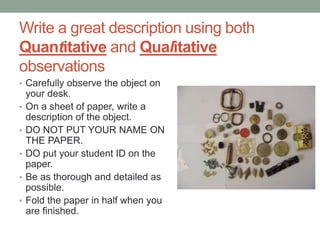
• Carefully observe the object on
your desk.
• On a sheet of paper, write a
description of the object.
• DO NOT PUT YOUR NAME ON
THE PAPER.
• DO put your student ID on the
paper.
• Be as thorough and detailed as
possible.
• Fold the paper in half when you
are finished.
Discussion Questions
1. What was the most helpful part of the description you
were given?
2. What was the least helpful part of the description you
were given?
3. What are the qualities of making good observations in
science?
Closure
• People determine what you know from the work you
provide.
• Do not assume the person reading your work has the
same background knowledge as you. Explain everything
in detail.
• Your great ideas will never be fully appreciated unless you
learn to communicate them.
• Communicating in writing is even more important in the
technology age.

CP Chemistry writing good observations

  • 1.
  • 2.
    3 IMPORTANT THINGSTO HELP IMPROVE YOUR OBSERVATIONS IN SCIENCE
  • 3.
    1. Avoid vagueterms “The cell was hard to see through the microscope because it was too dark.” Better: “The microscope did not produce enough light to see the cell clearly.”
  • 4.
    2. Avoid subjectivestatements “The water temperature dropped quickly.” Better: “The temperature decreased at a rate of 5°C per minute”
  • 5.
    3. Use quantitativestatements whenever possible “We used a rectangular piece of filter paper.” Better: “We used a 10 cm x 5 cm piece of filter paper.”
  • 6.
    Write a greatdescription using both Quantitative and Qualitative observations • Carefully observe the object on your desk. • On a sheet of paper, write a description of the object. • DO NOT PUT YOUR NAME ON THE PAPER. • DO put your student ID on the paper. • Be as thorough and detailed as possible. • Fold the paper in half when you are finished.
  • 7.
    Discussion Questions 1. Whatwas the most helpful part of the description you were given? 2. What was the least helpful part of the description you were given? 3. What are the qualities of making good observations in science?
  • 8.
    Closure • People determinewhat you know from the work you provide. • Do not assume the person reading your work has the same background knowledge as you. Explain everything in detail. • Your great ideas will never be fully appreciated unless you learn to communicate them. • Communicating in writing is even more important in the technology age.

Editor's Notes

  • #4 Avoid words like “it” “they” and “that”. For the non-example – ask students “What does “it” refer to?” Was the room too dark? Was the cell too dark? What the microscope too dark? Were you working at night and it was dark outside? For CFU – TPS, or TWPS
  • #5 Subjective statements are influenced by opinions. For the non-example, ask students “Quickly compared to what? A snail? A rocket ship?” You cannot assume other people share your idea of words like fast, slow, loud, quiet, big and small. For CFU use TPS or TWPS
  • #6 Quantitative statements deal with numbers and provide much more detail that qualitative statements. For the non-example, ask students “how big is that paper?” For CFU – just have students show you with their hands
  • #7 Place rulers on the desks but do not instruct students to use them. They can if they choose to, of course. Pass out finished work to students. Students read description and have to find their object.