The 5-Step Approach to Design
   Controlled Experiments
                       Shengdong Zhao
                         NUS-HCI Lab
                National University of Singapore


This material is developed by Shengdong Zhao and colleagues. You are free to use the
material as long as the original authors are acknowledged.
                                                                                  1
Outline
The 5 Step Approach to Experiment Design
2.Define the research question
3.Determine variables
4.Arrange conditions
5.Decide blocks and trials
6.Set instruction and procedures
Let’s Start with an Example
          Problem
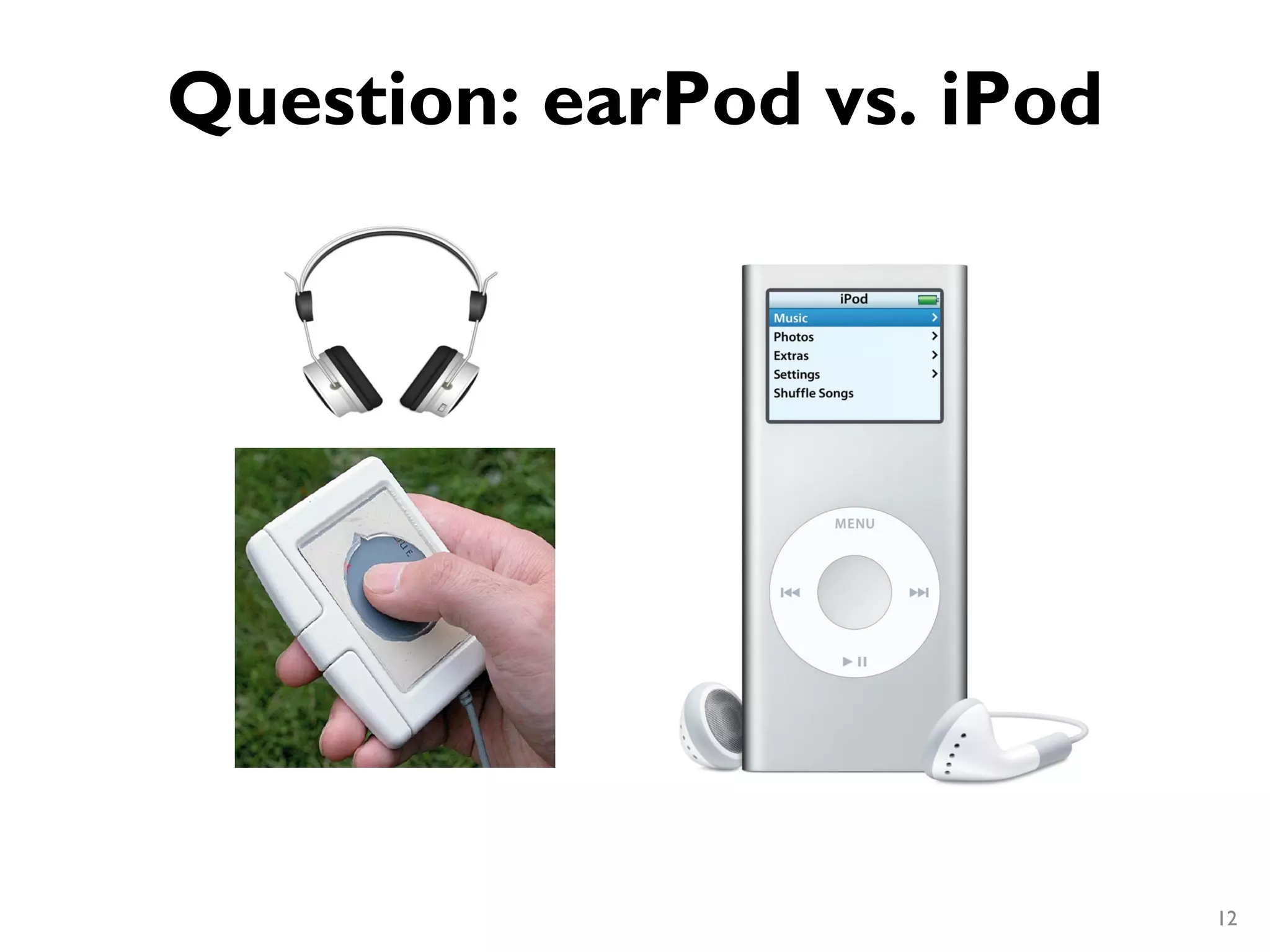
         earPod vs. iPod
4
Menu
Selection
on

Mobile
Devices
Often Requires


Visual
Feedback
                 5
Why Eyes-free?


                 6
Why eyes-free?


                 7
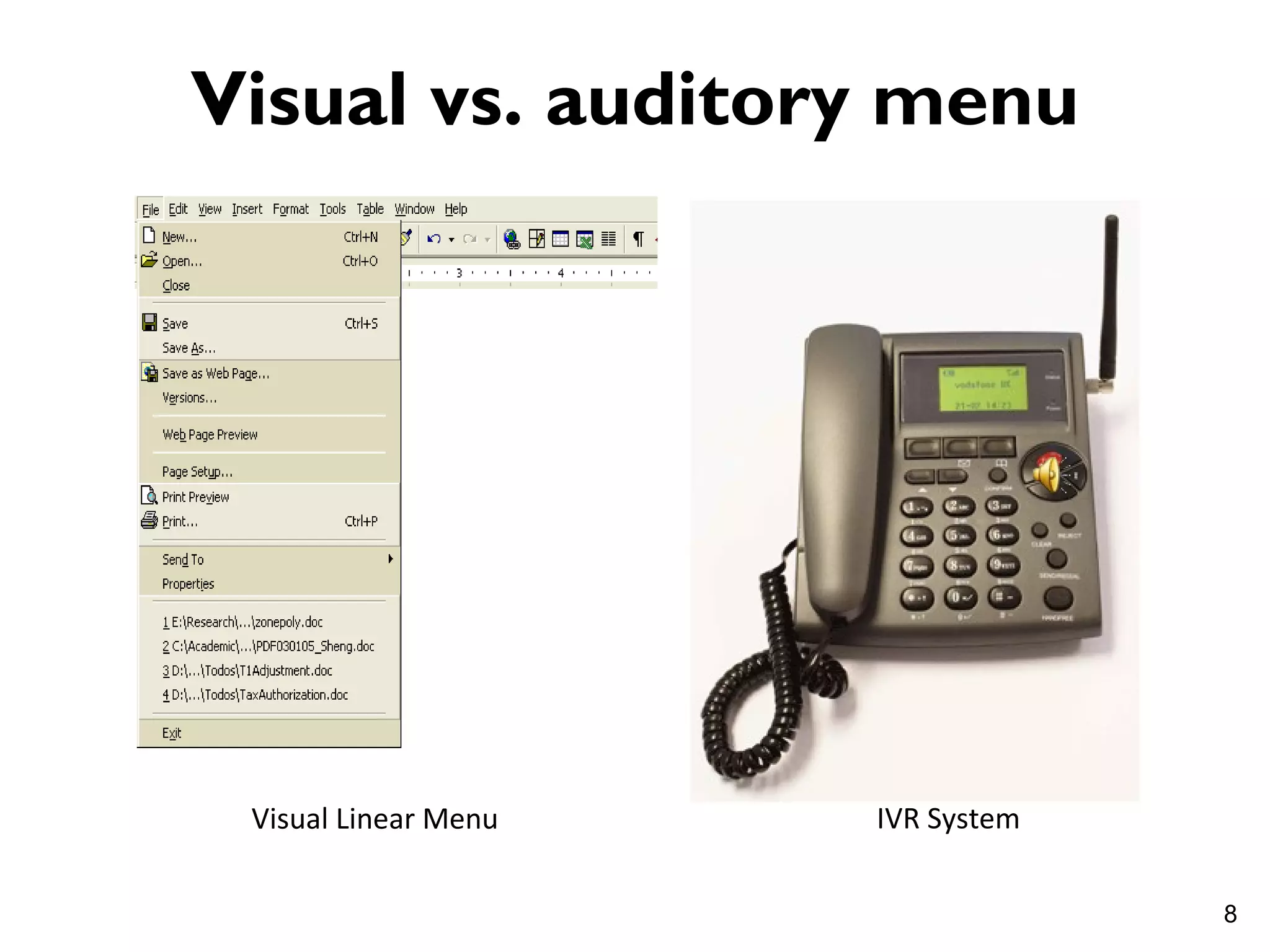
Visual vs. auditory menu


 Visual Linear Menu   IVR System

                                   8
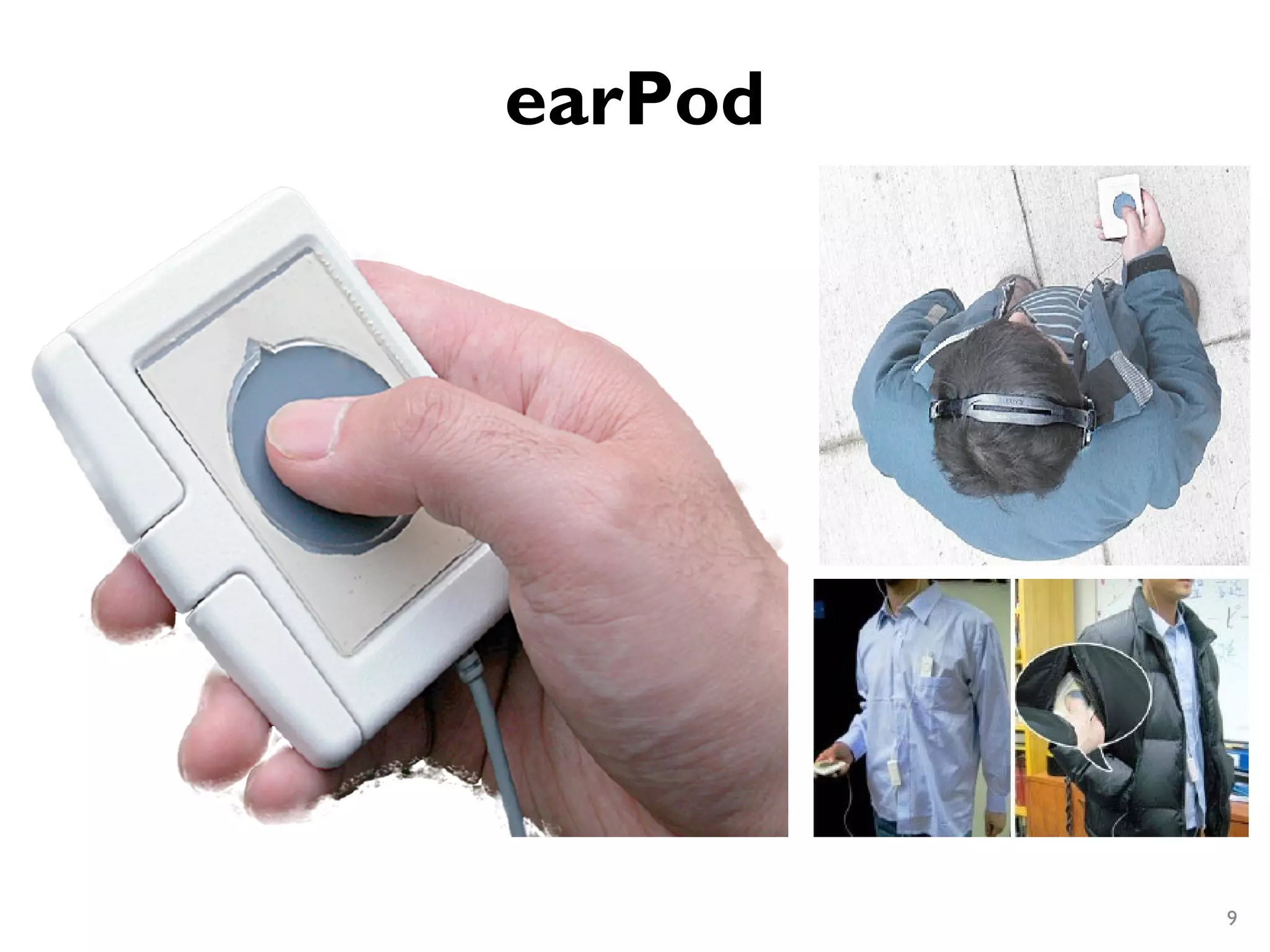
earPod


         9
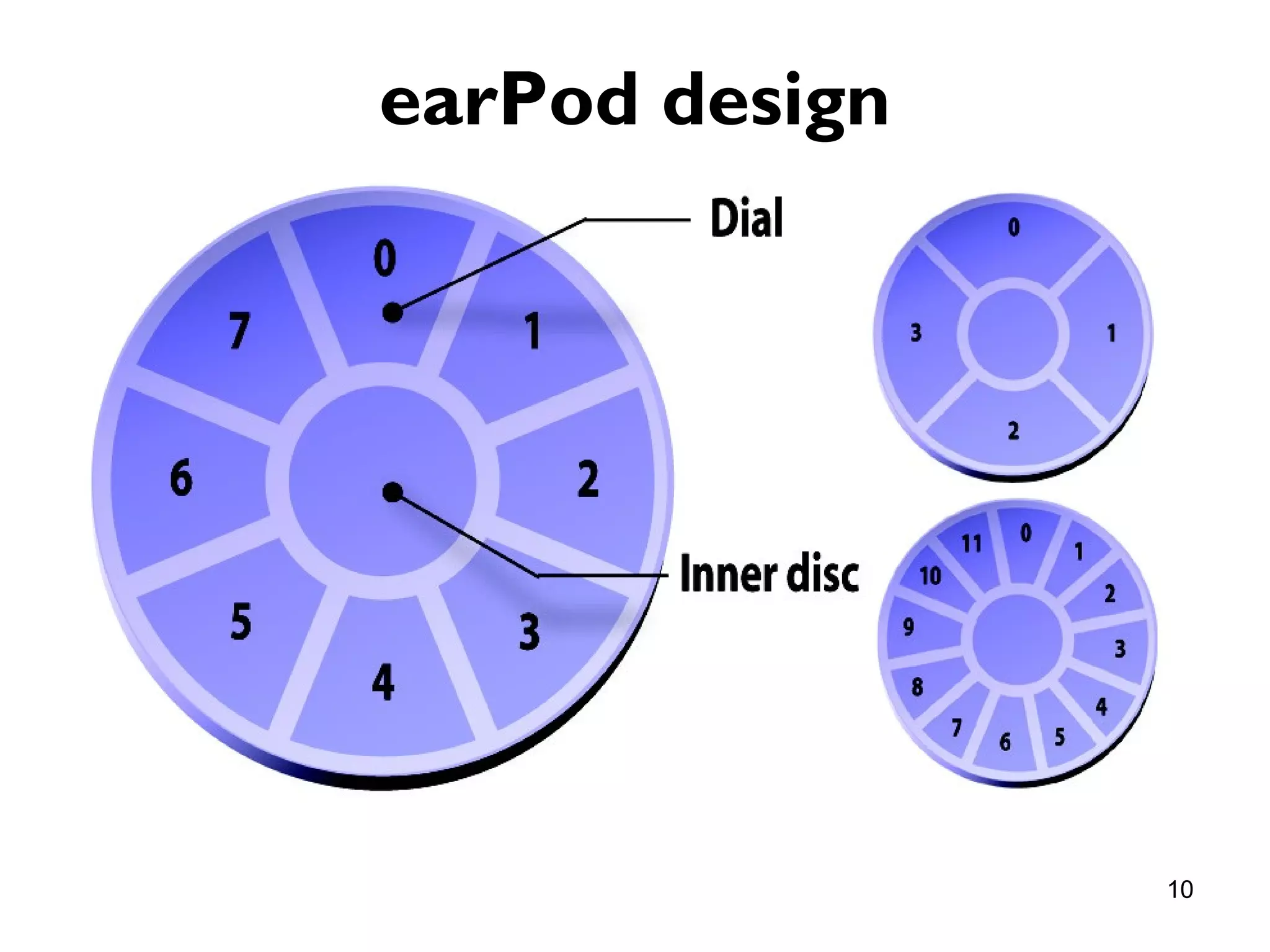
earPod design


                10
Video
• http://www.youtube.com/watch?v=bATkA0Usoio

Paper
  – Shengdong Zhao, Pierre Dragicevic, Mark H. Chignell,
    Ravin Balakrishnan, Patrick Baudisch (2007). 
    earPod: Eyes-free Menu Selection with Touch Input and Reactiv
    . Proceedings of the ACM Conference on Human Factors in
    Computing Systems (CHI). pp. 1395-1404


                                                             11
Question: earPod vs. iPod


                            12
The 5 Step Approach to
        Experiment Design
•   Define the research question
•   Determine variables
•   Arrange conditions
•   Decide blocks and trials
•   Set instruction and procedures
The 5 Step Approach to
            Experiment Design
1. Define the research question
     –   Step 1.1 Start with a general question
     –   Step 1.2 Define target population
     –   Step 1.3 Define task(s)
     –   Step 1.4 Define measure(s)
     –   Step 1.5 Define factor(s)

2.   Determine variables
3.   Arrange conditions
4.   Decide blocks and trials
5.   Set instruction and procedures
Step 1.1: Start with a General
           Question


 How does earPod compare
with iPod’s menu in terms of
        performance?
Step 1.2: Define Target
            Population
General question: How does earPod compare with
iPod’s menu in terms of performance?

Target population?
Question: we designed earPod for whom?
Step 1.3: Define Task(s)
General question: How does earPod compare with
iPod’s menu in terms of performance?

Task(s): menu selection
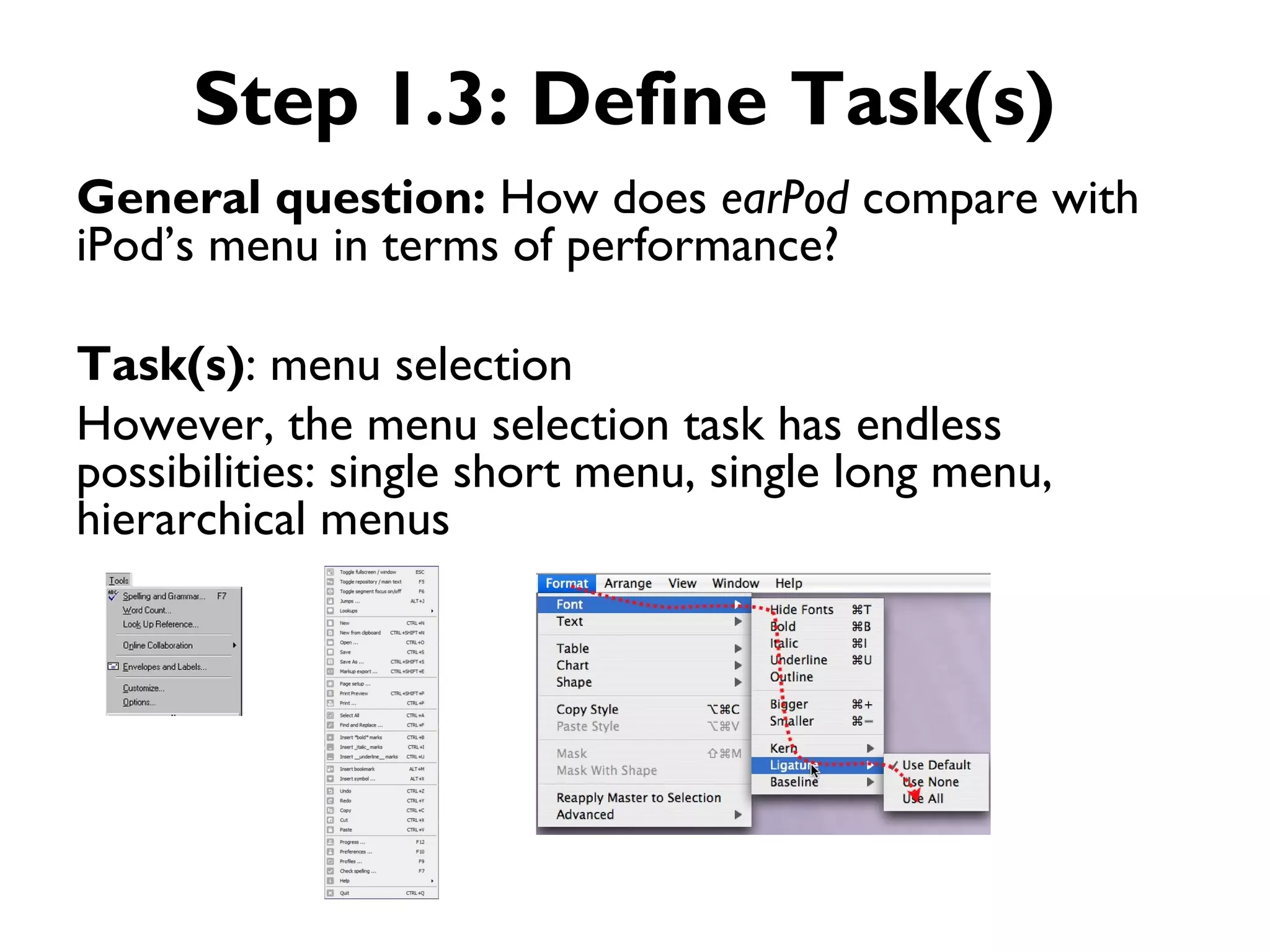
However, the menu selection task has endless
possibilities: single short menu, single long menu,
hierarchical menus
Step 1.3: Define Task(s)


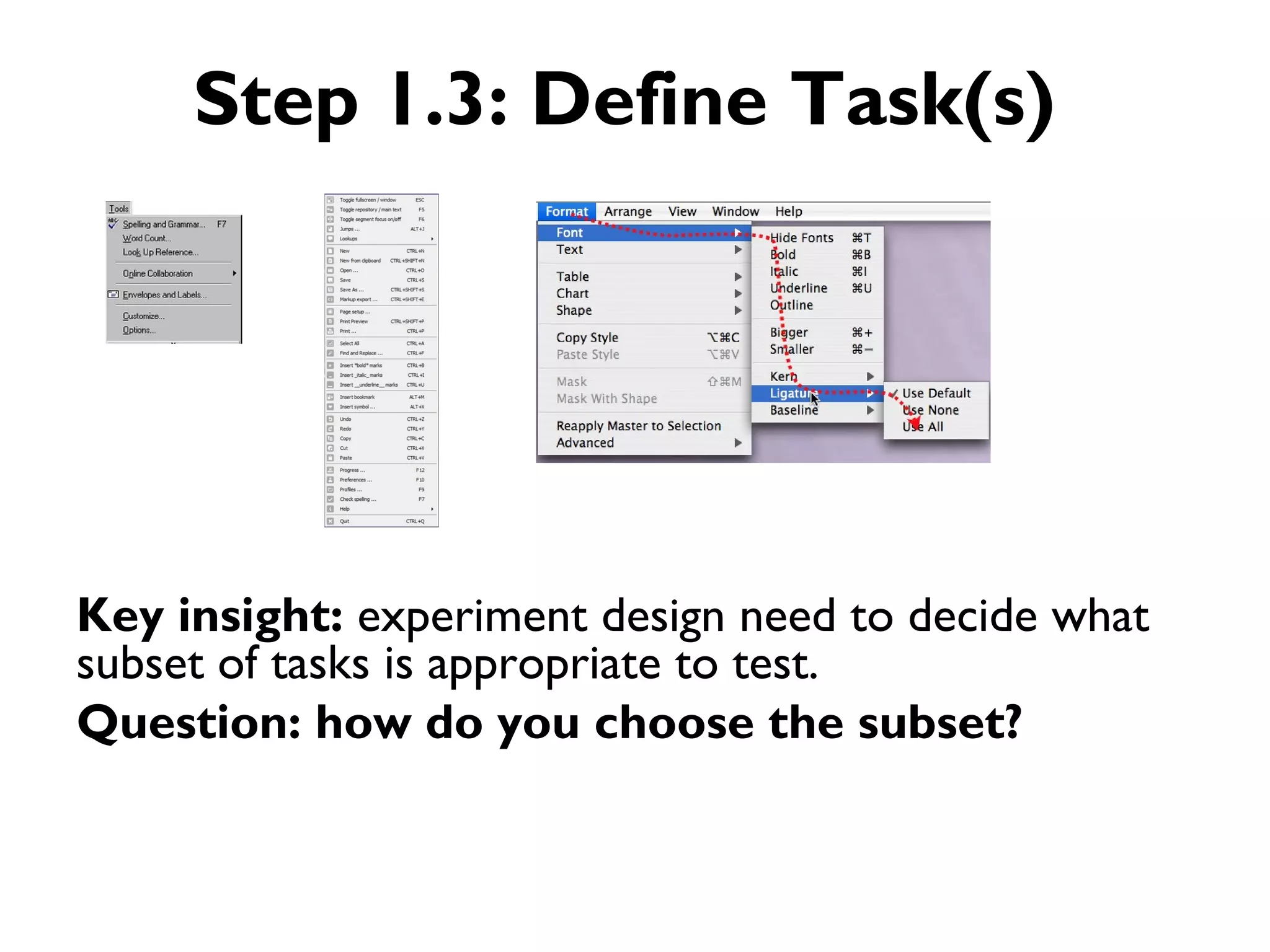
Key insight: experiment design need to decide what
subset of tasks is appropriate to test.
Question: how do you choose the subset?
Step 1.4: Define Measures
Question: How does earPod compare with iPod’s
menu in terms of performance?

Measures: performance

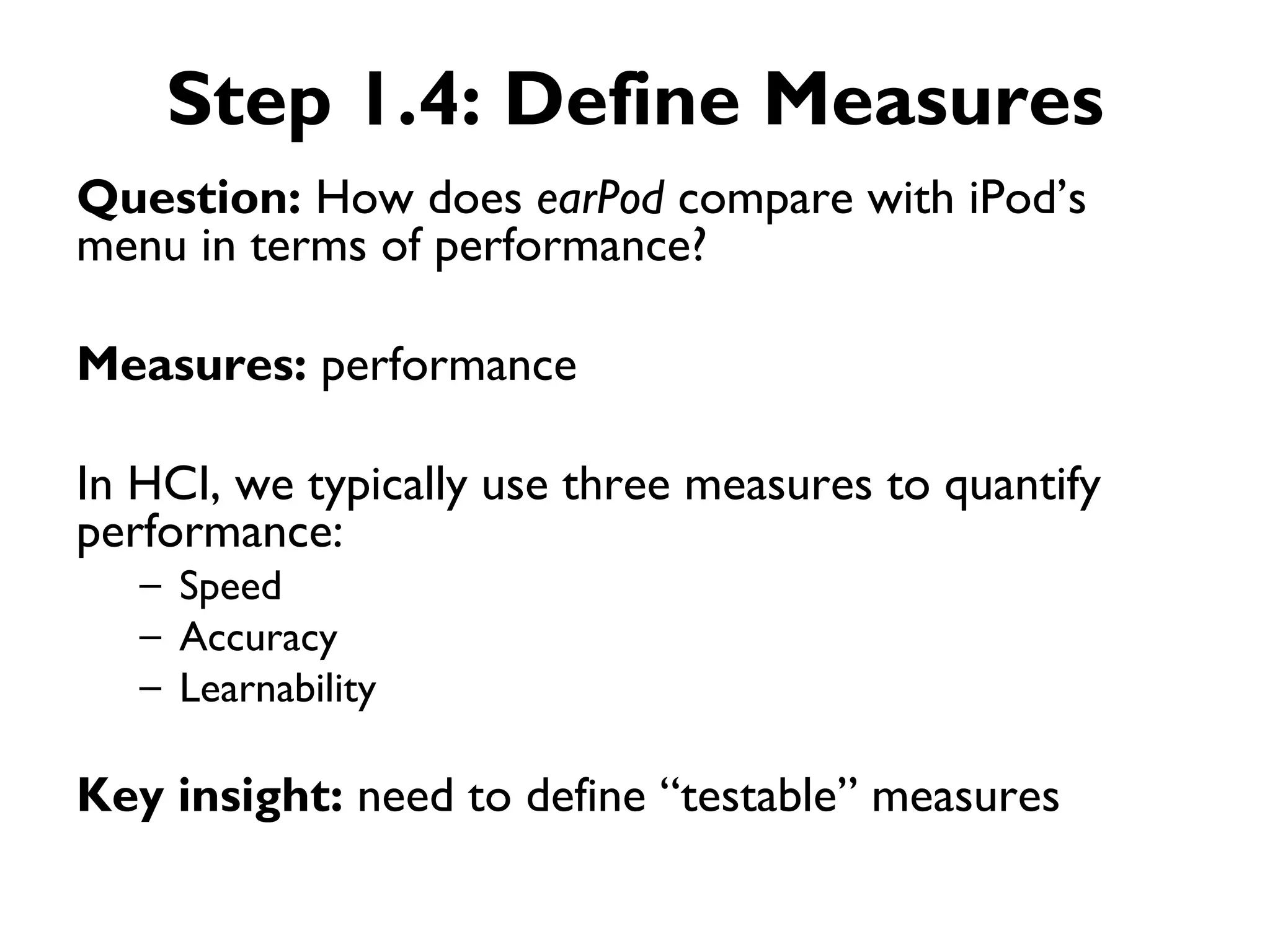
In HCI, we typically use three measures to quantify
performance:
   – Speed
   – Accuracy
   – Learnability

Key insight: need to define “testable” measures
Step 1.5: Define (other)
                   Factors with iPod’s menu in
Question: How does earPod compare
terms of performance?
Factors: other than the different type of tasks, what other
factors can influence the measures?
Again: the number of factors are unlimited …
•Scenario of use
•Input device
•Background of the user
   –   Educational level
   –   Gender
   –   Ethnic background
   –   Age
   –   …

Key insight: experiment design need to determine a
subset of factors to test.
Question: how to choose the factors?
Let’s Review Step 1

Step 1: Define the research question
  – Step 1.1: Start with a general question
  – Step 1.2: Define target population
  – Step 1.3: Define task(s)
  – Step 1.4: Define measure(s)
  – Step 1.5 Define factor(s)
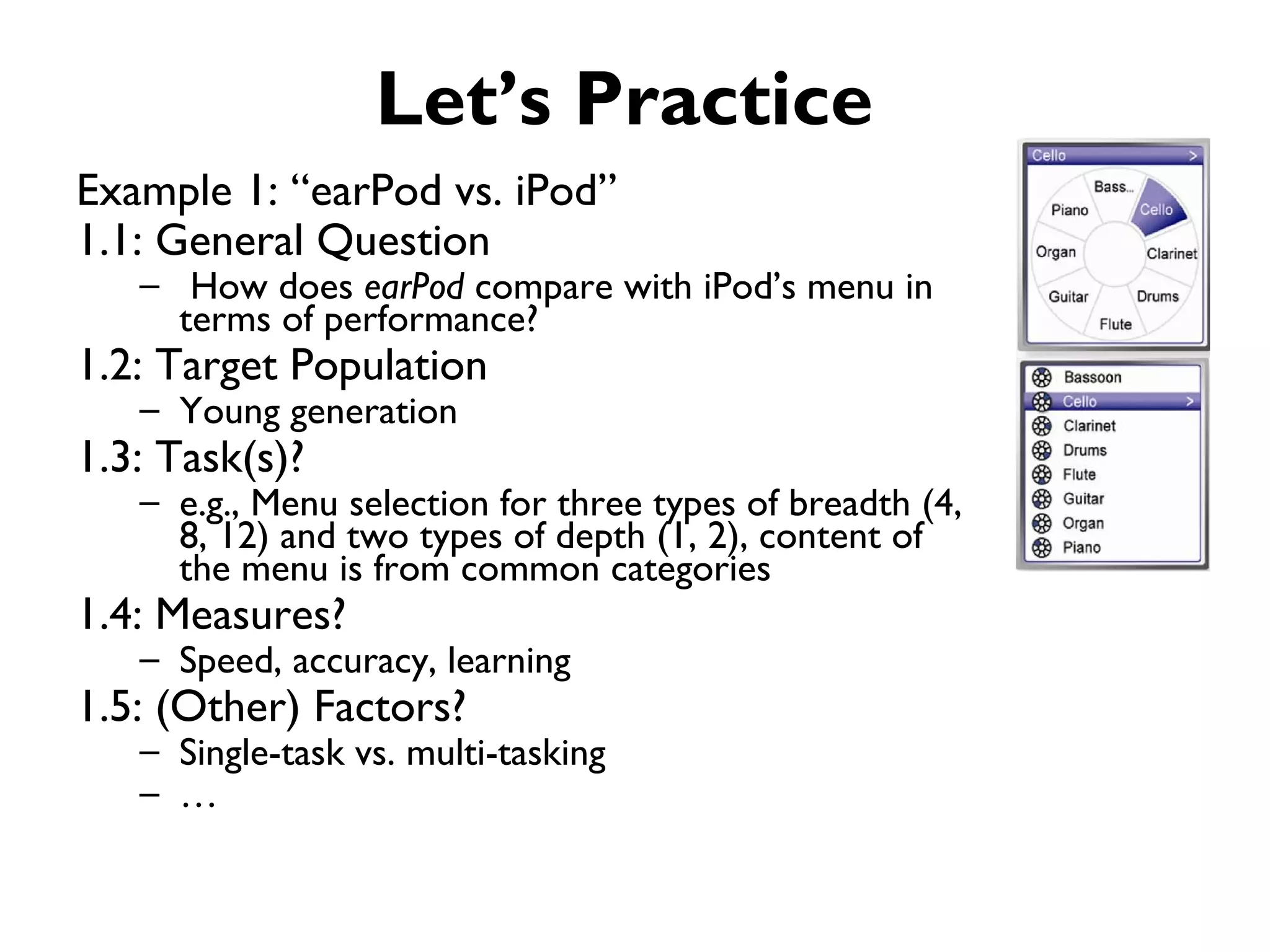
Let’s Practice
Example 1: “earPod vs. iPod”
1.1: General Question
   – How does earPod compare with iPod’s menu in
     terms of performance?
1.2: Target Population
   – Young generation
1.3: Task(s)?
   – e.g., Menu selection for three types of breadth (4,
     8, 12) and two types of depth (1, 2), content of
     the menu is from common categories
1.4: Measures?
   – Speed, accuracy, learning
1.5: (Other) Factors?
   – Single-task vs. multi-tasking
   – …
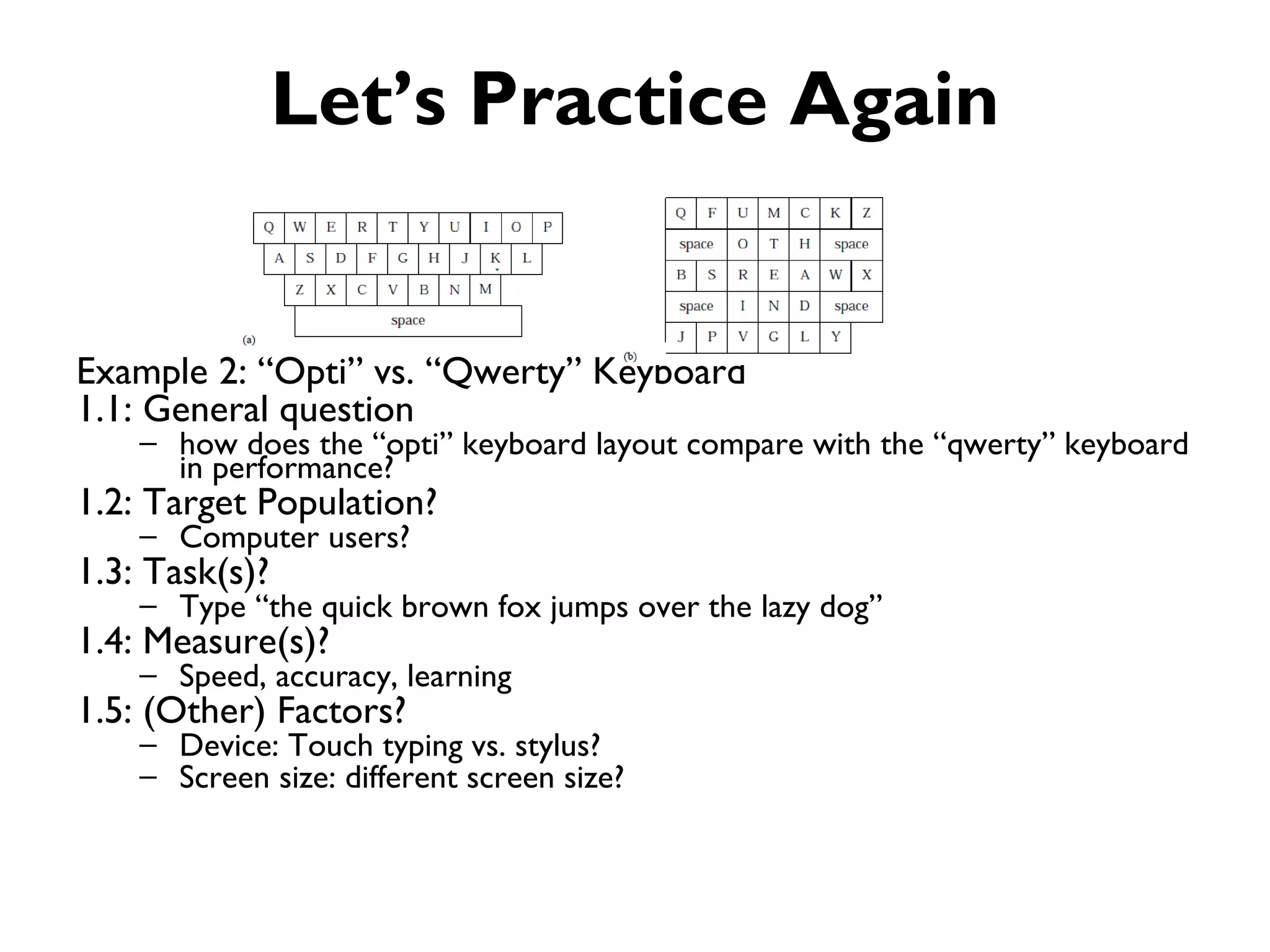
Let’s Practice Again


Example 2: “Opti” vs. “Qwerty” Keyboard
1.1: General question
    – how does the “opti” keyboard layout compare with the “qwerty” keyboard
      in performance?
1.2: Target Population?
    – Computer users?
1.3: Task(s)?
    – Type “the quick brown fox jumps over the lazy dog”
1.4: Measure(s)?
    – Speed, accuracy, learning
1.5: (Other) Factors?
    – Device: Touch typing vs. stylus?
    – Screen size: different screen size?
The 5 Step Approach to
        Experiment Design
•   Define the research question
•   Determine variables
•   Arrange conditions
•   Decide blocks and repetitions
•   Set instruction and trials
Step 2: Define Variables
Type of variables
•Independent variable (IV)
   – Factors that are manipulated in the experiment
   – Have multiple levels
•Dependent variable (DV)
   – Factors which are measured
•Control variable
   – Attributes that will be fixed throughout experiment
   – Confound – attribute that varied and was not accounted for
       • Problem: Confound rather than IV could have caused change in DVs
   – Confounds make it difficult/impossible to draw conclusions
•Random variable
   – Attributes that are randomly sampled
   – Increases generalizability
Type of Independent Variables
• Primary
  – The most important independent variable(s) that you want
    to investigate
  – For the question: “How does the earPod compare with
    iPod’s menu in terms of performance, the primary focus of
    interest is the different type of device/technique (earPod
    vs. iPod), so the primary IV is device/technique
• Secondary
  – The other interesting factors you want to manipulate in
    the experiment. They help to answer the main question in
    a richer way. For example, a secondary IV for the earPod
    vs. iPod experiment will be the scenario of use (stationary
    vs. mobile). This variable helps to answer the primary
    question “how does earPod vs. iPod” in a richer way:
    earPod may work better in mobile while iPod better in
    stationary, etc.
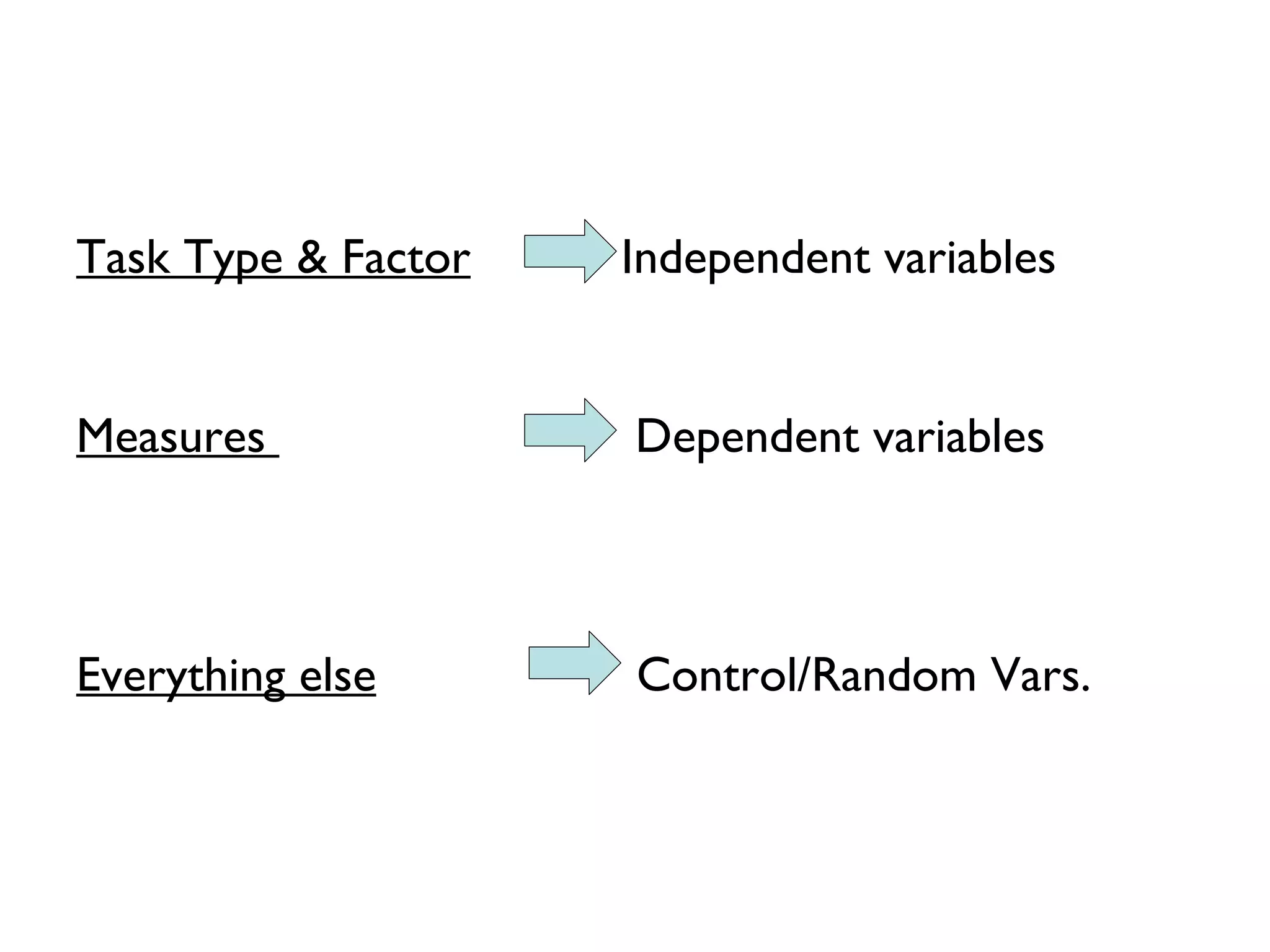
Task Type & Factor   Independent variables


Measures             Dependent variables


Everything else      Control/Random Vars.
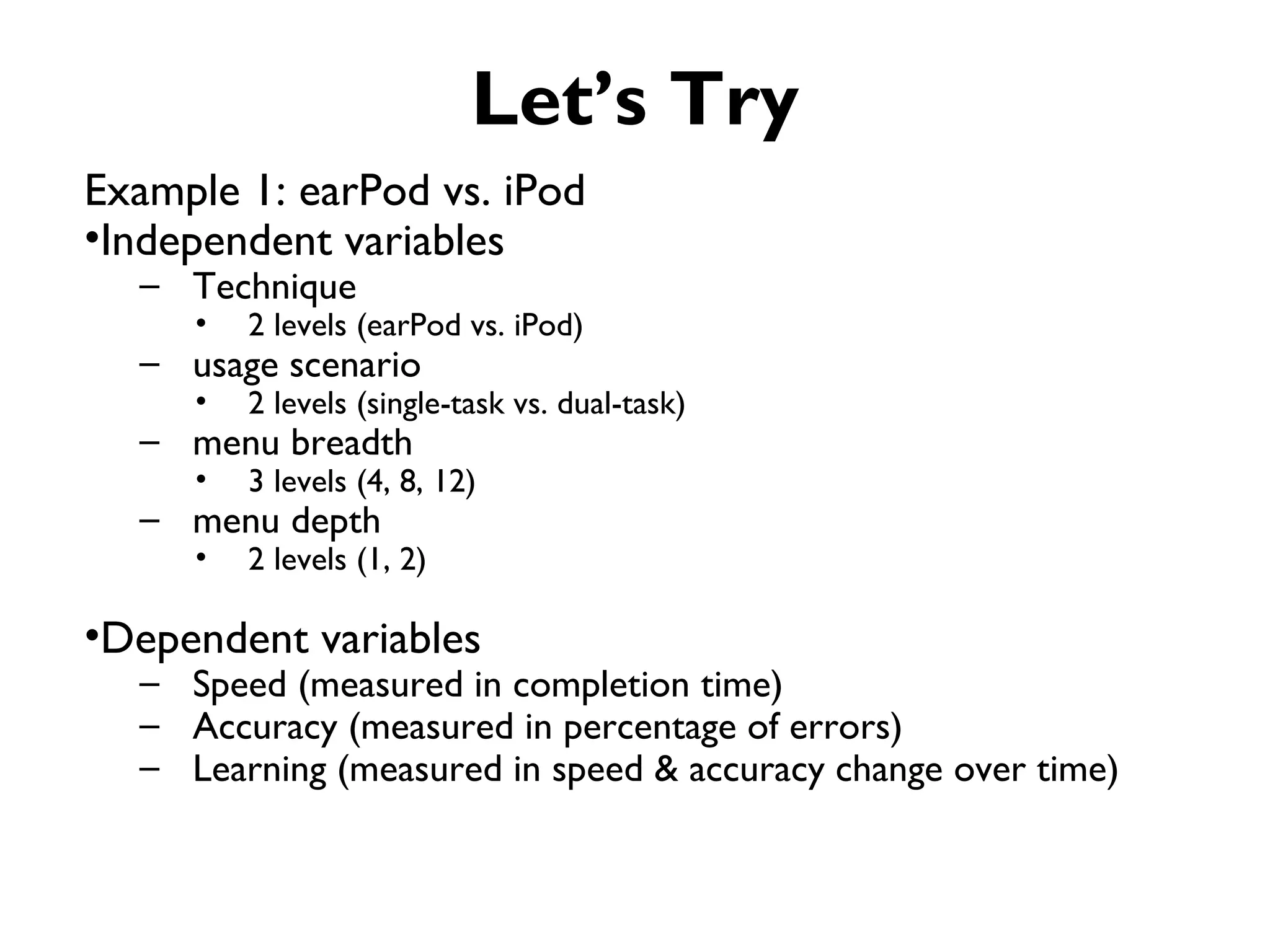
Let’s Try
Example 1: earPod vs. iPod
•Independent variables
  – Technique
     •   2 levels (earPod vs. iPod)
  – usage scenario
     •   2 levels (single-task vs. dual-task)
  – menu breadth
     •   3 levels (4, 8, 12)
  – menu depth
     •   2 levels (1, 2)

•Dependent variables
  – Speed (measured in completion time)
  – Accuracy (measured in percentage of errors)
  – Learning (measured in speed & accuracy change over time)
Let’s Try
Example 1: earPod vs. iPod
•Control variables
  – Same computer, experiment time, environment,
    instruction, etc.

•Random variables
  – Attributes of participants: age, gender, background, etc.
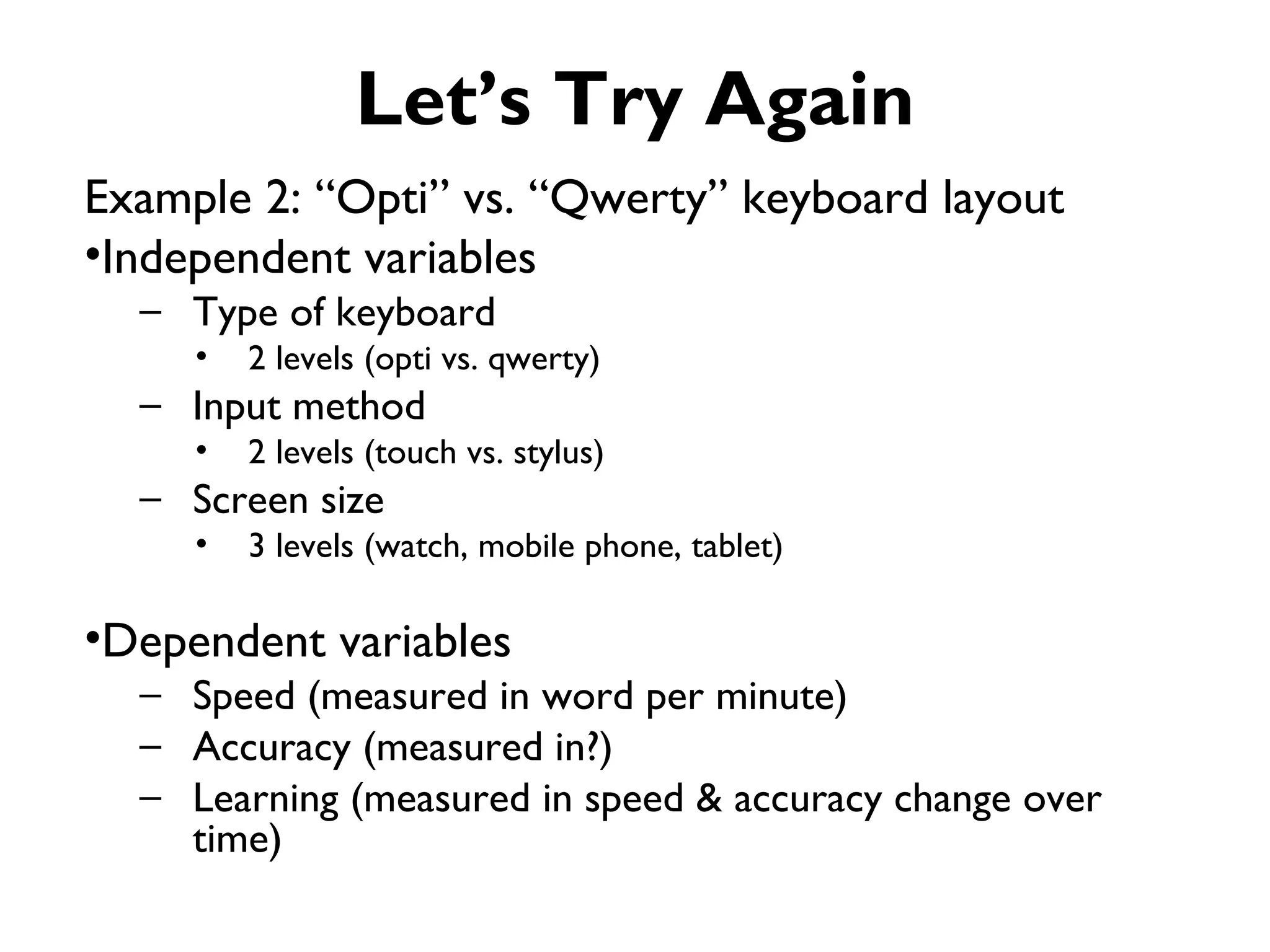
Let’s Try Again
Example 2: “Opti” vs. “Qwerty” keyboard layout
•Independent variables
  – Type of keyboard
     •   2 levels (opti vs. qwerty)
  – Input method
     •   2 levels (touch vs. stylus)
  – Screen size
     •   3 levels (watch, mobile phone, tablet)

•Dependent variables
  – Speed (measured in word per minute)
  – Accuracy (measured in?)
  – Learning (measured in speed & accuracy change over
    time)
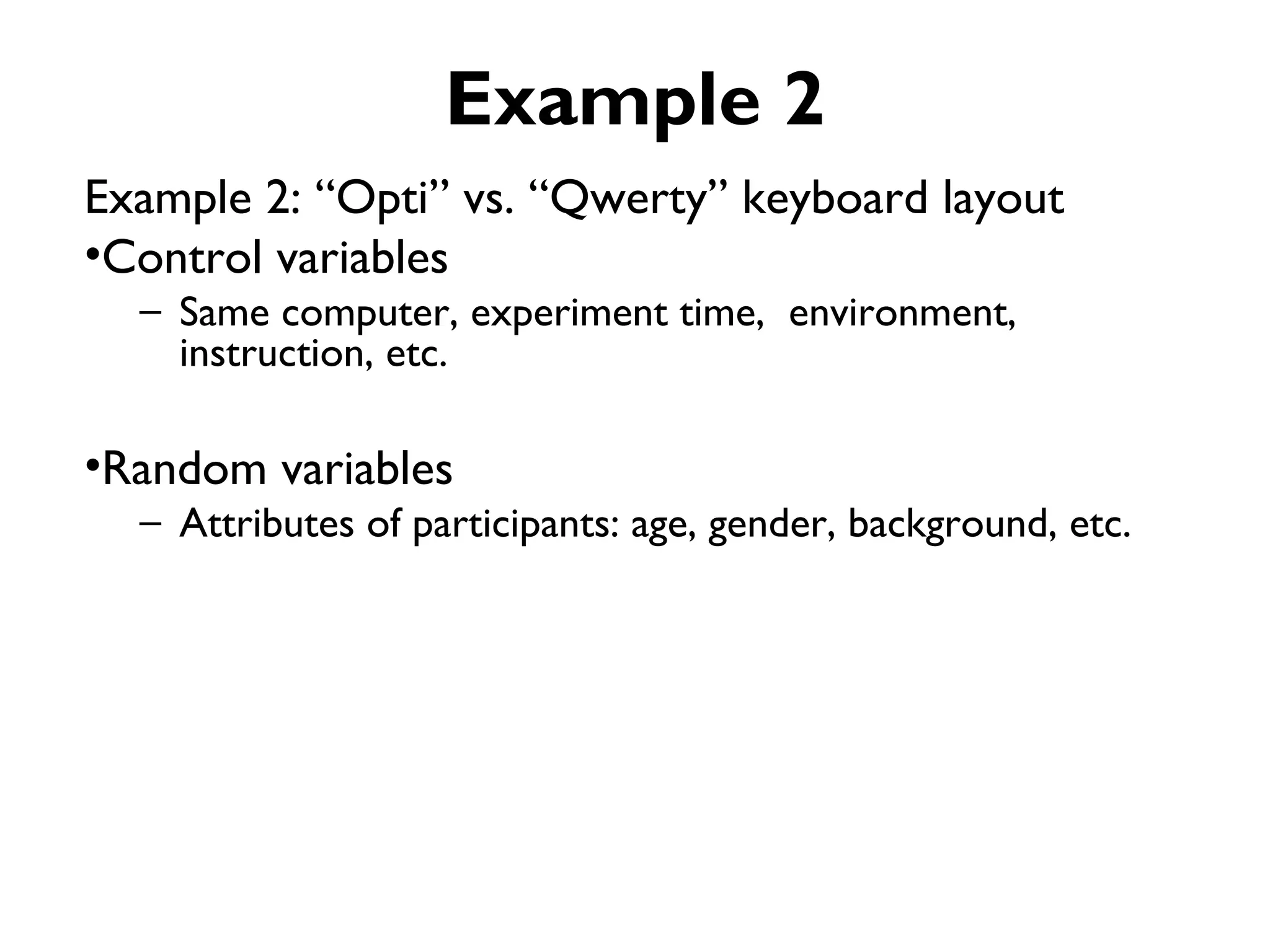
Example 2
Example 2: “Opti” vs. “Qwerty” keyboard layout
•Control variables
  – Same computer, experiment time, environment,
    instruction, etc.

•Random variables
  – Attributes of participants: age, gender, background, etc.
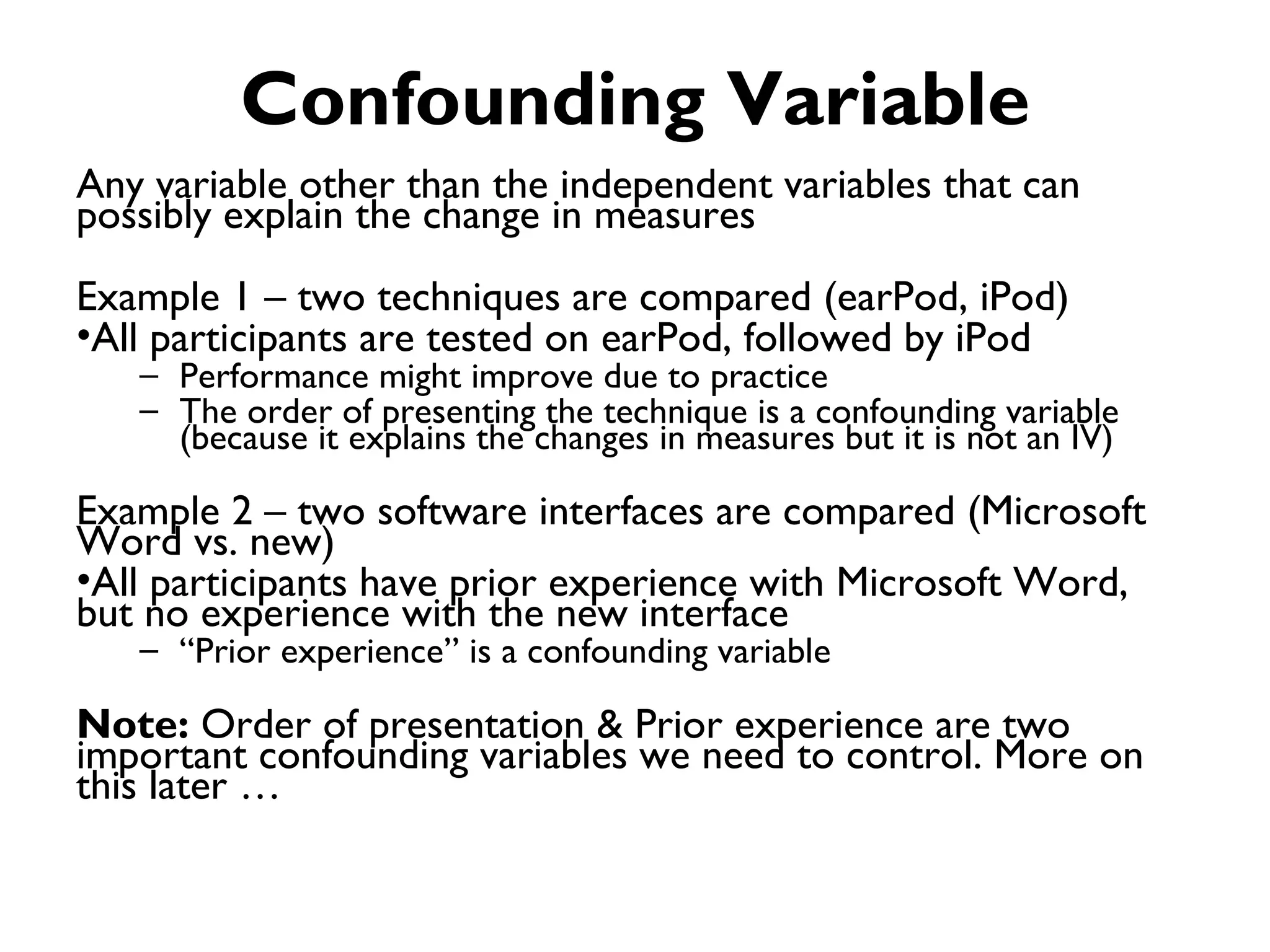
Confounding Variable
Any variable other than the independent variables that can
possibly explain the change in measures
Example 1 – two techniques are compared (earPod, iPod)
•All participants are tested on earPod, followed by iPod
   – Performance might improve due to practice
   – The order of presenting the technique is a confounding variable
     (because it explains the changes in measures but it is not an IV)

Example 2 – two software interfaces are compared (Microsoft
Word vs. new)
•All participants have prior experience with Microsoft Word,
but no experience with the new interface
   – “Prior experience” is a confounding variable

Note: Order of presentation & Prior experience are two
important confounding variables we need to control. More on
this later …
The 5 Step Approach to
         Experiment Design
•   Define the research question
•   Determine variables
•   Arrange conditions
    From Independent Variables to Experimental Conditions
4. Decide blocks and trials
5. Set instruction and procedures
What is a condition?
• Let’s start with an example
• A particular independent variable “Technique”
  has two levels: earPod and iPod.
   – If it is the only independent variable considered, this
     experiment has two conditions
• However, an experiment rarely only has 1
  independent variable, suppose there is another
  independent variable “Menu Breadth” with 3 levels
  (4, 8, 12).
   – There are 2 (Techniques) x 3 (Menu Breadth) = 6
     experimental conditions
   – The each unique combination of the different levels of the
     various independent variables (such as earPod, 4) is an
     experimental condition
How can We Test These
          Conditions?
• Method 1:
   – Recruit 6 participants, one for each condition (this is also
     called between-subject design, which means the
     conditions are tested between different subjects)
      •   P1: earPod, 4
      •   P2: earPod, 8
      •   P3: earPod, 12
      •   P4: iPod, 4
      •   P5: iPod, 8
      •   P6: iPod 12
   – What’s the problem of this approach?
      • What about individual differences?
      • To balance individual differences, we need lots of participants

• Key insight: this method is expensive
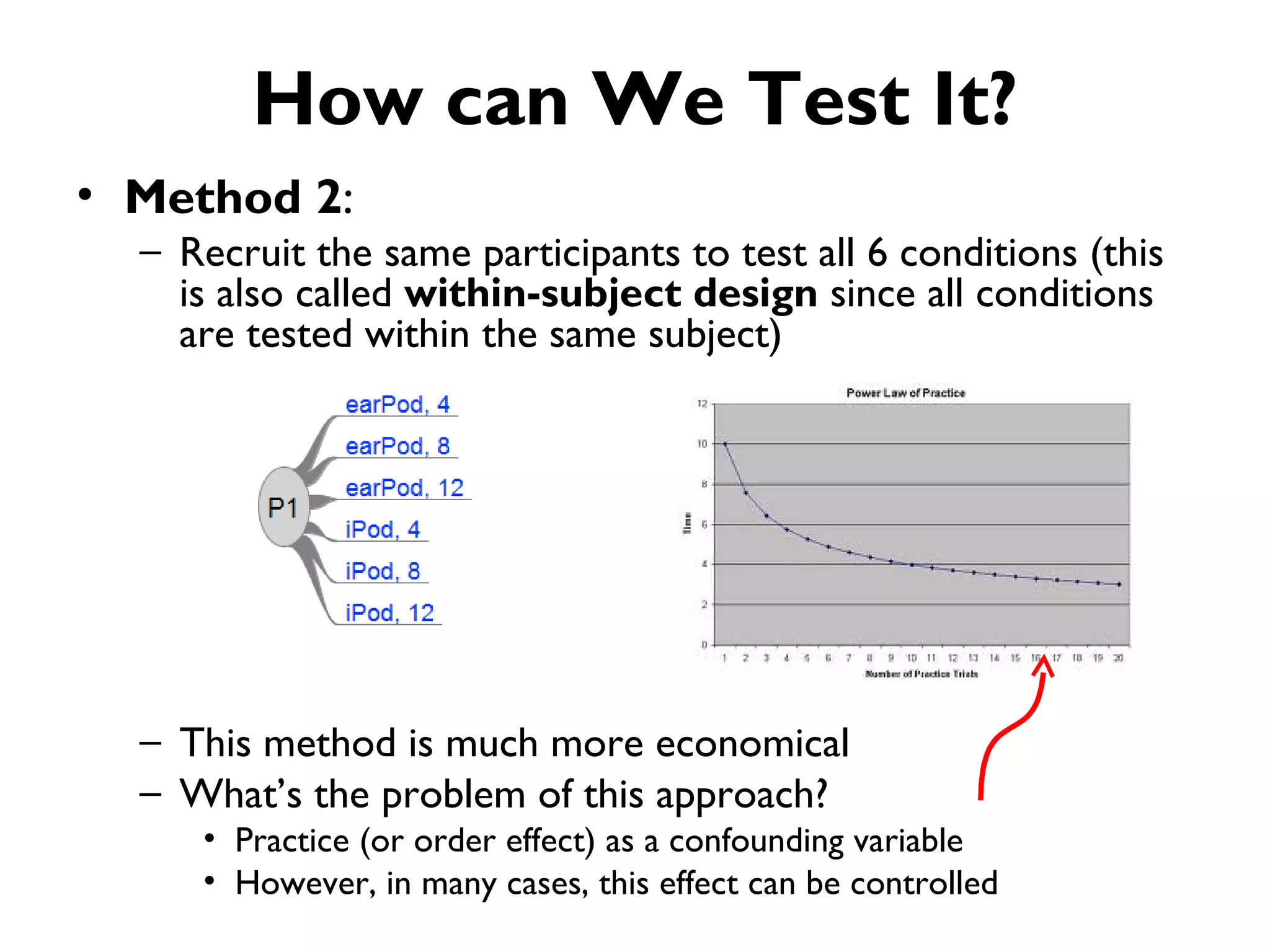
How can We Test It?
• Method 2:
  – Recruit the same participants to test all 6 conditions (this
    is also called within-subject design since all conditions
    are tested within the same subject)


  – This method is much more economical
  – What’s the problem of this approach?
     • Practice (or order effect) as a confounding variable
     • However, in many cases, this effect can be controlled
Control Order Effect using
      Counter-balancing
If we assume the order effect is symmetric, which means A
-> B = B->A, and is linear, which means the increment
between different conditions is about the same, we can use
counter-balancing to cancel the effect out.
E.g., we assume the transferring effect between (A after B)
and (B after A) are both 10
Participant 1: A followed by B (A B)
Participant 2: B followed by A (B A)
Observation: the order effect equally affects both A and
B, so the absolute relationship between A and B is not
changed.
However, a minimum number of participants is needed for
counter-balancing to work
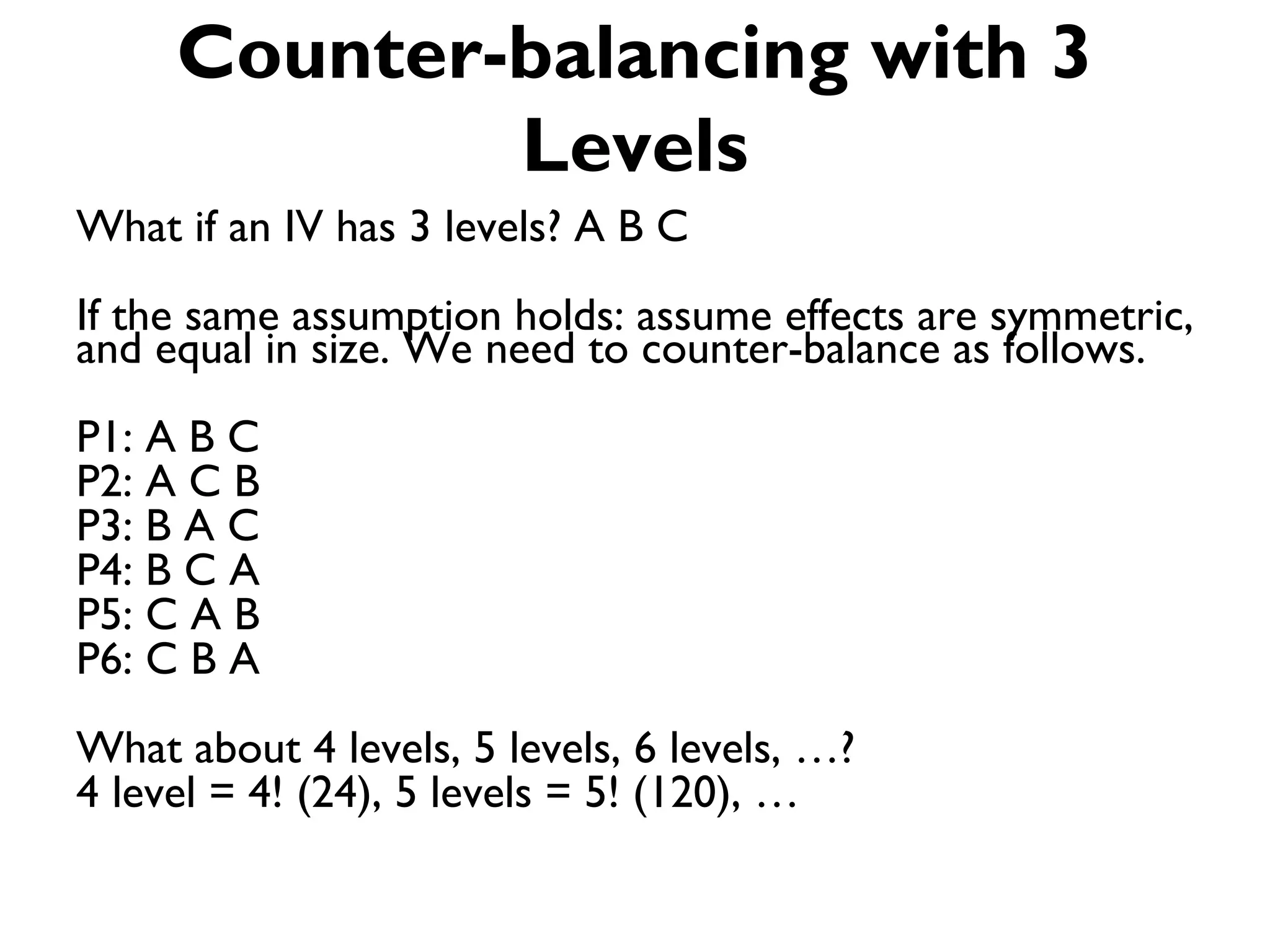
Counter-balancing with 3
             Levels
What if an IV has 3 levels? A B C
If the same assumption holds: assume effects are symmetric,
and equal in size. We need to counter-balance as follows.
P1: A B C
P2: A C B
P3: B A C
P4: B C A
P5: C A B
P6: C B A
What about 4 levels, 5 levels, 6 levels, …?
4 level = 4! (24), 5 levels = 5! (120), …
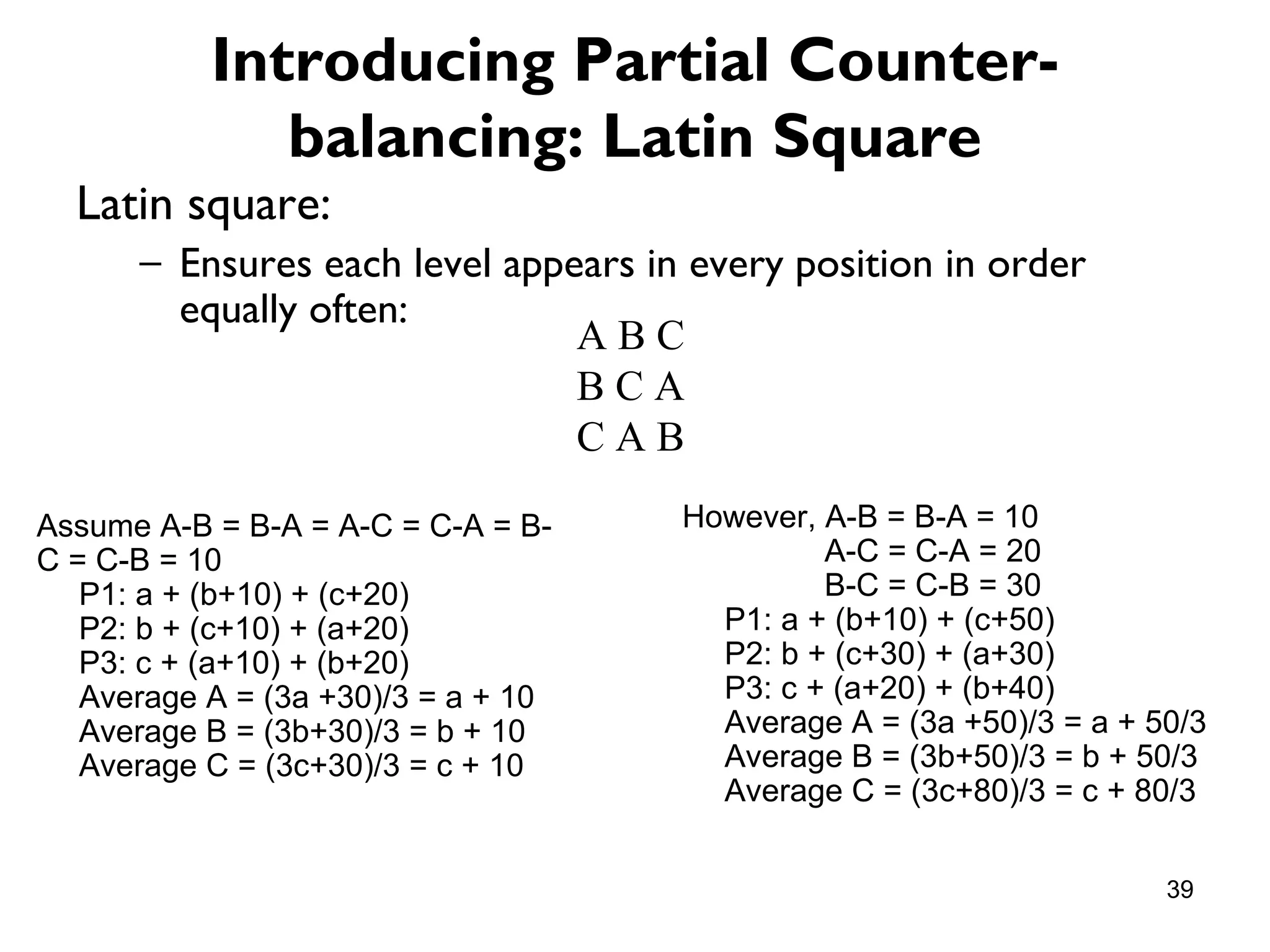
Introducing Partial Counter-
              balancing: Latin Square
  Latin square:
      – Ensures each level appears in every position in order
        equally often:
                               ABC
                               BCA
                               CAB

Assume A-B = B-A = A-C = C-A = B-    However, A-B = B-A = 10
C = C-B = 10                                  A-C = C-A = 20
   P1: a + (b+10) + (c+20)                    B-C = C-B = 30
   P2: b + (c+10) + (a+20)             P1: a + (b+10) + (c+50)
   P3: c + (a+10) + (b+20)             P2: b + (c+30) + (a+30)
   Average A = (3a +30)/3 = a + 10     P3: c + (a+20) + (b+40)
   Average B = (3b+30)/3 = b + 10      Average A = (3a +50)/3 = a + 50/3
   Average C = (3c+30)/3 = c + 10      Average B = (3b+50)/3 = b + 50/3
                                       Average C = (3c+80)/3 = c + 80/3


                                                                     39
Steps for Arranging Conditions
    for Within-Subject Design
3.1: List all Independent Variables and their levels
3.2: Decide counter-balancing strategy for each variable
3.3: Determine the minimum No. of participants 3.4:
Arrange the overall design
3.5: Determine detailed arrangement for each
participant
Example 1: earPod vs. iPod
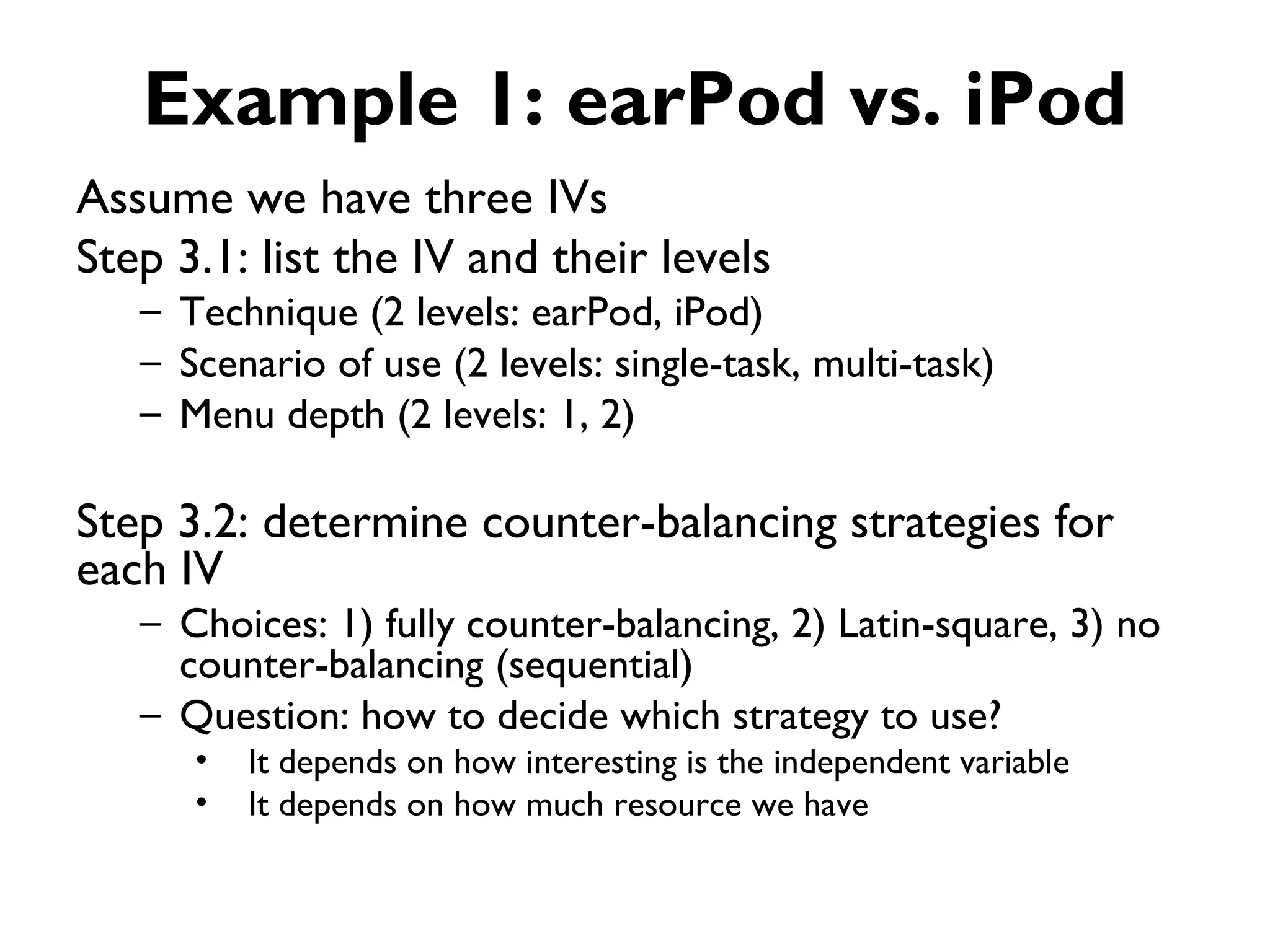
Assume we have three IVs
Step 3.1: list the IV and their levels
   – Technique (2 levels: earPod, iPod)
   – Scenario of use (2 levels: single-task, multi-task)
   – Menu depth (2 levels: 1, 2)

Step 3.2: determine counter-balancing strategies for
each IV
   – Choices: 1) fully counter-balancing, 2) Latin-square, 3) no
     counter-balancing (sequential)
   – Question: how to decide which strategy to use?
      •   It depends on how interesting is the independent variable
      •   It depends on how much resource we have
Example 1: earPod vs. iPod
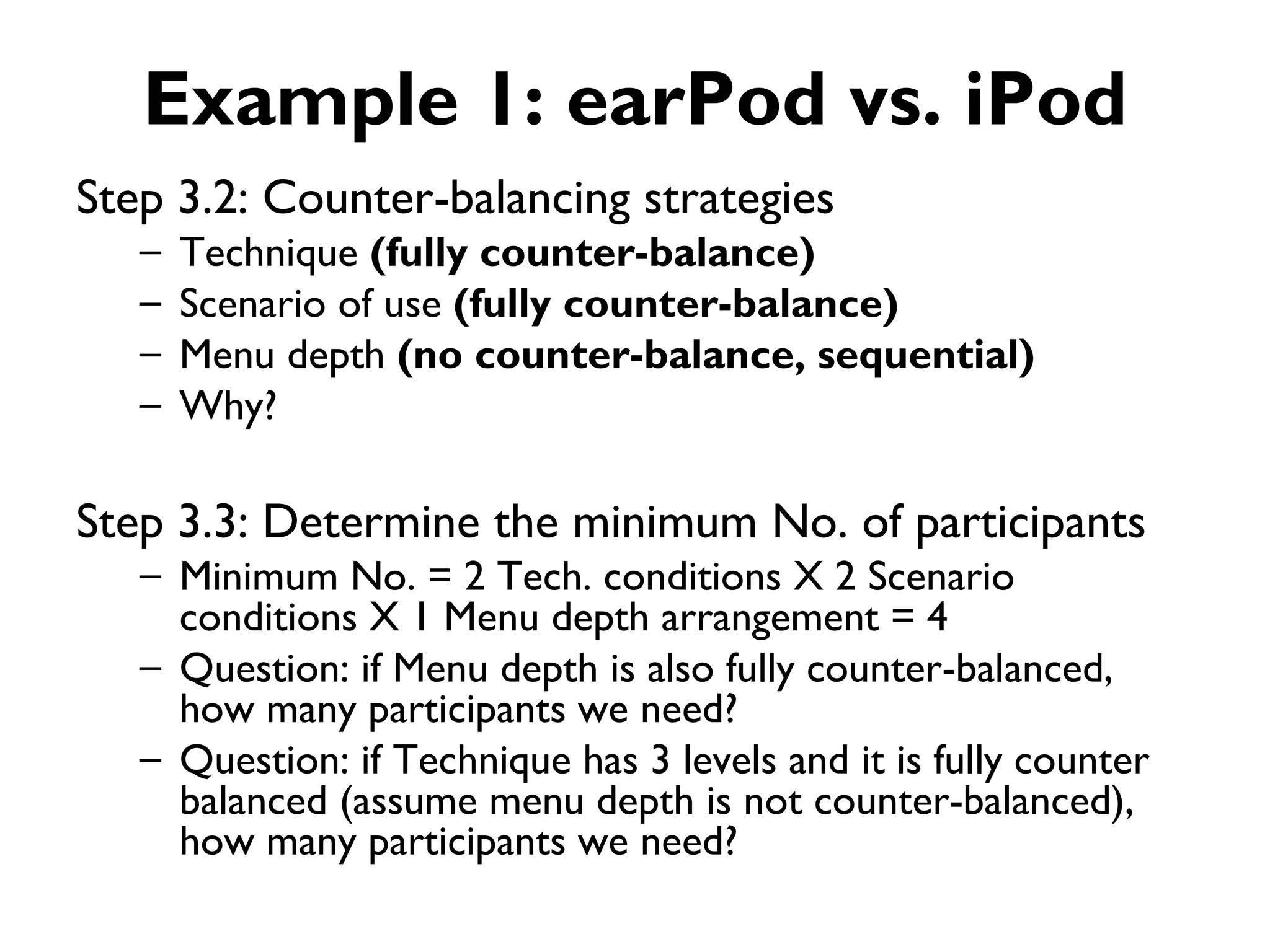
Step 3.2: Counter-balancing strategies
   –   Technique (fully counter-balance)
   –   Scenario of use (fully counter-balance)
   –   Menu depth (no counter-balance, sequential)
   –   Why?

Step 3.3: Determine the minimum No. of participants
   – Minimum No. = 2 Tech. conditions X 2 Scenario
     conditions X 1 Menu depth arrangement = 4
   – Question: if Menu depth is also fully counter-balanced,
     how many participants we need?
   – Question: if Technique has 3 levels and it is fully counter
     balanced (assume menu depth is not counter-balanced),
     how many participants we need?
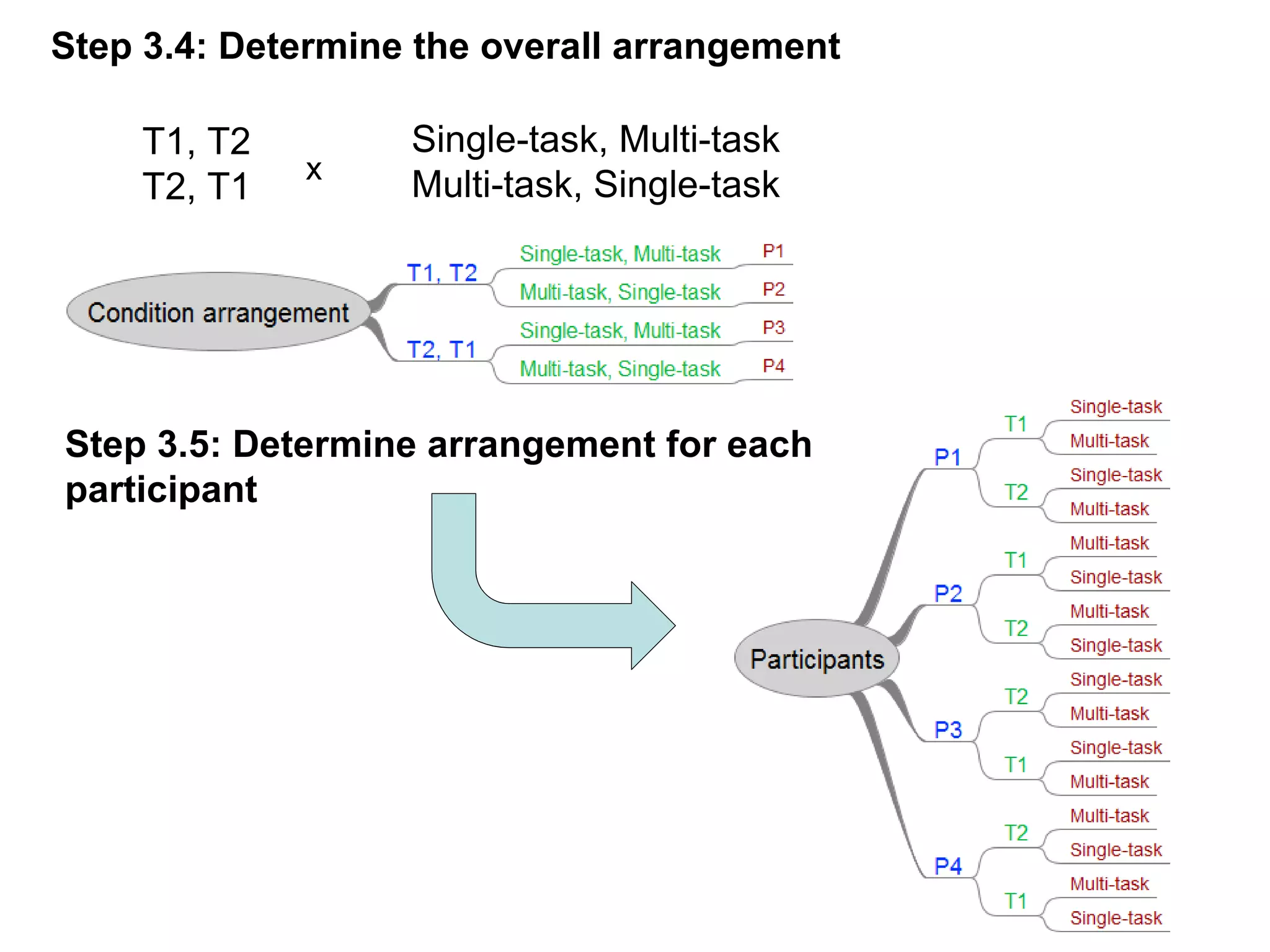
Step 3.4: Determine the overall arrangement

    T1, T2         Single-task, Multi-task
             x
    T2, T1         Multi-task, Single-task


Step 3.5: Determine arrangement for each
participant
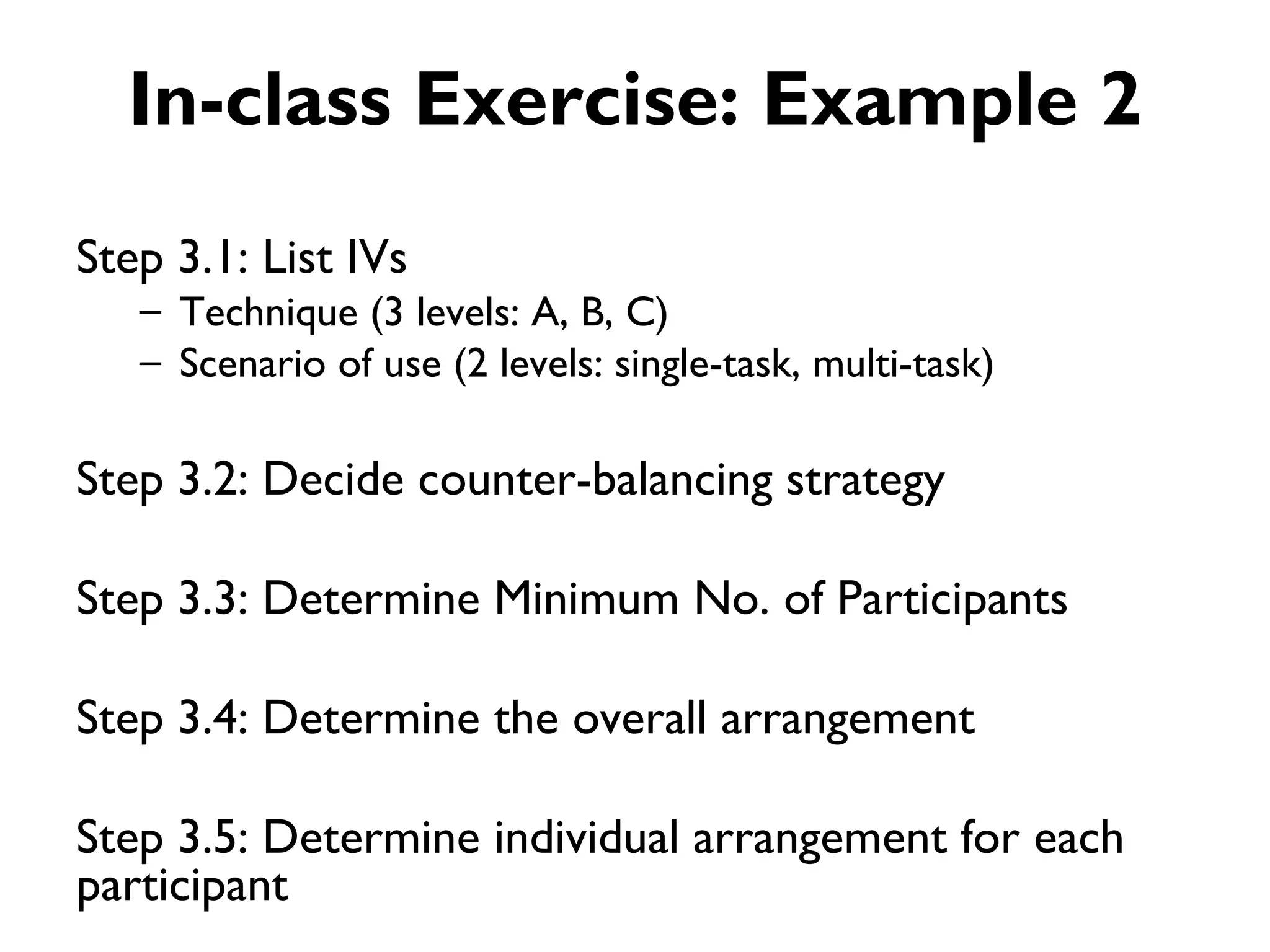
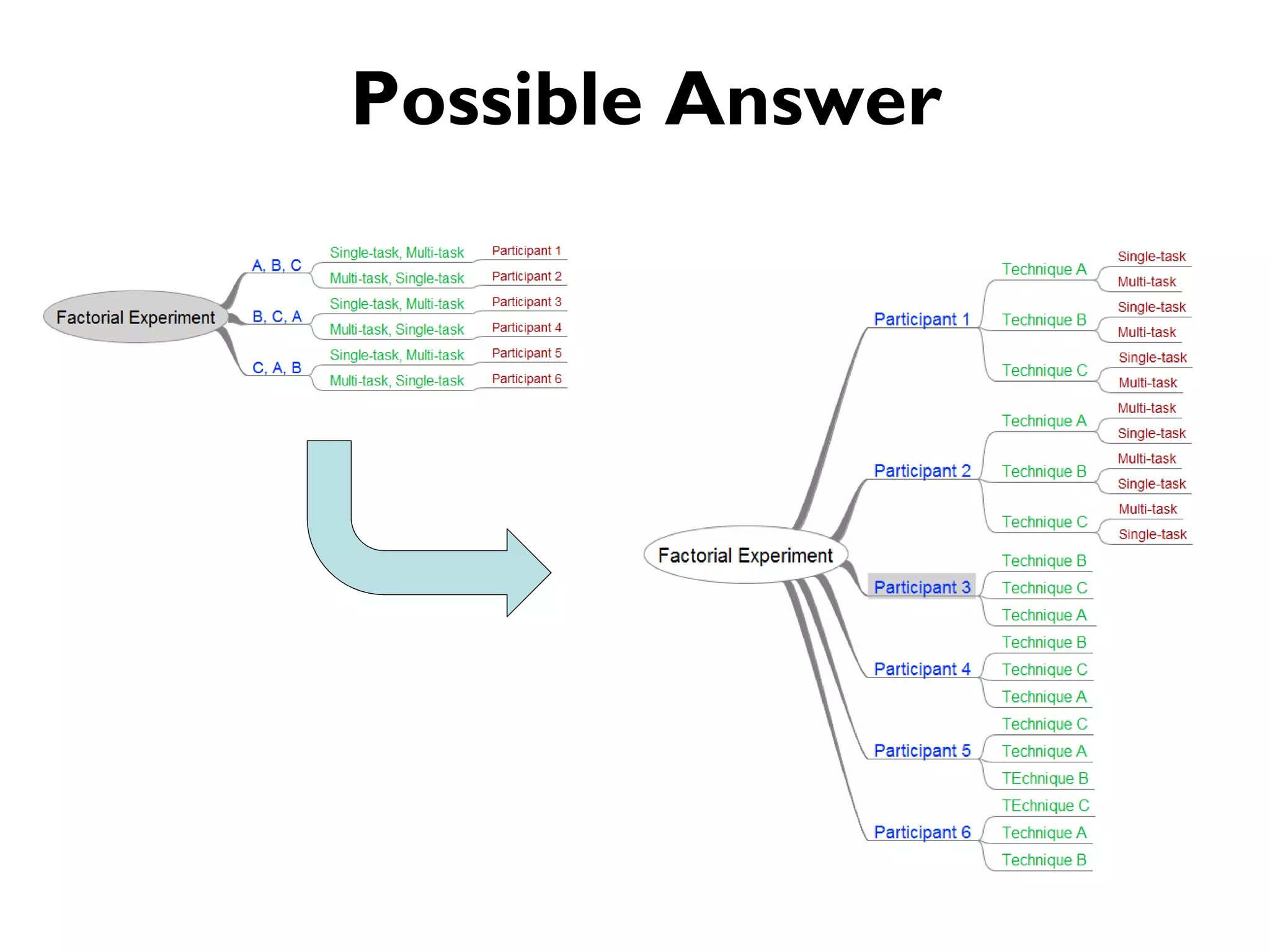
In-class Exercise: Example 2
Step 3.1: List IVs
   – Technique (3 levels: A, B, C)
   – Scenario of use (2 levels: single-task, multi-task)

Step 3.2: Decide counter-balancing strategy

Step 3.3: Determine Minimum No. of Participants

Step 3.4: Determine the overall arrangement

Step 3.5: Determine individual arrangement for each
participant
Possible Answer
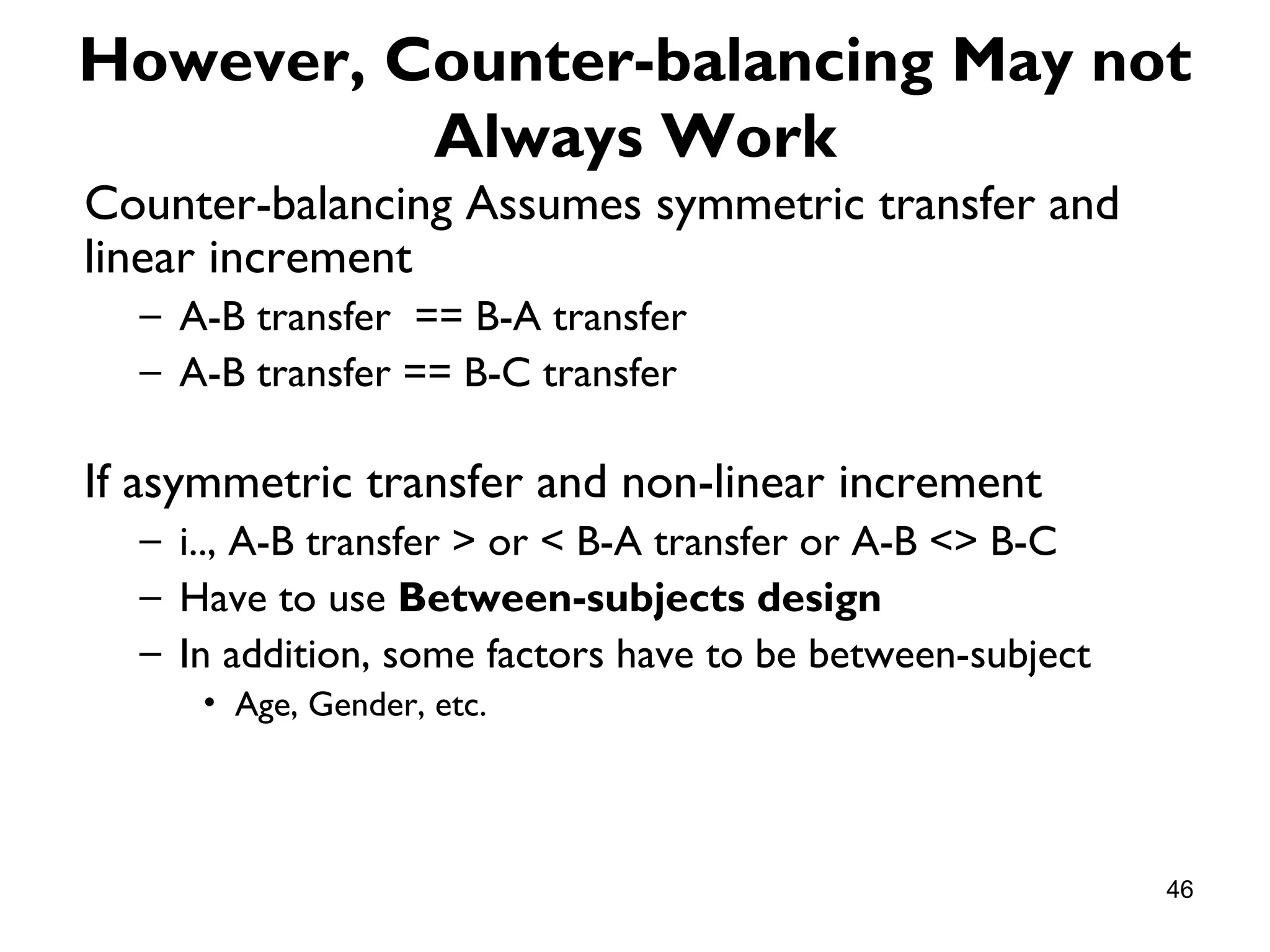
However, Counter-balancing May not
          Always Work
Counter-balancing Assumes symmetric transfer and
linear increment
  – A-B transfer == B-A transfer
  – A-B transfer == B-C transfer

If asymmetric transfer and non-linear increment
  – i.., A-B transfer > or < B-A transfer or A-B <> B-C
  – Have to use Between-subjects design
  – In addition, some factors have to be between-subject
     • Age, Gender, etc.


                                                           46
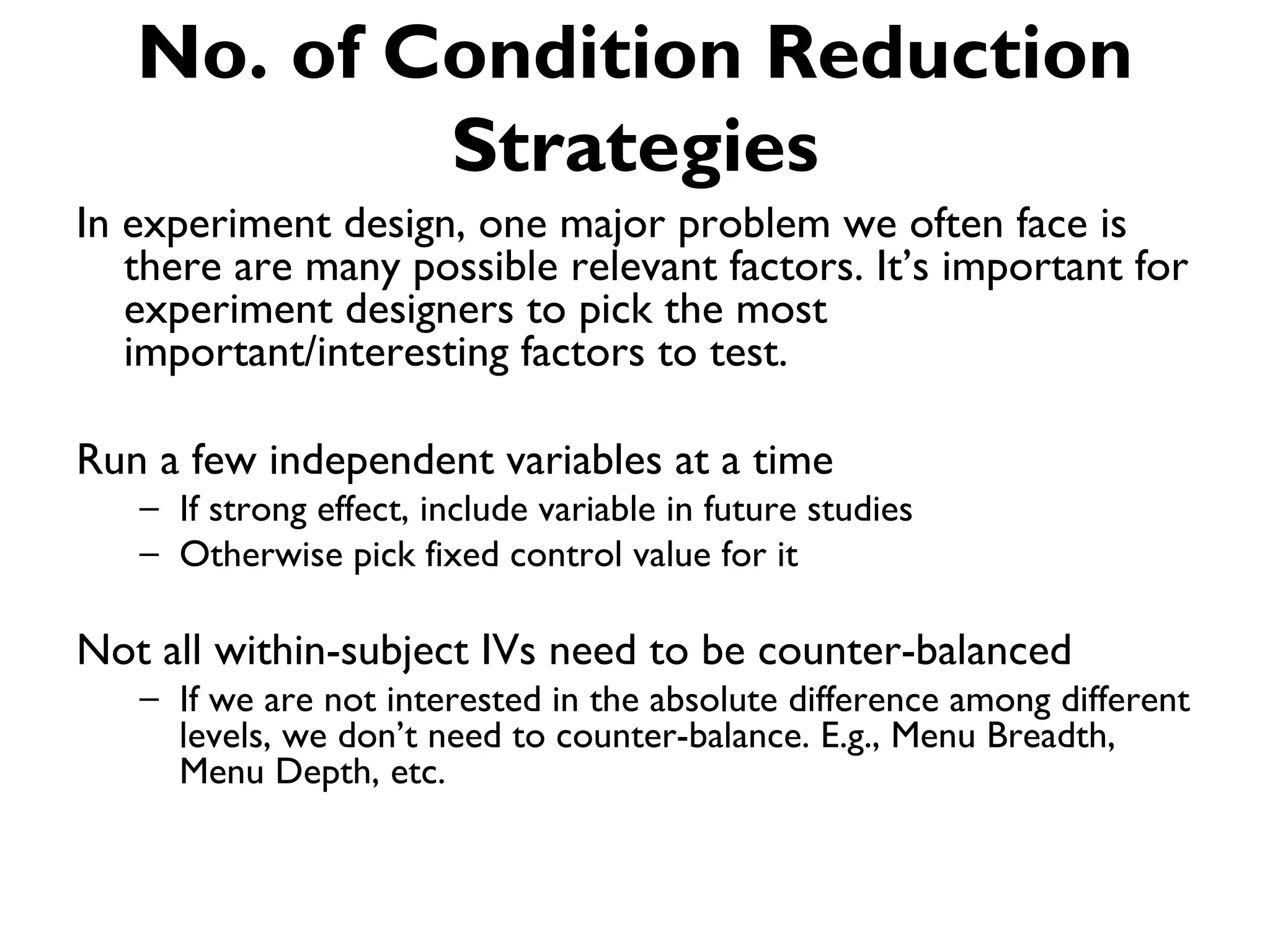
No. of Condition Reduction
           Strategies
In experiment design, one major problem we often face is
   there are many possible relevant factors. It’s important for
   experiment designers to pick the most
   important/interesting factors to test.

Run a few independent variables at a time
   – If strong effect, include variable in future studies
   – Otherwise pick fixed control value for it

Not all within-subject IVs need to be counter-balanced
   – If we are not interested in the absolute difference among different
     levels, we don’t need to counter-balance. E.g., Menu Breadth,
     Menu Depth, etc.
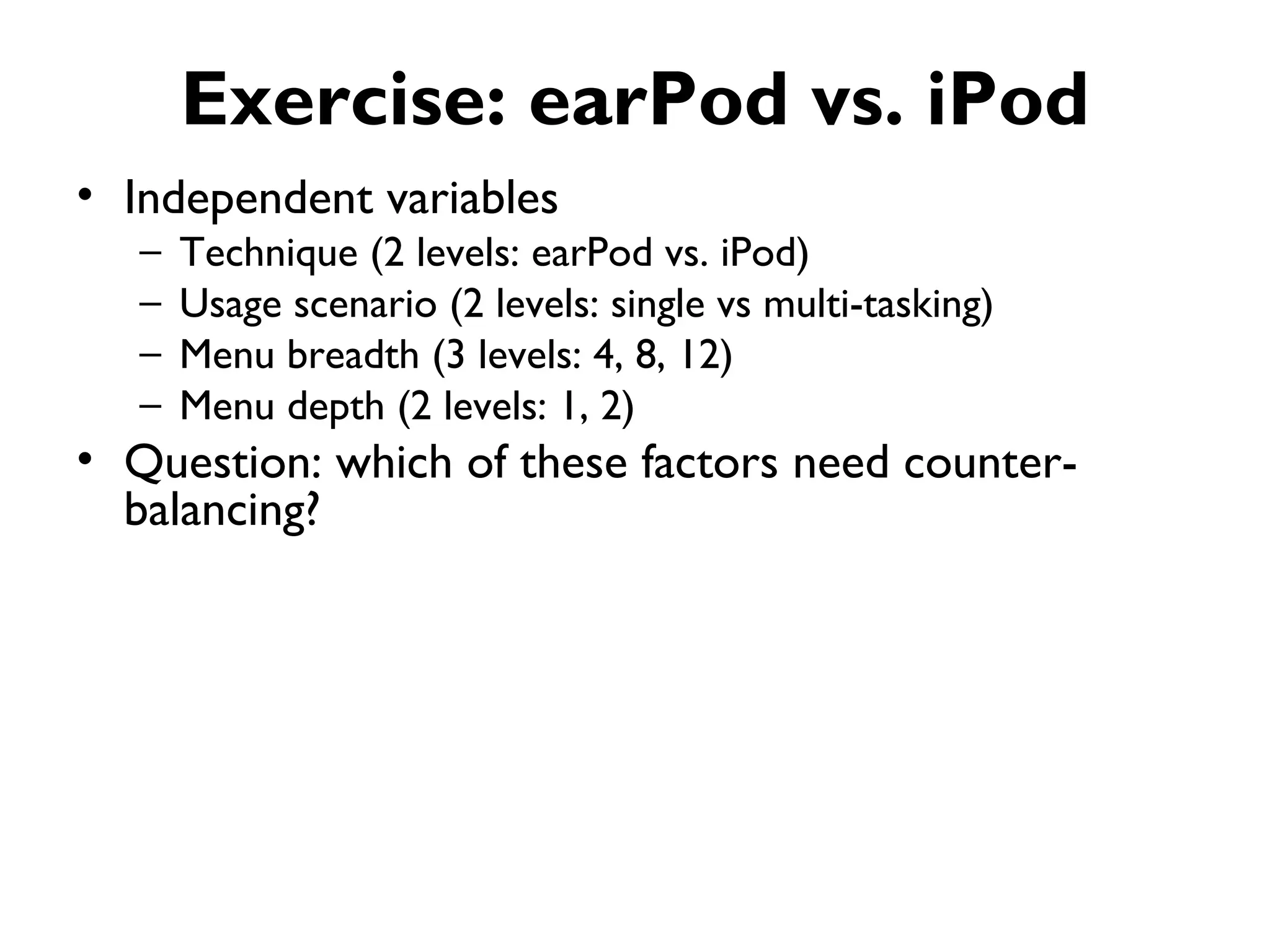
Exercise: earPod vs. iPod
• Independent variables
   –   Technique (2 levels: earPod vs. iPod)
   –   Usage scenario (2 levels: single vs multi-tasking)
   –   Menu breadth (3 levels: 4, 8, 12)
   –   Menu depth (2 levels: 1, 2)
• Question: which of these factors need counter-
  balancing?
Let’s Review: Between- vs.
     Within-Subject Design
• Method 1: use a lot of participants, randomly assign
  them to each technique (between-subject design)
   – Drawback: costly


• Method 2: use the same participant to test both
  techniques (within-subject design)
   – Drawback: practice effect
For Between-subject Design,
there is no need for counter-
    balancing, just assign
 different users to different
          conditions!
Steps for Arranging Conditions
    for Within-Subject Design
3.1: List all Independent Variables and their levels
3.2: Decide counter-balancing strategy for each variable
3.3: Determine the minimum No. of participants 3.4:
Arrange the overall design
3.5: Determine detailed arrangement for each
participant
The 5 Step Approach to
        Experiment Design
•   Define the research question
•   Determine variables
•   Arrange conditions
•   Decide blocks and trials
•   Set instruction and procedures
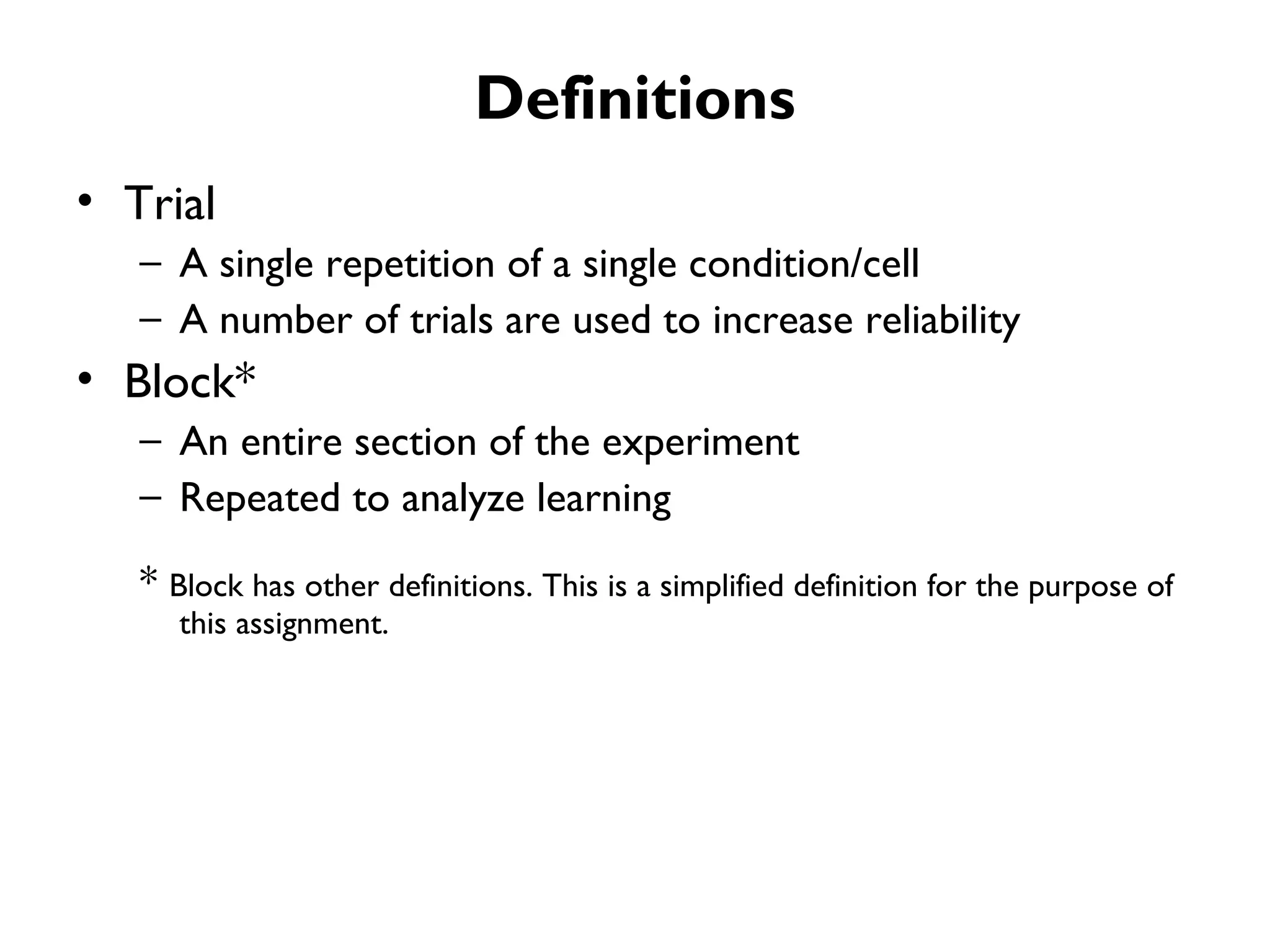
Definitions
• Trial
   – A single repetition of a single condition/cell
   – A number of trials are used to increase reliability
• Block*
   – An entire section of the experiment
   – Repeated to analyze learning

   * Block has other definitions. This is a simplified definition for the purpose of
      this assignment.
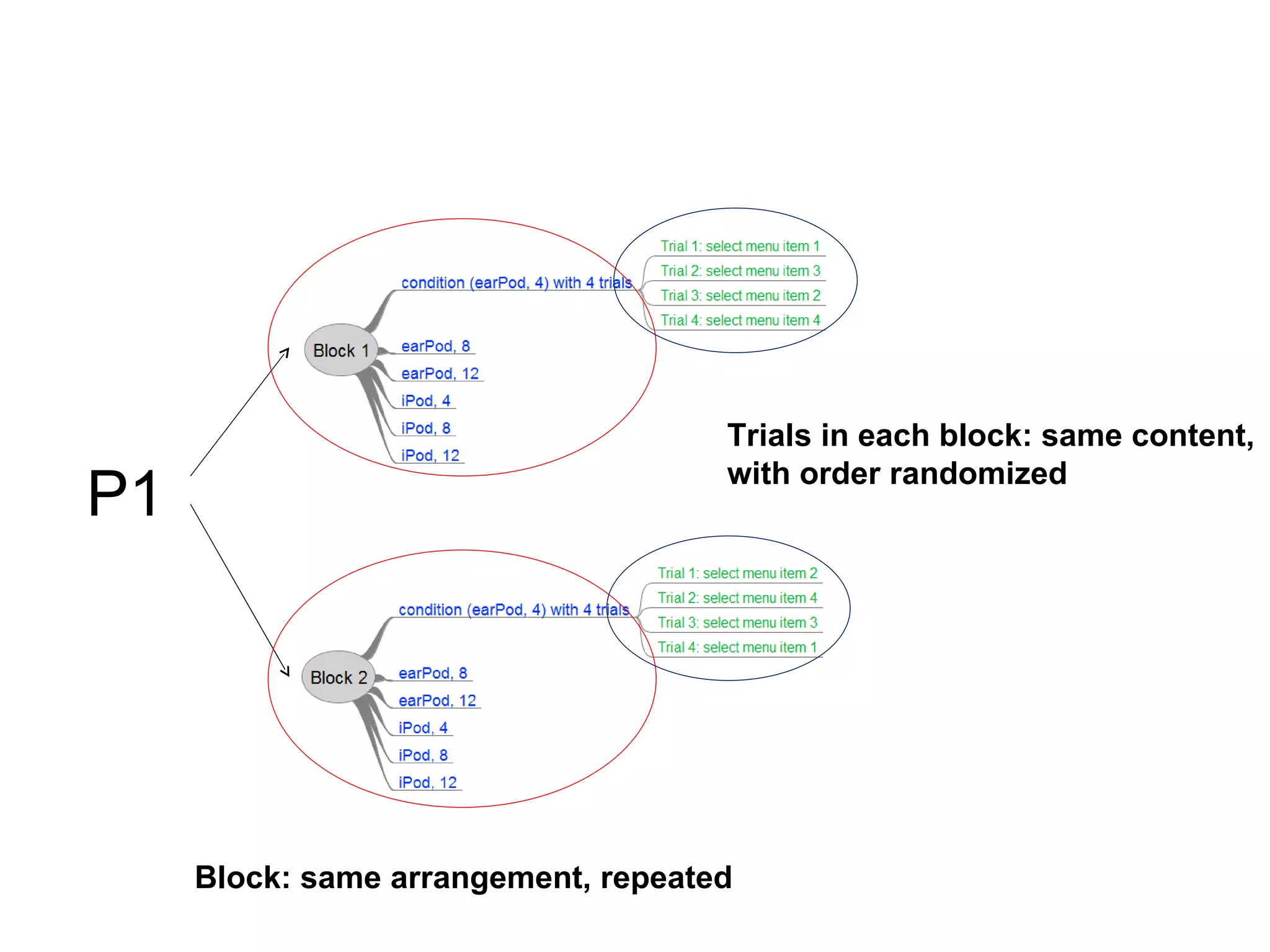
Trials in each block: same content,
                                     with order randomized
P1


     Block: same arrangement, repeated
Block Indicates Learning


 Adapted from the TiltText paper by Widgor & Balakrishnan
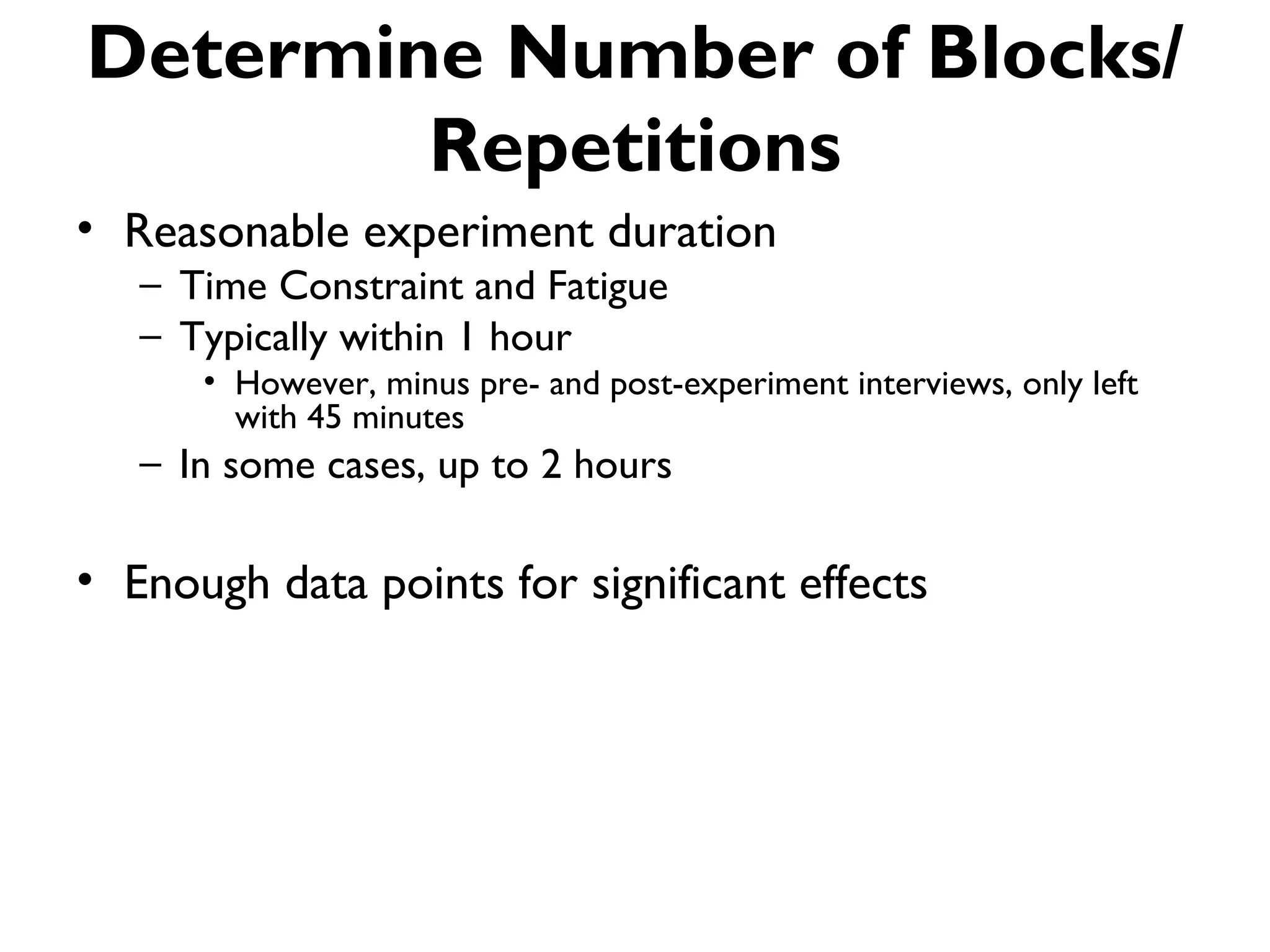
Determine Number of Blocks/
        Repetitions
• Reasonable experiment duration
   – Time Constraint and Fatigue
   – Typically within 1 hour
      • However, minus pre- and post-experiment interviews, only left
        with 45 minutes
   – In some cases, up to 2 hours

• Enough data points for significant effects
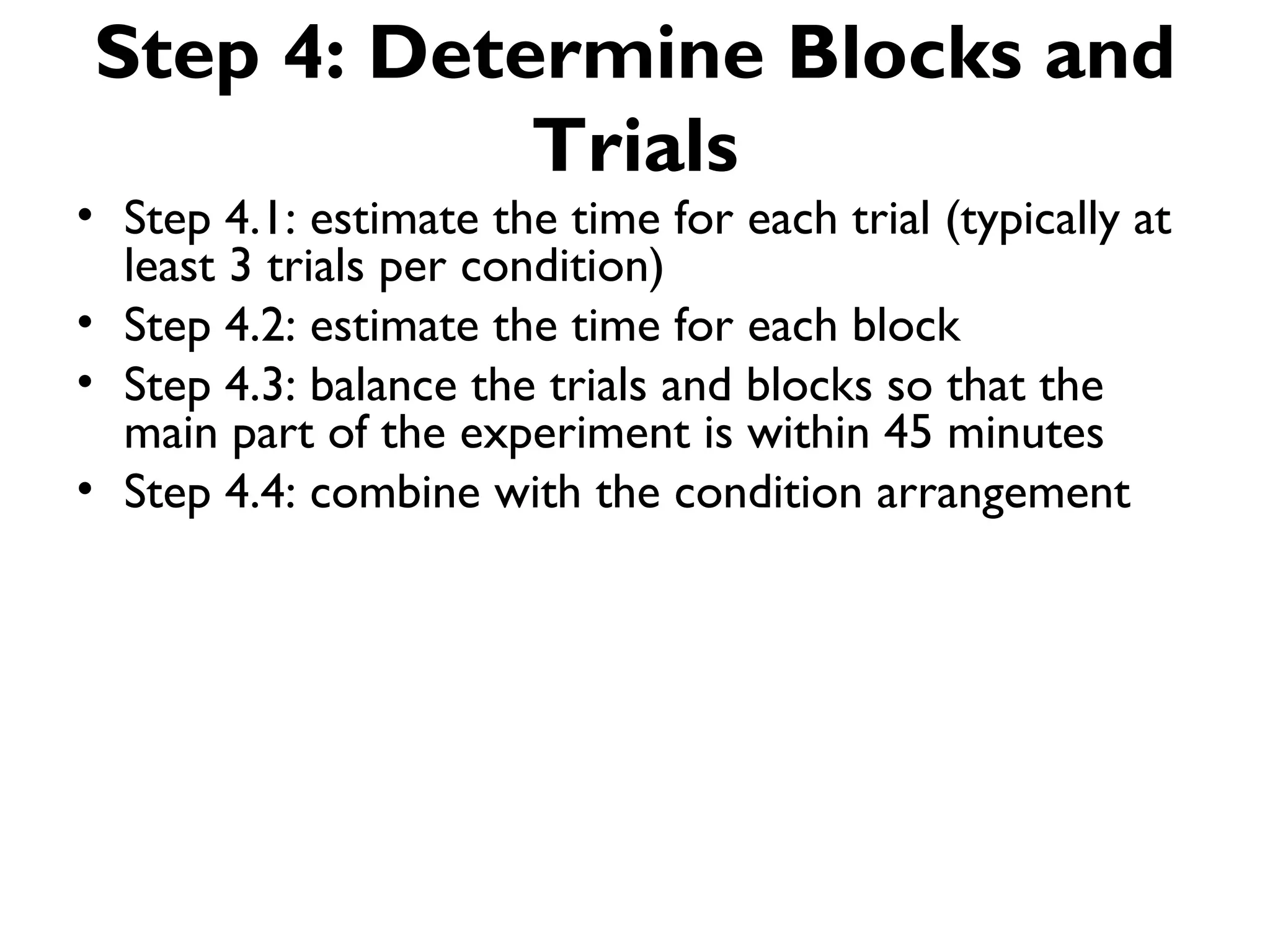
Step 4: Determine Blocks and
            Trials
• Step 4.1: estimate the time for each trial (typically at
  least 3 trials per condition)
• Step 4.2: estimate the time for each block
• Step 4.3: balance the trials and blocks so that the
  main part of the experiment is within 45 minutes
• Step 4.4: combine with the condition arrangement
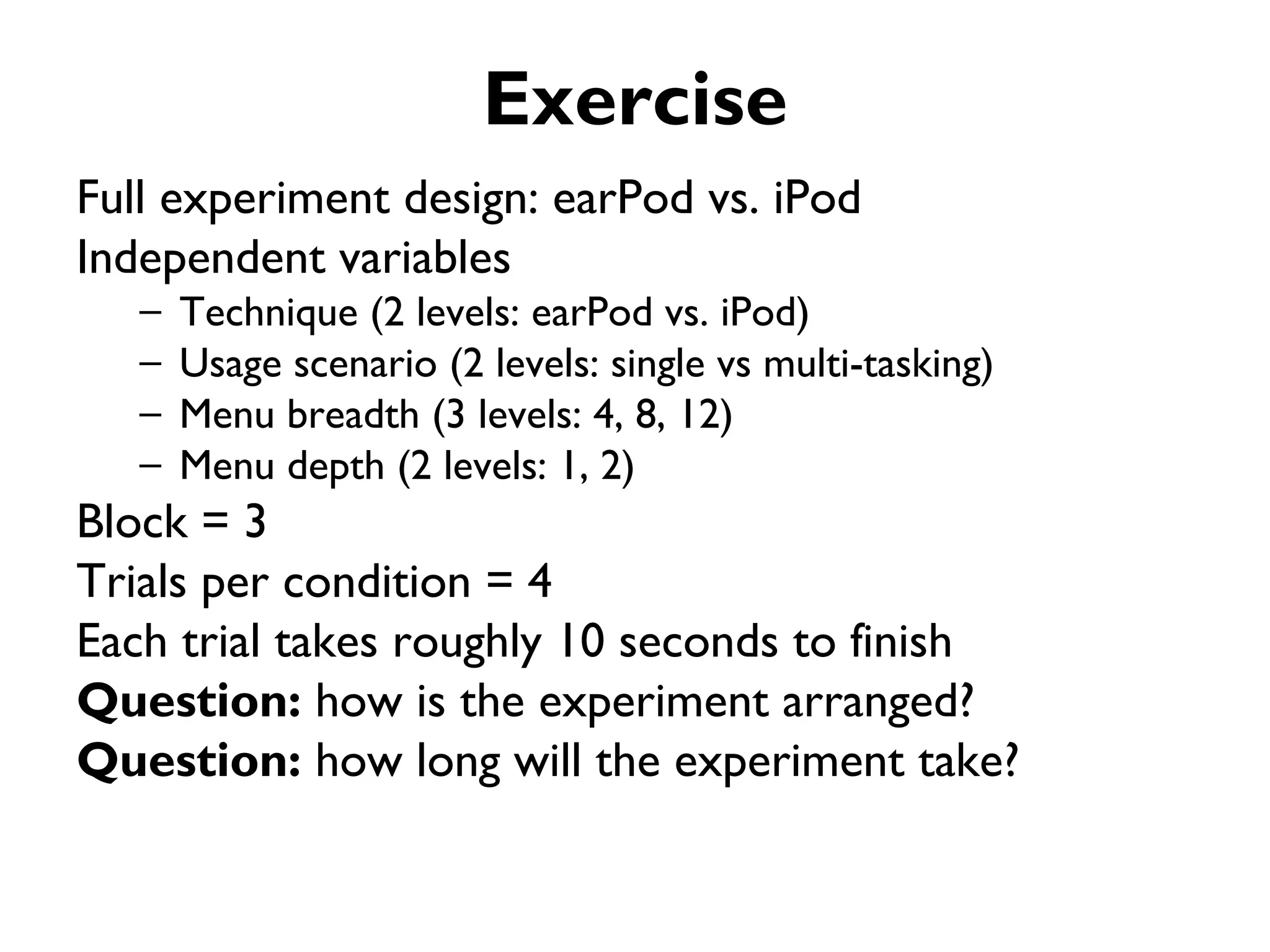
Exercise
Full experiment design: earPod vs. iPod
Independent variables
   –   Technique (2 levels: earPod vs. iPod)
   –   Usage scenario (2 levels: single vs multi-tasking)
   –   Menu breadth (3 levels: 4, 8, 12)
   –   Menu depth (2 levels: 1, 2)
Block = 3
Trials per condition = 4
Each trial takes roughly 10 seconds to finish
Question: how is the experiment arranged?
Question: how long will the experiment take?
The 5 Step Approach to
        Experiment Design
•   Define the research question
•   Determine variables
•   Arrange conditions
•   Decide blocks and trials
•   Set instruction and procedures
Detailed Steps
Step 5.1: Recruit participants (determine target users
and randomize)
Step 5.2: Consent form and pre-experiment
questionnaire
Step 5.3: Instructions
Step 5.4: Practice trials
Step 5.5: Main experiment with breaks
Step 5.6: Post-experiment questionnaire and interview
Step 5.7: Debriefing
Conducting the Experiment
Before the experiment
  – Have them read and sign the consent form
  – Explain the goal of the experiment
     • In a way accessible to users
     • Be careful about the demand characteristic
         – Participants biased towards experimenter’s hypothesis
  – Answer questions

During the experiment
  – Stay neutral
  – Never indicate displeasure with users performance

After the experiment
  – Debrief users
     • Inform users about the goal of the experiment
  – Answer any questions they have
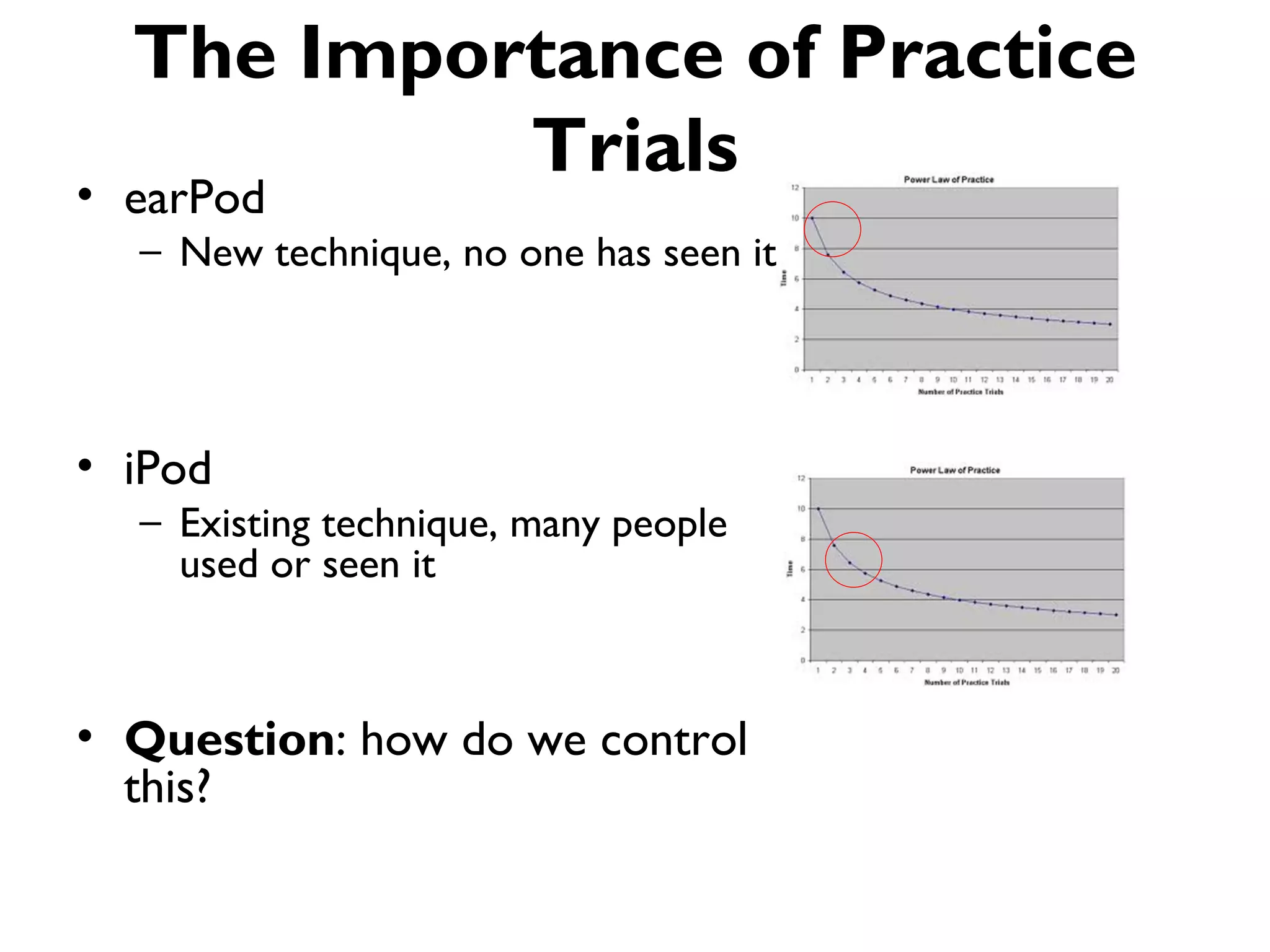
The Importance of Practice
           Trials
• earPod
  – New technique, no one has seen it


• iPod
  – Existing technique, many people
    used or seen it


• Question: how do we control
  this?
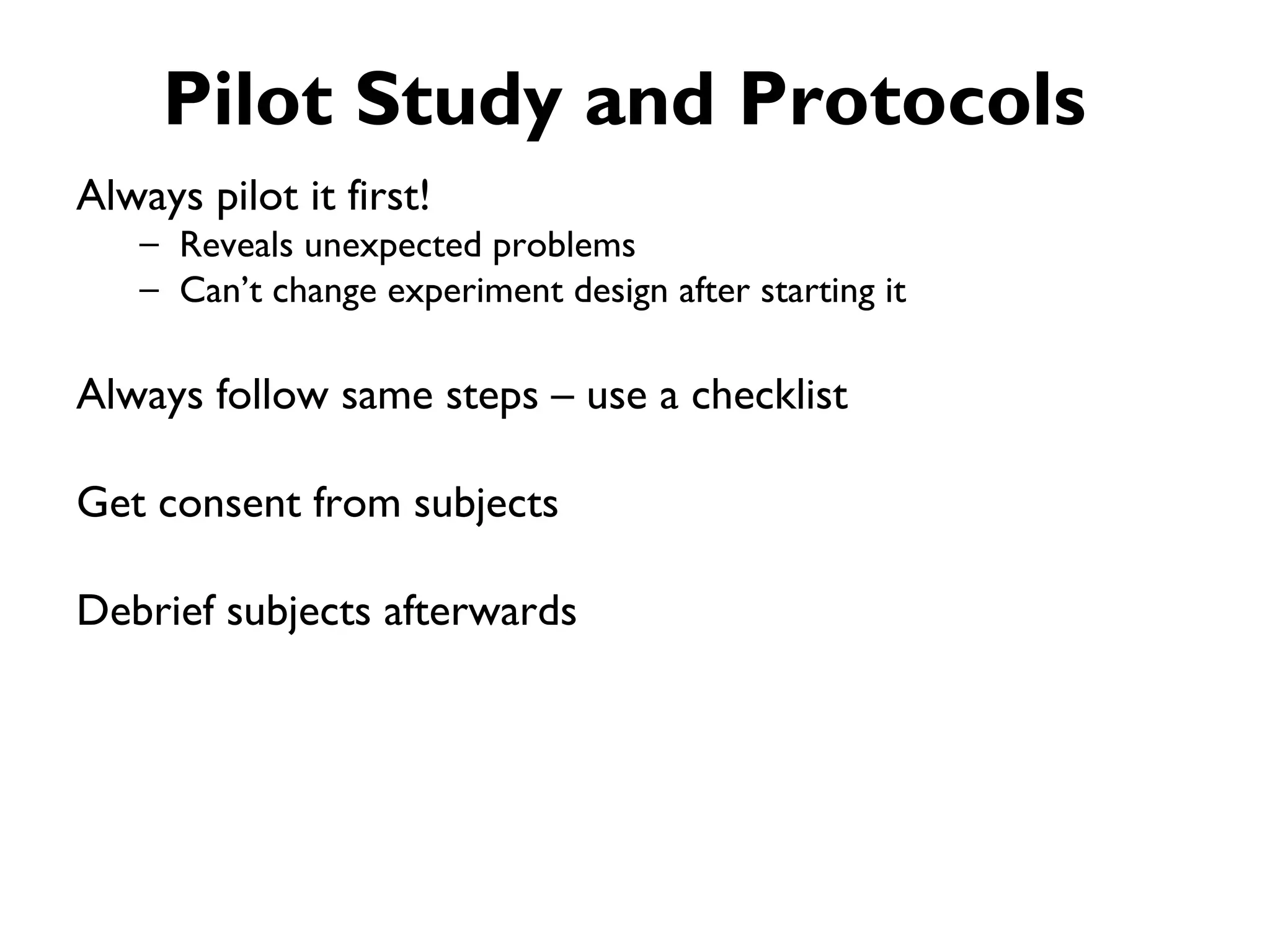
Pilot Study and Protocols
Always pilot it first!
   – Reveals unexpected problems
   – Can’t change experiment design after starting it

Always follow same steps – use a checklist

Get consent from subjects

Debrief subjects afterwards
Let’s Review the Entire
                Process
1.   Define the research question
2.   Determine variables
3.   Arrange conditions
4.   Decide blocks and trials
5.   Set instruction and procedures
Step 1: Define the Research
           Question
Define the research question has 4 sub-steps
Step 1.1 Start with a general question
Step 1.2 Define the target population
Step 1.3 Define task(s)
Step 1.4 Define measure(s)
Step 1.5 Define factor(s)
Step 2: Define Variables
Task Type & Factor       Independent variables


Measures                  Dependent variables


Everything else           Control/Random Vars.


Spot and remove confounding variables
Step 3: Arranging Conditions for
      Within-Subject Design
3.1: List all Independent Variables and their levels
3.2: Decide counter-balancing strategy for each variable
3.3: Determine the minimum No. of participants
3.4: Arrange the overall design
3.5: Determine detailed arrangement for each
participant
Step 4: Determine Blocks and
            Trials
• Step 4.1: estimate the time for each trial (typically at
  least 3 trials per condition)
• Step 4.2: estimate the time for each block
• Step 4.3: balance the trials and blocks so that the
  main part of the experiment is within 45 minutes
• Step 4.4: combine with the condition arrangement
Step 5: Set Introduction &
            Procedure
Step 5.1: Recruit participants (determine target users
and randomize)
Step 5.2: Consent form and pre-experiment
questionnaire
Step 5.3: Instructions
Step 5.4: Practice trials
Step 5.5: Main experiment with breaks
Step 5.6: Post-experiment questionnaire and interview
Step 5.7: Debriefing
Final Note
One of the challenges in experiment design is to decide
what to test (independent variables) and what to
measure (dependent variables). With the 5-Step
approach, things become much easier, but you still have
to make those tough decisions. When you face
difficulties, it’s always important to go back to your
research question and ask what exactly you want to
test in the experiment. This will help you to prioritize
your choices.
End

The 5-step Approach to Controlled Experiment Design for Human Computer Interaction

  • 1.
    The 5-Step Approachto Design Controlled Experiments Shengdong Zhao NUS-HCI Lab National University of Singapore This material is developed by Shengdong Zhao and colleagues. You are free to use the material as long as the original authors are acknowledged. 1
  • 2.
    Outline The 5 StepApproach to Experiment Design 2.Define the research question 3.Determine variables 4.Arrange conditions 5.Decide blocks and trials 6.Set instruction and procedures
  • 3.
    Let’s Start withan Example Problem earPod vs. iPod
  • 4.
  • 5.
  • 6.
  • 7.
  • 8.
    Visual vs. auditorymenu Visual Linear Menu IVR System 8
  • 9.
  • 10.
  • 11.
    Video • http://www.youtube.com/watch?v=bATkA0Usoio Paper – Shengdong Zhao, Pierre Dragicevic, Mark H. Chignell, Ravin Balakrishnan, Patrick Baudisch (2007).  earPod: Eyes-free Menu Selection with Touch Input and Reactiv . Proceedings of the ACM Conference on Human Factors in Computing Systems (CHI). pp. 1395-1404 11
  • 12.
  • 13.
    The 5 StepApproach to Experiment Design • Define the research question • Determine variables • Arrange conditions • Decide blocks and trials • Set instruction and procedures
  • 14.
    The 5 StepApproach to Experiment Design 1. Define the research question – Step 1.1 Start with a general question – Step 1.2 Define target population – Step 1.3 Define task(s) – Step 1.4 Define measure(s) – Step 1.5 Define factor(s) 2. Determine variables 3. Arrange conditions 4. Decide blocks and trials 5. Set instruction and procedures
  • 15.
    Step 1.1: Startwith a General Question How does earPod compare with iPod’s menu in terms of performance?
  • 16.
    Step 1.2: DefineTarget Population General question: How does earPod compare with iPod’s menu in terms of performance? Target population? Question: we designed earPod for whom?
  • 17.
    Step 1.3: DefineTask(s) General question: How does earPod compare with iPod’s menu in terms of performance? Task(s): menu selection However, the menu selection task has endless possibilities: single short menu, single long menu, hierarchical menus
  • 18.
    Step 1.3: DefineTask(s) Key insight: experiment design need to decide what subset of tasks is appropriate to test. Question: how do you choose the subset?
  • 19.
    Step 1.4: DefineMeasures Question: How does earPod compare with iPod’s menu in terms of performance? Measures: performance In HCI, we typically use three measures to quantify performance: – Speed – Accuracy – Learnability Key insight: need to define “testable” measures
  • 20.
    Step 1.5: Define(other) Factors with iPod’s menu in Question: How does earPod compare terms of performance? Factors: other than the different type of tasks, what other factors can influence the measures? Again: the number of factors are unlimited … •Scenario of use •Input device •Background of the user – Educational level – Gender – Ethnic background – Age – … Key insight: experiment design need to determine a subset of factors to test. Question: how to choose the factors?
  • 21.
    Let’s Review Step1 Step 1: Define the research question – Step 1.1: Start with a general question – Step 1.2: Define target population – Step 1.3: Define task(s) – Step 1.4: Define measure(s) – Step 1.5 Define factor(s)
  • 22.
    Let’s Practice Example 1:“earPod vs. iPod” 1.1: General Question – How does earPod compare with iPod’s menu in terms of performance? 1.2: Target Population – Young generation 1.3: Task(s)? – e.g., Menu selection for three types of breadth (4, 8, 12) and two types of depth (1, 2), content of the menu is from common categories 1.4: Measures? – Speed, accuracy, learning 1.5: (Other) Factors? – Single-task vs. multi-tasking – …
  • 23.
    Let’s Practice Again Example2: “Opti” vs. “Qwerty” Keyboard 1.1: General question – how does the “opti” keyboard layout compare with the “qwerty” keyboard in performance? 1.2: Target Population? – Computer users? 1.3: Task(s)? – Type “the quick brown fox jumps over the lazy dog” 1.4: Measure(s)? – Speed, accuracy, learning 1.5: (Other) Factors? – Device: Touch typing vs. stylus? – Screen size: different screen size?
  • 24.
    The 5 StepApproach to Experiment Design • Define the research question • Determine variables • Arrange conditions • Decide blocks and repetitions • Set instruction and trials
  • 25.
    Step 2: DefineVariables Type of variables •Independent variable (IV) – Factors that are manipulated in the experiment – Have multiple levels •Dependent variable (DV) – Factors which are measured •Control variable – Attributes that will be fixed throughout experiment – Confound – attribute that varied and was not accounted for • Problem: Confound rather than IV could have caused change in DVs – Confounds make it difficult/impossible to draw conclusions •Random variable – Attributes that are randomly sampled – Increases generalizability
  • 26.
    Type of IndependentVariables • Primary – The most important independent variable(s) that you want to investigate – For the question: “How does the earPod compare with iPod’s menu in terms of performance, the primary focus of interest is the different type of device/technique (earPod vs. iPod), so the primary IV is device/technique • Secondary – The other interesting factors you want to manipulate in the experiment. They help to answer the main question in a richer way. For example, a secondary IV for the earPod vs. iPod experiment will be the scenario of use (stationary vs. mobile). This variable helps to answer the primary question “how does earPod vs. iPod” in a richer way: earPod may work better in mobile while iPod better in stationary, etc.
  • 27.
    Task Type &Factor Independent variables Measures Dependent variables Everything else Control/Random Vars.
  • 28.
    Let’s Try Example 1:earPod vs. iPod •Independent variables – Technique • 2 levels (earPod vs. iPod) – usage scenario • 2 levels (single-task vs. dual-task) – menu breadth • 3 levels (4, 8, 12) – menu depth • 2 levels (1, 2) •Dependent variables – Speed (measured in completion time) – Accuracy (measured in percentage of errors) – Learning (measured in speed & accuracy change over time)
  • 29.
    Let’s Try Example 1:earPod vs. iPod •Control variables – Same computer, experiment time, environment, instruction, etc. •Random variables – Attributes of participants: age, gender, background, etc.
  • 30.
    Let’s Try Again Example2: “Opti” vs. “Qwerty” keyboard layout •Independent variables – Type of keyboard • 2 levels (opti vs. qwerty) – Input method • 2 levels (touch vs. stylus) – Screen size • 3 levels (watch, mobile phone, tablet) •Dependent variables – Speed (measured in word per minute) – Accuracy (measured in?) – Learning (measured in speed & accuracy change over time)
  • 31.
    Example 2 Example 2:“Opti” vs. “Qwerty” keyboard layout •Control variables – Same computer, experiment time, environment, instruction, etc. •Random variables – Attributes of participants: age, gender, background, etc.
  • 32.
    Confounding Variable Any variableother than the independent variables that can possibly explain the change in measures Example 1 – two techniques are compared (earPod, iPod) •All participants are tested on earPod, followed by iPod – Performance might improve due to practice – The order of presenting the technique is a confounding variable (because it explains the changes in measures but it is not an IV) Example 2 – two software interfaces are compared (Microsoft Word vs. new) •All participants have prior experience with Microsoft Word, but no experience with the new interface – “Prior experience” is a confounding variable Note: Order of presentation & Prior experience are two important confounding variables we need to control. More on this later …
  • 33.
    The 5 StepApproach to Experiment Design • Define the research question • Determine variables • Arrange conditions From Independent Variables to Experimental Conditions 4. Decide blocks and trials 5. Set instruction and procedures
  • 34.
    What is acondition? • Let’s start with an example • A particular independent variable “Technique” has two levels: earPod and iPod. – If it is the only independent variable considered, this experiment has two conditions • However, an experiment rarely only has 1 independent variable, suppose there is another independent variable “Menu Breadth” with 3 levels (4, 8, 12). – There are 2 (Techniques) x 3 (Menu Breadth) = 6 experimental conditions – The each unique combination of the different levels of the various independent variables (such as earPod, 4) is an experimental condition
  • 35.
    How can WeTest These Conditions? • Method 1: – Recruit 6 participants, one for each condition (this is also called between-subject design, which means the conditions are tested between different subjects) • P1: earPod, 4 • P2: earPod, 8 • P3: earPod, 12 • P4: iPod, 4 • P5: iPod, 8 • P6: iPod 12 – What’s the problem of this approach? • What about individual differences? • To balance individual differences, we need lots of participants • Key insight: this method is expensive
  • 36.
    How can WeTest It? • Method 2: – Recruit the same participants to test all 6 conditions (this is also called within-subject design since all conditions are tested within the same subject) – This method is much more economical – What’s the problem of this approach? • Practice (or order effect) as a confounding variable • However, in many cases, this effect can be controlled
  • 37.
    Control Order Effectusing Counter-balancing If we assume the order effect is symmetric, which means A -> B = B->A, and is linear, which means the increment between different conditions is about the same, we can use counter-balancing to cancel the effect out. E.g., we assume the transferring effect between (A after B) and (B after A) are both 10 Participant 1: A followed by B (A B) Participant 2: B followed by A (B A) Observation: the order effect equally affects both A and B, so the absolute relationship between A and B is not changed. However, a minimum number of participants is needed for counter-balancing to work
  • 38.
    Counter-balancing with 3 Levels What if an IV has 3 levels? A B C If the same assumption holds: assume effects are symmetric, and equal in size. We need to counter-balance as follows. P1: A B C P2: A C B P3: B A C P4: B C A P5: C A B P6: C B A What about 4 levels, 5 levels, 6 levels, …? 4 level = 4! (24), 5 levels = 5! (120), …
  • 39.
    Introducing Partial Counter- balancing: Latin Square Latin square: – Ensures each level appears in every position in order equally often: ABC BCA CAB Assume A-B = B-A = A-C = C-A = B- However, A-B = B-A = 10 C = C-B = 10 A-C = C-A = 20 P1: a + (b+10) + (c+20) B-C = C-B = 30 P2: b + (c+10) + (a+20) P1: a + (b+10) + (c+50) P3: c + (a+10) + (b+20) P2: b + (c+30) + (a+30) Average A = (3a +30)/3 = a + 10 P3: c + (a+20) + (b+40) Average B = (3b+30)/3 = b + 10 Average A = (3a +50)/3 = a + 50/3 Average C = (3c+30)/3 = c + 10 Average B = (3b+50)/3 = b + 50/3 Average C = (3c+80)/3 = c + 80/3 39
  • 40.
    Steps for ArrangingConditions for Within-Subject Design 3.1: List all Independent Variables and their levels 3.2: Decide counter-balancing strategy for each variable 3.3: Determine the minimum No. of participants 3.4: Arrange the overall design 3.5: Determine detailed arrangement for each participant
  • 41.
    Example 1: earPodvs. iPod Assume we have three IVs Step 3.1: list the IV and their levels – Technique (2 levels: earPod, iPod) – Scenario of use (2 levels: single-task, multi-task) – Menu depth (2 levels: 1, 2) Step 3.2: determine counter-balancing strategies for each IV – Choices: 1) fully counter-balancing, 2) Latin-square, 3) no counter-balancing (sequential) – Question: how to decide which strategy to use? • It depends on how interesting is the independent variable • It depends on how much resource we have
  • 42.
    Example 1: earPodvs. iPod Step 3.2: Counter-balancing strategies – Technique (fully counter-balance) – Scenario of use (fully counter-balance) – Menu depth (no counter-balance, sequential) – Why? Step 3.3: Determine the minimum No. of participants – Minimum No. = 2 Tech. conditions X 2 Scenario conditions X 1 Menu depth arrangement = 4 – Question: if Menu depth is also fully counter-balanced, how many participants we need? – Question: if Technique has 3 levels and it is fully counter balanced (assume menu depth is not counter-balanced), how many participants we need?
  • 43.
    Step 3.4: Determinethe overall arrangement T1, T2 Single-task, Multi-task x T2, T1 Multi-task, Single-task Step 3.5: Determine arrangement for each participant
  • 44.
    In-class Exercise: Example2 Step 3.1: List IVs – Technique (3 levels: A, B, C) – Scenario of use (2 levels: single-task, multi-task) Step 3.2: Decide counter-balancing strategy Step 3.3: Determine Minimum No. of Participants Step 3.4: Determine the overall arrangement Step 3.5: Determine individual arrangement for each participant
  • 45.
  • 46.
    However, Counter-balancing Maynot Always Work Counter-balancing Assumes symmetric transfer and linear increment – A-B transfer == B-A transfer – A-B transfer == B-C transfer If asymmetric transfer and non-linear increment – i.., A-B transfer > or < B-A transfer or A-B <> B-C – Have to use Between-subjects design – In addition, some factors have to be between-subject • Age, Gender, etc. 46
  • 47.
    No. of ConditionReduction Strategies In experiment design, one major problem we often face is there are many possible relevant factors. It’s important for experiment designers to pick the most important/interesting factors to test. Run a few independent variables at a time – If strong effect, include variable in future studies – Otherwise pick fixed control value for it Not all within-subject IVs need to be counter-balanced – If we are not interested in the absolute difference among different levels, we don’t need to counter-balance. E.g., Menu Breadth, Menu Depth, etc.
  • 48.
    Exercise: earPod vs.iPod • Independent variables – Technique (2 levels: earPod vs. iPod) – Usage scenario (2 levels: single vs multi-tasking) – Menu breadth (3 levels: 4, 8, 12) – Menu depth (2 levels: 1, 2) • Question: which of these factors need counter- balancing?
  • 49.
    Let’s Review: Between-vs. Within-Subject Design • Method 1: use a lot of participants, randomly assign them to each technique (between-subject design) – Drawback: costly • Method 2: use the same participant to test both techniques (within-subject design) – Drawback: practice effect
  • 50.
    For Between-subject Design, thereis no need for counter- balancing, just assign different users to different conditions!
  • 51.
    Steps for ArrangingConditions for Within-Subject Design 3.1: List all Independent Variables and their levels 3.2: Decide counter-balancing strategy for each variable 3.3: Determine the minimum No. of participants 3.4: Arrange the overall design 3.5: Determine detailed arrangement for each participant
  • 52.
    The 5 StepApproach to Experiment Design • Define the research question • Determine variables • Arrange conditions • Decide blocks and trials • Set instruction and procedures
  • 53.
    Definitions • Trial – A single repetition of a single condition/cell – A number of trials are used to increase reliability • Block* – An entire section of the experiment – Repeated to analyze learning * Block has other definitions. This is a simplified definition for the purpose of this assignment.
  • 54.
    Trials in eachblock: same content, with order randomized P1 Block: same arrangement, repeated
  • 55.
    Block Indicates Learning Adapted from the TiltText paper by Widgor & Balakrishnan
  • 56.
    Determine Number ofBlocks/ Repetitions • Reasonable experiment duration – Time Constraint and Fatigue – Typically within 1 hour • However, minus pre- and post-experiment interviews, only left with 45 minutes – In some cases, up to 2 hours • Enough data points for significant effects
  • 57.
    Step 4: DetermineBlocks and Trials • Step 4.1: estimate the time for each trial (typically at least 3 trials per condition) • Step 4.2: estimate the time for each block • Step 4.3: balance the trials and blocks so that the main part of the experiment is within 45 minutes • Step 4.4: combine with the condition arrangement
  • 58.
    Exercise Full experiment design:earPod vs. iPod Independent variables – Technique (2 levels: earPod vs. iPod) – Usage scenario (2 levels: single vs multi-tasking) – Menu breadth (3 levels: 4, 8, 12) – Menu depth (2 levels: 1, 2) Block = 3 Trials per condition = 4 Each trial takes roughly 10 seconds to finish Question: how is the experiment arranged? Question: how long will the experiment take?
  • 59.
    The 5 StepApproach to Experiment Design • Define the research question • Determine variables • Arrange conditions • Decide blocks and trials • Set instruction and procedures
  • 60.
    Detailed Steps Step 5.1:Recruit participants (determine target users and randomize) Step 5.2: Consent form and pre-experiment questionnaire Step 5.3: Instructions Step 5.4: Practice trials Step 5.5: Main experiment with breaks Step 5.6: Post-experiment questionnaire and interview Step 5.7: Debriefing
  • 61.
    Conducting the Experiment Beforethe experiment – Have them read and sign the consent form – Explain the goal of the experiment • In a way accessible to users • Be careful about the demand characteristic – Participants biased towards experimenter’s hypothesis – Answer questions During the experiment – Stay neutral – Never indicate displeasure with users performance After the experiment – Debrief users • Inform users about the goal of the experiment – Answer any questions they have
  • 62.
    The Importance ofPractice Trials • earPod – New technique, no one has seen it • iPod – Existing technique, many people used or seen it • Question: how do we control this?
  • 63.
    Pilot Study andProtocols Always pilot it first! – Reveals unexpected problems – Can’t change experiment design after starting it Always follow same steps – use a checklist Get consent from subjects Debrief subjects afterwards
  • 64.
    Let’s Review theEntire Process 1. Define the research question 2. Determine variables 3. Arrange conditions 4. Decide blocks and trials 5. Set instruction and procedures
  • 65.
    Step 1: Definethe Research Question Define the research question has 4 sub-steps Step 1.1 Start with a general question Step 1.2 Define the target population Step 1.3 Define task(s) Step 1.4 Define measure(s) Step 1.5 Define factor(s)
  • 66.
    Step 2: DefineVariables Task Type & Factor Independent variables Measures Dependent variables Everything else Control/Random Vars. Spot and remove confounding variables
  • 67.
    Step 3: ArrangingConditions for Within-Subject Design 3.1: List all Independent Variables and their levels 3.2: Decide counter-balancing strategy for each variable 3.3: Determine the minimum No. of participants 3.4: Arrange the overall design 3.5: Determine detailed arrangement for each participant
  • 68.
    Step 4: DetermineBlocks and Trials • Step 4.1: estimate the time for each trial (typically at least 3 trials per condition) • Step 4.2: estimate the time for each block • Step 4.3: balance the trials and blocks so that the main part of the experiment is within 45 minutes • Step 4.4: combine with the condition arrangement
  • 69.
    Step 5: SetIntroduction & Procedure Step 5.1: Recruit participants (determine target users and randomize) Step 5.2: Consent form and pre-experiment questionnaire Step 5.3: Instructions Step 5.4: Practice trials Step 5.5: Main experiment with breaks Step 5.6: Post-experiment questionnaire and interview Step 5.7: Debriefing
  • 70.
    Final Note One ofthe challenges in experiment design is to decide what to test (independent variables) and what to measure (dependent variables). With the 5-Step approach, things become much easier, but you still have to make those tough decisions. When you face difficulties, it’s always important to go back to your research question and ask what exactly you want to test in the experiment. This will help you to prioritize your choices.
  • 71.

Editor's Notes

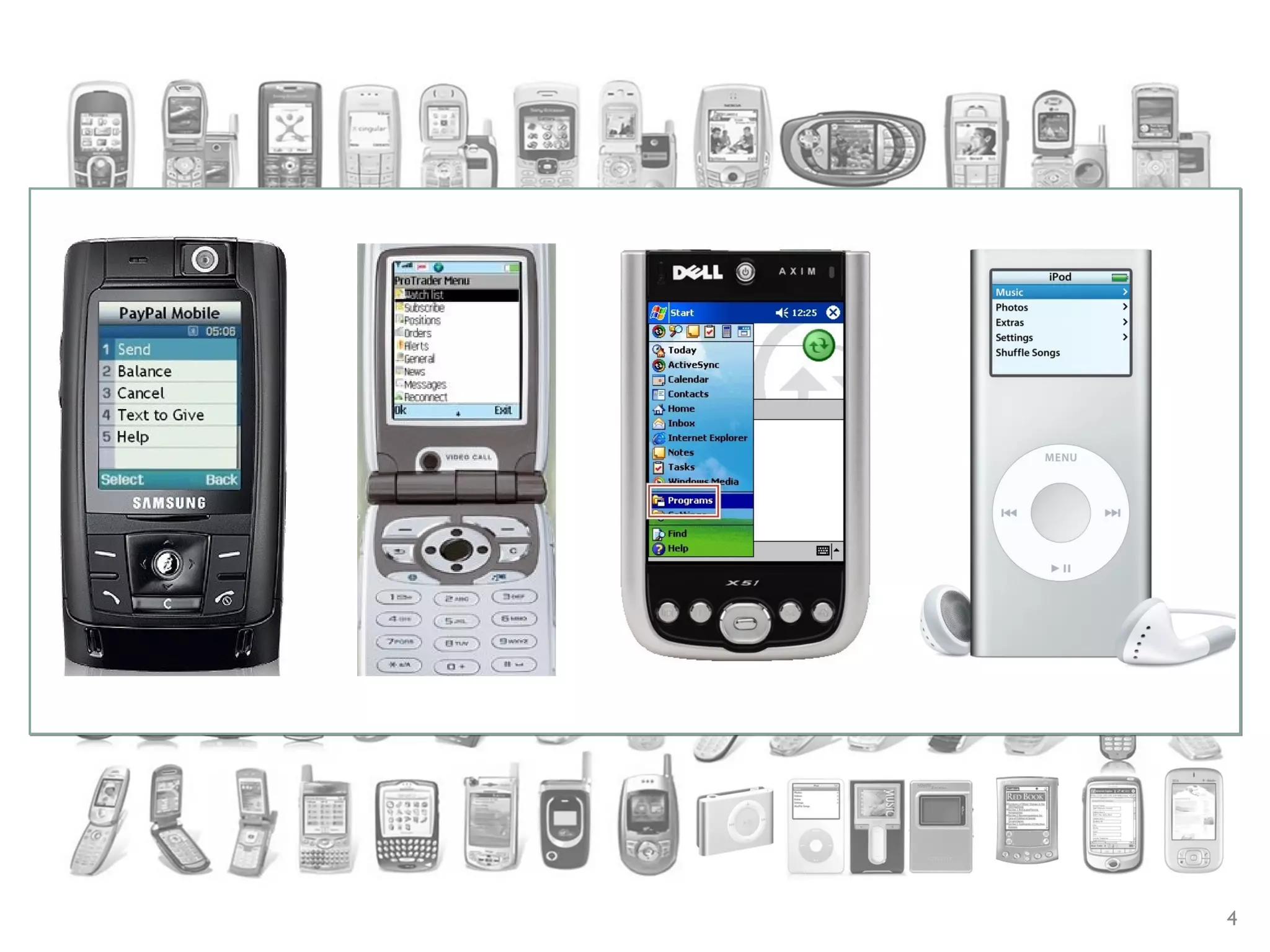
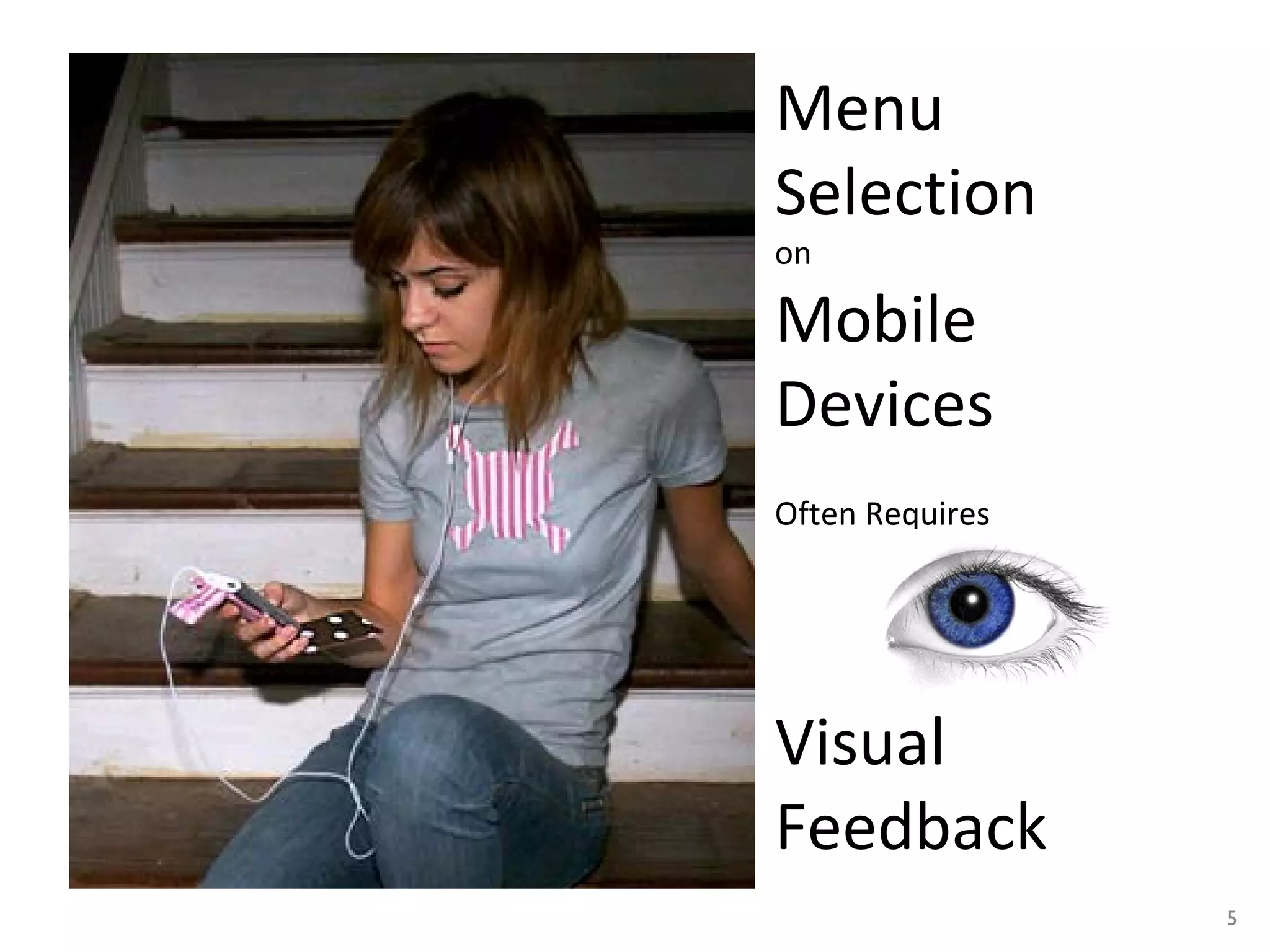
  • #5 Most of these mobile devices allow the users to use its rich features through a hierarchical menu
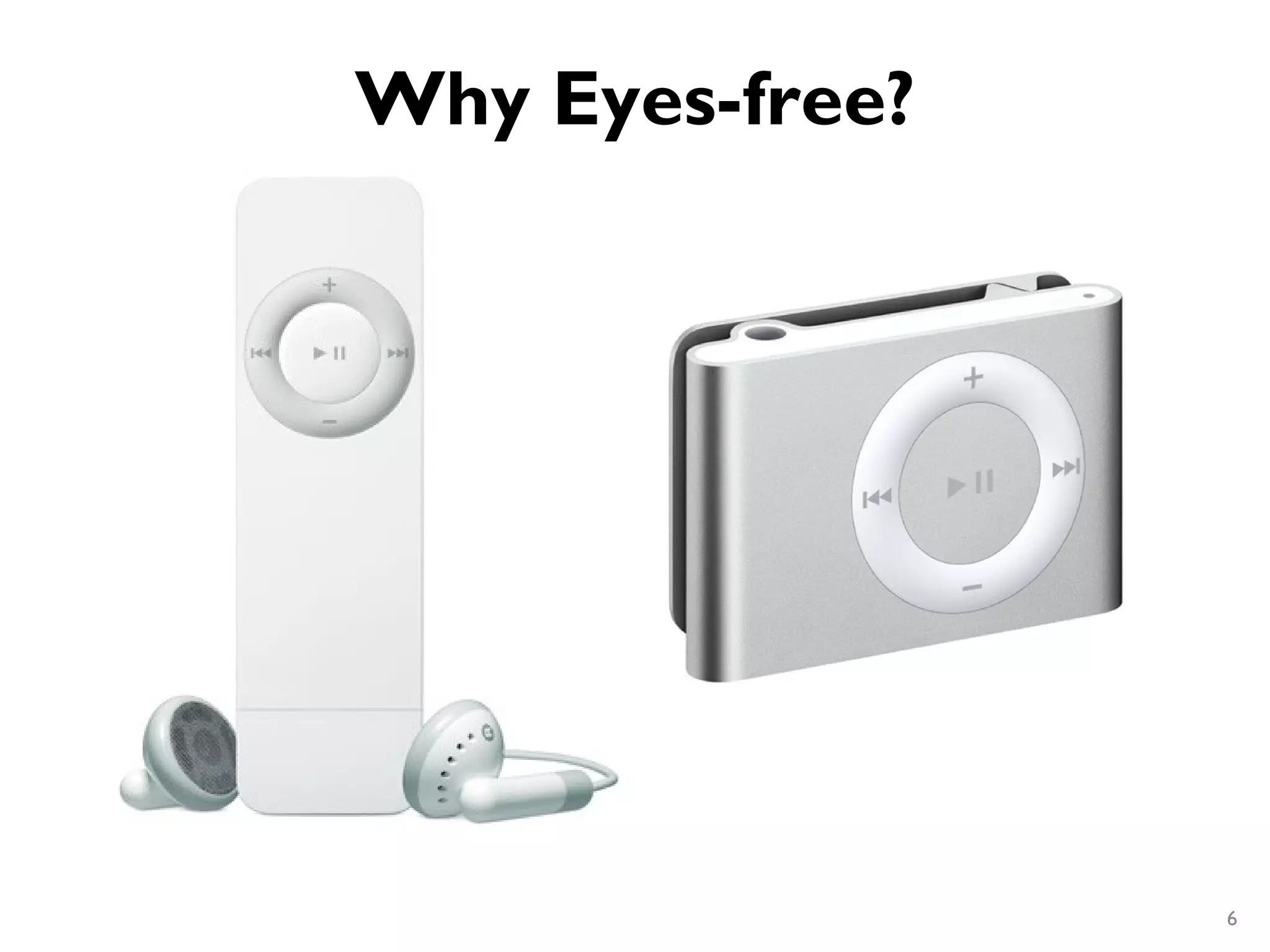
  • #6 However, almost all of them requires visual attention to operate. In mobile scenarios, visual attention or feedback is not always desirable or feasible due to a number of reasons.
  • #7 For example, to reduce the device form factor, and increase portability, or to reduce the cost, or save battery life, some mobile devices are build without a visual display.
  • #8 When you are in the mobile scenarios, such as walking, running, or driving, you need to pay attention to the environment, looking at the interface might be disruptive or even dangerous.
  • #9 Here is an IVR style menu. Please pay attention to how long it takes. Well it takes full 20 seconds, and it only has 4 to 5 options. It uses an imposed rate of presentation and user can’t scan and compare, so people have to rely on their short-term memory. The presentation rate will often be either too slow (e.g., when information is irrelevant) or too fast (e.g., when information is critical) for the user. No wonder they are called the “Touchtone Hell”. using audio to convey a list of choices requires users to adapt to an imposed rate of presentation and rely on their short-term memory. The presentation rate will often be either too slow (e.g., when information is irrelevant) or too fast (e.g., when information is critical) for the user.
  • #10 earPod uses a round touchpad as it’s input device which can be comfortably hold in hand, and it’s light weight and portable, so it can be used even inside the pocket.
  • #11 This area is divided into two zones. The outer zone is the dial which can be divided into many subsections, and each subsection will be mapped to particular menu item. The inner disc is reserved for specific functions such as canceling a selection. According to the previous studies in various marking menu settings. Commonly, we can divide the outer disk or the dial into 4, 8, or 12 subsections to allow best performance, which is the breadth of a menu.
  • #16 Talk about the scientific method a little here as well.
  • #17 For young people
  • #18 Question: are the selection performance the same for all positions in a menu? How about a short menu compared with a very long menu? What about hierarchical menus? -------------- To be comprehensive, we might need to test all positions in different size of menus and with different level of hierarchies, but is that possible? How to choose the subset? One way is to check for the most typical tasks performed. For example, if this is a menu designed for cellphone, it typically does not have many level of hierarchies, and each menu is not very long. There is no standard answer here. You have to use your judgment to argue the cases you selected is reasonable. What is the content of the menu? Do you use familiar words? Or not?
  • #19 Question: are the selection performance the same for all positions in a menu? How about a short menu compared with a very long menu? What about hierarchical menus? -------------- To be comprehensive, we might need to test all positions in different size of menus and with different level of hierarchies, but is that possible? How to choose the subset? One way is to check for the most typical tasks performed. For example, if this is a menu designed for cellphone, it typically does not have many level of hierarchies, and each menu is not very long. There is no standard answer here. You have to use your judgment to argue the cases you selected is reasonable. What is the content of the menu? Do you use familiar words? Or not?
  • #21 Again, the list can be endless Scenario of use (used at the desktop condition vs. driving vs. walking?) You want to see if there is any key insights.
  • #23 We can type 26 letters Common words? What kind of task can best reflect the target usage? Depending on the test
  • #26 Now, our goal is to check how these factors affect the performance of these measures in a given task But, how do we know these factors are the only factors to influence the condition? There can be a lot of other factors One key issue we need to consider is to eliminate the explanation of all possible factors so that the experiment can only be explained by the factors we manipulate Definition: a Confounding Variable is an extraneous variable whose presence affects the variables being studied so that the results you get do not reflect the actual relationship between the variables under investigation.
  • #31 There are different ways to measure errors (do we allow correction or not?) How do we count as an error? Percentage of letters entered wrongly /number of characters? Or does not really matter how many errors in one trial, as long as there is more than one letters wrong, it counts as an error for the trial. I performed an exercise here for students to try out. To list 3 independent variables 1 Primary independent variables
  • #32 There are different ways to measure errors (do we allow correction or not?) How do we count as an error? Percentage of letters entered wrongly /number of characters? Or does not really matter how many errors in one trial, as long as there is more than one letters wrong, it counts as an error for the trial.
  • #35 Now, given this, how can we test the 6 conditions?
  • #38 The real effect is P1 A = a B = b + 10 P2 B = b A = a+ 10 Average performance of A = (2a+10)/2 = a+5 Average performance of B = (2b+10)/2 = b+5 So if a &lt; b, after the experiment, after this experiment, the same result will be obtained However, this will not work A-B = 10 B-A = 20 P1 A = a B = b + 10 P2 B = b A = a+ 20 Average performance of A = (2a+20)/2 = a+10 Average performance of B = (2b+10)/2 = b+5 If a &lt; b, but after the experiment we conclude that A &gt; B.
  • #39 What if we have 4 techniques? A B C D e.g., mouse vs. touchpad vs. trackball vs. joystick vs. pen Fully counter-balancing requires 4x3x2 = 24 participants What if we have 5 techniques? A B C D E e.g., mouse vs. touchpad vs. trackball vs. joystick vs. pen Fully counter-balancing requires 5x4x3x2 = 120 participants
  • #40 Balanced Latin Squares do not exist for “odd” order squares, such as 3 x 3, 5 x 5, etc. However, it is possible to construct a balanced Latin square for any even number of conditions (see http://rintintin.colorado.edu/~chathach/balancedlatinsquares.html for instructions).
  • #41 Counter-balancing for one independent variable of multiple levels Full counter-balance Latin square What about counter-balancing multiple independent variables with multiple levels E.g., Technique (2 levels, earPod vs. iPod) Scenario (2 levels, single task vs. multi-tasking)
  • #42 This part needs a bit of introduction. Use fully counter-balancing when it is possible. However, most of the time, Latin-square will be sufficient. No counter-balancing can be used if we are not interested in knowing the absolute relationship between the different levels of an independent variable, but we are more interested to see if the results of another IV can be generalized to the different levels, and found out the rough trend in relationship with the primary IV. Remember to provide an example here.
  • #43 Answer: because we don’t care about the difference between menu depth. We only want to check to see if the main results or the difference between the other independent variables holds for the different menu depth; therefore, no counter-balancing of menu depth is needed. Answer 2: if menu depth is fully counter-balanced, it needs 2x2x2 = 8 participants Answer 3: if technique has 3 level and it is fully counter-balanced, it needs 6x2x1 = 12 or 6x2x2 = 24 participants (depending on menu depth is counter-balanced or not) Ask students to perform an exercise here.
  • #52 Counter-balancing for one independent variable of multiple levels Full counter-balance Latin square What about counter-balancing multiple independent variables with multiple levels E.g., Technique (2 levels, earPod vs. iPod) Scenario (2 levels, single task vs. multi-tasking)
  • #56 Same trials, repeated.
  • #62 Demand characteristic: the user s will be baised toward the hypothesis prefered by the experimenter Use a script
  • #63 Find participants who have never seen iPod before. Or provide enough practice
  • #68 Counter-balancing for one independent variable of multiple levels Full counter-balance Latin square What about counter-balancing multiple independent variables with multiple levels E.g., Technique (2 levels, earPod vs. iPod) Scenario (2 levels, single task vs. multi-tasking)