Dr. Zaheer Ahmad
Course Coordinator
Unit: 5
OBJECTIVES OF THE UNIT
 Explain the concept of scientific method
 Discuss the important steps involved in scientific method
 Describe the concept and significance of hypothesis
 Identify the different forms of hypothesis
 Specify the process of data collection
 Analyse the data analysis process
 Suggest ways of giving findings of a study
 State conclusions of the study
 Identify the problems involved in using scientific method
 Discuss the limitations of scientific method
THE SCIENTIFIC METHOD
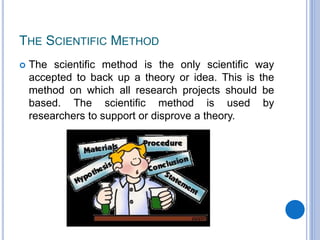
 The scientific method is the only scientific way
accepted to back up a theory or idea. This is the
method on which all research projects should be
based. The scientific method is used by
researchers to support or disprove a theory.
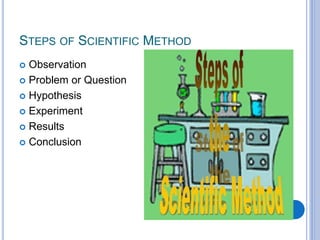
STEPS OF SCIENTIFIC METHOD
 Observation
 Problem or Question
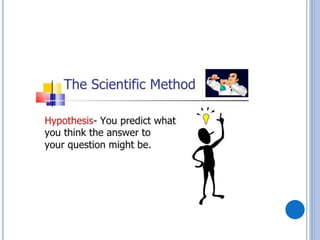
 Hypothesis
 Experiment
 Results
 Conclusion
CONTINUED OBSERVATION
 Observations based on senses or tools
 Sight, Smell, Touch etc.
 Observations of natural events usually raise a
question
 Why did the water rise when the candle went out?
 Research is usually done to help find out more about
the question raised
FORMULATING THE PROBLEM
 “To define a problem means to put a fence around it
to separate it by careful distinctions from the like
questions, found in related situations of need” (F.L.
Whitney)
A full definition of the problem helps:
1. Provide clear framework of the study
2. Enables the investigator to focus his attention on
relevant facts and conclusions.
3. Provide basis to the guide or advisor for guidance
and help
4. Provide basis for evaluation of the proposed
project.
CONSIDERATIONS IN IDENTIFYING THE
PROBLEM
 Problem area
 Significant problem
 Facilities available
 Guidance Facilities available
 Necessary competency
 Time factor
 Availability of the data
 Risks and the costs
 Possibility of the publication of the results
 A hypothesis tries to predict or determine the
outcome of your experiment even before the
experiment is done
 A proposition to be put to test to determine its
validity
 A tentative suggestion or provisional guess
 A tentative generalization the validity of which
remains to be tested
 A statement temporarily accepted as true.
 A guess to the probable outcome
 A statement whose tenability is to be tested.
IMPORTANCE OF HYPOTHESIS
 Gives help in deciding the direction in which to be
proceed
 It helps in selecting pertinent fact
 It helps in drawing conclusions
 It focuses research on specific points
 It links facts together
 It present blind research
 It serves as a guiding light.
DIFFERENT FORMS OF HYPOTHESIS
 Declarative form (state a relationship)
 Null hypothesis (state no relationship exist)
 Question form
CHARACTERISTICS OF THE HYPOTHESIS
 It should be testable
 It should state relationship between variables
 It should be limited in scope
 It should be considered with most known facts
 It should be stated as far as possible in simple
terms
 It should be amendable to testing within a
reasonable time.
TEST THE HYPOTHESIS
 Controlled Experiments are used to test a
hypothesis
 A controlled experiment is an experiment that
tests only one factor at a time by
 a control group is compared with an
experimental group. Variables are not changed
in the Control Group.
 Control groups allows you to see if a change in a
variable creates an observed outcome by
comparing the control group with the exp gp
 A variable is a factor that changes in a
controlled experiment. Variables are changed
in the Exp Group AND SERVE AS THE
FACTOR TESTED
VARIABLES
 INDEPENDENT
 The variable being changed in the experiment
 DEPENDENT
 The variable that responds to the changed independent
variable
 The variable being measured
 EX: growing plants with different amounts of
fertilizer
EXPERIMENT CONTINUED
 Scientists try to design experiments that will clearly
show whether a particular VARIABLE caused an
observed outcome
 IF IT CANNOT BE OBSERVED THEN IT CANNOT
BE TESTED!!!
 Can we test if a comet impact kill the dinosaurs? Why or Why
Not?
 Sometimes models are used to represent a real
object
 Used when it is difficult to control all of the variables or not
possible to test “the real thing”
COLLECTION OF DATA
 For two main sources of data in educational
research come from the inner world of library and
the outside world of living people, we may call
these two main sources simply the
 “paper” and
“people”.
RESEARCH TOOLS
 the instrument that are employed to gather new
facts or to explore new fields are called “tools”
 It is of vital importance to to select suitable
instrument or tool.
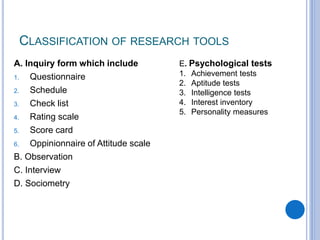
CLASSIFICATION OF RESEARCH TOOLS
A. Inquiry form which include
1. Questionnaire
2. Schedule
3. Check list
4. Rating scale
5. Score card
6. Oppinionnaire of Attitude scale
B. Observation
C. Interview
D. Sociometry
E. Psychological tests
1. Achievement tests
2. Aptitude tests
3. Intelligence tests
4. Interest inventory
5. Personality measures
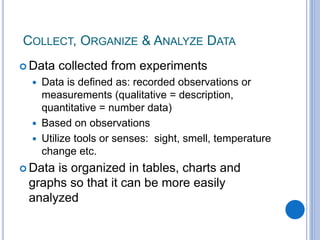
COLLECT, ORGANIZE & ANALYZE DATA
 Data collected from experiments
 Data is defined as: recorded observations or
measurements (qualitative = description,
quantitative = number data)
 Based on observations
 Utilize tools or senses: sight, smell, temperature
change etc.
 Data is organized in tables, charts and
graphs so that it can be more easily
analyzed
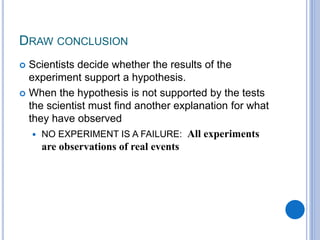
DRAW CONCLUSION
 Scientists decide whether the results of the
experiment support a hypothesis.
 When the hypothesis is not supported by the tests
the scientist must find another explanation for what
they have observed
 NO EXPERIMENT IS A FAILURE: All experiments
are observations of real events
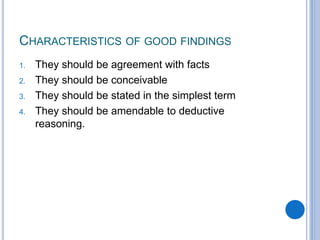
CHARACTERISTICS OF GOOD FINDINGS
1. They should be agreement with facts
2. They should be conceivable
3. They should be stated in the simplest term
4. They should be amendable to deductive
reasoning.
ERRORS TO AVOID FORMULATING FINDINGS.
 Finding should not be formulated on
unrepresentative data
 Not be formulated on selective data
 Not be formulated on incomplete data
 Not be formulated on insufficient data
 Illogical comparison should not be made
 Not be formulated on when they are inconsistent
among themselves or with external realities.
GUIDELINES FOR FORMULATING FINDINGS
1. Formulated on the basis of adequate and
complete data
2. Tested for agreement with facts
3. Stated in simple and precise terms
4. Answer the question asked in statement of
problem
5. Prove or disprove the hypothesis
6. Accept the limitations
7. Accompanied by suggestions for application
8. Accompanied by suggestions for problems for
further study and investigation.
COMMUNICATE THE RESULTS
 Results must be communicated in the form of a
written paper or presentation
 Communication helps other scientists performing
the same experiments to see if the results of your
experiment are the same as their results
 Helps people see if results are repeatable!
aiou code 837

aiou code 837

  • 1.
    Dr. Zaheer Ahmad CourseCoordinator Unit: 5
  • 2.
    OBJECTIVES OF THEUNIT  Explain the concept of scientific method  Discuss the important steps involved in scientific method  Describe the concept and significance of hypothesis  Identify the different forms of hypothesis  Specify the process of data collection  Analyse the data analysis process  Suggest ways of giving findings of a study  State conclusions of the study  Identify the problems involved in using scientific method  Discuss the limitations of scientific method
  • 4.
    THE SCIENTIFIC METHOD The scientific method is the only scientific way accepted to back up a theory or idea. This is the method on which all research projects should be based. The scientific method is used by researchers to support or disprove a theory.
  • 5.
    STEPS OF SCIENTIFICMETHOD  Observation  Problem or Question  Hypothesis  Experiment  Results  Conclusion
  • 7.
    CONTINUED OBSERVATION  Observationsbased on senses or tools  Sight, Smell, Touch etc.  Observations of natural events usually raise a question  Why did the water rise when the candle went out?  Research is usually done to help find out more about the question raised
  • 9.
    FORMULATING THE PROBLEM “To define a problem means to put a fence around it to separate it by careful distinctions from the like questions, found in related situations of need” (F.L. Whitney) A full definition of the problem helps: 1. Provide clear framework of the study 2. Enables the investigator to focus his attention on relevant facts and conclusions. 3. Provide basis to the guide or advisor for guidance and help 4. Provide basis for evaluation of the proposed project.
  • 10.
    CONSIDERATIONS IN IDENTIFYINGTHE PROBLEM  Problem area  Significant problem  Facilities available  Guidance Facilities available  Necessary competency  Time factor  Availability of the data  Risks and the costs  Possibility of the publication of the results
  • 12.
     A hypothesistries to predict or determine the outcome of your experiment even before the experiment is done  A proposition to be put to test to determine its validity  A tentative suggestion or provisional guess  A tentative generalization the validity of which remains to be tested  A statement temporarily accepted as true.  A guess to the probable outcome  A statement whose tenability is to be tested.
  • 13.
    IMPORTANCE OF HYPOTHESIS Gives help in deciding the direction in which to be proceed  It helps in selecting pertinent fact  It helps in drawing conclusions  It focuses research on specific points  It links facts together  It present blind research  It serves as a guiding light.
  • 14.
    DIFFERENT FORMS OFHYPOTHESIS  Declarative form (state a relationship)  Null hypothesis (state no relationship exist)  Question form
  • 15.
    CHARACTERISTICS OF THEHYPOTHESIS  It should be testable  It should state relationship between variables  It should be limited in scope  It should be considered with most known facts  It should be stated as far as possible in simple terms  It should be amendable to testing within a reasonable time.
  • 16.
    TEST THE HYPOTHESIS Controlled Experiments are used to test a hypothesis  A controlled experiment is an experiment that tests only one factor at a time by  a control group is compared with an experimental group. Variables are not changed in the Control Group.  Control groups allows you to see if a change in a variable creates an observed outcome by comparing the control group with the exp gp  A variable is a factor that changes in a controlled experiment. Variables are changed in the Exp Group AND SERVE AS THE FACTOR TESTED
  • 17.
    VARIABLES  INDEPENDENT  Thevariable being changed in the experiment  DEPENDENT  The variable that responds to the changed independent variable  The variable being measured  EX: growing plants with different amounts of fertilizer
  • 19.
    EXPERIMENT CONTINUED  Scientiststry to design experiments that will clearly show whether a particular VARIABLE caused an observed outcome  IF IT CANNOT BE OBSERVED THEN IT CANNOT BE TESTED!!!  Can we test if a comet impact kill the dinosaurs? Why or Why Not?  Sometimes models are used to represent a real object  Used when it is difficult to control all of the variables or not possible to test “the real thing”
  • 20.
    COLLECTION OF DATA For two main sources of data in educational research come from the inner world of library and the outside world of living people, we may call these two main sources simply the  “paper” and “people”.
  • 21.
    RESEARCH TOOLS  theinstrument that are employed to gather new facts or to explore new fields are called “tools”  It is of vital importance to to select suitable instrument or tool.
  • 22.
    CLASSIFICATION OF RESEARCHTOOLS A. Inquiry form which include 1. Questionnaire 2. Schedule 3. Check list 4. Rating scale 5. Score card 6. Oppinionnaire of Attitude scale B. Observation C. Interview D. Sociometry E. Psychological tests 1. Achievement tests 2. Aptitude tests 3. Intelligence tests 4. Interest inventory 5. Personality measures
  • 25.
    COLLECT, ORGANIZE &ANALYZE DATA  Data collected from experiments  Data is defined as: recorded observations or measurements (qualitative = description, quantitative = number data)  Based on observations  Utilize tools or senses: sight, smell, temperature change etc.  Data is organized in tables, charts and graphs so that it can be more easily analyzed
  • 27.
    DRAW CONCLUSION  Scientistsdecide whether the results of the experiment support a hypothesis.  When the hypothesis is not supported by the tests the scientist must find another explanation for what they have observed  NO EXPERIMENT IS A FAILURE: All experiments are observations of real events
  • 28.
    CHARACTERISTICS OF GOODFINDINGS 1. They should be agreement with facts 2. They should be conceivable 3. They should be stated in the simplest term 4. They should be amendable to deductive reasoning.
  • 29.
    ERRORS TO AVOIDFORMULATING FINDINGS.  Finding should not be formulated on unrepresentative data  Not be formulated on selective data  Not be formulated on incomplete data  Not be formulated on insufficient data  Illogical comparison should not be made  Not be formulated on when they are inconsistent among themselves or with external realities.
  • 30.
    GUIDELINES FOR FORMULATINGFINDINGS 1. Formulated on the basis of adequate and complete data 2. Tested for agreement with facts 3. Stated in simple and precise terms 4. Answer the question asked in statement of problem 5. Prove or disprove the hypothesis 6. Accept the limitations 7. Accompanied by suggestions for application 8. Accompanied by suggestions for problems for further study and investigation.
  • 31.
    COMMUNICATE THE RESULTS Results must be communicated in the form of a written paper or presentation  Communication helps other scientists performing the same experiments to see if the results of your experiment are the same as their results  Helps people see if results are repeatable!