The Scientific Method involves a series of
steps that are used to investigate a natural
occurrence.


        SCIENTIFIC
         METHOD
Steps in the Scientific
        Method
               Observation
               Hypothesis
               Experiment
               Conclusion
Observations

      Gathered
     through your
         senses
   Identifying and
    clearly defining
      the problem
Observations
   An example of an
    observation might
     be noticing that
    many salamanders
    near a pond have
       curved, not
      straight, tails
Hypothesis
   A suggested
    solution to the
    problem.
   Must be testable
   Sometimes written
    as If…Then…
    statements
   Predicts an
    outcome
Hypothesis
   An example of a
    hypothesis might
    be that the
    salamanders have
    curved tails due to
    a pollutant in the
    moist soil where
    they live.
Experiment
  A procedure to test
      the hypothesis.
 Conducting controlled

  attempts to test one
    or more hypotheses
   Includes recording

   and analyzing results
Experiment

 Variable –
factor in the
 experiment
that is being
   tested
Experiment

 A good or
    “valid”
 experiment
will only have
     ONE
   variable!
CONTROLS AND
  VARIABLES
Scientific Experiments Follow
            Rules
   An
    experimenter
    changes one
    factor and
    observes or
    measures what
    happens.
The Control
Variable/Group
The experimenter makes a
 special effort to keep other
 factors constant so that
 they will not effect the
 outcome.
 Those factors are called

 control/constant variables.
What is the Purpose of a
        Control?

  Controls are NOT being
   tested
  Controls are used for

   COMPARISON
Other Variables
   The factor that is changed is
    known as the independent
    variable.
   The factor that is measured or
    observed is called the dependent
    variable.
Example of Controls &
               Variables
   For example, suppose you want to figure
    out the fastest route to walk home from
    school.
   You will try several different routes and
    time how long it takes you to get home by
    each one.
   Since you are only interested in finding a
    route that is fastest for you, you will do
    the walking yourself.
What are the Variables in
   Your Experiment?
  Varying the route is the
   independent variable
  The time it takes is the

   dependent variable
  Keeping the same walker

   throughout makes the walker a
   control variable.
One more thing… it is best
to make several trials with
each independent variable.
VALID EXPERIMENTS
Remember: To be a Valid
         Experiment:
 Two groups are required ---
  the control & experimental
  groups
 There should be only one

  variable
Data
 Results of the
  experiment
 May be

  quantitative
  (numbers) or
  qualitative
Data
 Must be
  organized
 Can be

  organized into
  charts,
  tables, or
  graphs
Conclusion
   The answer to the
    hypothesis based on
    the data obtained
    from the experiment
   Formulating a
    generalization about
    the results, which
    may accept, reject or
    modify a hypothesis
Retest

In order to
 verify the
   results,
experiments
   must be
  retested.
Sample Problems
Let's say I have a problem: My car won't start. How would I use the
   scientific method to solve this problem?
    
  Problem: My car won’t start. I want it to start.
  Hypothesis: If I put gas in my car, it will start.
  Materials: 5 gallon gas can, 5 gallons gasoline, money to buy gasoline, a
   ride to the gas station
  Experiment: First, I will call my friend Bill and ask for a ride to the gas
   station. I will take the five gallon gas can and fill it with five gallons of
   gasoline at the pump. After paying the gas station owner for the
   gasoline, I will get a ride back to my car and put the gasoline in the
   tank. Once the gasoline is in the tank, I will attempt to restart the car.
  Results: The car started on the first try.
  Conclusion: When I put gas in my car, it started.
   Mr. Smithers believes that a special juice will increase the
    productivity of workers.
   He creates two groups of 50 workers each and assigns
    each group the same task (in this case, they're supposed
    to staple a set of papers.)
   Group A is given the special juice to drink while they work.
    Group B is not given the special juice.
   After an hour, Mr. Smithers counts how many stacks of
    papers each group has made. Group A made 1,587 stacks,
    Group B made 2,113 stacks.

    The control group of this example is Group B, because
    they are not given the special juice. They are just there
    for explaining the results. The experimental group of this
    example is Group A, because they are given the special
    juice. This is the factor that you are experimenting on.
Question         Independent     Dependent               Controlled
                 Variable        Variables               Variables
                 (What I         (What I                 (What I keep
                 Change)         Observe)                the same)
Who listens to   The groups      The amount of           Ask the
music the        receiving the   time that each          question in
most:            survey:         person listens          exactly the
teenagers or     teenagers or                            same way to
                                 to music per
their parents?   parents                                 each individual
                                 day measured

How fast does a Time measured     in hours
                                 Height of candle    •     Use same
candle burn?     in minutes      measured in               type of
                                 centimeters at            candle for
                                 regular intervals         every test
                                 of time (for        •     Wind--make
                                 example, every
                                                           sure there is
                                 five minutes)
                                                           none
REVIEW
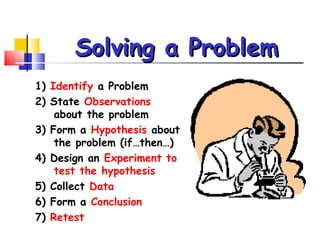
Solving a Problem
1) Identify a Problem
2) State Observations
    about the problem
3) Form a Hypothesis about
    the problem (if…then…)
4) Design an Experiment to
    test the hypothesis
5) Collect Data
6) Form a Conclusion
7) Retest
Scientific Method

Scientific Method

  • 1.
    The Scientific Methodinvolves a series of steps that are used to investigate a natural occurrence. SCIENTIFIC METHOD
  • 2.
    Steps in theScientific Method  Observation  Hypothesis  Experiment  Conclusion
  • 3.
    Observations  Gathered through your senses  Identifying and clearly defining the problem
  • 4.
    Observations  An example of an observation might be noticing that many salamanders near a pond have curved, not straight, tails
  • 5.
    Hypothesis  A suggested solution to the problem.  Must be testable  Sometimes written as If…Then… statements  Predicts an outcome
  • 6.
    Hypothesis  An example of a hypothesis might be that the salamanders have curved tails due to a pollutant in the moist soil where they live.
  • 7.
    Experiment  Aprocedure to test the hypothesis.  Conducting controlled attempts to test one or more hypotheses  Includes recording and analyzing results
  • 8.
    Experiment Variable – factorin the experiment that is being tested
  • 9.
    Experiment A goodor “valid” experiment will only have ONE variable!
  • 10.
    CONTROLS AND VARIABLES
  • 11.
    Scientific Experiments Follow Rules  An experimenter changes one factor and observes or measures what happens.
  • 12.
    The Control Variable/Group The experimentermakes a special effort to keep other factors constant so that they will not effect the outcome.  Those factors are called control/constant variables.
  • 13.
    What is thePurpose of a Control?  Controls are NOT being tested  Controls are used for COMPARISON
  • 14.
    Other Variables  The factor that is changed is known as the independent variable.  The factor that is measured or observed is called the dependent variable.
  • 15.
    Example of Controls& Variables  For example, suppose you want to figure out the fastest route to walk home from school.  You will try several different routes and time how long it takes you to get home by each one.  Since you are only interested in finding a route that is fastest for you, you will do the walking yourself.
  • 16.
    What are theVariables in Your Experiment?  Varying the route is the independent variable  The time it takes is the dependent variable  Keeping the same walker throughout makes the walker a control variable.
  • 17.
    One more thing…it is best to make several trials with each independent variable.
  • 18.
  • 19.
    Remember: To bea Valid Experiment:  Two groups are required --- the control & experimental groups  There should be only one variable
  • 20.
    Data  Results ofthe experiment  May be quantitative (numbers) or qualitative
  • 21.
    Data  Must be organized  Can be organized into charts, tables, or graphs
  • 22.
    Conclusion  The answer to the hypothesis based on the data obtained from the experiment  Formulating a generalization about the results, which may accept, reject or modify a hypothesis
  • 23.
    Retest In order to verify the results, experiments must be retested.
  • 24.
    Sample Problems Let's sayI have a problem: My car won't start. How would I use the scientific method to solve this problem?    Problem: My car won’t start. I want it to start.  Hypothesis: If I put gas in my car, it will start.  Materials: 5 gallon gas can, 5 gallons gasoline, money to buy gasoline, a ride to the gas station  Experiment: First, I will call my friend Bill and ask for a ride to the gas station. I will take the five gallon gas can and fill it with five gallons of gasoline at the pump. After paying the gas station owner for the gasoline, I will get a ride back to my car and put the gasoline in the tank. Once the gasoline is in the tank, I will attempt to restart the car.  Results: The car started on the first try.  Conclusion: When I put gas in my car, it started.
  • 25.
    Mr. Smithers believes that a special juice will increase the productivity of workers.  He creates two groups of 50 workers each and assigns each group the same task (in this case, they're supposed to staple a set of papers.)  Group A is given the special juice to drink while they work. Group B is not given the special juice.  After an hour, Mr. Smithers counts how many stacks of papers each group has made. Group A made 1,587 stacks, Group B made 2,113 stacks. The control group of this example is Group B, because they are not given the special juice. They are just there for explaining the results. The experimental group of this example is Group A, because they are given the special juice. This is the factor that you are experimenting on.
  • 26.
    Question Independent Dependent Controlled Variable Variables Variables (What I (What I (What I keep Change) Observe) the same) Who listens to The groups The amount of Ask the music the receiving the time that each question in most: survey: person listens exactly the teenagers or teenagers or same way to to music per their parents? parents each individual day measured How fast does a Time measured in hours Height of candle • Use same candle burn? in minutes measured in type of centimeters at candle for regular intervals every test of time (for • Wind--make example, every sure there is five minutes) none
  • 27.
  • 28.
    Solving a Problem 1)Identify a Problem 2) State Observations about the problem 3) Form a Hypothesis about the problem (if…then…) 4) Design an Experiment to test the hypothesis 5) Collect Data 6) Form a Conclusion 7) Retest