Introduction to
Design of Experiments
Presented by
Ang Teck Nam
(For the course KKEK 4283)
University of Malaya
Department of Chemical Engineering
21st October 2011, 10 am
After this talk, you should know…
1. The purpose of experiment
2. The various strategies of experiment
3. How to plan and design experiment
4. Handling of experimental data
2
Why a well designed experimental plan is essential?
1. Maximize the amount of information from minimal
number of experiments
2. Gain knowledge from the experiments
3. Gain control on the reliability of experimental results
4. Facilitate correct evaluation and writing of reports
5. Make communication possible and correct
3
Main applications of design of experiments
1. Discovering interactions among factors
2. Screening many factors
3. Establishing and maintaining quality control
4. Optimizing a process
5. Designing robust products
4
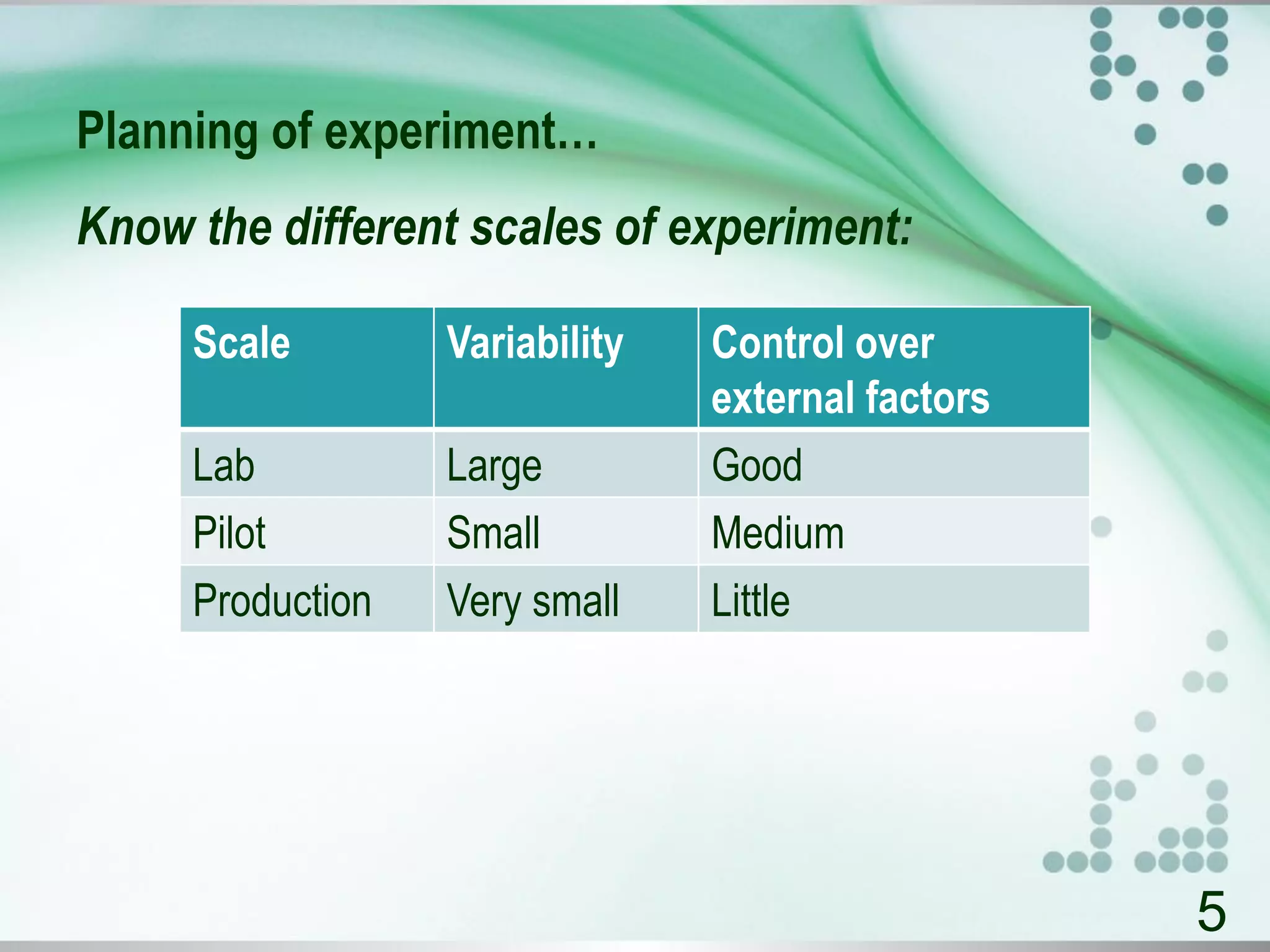
Planning of experiment…
Know the different scales of experiment:
5
Scale Variability Control over
external factors
Lab Large Good
Pilot Small Medium
Production Very small Little
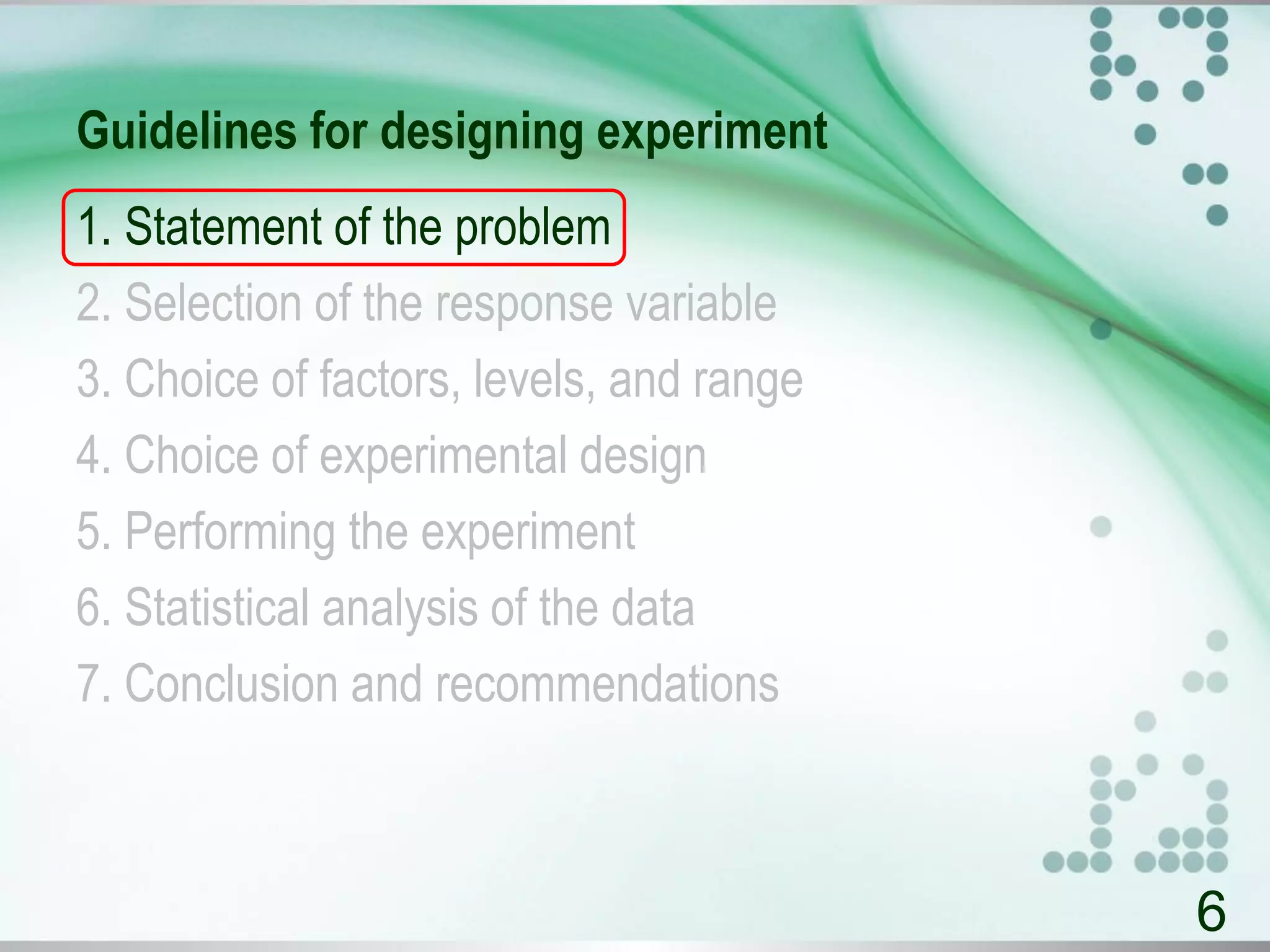
Guidelines for designing experiment
1. Statement of the problem
2. Selection of the response variable
3. Choice of factors, levels, and range
4. Choice of experimental design
5. Performing the experiment
6. Statistical analysis of the data
7. Conclusion and recommendations
6
Planning of experiment…
What is the purpose of experiment?
1. Increase yield/productivity
2. Increase knowledge
3. Evaluation and comparison of basic design
configurations
4. Evaluation of material alternatives
7
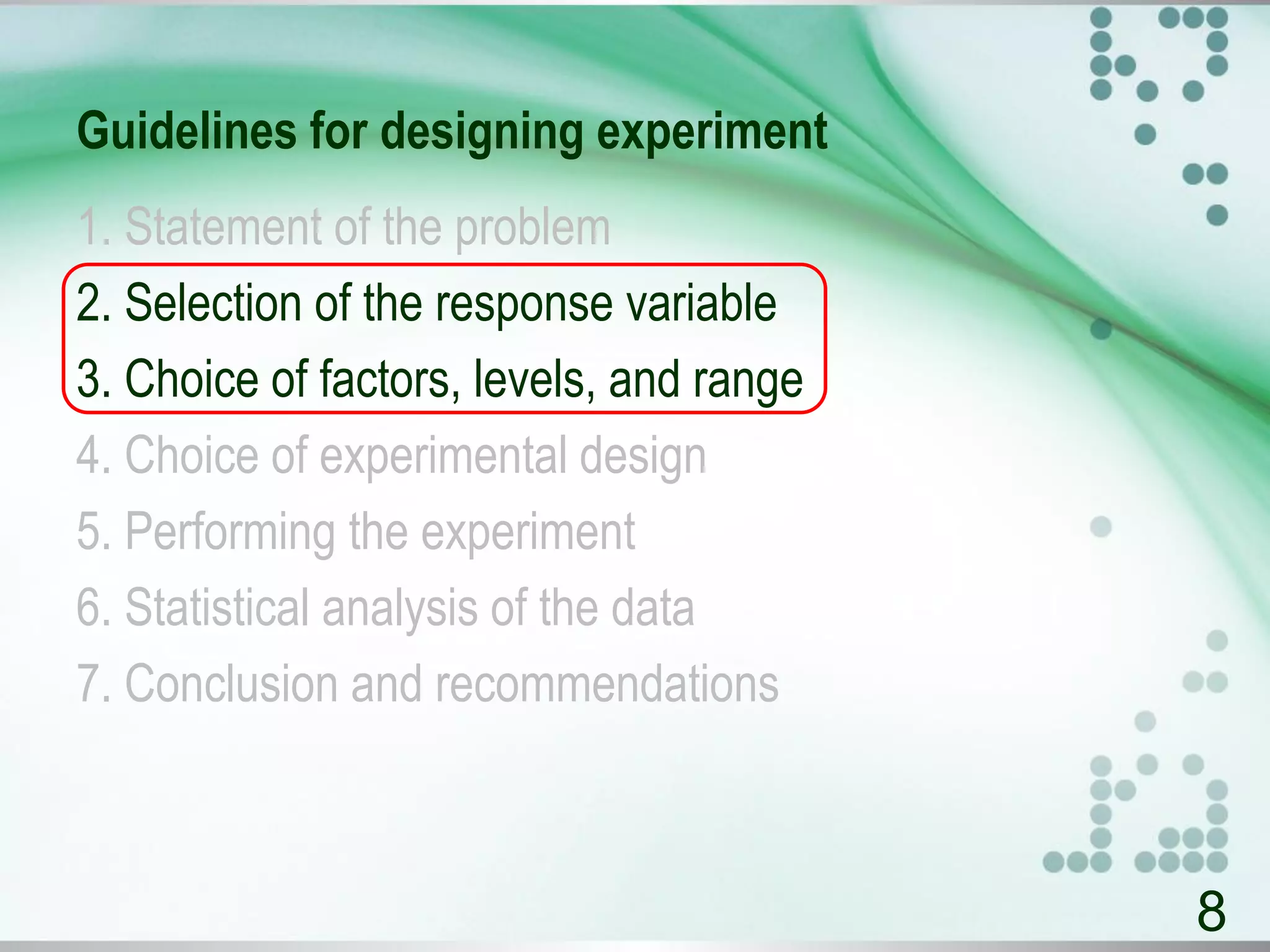
Guidelines for designing experiment
1. Statement of the problem
2. Selection of the response variable
3. Choice of factors, levels, and range
4. Choice of experimental design
5. Performing the experiment
6. Statistical analysis of the data
7. Conclusion and recommendations
8
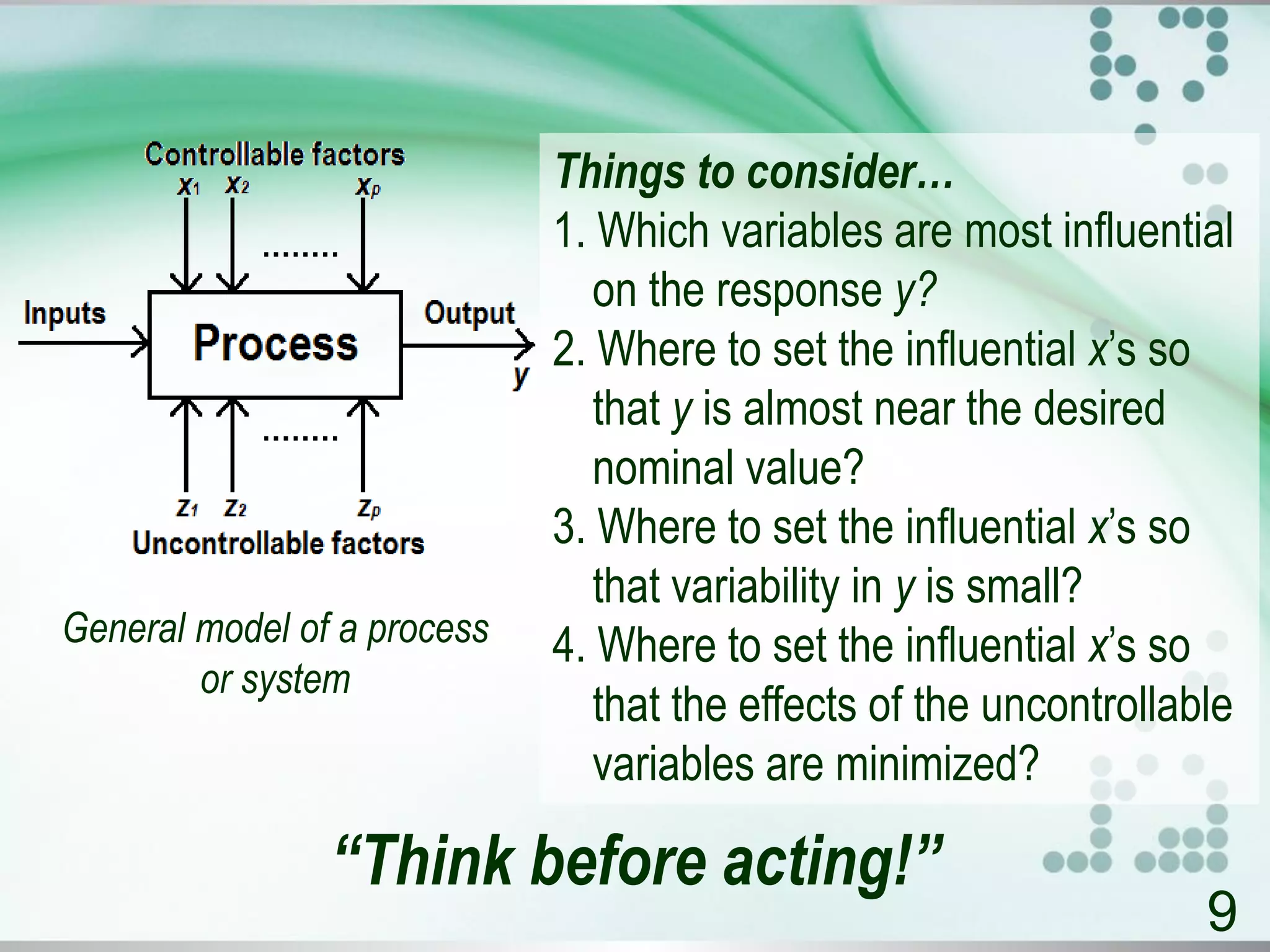
General model of a process
or system
Things to consider…
1. Which variables are most influential
on the response y?
2. Where to set the influential x’s so
that y is almost near the desired
nominal value?
3. Where to set the influential x’s so
that variability in y is small?
4. Where to set the influential x’s so
that the effects of the uncontrollable
variables are minimized?
9
“Think before acting!”
Guidelines for designing experiment
1. Statement of the problem
2. Selection of the response variable
3. Choice of factors, levels, and range
4. Choice of experimental design
5. Performing the experiment
6. Statistical analysis of the data
7. Conclusion and recommendations
10
Strategies of experimentation
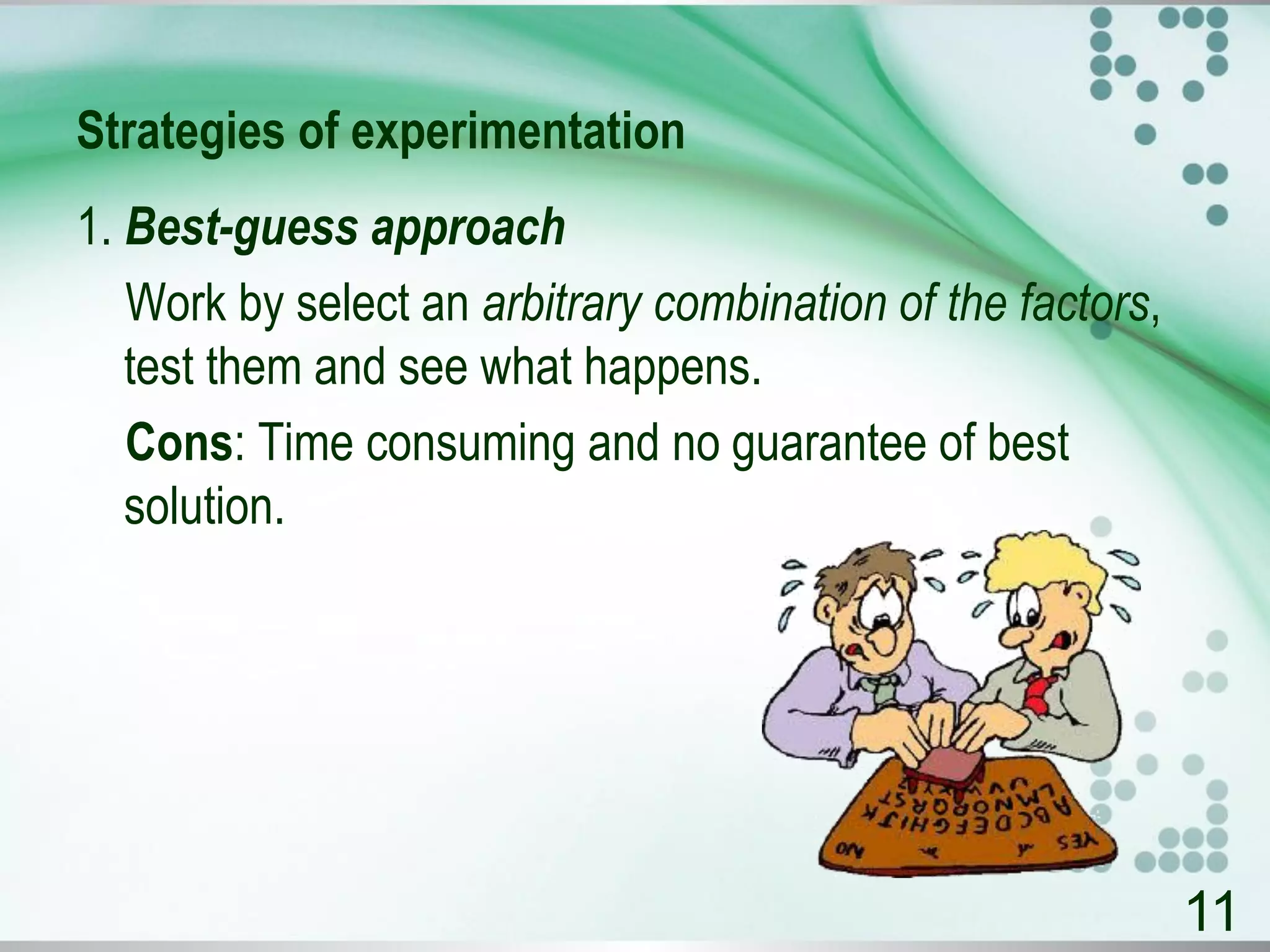
1. Best-guess approach
Work by select an arbitrary combination of the factors,
test them and see what happens.
Cons: Time consuming and no guarantee of best
solution.
11
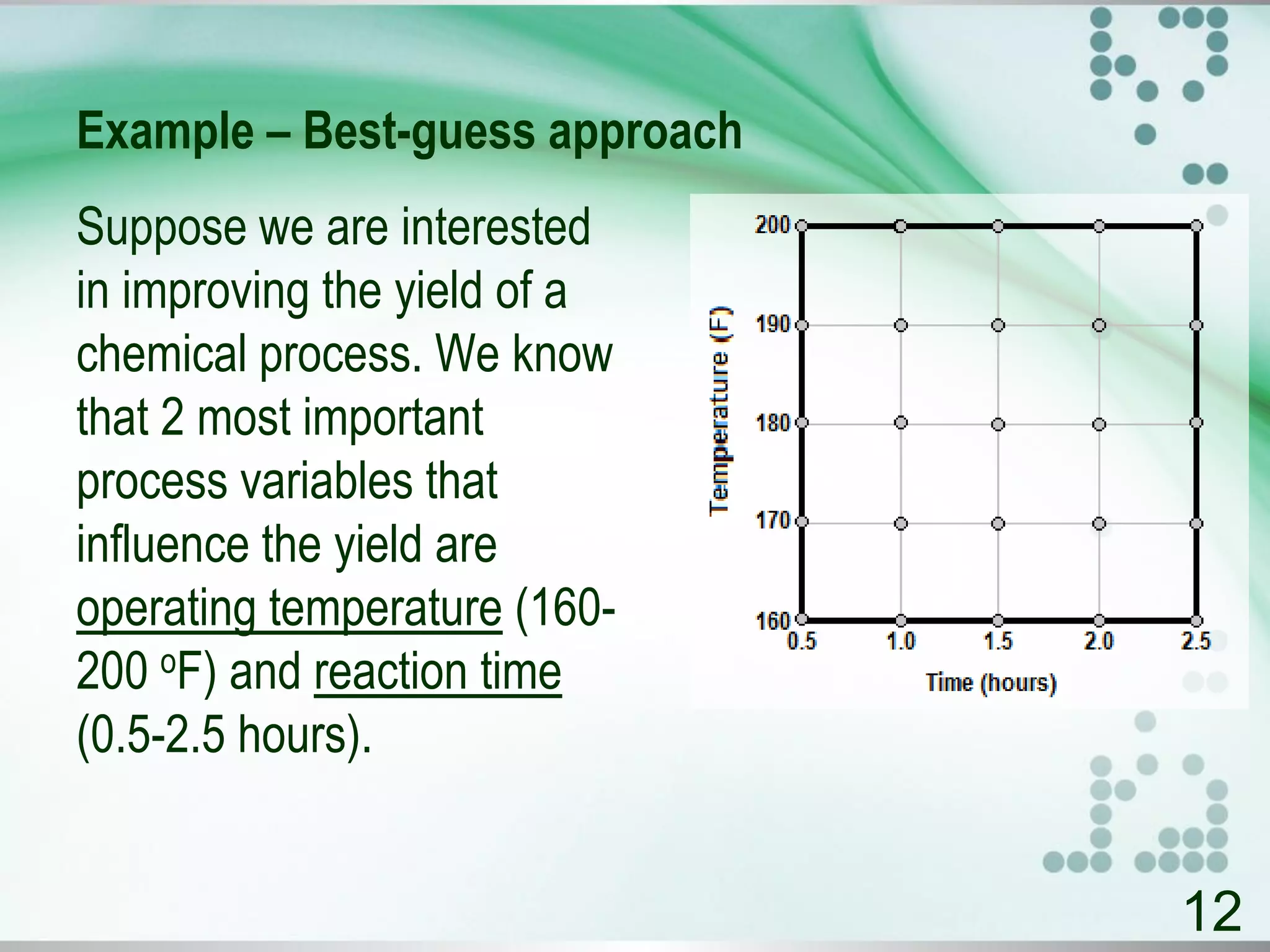
Example – Best-guess approach
Suppose we are interested
in improving the yield of a
chemical process. We know
that 2 most important
process variables that
influence the yield are
operating temperature (160-
200 oF) and reaction time
(0.5-2.5 hours).
12
Strategies of experimentation – con’t
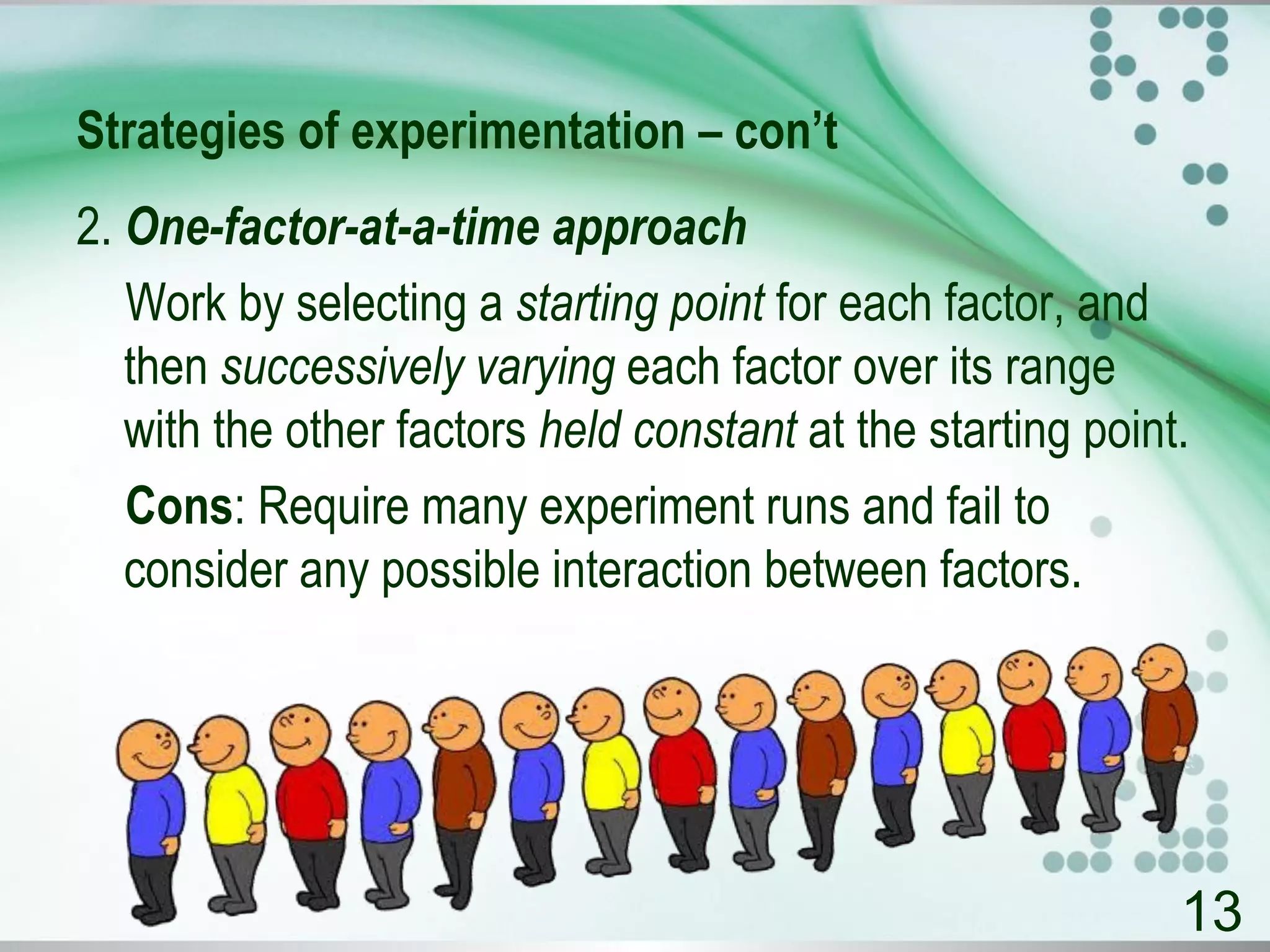
2. One-factor-at-a-time approach
Work by selecting a starting point for each factor, and
then successively varying each factor over its range
with the other factors held constant at the starting point.
Cons: Require many experiment runs and fail to
consider any possible interaction between factors.
13
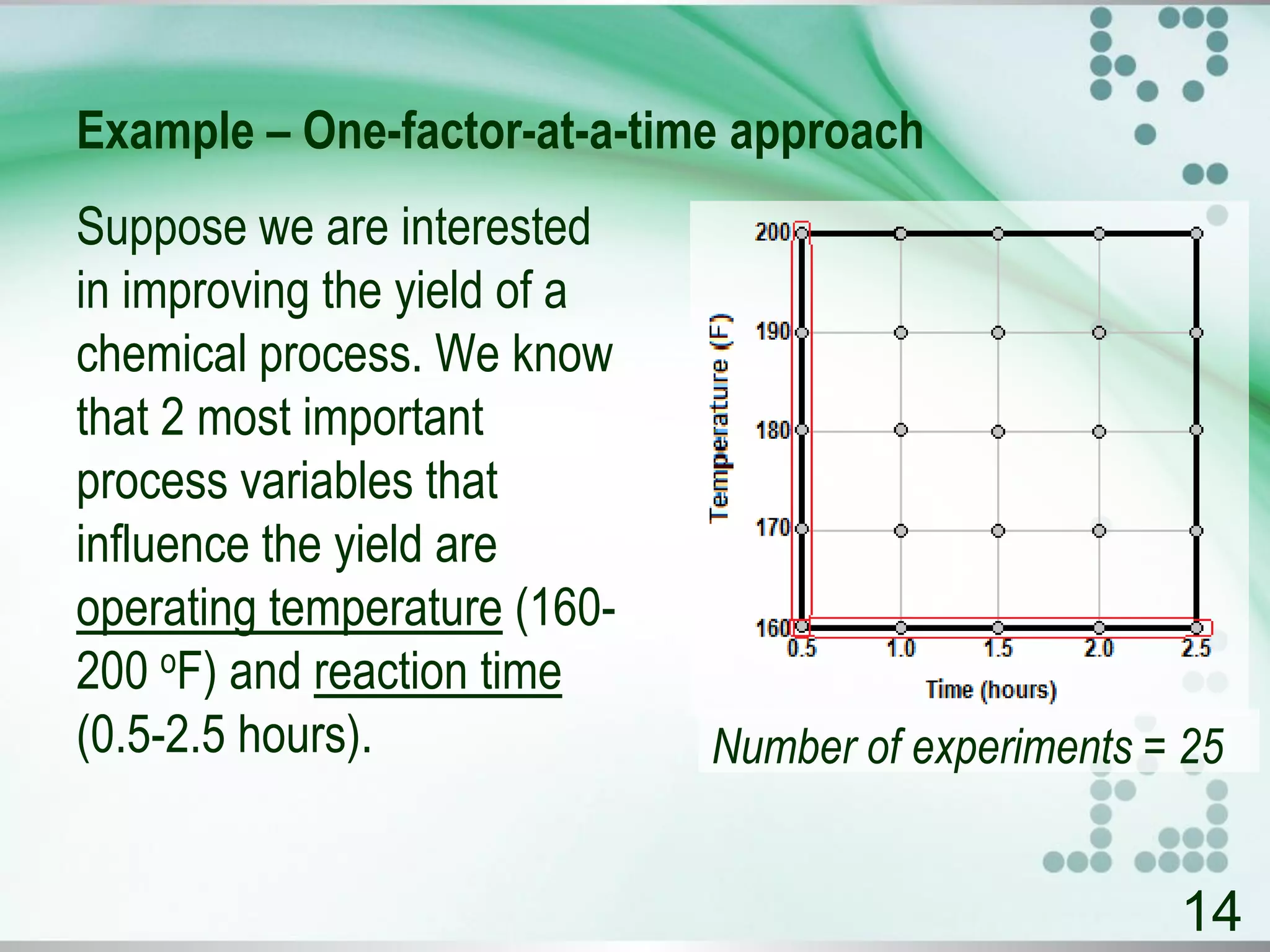
Example – One-factor-at-a-time approach
Suppose we are interested
in improving the yield of a
chemical process. We know
that 2 most important
process variables that
influence the yield are
operating temperature (160-
200 oF) and reaction time
(0.5-2.5 hours). Number of experiments = 25
14
Strategies of experimentation – con’t
3. Factorial experiment
- Reduction or minimization of total number of trials.
- Factors under investigation are varied together.
- Study of interaction effect of factors.
15
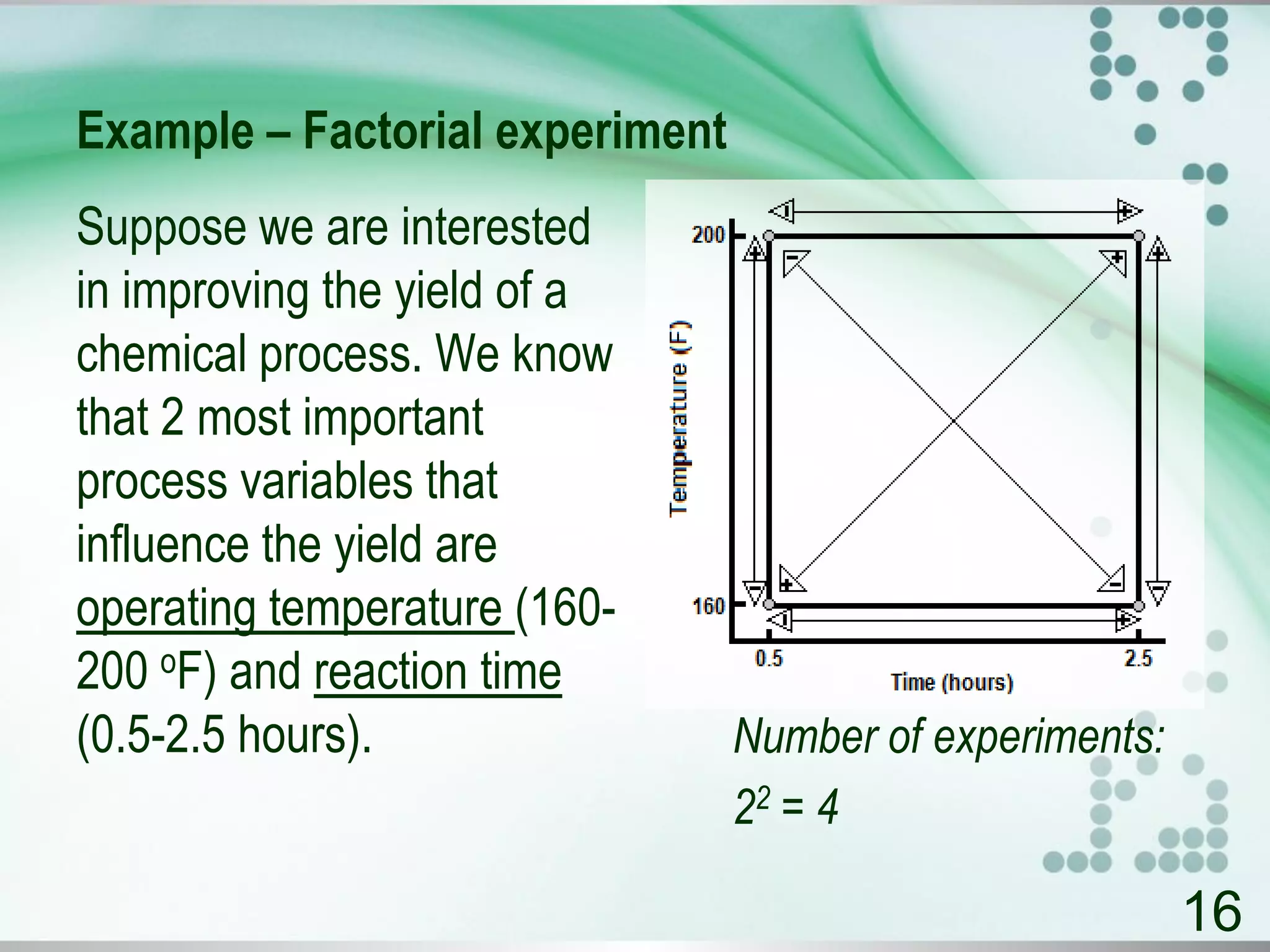
Example – Factorial experiment
Suppose we are interested
in improving the yield of a
chemical process. We know
that 2 most important
process variables that
influence the yield are
operating temperature (160-
200 oF) and reaction time
(0.5-2.5 hours). Number of experiments:
22 = 4
16
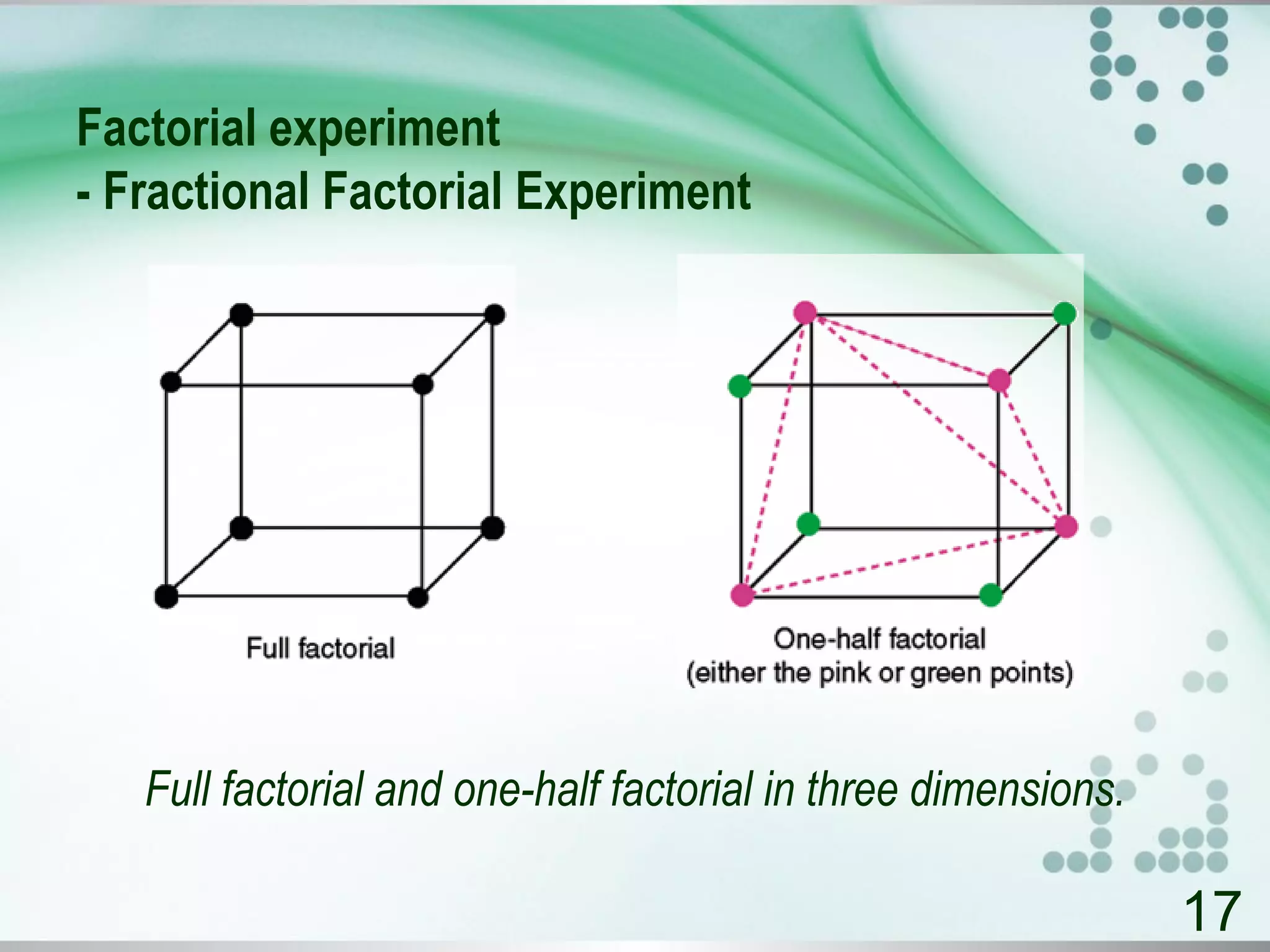
Factorial experiment
- Fractional Factorial Experiment
17
Full factorial and one-half factorial in three dimensions.
Variants of factorial experiment
18
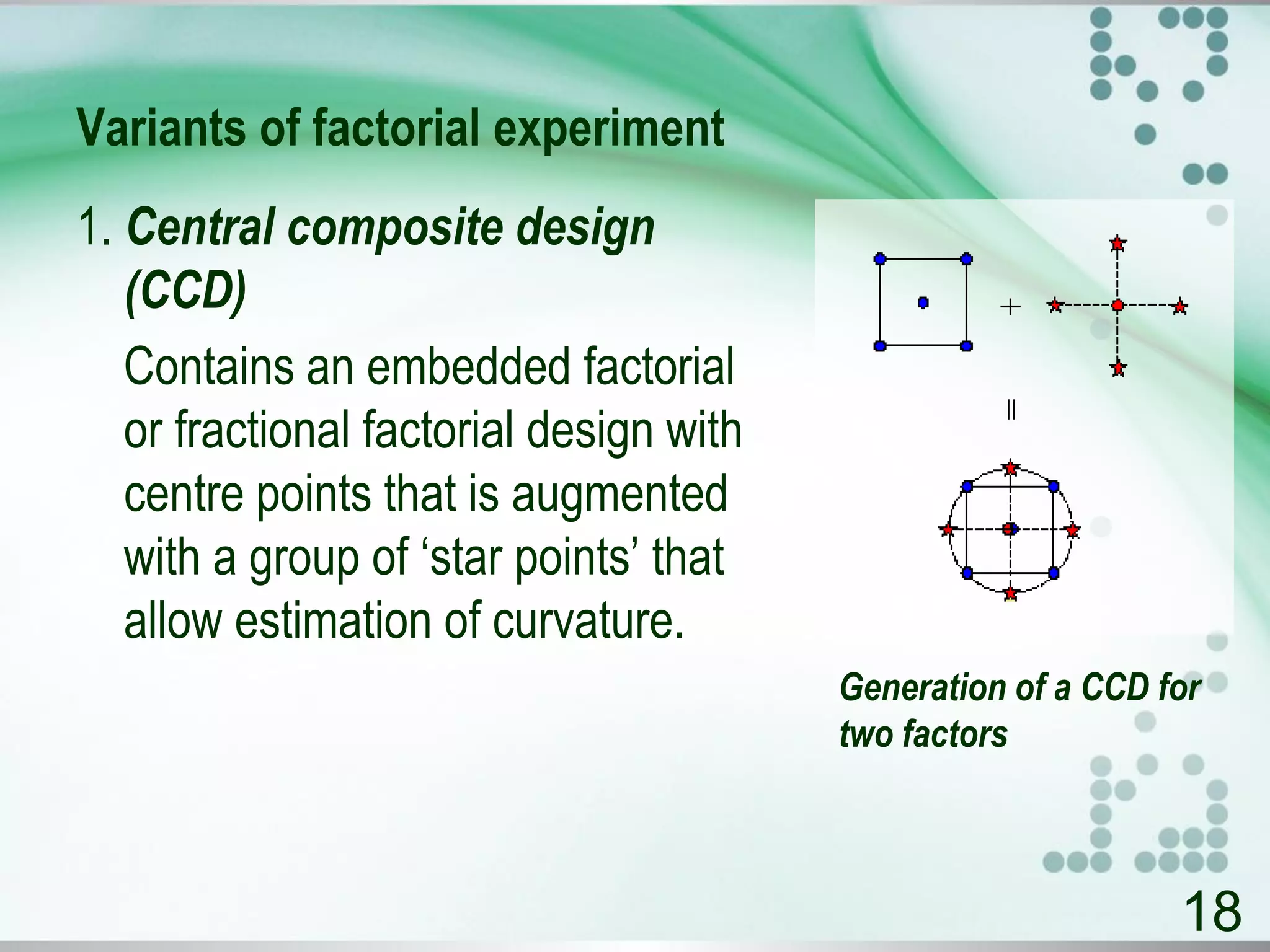
1. Central composite design
(CCD)
Contains an embedded factorial
or fractional factorial design with
centre points that is augmented
with a group of ‘star points’ that
allow estimation of curvature.
Generation of a CCD for
two factors
Variants of factorial experiment
19
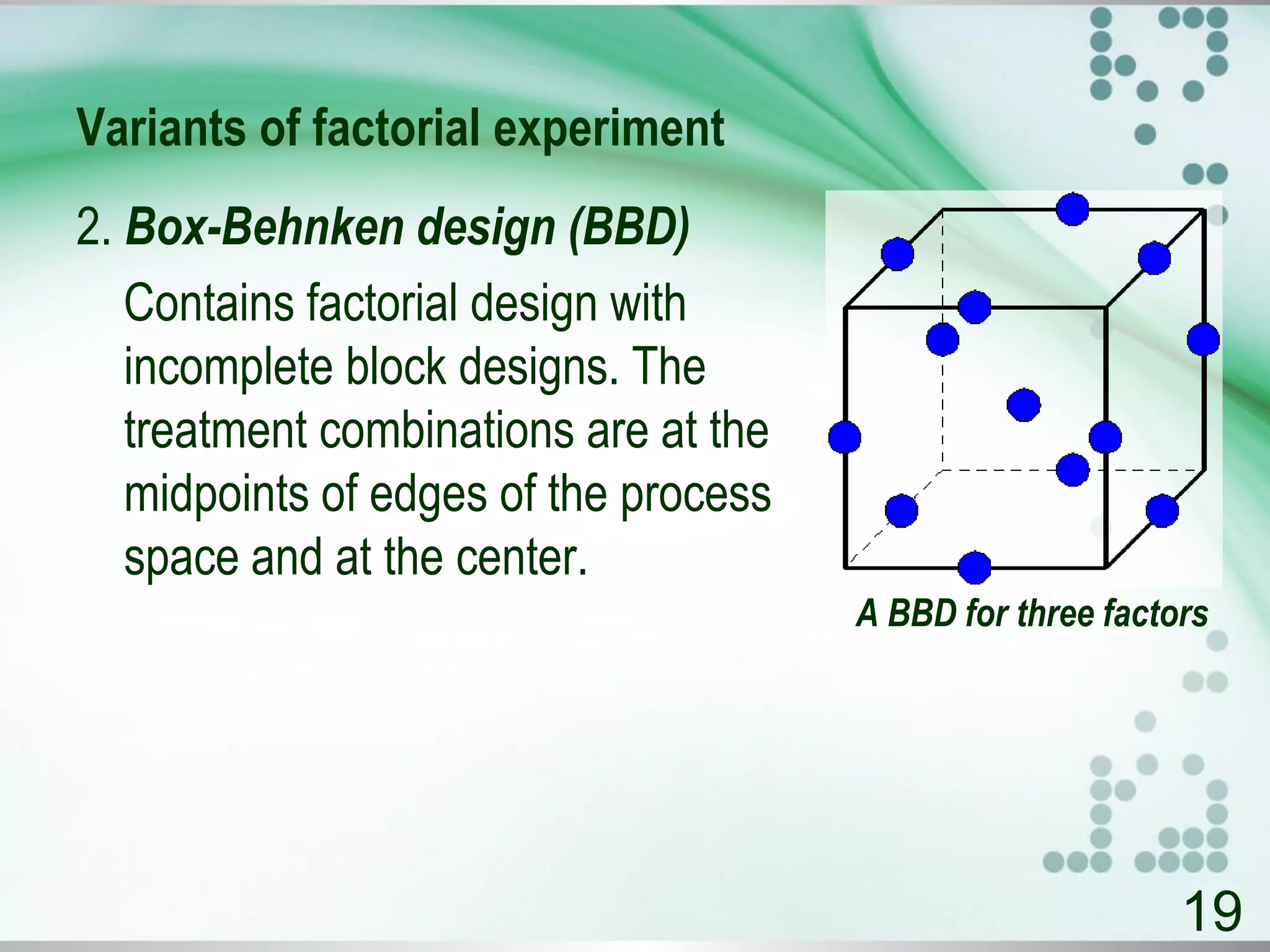
2. Box-Behnken design (BBD)
Contains factorial design with
incomplete block designs. The
treatment combinations are at the
midpoints of edges of the process
space and at the center.
A BBD for three factors
Guidelines for designing experiment
1. Statement of the problem
2. Selection of the response variable
3. Choice of factors, levels, and range
4. Choice of experimental design
5. Performing the experiment
6. Statistical analysis of the data
7. Conclusion and recommendations
20
Response Surface Methodology (RSM)
RSM is a collection of mathematical and statistical
techniques useful for modeling and analysis of problems
where a response of interest is influenced by several
variables and the objective is to optimize this response.
- Defines the effects of the independent variables and
interaction of variables on the process.
- Generates a mathematical model describing the process.
- The response surface is visualized by response surface and
contour plots.
21
What about dealing with large number of variables?
22
Screening experiment to determine the influential factors
Response surface experiment to determine the shape of the
factor effects (linear or curved)
Another example…
Application of statistical experimental designs for the
optimization of medium constituents for the production of
L-Asparaginase by Serratia marcescens
Aim: To optimize medium constituents for L-Asparaginase
production by S. marcescens in solid-state fermentation
using sesame oil cake as the sole substrate
23
Adapted from Vuddaraju SP, Nikku MY, Chaduvula AIR, Dasari VRRK, Donthireddy SRR
(2010) Application of Statistical Experimental Designs for the Optimization
of Medium Constituents for the Production of L-Asparaginase by Serratia
Marcescens. J microbial Biochem Technol 2: 89-94.
Another example – con’t
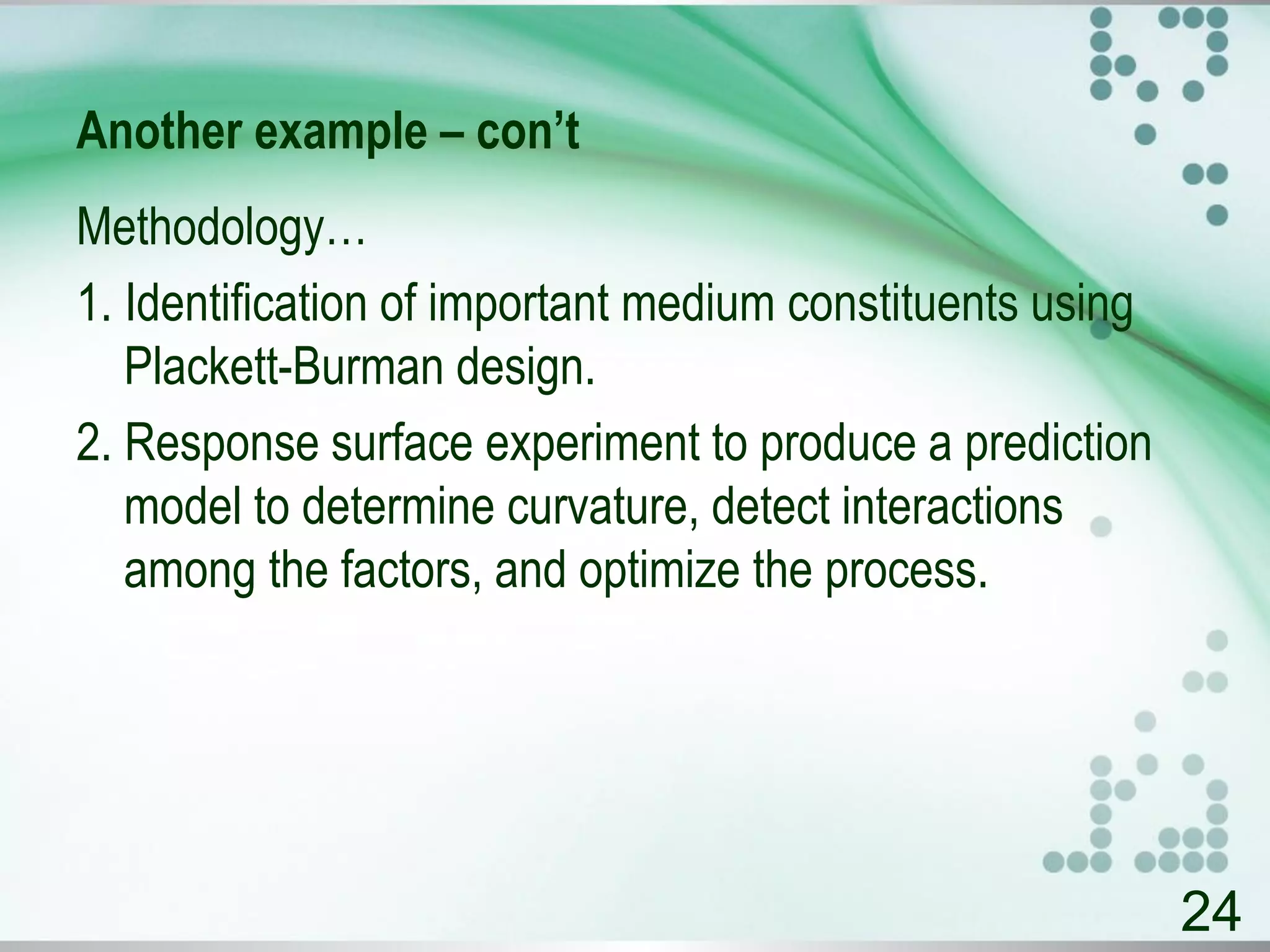
Methodology…
1. Identification of important medium constituents using
Plackett-Burman design.
2. Response surface experiment to produce a prediction
model to determine curvature, detect interactions
among the factors, and optimize the process.
24
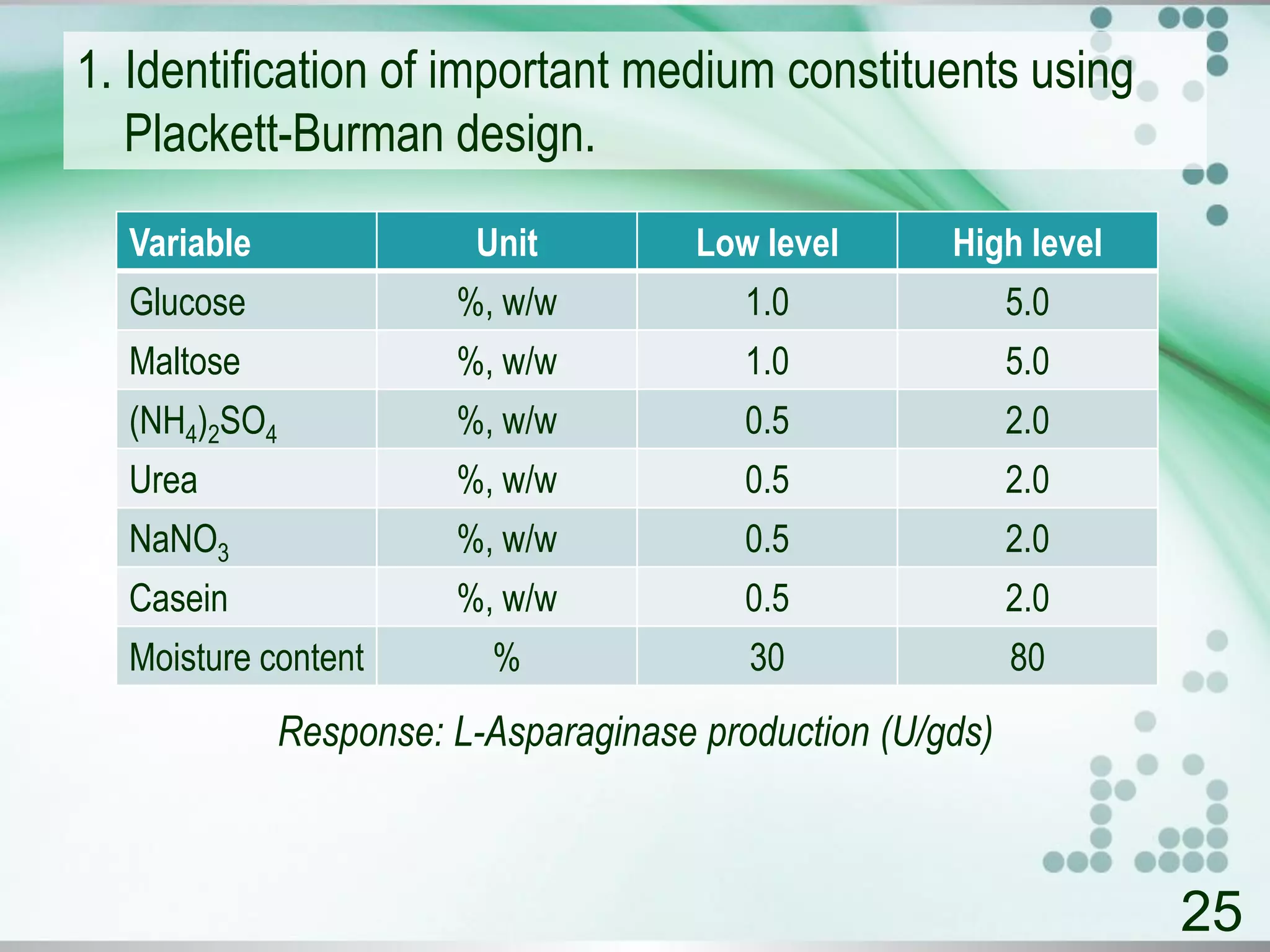
1. Identification of important medium constituents using
Plackett-Burman design.
25
Variable Unit Low level High level
Glucose %, w/w 1.0 5.0
Maltose %, w/w 1.0 5.0
(NH4)2SO4 %, w/w 0.5 2.0
Urea %, w/w 0.5 2.0
NaNO3 %, w/w 0.5 2.0
Casein %, w/w 0.5 2.0
Moisture content % 30 80
Response: L-Asparaginase production (U/gds)
26
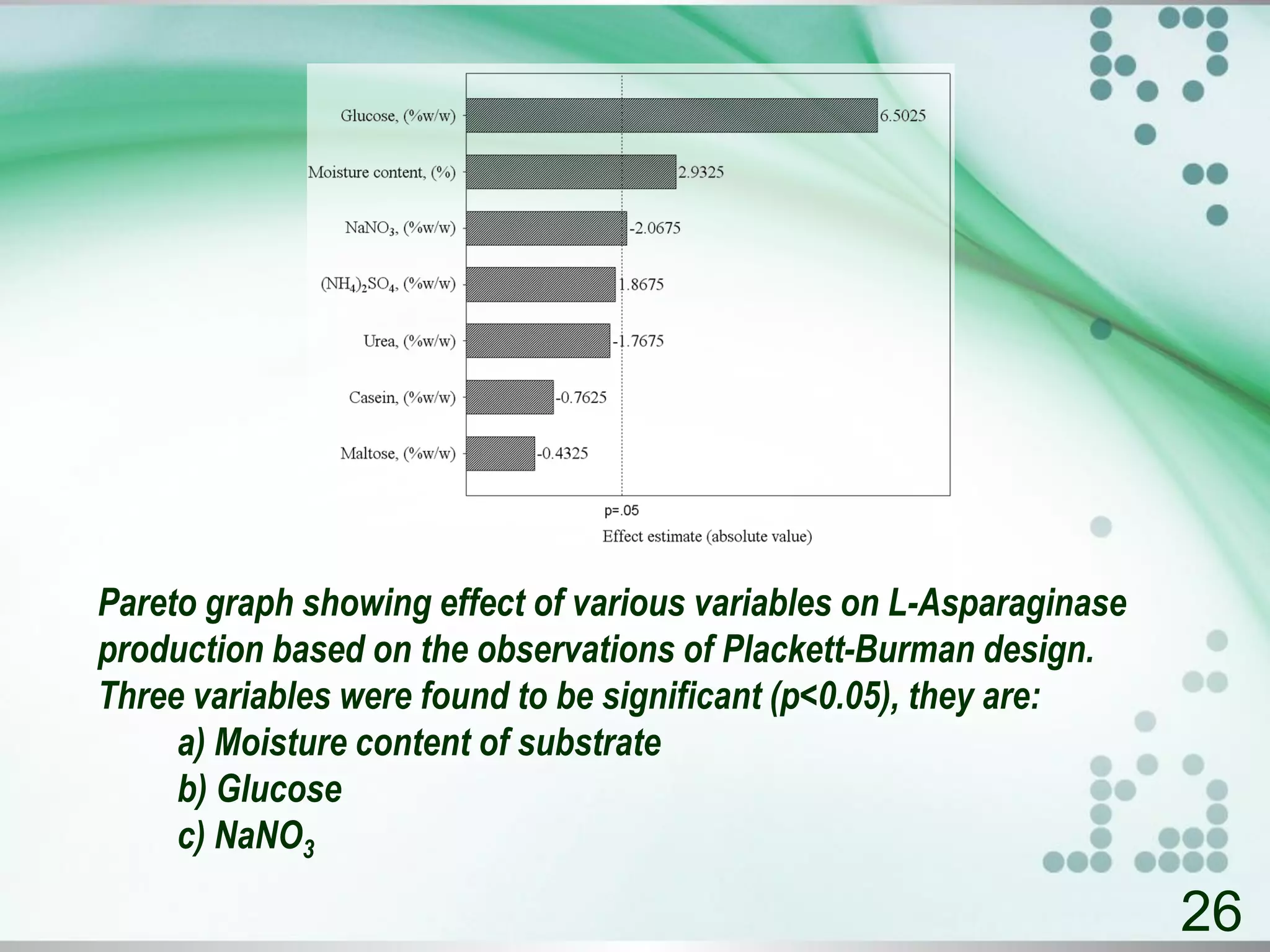
Pareto graph showing effect of various variables on L-Asparaginase
production based on the observations of Plackett-Burman design.
Three variables were found to be significant (p<0.05), they are:
a) Moisture content of substrate
b) Glucose
c) NaNO3
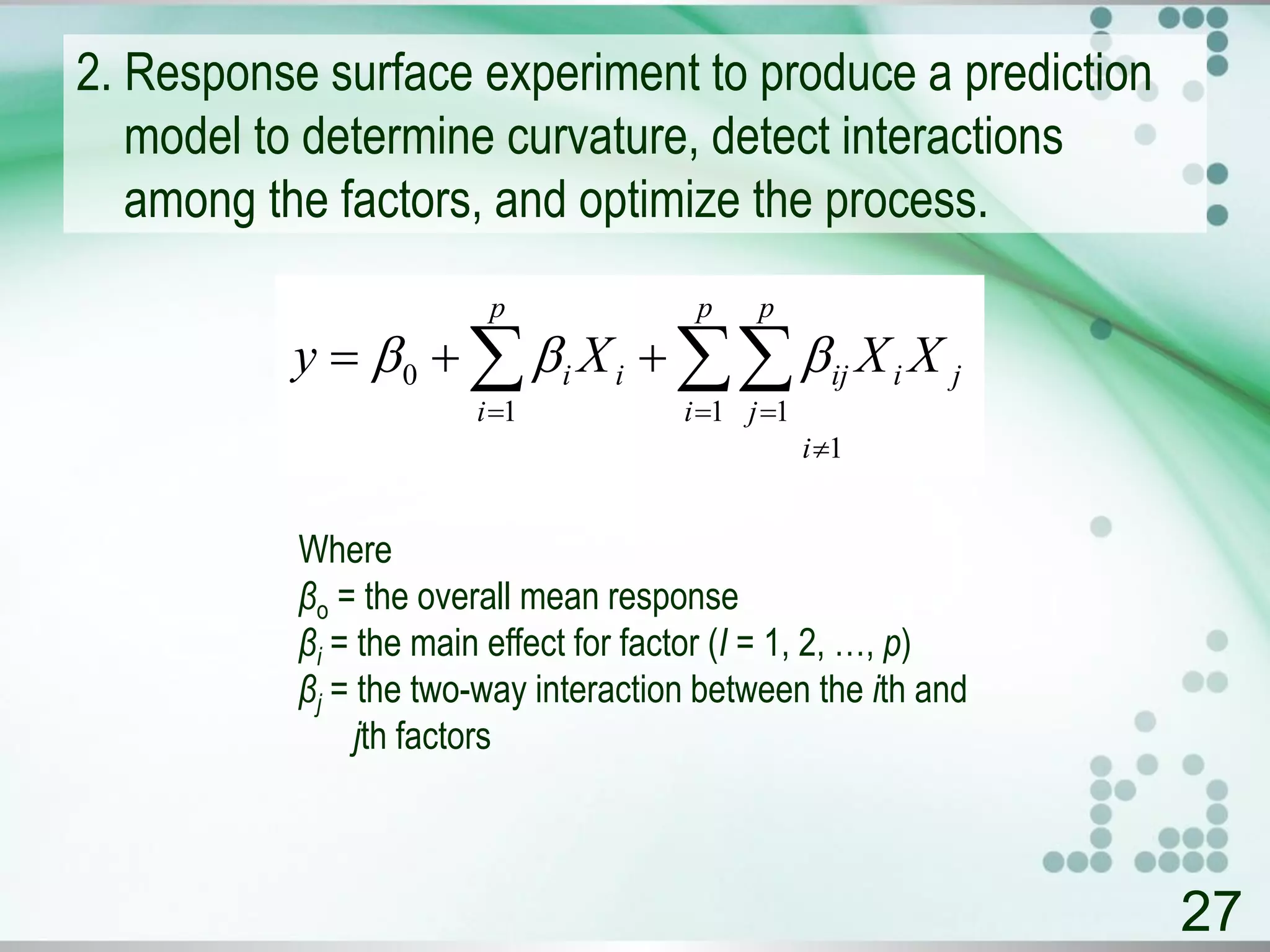
2. Response surface experiment to produce a prediction
model to determine curvature, detect interactions
among the factors, and optimize the process.
27
1
1 11
0

 
 
i
p
i
p
j
jiiji
p
i
i XXXy 
Where
βo = the overall mean response
βi = the main effect for factor (I = 1, 2, …, p)
βj = the two-way interaction between the ith and
jth factors
2. Response surface experiment to produce a prediction
model to determine curvature, detect interactions
among the factors, and optimize the process.
28
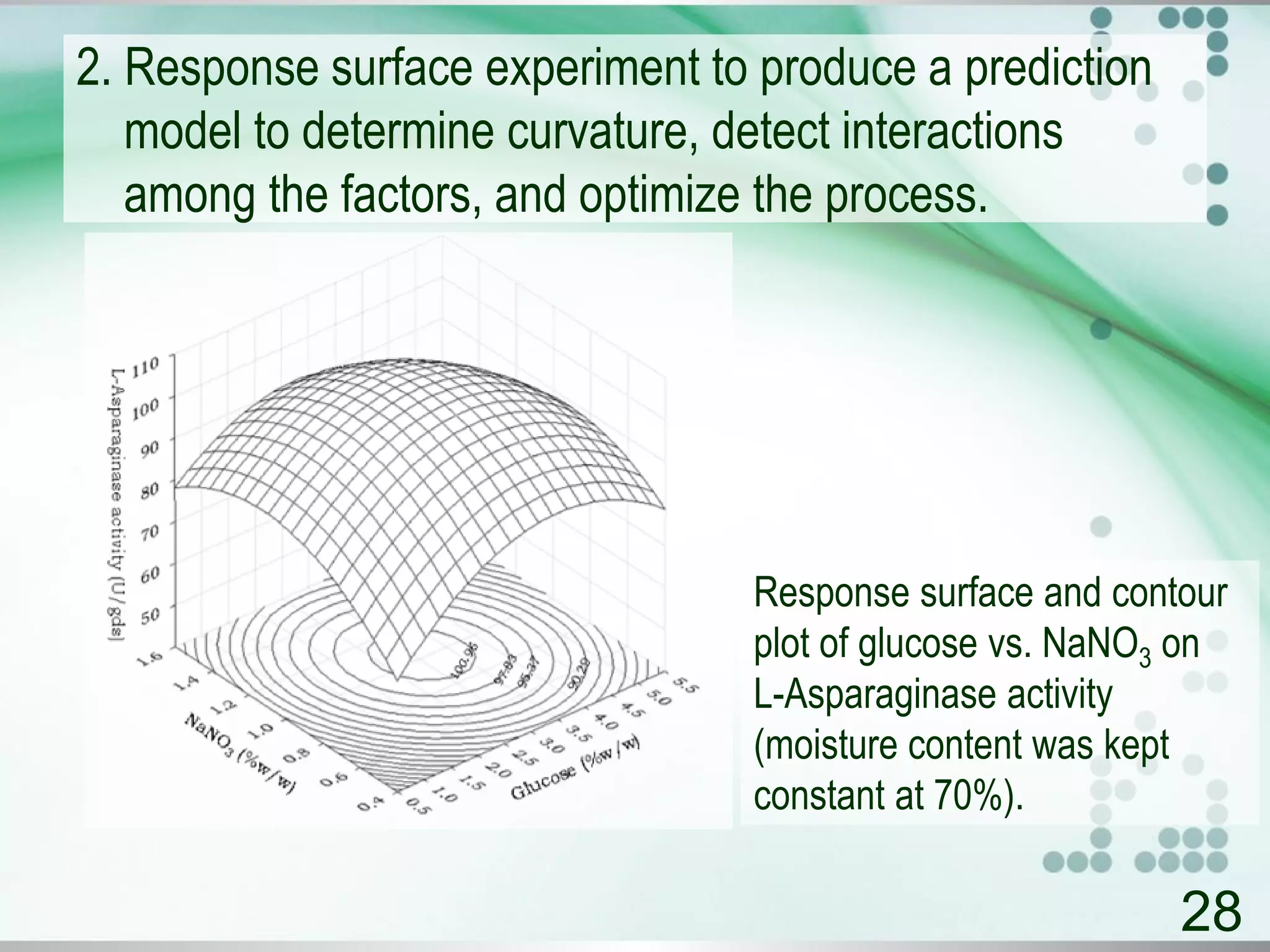
Response surface and contour
plot of glucose vs. NaNO3 on
L-Asparaginase activity
(moisture content was kept
constant at 70%).
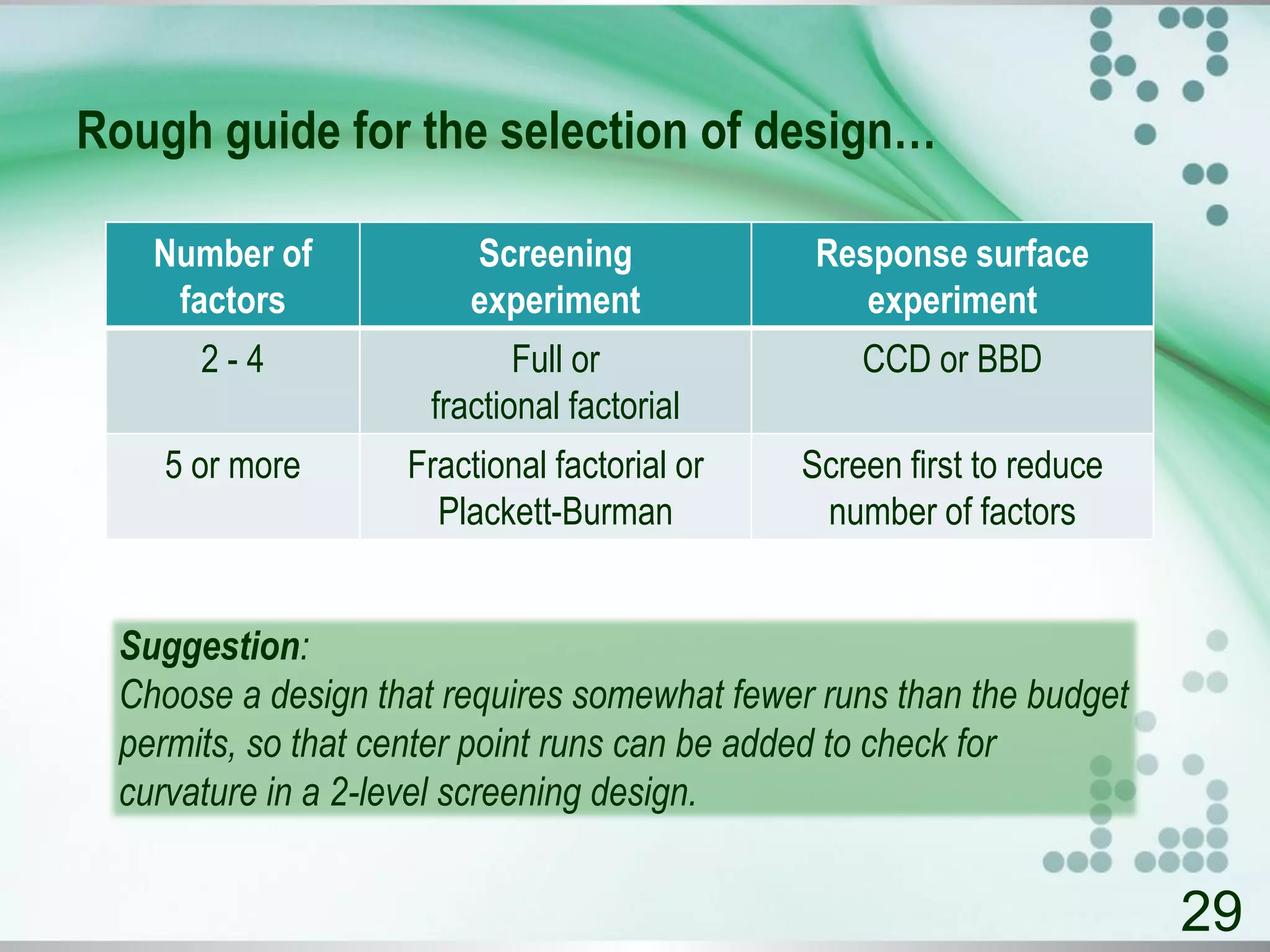
Rough guide for the selection of design…
Number of
factors
Screening
experiment
Response surface
experiment
2 - 4 Full or
fractional factorial
CCD or BBD
5 or more Fractional factorial or
Plackett-Burman
Screen first to reduce
number of factors
29
Suggestion:
Choose a design that requires somewhat fewer runs than the budget
permits, so that center point runs can be added to check for
curvature in a 2-level screening design.
Available DOE software
1. Design-Expert® (Stat-Ease Inc.)
2. DOE++® (ReliaSoft Corp.)
3. Minitab® (Minitab Inc.)
4. MATLAB ® (The MathWorks Inc.)
30
Useful references…
1. A Brief Introduction to Design of Experiments by
Jacqueline K. Telford
[Retrieved from
www.jhuapl.edu/techdigest/TD/td2703/telford.pdf]
2. Design and Analysis of Experiments (John Wiley &
Sons, Inc.) by Douglas C. Montgomery
31
Q & A session
32
Thankyoufor your time!

Introduction to Design of Experiments by Teck Nam Ang (University of Malaya)

  • 1.
    Introduction to Design ofExperiments Presented by Ang Teck Nam (For the course KKEK 4283) University of Malaya Department of Chemical Engineering 21st October 2011, 10 am
  • 2.
    After this talk,you should know… 1. The purpose of experiment 2. The various strategies of experiment 3. How to plan and design experiment 4. Handling of experimental data 2
  • 3.
    Why a welldesigned experimental plan is essential? 1. Maximize the amount of information from minimal number of experiments 2. Gain knowledge from the experiments 3. Gain control on the reliability of experimental results 4. Facilitate correct evaluation and writing of reports 5. Make communication possible and correct 3
  • 4.
    Main applications ofdesign of experiments 1. Discovering interactions among factors 2. Screening many factors 3. Establishing and maintaining quality control 4. Optimizing a process 5. Designing robust products 4
  • 5.
    Planning of experiment… Knowthe different scales of experiment: 5 Scale Variability Control over external factors Lab Large Good Pilot Small Medium Production Very small Little
  • 6.
    Guidelines for designingexperiment 1. Statement of the problem 2. Selection of the response variable 3. Choice of factors, levels, and range 4. Choice of experimental design 5. Performing the experiment 6. Statistical analysis of the data 7. Conclusion and recommendations 6
  • 7.
    Planning of experiment… Whatis the purpose of experiment? 1. Increase yield/productivity 2. Increase knowledge 3. Evaluation and comparison of basic design configurations 4. Evaluation of material alternatives 7
  • 8.
    Guidelines for designingexperiment 1. Statement of the problem 2. Selection of the response variable 3. Choice of factors, levels, and range 4. Choice of experimental design 5. Performing the experiment 6. Statistical analysis of the data 7. Conclusion and recommendations 8
  • 9.
    General model ofa process or system Things to consider… 1. Which variables are most influential on the response y? 2. Where to set the influential x’s so that y is almost near the desired nominal value? 3. Where to set the influential x’s so that variability in y is small? 4. Where to set the influential x’s so that the effects of the uncontrollable variables are minimized? 9 “Think before acting!”
  • 10.
    Guidelines for designingexperiment 1. Statement of the problem 2. Selection of the response variable 3. Choice of factors, levels, and range 4. Choice of experimental design 5. Performing the experiment 6. Statistical analysis of the data 7. Conclusion and recommendations 10
  • 11.
    Strategies of experimentation 1.Best-guess approach Work by select an arbitrary combination of the factors, test them and see what happens. Cons: Time consuming and no guarantee of best solution. 11
  • 12.
    Example – Best-guessapproach Suppose we are interested in improving the yield of a chemical process. We know that 2 most important process variables that influence the yield are operating temperature (160- 200 oF) and reaction time (0.5-2.5 hours). 12
  • 13.
    Strategies of experimentation– con’t 2. One-factor-at-a-time approach Work by selecting a starting point for each factor, and then successively varying each factor over its range with the other factors held constant at the starting point. Cons: Require many experiment runs and fail to consider any possible interaction between factors. 13
  • 14.
    Example – One-factor-at-a-timeapproach Suppose we are interested in improving the yield of a chemical process. We know that 2 most important process variables that influence the yield are operating temperature (160- 200 oF) and reaction time (0.5-2.5 hours). Number of experiments = 25 14
  • 15.
    Strategies of experimentation– con’t 3. Factorial experiment - Reduction or minimization of total number of trials. - Factors under investigation are varied together. - Study of interaction effect of factors. 15
  • 16.
    Example – Factorialexperiment Suppose we are interested in improving the yield of a chemical process. We know that 2 most important process variables that influence the yield are operating temperature (160- 200 oF) and reaction time (0.5-2.5 hours). Number of experiments: 22 = 4 16
  • 17.
    Factorial experiment - FractionalFactorial Experiment 17 Full factorial and one-half factorial in three dimensions.
  • 18.
    Variants of factorialexperiment 18 1. Central composite design (CCD) Contains an embedded factorial or fractional factorial design with centre points that is augmented with a group of ‘star points’ that allow estimation of curvature. Generation of a CCD for two factors
  • 19.
    Variants of factorialexperiment 19 2. Box-Behnken design (BBD) Contains factorial design with incomplete block designs. The treatment combinations are at the midpoints of edges of the process space and at the center. A BBD for three factors
  • 20.
    Guidelines for designingexperiment 1. Statement of the problem 2. Selection of the response variable 3. Choice of factors, levels, and range 4. Choice of experimental design 5. Performing the experiment 6. Statistical analysis of the data 7. Conclusion and recommendations 20
  • 21.
    Response Surface Methodology(RSM) RSM is a collection of mathematical and statistical techniques useful for modeling and analysis of problems where a response of interest is influenced by several variables and the objective is to optimize this response. - Defines the effects of the independent variables and interaction of variables on the process. - Generates a mathematical model describing the process. - The response surface is visualized by response surface and contour plots. 21
  • 22.
    What about dealingwith large number of variables? 22 Screening experiment to determine the influential factors Response surface experiment to determine the shape of the factor effects (linear or curved)
  • 23.
    Another example… Application ofstatistical experimental designs for the optimization of medium constituents for the production of L-Asparaginase by Serratia marcescens Aim: To optimize medium constituents for L-Asparaginase production by S. marcescens in solid-state fermentation using sesame oil cake as the sole substrate 23 Adapted from Vuddaraju SP, Nikku MY, Chaduvula AIR, Dasari VRRK, Donthireddy SRR (2010) Application of Statistical Experimental Designs for the Optimization of Medium Constituents for the Production of L-Asparaginase by Serratia Marcescens. J microbial Biochem Technol 2: 89-94.
  • 24.
    Another example –con’t Methodology… 1. Identification of important medium constituents using Plackett-Burman design. 2. Response surface experiment to produce a prediction model to determine curvature, detect interactions among the factors, and optimize the process. 24
  • 25.
    1. Identification ofimportant medium constituents using Plackett-Burman design. 25 Variable Unit Low level High level Glucose %, w/w 1.0 5.0 Maltose %, w/w 1.0 5.0 (NH4)2SO4 %, w/w 0.5 2.0 Urea %, w/w 0.5 2.0 NaNO3 %, w/w 0.5 2.0 Casein %, w/w 0.5 2.0 Moisture content % 30 80 Response: L-Asparaginase production (U/gds)
  • 26.
    26 Pareto graph showingeffect of various variables on L-Asparaginase production based on the observations of Plackett-Burman design. Three variables were found to be significant (p<0.05), they are: a) Moisture content of substrate b) Glucose c) NaNO3
  • 27.
    2. Response surfaceexperiment to produce a prediction model to determine curvature, detect interactions among the factors, and optimize the process. 27 1 1 11 0      i p i p j jiiji p i i XXXy  Where βo = the overall mean response βi = the main effect for factor (I = 1, 2, …, p) βj = the two-way interaction between the ith and jth factors
  • 28.
    2. Response surfaceexperiment to produce a prediction model to determine curvature, detect interactions among the factors, and optimize the process. 28 Response surface and contour plot of glucose vs. NaNO3 on L-Asparaginase activity (moisture content was kept constant at 70%).
  • 29.
    Rough guide forthe selection of design… Number of factors Screening experiment Response surface experiment 2 - 4 Full or fractional factorial CCD or BBD 5 or more Fractional factorial or Plackett-Burman Screen first to reduce number of factors 29 Suggestion: Choose a design that requires somewhat fewer runs than the budget permits, so that center point runs can be added to check for curvature in a 2-level screening design.
  • 30.
    Available DOE software 1.Design-Expert® (Stat-Ease Inc.) 2. DOE++® (ReliaSoft Corp.) 3. Minitab® (Minitab Inc.) 4. MATLAB ® (The MathWorks Inc.) 30
  • 31.
    Useful references… 1. ABrief Introduction to Design of Experiments by Jacqueline K. Telford [Retrieved from www.jhuapl.edu/techdigest/TD/td2703/telford.pdf] 2. Design and Analysis of Experiments (John Wiley & Sons, Inc.) by Douglas C. Montgomery 31
  • 32.
    Q & Asession 32 Thankyoufor your time!