PRESENTED BY MODERATOR
DR.R.HARIPRIYA
PG IN OPHTHALMOLOGY
SSSIHMS
DR.AMIT CHABRA
DEPT OF OPHTHALMOLOGY
 Visual Disorder-Anatomical changes
 Visual impairment-Functional changes
 Visual disability-Skills &abilities affected
 Visual handicap-Socio economic consequences.
 Legal Blindness
◦ Best corrected distance visual acuity of CF-1MT or
worse in better eye
◦ Visual field of 10 degrees or less in the better eye
 Low Vision
◦ Best corrected visual acuity worse than 20/60 in the
better eye(or) visual field of less then 10⁰ from the point
of fixation.
1)Moderate visual impairment- best corrected VA
less than 6/18 to 6/60.
2)Severe visual impairment- best corrected visual acuity
of less than 6/60 to CF-3MTS (or) visual field diameter
of 20⁰ or less.
3)Profound visual impairment- best corrected visual
acuity of less than CF-3MTS to CF-1MT or visual field
diameter of 10⁰ or less.
 4)Near total vision loss- best corrected visual
acuity of CF-1MT or less.
 5)Total blindness- no perception of light.
 Loss of central vision
(visual acuity)
 Loss of peripheral vision
(visual field)
 Glare and contrast
 Difficulty reading
 Problems writing/
completing paperwork
 Inability to recognize
distance objects and faces
 Need for additional lighting
 Problems with glare
 Increased adjustment to changes
in illumination
 Visual discomfort and fatigue
 CLOUDY MEDIA:
uncorrected refractive errors, dry eyes,corneal
dystrophies,keratoconus,corneal scarring from
H.simplex,traumatic mydriasis,cataract,vitreous
hemorrhage & posterior uveitis.
 Location of scotoma important!
 Generalized loss of visual field
difficult to compensate for
 Mobility and independent travel
 Reading may require adaptations
 CENTRAL FIELD DEFICITS:
Macular degenerations, macular hole, diabetic
macular edema and ischemia, myopic
degeneration, toxoplasmosis , histoplasmosis,
phototoxicity, drug toxicity, focal or grid laser for
CSME, iatrogenic central and paracentral
scotoma.
 PERIPHERAL FIELD DEFICIT:
Retinal dystrophies, RP , RD , PDR,
Glaucoma,Ischemic optic
neuropathy,Stroke,Trauma,Tumour,Panretinal
laser photocoagulation.
 History/ intake
 Visual acuity
 Visual field testing
 Pupils
 Extraocular muscle testing
 Refraction
 Color vision and Contrast Testing
 Ocular Health
 Confrontation
 Arc perimeter
 Automated perimetry
 Goldmann perimetry
 Ishihara
 Color Vision Testing Made Easy
 D-15
 Pelli-Robson
 Vistech Contrast System
 Mr. Happy
 Enlarges image on retina to stimulate more retinal
cells
 Can be achieved in many ways
◦ Relative Distance
◦ Relative Size
◦ Optical / Angular
◦ Electronic
1)Magnifying spectacles
2) Hand magnifiers
3)Stand magnifiers
4)Telescopes
5)Electronic magnifiers
 Macular
Degeneration
 Glaucoma
 Diabetic Retinopathy
 Stroke/ brain injury
 Retinitis pigmentosa
 Optic Nerve disease
 Albinism
 Nystagmus
 Cortical Visual
Impairment
 Hand held telescopes
 Mounted telescopes
 Electronic systems
 Spectacles
◦ Prismatic ½ eyes
◦ Full-field microscopes
 Magnifiers
◦ Hand held or Stand held
◦ Illuminated or non-illuminated
 Telemicroscopes
 Electronic Devices
 Magnifying devices work by increasing the angle
subtended by the object at the eye thus producing
an enlarged retinal image(angular magnification).
 MP= RETINAL IMAGE WITH USE OF
INSTRUMENT/RETINAL IMAGE WITH OUT USE
OF INSTRUMENT.
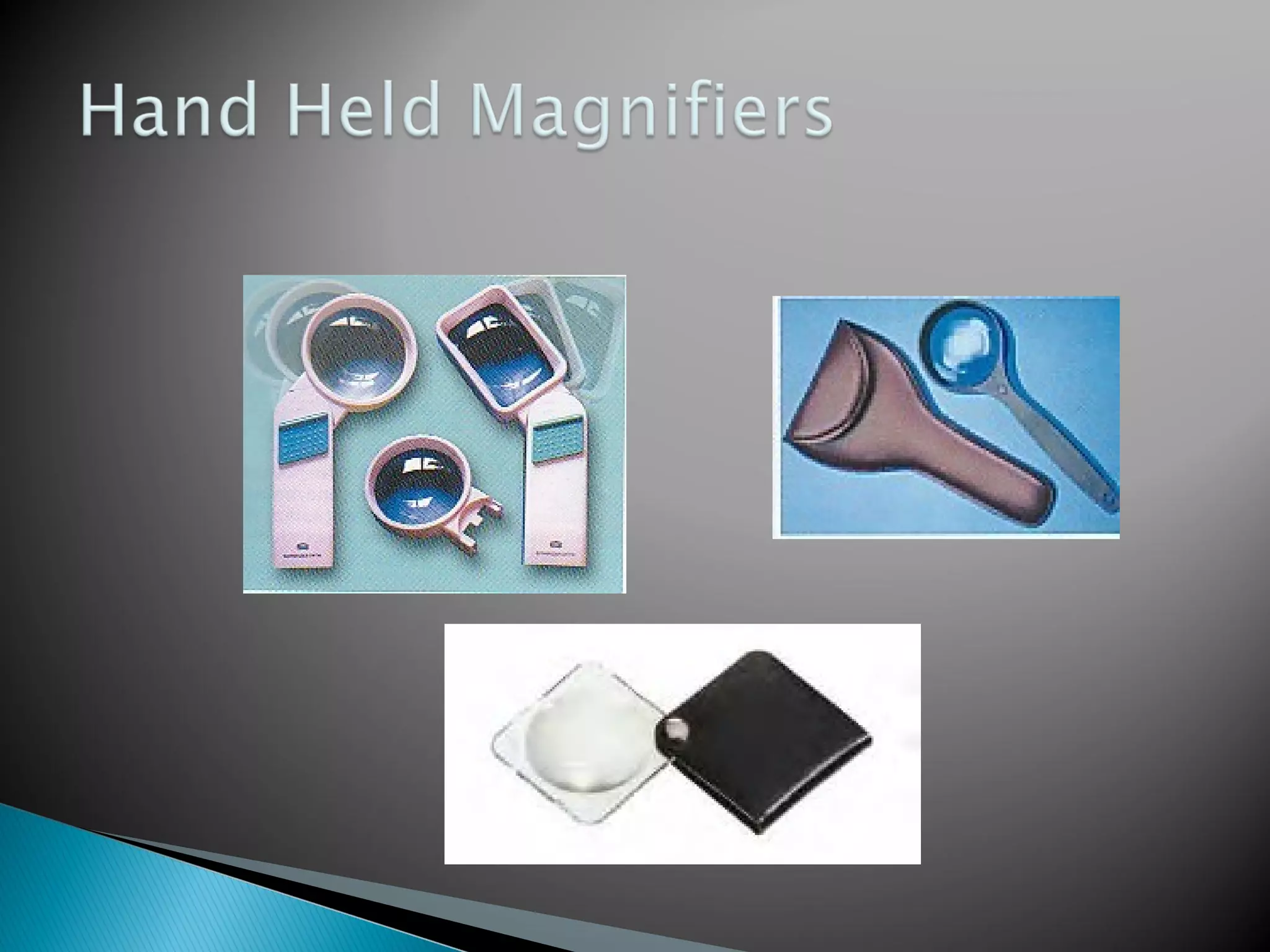
 Convex lenses are used as hand held magnifiers
or stand magnifiers.Here the object is located
between the first principal focus and lens gives
virtual,erect,magnified image for the eye.
 As the object moves nearer to first principal
focus,the virtual image becomes larger and is
situated futher from the eye.
 Field of vision depends upon size or aperture
of the lens and on eye lens distance.
 Greater the eye lens distance smaller the field
of vision.
 Conex cylindrical lenses which has no
refractive power or only a low converging
power in its long axis and high converging
power in cross section provides vertical
magnification of powers.
 Galilean telescopes composed of convex
objective and concave eye piece, seperated by
difference of their focal length.
 It produces a errect, magnified image.
 It mainly acts by increasing angle subtended by
the object at the eye.
 Astronomical(keplers) telescopes consists of two
convex lenses seperated by sum of their focal
lengths.
 This system produces a magnified,inverted image.
 Prisms or mirrors are used to invert the image.
 Types & designs-
1)Binocular spectales
2) Monocular spectacles-standard aspheric lenses
from +4D to +20D in 2D increments
-specially designed microscopic and double lenses
from +24D to 60D.
3)Half eye glasses are preferable because they reduce
the weight,thickness & size for near vision.
4)High add bifocals or high add trifocals can be
used to read large prints at great distance.
 Cosmetically acceptable
 Comfortable and easy to use
 Both hands are free
 Field of vision is large
 Simultaneous vision for near & distance vision is
possible
 Less expensive
 Spherical aberations are created with high plus
lenes unless aspherical lenses are used.
 Short focal length of high plus lenses makes the
patient hold print close to the eye thereby
illumination decreases.
 Mainly used for near vision problem
 Does not require accomidation to see the
image
 Indications-
-for spot or short time tasks in patients with
field of vision reduced to 10⁰ or more.
-as auxiliary lens for finer jobs.
 Available from +4 to+40D
 Their magnification is variable,since the power
varies with distance between the object and focal
point of magnifier.
 These has wide field of vision,light weight, self
contained illumination.
 Working distance is more
 Accomidation is not required for reading
 Easy to view eccentrically
 Hand is not free.
 Inconvenient and tiring
 Reduced field of vision when compared to
spectacles.
 Not useful in the absence of manual dexterity.
 Need to be held at correct distance to obtain
maximum power.
 Types & design-
-available in two forms
1)Prefocused
2)Focusable
-range in power from +4 to +60D.
-self illuminated devices available which
prevent glare.
-requires some accomidative effort.
 Technically simple as they are prefocused and
rest on a rigid mount.
 Choice for patients with hand tremors.
 Small field of vision
 Difficult to use if surface is not flat.
 TYPES & DESIGNS:

Monocular telescopes- easy to carry and use
Binocular telescopes- offers a good grip,
cumbersome to carry. If one eye is worse than
other, these offers no improvement in viewing
quality.
 Telescopes can be either hand held or spectacle
mounted.
 The poorer the vision, stronger is the power of the
telescope required.
 The maximum power useful for hand held type is
8X and for spectacle type is 4X.
 Telescopic spectacle systems are used for
intermitent basis for sedentary distance viewing.
 Telescopic systems are used when it is not
possible to obtain magnification by moving closer.
 Hand held and ring style telescopes are used for
distance spotting.
 For near and intermediate tasks, one can focus
the telescope for near viewing by
a)adding plus lenses behind the optics of
telescope
b)adding plus lenses infront of objective lenses
c)increasing the tube length of telescope.
 Reduction in the field of vision
 Ring scotomas
 Parallax and a decrease in the depth of focus
 Not useful for ordinary distance viewing as
illumination decreases.
 These are consider contravesial for driving
because of constricted fields.
 Closed circuit television
 Large print computers
 Low vision enhancement system
 In this camera picks up the reading
material,magnifies it and displays it on the TV
screen.
 CCTV magnifiers provide excellent contrast and
magnification(linear magnification electronically
upto 60x).
 It provides a distortion free, brighter, magnified
image with enhanced contrast on a larger screen.
 White letters on a black field helps in improvement
of image clarity
 Expensive
 Heavy
 Difficult to move around
 May be difficult for some patients to operate it.
 Computer can provide enlarged print on the
screen through standardized or dedicated
software.
 Software is also available to provide speech for
the computer.
 Recent advances in low vision rehabilitation
 It comprises surgical implantation of
intraoccular telescopic aids.
 Intraoccular low vision aids consists of special
lense that provides a 3x magnification in the
fundus of patients eye.
 Resultant retinal image is perceived through
peripheral retina.
 Absorptive lenses- used to reduce the glare and
dark adaptation time.
Especially used in patients with albinism.
Types- Tinted lenses
-Photochromatic lenses
-Polarization
-Filters
 Field expanders
used in patients with defects in peripheral
visual fields
Types- Fresnel prisms
-Gottlieb field expanders
-Reverse telescopes
-Hemianopic mirrors
 Approach magnification
 Lighting
 Contrast enhancement
 Increasing the size of the object to be viewed
 Personal items
 Auditory aids
 Electronic devices
 Writing and communication devices
 Medical assistive devices
 Mobility assistive devices
 Tactile substitute include Braille,paperlessBraille
outputs and non-Braille tactile outputs.
 Orientation and mobility training
 Independent living skills training
 Support groups
 Braille instruction
 Computer training
 Genetic counseling

Low vision aid

  • 1.
    PRESENTED BY MODERATOR DR.R.HARIPRIYA PGIN OPHTHALMOLOGY SSSIHMS DR.AMIT CHABRA DEPT OF OPHTHALMOLOGY
  • 2.
     Visual Disorder-Anatomicalchanges  Visual impairment-Functional changes  Visual disability-Skills &abilities affected  Visual handicap-Socio economic consequences.
  • 3.
     Legal Blindness ◦Best corrected distance visual acuity of CF-1MT or worse in better eye ◦ Visual field of 10 degrees or less in the better eye  Low Vision ◦ Best corrected visual acuity worse than 20/60 in the better eye(or) visual field of less then 10⁰ from the point of fixation.
  • 4.
    1)Moderate visual impairment-best corrected VA less than 6/18 to 6/60. 2)Severe visual impairment- best corrected visual acuity of less than 6/60 to CF-3MTS (or) visual field diameter of 20⁰ or less. 3)Profound visual impairment- best corrected visual acuity of less than CF-3MTS to CF-1MT or visual field diameter of 10⁰ or less.
  • 5.
     4)Near totalvision loss- best corrected visual acuity of CF-1MT or less.  5)Total blindness- no perception of light.
  • 6.
     Loss ofcentral vision (visual acuity)  Loss of peripheral vision (visual field)  Glare and contrast
  • 7.
     Difficulty reading Problems writing/ completing paperwork  Inability to recognize distance objects and faces
  • 8.
     Need foradditional lighting  Problems with glare  Increased adjustment to changes in illumination  Visual discomfort and fatigue
  • 9.
     CLOUDY MEDIA: uncorrectedrefractive errors, dry eyes,corneal dystrophies,keratoconus,corneal scarring from H.simplex,traumatic mydriasis,cataract,vitreous hemorrhage & posterior uveitis.
  • 10.
     Location ofscotoma important!  Generalized loss of visual field difficult to compensate for  Mobility and independent travel  Reading may require adaptations
  • 11.
     CENTRAL FIELDDEFICITS: Macular degenerations, macular hole, diabetic macular edema and ischemia, myopic degeneration, toxoplasmosis , histoplasmosis, phototoxicity, drug toxicity, focal or grid laser for CSME, iatrogenic central and paracentral scotoma.
  • 12.
     PERIPHERAL FIELDDEFICIT: Retinal dystrophies, RP , RD , PDR, Glaucoma,Ischemic optic neuropathy,Stroke,Trauma,Tumour,Panretinal laser photocoagulation.
  • 13.
     History/ intake Visual acuity  Visual field testing  Pupils  Extraocular muscle testing  Refraction  Color vision and Contrast Testing  Ocular Health
  • 16.
     Confrontation  Arcperimeter  Automated perimetry  Goldmann perimetry
  • 17.
     Ishihara  ColorVision Testing Made Easy  D-15  Pelli-Robson  Vistech Contrast System  Mr. Happy
  • 20.
     Enlarges imageon retina to stimulate more retinal cells  Can be achieved in many ways ◦ Relative Distance ◦ Relative Size ◦ Optical / Angular ◦ Electronic
  • 21.
    1)Magnifying spectacles 2) Handmagnifiers 3)Stand magnifiers 4)Telescopes 5)Electronic magnifiers
  • 22.
     Macular Degeneration  Glaucoma Diabetic Retinopathy  Stroke/ brain injury  Retinitis pigmentosa  Optic Nerve disease  Albinism  Nystagmus  Cortical Visual Impairment
  • 23.
     Hand heldtelescopes  Mounted telescopes  Electronic systems
  • 24.
     Spectacles ◦ Prismatic½ eyes ◦ Full-field microscopes  Magnifiers ◦ Hand held or Stand held ◦ Illuminated or non-illuminated  Telemicroscopes  Electronic Devices
  • 25.
     Magnifying deviceswork by increasing the angle subtended by the object at the eye thus producing an enlarged retinal image(angular magnification).  MP= RETINAL IMAGE WITH USE OF INSTRUMENT/RETINAL IMAGE WITH OUT USE OF INSTRUMENT.
  • 26.
     Convex lensesare used as hand held magnifiers or stand magnifiers.Here the object is located between the first principal focus and lens gives virtual,erect,magnified image for the eye.  As the object moves nearer to first principal focus,the virtual image becomes larger and is situated futher from the eye.
  • 27.
     Field ofvision depends upon size or aperture of the lens and on eye lens distance.  Greater the eye lens distance smaller the field of vision.  Conex cylindrical lenses which has no refractive power or only a low converging power in its long axis and high converging power in cross section provides vertical magnification of powers.
  • 28.
     Galilean telescopescomposed of convex objective and concave eye piece, seperated by difference of their focal length.  It produces a errect, magnified image.  It mainly acts by increasing angle subtended by the object at the eye.
  • 29.
     Astronomical(keplers) telescopesconsists of two convex lenses seperated by sum of their focal lengths.  This system produces a magnified,inverted image.  Prisms or mirrors are used to invert the image.
  • 30.
     Types &designs- 1)Binocular spectales 2) Monocular spectacles-standard aspheric lenses from +4D to +20D in 2D increments -specially designed microscopic and double lenses from +24D to 60D. 3)Half eye glasses are preferable because they reduce the weight,thickness & size for near vision.
  • 33.
    4)High add bifocalsor high add trifocals can be used to read large prints at great distance.
  • 34.
     Cosmetically acceptable Comfortable and easy to use  Both hands are free  Field of vision is large  Simultaneous vision for near & distance vision is possible  Less expensive
  • 35.
     Spherical aberationsare created with high plus lenes unless aspherical lenses are used.  Short focal length of high plus lenses makes the patient hold print close to the eye thereby illumination decreases.
  • 36.
     Mainly usedfor near vision problem  Does not require accomidation to see the image  Indications- -for spot or short time tasks in patients with field of vision reduced to 10⁰ or more. -as auxiliary lens for finer jobs.
  • 38.
     Available from+4 to+40D  Their magnification is variable,since the power varies with distance between the object and focal point of magnifier.  These has wide field of vision,light weight, self contained illumination.
  • 39.
     Working distanceis more  Accomidation is not required for reading  Easy to view eccentrically
  • 40.
     Hand isnot free.  Inconvenient and tiring  Reduced field of vision when compared to spectacles.  Not useful in the absence of manual dexterity.  Need to be held at correct distance to obtain maximum power.
  • 41.
     Types &design- -available in two forms 1)Prefocused 2)Focusable -range in power from +4 to +60D. -self illuminated devices available which prevent glare. -requires some accomidative effort.
  • 44.
     Technically simpleas they are prefocused and rest on a rigid mount.  Choice for patients with hand tremors.
  • 45.
     Small fieldof vision  Difficult to use if surface is not flat.
  • 46.
     TYPES &DESIGNS:  Monocular telescopes- easy to carry and use Binocular telescopes- offers a good grip, cumbersome to carry. If one eye is worse than other, these offers no improvement in viewing quality.
  • 52.
     Telescopes canbe either hand held or spectacle mounted.  The poorer the vision, stronger is the power of the telescope required.  The maximum power useful for hand held type is 8X and for spectacle type is 4X.
  • 53.
     Telescopic spectaclesystems are used for intermitent basis for sedentary distance viewing.  Telescopic systems are used when it is not possible to obtain magnification by moving closer.  Hand held and ring style telescopes are used for distance spotting.
  • 54.
     For nearand intermediate tasks, one can focus the telescope for near viewing by a)adding plus lenses behind the optics of telescope b)adding plus lenses infront of objective lenses c)increasing the tube length of telescope.
  • 55.
     Reduction inthe field of vision  Ring scotomas  Parallax and a decrease in the depth of focus  Not useful for ordinary distance viewing as illumination decreases.  These are consider contravesial for driving because of constricted fields.
  • 56.
     Closed circuittelevision  Large print computers  Low vision enhancement system
  • 58.
     In thiscamera picks up the reading material,magnifies it and displays it on the TV screen.  CCTV magnifiers provide excellent contrast and magnification(linear magnification electronically upto 60x).
  • 59.
     It providesa distortion free, brighter, magnified image with enhanced contrast on a larger screen.  White letters on a black field helps in improvement of image clarity
  • 60.
     Expensive  Heavy Difficult to move around  May be difficult for some patients to operate it.
  • 61.
     Computer canprovide enlarged print on the screen through standardized or dedicated software.  Software is also available to provide speech for the computer.
  • 63.
     Recent advancesin low vision rehabilitation  It comprises surgical implantation of intraoccular telescopic aids.  Intraoccular low vision aids consists of special lense that provides a 3x magnification in the fundus of patients eye.  Resultant retinal image is perceived through peripheral retina.
  • 66.
     Absorptive lenses-used to reduce the glare and dark adaptation time. Especially used in patients with albinism. Types- Tinted lenses -Photochromatic lenses -Polarization -Filters
  • 70.
     Field expanders usedin patients with defects in peripheral visual fields Types- Fresnel prisms -Gottlieb field expanders -Reverse telescopes -Hemianopic mirrors
  • 76.
     Approach magnification Lighting  Contrast enhancement  Increasing the size of the object to be viewed  Personal items  Auditory aids
  • 79.
     Electronic devices Writing and communication devices  Medical assistive devices  Mobility assistive devices  Tactile substitute include Braille,paperlessBraille outputs and non-Braille tactile outputs.
  • 81.
     Orientation andmobility training  Independent living skills training  Support groups  Braille instruction  Computer training  Genetic counseling