LOW VISUAL AIDS
PRESENTER : Dr Chethan Murthy
Guide : Dr Santosh Patil
Low Vision
• Low vision essential refers to :
• “Level of vision that prevents a person from performing customary
vision activities with standard or conventional optical correction”
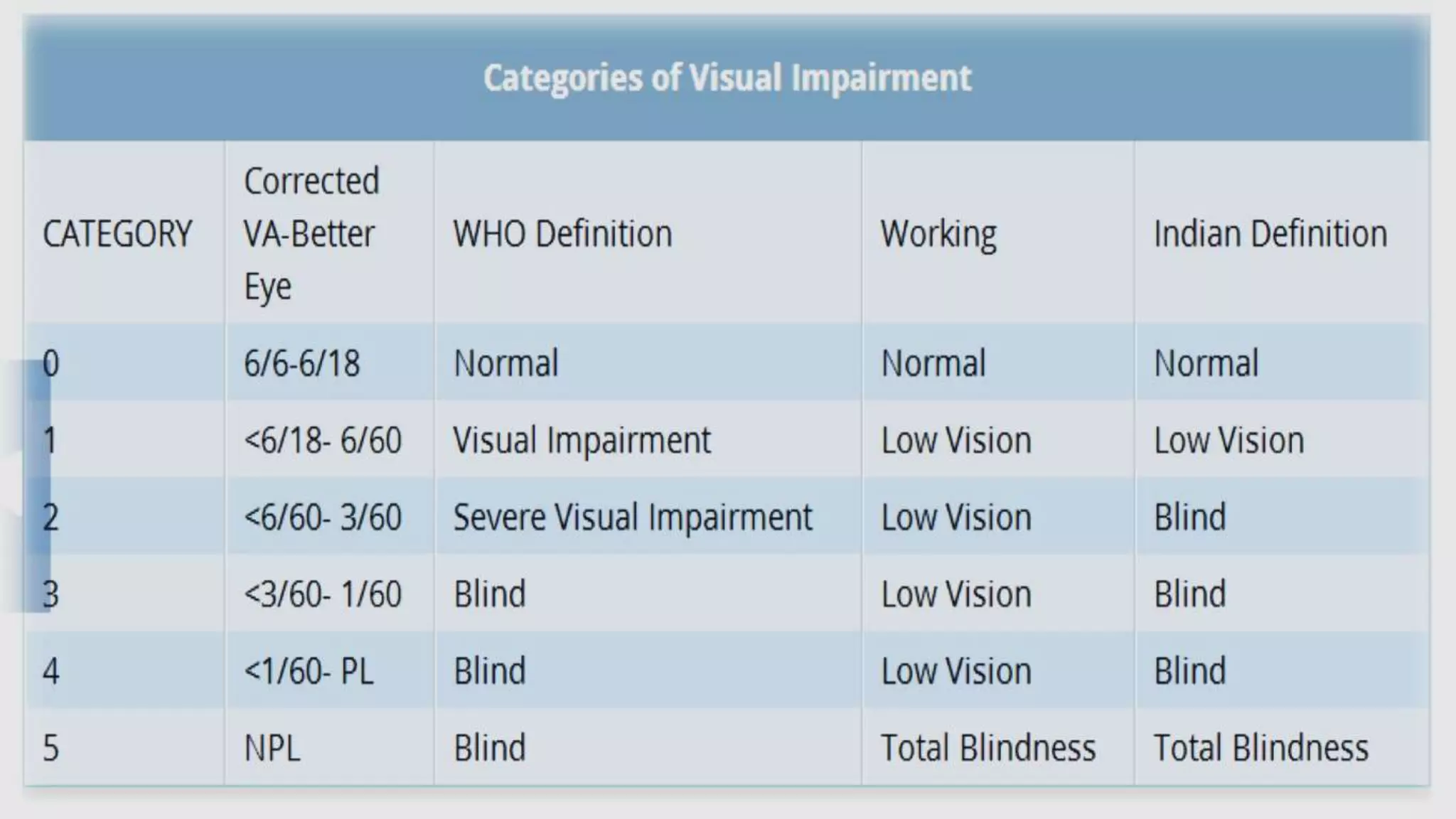
• ICD : Visual Impairment – [Maximum Visual Loss less than
6/18 snellen in better eye/ field of vision of 10 degree or less]
divided into 5 categories
Causes of Low vision
In Children
• Albinism
• Optic neuropathy
• Trauma
• And congenital malformations
In young adults
• Late onset congenital disorders
• High refractive errors
• Ocular injuries
In Old Age
• ARMD
• Diabetic Maculopathy
• Macular and retinal degenerations
• Glaucoma
• Myopic degenerations
Irreversible damage to ocular media or visual pathway due to any disease results in
low vision
Low Visual Aids
Low visual aid refers to optical device that improves , enhances residual
vison by magnifying the image at retinal image
Mainly Optical devices, but consists Non optical devices also
Basic Optics :
Four different ways of enlarging an image are used in low vision practice
• Relative distance enlargement
• Relative size enlargement
• Electronic (transverse) enlargement
• Angular enlargement
Relative distance enlargement
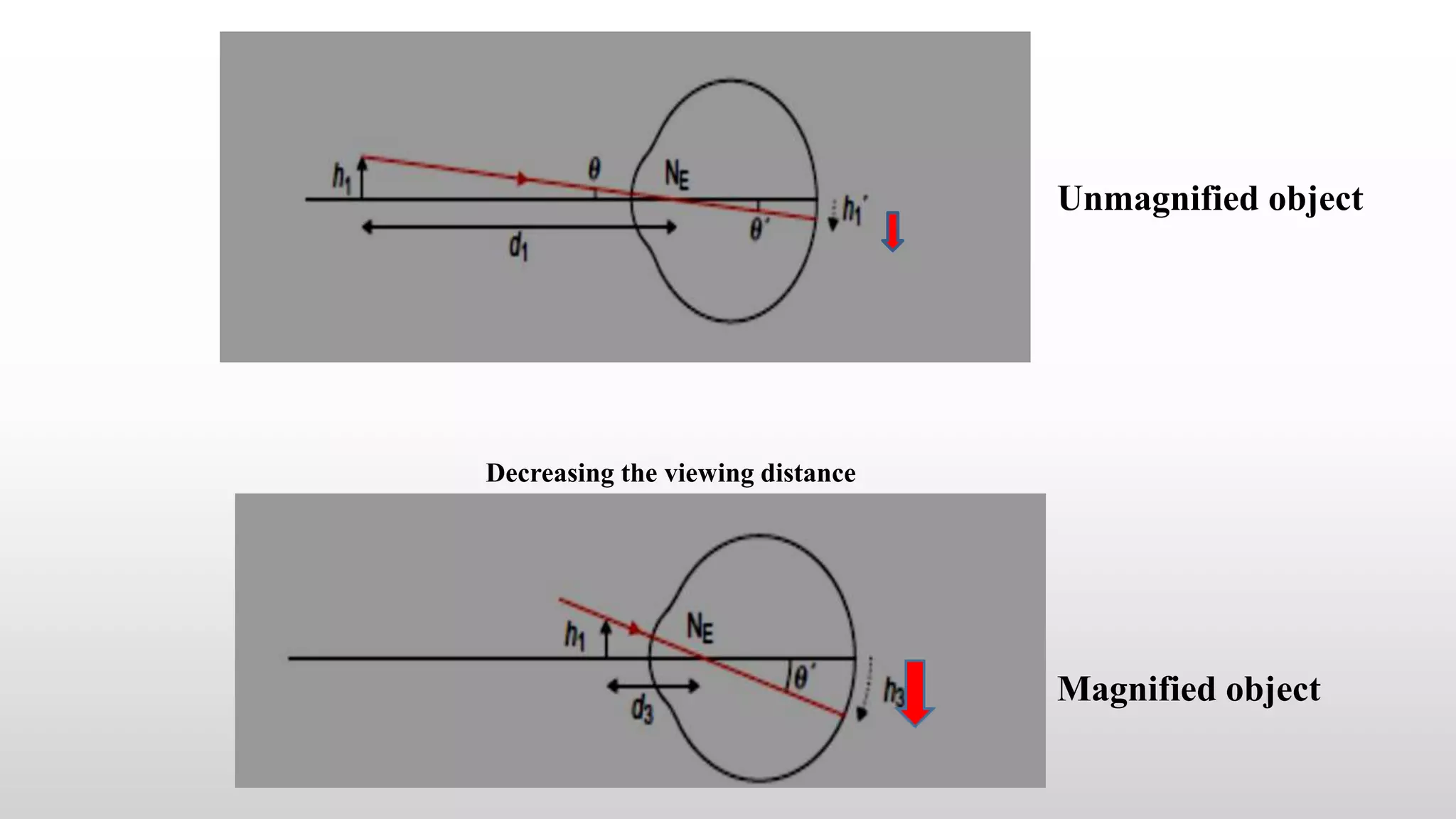
Enlargement that results from a reduction in the object viewing distance -
usually 25 -20 cm
result of reducing the object viewing distance is to increase the angular subtend
of the object at the pupil entrance
Thus, an object observed at an initial reference working distance of 40 cm
produces a retinal image twice as large as the original when viewed at a new
working distance of 20 cm
This is the principle behind hand and stand magnifiers and all spectacle-
mounted magnifiers
Unmagnified object
Decreasing the viewing distance
Magnified object
• Schematic representation of the effect of initial reference working distance on the calculated enlargement
1
2
Relative size enlargement
• Magnification achieved by increasing the size of the object while the working distance
remains the same
• The enlargement ratio is the comparison between the standard text size
• E.g: 12-point print type compared with the enlarged version e.g:- 24 point
Measurement is by direct scale comparison which, in the above case, is
24/12 = 2×
• If the use of large print text is combined with a closer working distance, the
overall enlargement ratio is the product of the two
• for example, 24-point print read at 20 cm compared with 12-point print at
33 cm provides an enlargement ratio of
• Relative size magnification (24/12 = 2) multiplied by Relative distance
magnification (33/20 = 1.6); i.e. 2× 1.6 = 3.2×
• The retinal image size produced by the combination of large print held at a
reduced working distance is therefore increased by a factor of 3.2
Electronic (transverse) enlargement
• Enlargement is achieved by projecting or electronically changing an image so that the new image
has an increased angular subtend at the eye
• Enlargement of the image is measured directly by dividing the image height measured from the
screen by the original object height
• Eg: If the image of a 1 cm object produced on the screen measures 9 cm, the enlargement is 9×.
• This form of enlargement usually allows longer working distances to be utilized
• Eg: the person habitually uses a working distance of 10 cm, but use of the EVES increases the
working distance to 30 cm, the overall enlargement is reduced by a factor of 3
• Overall enlargement is thus 9/3 = 3×
• Electronic vision enhancement system (EVES), often referred to as a CCTV (closed-circuit
television), provides this form of enlargement
Electronic (transverse) enlargement
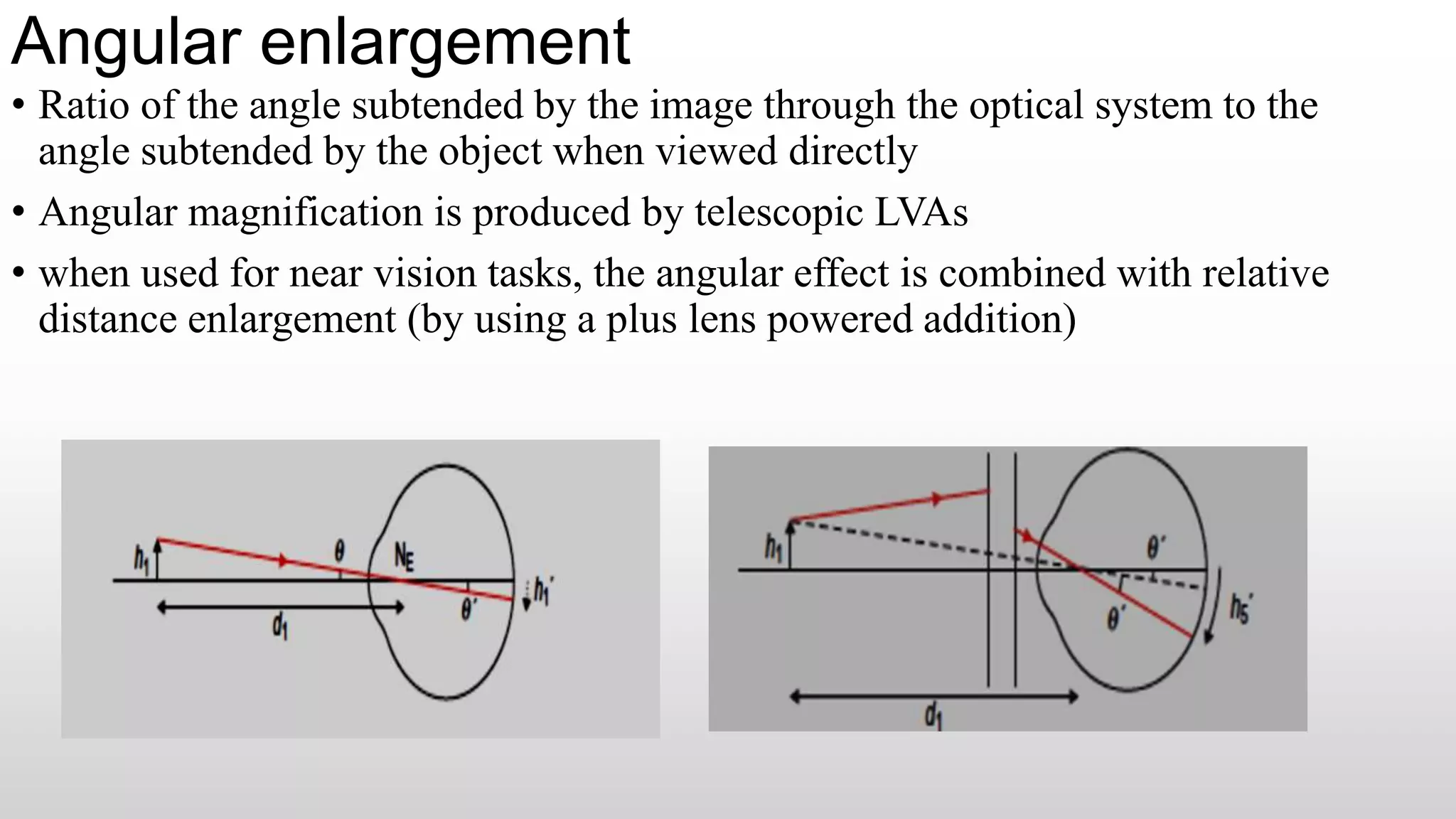
Angular enlargement
• Ratio of the angle subtended by the image through the optical system to the
angle subtended by the object when viewed directly
• Angular magnification is produced by telescopic LVAs
• when used for near vision tasks, the angular effect is combined with relative
distance enlargement (by using a plus lens powered addition)
LVAs
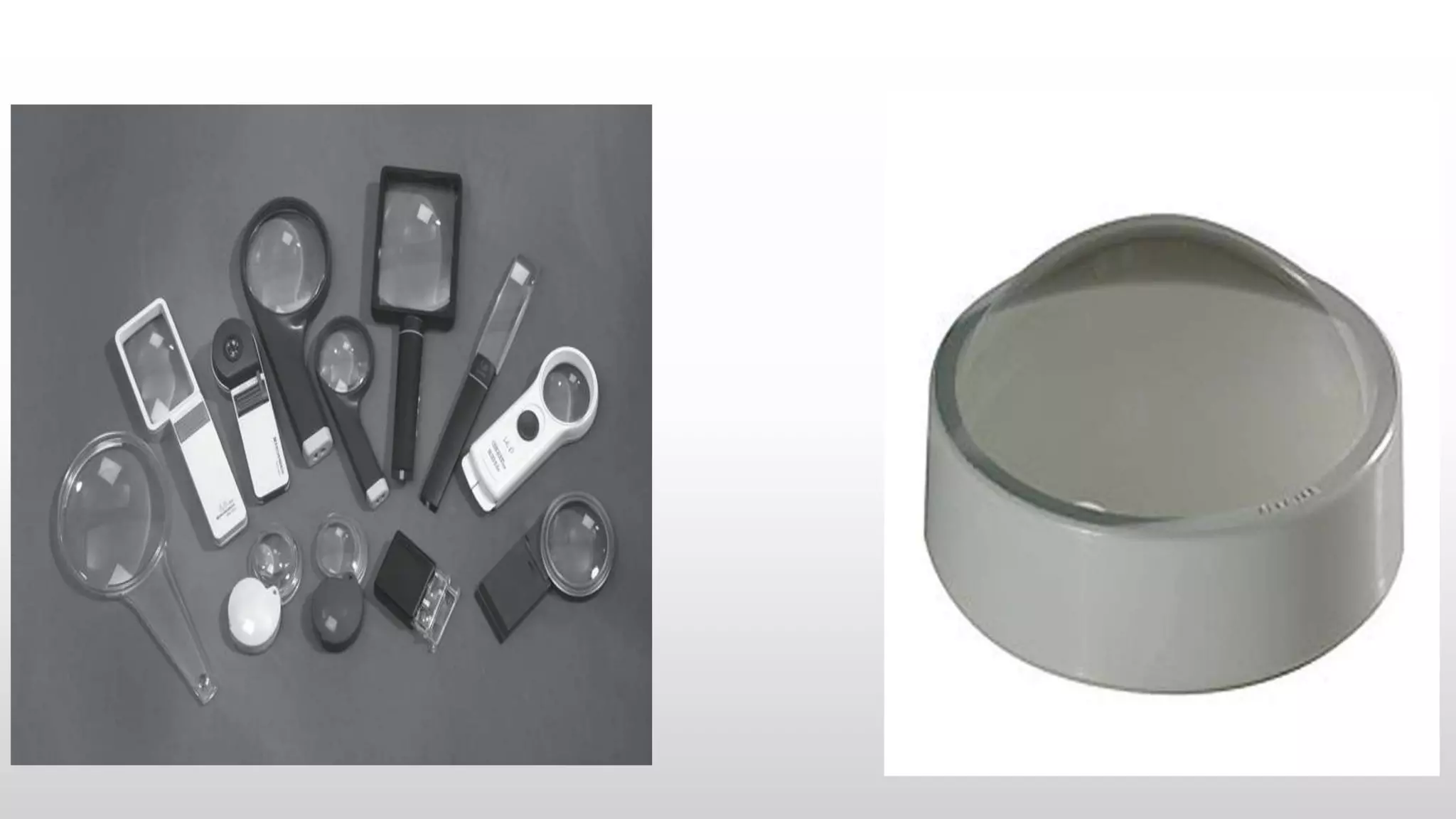
Hand Magnifiers
• The hand magnifier is the most familiar of all low vision aids
• These magnifiers are generally suitable only when small amounts of
image enlargement are required
• Usually used for near vision problems
• Can be used along with distance and reading spectacles or within bifocal
reading addition
• Indications
• Primarily indicated for spot and short-time tasks in patients with filed of vision
reduced to 10 degree or more
• Also used by patients with low vision as an auxiliary lens for finer jobs
• Types and design
• Available from +4 to +40 D or higher
• Most patients accepts 8, 12, 16, 20 D depending on task and degree of impairment
• They should be preferably have wide field , light weighted, and self contained
illumination
Visolett Magnifiers
• Special types of hand magnifiers, that almost double the spectacle magnification
achieved by reading without correction
• Diffusely increase illumination, binocularity
• Has constant magnification of 1.8X
• Used as LVAs in high Myopes
Stand magnifiers
• Most people with visual impairment are elderly and often have hand
tremors or suffer fatigue after even relatively short periods of having
to support a hand magnifier steadily
• Being able to support the magnifying lens without using the hand to
sustain a fixed lens-to-working plane distance
• Although low-powered stand magnifiers are available, they are often
bulky as a tall stand is required to ensure that the lens-to working
plane distance approaches Fm
• As it is frequently difficult to perform tasks beneath high-powered
stand magnifiers, they often have solid sides and built-in illumination.
Practical optics
• Most stand magnifiers have a fixed focus, although they can consist of a lens
suspended around the neck on a cord (often termed a ‘chest’ magnifier) or
held on an adjustable or flexible ‘arm’
• Variable focus stand magnifiers
The distance between the object plane and the lens can be freely selected by the patient,
so these magnifiers can be used essentially as a ‘steadied’ hand magnifier.
This type of low vision aid is particularly valuable to the model maker or crafts makers,
although supplementary lighting is almost essential.
• Fixed focus stand magnifiers
• Fixed focus stand magnifiers are typically designed so that the magnifier lens-to-object
plane distance is less than the anterior focal length of the lens, Hence the light leaving
the lens is divergent
• The light must therefore be converged before reaching the retina
• This can be achieved by ocular accommodation and/or through the use of a near reading
addition (Fa), so that parallel light enters the eye.
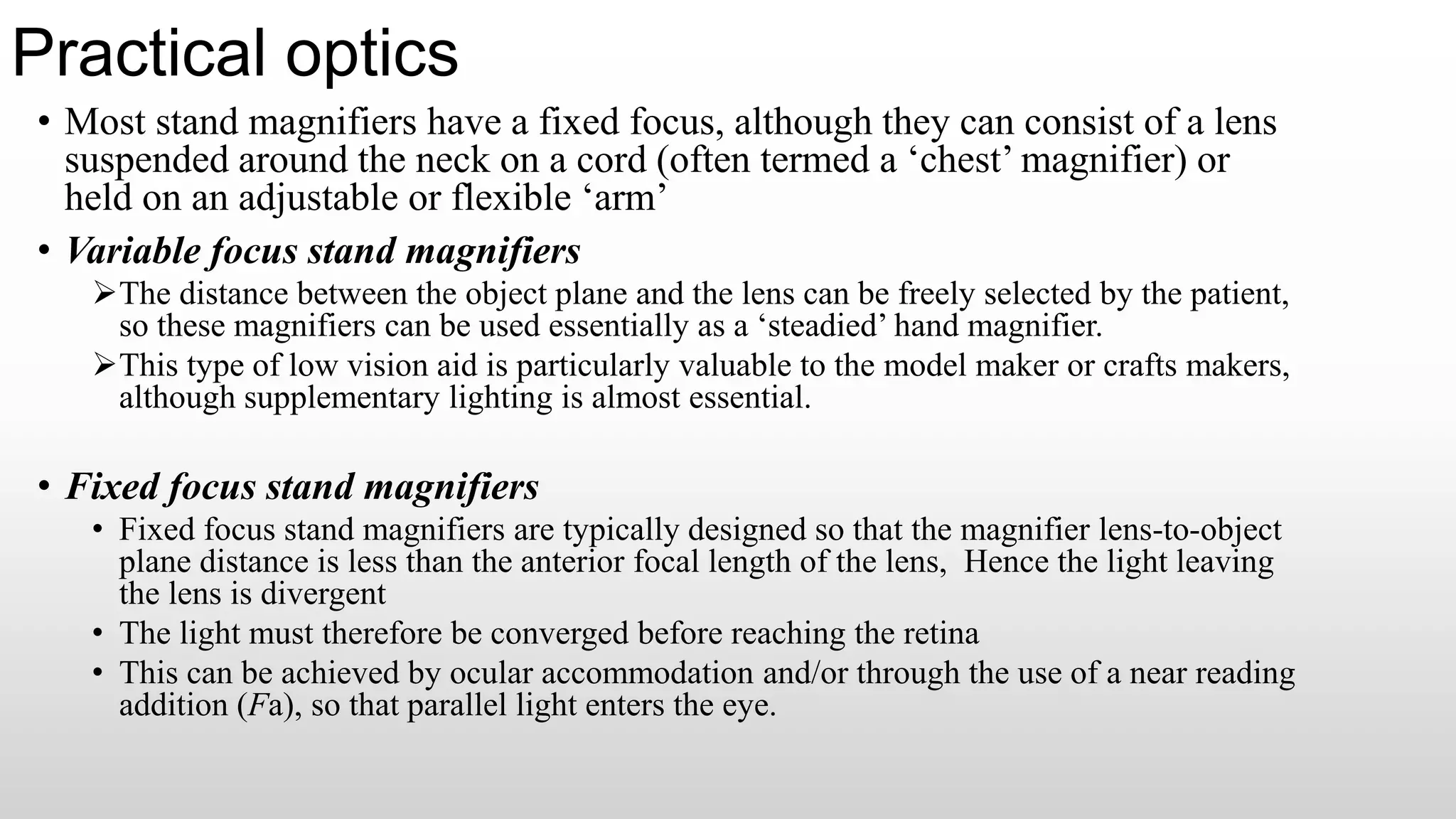
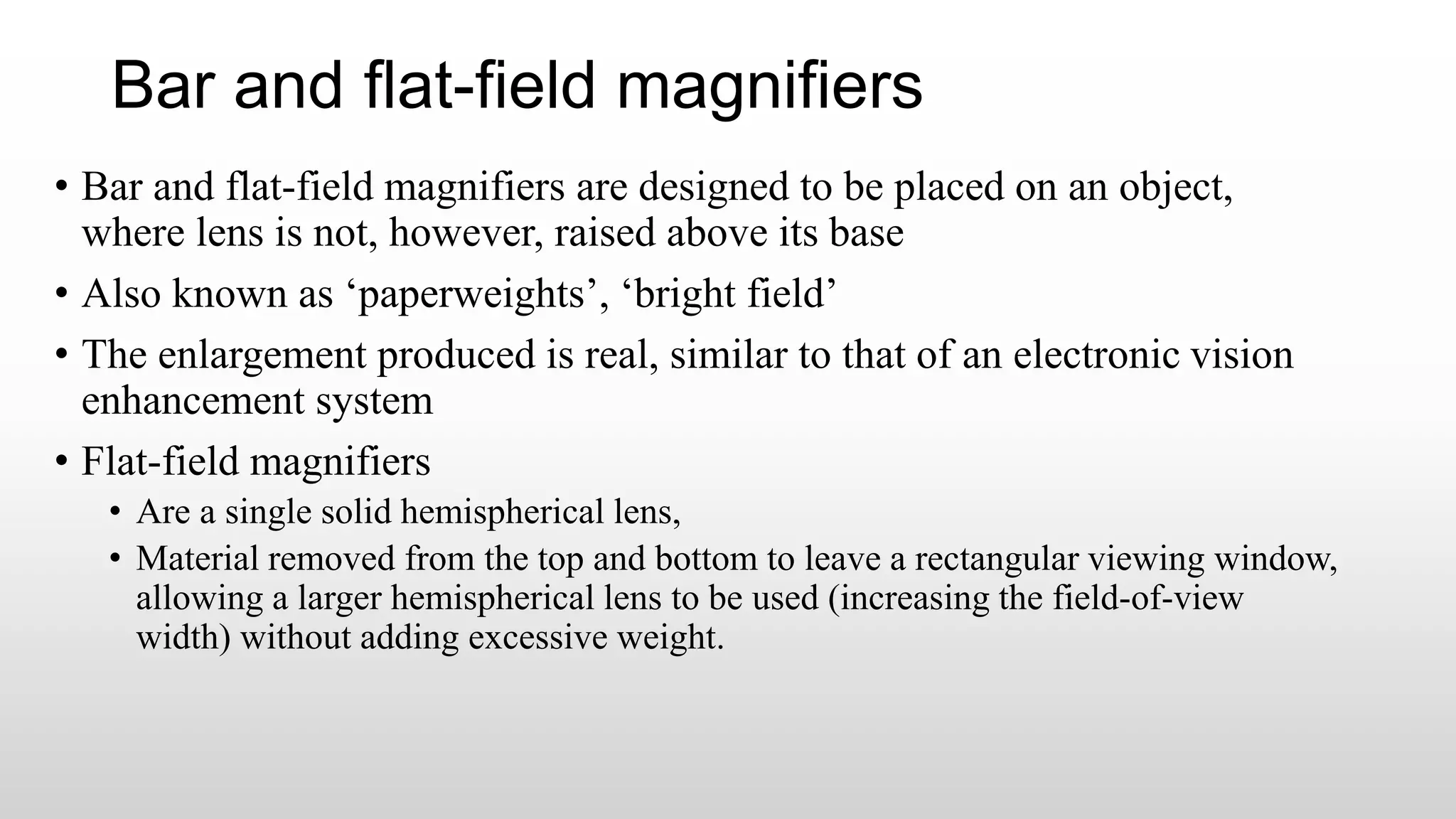
Bar and flat-field magnifiers
• Bar and flat-field magnifiers are designed to be placed on an object,
where lens is not, however, raised above its base
• Also known as ‘paperweights’, ‘bright field’
• The enlargement produced is real, similar to that of an electronic vision
enhancement system
• Flat-field magnifiers
• Are a single solid hemispherical lens,
• Material removed from the top and bottom to leave a rectangular viewing window,
allowing a larger hemispherical lens to be used (increasing the field-of-view
width) without adding excessive weight.
• In practice, enlargement is generally up to 3×
• The image is formed close to the original object, regardless of the bar or flat
field magnifier thickness.
• Hence enlargement is not created by a reduction in viewing distance (as
with other plus lens magnifiers) and the field of view is not increased by
decreasing the eye-to magnifier distance.
• image is formed close to the patient’s normal working distance, so the bar or
flat-field magnifier can be used with no change in posture and with normal
reading glasses
• Binocular viewing is also possible
• The larger the proportion of a sphere used to create a flat-field magnifier,
the higher the magnification, but the smaller the field of view
• Bar magnifiers
• single solid lenses of hemi cylindrical shape that magnify only in the vertical direction
when the length of the magnifier is positioned horizontally
Spectacle magnifiers
• A spectacle magnifier is any lens mounted in the spectacle plane with a
front vertex power greater than that used as a conventional reading
addition
• This magnifying lens may be monocular or binocular, spherical or
aspheric, single vision, bifocal or even multifocal
• It differs from a telescope in having no vergence amplification
• Practical optics
• Spectacle magnifier provides for an increase in retinal image size by increasing the
front vertex power, enabling a closer working distance to be used effectively
• It thus provides a form of relative distance enlargement
• An erect, virtual, and magnified image is produced
Types and designs
• Half eye glasses : Preferable because they reduce the weight , thickness and
size
• High add bifocals or high add trifocals can be used to read large print at
greater distance
• Binocular spectacles:
• Prescribed usually vary in power from 4D with 6Δ base in to 12 D with 14Δ base in
• Monocular Spectacles:
• Consists of standard aspheric lenses from 4D to 20D in 2D increments and specially
designed microscopic and double lenses from 24D (6X) to 60D (15X)
Instructions :
• Patients are instructed to hold material very close and then move it out and scan the
line one by one
• Light must be properly adjusted , and patient should be advised to have patience and
learn reading skills, since speed is reduced to word by word pace.
A range of binocular high-powered near addition readers
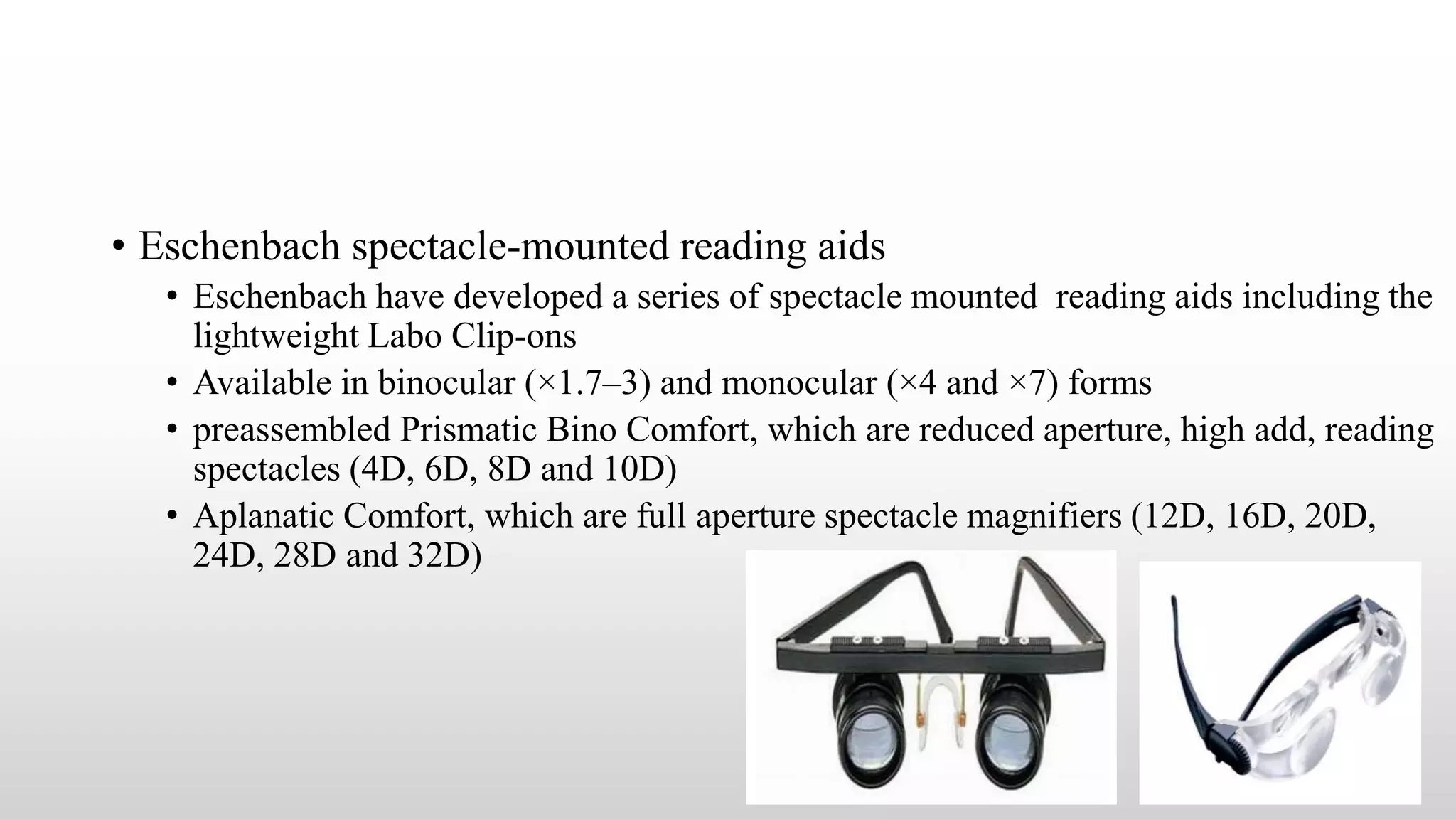
• Eschenbach spectacle-mounted reading aids
• Eschenbach have developed a series of spectacle mounted reading aids including the
lightweight Labo Clip-ons
• Available in binocular (×1.7–3) and monocular (×4 and ×7) forms
• preassembled Prismatic Bino Comfort, which are reduced aperture, high add, reading
spectacles (4D, 6D, 8D and 10D)
• Aplanatic Comfort, which are full aperture spectacle magnifiers (12D, 16D, 20D,
24D, 28D and 32D)
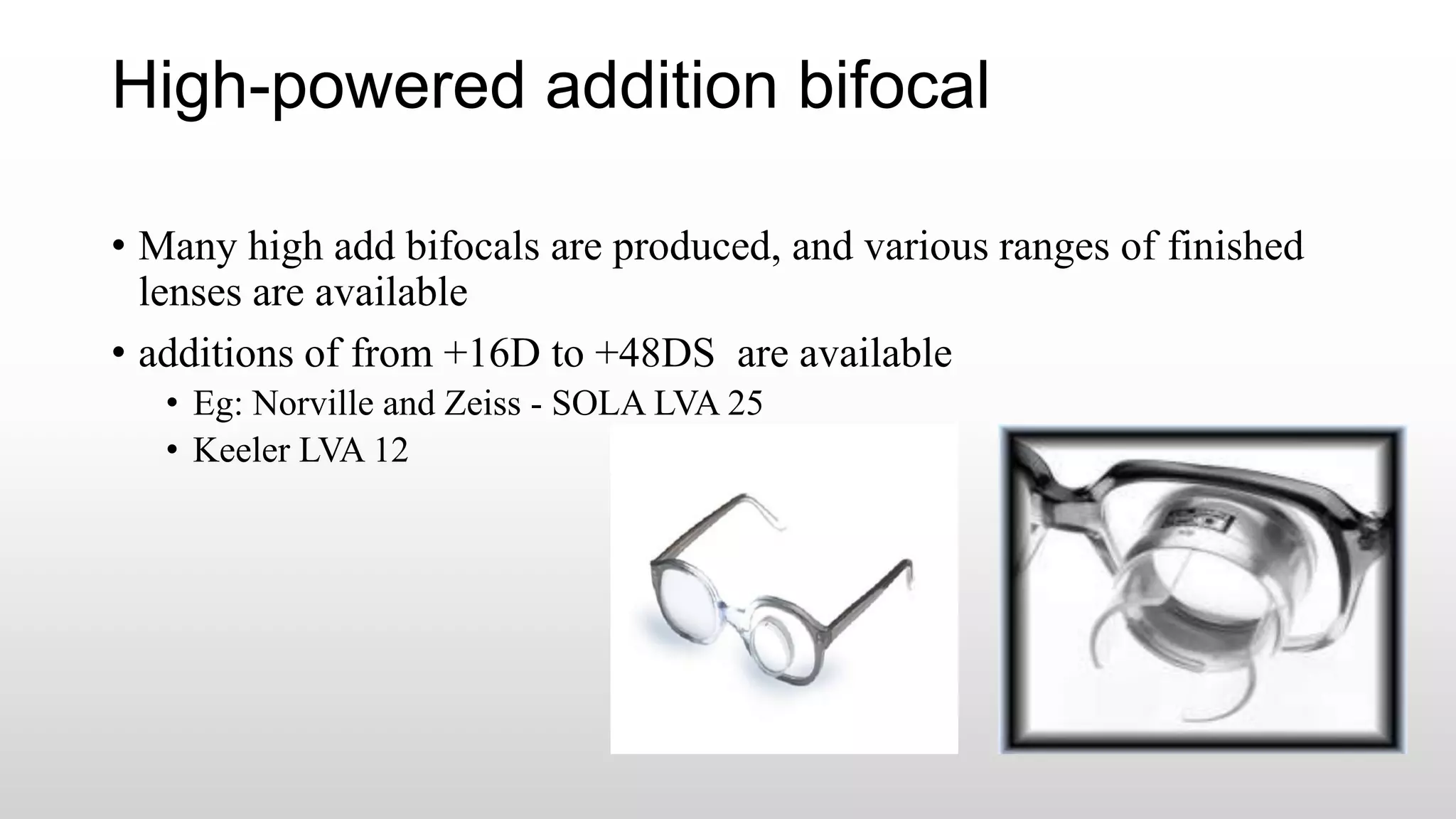
High-powered addition bifocal
• Many high add bifocals are produced, and various ranges of finished
lenses are available
• additions of from +16D to +48DS are available
• Eg: Norville and Zeiss - SOLA LVA 25
• Keeler LVA 12
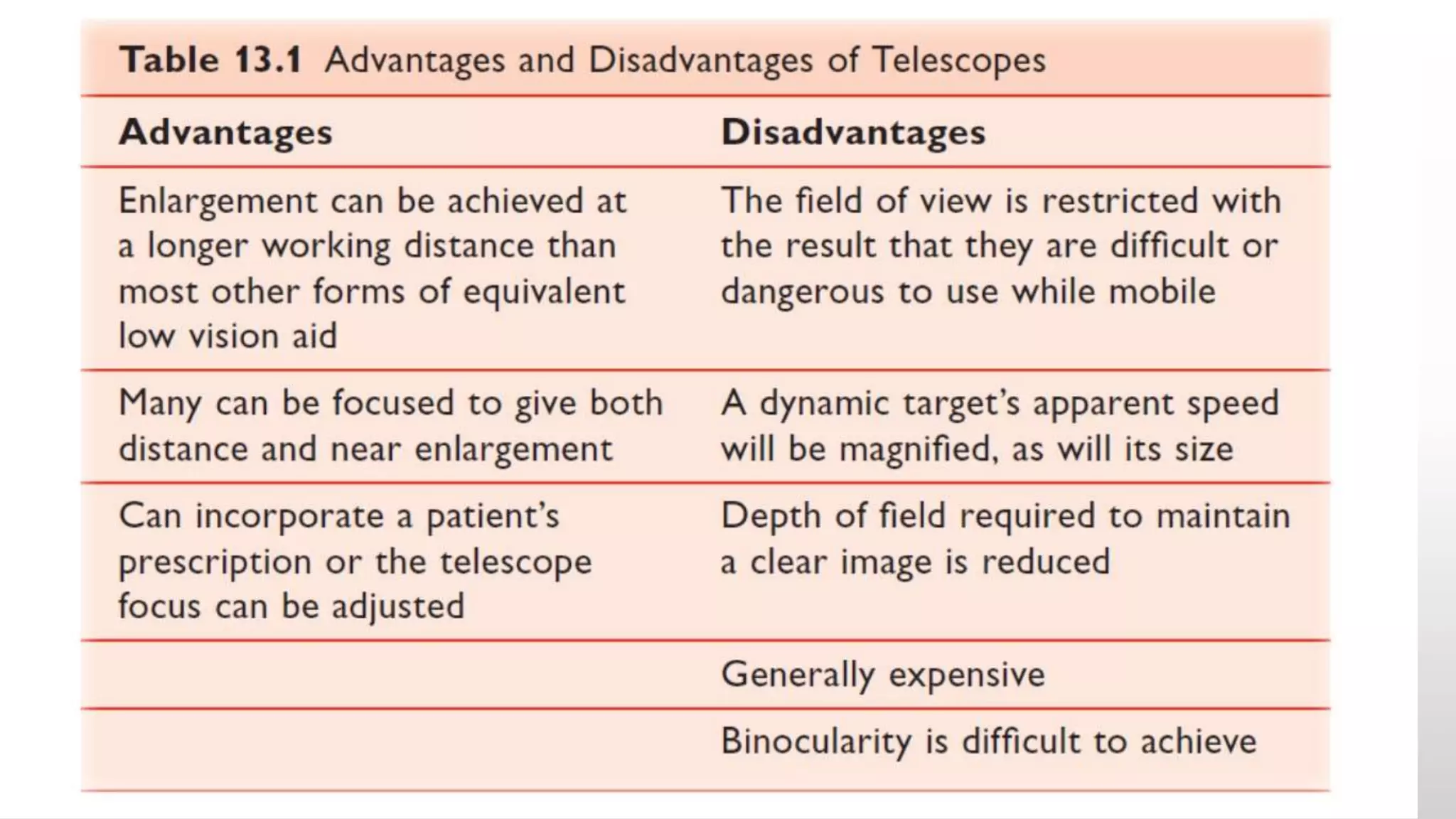
Telescopes
• Telescopes increase angular subtense without requiring a change in
working distance
• Ideal for tasks that have to be undertaken at far and intermediate
distances, such as spotting bus numbers and reading music
• useful when undertaking near tasks, as a longer working distance can
be achieved than by proximal enlargement
• Telescopes are essentially afocal systems, in which the rays of light
entering the telescope from a distant object are parallel, as are the rays
leaving the telescope and entering the user’s eyes
• Astronomical telescopes(also known as Keplerian telescopes)
• consist of two convex (positive) lenses; the first (Fo) converges the light so
that the rays reverse when they pass the lenses focal length ( fo)
• second eyepiece lens (Fe) converges the now divergent rays so that they are
parallel when exiting the system
• The image is inverted, a situation that is rectified, both laterally and vertically,
by prisms
• Can be achieved using two right-angled (Porro) prisms, as in conventional
binoculars; these also allow light paths to be folded, reducing the length of the
telescope
Astronomical telescopes
[Keplerian] telescopes
• Consist of two convex (positive) lenses;
the first (Fo) converges the light so that
the rays reverse when they pass the
lenses focal length ( fo)
• Second eyepiece lens (Fe) converges the
now divergent rays so that they are
parallel when exiting the system
• The image is inverted, a situation that is
rectified, both laterally and vertically, by
prisms
• For an astronomical telescope, both
lenses are convex and therefore both fo
and fe are positive
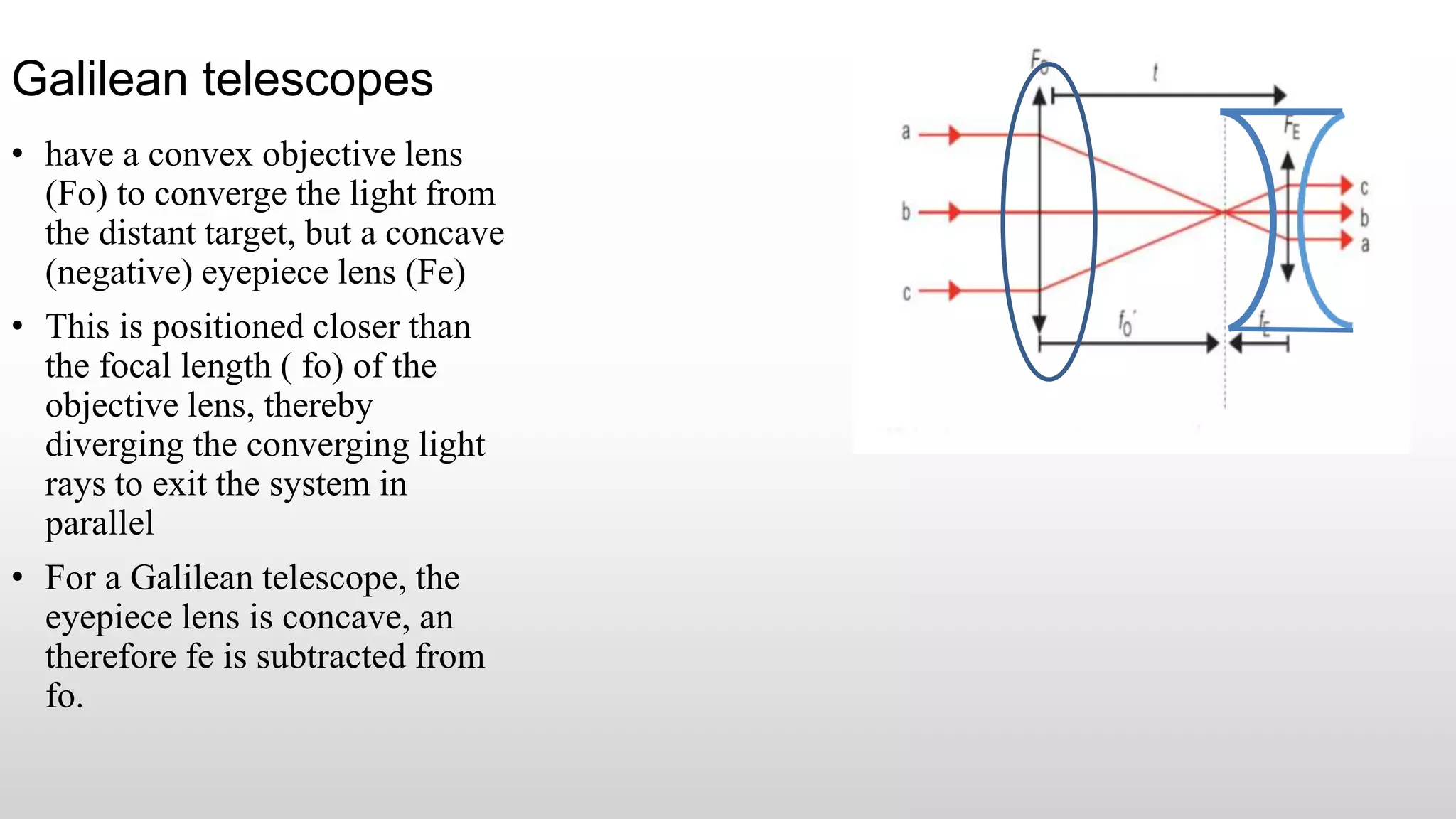
Galilean telescopes
• have a convex objective lens
(Fo) to converge the light from
the distant target, but a concave
(negative) eyepiece lens (Fe)
• This is positioned closer than
the focal length ( fo) of the
objective lens, thereby
diverging the converging light
rays to exit the system in
parallel
• For a Galilean telescope, the
eyepiece lens is concave, an
therefore fe is subtracted from
fo.
Telescopes designed
for mobility
Bioptic telescopes
• typically present a magnified retinal image,
but only to part of the field of view
• User views through their refractive
correction, utilizing the image enhancement
through the compact low-powered
telescope, by a change in head/eye position
as required
• Disadvantage : cause ring scotoma around
the magnified zone
Autofocus telescopes
• lightweight autofocus is available on some
designs of telescope to allow users to track
objects more easily at changing distances
• If the system is binocular, convergence of
the telescope tubes will also have to be
motorized, to provide autofocus
Contact lens and spectacle
lens combination telescopes
• field of view of a telescope can be
increased by decreasing the distance
between the objective lens and the eye
• Hence fitting the eye with a negative
powered contact lens (typically about
−30.00D) in combination with a positive
powered spectacle lens creates a Galilean
telescope with a length equal to the back
vertex distance of the spectacles.
• The field of view is dependent on the
power, diameter and vertex distance of
the spectacle lens
• A ring scotoma around the lens edge can
be minimised by using a blended aspheric
lens
Aids for peripheral field loss
• Field loss, particularly if less than 20º of the visual field remains, can cause severe
visual impairment
• Retinitis pigmentosa and end-stage glaucoma can severely constrict the visual
field, and stroke or other brain injuries can cause hemianopic field loss
• Reversed telescopes
• these increase the field of view (although in commercial designs this is limited by the now smaller
objective lens) at the expense of visual acuity
• Negatively powered lens
• held 20–30 cm from the eye, this lens acts as the objective of a reversed Galilean telescope with the
patient’s accommodation as the eyepiece.
• Spectacle reflecting systems: alternative to telescopic systems, typically used in hemianopic
field loss, can reduce the eye or head movement needed to scan the visual environment
• a mirror in front of the seeing field to reflect objects in the non-seeing area into the seeing field,
• a right-angled prism, base towards the field defect in front of the non-seeing field
• Eg: Fresnel Prisms
Electronic vision
enhancement systems
• Electronic devices that provide electronic (transverse) enlargement
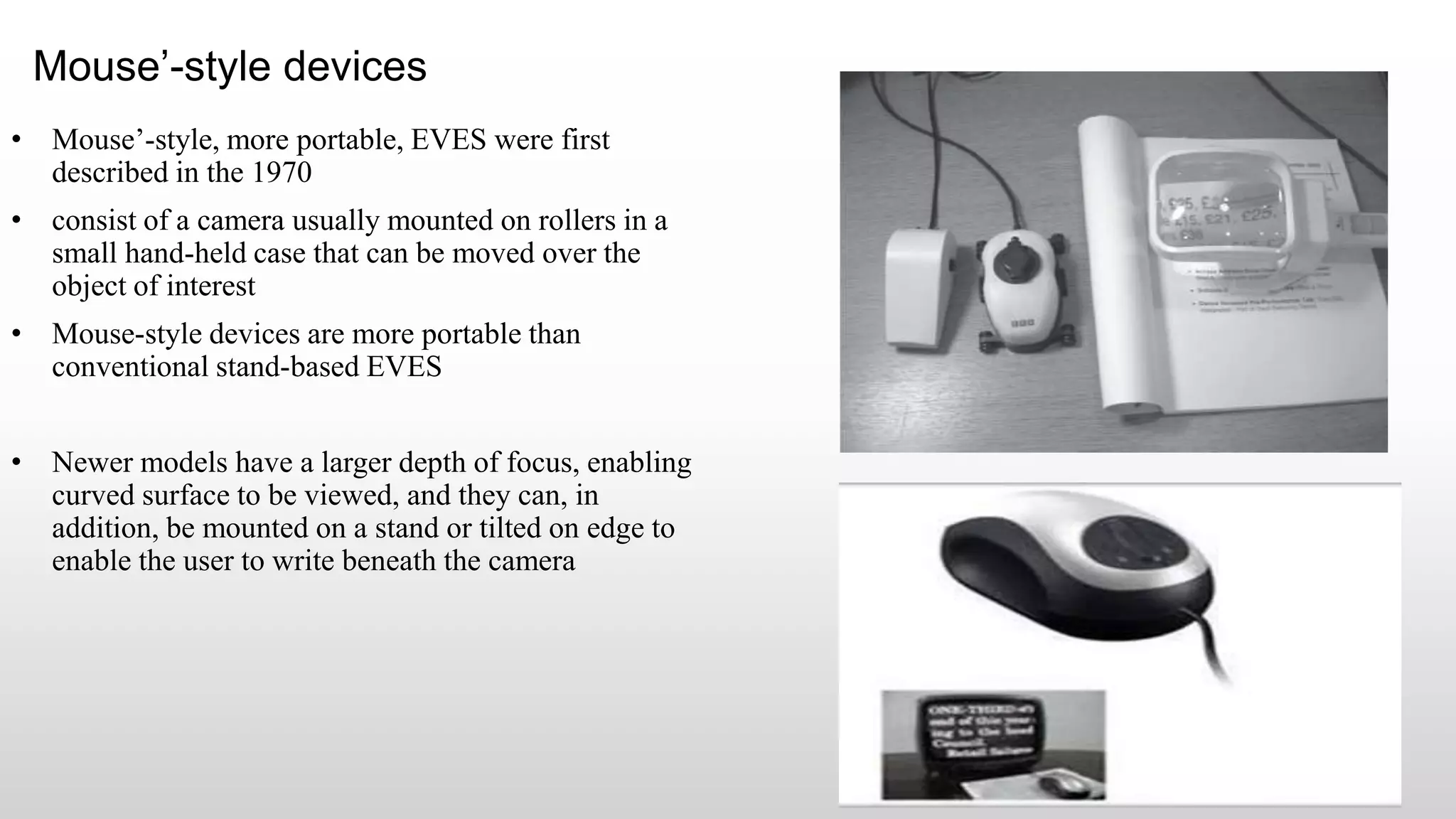
Mouse’-style devices
• Mouse’-style, more portable, EVES were first
described in the 1970
• consist of a camera usually mounted on rollers in a
small hand-held case that can be moved over the
object of interest
• Mouse-style devices are more portable than
conventional stand-based EVES
• Newer models have a larger depth of focus, enabling
curved surface to be viewed, and they can, in
addition, be mounted on a stand or tilted on edge to
enable the user to write beneath the camera
Closed circuit television
CCTV the camera picks up the reading material , magnifies it and
displays it on tv screen
CCTV provides excellent contrast and magnification, color and
reverse contrast polarity
Can provide magnification electronically upto 60X
Advantages:
Provides Distortion free, brighter, magnified image with enhanced
contrast on a larger screen
Reverse Polarity also helps in improvement of image clarity
Disadvantages:
Expensive, heavy and difficult to move around
Difficulty in operation for some patients
Large Print Computers
• Can provide Enlarged print on the screen through either standardized and
dedicated software
• In some programs the image may be enlarged and moved infront of the
observer's eye
Head-mounted devices Large Print Computers
Intraocular Low vision aids
• IO-LVA is the recent advance in low vision rehabilitation
• Involves Surgical implantation of intra ocular aids
• It provides 3X magnification in the fundus, so the resultant retinal image is
perceived through peripheral retina
.
implantable miniaturized telescope mounted in the lens capsule using a carrier lens similar to
common intraocular lenses an supported anteriorly by the iris.
Carrier system
Section through telescope
multiple-unit artificial retina chipset
(MARC) system
retinal prosthesis is based on the
fundamental
concept of replacing photoreceptor
function with an electronic device
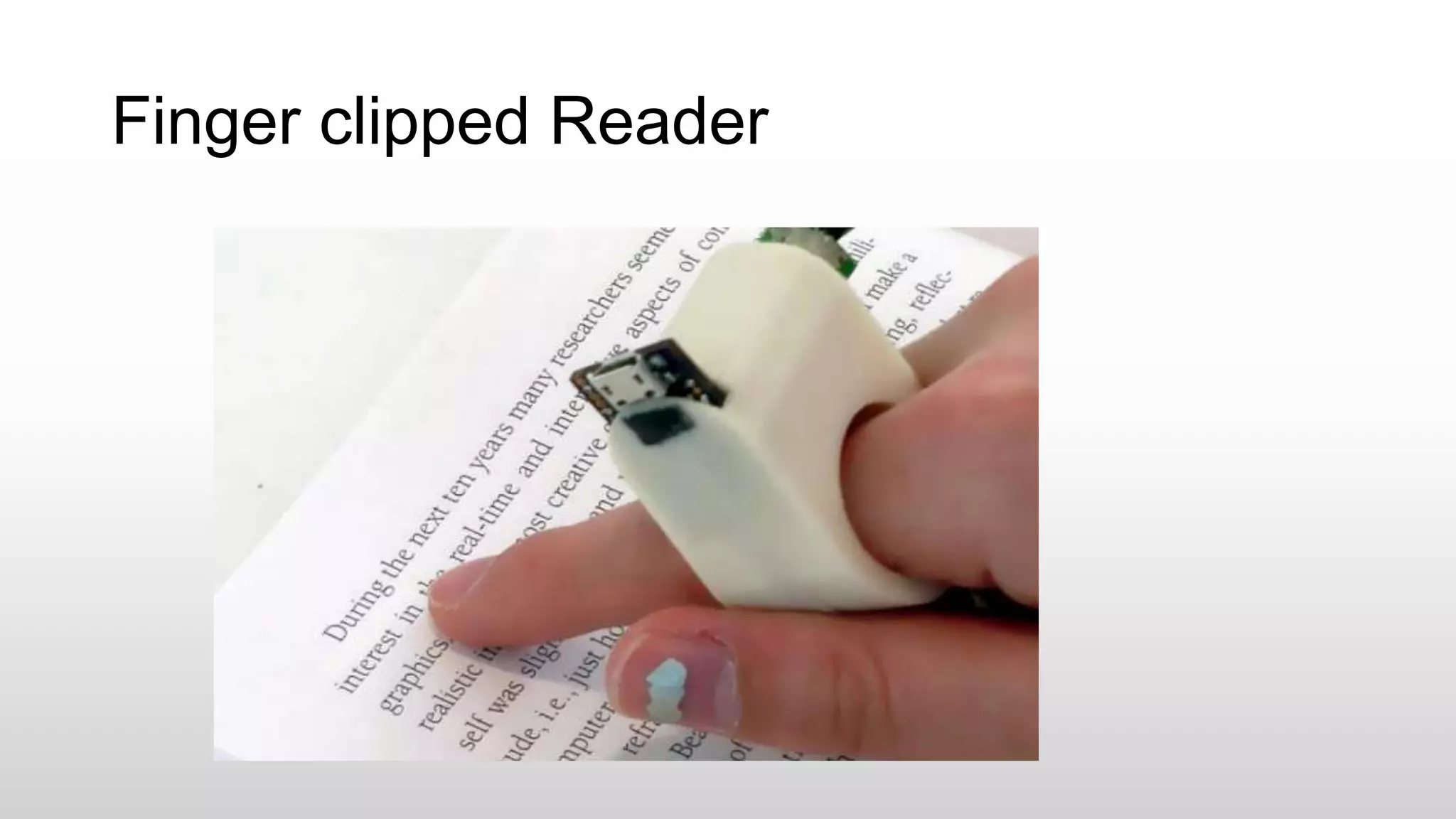
Finger clipped Reader
Other Optical devices
Absorptive lenses
Tinted Lenses : Low absorptive high transmission
Photochromatic : help to people who are less light sensitive
Filters : Contrast can be enhanced by using spectacles with yellow and amber
filters
Corning CPF filters
Younger Protective lens series
Medical Technology Filters
• Discomfort glare can be removed by reducing light with a tint
• A grey neutral density filter will simply reduce all the light and hence not
change the contrast of the retinal image
• Blue light is scattered more than red light by the lens, and is also thought to b
more harmful to the macula. Therefore yellow, amber and brown tints, which
absorb shorter wavelengths of light, have been suggested as being of benefit to
patients with low vision who suffer from disability glare
Non Optical Devices
• Approach Magnification
• Lightning
• Contrast Enhancement
• Increasing the size of the object
• Personal Items : Needle threader
• Auditory aids: talking clocks, watches
• Writing and communication guides : hand writing guides, signature guides,
check guides
• Mobility assistive devices : Sighted guide. Dog guides, Night scopes etc
• Sensory substitute assistive and adaptive devices
• Auditory substitutions : talking books, reader services and audio descriptive devices
• Tactile Substitutions : Braille
Evaluation of the patient with low vision
• History taking
• Onset, progression of visual loss
• Educational status, Professional requirements
• Exact requirements of the patient in terms of near, intermediate or distance vision
• Ocular Examination
• Slit lamp /fundus examination
• Refraction
• Snellen’s chart
• Pinhole test – Pinhole mask – particularly used when Vn is less than 6/18
• Special Low vision charts :
• Distance Vision Charts- Bausch ad Lomb, Sloan, Bailey and love log mar and modified ETDRS .
• Near vision Charts that are recommended are Sloan’s M chart, Keeler’s chart, modified ETDRS charts with
spectacle correction for near work – Nv Is taken at 40 cm
• Assessment of the magnification required for reading
• Slogan’s M chart – M1 to M20
• Directly gives the magnification required : If the patient reads comfortably M5 chart , then magnification
required is 5 times…
• Functions tests : Amsler grid , Contrast sensitivity , Glare test, Visual fields, Colour vision,
Binocular vision
Prescription of LVA’s
• Guidelines
• Aim is to provide maximum vision without compromising mobility of patients
• When Magnification increases both working distance and visual filed
decreases
• Aid chosen should be simple, light weight, portable, flexible
• All the devices with similar magnification should be tried before prescribing a
particular LVA
• Patients Visual status , mental status, needs, and motivation should be given
due consideration while prescribing LVA
Dispensing LVA
• Magnifiation trial
• Magnification required should be calculated taking into influence of scotometry, contrast and glare
data
• Power of reading correction should be adjusted until the patient can read the target size words and text
• Presciption of Appropiate devices
• Various LVAs of the calculated power should be testes systematically in sequence : Convex lens first as
a spectacle [either monocular/ binocular with converging prisms]
• Second as a hand magnifier and third as a stand magnifier
• Complex telescopes, microscopic doublet, electronic systems should be reserved as last choice
• Final Choice depends on Patients compability
Training to use appropriate LVA
• Patient should be taught how to handle the aid, how to hold the printed material,
Working distance
• Should be educated regarding optimal Lightning , take care of the device
• Counselling and motivation of the patient for the continue use of LVA
• Periodic Follow up – User performance with the aid, amount of progression made
THANK YOU
Bibilography
• Optics and refraction – Khurana
• Clinical Optics : AAO
• Low visual Manual- Jhonathan jackson

Low visual aids

  • 1.
    LOW VISUAL AIDS PRESENTER: Dr Chethan Murthy Guide : Dr Santosh Patil
  • 2.
    Low Vision • Lowvision essential refers to : • “Level of vision that prevents a person from performing customary vision activities with standard or conventional optical correction” • ICD : Visual Impairment – [Maximum Visual Loss less than 6/18 snellen in better eye/ field of vision of 10 degree or less] divided into 5 categories
  • 4.
    Causes of Lowvision In Children • Albinism • Optic neuropathy • Trauma • And congenital malformations In young adults • Late onset congenital disorders • High refractive errors • Ocular injuries In Old Age • ARMD • Diabetic Maculopathy • Macular and retinal degenerations • Glaucoma • Myopic degenerations Irreversible damage to ocular media or visual pathway due to any disease results in low vision
  • 5.
    Low Visual Aids Lowvisual aid refers to optical device that improves , enhances residual vison by magnifying the image at retinal image Mainly Optical devices, but consists Non optical devices also Basic Optics : Four different ways of enlarging an image are used in low vision practice • Relative distance enlargement • Relative size enlargement • Electronic (transverse) enlargement • Angular enlargement
  • 6.
    Relative distance enlargement Enlargementthat results from a reduction in the object viewing distance - usually 25 -20 cm result of reducing the object viewing distance is to increase the angular subtend of the object at the pupil entrance Thus, an object observed at an initial reference working distance of 40 cm produces a retinal image twice as large as the original when viewed at a new working distance of 20 cm This is the principle behind hand and stand magnifiers and all spectacle- mounted magnifiers
  • 7.
    Unmagnified object Decreasing theviewing distance Magnified object
  • 8.
    • Schematic representationof the effect of initial reference working distance on the calculated enlargement 1 2
  • 9.
    Relative size enlargement •Magnification achieved by increasing the size of the object while the working distance remains the same
  • 10.
    • The enlargementratio is the comparison between the standard text size • E.g: 12-point print type compared with the enlarged version e.g:- 24 point Measurement is by direct scale comparison which, in the above case, is 24/12 = 2× • If the use of large print text is combined with a closer working distance, the overall enlargement ratio is the product of the two • for example, 24-point print read at 20 cm compared with 12-point print at 33 cm provides an enlargement ratio of • Relative size magnification (24/12 = 2) multiplied by Relative distance magnification (33/20 = 1.6); i.e. 2× 1.6 = 3.2× • The retinal image size produced by the combination of large print held at a reduced working distance is therefore increased by a factor of 3.2
  • 11.
    Electronic (transverse) enlargement •Enlargement is achieved by projecting or electronically changing an image so that the new image has an increased angular subtend at the eye • Enlargement of the image is measured directly by dividing the image height measured from the screen by the original object height • Eg: If the image of a 1 cm object produced on the screen measures 9 cm, the enlargement is 9×. • This form of enlargement usually allows longer working distances to be utilized • Eg: the person habitually uses a working distance of 10 cm, but use of the EVES increases the working distance to 30 cm, the overall enlargement is reduced by a factor of 3 • Overall enlargement is thus 9/3 = 3× • Electronic vision enhancement system (EVES), often referred to as a CCTV (closed-circuit television), provides this form of enlargement
  • 12.
  • 13.
    Angular enlargement • Ratioof the angle subtended by the image through the optical system to the angle subtended by the object when viewed directly • Angular magnification is produced by telescopic LVAs • when used for near vision tasks, the angular effect is combined with relative distance enlargement (by using a plus lens powered addition)
  • 14.
    LVAs Hand Magnifiers • Thehand magnifier is the most familiar of all low vision aids • These magnifiers are generally suitable only when small amounts of image enlargement are required • Usually used for near vision problems • Can be used along with distance and reading spectacles or within bifocal reading addition • Indications • Primarily indicated for spot and short-time tasks in patients with filed of vision reduced to 10 degree or more • Also used by patients with low vision as an auxiliary lens for finer jobs
  • 15.
    • Types anddesign • Available from +4 to +40 D or higher • Most patients accepts 8, 12, 16, 20 D depending on task and degree of impairment • They should be preferably have wide field , light weighted, and self contained illumination Visolett Magnifiers • Special types of hand magnifiers, that almost double the spectacle magnification achieved by reading without correction • Diffusely increase illumination, binocularity • Has constant magnification of 1.8X • Used as LVAs in high Myopes
  • 18.
    Stand magnifiers • Mostpeople with visual impairment are elderly and often have hand tremors or suffer fatigue after even relatively short periods of having to support a hand magnifier steadily • Being able to support the magnifying lens without using the hand to sustain a fixed lens-to-working plane distance • Although low-powered stand magnifiers are available, they are often bulky as a tall stand is required to ensure that the lens-to working plane distance approaches Fm • As it is frequently difficult to perform tasks beneath high-powered stand magnifiers, they often have solid sides and built-in illumination.
  • 19.
    Practical optics • Moststand magnifiers have a fixed focus, although they can consist of a lens suspended around the neck on a cord (often termed a ‘chest’ magnifier) or held on an adjustable or flexible ‘arm’ • Variable focus stand magnifiers The distance between the object plane and the lens can be freely selected by the patient, so these magnifiers can be used essentially as a ‘steadied’ hand magnifier. This type of low vision aid is particularly valuable to the model maker or crafts makers, although supplementary lighting is almost essential. • Fixed focus stand magnifiers • Fixed focus stand magnifiers are typically designed so that the magnifier lens-to-object plane distance is less than the anterior focal length of the lens, Hence the light leaving the lens is divergent • The light must therefore be converged before reaching the retina • This can be achieved by ocular accommodation and/or through the use of a near reading addition (Fa), so that parallel light enters the eye.
  • 22.
    Bar and flat-fieldmagnifiers • Bar and flat-field magnifiers are designed to be placed on an object, where lens is not, however, raised above its base • Also known as ‘paperweights’, ‘bright field’ • The enlargement produced is real, similar to that of an electronic vision enhancement system • Flat-field magnifiers • Are a single solid hemispherical lens, • Material removed from the top and bottom to leave a rectangular viewing window, allowing a larger hemispherical lens to be used (increasing the field-of-view width) without adding excessive weight.
  • 23.
    • In practice,enlargement is generally up to 3× • The image is formed close to the original object, regardless of the bar or flat field magnifier thickness. • Hence enlargement is not created by a reduction in viewing distance (as with other plus lens magnifiers) and the field of view is not increased by decreasing the eye-to magnifier distance. • image is formed close to the patient’s normal working distance, so the bar or flat-field magnifier can be used with no change in posture and with normal reading glasses • Binocular viewing is also possible • The larger the proportion of a sphere used to create a flat-field magnifier, the higher the magnification, but the smaller the field of view
  • 24.
    • Bar magnifiers •single solid lenses of hemi cylindrical shape that magnify only in the vertical direction when the length of the magnifier is positioned horizontally
  • 25.
    Spectacle magnifiers • Aspectacle magnifier is any lens mounted in the spectacle plane with a front vertex power greater than that used as a conventional reading addition • This magnifying lens may be monocular or binocular, spherical or aspheric, single vision, bifocal or even multifocal • It differs from a telescope in having no vergence amplification • Practical optics • Spectacle magnifier provides for an increase in retinal image size by increasing the front vertex power, enabling a closer working distance to be used effectively • It thus provides a form of relative distance enlargement • An erect, virtual, and magnified image is produced
  • 26.
    Types and designs •Half eye glasses : Preferable because they reduce the weight , thickness and size • High add bifocals or high add trifocals can be used to read large print at greater distance • Binocular spectacles: • Prescribed usually vary in power from 4D with 6Δ base in to 12 D with 14Δ base in • Monocular Spectacles: • Consists of standard aspheric lenses from 4D to 20D in 2D increments and specially designed microscopic and double lenses from 24D (6X) to 60D (15X) Instructions : • Patients are instructed to hold material very close and then move it out and scan the line one by one • Light must be properly adjusted , and patient should be advised to have patience and learn reading skills, since speed is reduced to word by word pace.
  • 27.
    A range ofbinocular high-powered near addition readers
  • 28.
    • Eschenbach spectacle-mountedreading aids • Eschenbach have developed a series of spectacle mounted reading aids including the lightweight Labo Clip-ons • Available in binocular (×1.7–3) and monocular (×4 and ×7) forms • preassembled Prismatic Bino Comfort, which are reduced aperture, high add, reading spectacles (4D, 6D, 8D and 10D) • Aplanatic Comfort, which are full aperture spectacle magnifiers (12D, 16D, 20D, 24D, 28D and 32D)
  • 29.
    High-powered addition bifocal •Many high add bifocals are produced, and various ranges of finished lenses are available • additions of from +16D to +48DS are available • Eg: Norville and Zeiss - SOLA LVA 25 • Keeler LVA 12
  • 31.
    Telescopes • Telescopes increaseangular subtense without requiring a change in working distance • Ideal for tasks that have to be undertaken at far and intermediate distances, such as spotting bus numbers and reading music • useful when undertaking near tasks, as a longer working distance can be achieved than by proximal enlargement • Telescopes are essentially afocal systems, in which the rays of light entering the telescope from a distant object are parallel, as are the rays leaving the telescope and entering the user’s eyes
  • 32.
    • Astronomical telescopes(alsoknown as Keplerian telescopes) • consist of two convex (positive) lenses; the first (Fo) converges the light so that the rays reverse when they pass the lenses focal length ( fo) • second eyepiece lens (Fe) converges the now divergent rays so that they are parallel when exiting the system • The image is inverted, a situation that is rectified, both laterally and vertically, by prisms • Can be achieved using two right-angled (Porro) prisms, as in conventional binoculars; these also allow light paths to be folded, reducing the length of the telescope
  • 33.
    Astronomical telescopes [Keplerian] telescopes •Consist of two convex (positive) lenses; the first (Fo) converges the light so that the rays reverse when they pass the lenses focal length ( fo) • Second eyepiece lens (Fe) converges the now divergent rays so that they are parallel when exiting the system • The image is inverted, a situation that is rectified, both laterally and vertically, by prisms • For an astronomical telescope, both lenses are convex and therefore both fo and fe are positive
  • 34.
    Galilean telescopes • havea convex objective lens (Fo) to converge the light from the distant target, but a concave (negative) eyepiece lens (Fe) • This is positioned closer than the focal length ( fo) of the objective lens, thereby diverging the converging light rays to exit the system in parallel • For a Galilean telescope, the eyepiece lens is concave, an therefore fe is subtracted from fo.
  • 37.
    Telescopes designed for mobility Bioptictelescopes • typically present a magnified retinal image, but only to part of the field of view • User views through their refractive correction, utilizing the image enhancement through the compact low-powered telescope, by a change in head/eye position as required • Disadvantage : cause ring scotoma around the magnified zone Autofocus telescopes • lightweight autofocus is available on some designs of telescope to allow users to track objects more easily at changing distances • If the system is binocular, convergence of the telescope tubes will also have to be motorized, to provide autofocus
  • 38.
    Contact lens andspectacle lens combination telescopes • field of view of a telescope can be increased by decreasing the distance between the objective lens and the eye • Hence fitting the eye with a negative powered contact lens (typically about −30.00D) in combination with a positive powered spectacle lens creates a Galilean telescope with a length equal to the back vertex distance of the spectacles. • The field of view is dependent on the power, diameter and vertex distance of the spectacle lens • A ring scotoma around the lens edge can be minimised by using a blended aspheric lens
  • 39.
    Aids for peripheralfield loss • Field loss, particularly if less than 20º of the visual field remains, can cause severe visual impairment • Retinitis pigmentosa and end-stage glaucoma can severely constrict the visual field, and stroke or other brain injuries can cause hemianopic field loss • Reversed telescopes • these increase the field of view (although in commercial designs this is limited by the now smaller objective lens) at the expense of visual acuity • Negatively powered lens • held 20–30 cm from the eye, this lens acts as the objective of a reversed Galilean telescope with the patient’s accommodation as the eyepiece. • Spectacle reflecting systems: alternative to telescopic systems, typically used in hemianopic field loss, can reduce the eye or head movement needed to scan the visual environment • a mirror in front of the seeing field to reflect objects in the non-seeing area into the seeing field, • a right-angled prism, base towards the field defect in front of the non-seeing field • Eg: Fresnel Prisms
  • 40.
    Electronic vision enhancement systems •Electronic devices that provide electronic (transverse) enlargement
  • 41.
    Mouse’-style devices • Mouse’-style,more portable, EVES were first described in the 1970 • consist of a camera usually mounted on rollers in a small hand-held case that can be moved over the object of interest • Mouse-style devices are more portable than conventional stand-based EVES • Newer models have a larger depth of focus, enabling curved surface to be viewed, and they can, in addition, be mounted on a stand or tilted on edge to enable the user to write beneath the camera
  • 42.
    Closed circuit television CCTVthe camera picks up the reading material , magnifies it and displays it on tv screen CCTV provides excellent contrast and magnification, color and reverse contrast polarity Can provide magnification electronically upto 60X Advantages: Provides Distortion free, brighter, magnified image with enhanced contrast on a larger screen Reverse Polarity also helps in improvement of image clarity Disadvantages: Expensive, heavy and difficult to move around Difficulty in operation for some patients Large Print Computers • Can provide Enlarged print on the screen through either standardized and dedicated software • In some programs the image may be enlarged and moved infront of the observer's eye
  • 43.
  • 44.
    Intraocular Low visionaids • IO-LVA is the recent advance in low vision rehabilitation • Involves Surgical implantation of intra ocular aids • It provides 3X magnification in the fundus, so the resultant retinal image is perceived through peripheral retina . implantable miniaturized telescope mounted in the lens capsule using a carrier lens similar to common intraocular lenses an supported anteriorly by the iris. Carrier system Section through telescope
  • 45.
    multiple-unit artificial retinachipset (MARC) system retinal prosthesis is based on the fundamental concept of replacing photoreceptor function with an electronic device
  • 46.
  • 47.
    Other Optical devices Absorptivelenses Tinted Lenses : Low absorptive high transmission Photochromatic : help to people who are less light sensitive Filters : Contrast can be enhanced by using spectacles with yellow and amber filters Corning CPF filters Younger Protective lens series Medical Technology Filters • Discomfort glare can be removed by reducing light with a tint • A grey neutral density filter will simply reduce all the light and hence not change the contrast of the retinal image • Blue light is scattered more than red light by the lens, and is also thought to b more harmful to the macula. Therefore yellow, amber and brown tints, which absorb shorter wavelengths of light, have been suggested as being of benefit to patients with low vision who suffer from disability glare
  • 48.
    Non Optical Devices •Approach Magnification • Lightning • Contrast Enhancement • Increasing the size of the object • Personal Items : Needle threader • Auditory aids: talking clocks, watches • Writing and communication guides : hand writing guides, signature guides, check guides • Mobility assistive devices : Sighted guide. Dog guides, Night scopes etc • Sensory substitute assistive and adaptive devices • Auditory substitutions : talking books, reader services and audio descriptive devices • Tactile Substitutions : Braille
  • 50.
    Evaluation of thepatient with low vision • History taking • Onset, progression of visual loss • Educational status, Professional requirements • Exact requirements of the patient in terms of near, intermediate or distance vision • Ocular Examination • Slit lamp /fundus examination • Refraction • Snellen’s chart • Pinhole test – Pinhole mask – particularly used when Vn is less than 6/18 • Special Low vision charts : • Distance Vision Charts- Bausch ad Lomb, Sloan, Bailey and love log mar and modified ETDRS . • Near vision Charts that are recommended are Sloan’s M chart, Keeler’s chart, modified ETDRS charts with spectacle correction for near work – Nv Is taken at 40 cm • Assessment of the magnification required for reading • Slogan’s M chart – M1 to M20 • Directly gives the magnification required : If the patient reads comfortably M5 chart , then magnification required is 5 times… • Functions tests : Amsler grid , Contrast sensitivity , Glare test, Visual fields, Colour vision, Binocular vision
  • 52.
    Prescription of LVA’s •Guidelines • Aim is to provide maximum vision without compromising mobility of patients • When Magnification increases both working distance and visual filed decreases • Aid chosen should be simple, light weight, portable, flexible • All the devices with similar magnification should be tried before prescribing a particular LVA • Patients Visual status , mental status, needs, and motivation should be given due consideration while prescribing LVA
  • 53.
    Dispensing LVA • Magnifiationtrial • Magnification required should be calculated taking into influence of scotometry, contrast and glare data • Power of reading correction should be adjusted until the patient can read the target size words and text • Presciption of Appropiate devices • Various LVAs of the calculated power should be testes systematically in sequence : Convex lens first as a spectacle [either monocular/ binocular with converging prisms] • Second as a hand magnifier and third as a stand magnifier • Complex telescopes, microscopic doublet, electronic systems should be reserved as last choice • Final Choice depends on Patients compability Training to use appropriate LVA • Patient should be taught how to handle the aid, how to hold the printed material, Working distance • Should be educated regarding optimal Lightning , take care of the device • Counselling and motivation of the patient for the continue use of LVA • Periodic Follow up – User performance with the aid, amount of progression made
  • 54.
  • 55.
    Bibilography • Optics andrefraction – Khurana • Clinical Optics : AAO • Low visual Manual- Jhonathan jackson