Rabindra Adhikary
ravinems@iom.edu.np
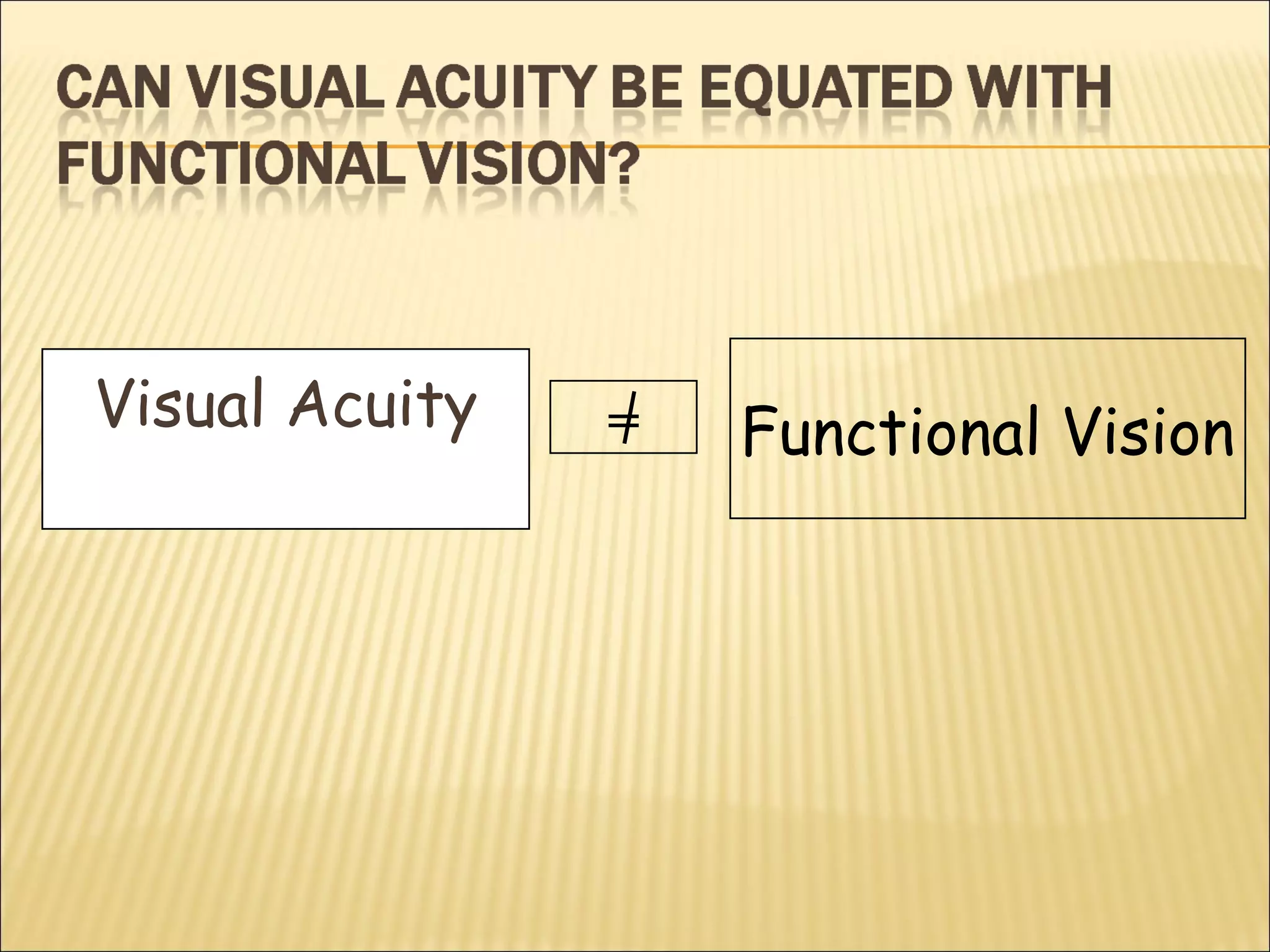
Visual Acuity = Functional Vision
 Ratio of image size to object size (for a lens
system)
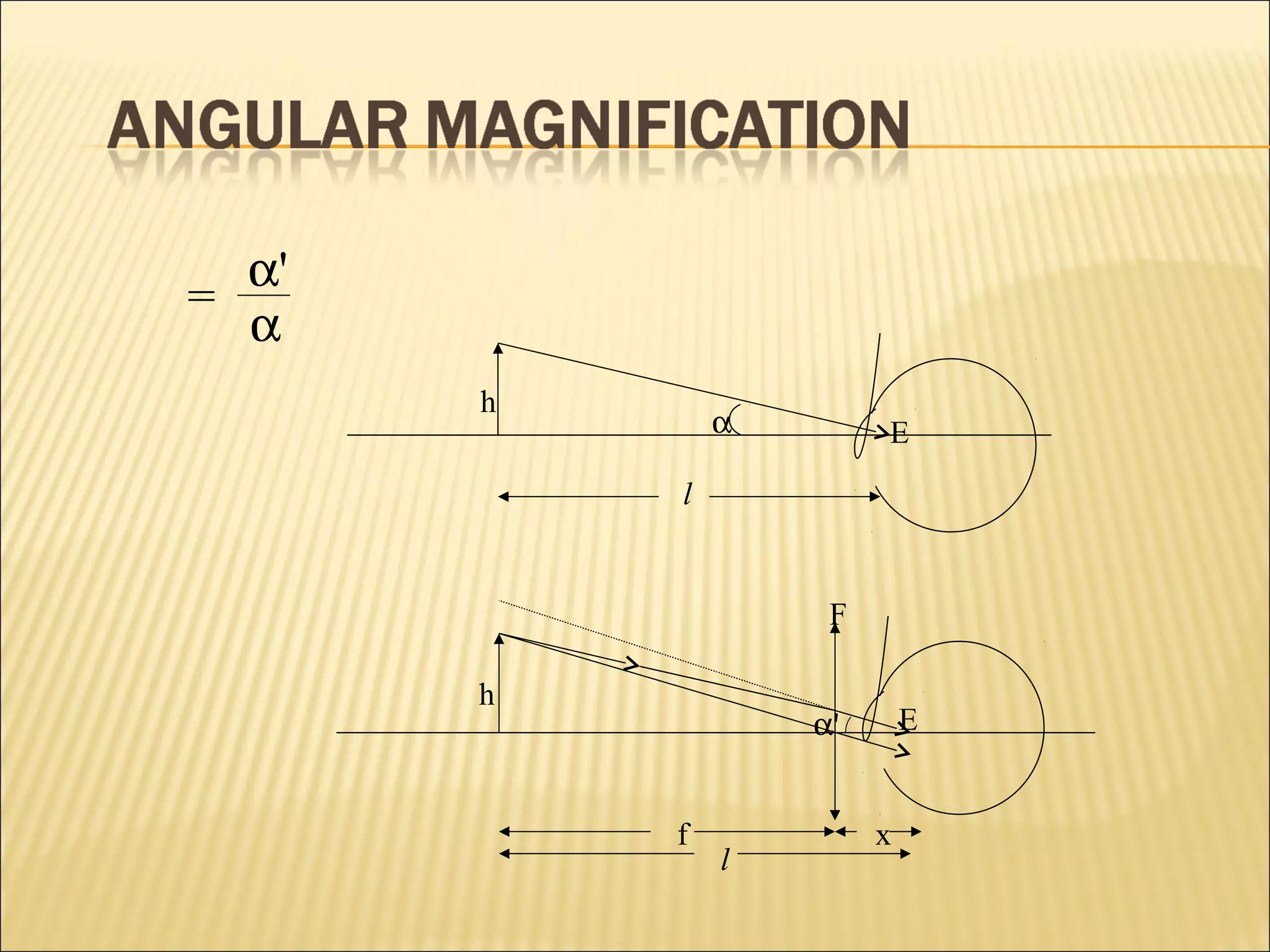
 M = I/O = h’/h = l’/l = α’/ α
 Many different types each with different
meaning
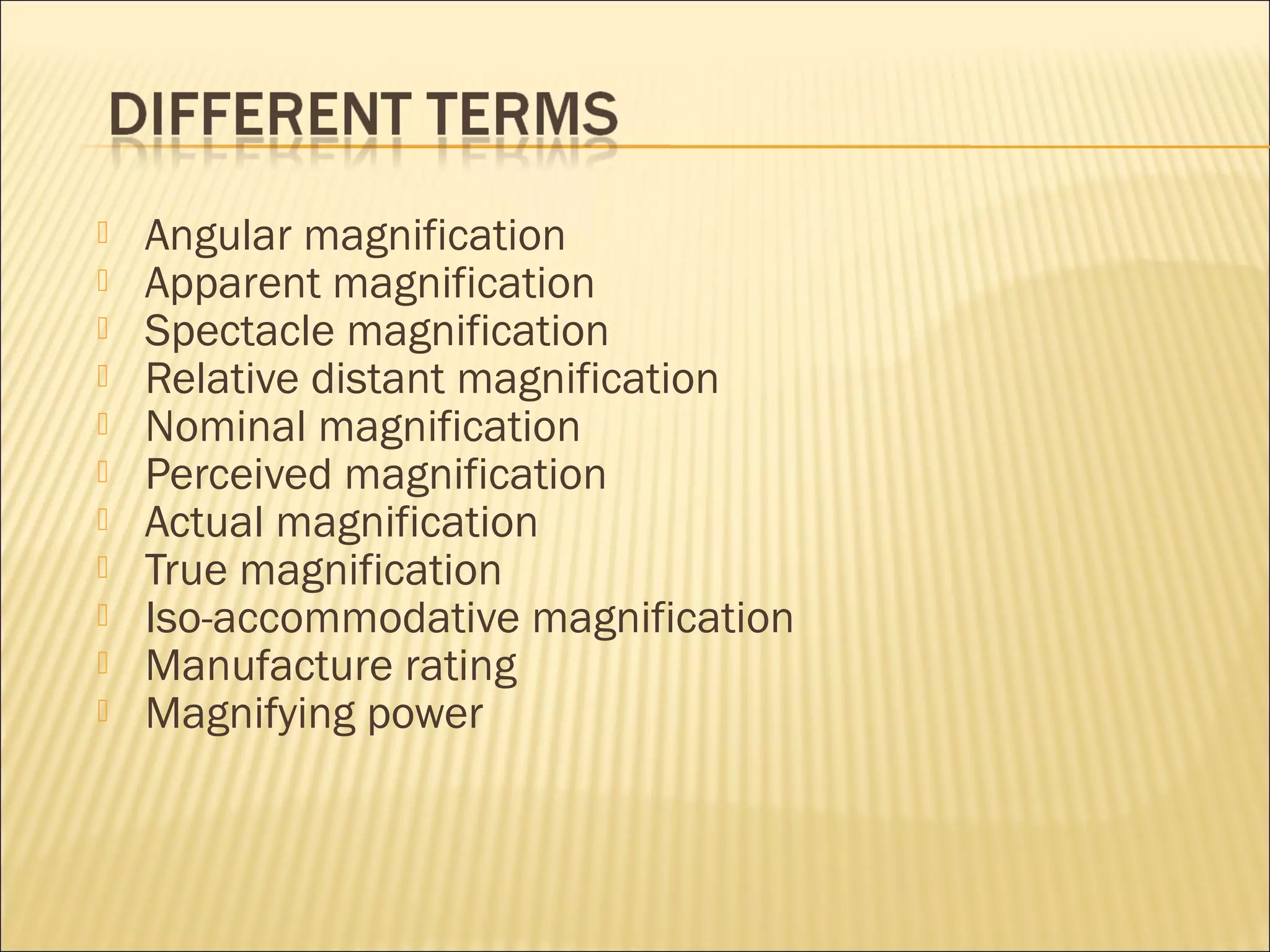
 Angular magnification
 Apparent magnification
 Spectacle magnification
 Relative distant magnification
 Nominal magnification
 Perceived magnification
 Actual magnification
 True magnification
 Iso-accommodative magnification
 Manufacture rating
 Magnifying power
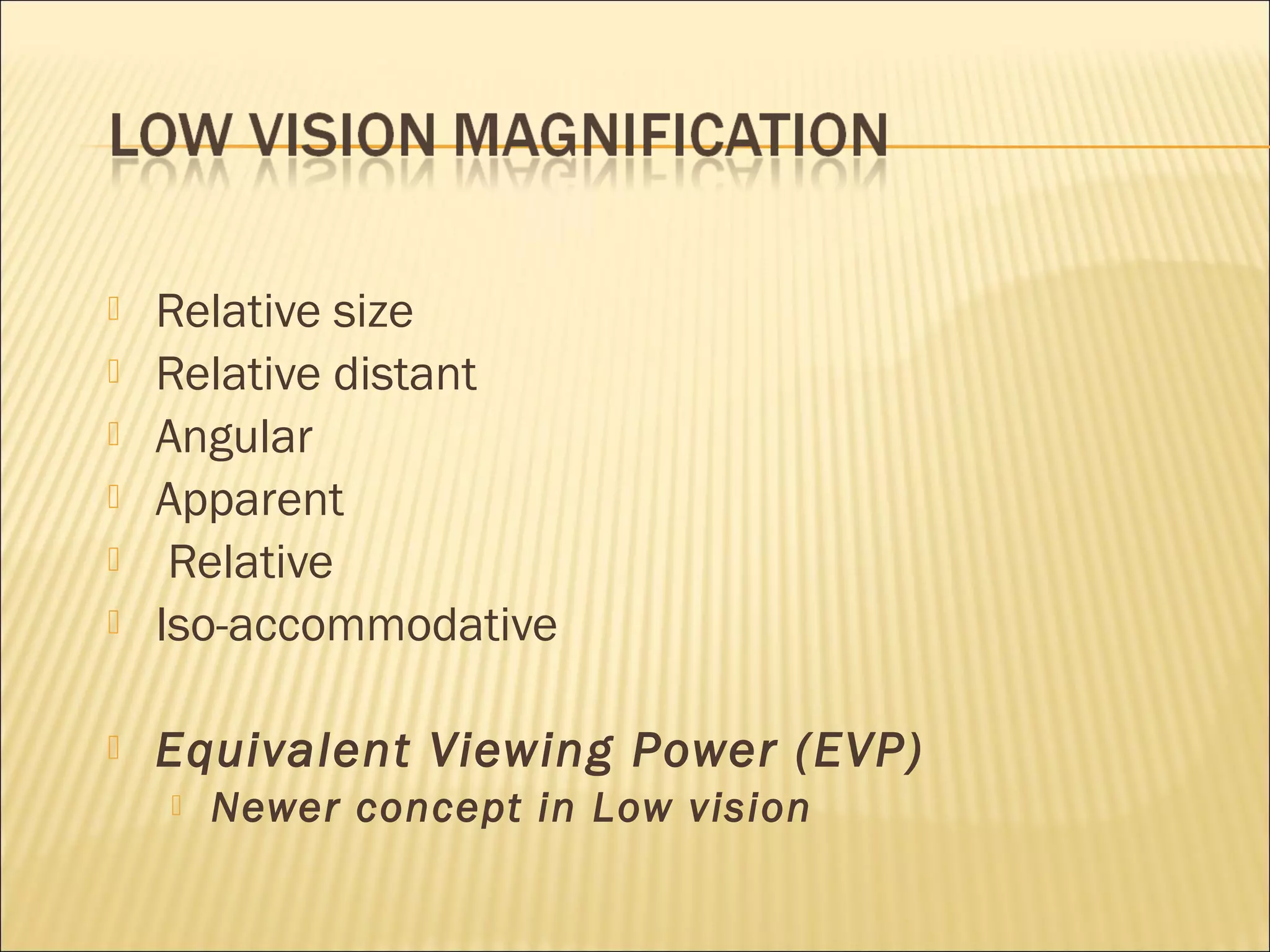
 Relative size
 Relative distant
 Angular
 Apparent
 Relative
 Iso-accommodative
 Equivalent Viewing Power (EVP)
 Newer concept in Low vision
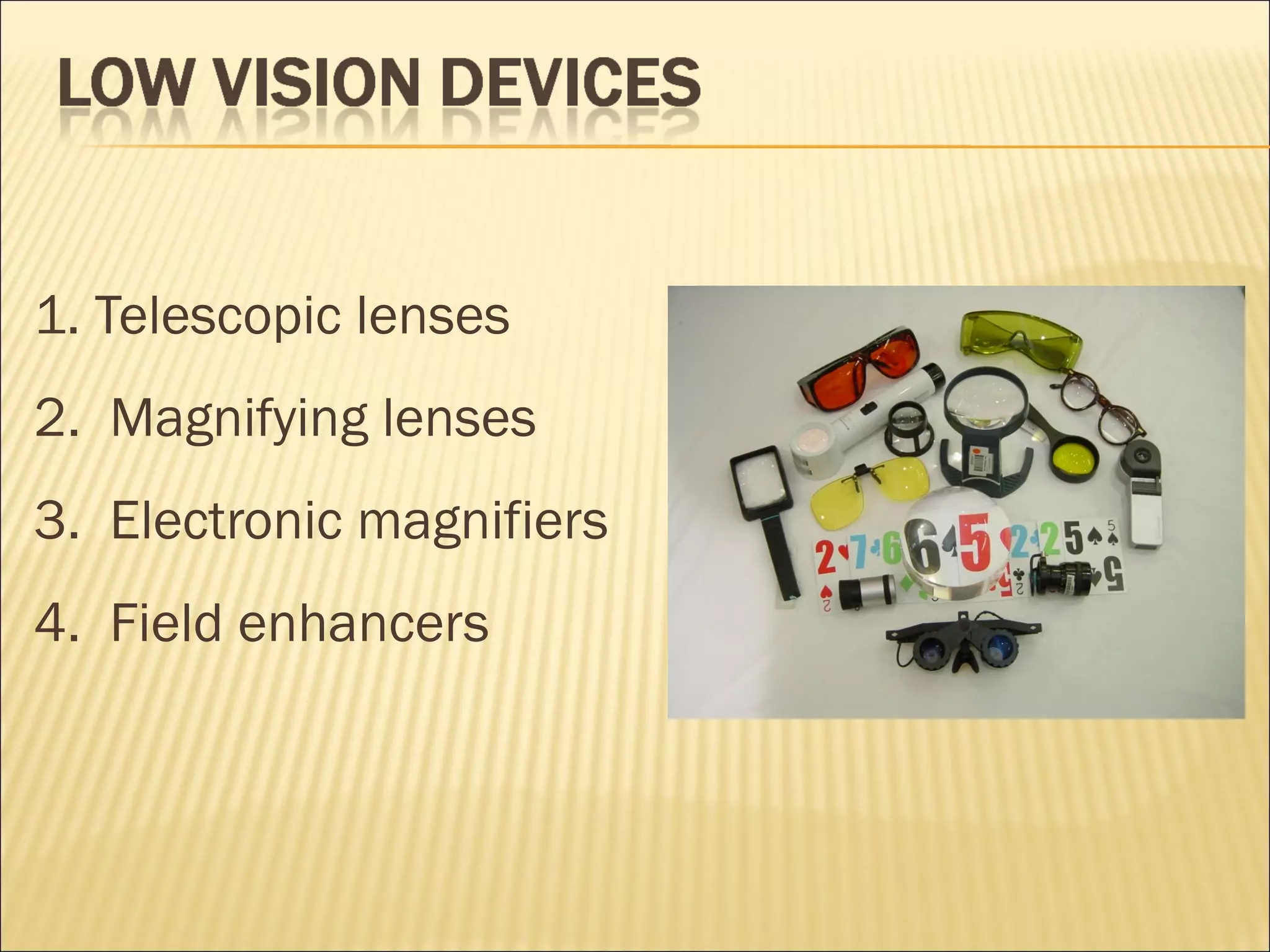
1. Telescopic lenses
2. Magnifying lenses
3. Electronic magnifiers
4. Field enhancers
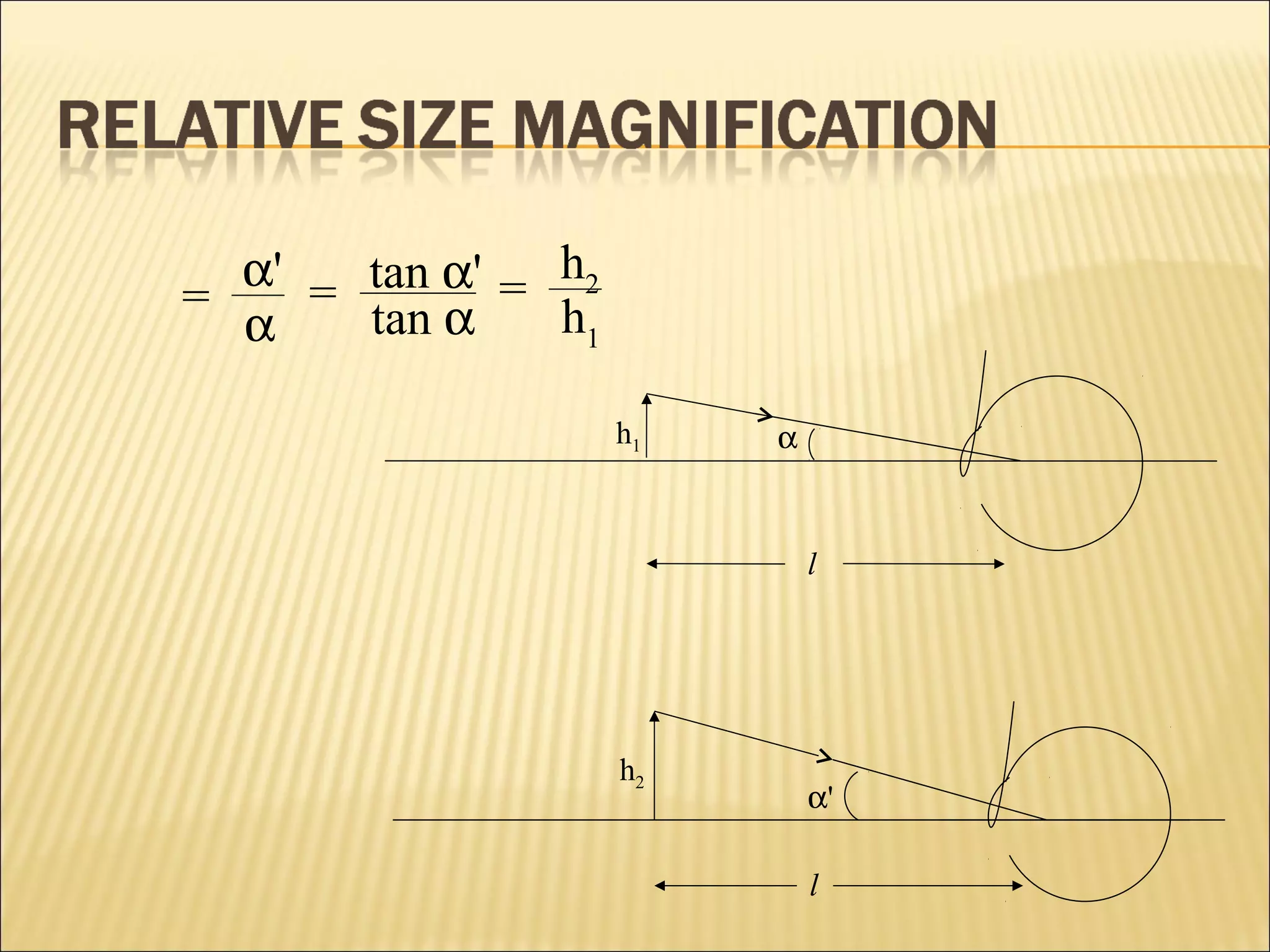
α'
α
= = tan α'
tan α
h2
h1
=
l
h1 α
h2
l
α'
Large Print Cards
Large Print Calculator
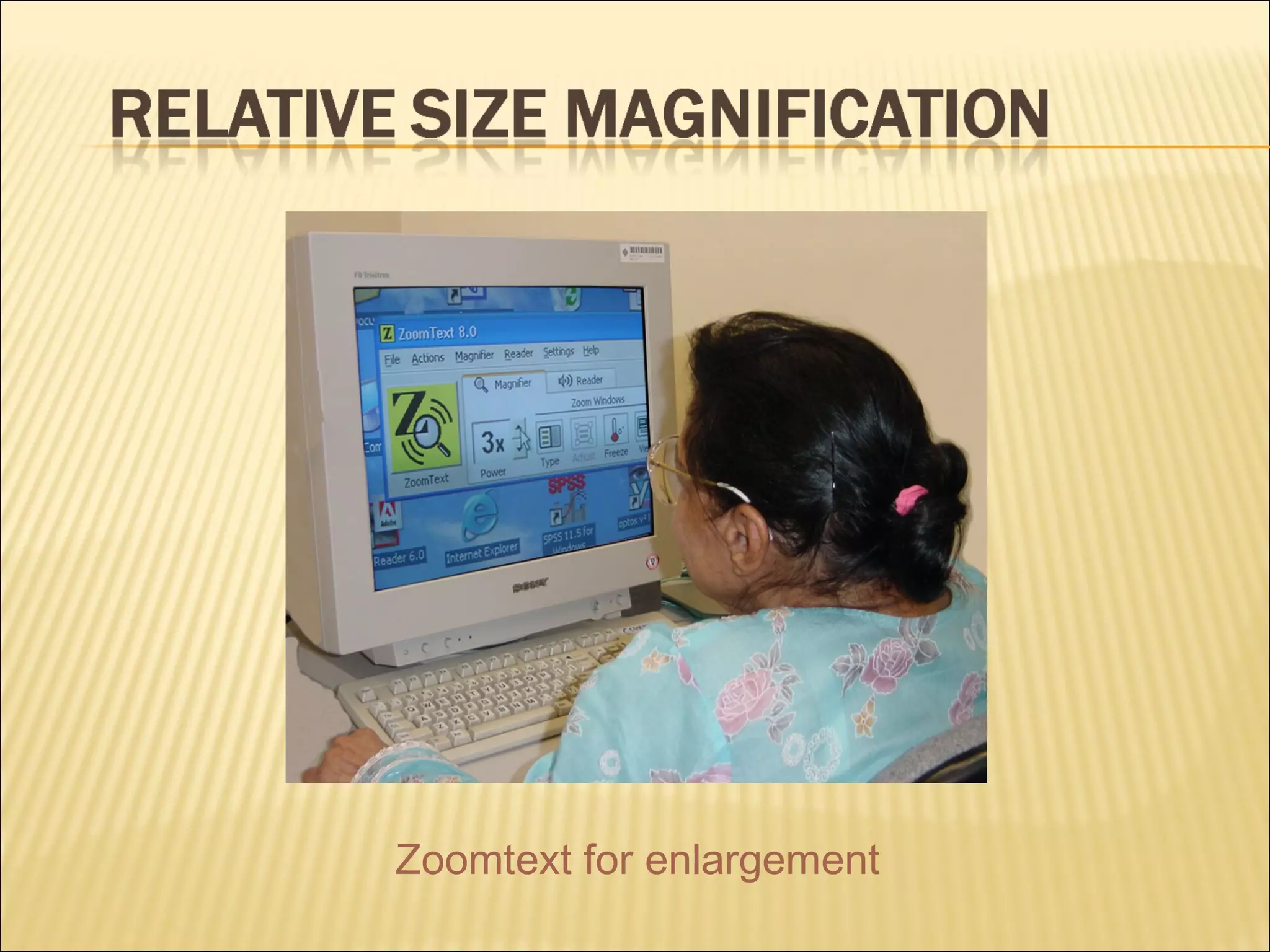
Zoomtext for enlargement
h
l1
Eα
h
l2
E
α'
α'
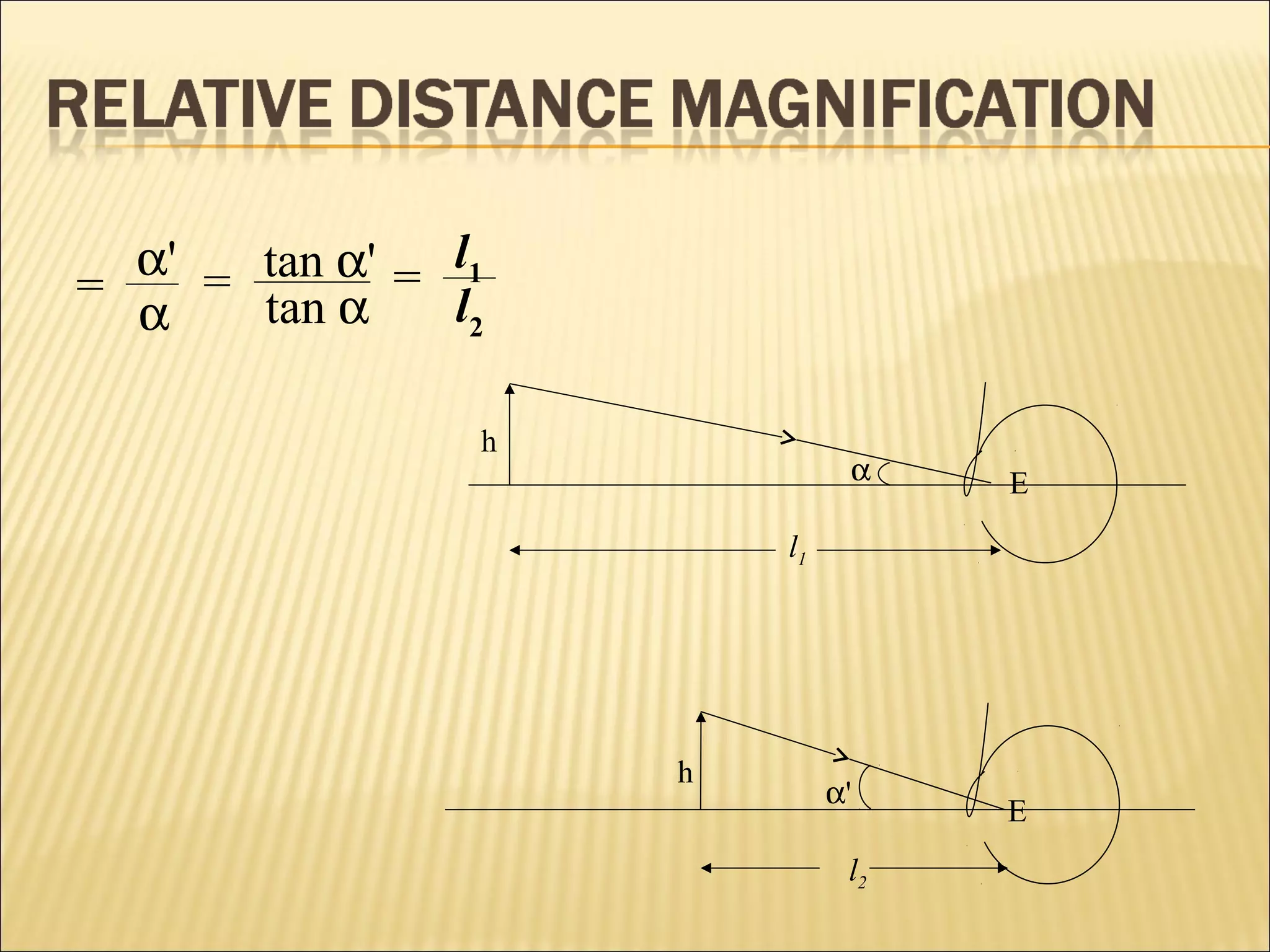
α
= = tan α'
tan α
l1
l2
=
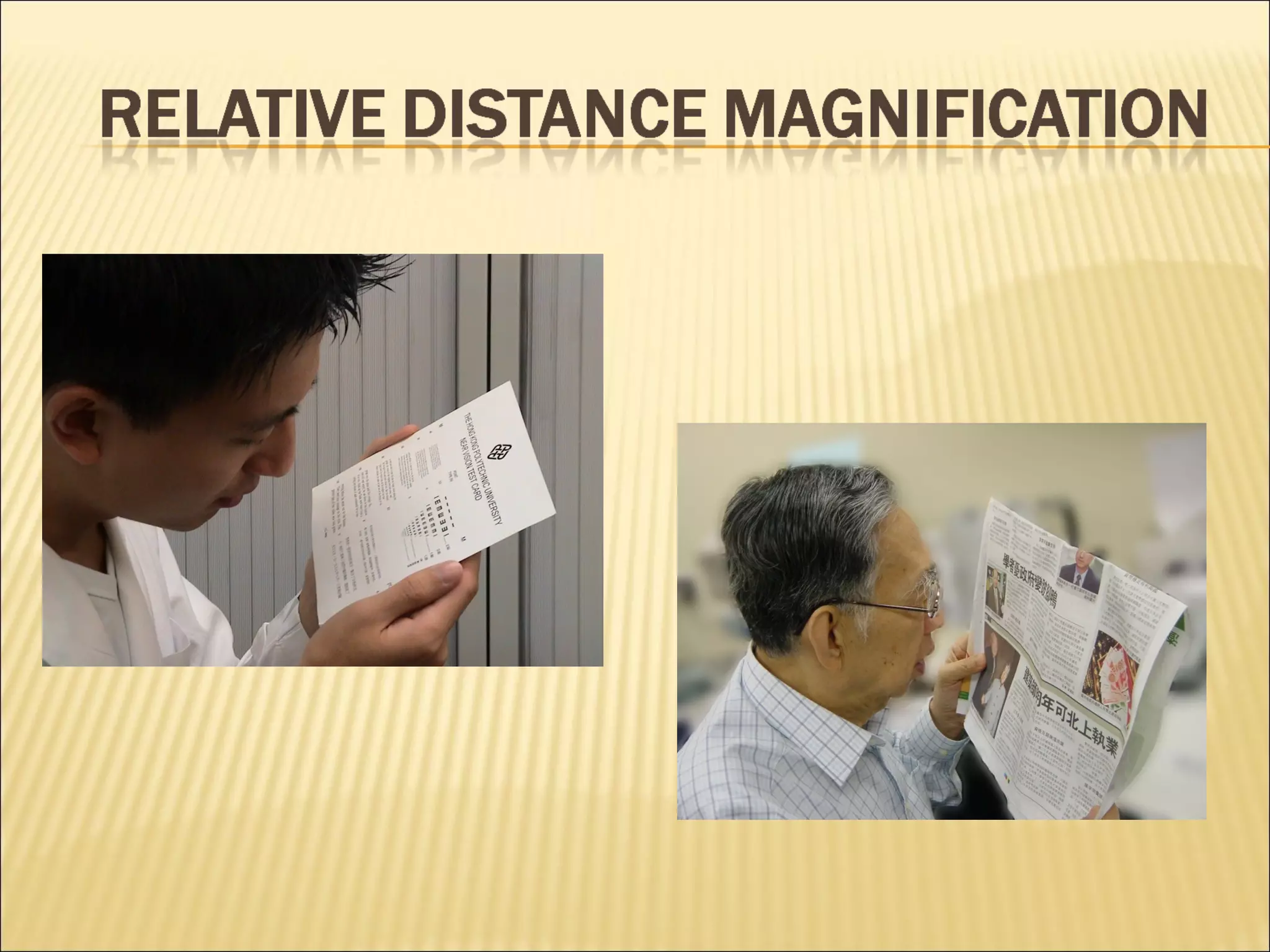
 Achieved by decreasing the distance between
the object & eye
 Need either accommodation/ Plus lenses to
maintain clear focus
 due to the large accommodative demand created
by short viewing distance
α'
α
=
h
l
Eα
l
F
h
E
xf
α'
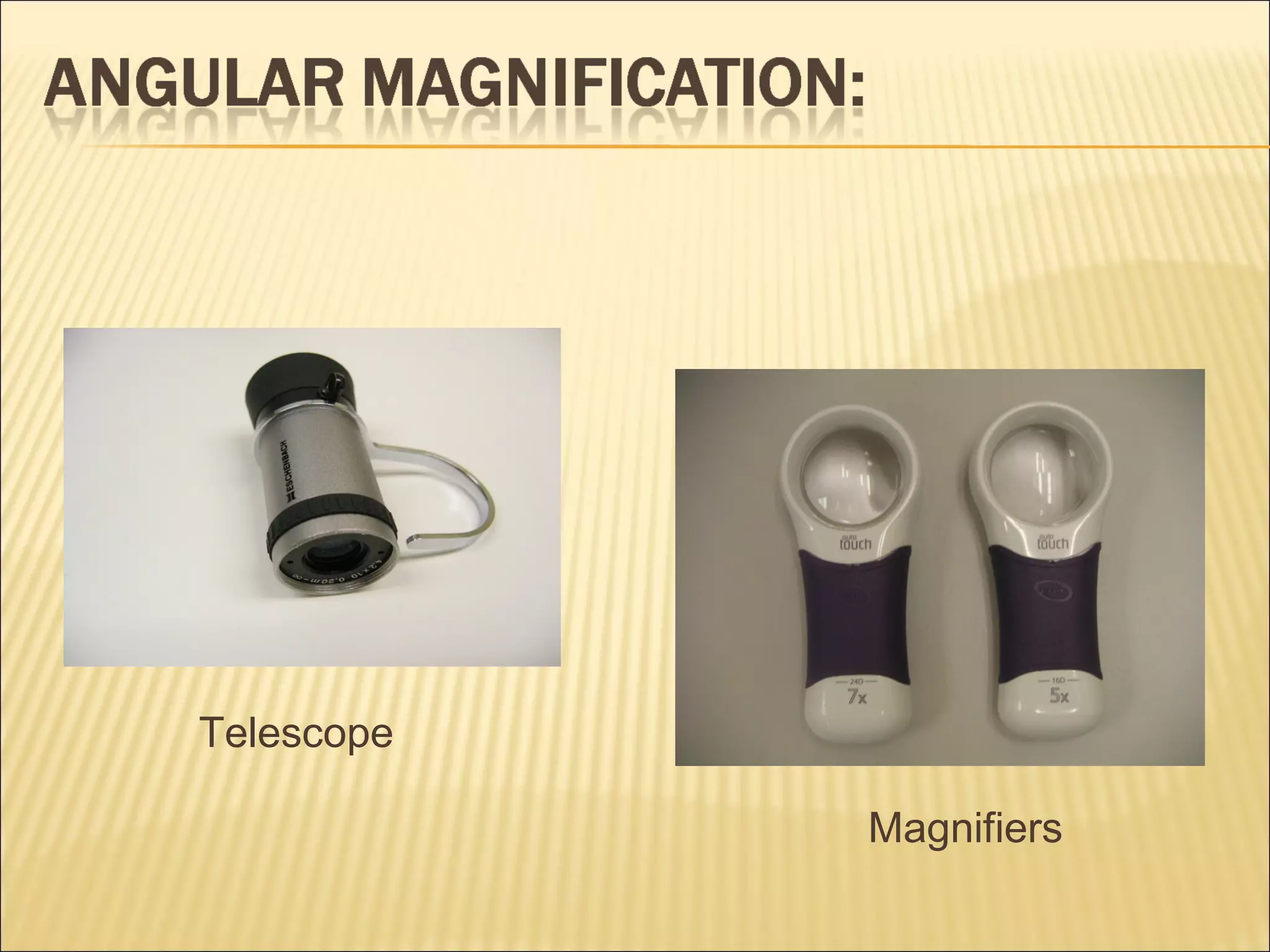
Telescope
Magnifiers
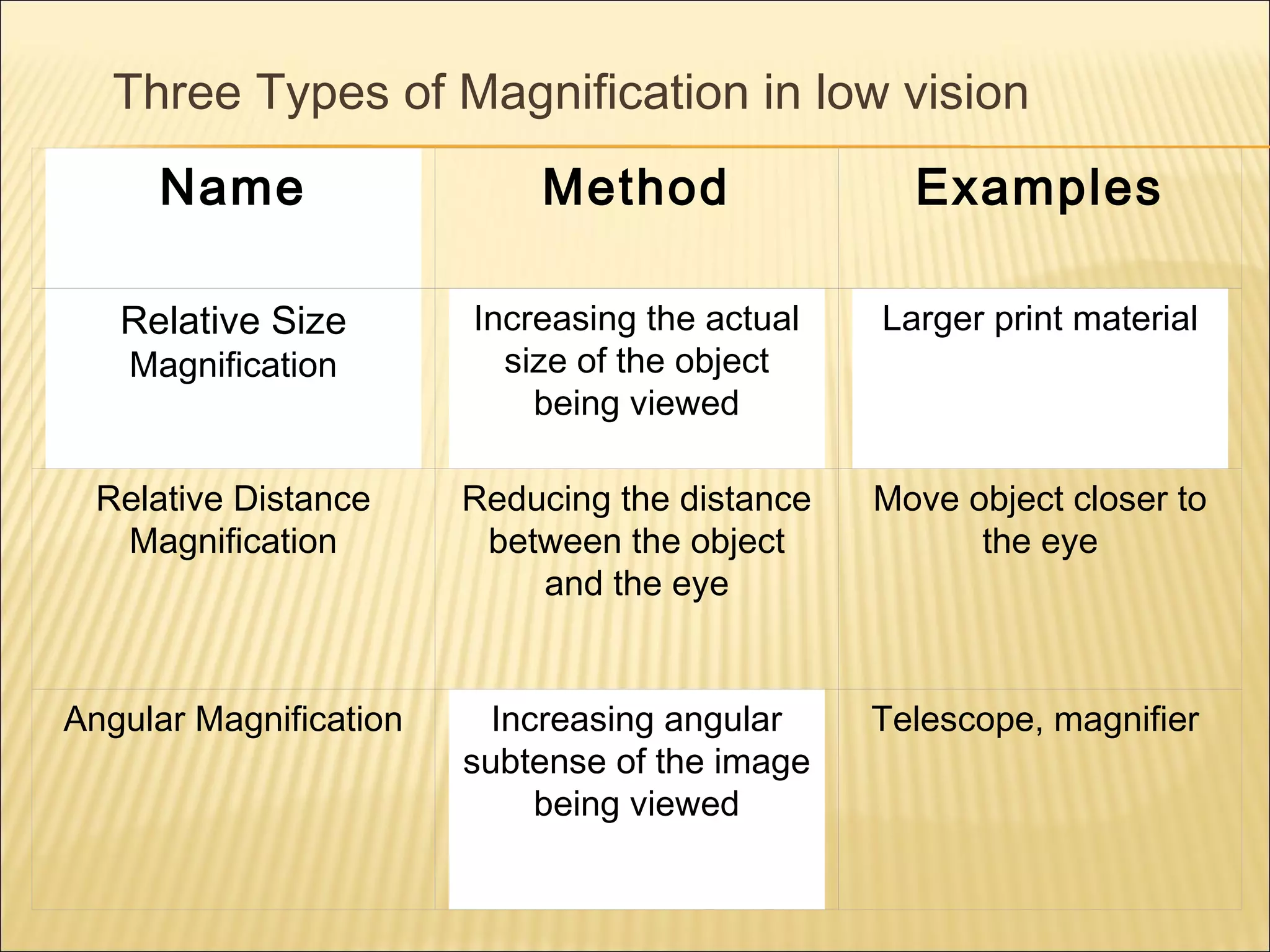
Name Method Examples
Relative Size
Magnification
Increasing the actual
size of the object
being viewed
Larger print material
Relative Distance
Magnification
Reducing the distance
between the object
and the eye
Move object closer to
the eye
Angular Magnification Increasing angular
subtense of the image
being viewed
Telescope, magnifier
Three Types of Magnification in low vision
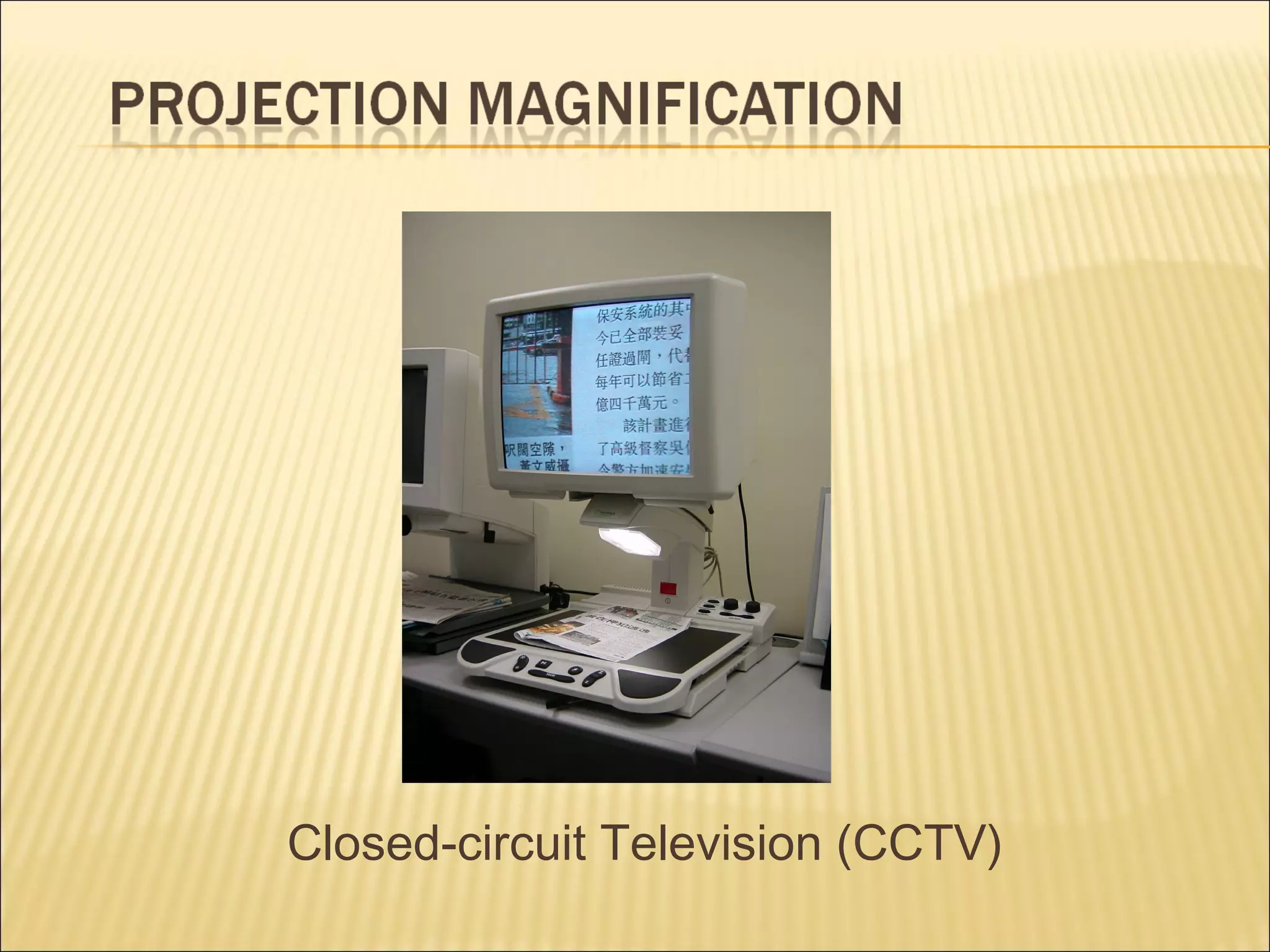
Closed-circuit Television (CCTV)
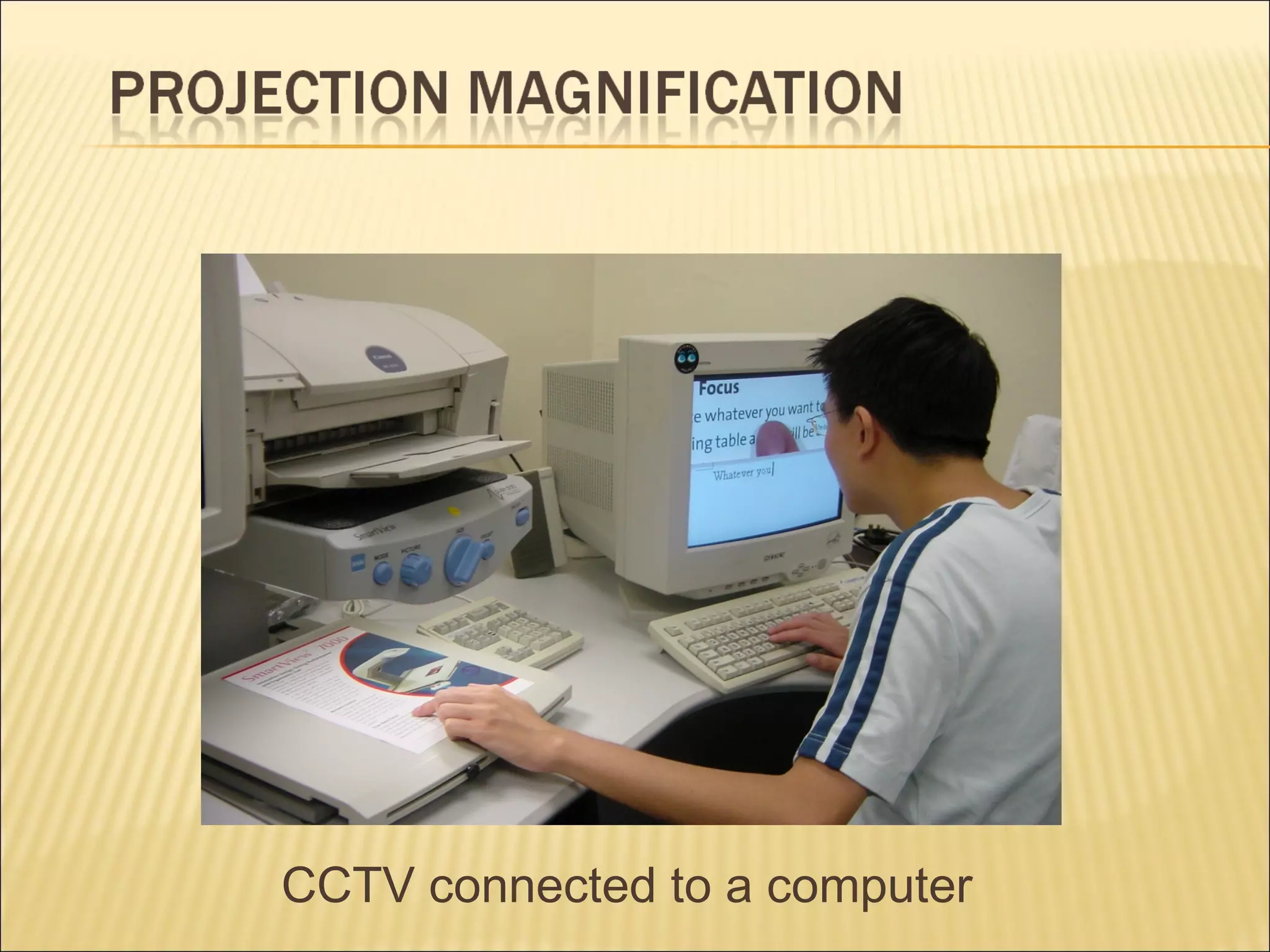
CCTV connected to a computer
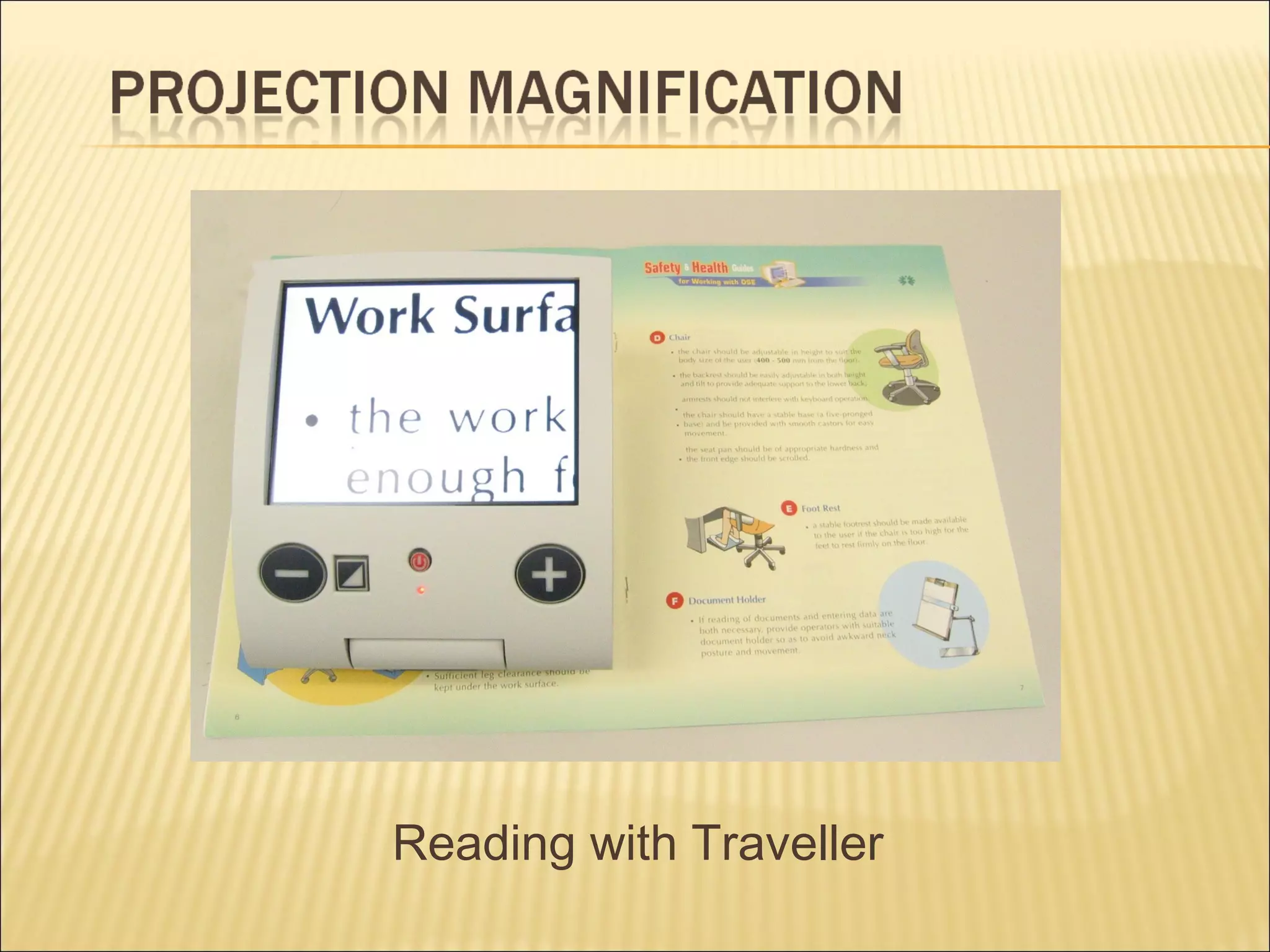
Reading with Traveller
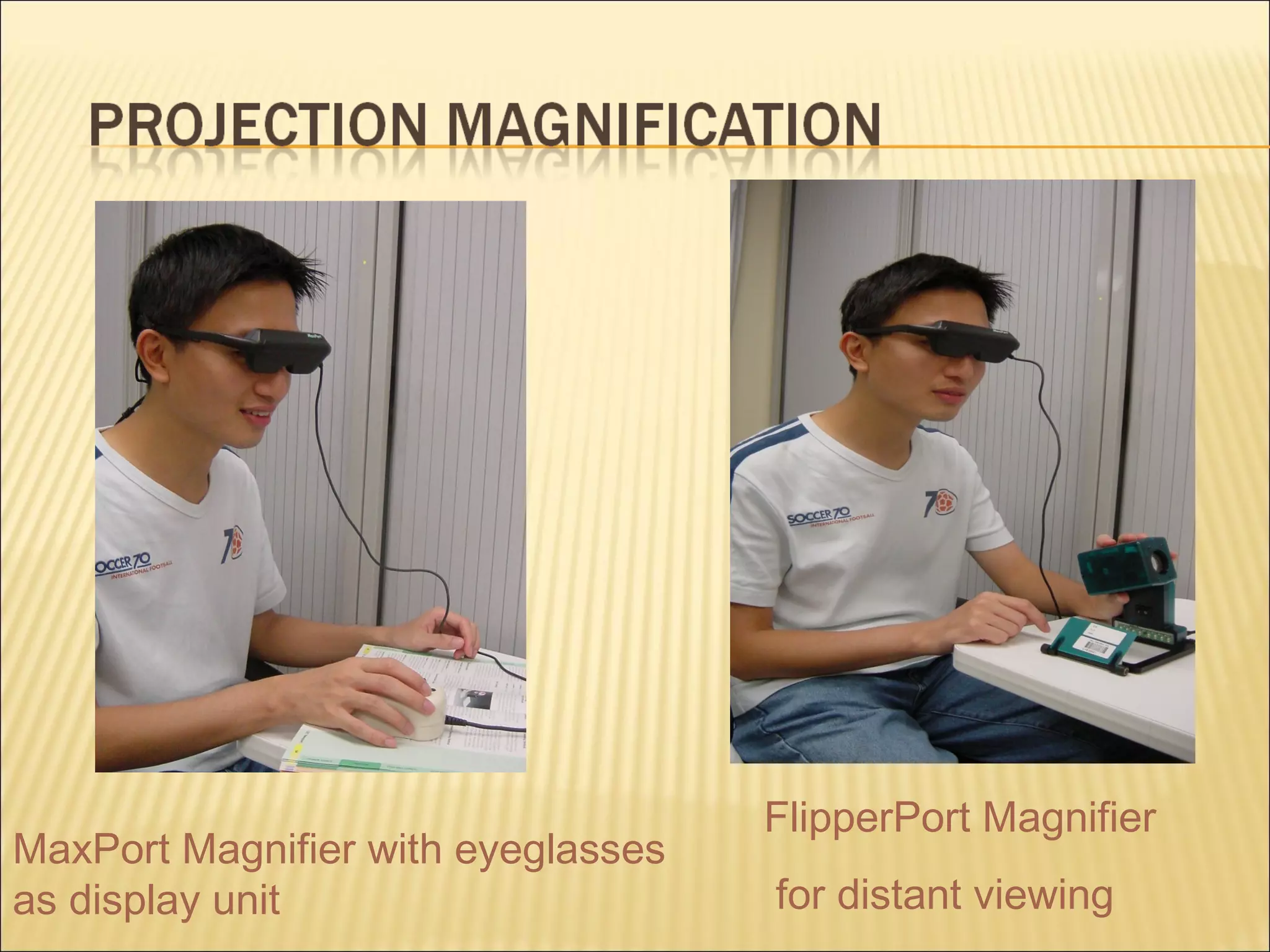
MaxPort Magnifier with eyeglasses
as display unit
FlipperPort Magnifier
for distant viewing
 Screen enlargers and screen magnifiers
 Screen reviewers and screen readers
 On-screen keyboards
 Keyboard enhancement
 Voice input aids or speech recognition
 Alternative input devices
 Perceived Magnification
 Ratio between the angle subtended by the image at
entrance pupil of eye to the angle subtended by the
object without magnifier
 System
 Object at anterior focal plane of lens
 Object not at focal plane of lens
 For accurate apparent magnification
 Viewing distance / Equivalent power of magnifier
should specified

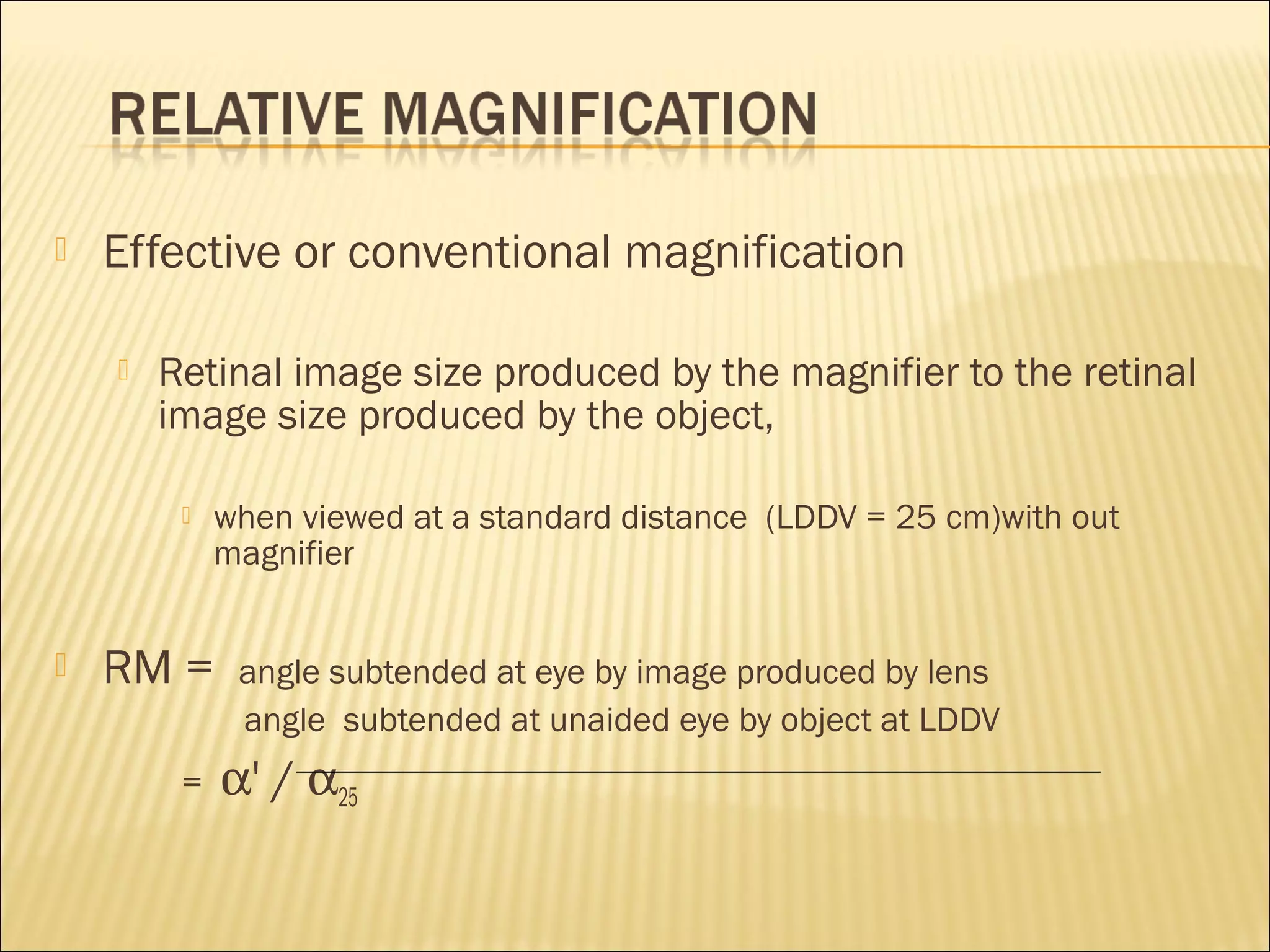
 Effective or conventional magnification
 Retinal image size produced by the magnifier to the retinal
image size produced by the object,
 when viewed at a standard distance (LDDV = 25 cm)with out
magnifier
 RM = angle subtended at eye by image produced by lens
angle subtended at unaided eye by object at LDDV
= α' / α25
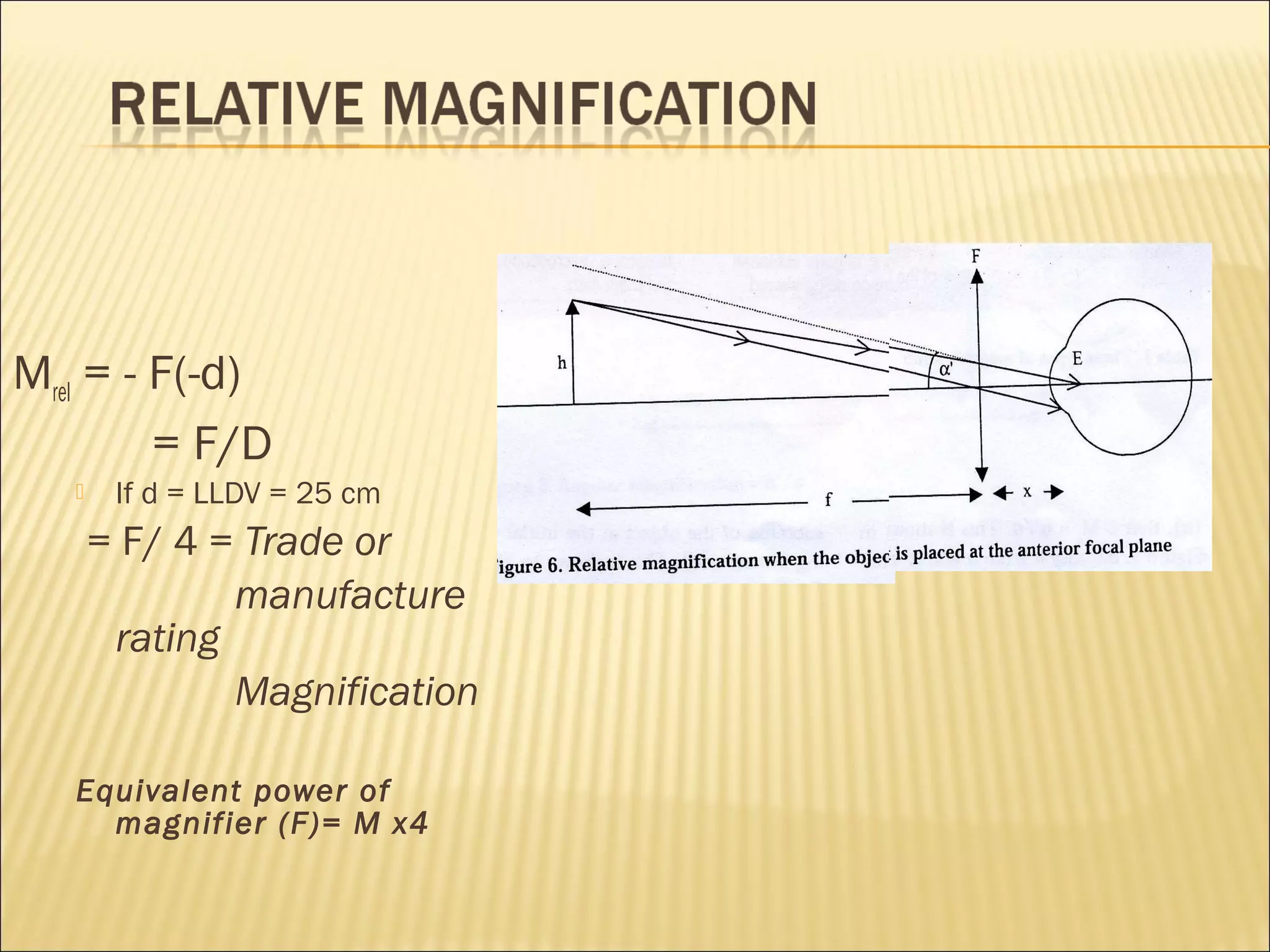
Mrel = - F(-d)
= F/D
 If d = LLDV = 25 cm
= F/ 4 = Trade or
manufacture
rating
Magnification
Equivalent power of
magnifier (F)= M x4
 For : Relative = Actual magnification
 Will be true for following conditions
 Patient should be emmetropic or corrected for any ametropia
 For Myopia = Actual Magnification increase
 For Hyperopia = Smaller magnification than specified
 Object at anterior focal plane of the magnifier, so that image formed
at infinity
 If located at less distance = Actual magnification increase
 If located further away = Actual magnification decrease
 Reference object distance
 For ref. Distance 25 cm, M = F/4
 But in real life situation
 Reading distance , 33 cm . M = F/3
 Reading distance, 40 cm = F/2.5
 The ratio of the angle subtended at the
entrance pupil of the eye by the magnified
image to the angle subtended by object
 When viewed from same distance
 Type of Relative magnification
 Object is located outside the anterior focal plane
of magnifying lense
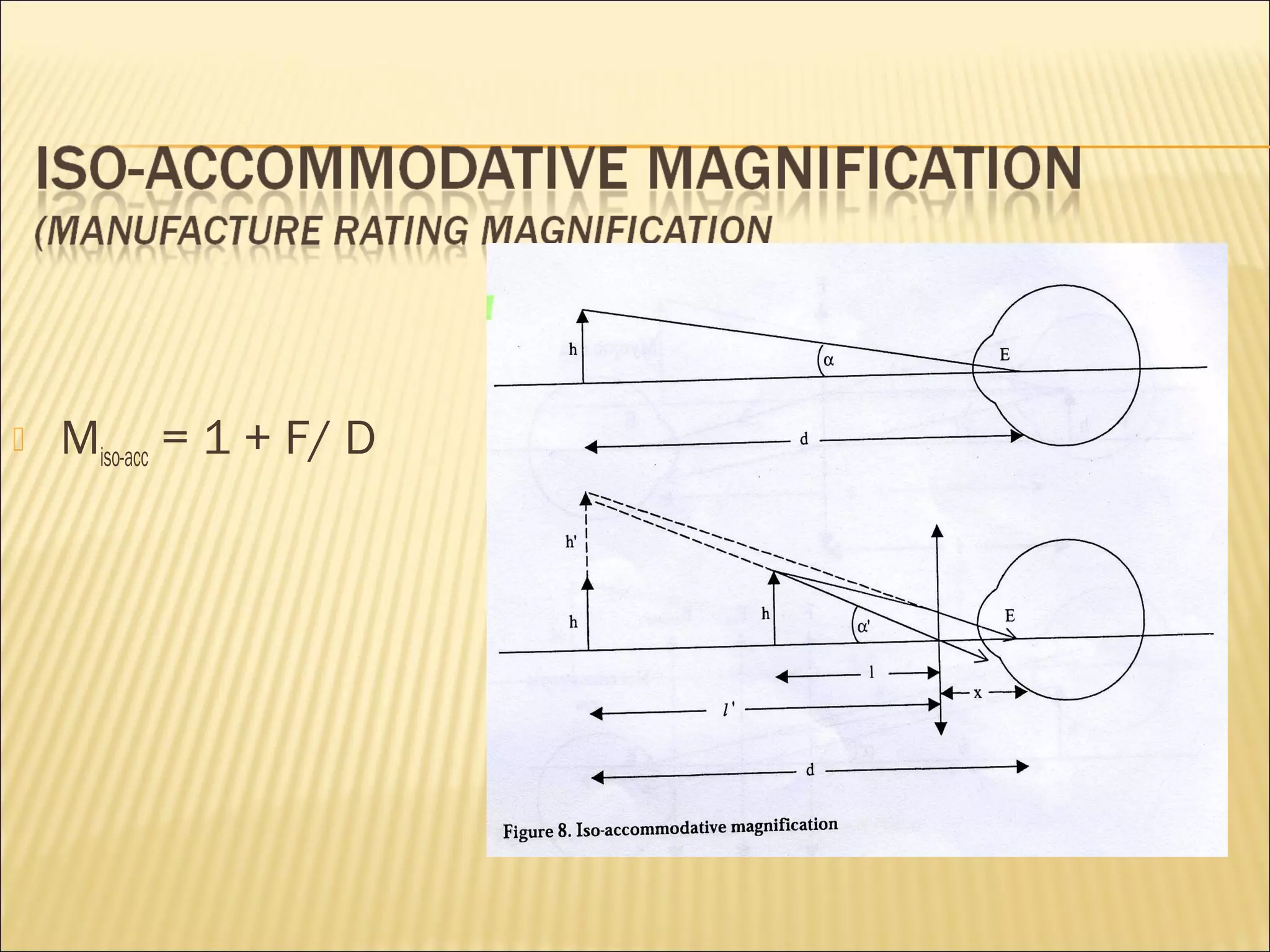
 Miso-acc = 1 + F/ D
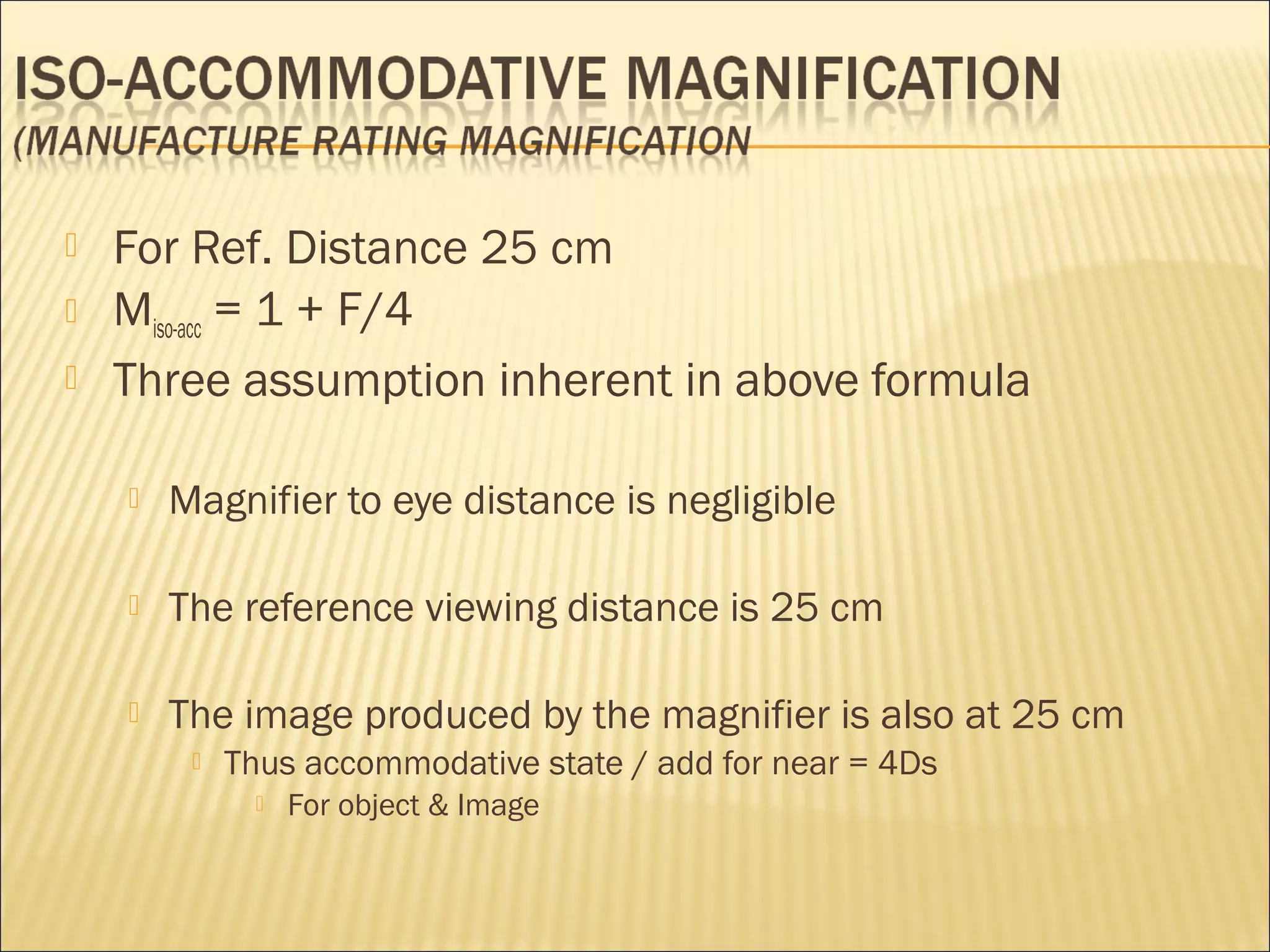
 For Ref. Distance 25 cm
 Miso-acc = 1 + F/4
 Three assumption inherent in above formula
 Magnifier to eye distance is negligible
 The reference viewing distance is 25 cm
 The image produced by the magnifier is also at 25 cm
 Thus accommodative state / add for near = 4Ds
 For object & Image
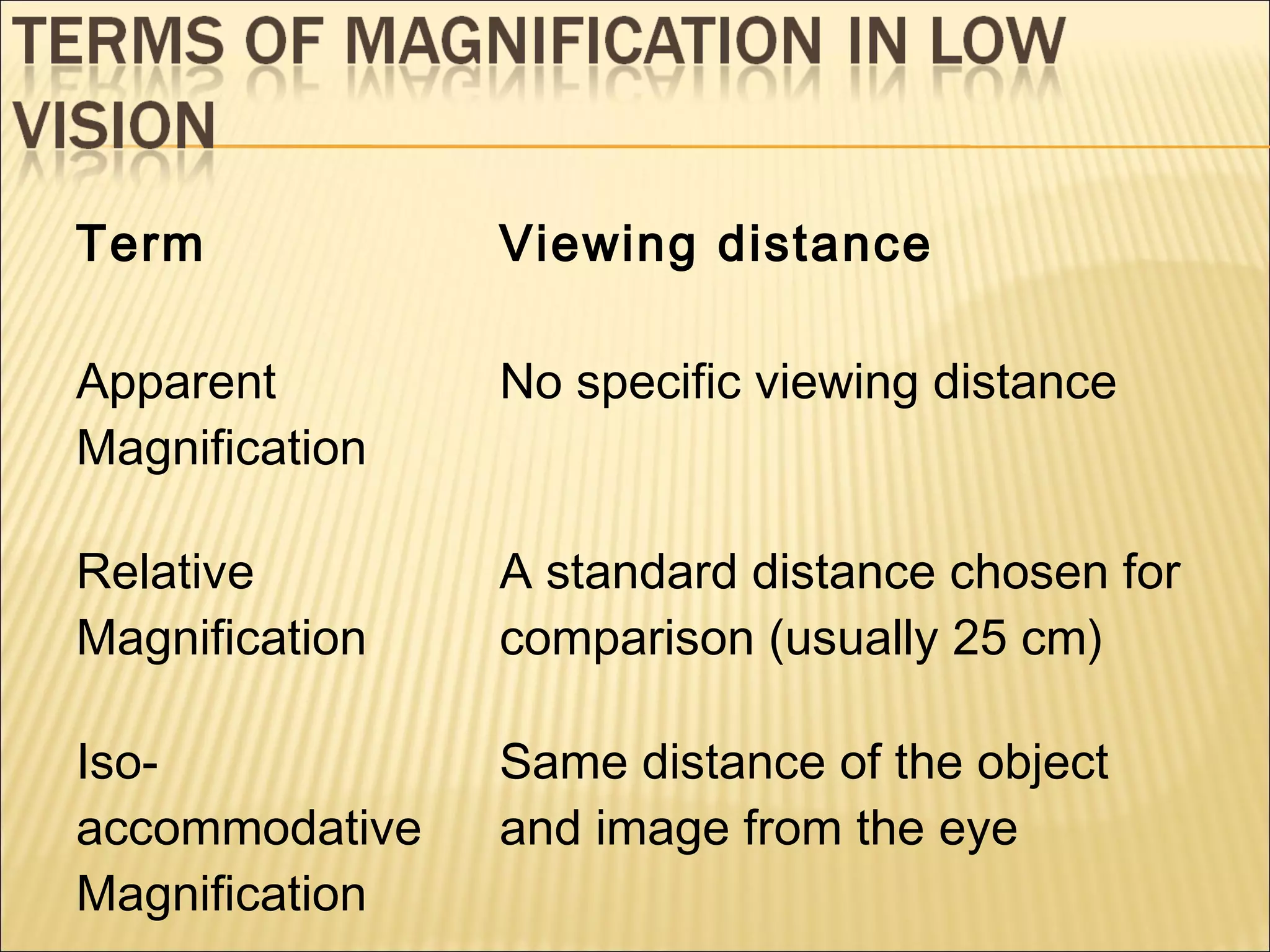
Term Viewing distance
Apparent
Magnification
No specific viewing distance
Relative
Magnification
A standard distance chosen for
comparison (usually 25 cm)
Iso-
accommodative
Magnification
Same distance of the object
and image from the eye
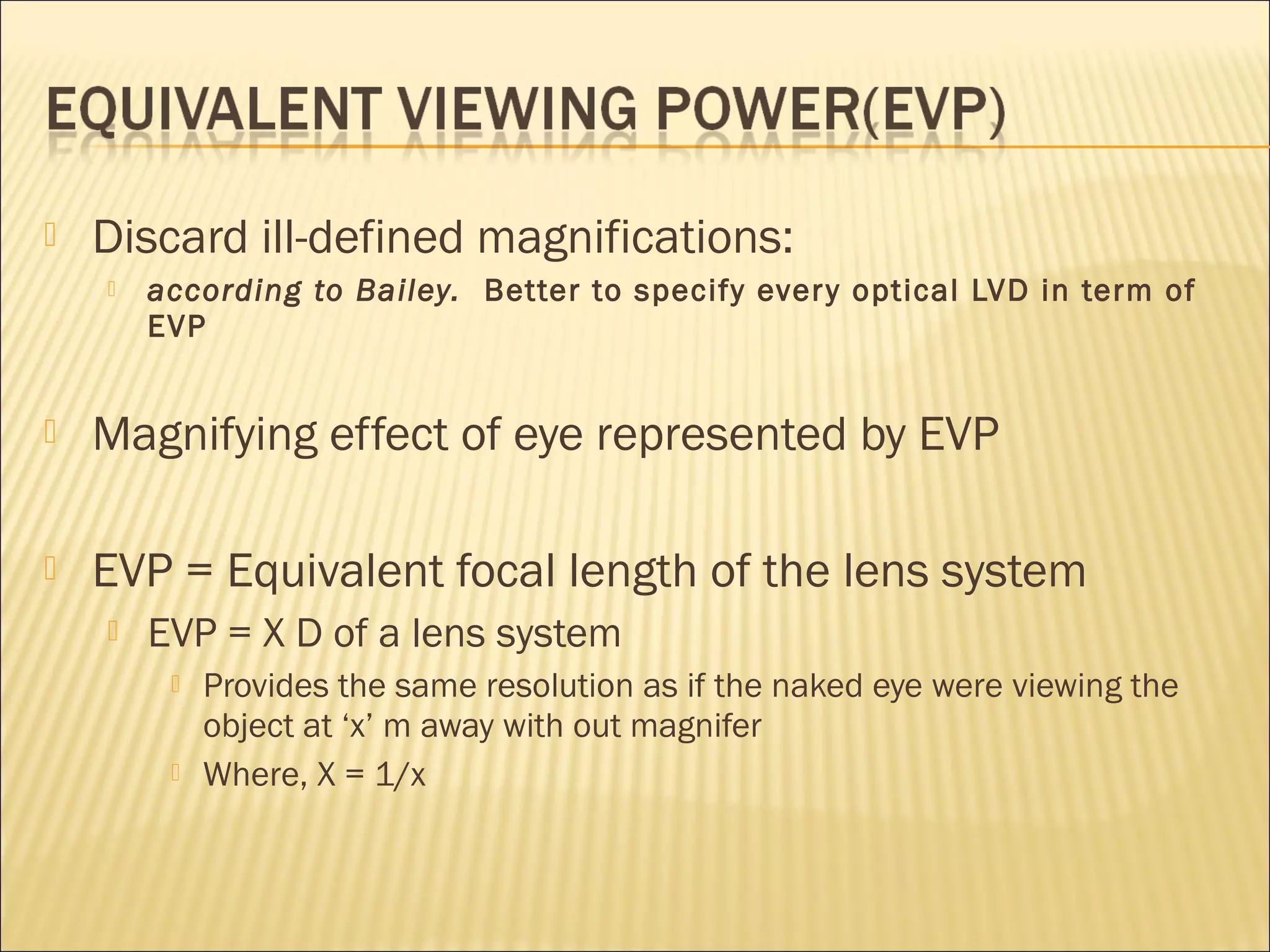
 Discard ill-defined magnifications:
 according to Bailey. Better to specify every optical LVD in term of
EVP
 Magnifying effect of eye represented by EVP
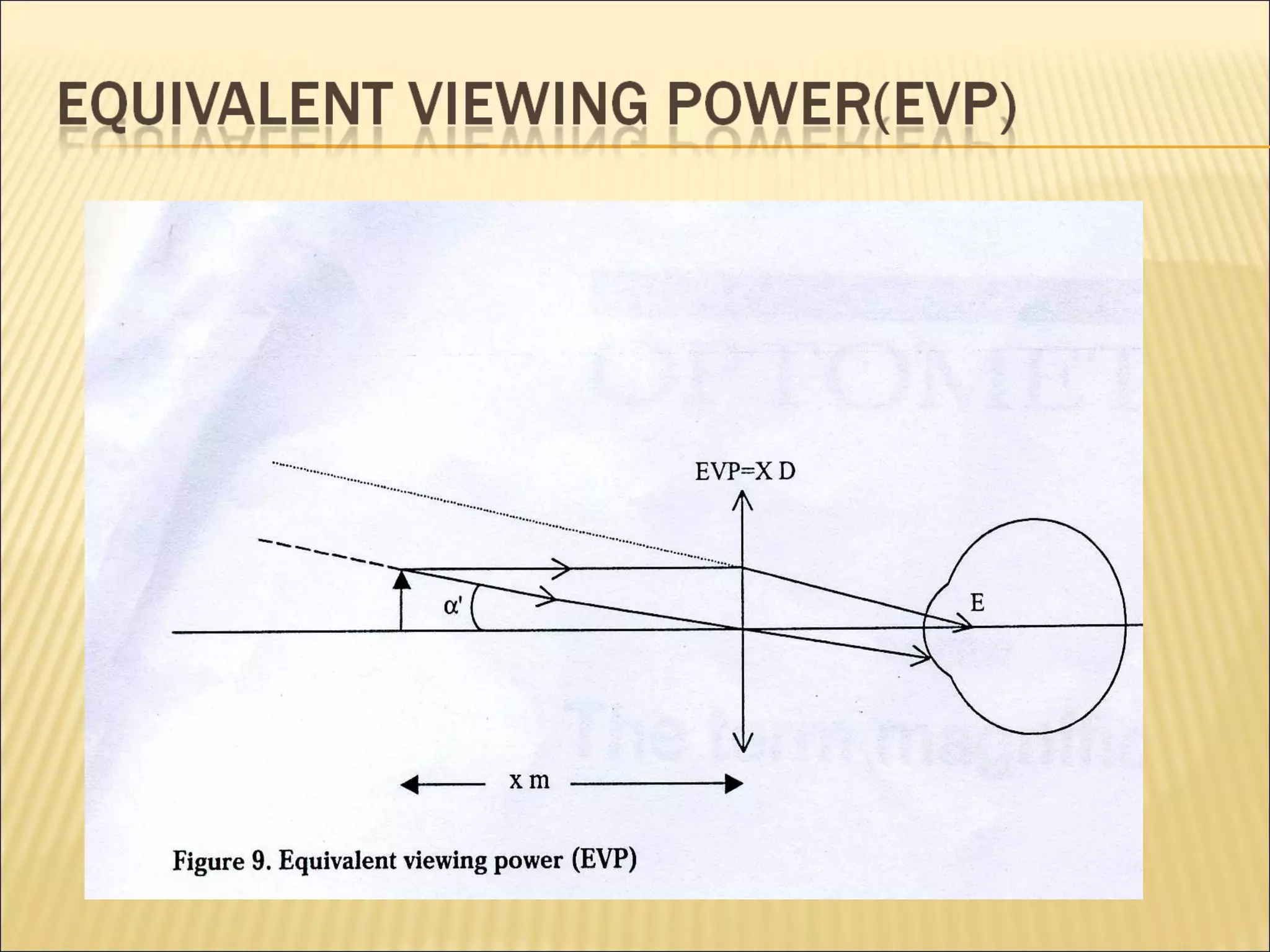
 EVP = Equivalent focal length of the lens system
 EVP = X D of a lens system
 Provides the same resolution as if the naked eye were viewing the
object at ‘x’ m away with out magnifer
 Where, X = 1/x
 EVP represents
 intrinsic property of an optical system that
corresponds to the resolution afforded by the system
 If EVP of a system that gives certain resolution to the
patient is know,
 the resolution capability by any other system can be known
by simple proportion
 Eg:
 If NVA with + 2.50 D is 6/18 at 40 cm, an EVP of +
7.50 Ds magnifier will increase VA to 6/6 at 13 cm.
 By knowing EVP of a optical system is known
 A logical & efficient conversion of one magnifying optical
system to another
 Eg: If a +10.00 D add is required to read 2M print at 10 cm
 For a CCTV, with 5 x magnification viewed at 50 cm &
+2.00D add will enable patient to read 2M print
 Accurate corrected near visual acuity assessment
 Always in Metric system (1M = N8)
 For unknown sized reading material
 Conversion to metric system =
letter size in mm/1.45
mm
 Average number of letters + space counted in 1 inch
 Divide that number to 1000 for metric system
 Resultant is reduced snellen denominator
 Eg: 40 spaces & letters in 1 inch of text patient wants to
read
 1000/40 = 25 : Reduced acuity size of the print= 20/25
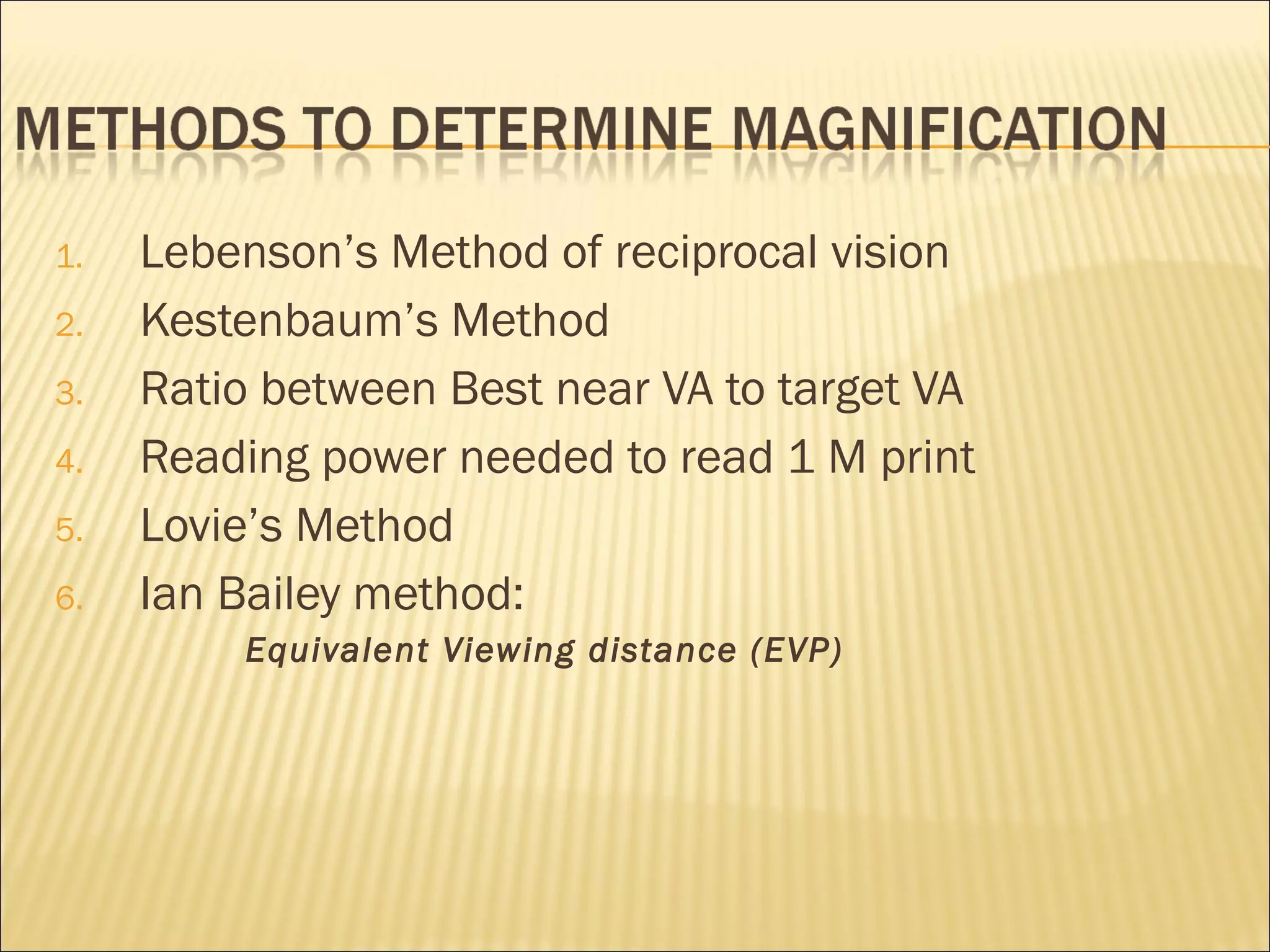
1. Lebenson’s Method of reciprocal vision
2. Kestenbaum’s Method
3. Ratio between Best near VA to target VA
4. Reading power needed to read 1 M print
5. Lovie’s Method
6. Ian Bailey method:
Equivalent Viewing distance (EVP)
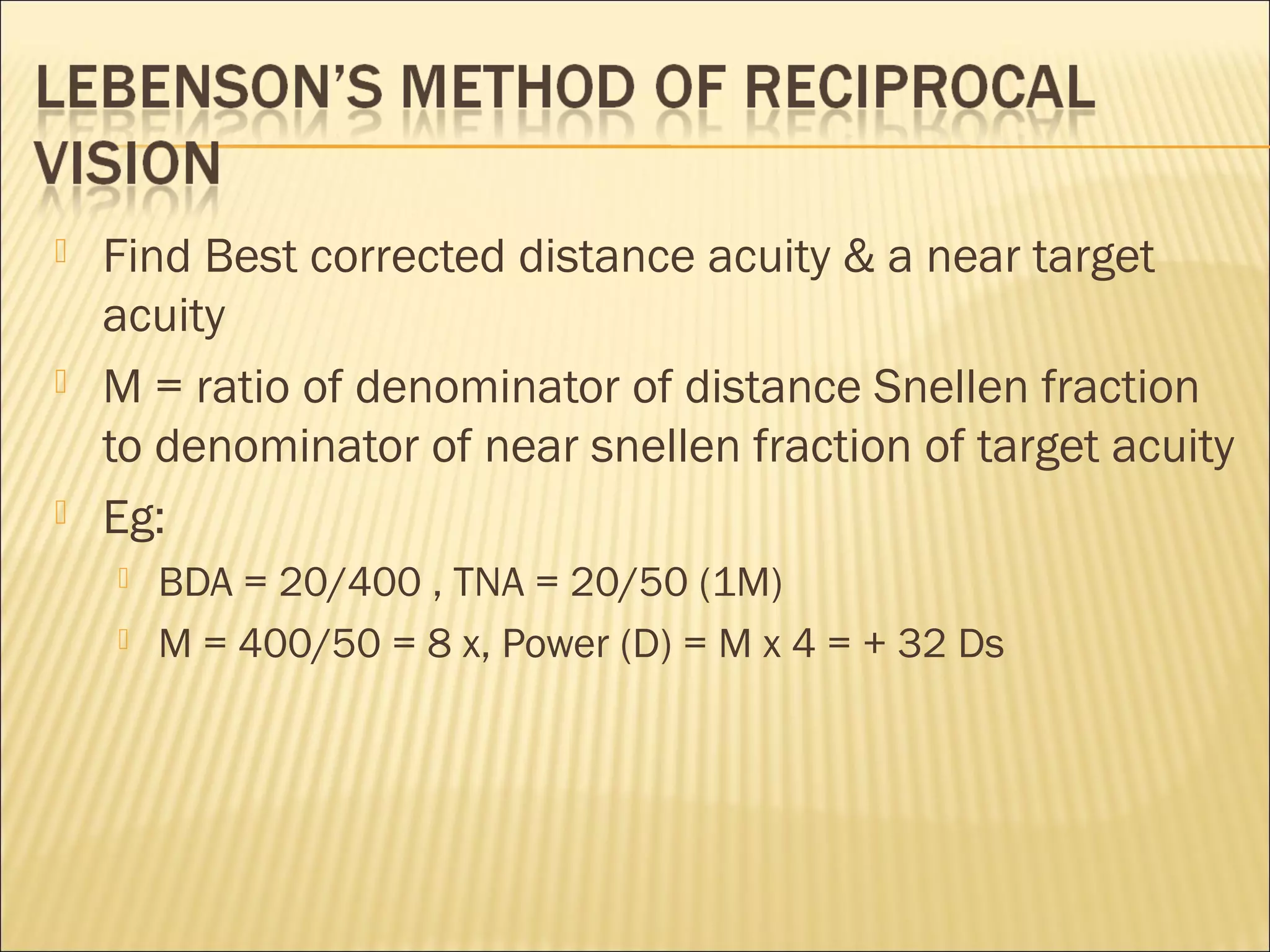
 Find Best corrected distance acuity & a near target
acuity
 M = ratio of denominator of distance Snellen fraction
to denominator of near snellen fraction of target acuity
 Eg:
 BDA = 20/400 , TNA = 20/50 (1M)
 M = 400/50 = 8 x, Power (D) = M x 4 = + 32 Ds
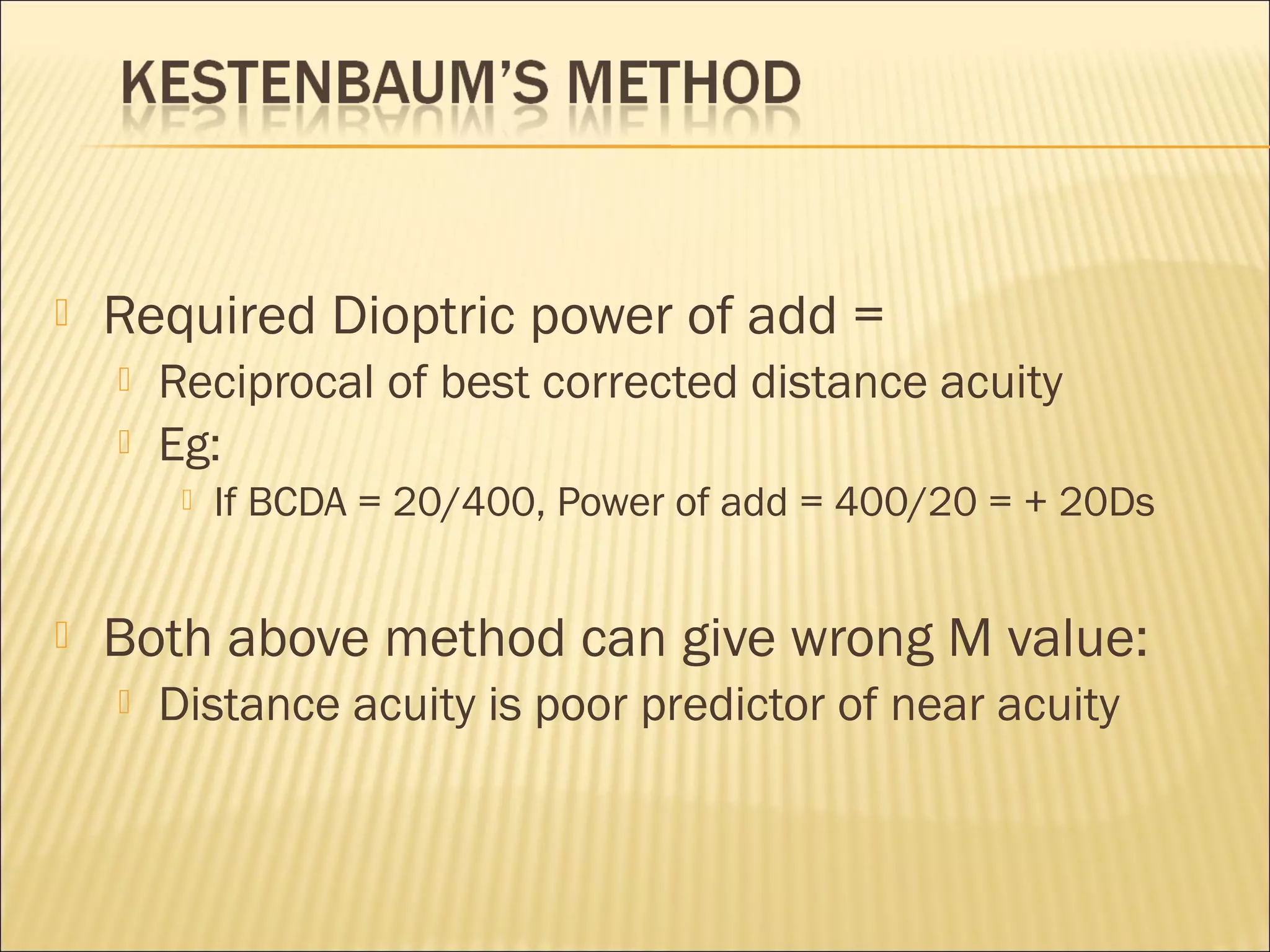
 Required Dioptric power of add =
 Reciprocal of best corrected distance acuity
 Eg:
 If BCDA = 20/400, Power of add = 400/20 = + 20Ds
 Both above method can give wrong M value:
 Distance acuity is poor predictor of near acuity
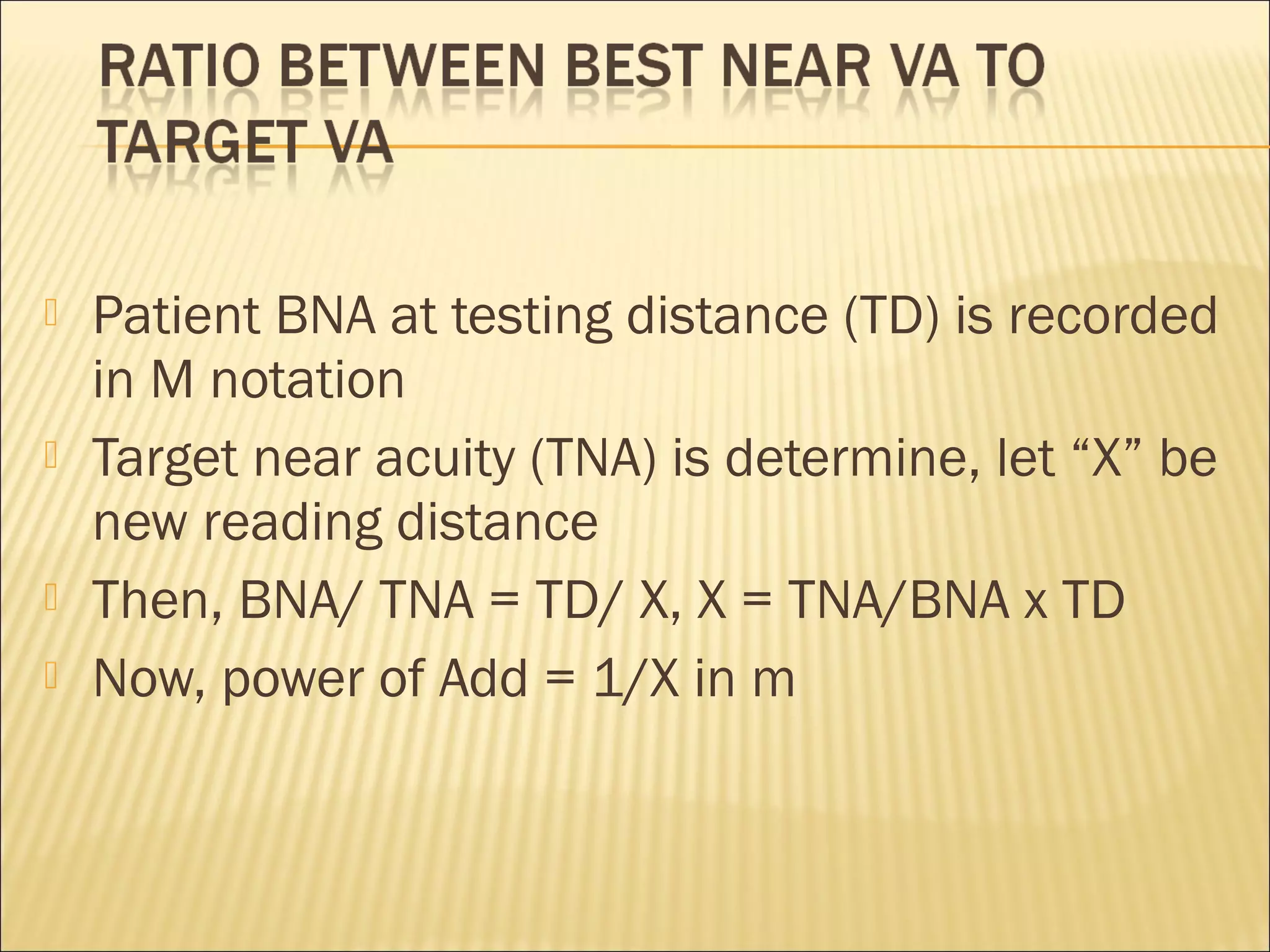
 Patient BNA at testing distance (TD) is recorded
in M notation
 Target near acuity (TNA) is determine, let “X” be
new reading distance
 Then, BNA/ TNA = TD/ X, X = TNA/BNA x TD
 Now, power of Add = 1/X in m
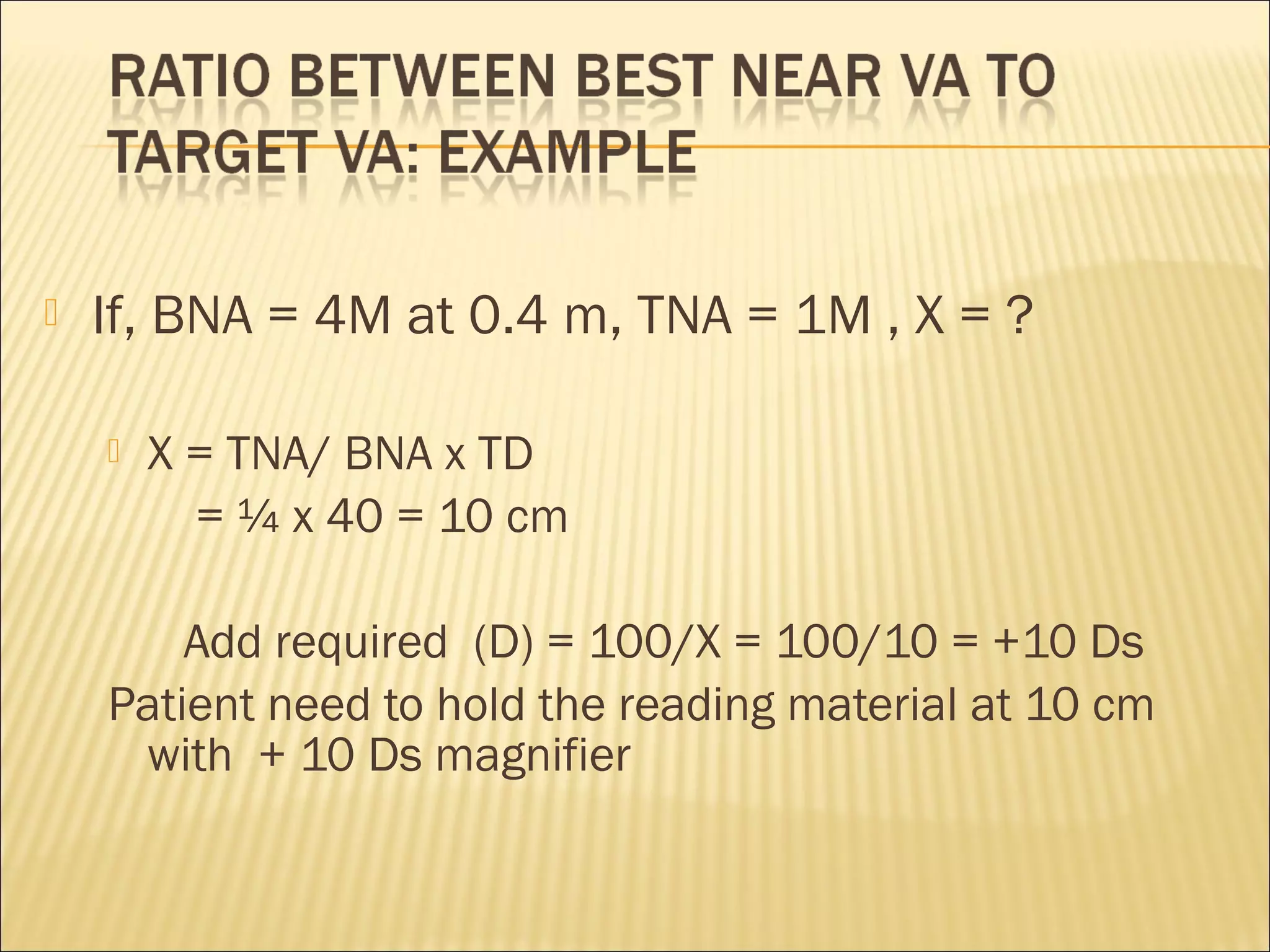
 If, BNA = 4M at 0.4 m, TNA = 1M , X = ?
 X = TNA/ BNA x TD
= ¼ x 40 = 10 cm
Add required (D) = 100/X = 100/10 = +10 Ds
Patient need to hold the reading material at 10 cm
with + 10 Ds magnifier
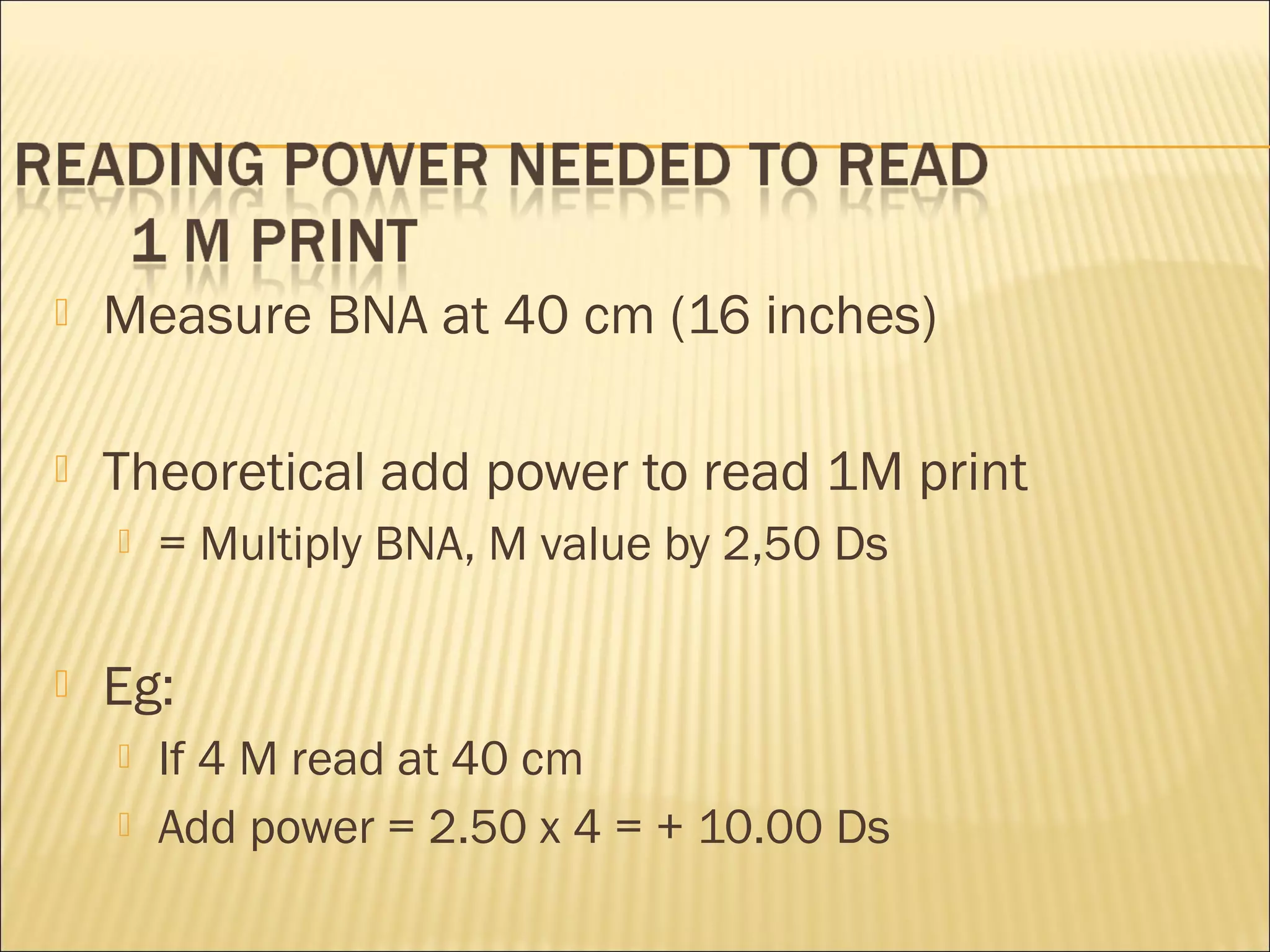
 Measure BNA at 40 cm (16 inches)
 Theoretical add power to read 1M print
 = Multiply BNA, M value by 2,50 Ds
 Eg:
 If 4 M read at 40 cm
 Add power = 2.50 x 4 = + 10.00 Ds
 To find the patient goal and expected reading rate
 Reading rate (words per minute) for normal
 To spot: 80 wpm – Enables identification of single word
 To be fluent : 160 wpm – Enables reading accurately
 Maximum: 320 wpm – Enables reading accurately at
a high speed
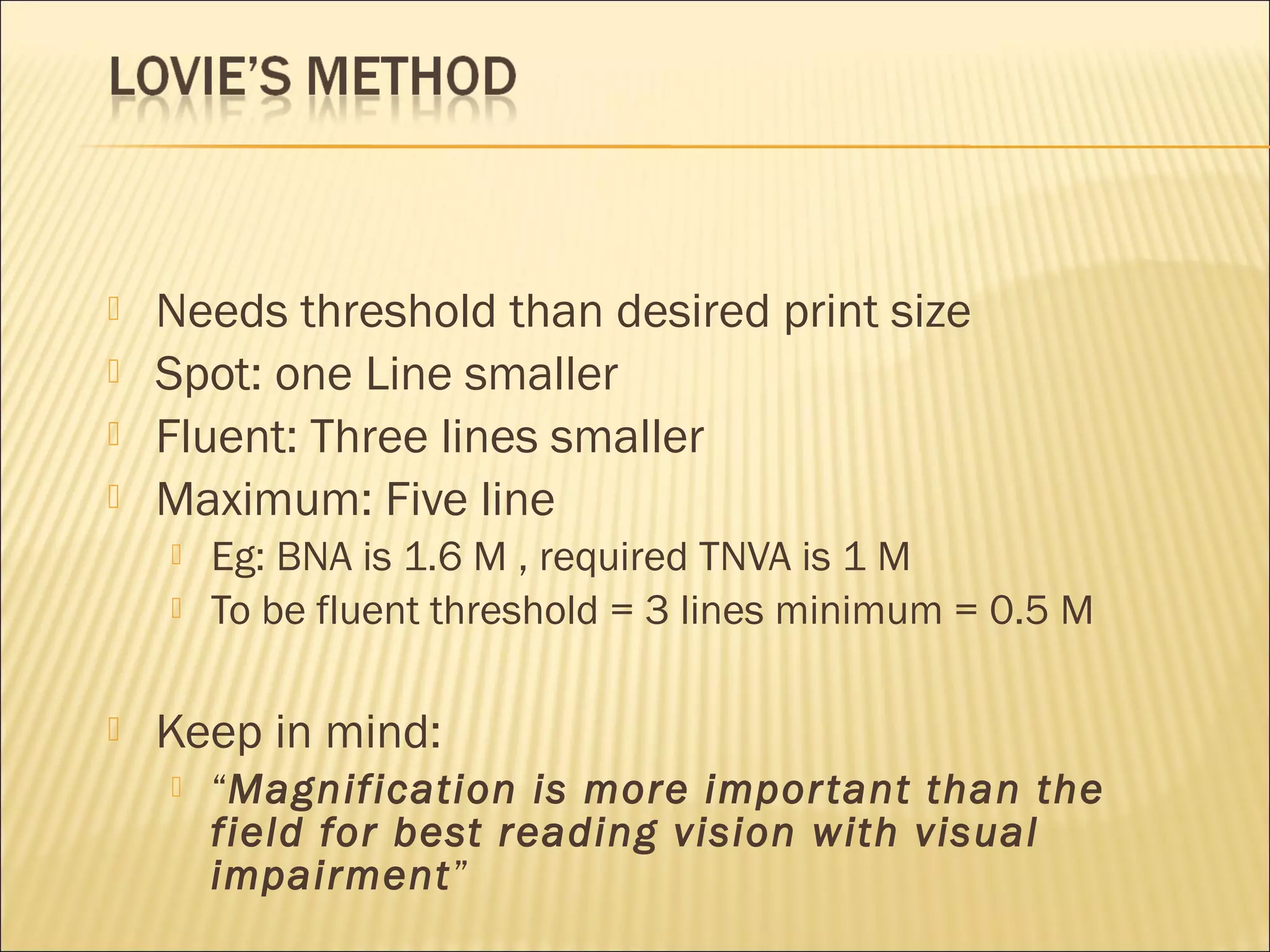
 Needs threshold than desired print size
 Spot: one Line smaller
 Fluent: Three lines smaller
 Maximum: Five line
 Eg: BNA is 1.6 M , required TNVA is 1 M
 To be fluent threshold = 3 lines minimum = 0.5 M
 Keep in mind:
 “Magnification is more important than the
field for best reading vision with visual
impairment”
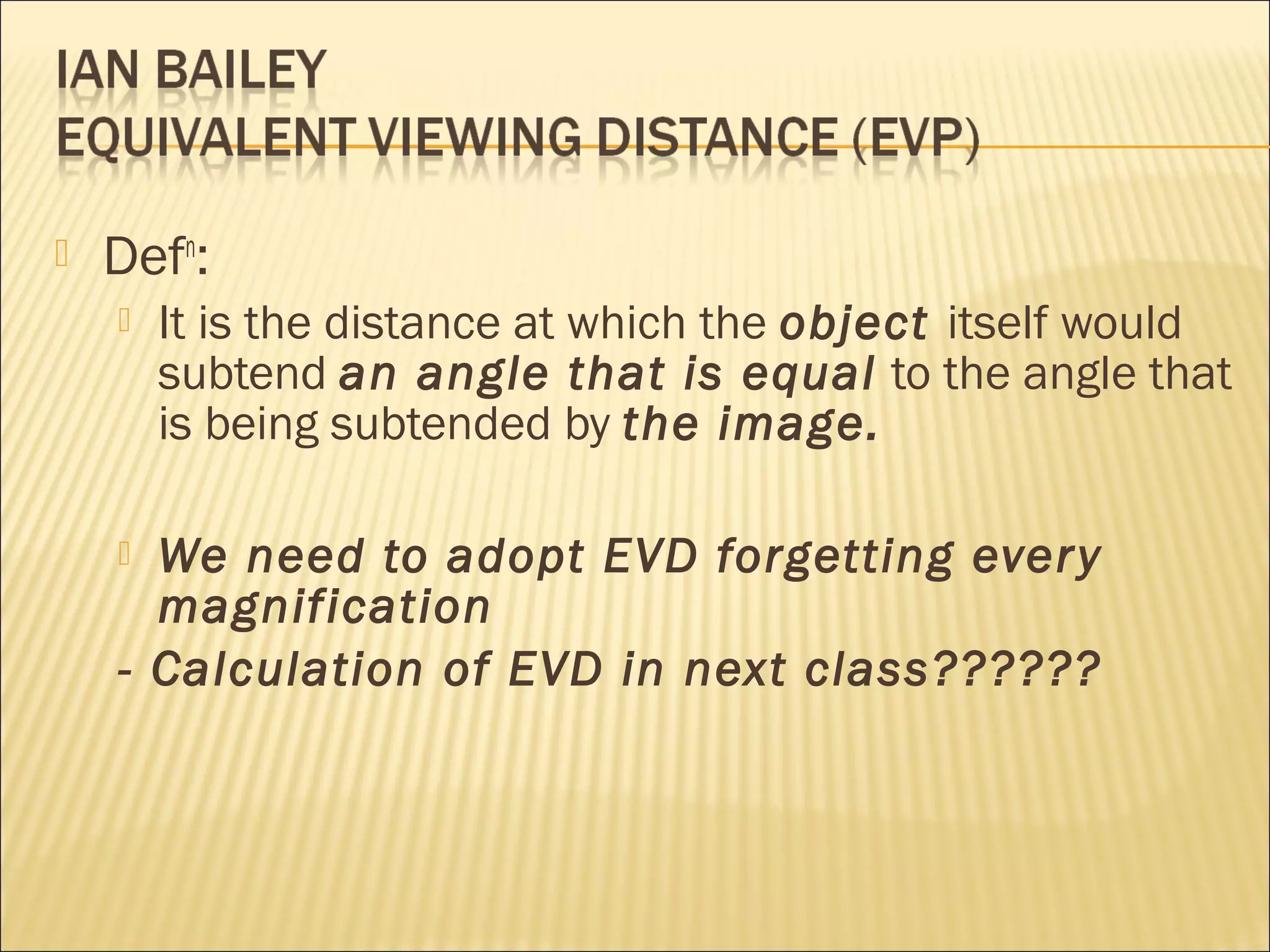
 Defn
:
 It is the distance at which the object itself would
subtend an angle that is equal to the angle that
is being subtended by the image.
 We need to adopt EVD forgetting every
magnification
- Calculation of EVD in next class??????
 Jyoti Khadka
 Optometry Instructor
 Prof. George C Woo
 The Hong Kong Polytechnique Univeristy

Calculation of magnification in low vision

  • 1.
  • 2.
    Visual Acuity =Functional Vision
  • 3.
     Ratio ofimage size to object size (for a lens system)  M = I/O = h’/h = l’/l = α’/ α  Many different types each with different meaning
  • 4.
     Angular magnification Apparent magnification  Spectacle magnification  Relative distant magnification  Nominal magnification  Perceived magnification  Actual magnification  True magnification  Iso-accommodative magnification  Manufacture rating  Magnifying power
  • 5.
     Relative size Relative distant  Angular  Apparent  Relative  Iso-accommodative  Equivalent Viewing Power (EVP)  Newer concept in Low vision
  • 6.
    1. Telescopic lenses 2.Magnifying lenses 3. Electronic magnifiers 4. Field enhancers
  • 7.
    α' α = = tanα' tan α h2 h1 = l h1 α h2 l α'
  • 8.
    Large Print Cards LargePrint Calculator
  • 9.
  • 10.
  • 11.
     Achieved bydecreasing the distance between the object & eye  Need either accommodation/ Plus lenses to maintain clear focus  due to the large accommodative demand created by short viewing distance
  • 13.
  • 14.
  • 15.
    Name Method Examples RelativeSize Magnification Increasing the actual size of the object being viewed Larger print material Relative Distance Magnification Reducing the distance between the object and the eye Move object closer to the eye Angular Magnification Increasing angular subtense of the image being viewed Telescope, magnifier Three Types of Magnification in low vision
  • 16.
  • 17.
  • 18.
  • 19.
    MaxPort Magnifier witheyeglasses as display unit FlipperPort Magnifier for distant viewing
  • 20.
     Screen enlargersand screen magnifiers  Screen reviewers and screen readers  On-screen keyboards  Keyboard enhancement  Voice input aids or speech recognition  Alternative input devices
  • 21.
     Perceived Magnification Ratio between the angle subtended by the image at entrance pupil of eye to the angle subtended by the object without magnifier  System  Object at anterior focal plane of lens  Object not at focal plane of lens  For accurate apparent magnification  Viewing distance / Equivalent power of magnifier should specified
  • 22.
  • 23.
     Effective orconventional magnification  Retinal image size produced by the magnifier to the retinal image size produced by the object,  when viewed at a standard distance (LDDV = 25 cm)with out magnifier  RM = angle subtended at eye by image produced by lens angle subtended at unaided eye by object at LDDV = α' / α25
  • 24.
    Mrel = -F(-d) = F/D  If d = LLDV = 25 cm = F/ 4 = Trade or manufacture rating Magnification Equivalent power of magnifier (F)= M x4
  • 25.
     For :Relative = Actual magnification  Will be true for following conditions  Patient should be emmetropic or corrected for any ametropia  For Myopia = Actual Magnification increase  For Hyperopia = Smaller magnification than specified  Object at anterior focal plane of the magnifier, so that image formed at infinity  If located at less distance = Actual magnification increase  If located further away = Actual magnification decrease  Reference object distance  For ref. Distance 25 cm, M = F/4  But in real life situation  Reading distance , 33 cm . M = F/3  Reading distance, 40 cm = F/2.5
  • 26.
     The ratioof the angle subtended at the entrance pupil of the eye by the magnified image to the angle subtended by object  When viewed from same distance  Type of Relative magnification  Object is located outside the anterior focal plane of magnifying lense
  • 27.
  • 28.
     For Ref.Distance 25 cm  Miso-acc = 1 + F/4  Three assumption inherent in above formula  Magnifier to eye distance is negligible  The reference viewing distance is 25 cm  The image produced by the magnifier is also at 25 cm  Thus accommodative state / add for near = 4Ds  For object & Image
  • 29.
    Term Viewing distance Apparent Magnification Nospecific viewing distance Relative Magnification A standard distance chosen for comparison (usually 25 cm) Iso- accommodative Magnification Same distance of the object and image from the eye
  • 30.
     Discard ill-definedmagnifications:  according to Bailey. Better to specify every optical LVD in term of EVP  Magnifying effect of eye represented by EVP  EVP = Equivalent focal length of the lens system  EVP = X D of a lens system  Provides the same resolution as if the naked eye were viewing the object at ‘x’ m away with out magnifer  Where, X = 1/x
  • 32.
     EVP represents intrinsic property of an optical system that corresponds to the resolution afforded by the system  If EVP of a system that gives certain resolution to the patient is know,  the resolution capability by any other system can be known by simple proportion  Eg:  If NVA with + 2.50 D is 6/18 at 40 cm, an EVP of + 7.50 Ds magnifier will increase VA to 6/6 at 13 cm.
  • 33.
     By knowingEVP of a optical system is known  A logical & efficient conversion of one magnifying optical system to another  Eg: If a +10.00 D add is required to read 2M print at 10 cm  For a CCTV, with 5 x magnification viewed at 50 cm & +2.00D add will enable patient to read 2M print
  • 34.
     Accurate correctednear visual acuity assessment  Always in Metric system (1M = N8)  For unknown sized reading material  Conversion to metric system = letter size in mm/1.45 mm
  • 35.
     Average numberof letters + space counted in 1 inch  Divide that number to 1000 for metric system  Resultant is reduced snellen denominator  Eg: 40 spaces & letters in 1 inch of text patient wants to read  1000/40 = 25 : Reduced acuity size of the print= 20/25
  • 36.
    1. Lebenson’s Methodof reciprocal vision 2. Kestenbaum’s Method 3. Ratio between Best near VA to target VA 4. Reading power needed to read 1 M print 5. Lovie’s Method 6. Ian Bailey method: Equivalent Viewing distance (EVP)
  • 37.
     Find Bestcorrected distance acuity & a near target acuity  M = ratio of denominator of distance Snellen fraction to denominator of near snellen fraction of target acuity  Eg:  BDA = 20/400 , TNA = 20/50 (1M)  M = 400/50 = 8 x, Power (D) = M x 4 = + 32 Ds
  • 38.
     Required Dioptricpower of add =  Reciprocal of best corrected distance acuity  Eg:  If BCDA = 20/400, Power of add = 400/20 = + 20Ds  Both above method can give wrong M value:  Distance acuity is poor predictor of near acuity
  • 39.
     Patient BNAat testing distance (TD) is recorded in M notation  Target near acuity (TNA) is determine, let “X” be new reading distance  Then, BNA/ TNA = TD/ X, X = TNA/BNA x TD  Now, power of Add = 1/X in m
  • 40.
     If, BNA= 4M at 0.4 m, TNA = 1M , X = ?  X = TNA/ BNA x TD = ¼ x 40 = 10 cm Add required (D) = 100/X = 100/10 = +10 Ds Patient need to hold the reading material at 10 cm with + 10 Ds magnifier
  • 41.
     Measure BNAat 40 cm (16 inches)  Theoretical add power to read 1M print  = Multiply BNA, M value by 2,50 Ds  Eg:  If 4 M read at 40 cm  Add power = 2.50 x 4 = + 10.00 Ds
  • 42.
     To findthe patient goal and expected reading rate  Reading rate (words per minute) for normal  To spot: 80 wpm – Enables identification of single word  To be fluent : 160 wpm – Enables reading accurately  Maximum: 320 wpm – Enables reading accurately at a high speed
  • 43.
     Needs thresholdthan desired print size  Spot: one Line smaller  Fluent: Three lines smaller  Maximum: Five line  Eg: BNA is 1.6 M , required TNVA is 1 M  To be fluent threshold = 3 lines minimum = 0.5 M  Keep in mind:  “Magnification is more important than the field for best reading vision with visual impairment”
  • 44.
     Defn :  Itis the distance at which the object itself would subtend an angle that is equal to the angle that is being subtended by the image.  We need to adopt EVD forgetting every magnification - Calculation of EVD in next class??????
  • 45.
     Jyoti Khadka Optometry Instructor  Prof. George C Woo  The Hong Kong Polytechnique Univeristy