LOW VISION REHABILITATION Tips for Independence Avani Patel, O.D., F.A.A.O. Private Practice: Los Alamitos, CA (562) 430-6161 Hospital: Long Beach Memorial Med. Center (562) 933-0123
July is UV Awareness Month Ultra-violet exposure is linked to eye damage including: Cataracts, Age-Related Macular Degeneration, Pterygium, Photokeratitis, Melanomas. Make sure all sun wear has UV-A and UV-B protection
LOW VISION Impairment of vision that significantly impairs how an individual functions. Vision cannot be corrected adequately with medical, surgical therapy or conventional glasses/contact lenses. Individual may experience loss of central vision, peripheral vision, distorted vision, double vision, glare sensitivity and loss of contrast.
LOW VISION Low Vision services do not “cure” the problem, but enable an individual to maximize their remaining sight so they can function as independently as possible. Low Vision care does NOT replace the need for concurrent ophthalmological treatment. Low Vision Rehabilitation is a collaborative approach to helping individuals.
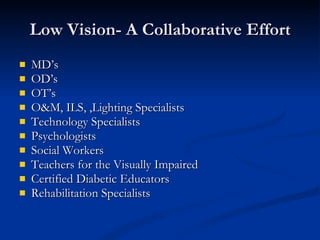
Low Vision- A Collaborative Effort MD’s  OD’s OT’s O&M, ILS, ,Lighting Specialists Technology Specialists Psychologists Social Workers Teachers for the Visually Impaired Certified Diabetic Educators Rehabilitation Specialists
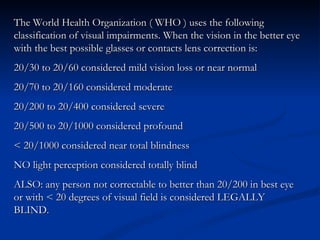
The World Health Organization ( WHO ) uses the following classification of visual impairments. When the vision in the better eye with the best possible glasses or contacts lens correction is:  20/30 to 20/60 considered mild vision loss or near normal 20/70 to 20/160 considered moderate 20/200 to 20/400 considered severe 20/500 to 20/1000 considered profound < 20/1000 considered near total blindness NO light perception considered totally blind ALSO: any person not correctable to better than 20/200 in best eye or with < 20 degrees of visual field is considered LEGALLY BLIND.
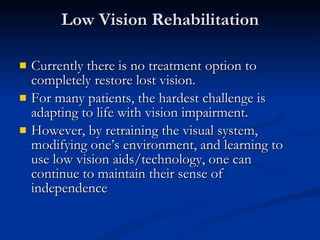
Low Vision Rehabilitation Currently there is no treatment option to completely restore lost vision. For many patients, the hardest challenge is adapting to life with vision impairment. However, by retraining the visual system, modifying one’s environment, and learning to use low vision aids/technology, one can continue to maintain their sense of independence
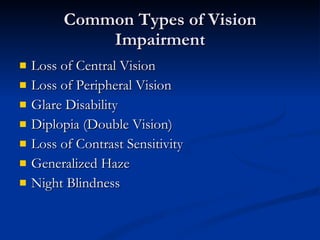
Common Types of Vision Impairment Loss of Central Vision Loss of Peripheral Vision Glare Disability Diplopia (Double Vision) Loss of Contrast Sensitivity Generalized Haze Night Blindness
Eye Care Professionals 1. Ophthalmologist (M.D.) 2. Optometrist (O.D.)
THE LOW VISION EYE DOCTOR Low Vision Specialists are licensed Doctors of Optometry or Ophthalmology, who are skilled in examining and managing patients whose vision cannot be corrected with conventional means. Low Vision is a team approach involving specialists in many areas from vision to rehabilitation.
LOW VISION Low Vision doctors  may prescribe the following aids: Custom made prescription eyewear  Tints/filters to reduce glare or enhance contrast Prisms to reduce double vision Telescopic & Microscopic eyewear, Magnifiers,  Electronic adaptive aids, video magnifiers Specialized computer software programs Independent Living Skills, Orientation Mobility Skills,  Counseling…
Low Vision Exam- A Critical Component Not a regular eye exam with reading the distance eye chart. It is a FUNCTIONAL assessment of how an individual works with the vision they have (sight at different distances is measured i.e. faces, stove dials, small print, street signs...) Evaluate blurry/blindspots in the visual field, contrast sensitivity, extent of color vision, glare tolerance, double vision, visual/cognitive processing, eye tracking… It is tailored to each individual’s need
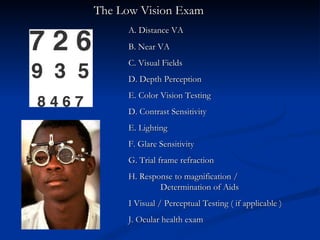
  The Low Vision Exam A. Distance VA  B. Near VA C. Visual Fields D. Depth Perception E. Color Vision Testing D. Contrast Sensitivity E. Lighting F. Glare Sensitivity G. Trial frame refraction  H. Response to magnification /    Determination of Aids I Visual / Perceptual Testing ( if applicable ) J. Ocular health exam
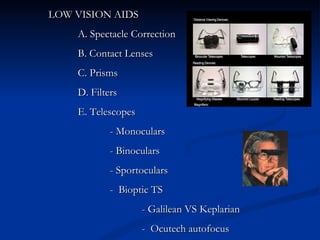
  LOW VISION AIDS A. Spectacle Correction B. Contact Lenses C. Prisms  D. Filters E. Telescopes  - Monoculars  - Binoculars - Sportoculars -  Bioptic TS  - Galilean VS Keplarian    -  Ocutech autofocus
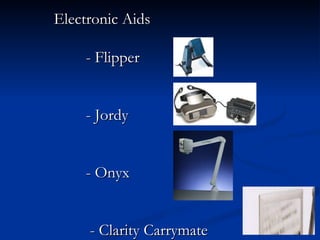
Electronic Aids  - Flipper - Jordy   - Onyx   - Clarity Carrymate
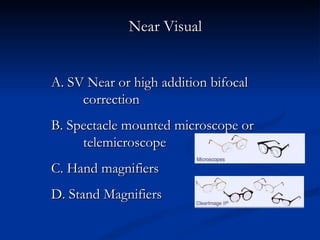
Near Visual A. SV Near or high addition bifocal  correction B. Spectacle mounted microscope or  telemicroscope  C. Hand magnifiers D. Stand Magnifiers
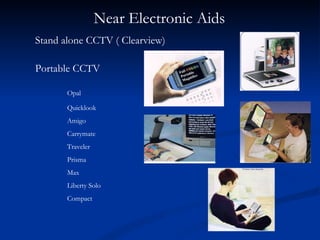
Near Electronic Aids   Stand alone CCTV ( Clearview) Portable CCTV   Opal Quicklook Amigo Carrymate Traveler Prisma Max Liberty Solo Compact
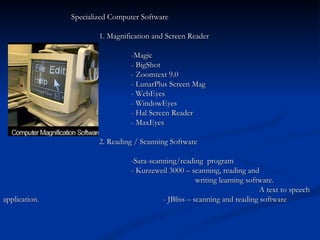
  Specialized Computer Software  1. Magnification and Screen Reader -Magic - BigShot - Zoomtext 9.0 - LunarPlus Screen Mag - WebEyes - WindowEyes - Hal Screen Reader - MaxEyes 2. Reading / Scanning Software -Sara-scanning/reading  program  -   Kurzeweil   3000 – scanning, reading and  writing learning software.  A text to speech application. - JBliss – scanning and reading software
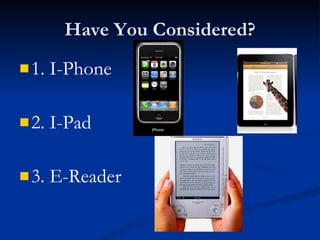
Have You Considered? 1. I-Phone 2. I-Pad 3. E-Reader
NON-OPTICAL, REHABILITATION OPTIONS Orientation And Mobility Training Independent Living Skills Lighting Evaluation Counseling Diabetic Support Services Educational/Vocational Training Talking Books, Big Button Phones, Large Print Checks, Talking Clocks, Felt-tip Markers…
Top 5 Tips 1. Improve lighting  2. Improve contrast  3. Reduce glare  4. Utilize large print 5. Mark appliances

Patel presentation

  • 1.
    LOW VISION REHABILITATIONTips for Independence Avani Patel, O.D., F.A.A.O. Private Practice: Los Alamitos, CA (562) 430-6161 Hospital: Long Beach Memorial Med. Center (562) 933-0123
  • 2.
    July is UVAwareness Month Ultra-violet exposure is linked to eye damage including: Cataracts, Age-Related Macular Degeneration, Pterygium, Photokeratitis, Melanomas. Make sure all sun wear has UV-A and UV-B protection
  • 3.
    LOW VISION Impairmentof vision that significantly impairs how an individual functions. Vision cannot be corrected adequately with medical, surgical therapy or conventional glasses/contact lenses. Individual may experience loss of central vision, peripheral vision, distorted vision, double vision, glare sensitivity and loss of contrast.
  • 4.
    LOW VISION LowVision services do not “cure” the problem, but enable an individual to maximize their remaining sight so they can function as independently as possible. Low Vision care does NOT replace the need for concurrent ophthalmological treatment. Low Vision Rehabilitation is a collaborative approach to helping individuals.
  • 5.
    Low Vision- ACollaborative Effort MD’s OD’s OT’s O&M, ILS, ,Lighting Specialists Technology Specialists Psychologists Social Workers Teachers for the Visually Impaired Certified Diabetic Educators Rehabilitation Specialists
  • 6.
    The World HealthOrganization ( WHO ) uses the following classification of visual impairments. When the vision in the better eye with the best possible glasses or contacts lens correction is: 20/30 to 20/60 considered mild vision loss or near normal 20/70 to 20/160 considered moderate 20/200 to 20/400 considered severe 20/500 to 20/1000 considered profound < 20/1000 considered near total blindness NO light perception considered totally blind ALSO: any person not correctable to better than 20/200 in best eye or with < 20 degrees of visual field is considered LEGALLY BLIND.
  • 7.
    Low Vision RehabilitationCurrently there is no treatment option to completely restore lost vision. For many patients, the hardest challenge is adapting to life with vision impairment. However, by retraining the visual system, modifying one’s environment, and learning to use low vision aids/technology, one can continue to maintain their sense of independence
  • 8.
    Common Types ofVision Impairment Loss of Central Vision Loss of Peripheral Vision Glare Disability Diplopia (Double Vision) Loss of Contrast Sensitivity Generalized Haze Night Blindness
  • 9.
    Eye Care Professionals1. Ophthalmologist (M.D.) 2. Optometrist (O.D.)
  • 10.
    THE LOW VISIONEYE DOCTOR Low Vision Specialists are licensed Doctors of Optometry or Ophthalmology, who are skilled in examining and managing patients whose vision cannot be corrected with conventional means. Low Vision is a team approach involving specialists in many areas from vision to rehabilitation.
  • 11.
    LOW VISION LowVision doctors may prescribe the following aids: Custom made prescription eyewear Tints/filters to reduce glare or enhance contrast Prisms to reduce double vision Telescopic & Microscopic eyewear, Magnifiers, Electronic adaptive aids, video magnifiers Specialized computer software programs Independent Living Skills, Orientation Mobility Skills, Counseling…
  • 12.
    Low Vision Exam-A Critical Component Not a regular eye exam with reading the distance eye chart. It is a FUNCTIONAL assessment of how an individual works with the vision they have (sight at different distances is measured i.e. faces, stove dials, small print, street signs...) Evaluate blurry/blindspots in the visual field, contrast sensitivity, extent of color vision, glare tolerance, double vision, visual/cognitive processing, eye tracking… It is tailored to each individual’s need
  • 13.
    TheLow Vision Exam A. Distance VA B. Near VA C. Visual Fields D. Depth Perception E. Color Vision Testing D. Contrast Sensitivity E. Lighting F. Glare Sensitivity G. Trial frame refraction H. Response to magnification / Determination of Aids I Visual / Perceptual Testing ( if applicable ) J. Ocular health exam
  • 14.
    LOWVISION AIDS A. Spectacle Correction B. Contact Lenses C. Prisms D. Filters E. Telescopes - Monoculars - Binoculars - Sportoculars - Bioptic TS - Galilean VS Keplarian - Ocutech autofocus
  • 15.
    Electronic Aids - Flipper - Jordy - Onyx - Clarity Carrymate
  • 16.
    Near Visual A.SV Near or high addition bifocal correction B. Spectacle mounted microscope or telemicroscope C. Hand magnifiers D. Stand Magnifiers
  • 17.
    Near Electronic Aids Stand alone CCTV ( Clearview) Portable CCTV Opal Quicklook Amigo Carrymate Traveler Prisma Max Liberty Solo Compact
  • 18.
    SpecializedComputer Software 1. Magnification and Screen Reader -Magic - BigShot - Zoomtext 9.0 - LunarPlus Screen Mag - WebEyes - WindowEyes - Hal Screen Reader - MaxEyes 2. Reading / Scanning Software -Sara-scanning/reading program - Kurzeweil 3000 – scanning, reading and writing learning software. A text to speech application. - JBliss – scanning and reading software
  • 19.
    Have You Considered?1. I-Phone 2. I-Pad 3. E-Reader
  • 20.
    NON-OPTICAL, REHABILITATION OPTIONSOrientation And Mobility Training Independent Living Skills Lighting Evaluation Counseling Diabetic Support Services Educational/Vocational Training Talking Books, Big Button Phones, Large Print Checks, Talking Clocks, Felt-tip Markers…
  • 21.
    Top 5 Tips1. Improve lighting 2. Improve contrast 3. Reduce glare 4. Utilize large print 5. Mark appliances